Tank volume is not simply a convenience number. In aquaponics and recirculating systems, it determines stocking density, filtration turnover requirements, heating load, dissolved oxygen demand, and the structural weight your floor must carry indefinitely. An error of even a few gallons in either direction cascades into miscalculated aeration rates, undersized filtration, and, for larger builds, real structural risk. The calculation itself is straightforward; the consequences of skipping it are not.
This aquarium volume calculator takes three interior dimensions in inches and returns total volume in US gallons, an equivalent liter figure, and the filled water weight in pounds. It does not account for substrate displacement, decorations, sump volume, or equipment footprint. Those adjustments belong in your system design phase, after you have a reliable baseline volume from actual tank measurements.
Once you have the gallon figure, you can make a firm decision about whether your floor, your filtration spec, and your water management plan are actually sized for this tank. If you manage greenhouse climate alongside your aquaponics system, cross-referencing your tank heat load with a vapor pressure deficit calculator will help you understand how your water surface affects ambient humidity in enclosed growing spaces.
Use the Tool
Aquarium Volume Calculator
Fish Tank Volume & Weight — Greenhouse, Hydroponics & Climate
| Tank Name | Dims (L×W×H in) | Volume (gal) | Weight (lbs) |
|---|
How This Calculator Works
Gallons = (L × W × H) ÷ 231
- Step 1 — Measure: Record the interior length (L), width (W), and height (H) of the tank in inches.
- Step 2 — Volume in cubic inches: Multiply L × W × H to get total cubic inches.
- Step 3 — Convert to gallons: Divide by 231 (there are exactly 231 cubic inches in one US liquid gallon).
- Step 4 — Water weight: Multiply gallons by 8.34 lbs/gal (density of water at room temperature) to find the filled weight.
- Formula assumes a rectangular (cuboid) tank with no curvature or internal obstructions.
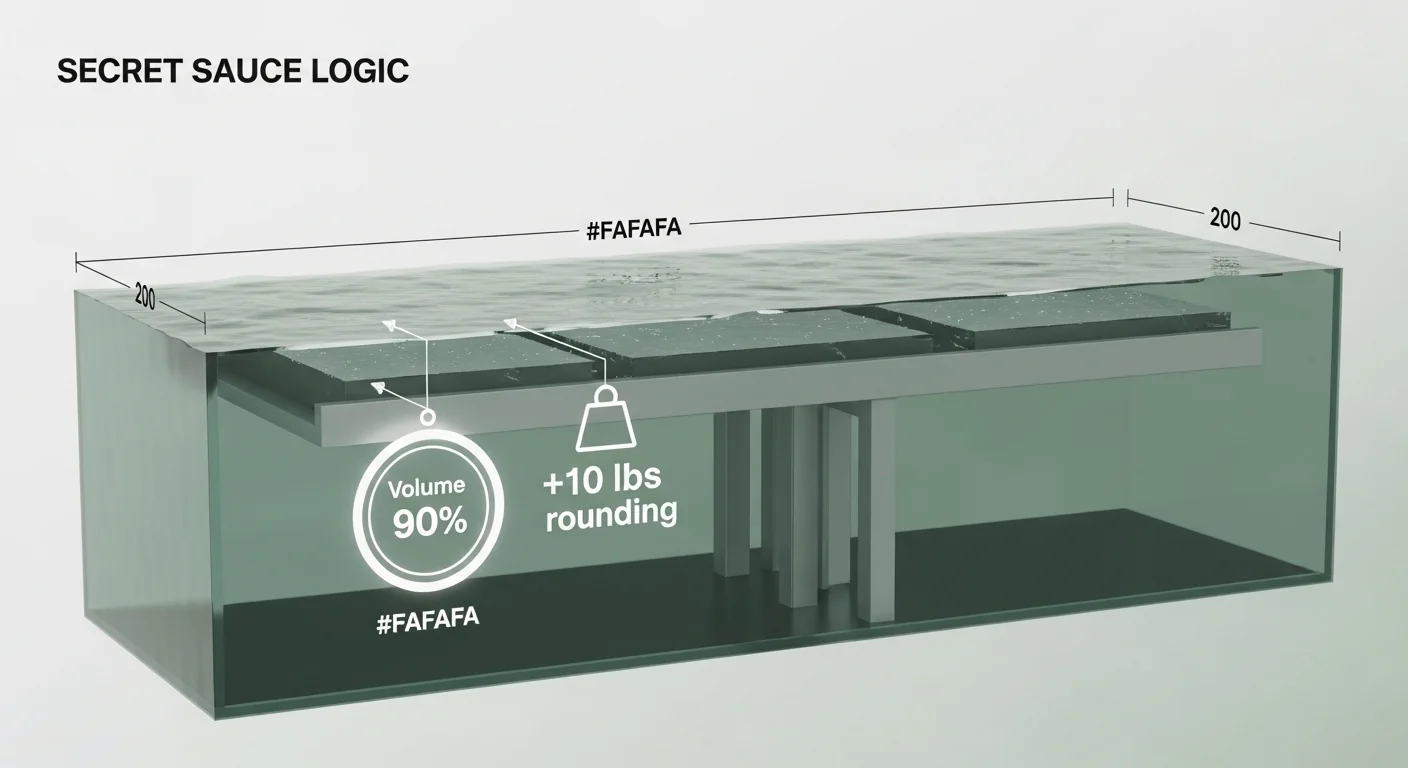
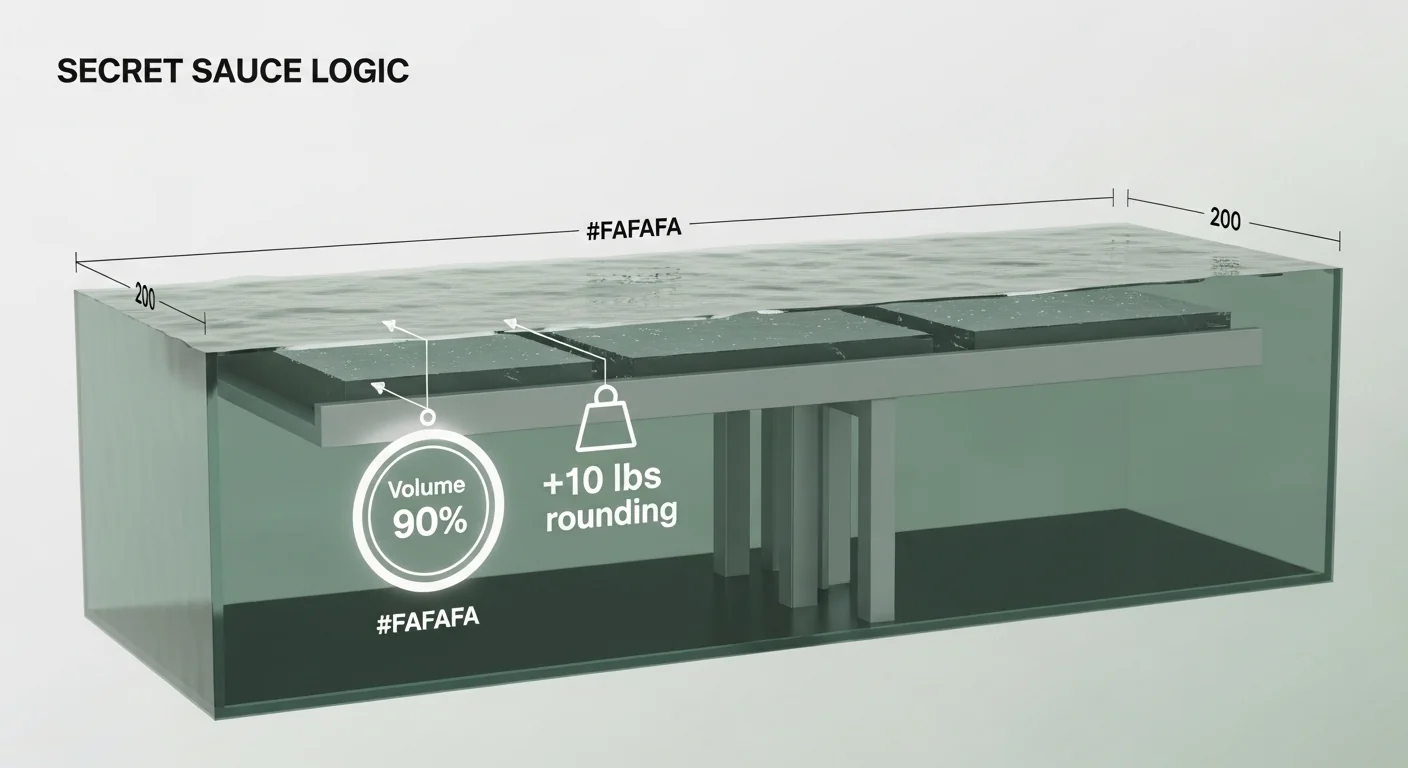
- Result is total water capacity; actual fill level is typically 80–90% of maximum volume.
- Uses US liquid gallons (1 gal = 231 in³ = 3.785 L).
- Water density assumed at 68°F (20°C); saltwater is ~8.55 lbs/gal.
- Floor load advisory applies to total filled weight plus tank and equipment weight. A general rule of thumb: tanks over 55 gal on upper floors should be assessed by a structural engineer.
- Dimensions must be positive numbers greater than zero.
Before entering values, grab a tape measure and record the interior dimensions of the tank, not the outside frame. Glass and acrylic panels on aquariums typically add 0.25 to 0.5 inches per side, and measuring the exterior can inflate your volume estimate by several gallons on larger tanks. Measure length, width, and height in inches. If your tank came with a manufacturer volume rating, use the calculator result to verify it rather than trusting the label blindly.
Once you have your tank volume, the next logical step is often sizing aeration. The DWC air pump calculator on this site lets you match pump output to tank volume for recirculating aquaponics and deep water culture setups.
Quick Start (60 Seconds)
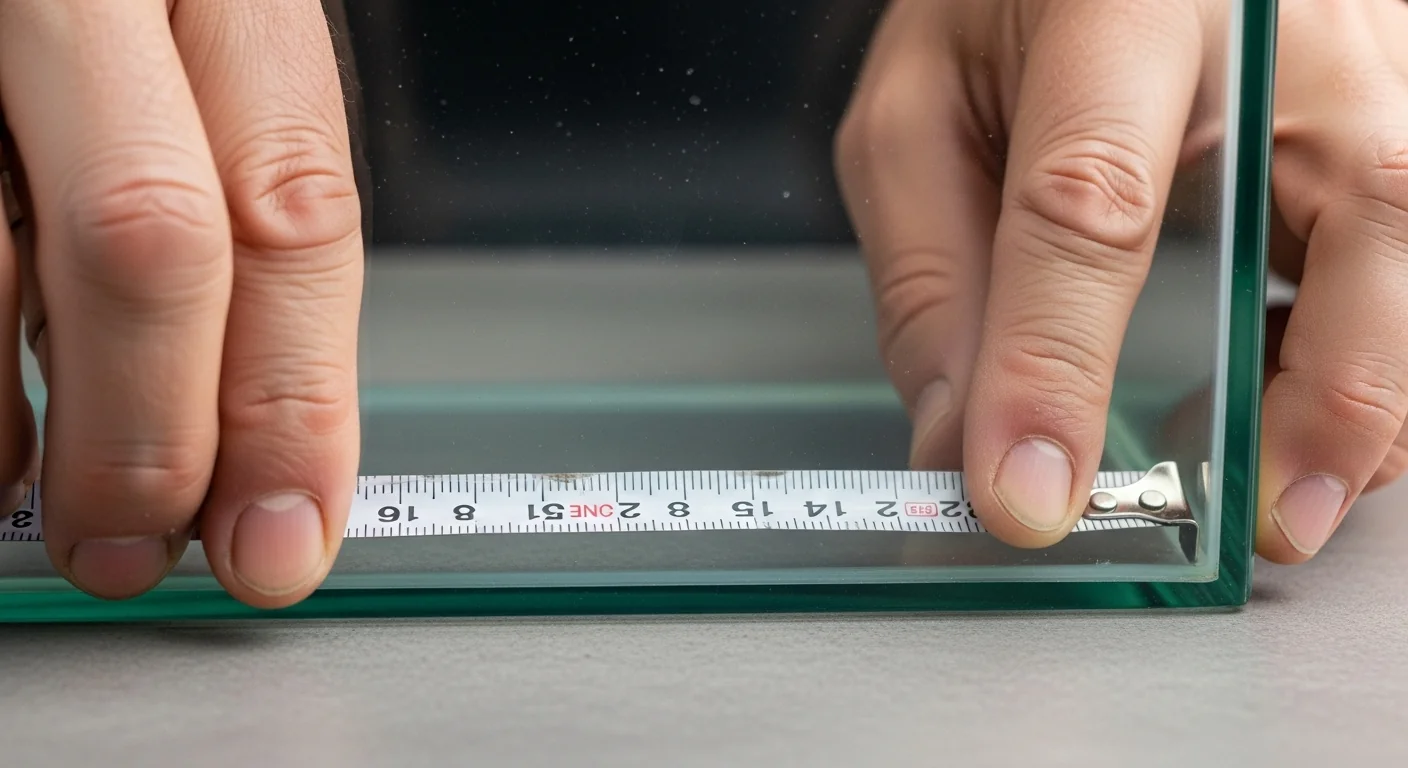
- Measure interior length first. Run the tape along the inside bottom from one end wall to the other. This is your L value in inches.
- Measure interior width. This is the shorter horizontal dimension, taken across the front-to-back span of the tank floor. Units must be inches.
- Measure interior height. Measure from the inside bottom to the waterline or tank top. Do not measure the outside height including the rim or stand.
- Do not estimate or use exterior dimensions. The most common error is measuring the outside of the frame. Subtract the glass thickness from each side if you only have exterior measurements.
- Enter whole or decimal numbers only. The calculator accepts decimal inch values (e.g., 47.5) for precision. No fractions.
- Review the water weight output before you fill. The filled weight is the number you need for floor load planning, not the gallon figure.
- Read the floor advisory if it appears. Tanks at or above 55 gallons trigger a structural warning. That threshold is not arbitrary; it reflects the point at which total water weight plus tank hardware routinely exceeds what residential floor joists are engineered for on a continuous basis.
Inputs and Outputs (What Each Field Means)
| Field | Unit | What It Means | Common Mistake | Safe Entry Guidance |
|---|---|---|---|---|
| Length (L) | Inches (in) | Interior measurement along the longest horizontal axis of the tank | Measuring the outside frame, which adds glass thickness on both ends | Measure from inner glass surface to inner glass surface along the bottom |
| Width (W) | Inches (in) | Interior measurement of the front-to-back depth of the tank | Confusing width and height, especially on tall or cube-style tanks | This is the horizontal depth, not the vertical dimension; measure it at the bottom |
| Height (H) | Inches (in) | Interior measurement from the tank floor to the top of the water column | Using the full outer height including base bracing and rim flange | Measure from inside the bottom to the intended fill level, not to the top of the frame |
| Volume (Output) | US Gallons | Total water capacity of the rectangular tank at the measured height | Treating this as operating volume; actual stocked volume is typically less after accounting for substrate and equipment | Use this figure as your maximum capacity baseline, not your target fill volume |
| Water Weight (Output) | Pounds (lbs) | Mass of the water alone at full capacity, calculated at 8.34 lbs per US gallon | Forgetting to add tank weight, substrate, rock, and equipment to this figure for floor planning | Add at minimum 15 to 25 lbs for an empty glass tank and substrate when assessing total floor load |
| Volume in Liters (Output) | Liters (L) | Metric equivalent of the gallon result using a conversion factor of 3.785 liters per gallon | Rounding to 3.8 and then using that rounded figure in subsequent dosing calculations, which compounds error | Use the full liter value for nutrient and chemical dosing calculations |
Worked Examples (Real Numbers)
Example 1: Standard 55-Gallon Freshwater Setup
- Length: 48 in
- Width: 13 in
- Height: 20 in
Result: (48 x 13 x 20) / 231 = 12,480 / 231 = 54.0 gallons. Water weight: 54.0 x 8.34 = 450 lbs.
This is the classic “55-gallon” long tank. The actual calculated volume is 54.0 gallons, not 55, because manufacturer ratings often round up. At 450 lbs of water weight alone, this tank requires a floor load assessment if it is being placed on a second story or a suspended floor system.
Example 2: Small Aquaponics Fish Tank (Desktop or Bench Scale)
- Length: 24 in
- Width: 12 in
- Height: 16 in
Result: (24 x 12 x 16) / 231 = 4,608 / 231 = 19.9 gallons. Water weight: 19.9 x 8.34 = 166 lbs.
This size is typical for countertop or greenhouse bench aquaponics units. At under 20 gallons, floor loading is not a structural concern on most surfaces, though a reinforced bench or dedicated stand is still good practice.
Example 3: Large Aquaponics System Fish Tank
- Length: 60 in
- Width: 24 in
- Height: 24 in
Result: (60 x 24 x 24) / 231 = 34,560 / 231 = 149.6 gallons. Water weight: 149.6 x 8.34 = 1,247 lbs.
A tank at this scale is well into territory where floor engineering is mandatory, not optional. Water weight alone at 1,247 lbs exceeds the load limit of most residential floor bays. A greenhouse concrete slab or purpose-built structural frame is the correct installation context for this size.
Reference Table (Fast Lookup)
| Tank Name | Interior L x W x H (in) | Volume (US gal) | Water Weight (lbs) | Volume (Liters) | Floor Load Risk |
|---|---|---|---|---|---|
| 5 Gallon | 16 x 8 x 10 | 5.5 | 46 | 20.9 | Low – no concern |
| 10 Gallon | 20 x 10 x 12 | 10.4 | 87 | 39.3 | Low – no concern |
| 20 Gallon High | 24 x 12 x 16 | 19.9 | 166 | 75.3 | Low – standard bench support adequate |
| 29 Gallon | 30 x 12 x 18 | 28.1 | 234 | 106 | Low to moderate – verify stand rating |
| 40 Gallon Breeder | 36 x 18 x 16 | 44.9 | 375 | 170 | Moderate – check floor joist span |
| 55 Gallon | 48 x 13 x 20 | 54.0 | 450 | 204 | Advisory threshold – floor assessment recommended |
| 75 Gallon | 48 x 18 x 21 | 79.1 | 660 | 299 | Structural review required for upper floors |
| 120 Gallon | 48 x 24 x 25 | 124.7 | 1,040 | 472 | Engineer assessment required |
| 150 Gallon (Custom) | 72 x 18 x 28 | 157.9 | 1,317 | 598 | Concrete slab or structural framing only |
How the Calculation Works (Formula + Assumptions)
Show the calculation steps
The formula for a rectangular aquarium is derived directly from basic geometry and the US liquid gallon definition.
- Multiply interior dimensions: L (inches) x W (inches) x H (inches) = total cubic inches.
- Divide by 231: One US liquid gallon equals exactly 231 cubic inches by legal definition. Dividing your cubic inch total by 231 gives US gallons.
- Multiply by 8.34 for water weight: Freshwater at room temperature has a density of approximately 8.34 lbs per US gallon. Gallons x 8.34 = water weight in pounds.
- Multiply by 3.785 for liters: One US gallon equals 3.785 liters. Gallons x 3.785 = total liters.
Rounding: Volume is shown to one decimal place. Weight is shown to one decimal place for individual use and rounded to the nearest 10 lbs for the floor advisory message to avoid false precision in a structural context.
Assumptions and Limits
- The formula assumes a perfect rectangular cuboid with flat, vertical walls and a flat bottom. Bow-front, hexagonal, cylindrical, and irregular tanks require different geometric formulas.
- Dimensions must be interior measurements. Glass and acrylic panel thickness is not automatically subtracted.
- Water density is assumed at 68 degrees Fahrenheit (20 degrees Celsius) for freshwater. Saltwater runs approximately 8.55 lbs per gallon, making the weight output a slight underestimate for marine tanks.
- The volume result represents full capacity to the measured height. Actual operating volume is typically 80 to 90% of maximum capacity after substrate, rock, and equipment displacement.
- The floor load advisory is based on water weight only. Total installed weight including the empty tank, substrate, rocks, and equipment will always exceed the water weight figure shown.
- The calculator does not account for sump volume, connected grow beds, or external reservoir tanks in an aquaponics system. Each vessel must be calculated separately.
- Input values above 9,999 inches are rejected by the widget as outside practical use range.
Standards, Safety Checks, and “Secret Sauce” Warnings
Critical Warnings
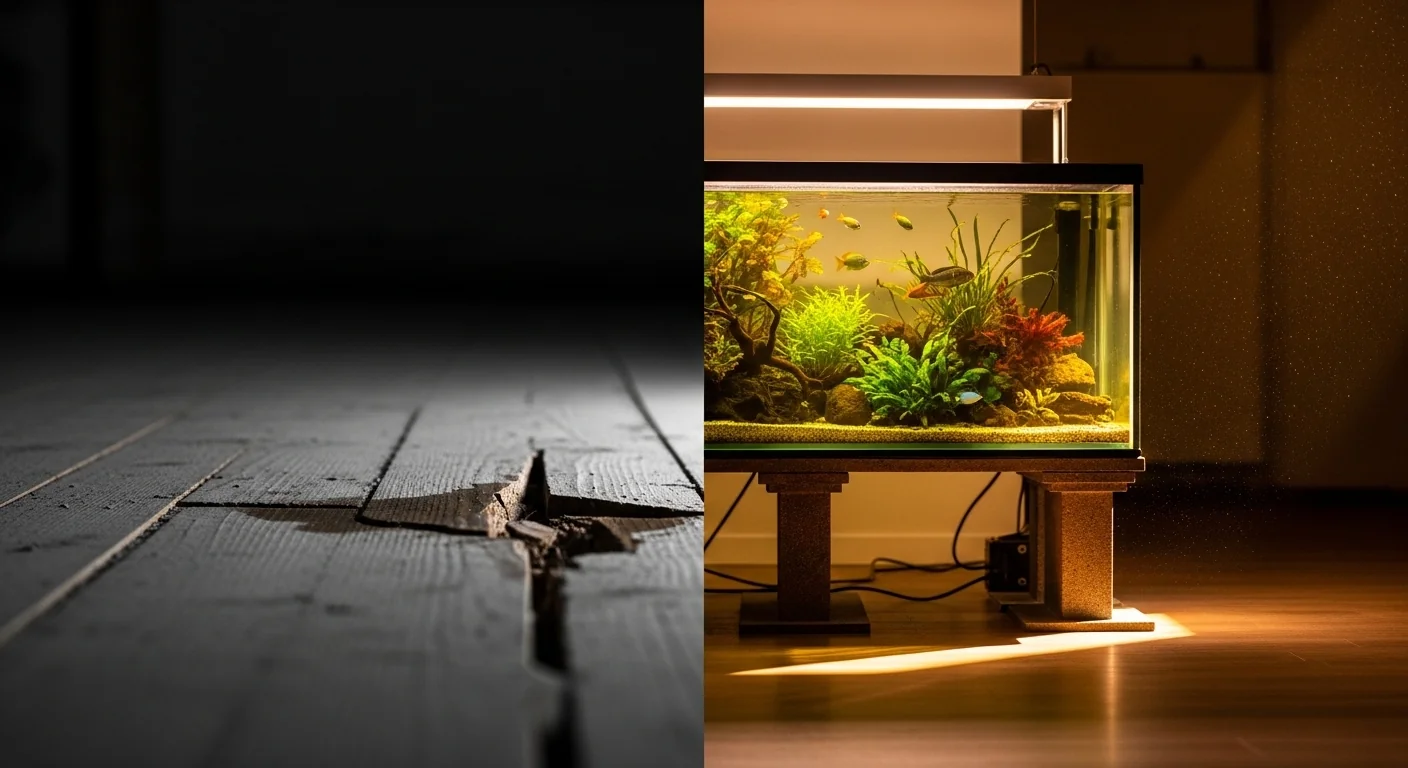
- Water weight does not include the tank itself. A filled 55-gallon glass aquarium carries approximately 450 lbs of water alone. Add the empty tank weight (typically 70 to 100 lbs for glass tanks of this size), substrate, and equipment, and the total floor load can approach or exceed 600 lbs concentrated in one spot. The calculator shows water weight as a baseline figure, not as the final floor load number.
- The 55-gallon threshold is a trigger for assessment, not a hard pass/fail line. Whether a floor can handle the load depends on joist size, joist spacing, span length, and the tank’s footprint. A 55-gallon tank placed perpendicular to floor joists over a short span may be fine; the same tank placed parallel to joists over a long unsupported span may not. Use the calculator output to start the conversation with a structural professional, not to end it.
- Saltwater and temperature corrections matter at scale. For marine aquariums or heated aquaponics systems, freshwater density (8.34 lbs/gal) underestimates actual water weight. This becomes relevant at 100 gallons and above.
Minimum Standards
- Always verify calculated volume against the manufacturer’s published gallon rating before purchasing filtration or heaters. Discrepancies of 5 to 10 gallons are common and affect equipment sizing.
- Use the liter output when calculating chemical dosing, nutrient additions, or water treatment products, as most product instructions specify dose rates per liter or per 100 liters.
For aquaponics systems where water temperature is critical for fish welfare and plant nutrient uptake, cross-reference your tank volume with a water temperature calculator to confirm your heater or chiller is sized for the actual gallon figure, not an estimate. Nutrient concentration management also benefits from knowing exact volume; the hydroponic EC calculator uses tank volume directly to dial in target electrical conductivity levels for your grow system.
Competitor Trap: Most aquarium volume guides show the formula and stop there. The number that actually protects your building and your fish is the filled weight, not the gallon count. A hobbyist who reads that a 75-gallon tank holds 75 gallons walks away with an interesting statistic. One who reads that it holds 660 lbs of water, plus equipment, continuously, on a residential floor joist system, walks away with an engineering question that needs answering before installation day. Floor failures under large aquariums are documented and preventable. The gallon number is the input; the weight is the decision variable.
Common Mistakes and Fixes
Mistake: Using Exterior Dimensions
Glass aquariums have sidewall thicknesses ranging from 0.25 inches on small tanks to 0.5 inches or more on tanks above 75 gallons. Measuring the outside of the frame on both the length and width adds the glass thickness twice per dimension. On a large tank, this can overstate volume by 2 to 5 gallons before you account for height.
Fix: Measure from the inside surface of the glass on each dimension, running the tape along the tank floor.
Mistake: Applying Total Volume as Operating Volume
A tank calculated at 55 gallons does not hold 55 gallons of productive water in a stocked aquaponics system. Substrate, decorative rock, fish displacement, and the space left at the top to prevent overflow all reduce actual water volume. Stocking density and filtration calculations based on the full theoretical volume will be wrong.
Fix: Use 80 to 90% of the calculated volume figure as your working volume estimate for system design purposes. Reserve the full gallon figure for structural and weight calculations only.
Mistake: Forgetting Sump and Grow Bed Volume
Aquaponics systems recirculate water through fish tanks, media beds, and sumps. Calculating only the fish tank volume while designing a system gives an incomplete picture of total system water volume, which affects nutrient concentration, water changes, and thermal mass.
Fix: Calculate each vessel separately and add them. If your system includes a nutrient dosing program, accurate total system volume is also what determines dose volumes. The PPM to EC converter can help you verify nutrient target levels across total system water volume once you have the correct figure.
Mistake: Treating the Manufacturer’s Gallon Rating as Exact
Tank manufacturers routinely round their volume ratings to the nearest convenient number. A “55-gallon” tank may calculate to 54.0 or 56.3 gallons depending on actual interior dimensions. This matters when sizing heaters, filters, and dosing equipment that are specified to gallon ranges.
Fix: Always calculate from measured interior dimensions and use the resulting figure as your design number. Treat the manufacturer rating as a naming convention, not a precise specification.
Mistake: Ignoring the Floor Load Warning
The floor advisory at 55 gallons and above is frequently dismissed by hobbyists and small-scale aquaponics operators who assume residential floors are built for arbitrary loads. They are not. Residential floor joists are typically engineered to a live load specification, and a large filled aquarium can concentrate several hundred to over a thousand pounds in a footprint smaller than a sofa.
Fix: Add the tank’s empty weight and an estimate for substrate and equipment to the water weight output from this calculator. If the combined total exceeds 400 lbs and the installation is on a wood-framed floor, consult a structural engineer or a licensed contractor before installation.
Next Steps in Your Workflow
Once you have your tank’s gallon figure, the two most immediate system design questions are water temperature management and equipment sizing. Large tanks in aquaponics systems are thermally massive, which is an advantage in temperature stability but a challenge when heating or chilling costs are a concern. The hydroponic water chiller calculator uses volume as its primary input, so your confirmed gallon figure feeds directly into that tool.
Nutrient management is the next frontier. In an aquaponics context where you are supplementing fish-derived nutrients with mineral additions, knowing precise system water volume allows accurate dosing. The cal-mag dosage calculator is particularly relevant here, since calcium and magnesium are the most frequently under-supplied secondary nutrients in recirculating aquaponics systems and dosing them incorrectly relative to water volume can cause deficiency or toxicity in sensitive crops.
FAQ
Why does my calculated volume not match the manufacturer’s label?
Manufacturer gallon ratings are almost always rounded to a recognizable number. The formula used here produces the precise theoretical volume based on your actual interior measurements. Small differences of 1 to 3 gallons are normal and expected. Large differences usually indicate you measured exterior rather than interior dimensions, or the tank has non-rectangular features like a bow front or tapered base.
Does the formula work for tanks that are not filled to the top?
Yes. Enter the intended fill height rather than the full interior height. For example, if your tank is 20 inches tall but you fill it to 18 inches, enter 18 as your H value. The formula calculates volume up to the height you specify, so it naturally handles partial fills.
What is the weight of a filled aquarium in metric units?
The calculator provides volume in liters. One liter of freshwater weighs 1 kilogram at standard temperature, so the liter figure and the kilogram weight figure are numerically identical for freshwater. A 75-liter tank holds approximately 75 kg of water. For saltwater, density increases slightly, so add a small margin.
How much does the tank itself weigh, apart from the water?
This calculator shows water weight only. Empty tank weight varies widely by material and thickness. Small glass tanks under 20 gallons typically weigh 10 to 25 lbs empty. A 55-gallon glass aquarium typically weighs 60 to 80 lbs empty. Acrylic tanks of equivalent volume weigh less. Add your tank’s empty weight and substrate weight to the water weight output to estimate total floor load.
Can I use this calculator for fish ponds or IBC tote systems?
For rectangular ponds with vertical sidewalls and a flat bottom, yes. Enter interior length, width, and water depth in inches. For IBC totes, the stated volume on the tote label (typically 275 or 330 gallons) is more accurate than measuring the irregular outer surface. For circular or oval systems, the rectangular formula does not apply and will overstate volume.
How do I calculate volume for an L-shaped or divided aquaponics tank?
Divide the tank into two or more rectangular sections. Calculate the volume of each section separately using the tool, then add the results. For a tank with an internal divider, measure each compartment as an independent rectangle and sum the totals. This approach also works for systems with a separate sump or settling chamber attached to the main tank.
Conclusion
The gallon count from an aquarium volume calculator is the foundation number for every downstream decision in tank management: filtration sizing, stocking density, heater or chiller selection, nutrient dosing, and structural planning. Using an estimated or manufacturer-rounded figure in those calculations introduces compounding error across all of them. Measuring interior dimensions and running them through the formula takes 60 seconds and eliminates that source of error entirely.
The single most consequential mistake aquaponics operators and aquarium hobbyists make with volume calculations is treating the water weight as the total floor load. It is not. It is a floor load minimum. If you are placing a tank above 55 gallons on any floor system that is not a concrete slab, account for the tank hardware, substrate, and equipment weight on top of what this calculator shows. For greenhouse ventilation planning as your system scales, the greenhouse fan calculator can help you size air movement to manage the humidity load that large open water surfaces generate in enclosed growing environments.