
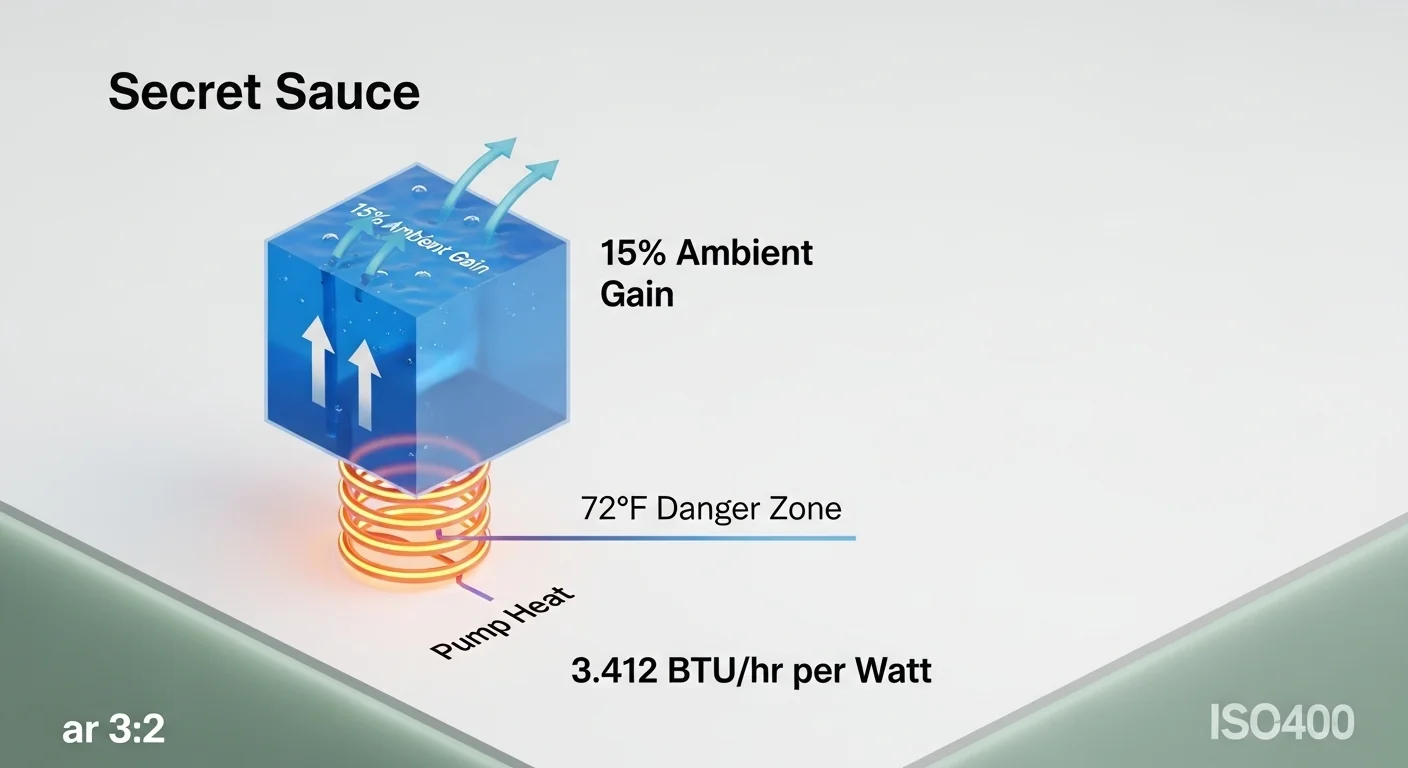
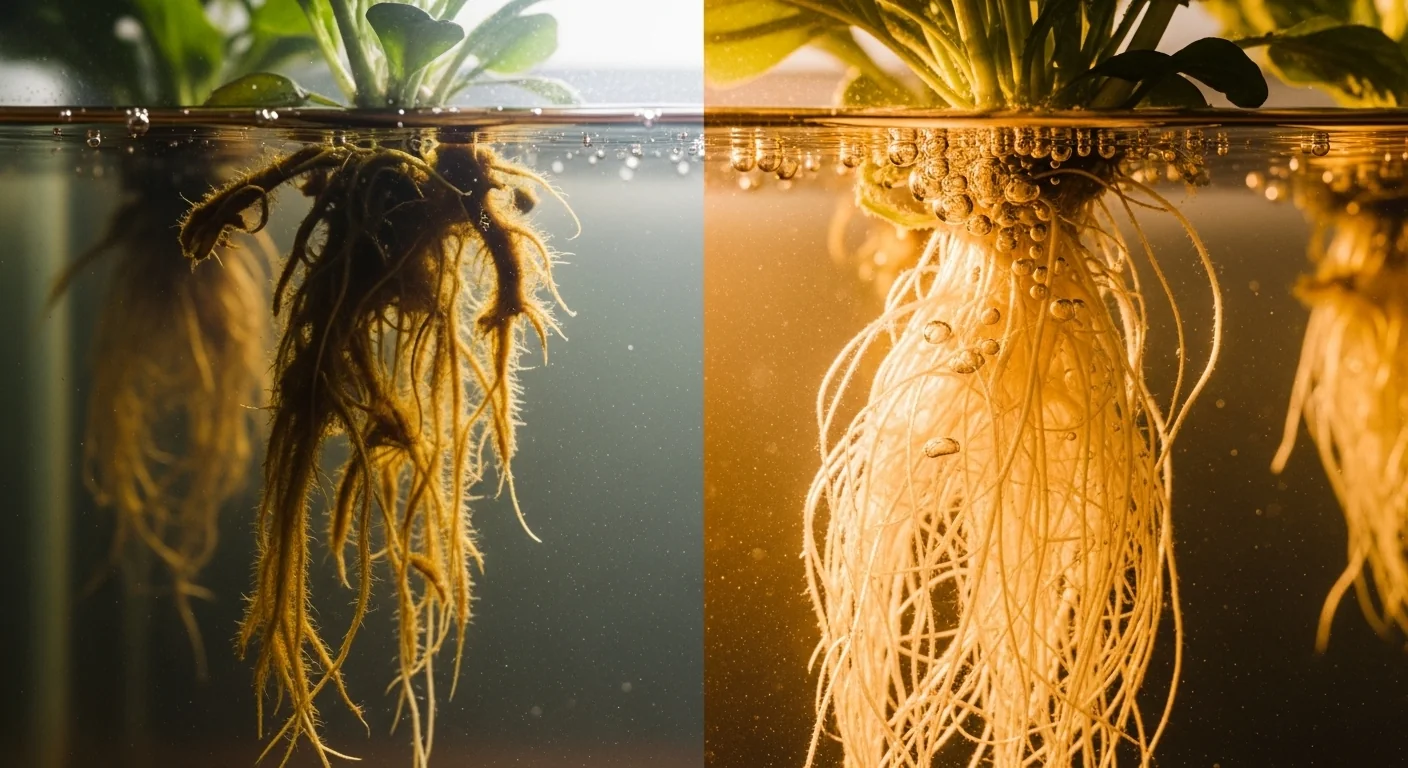
Reservoir temperature is a dissolved oxygen problem disguised as a thermometer reading. As water warms above 68°F, its capacity to hold dissolved oxygen (DO) contracts in a nonlinear way. Hydroponic plant roots depend entirely on dissolved oxygen to respire; when DO falls below what root cells require, anaerobic conditions form in the rhizosphere and the oomycete pathogen Pythium finds its opening. This is not a gradual decline you can observe and correct. Pythium converts healthy white roots into brown slime within 48 hours of a sustained excursion above 72°F, and there is no recovery treatment once the infection is established across a root mass.
This hydroponic water chiller calculator quantifies three distinct heat loads: the energy required to pull water temperature down from peak ambient, the continuous heat injected by your submersible pump (3.412 BTU/hr for every watt the pump consumes), and the ambient conduction gain through reservoir walls. It applies a 25% safety buffer to the sum, outputting the minimum BTU/hr your chiller must be rated to deliver. What the tool does not do: it does not model radiant heat from grow lights hitting reservoir surfaces, it does not handle split or recirculating systems with multiple separate reservoirs, and it is not a substitute for physically measuring dissolved oxygen levels once the chiller is running. For tracking reservoir baseline conditions before and after a chiller install, pair this result with a dedicated water temperature tool to establish your starting point.
After running your inputs, you will have a BTU/hr figure you can match directly to a chiller model’s rated capacity, and you will know whether your target temperature sits safely below the 72°F Pythium threshold or inside the danger zone where you need to lower your setpoint before shopping for hardware.
Use the Tool
Hydroponic Water Chiller BTU Sizer
Calculate the exact BTU/hr cooling capacity your reservoir needs — and discover the Pythium Heat Death zone.
| Reservoir (gal) | Pump Only (BTU/hr) | Est. Total BTU/hr | Chiller Size |
|---|
How This Calculator Works — Formula & Assumptions
Unit conversion: 1 Watt = 3.412 BTU/hr | Water density: 8.34 lb/US gal
- Pull-down time assumed to be 8 hours (overnight cool-down typical for controlled environments).
- Ambient gain factor of 15% assumes basic reservoir insulation; uninsulated reservoirs may need +20–30% more.
- Pump heat assumes 100% of wattage is transferred to the water (worst case — conservative and correct for most submersible pumps).
- Chiller efficiency (COP) degradation at high ambient temp is handled by the 25% safety buffer, not explicitly modeled.
- Calculator does not account for lighting heat radiation directly onto the reservoir surface — add insulated covers for best results.
- Results assume a single contiguous reservoir; split systems should be calculated individually then summed.
- For outdoor greenhouses, increase ambient gain factor to 25–35% and re-run with your peak solar hour temperature.
- Dissolved oxygen saturation values: 9.1 mg/L at 68°F, 7.6 mg/L at 77°F, 6.6 mg/L at 86°F — exponential decline above 72°F.
Before calculating, gather four numbers: the total combined volume of all reservoirs in your system (in US gallons), the hottest your grow space reaches on a peak summer day (in °F), your intended water temperature setpoint (in °F), and the wattage of every submersible pump that runs continuously inside the reservoir. If your pump label shows amperage rather than watts, multiply amps by your supply voltage (typically 120V in North America) to get watts. If you run multiple submerged pumps, enter their combined wattage. For guidance on calculating what your air and water pump setup is actually consuming, the DWC air pump calculator can help you cross-check pump sizing before you enter figures here.
Quick Start (60 Seconds)
- Reservoir Total Volume (gallons): Include every vessel that holds nutrient solution, not just the main tank. A 100-gallon system with a 20-gallon sump should be entered as 120 gallons. Enter US gallons, not liters.
- Peak Summer Ambient Air Temp (°F): Use the hottest recorded temperature inside your grow room or greenhouse, not the outdoor ambient. A sealed indoor room under high-wattage lighting frequently runs 10°F to 20°F above outdoor temperature. Do not underestimate this figure; it directly controls how hard the chiller must work.
- Target Water Temperature (°F): Enter your desired reservoir setpoint. The physiologically optimal range for most hydroponic crops is 65°F to 68°F. If you enter anything above 72°F, the calculator will flag a Pythium risk automatically. Do not enter the current water temperature; enter the temperature you want to maintain.
- Submersible Pump Wattage (W): Enter only the watts of pumps physically submerged in the reservoir. External inline pumps transfer heat to the plumbing, not directly to the water, and can be omitted. Water pumps, nutrient return pumps, and any submersible circulation pumps all count. Air pumps driving airstones are external and should not be included.
- Units: All temperature inputs must be in Fahrenheit. Volume must be in US gallons. Power must be in watts. The tool does not accept Celsius or liters.
- Zero-pump entry: If your system uses no submersible pumps (for example, a passive gravity-fed setup), enter 0 in the pump wattage field. The field is required; it cannot be left blank.
Inputs and Outputs (What Each Field Means)
The table below maps each calculator field to its physical meaning, flags the most common data entry error, and provides safe entry guidance derived from the formula’s underlying assumptions.
| Field | Unit | What It Represents | Common Mistake | Safe Entry Guidance |
|---|---|---|---|---|
| Reservoir Total Volume | US gallons | Total water and nutrient solution volume held in all connected vessels | Entering only the main tank and forgetting sumps, headers, or header pipes | Count every vessel that holds solution and stays at temperature; add them together |
| Peak Summer Ambient Air Temp | °F | The hottest air temperature your reservoir space reaches during peak cooling demand | Using outdoor ambient instead of indoor measured peak, which is always higher in closed grows | Place a max-min thermometer in the grow space for one week in summer; use the recorded max |
| Target Water Temperature | °F | The reservoir temperature setpoint you want the chiller to maintain continuously | Setting the target at 70°F to 72°F because it feels conservative, without knowing that 72°F is the Pythium threshold | Target 65°F to 68°F for maximum dissolved oxygen retention; the tool warns automatically above 72°F |
| Submersible Pump Wattage | Watts (W) | The combined wattage of all pumps physically submerged inside the reservoir, which convert their electrical input 100% into heat inside the water | Forgetting to include return pumps or circulation pumps; assuming pump heat is negligible on large wattage units | Check the pump label or specification sheet for rated wattage; sum all submerged pumps |
| Required Chiller Capacity (output) | BTU/hr | The minimum hourly cooling capacity a chiller must be rated to deliver to maintain your target temperature under peak conditions | Purchasing a chiller rated in HP without converting HP to BTU/hr; marketing HP ratings vary by manufacturer | Always compare chiller specifications using BTU/hr, not horsepower; request spec sheets when purchasing |
| Water Heat Load (output) | BTU/hr | The cooling energy needed to reduce the entire reservoir volume from ambient to target temperature over an 8-hour pull-down period | Assuming this is the only heat load; it is typically the largest but never the only component | Use this figure to understand what fraction of your total load is driven by the ambient-to-target gap |
| Pump Heat Load (output) | BTU/hr | Continuous heat addition from submerged pump operation; calculated at 3.412 BTU/hr per watt | Treating this as a one-time event; pump heat is continuous and the chiller must overcome it every hour the pump runs | For NFT and recirculating systems where pumps run 24 hours a day, this figure is permanent and cannot be offset by insulation. Consult the NFT system calculator for flow rate context |
| Ambient Gain (output) | BTU/hr | Heat conducted from surrounding air into the reservoir through uninsulated walls, estimated at 15% of the water heat load | Assuming insulation eliminates ambient gain; it reduces it but does not eliminate it | Wrapping reservoirs in reflective insulation can reduce this figure meaningfully, but enter your actual ambient temperature regardless |
| Safety Buffer 25% (output) | BTU/hr added | The additional capacity margin added to the raw total to account for chiller efficiency degradation when ambient temperatures are high | Skipping the buffer by purchasing a chiller rated exactly to the raw BTU/hr total | Do not subtract this margin when shopping; it exists because chiller performance curves fall off at high ambient, especially outdoors or in hot rooms |
Worked Examples (Real Numbers)
Example 1: Small Indoor DWC Setup
- Reservoir volume: 50 gallons
- Peak summer ambient: 85°F
- Target water temperature: 68°F
- Submersible pump wattage: 80W
Temperature differential: 85 − 68 = 17°F
Water heat load: 50 × 8.34 × 17 ÷ 8 = 884.6 BTU/hr
Pump heat load: 80 × 3.412 = 273.0 BTU/hr
Ambient gain: 884.6 × 0.15 = 132.7 BTU/hr
Raw total: 884.6 + 273.0 + 132.7 = 1,290.3 BTU/hr
Result: 1,290.3 × 1.25 = 1,613 BTU/hr recommended. Minimum chiller class: 1/10 HP.
At this scale, a basic 1/10 HP aquaponic chiller (rated to approximately 3,400 BTU/hr) provides substantial headroom. The pump heat load represents more than 21% of the raw total, which illustrates that even a modest 80W return pump on a small system cannot be ignored in the calculation.
Example 2: Medium NFT Bench System
- Reservoir volume: 200 gallons
- Peak summer ambient: 90°F
- Target water temperature: 68°F
- Submersible pump wattage: 250W
Temperature differential: 90 − 68 = 22°F
Water heat load: 200 × 8.34 × 22 ÷ 8 = 4,587.0 BTU/hr
Pump heat load: 250 × 3.412 = 853.0 BTU/hr
Ambient gain: 4,587.0 × 0.15 = 688.1 BTU/hr
Raw total: 4,587.0 + 853.0 + 688.1 = 6,128.1 BTU/hr
Result: 6,128.1 × 1.25 = 7,660 BTU/hr recommended. Minimum chiller class: 1/5 HP.
A 10°F increase in ambient temperature (from 85°F to 90°F in this example versus Example 1) dramatically shifts the minimum chiller requirement from 1/10 HP to 1/5 HP. Growers who size based on a mild spring ambient and then run through a hot summer without retesting are frequently undersized.
Example 3: Large Aquaponic System With Pythium Warning Active
- Reservoir volume: 500 gallons
- Peak summer ambient: 95°F
- Target water temperature: 74°F (above the 72°F Pythium threshold)
- Submersible pump wattage: 500W
Temperature differential: 95 − 74 = 21°F
Water heat load: 500 × 8.34 × 21 ÷ 8 = 10,947.8 BTU/hr
Pump heat load: 500 × 3.412 = 1,706.0 BTU/hr
Ambient gain: 10,947.8 × 0.15 = 1,642.2 BTU/hr
Raw total: 10,947.8 + 1,706.0 + 1,642.2 = 14,296.0 BTU/hr
Result: 14,296.0 × 1.25 = 17,870 BTU/hr recommended. Minimum chiller class: 1 HP. Pythium warning is active.
This operator would need to purchase a 1 HP chiller just to maintain a 74°F target that is already in the Pythium danger zone. The better decision is to recalculate for a 68°F target (increasing the BTU/hr requirement further) and buy the correct chiller upfront, rather than buy a smaller unit for a unsafe setpoint and lose a crop to root rot before the next system upgrade.
Reference Table (Fast Lookup)
The table below shows pre-computed chiller requirements across nine reservoir sizes. All rows assume a peak ambient of 85°F, a target of 68°F (17°F differential), and a continuous submersible pump load of 150W. If your inputs differ, use the calculator above; this table is for rapid orientation and shopping, not final design.
| Reservoir Size (gal) | Water Heat Load (BTU/hr) | Pump Heat Load (BTU/hr) | Ambient Gain (BTU/hr) | Recommended Total w/ Buffer (BTU/hr) | Min. Chiller Class |
|---|---|---|---|---|---|
| 25 | 442 | 512 | 66 | 1,276 | 1/10 HP |
| 50 | 885 | 512 | 133 | 1,912 | 1/10 HP |
| 100 | 1,769 | 512 | 265 | 3,183 | 1/10 HP |
| 150 | 2,654 | 512 | 398 | 4,455 | 1/5 HP |
| 200 | 3,539 | 512 | 531 | 5,728 | 1/5 HP |
| 300 | 5,308 | 512 | 796 | 8,270 | 1/3 HP |
| 500 | 8,846 | 512 | 1,327 | 13,356 | 1/2 HP |
| 750 | 13,269 | 512 | 1,990 | 19,714 | 1 HP |
| 1,000 | 17,693 | 512 | 2,654 | 26,073 | 1 HP |
Note on the pump column: The pump heat load of 512 BTU/hr (150W × 3.412) is the same across all rows because the pump is independent of reservoir volume. On smaller reservoirs, this fixed load is a larger share of the total and explains why a 25-gallon system cannot simply use the smallest chiller available without also accounting for pump size.
How the Calculation Works (Formula + Assumptions)
Show the calculation steps
Step 1: Compute the water heat load
The formula uses the specific heat of water and its weight per gallon to determine how much cooling energy is required to reduce the total reservoir mass from ambient temperature to target temperature over an assumed pull-down period of 8 hours.
Water Heat Load (BTU/hr) = Gallons × 8.34 lb/gal × (Ambient °F − Target °F) ÷ 8 hours
The constant 8.34 is the weight of one US gallon of water in pounds. The pull-down period of 8 hours reflects a realistic overnight cooling cycle in a controlled environment. The result is in BTU/hr because the total BTU needed is spread across the pull-down window.
Step 2: Compute the pump heat load
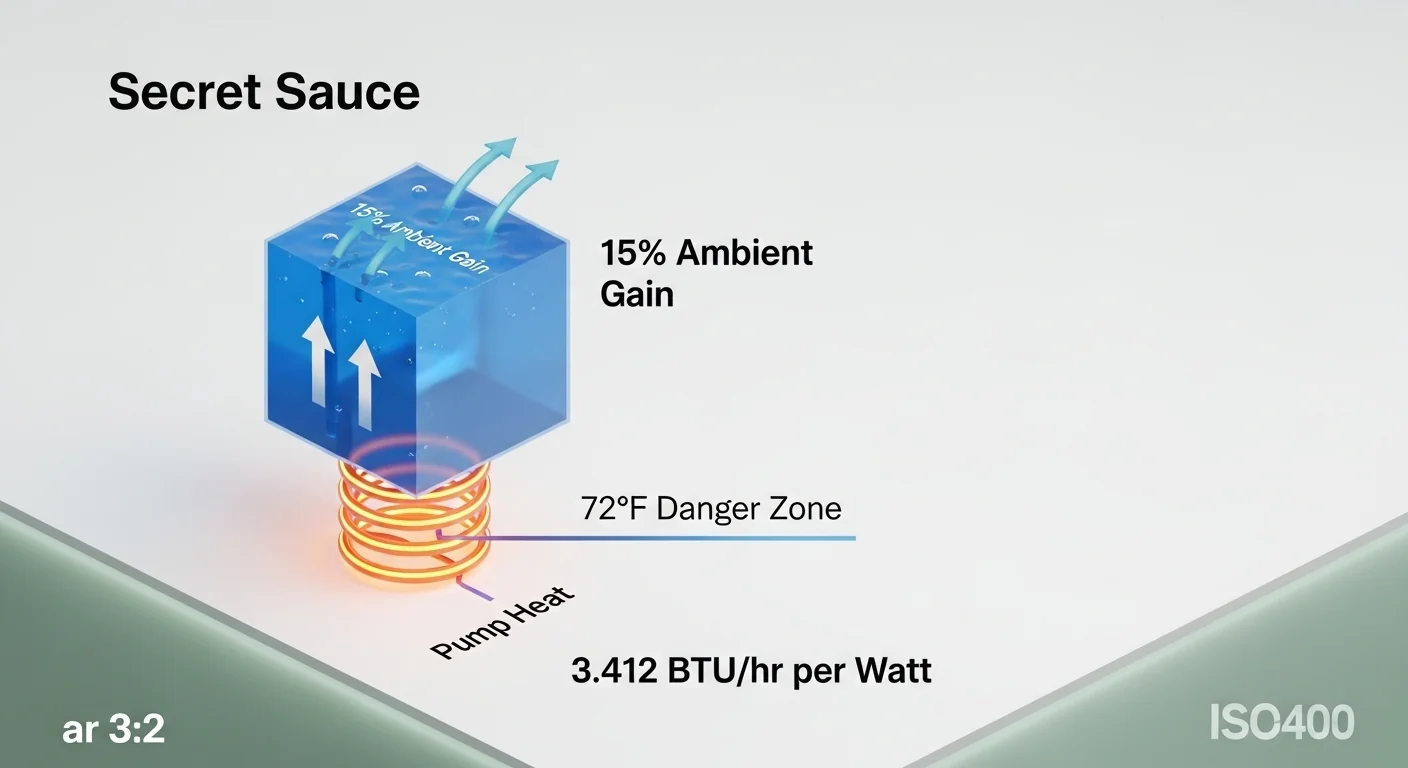
Every watt consumed by a submerged pump is converted to heat inside the water at a thermodynamically fixed conversion rate. This load is continuous, not a one-time pull-down event.
Pump Heat Load (BTU/hr) = Pump Watts × 3.412 BTU/hr per watt
The constant 3.412 is the exact conversion factor between watts and BTU/hr. It is not an approximation.
Step 3: Compute ambient gain
Even insulated reservoirs conduct heat from the surrounding air. This component is estimated at 15% of the water heat load, reflecting a reservoir with basic insulation. Uninsulated reservoirs in direct radiant environments will have higher conduction gains.
Ambient Gain (BTU/hr) = Water Heat Load × 0.15
Step 4: Sum all loads and apply the safety buffer
Raw Total (BTU/hr) = Water Heat Load + Pump Heat Load + Ambient Gain
Recommended Capacity (BTU/hr) = Raw Total × 1.25
The 25% safety buffer accounts for two real-world chiller performance reductions: (1) chiller refrigeration efficiency (COP) falls when the ambient temperature around the chiller unit rises, and (2) manufacturers rate chillers at ideal laboratory conditions that may not reflect your installation environment.
Rounding rule: All intermediate values are carried at full precision. The final recommended BTU/hr is rounded to the nearest whole number. All reference table values are rounded to the nearest BTU/hr.
Unit conversions used:
- 1 US gallon of water = 8.34 pounds
- 1 watt = 3.412 BTU/hr
- Temperature differential is always (Ambient °F − Target °F); negative values produce zero water heat load
Assumptions and Limits
- The pull-down period is fixed at 8 hours. Systems that require faster pull-down (for example, 4-hour emergency cooling after an excursion) will need a chiller with higher BTU/hr capacity than this tool recommends. Divide your target pull-down hours into 8 and multiply the water heat load component by that factor.
- The ambient gain factor of 15% assumes the reservoir is wrapped in at least a basic layer of insulation or a reflective cover. Bare, uninsulated reservoirs sitting in direct sun or under high-intensity lighting will have higher ambient gain; real-world losses can approach 30% in worst-case scenarios.
- The pump heat conversion assumes 100% of electrical input becomes thermal energy in the water. This is the correct conservative assumption for submerged pumps operating continuously. It is not pessimistic; it is physically accurate.
- The tool does not model grow light heat reaching the reservoir surface. If lights are positioned close to open-top reservoirs, the actual BTU/hr requirement will exceed this tool’s output. Cover reservoir openings with opaque lids where possible.
- Split systems with multiple physically separated reservoirs should be calculated individually per vessel and summed manually; entering a combined volume into a single calculation is only valid when all volumes share the same chiller circuit and the same ambient environment.
- The chiller efficiency degradation captured by the 25% buffer is an approximation. For installations where the chiller unit itself sits in a room exceeding 90°F, consider increasing the sizing margin further, as COP degradation accelerates sharply at high ambient temperatures around the condenser.
- Aquaponic systems with fish bioloads introduce additional oxygen consumption that is not captured in this calculator. DO management in aquaponics requires both reservoir temperature control and aeration strategies evaluated separately.
- Dissolved oxygen levels at 68°F are approximately 9.1 mg/L at saturation. At 77°F they fall to approximately 7.6 mg/L. At 86°F they fall to approximately 6.6 mg/L. These are saturation values under ideal conditions; actual DO in a system under root respiration load will be lower, making the temperature threshold even more critical than saturation figures suggest.
Standards, Safety Checks, and “Secret Sauce” Warnings
Critical Warnings
- The 72°F Pythium threshold is a hard biological boundary, not a preference. Pythium spp. are oomycetes present in virtually all growing environments. Below 68°F they are largely dormant in a healthy root zone. Above 72°F, declining DO creates the anaerobic conditions they require to proliferate rapidly. A sustained temperature of 74°F to 78°F for 24 to 48 hours can result in complete crop loss with no viable recovery path. The calculator flags this automatically; treat the warning as a system design error to fix before purchasing.
- Pump wattage is a continuous heat source that never turns off. The water heat load diminishes once the reservoir reaches setpoint. The pump heat load does not. A 300W submersible pump injects 1,023 BTU/hr into the water permanently. On a small 30-gallon reservoir, that single load can overwhelm an undersized chiller within hours of reaching setpoint. Size for the pump, not just the temperature differential.
- Chiller BTU/hr ratings degrade at high ambient temperatures. A chiller rated at 10,200 BTU/hr in a 70°F room may deliver only 7,000 to 8,000 BTU/hr when that room heats to 95°F in summer. The 25% safety buffer in this calculator accounts for this degradation in general terms. For grow rooms where ambient temperatures regularly exceed 90°F, request the manufacturer’s performance curve at elevated ambient conditions before purchasing. The counterpart to chiller sizing is cooling your grow room itself; for integrated climate sizing, the grow room AC sizing calculator addresses the room-level heat load separately.
- DO saturation alone is insufficient to confirm root safety. A chiller maintaining 68°F ensures the saturation capacity of the water is high, but dissolved oxygen in the root zone depends on how fast roots are consuming it versus how fast the water surface and airstones are replenishing it. Temperature control and aeration work together. Monitoring vapor pressure deficit in the canopy alongside reservoir temperature gives a more complete picture of transpiration demand and system stress during heat events.
Minimum Standards
- Target reservoir temperature: 65°F to 68°F for most hydroponic crops. Aquaponic systems with warmwater fish species may tolerate up to 72°F, but this represents the upper safe bound for the plant root zone, not an operational target.
- Chiller minimum sizing rule: always purchase a chiller rated at or above the calculated BTU/hr value with the 25% buffer applied. Never purchase to the raw total.
- Pull-down verification: after installation, the chiller should achieve pull-down from ambient to setpoint within 8 hours under peak ambient conditions. If it cannot, the system is undersized regardless of what the label says.
- Dissolved oxygen verification: use a calibrated digital DO meter 24 hours after achieving temperature setpoint. Acceptable DO for most hydroponic crops is above 6 mg/L at the root zone; above 8 mg/L is preferred and achievable at 68°F with adequate aeration.
Competitor Trap: Nearly every competing chiller sizing guide on the web recommends a chiller based solely on reservoir volume, using a simplified gallons-to-horsepower chart with no temperature differential, no pump heat accounting, and no safety buffer. These charts produce results that are systematically undersized in real grow rooms where ambient temperatures exceed the chart’s implicit assumptions and where submersible pumps add substantial continuous heat. A 200-gallon reservoir recommendation of “1/5 HP” from a volume-only chart may be correct in a 70°F climate-controlled lab. In a 90°F summer grow room with a 300W pump, that same reservoir needs a full 1/3 HP chiller, and possibly larger if the Pythium threshold matters to the operator, which it should always.
Common Mistakes and Fixes
Mistake: Using Outdoor Ambient Temperature Instead of Indoor Peak
Grow rooms, grow tents, and sealed greenhouses run substantially warmer than outdoors, especially when high-wattage lighting is operating. A grow tent in a 75°F room routinely reaches 85°F to 95°F internally. Using the outdoor temperature as your ambient input produces a BTU/hr result that is too low for actual operating conditions, and the chiller will be unable to maintain setpoint during summer. Growers relying on ambient readings for grow tent airflow often underestimate internal heat in the same way.
Fix: Place a max-min thermometer inside your grow space for at least one week in summer and use the recorded peak as your ambient input.
Mistake: Entering Only the Main Reservoir Volume
Systems with sumps, header tanks, nutrient reservoirs, and irrigation return vessels all hold water that must be chilled to the same setpoint. Entering only the main tank volume ignores the thermal mass of every connected vessel and understates the pull-down BTU/hr requirement. The error compounds when the overlooked vessels are in a warmer part of the facility.
Fix: Add the volume of every vessel in the chiller circuit before entering the total. If separate vessels are in different ambient environments, calculate each circuit independently.
Mistake: Ignoring Pump Wattage on High-Flow Systems
High-flow NFT and aeroponic systems frequently run pumps rated at 300W to 800W continuously. At 3.412 BTU/hr per watt, an 800W pump injects 2,730 BTU/hr into the reservoir every hour of operation. On a 100-gallon system, this single component can represent the majority of the sustained heat load. Many growers see the chiller reach setpoint in the morning and then watch the temperature creep up through the day, not realizing the pump is overwhelming the chiller’s continuous cooling capacity.
Fix: Always enter the true rated wattage of all submerged pumps. If the pump label is worn or missing, use a clamp meter to measure actual current draw and multiply by supply voltage.
Mistake: Purchasing a Chiller Matched Exactly to the Raw BTU/hr Total
The raw BTU/hr total (before the 25% safety buffer) represents the calculated load under modeled assumptions, not the actual load under worst-case real conditions. Chiller performance curves degrade as the ambient temperature around the chiller’s condenser rises. A chiller purchased to match the raw total will be at or above its rated capacity the first time your room hits peak summer temperature, and it will run continuously without achieving setpoint.
Fix: Always size to the buffered BTU/hr result, which includes the 25% margin. If your chiller’s placement area routinely exceeds 90°F, request the manufacturer’s performance data at that ambient and verify the rated output still meets your load.
Mistake: Setting the Target Temperature at 72°F and Calling It Safe
Seventy-two degrees Fahrenheit is not a safe operational target; it is the upper boundary of the danger zone. At 72°F, dissolved oxygen is already meaningfully lower than at 68°F, and any aeration inefficiency, biofilm accumulation in the reservoir, or short spike above 72°F creates the conditions for Pythium to activate. Operators who set 72°F as the target are one warm afternoon away from a crop loss event.
Fix: Set the chiller thermostat to maintain 65°F to 68°F. Use the calculator with a 68°F target to size correctly for a temperature that provides genuine biological safety margin, not one that sits at the failure threshold.
Next Steps in Your Workflow
Once you have your BTU/hr figure, the next purchase decision is a specific chiller model with a rated capacity that meets or exceeds that number, verified at elevated ambient conditions if your installation environment exceeds 85°F. After the chiller is installed and the system reaches thermal steady state (typically 24 to 48 hours), calibrate your nutrient solution. Reservoir temperature affects nutrient solubility and uptake rates, and the EC and pH values you maintained at 74°F will behave differently at 68°F. Use the hydroponic EC calculator to re-check your solution strength at the new operating temperature before resuming normal feeding schedules.
Temperature control is one pillar of reservoir management, but it operates in concert with nutrient concentration, pH, and dissolved oxygen replenishment. After confirming your target temperature is being held reliably, verify that your DO levels are responding as expected using a digital meter, then dial in your feeding program with the nutrient dosing calculator to ensure your plants are receiving the correct input rates for the growth stage they are in. These three variables together (temperature, EC, and DO) define the root zone environment that determines whether your chiller investment produces measurable yield gains.
FAQ
What dissolved oxygen level should I be targeting in my hydroponic reservoir?
For most hydroponic crops, dissolved oxygen above 6 mg/L at the root zone is the accepted minimum. A reading above 8 mg/L is preferable and is achievable at reservoir temperatures of 68°F or below with active aeration. At 68°F, the DO saturation ceiling is approximately 9.1 mg/L, giving your system room to deliver adequate oxygen even under heavy root respiration load. Measure at the root zone, not at the water surface, for an accurate reading.
Can I use this calculator for an aquarium chiller in an aquaponic system?
Yes, the BTU/hr formula is identical for aquaponic reservoirs. The key difference is that fish bioloads consume additional dissolved oxygen beyond what plant roots draw, making the 72°F threshold even more critical in aquaponics. For warmwater species, the biological constraints are different, but the chiller sizing math remains the same: enter total reservoir volume, ambient temperature, target temperature, and pump wattage to get your BTU/hr requirement.
Why does my chiller struggle to maintain temperature in summer even though it was fine in spring?
Chiller performance degrades as ambient temperature rises around the condenser unit. The BTU/hr output of a chiller rated in a 70°F environment can fall significantly when that environment heats to 90°F in summer. This is the performance degradation that the 25% safety buffer in this calculator is designed to compensate for. If your chiller was correctly sized for spring ambient temperatures but cannot maintain setpoint in summer, the unit may be undersized for peak conditions. Re-run the calculator with your actual summer peak ambient to see if a larger unit is warranted.
Should I insulate my reservoir before or instead of buying a chiller?
Insulation reduces the ambient gain component of your heat load, which the calculator estimates at 15% of the water heat load. It does not eliminate pump heat or the core water temperature pull-down requirement. Insulation is a complementary measure that can reduce the required chiller size at the margin, but it cannot replace a chiller in environments where ambient temperatures significantly exceed the target water temperature. Apply both for best results.
What does horsepower actually mean for water chillers and is it a reliable sizing metric?
Horsepower is a marketing convenience, not a precise engineering specification. Different chiller manufacturers rate the same nominal HP at different BTU/hr outputs, and almost all rate their equipment under ideal ambient conditions that do not reflect real grow room environments. The only reliable metric for comparing chiller capacity is BTU/hr as rated at a stated ambient temperature. Always ask for BTU/hr ratings when evaluating chiller models, and verify the ambient temperature at which that rating was measured.
How often should I re-run this calculator for an existing system?
Re-run the calculation whenever any of the four inputs change meaningfully: if you expand reservoir volume by adding a sump or additional vessel, if you change your submersible pump to a higher or lower wattage model, if you set up in a different location with a different ambient peak, or if you change your target temperature setpoint. For established systems, running the calculator once at the start of each summer season with the current year’s peak ambient temperature is a practical minimum. Ambient temperatures in grow facilities can vary substantially year to year based on HVAC changes or facility configuration shifts.
Conclusion
The central insight of this hydroponic water chiller calculator is that reservoir temperature is a dissolved oxygen management problem first and a hardware sizing problem second. Getting the BTU/hr number right matters, and the three-component formula (water heat load, pump heat load, ambient gain, with a 25% buffer applied to the sum) produces a result that accounts for the variables most sizing guides omit entirely. But the number only protects your crop if the target temperature you enter is set below the 72°F Pythium threshold, not at it.
The single most costly mistake in chiller sizing is purchasing a unit matched to the raw BTU/hr total without the safety buffer and setting the thermostat at 72°F rather than 68°F, effectively building two failure modes into the system simultaneously. Run your numbers, size to the buffered result, and target 65°F to 68°F. For facilities that operate through cold winters as well as hot summers, pair this calculation with your greenhouse heating requirements to ensure your climate system is designed for the full annual temperature range your crops will experience.