
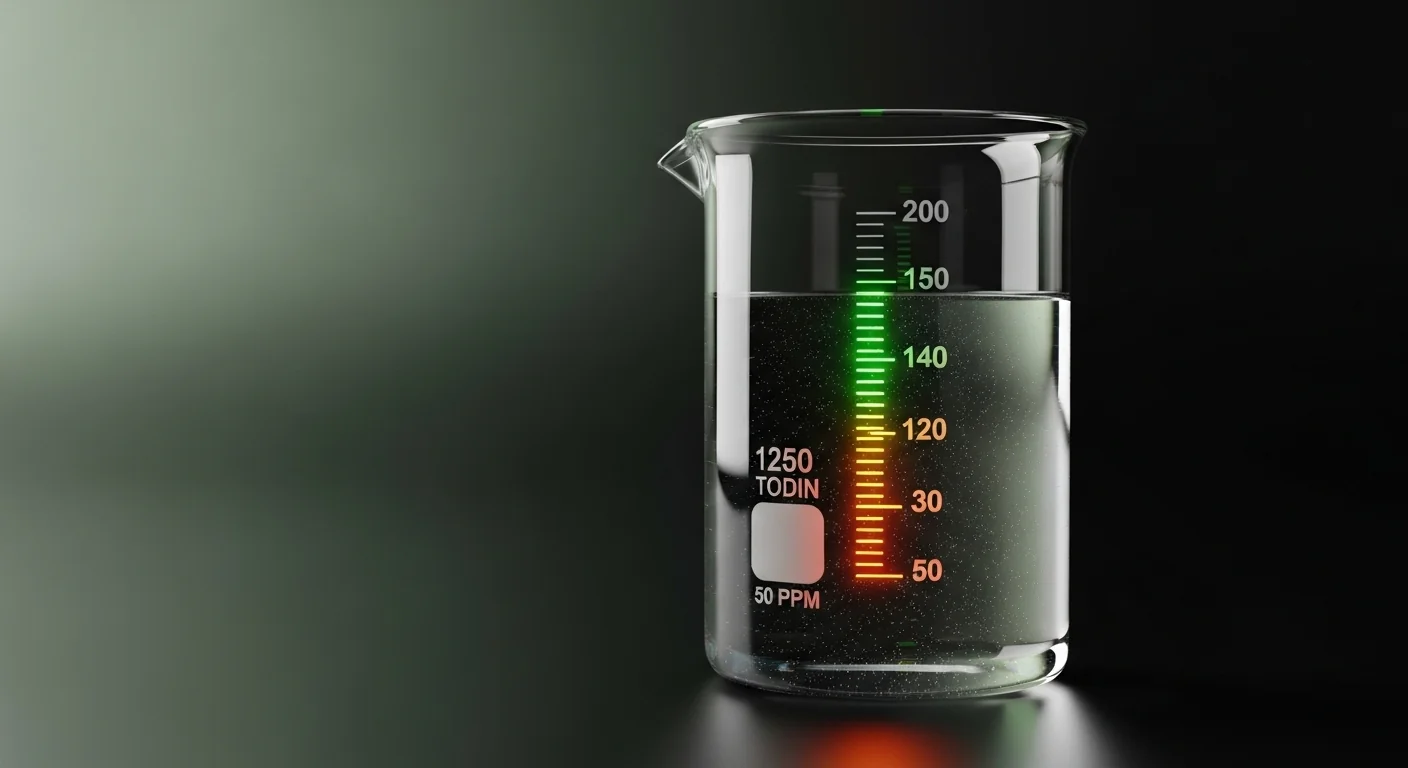

Reverse osmosis water is chemically near-pure by design, and that purity is exactly what makes it dangerous in hydroponics without proper remineralization. Standard hydroponic nutrients — bloom formulas, grow formulas, base nutrient lines — are engineered around tap water containing 50 to 150 parts per million (PPM) of ambient calcium and magnesium. When you mix those nutrients into zero-PPM RO water, the formula’s foundational mineral assumptions simply do not exist. Deficiency begins immediately, even before any visible symptoms appear. The crop is already behind before it takes its first nutrient uptake.
This cal mag dosage calculator computes the precise volume of calcium-magnesium supplement needed to bring your RO water up to a target base PPM before your main nutrients are added. It handles four inputs — starting PPM, target PPM, calcium-to-magnesium ratio, and reservoir size — and returns total dosage in milliliters, a per-gallon rate, and a calcium/magnesium PPM split derived from the ratio you select. It does not replace an in-line TDS meter, does not account for mineral contributions from soilless media like coco or rockwool, and does not calculate full nutrient solution EC. For unit conversion between PPM and EC, the PPM to EC converter handles that step separately.
After running this calculator, you will know exactly how many milliliters of cal-mag supplement to add per reservoir fill before any other nutrients go in — and whether your current source water PPM puts your crop in the tissue necrosis danger zone.
Use the Tool
RO Cal-Mag Buffer & Re-mineralization Calculator
Prevent blossom end rot & nutrient lockout — calculate exact cal-mag dosage for reverse osmosis water
| Scenario | Starting PPM | Target PPM | Missing PPM | Cal-Mag (mL) | Status |
|---|
How This Calculator Works
- Step 1 — Missing PPM:
Missing PPM = Target Base PPM − RO Starting PPM
This is the mineral deficit your water has versus what hydroponic base nutrients expect. Nutrient formulas designed for tap water assume 50–150 PPM of ambient calcium and magnesium already in your source water. - Step 2 — Cal-Mag Dose (mL):
Cal-Mag mL = (Missing PPM × Gallons) ÷ Concentration Factor
The concentration factor used is 5 (industry standard for Botanicare Cal-Mag Plus and similar products at ~3–5 mL/gal per 150 PPM rise). This gives you the total milliliters to add to your reservoir. - Step 3 — Calcium split:
Ca PPM = Missing PPM × Ratio ÷ (Ratio + 1) - Step 4 — Magnesium split:
Mg PPM = Missing PPM ÷ (Ratio + 1) - Critical threshold: If Starting PPM < 50 and no cal-mag is added, calcium and magnesium starvation triggers Blossom End Rot (tissue necrosis). This tool flags this condition automatically.
Assumptions: Botanicare Cal-Mag Plus concentration factor of 5. pH 5.5–6.5 is assumed stable. Values are estimates; always verify with an accurate TDS/EC meter after dosing.
Assumptions & Limits
- Water source: This tool is designed for RO (reverse osmosis) or zero-PPM water. Tap water users with >50 PPM should reduce or skip cal-mag accordingly.
- Product calibration: Dosage is calculated for Botanicare Cal-Mag Plus (concentration factor ≈ 5). Products vary — always follow your product’s label and adjust with a meter.
- Ratio ranges: Ca:Mg ratios below 2:1 risk magnesium toxicity; ratios above 5:1 risk magnesium deficiency. This tool supports 2:1 – 5:1 only.
- Starting PPM cap: This tool assumes starting PPM of 0–500. Values above 500 indicate non-RO water and require a different approach.
- Blossom End Rot trigger: The 50 PPM threshold for the tissue necrosis alert is based on published hydroponic agronomic research. This is a precautionary warning — growers with quality buffered bloom nutrients may tolerate lower base PPM.
- pH assumed stable: Cal-mag supplementation may slightly raise pH. Always recheck pH after dosing and adjust with pH Up/Down as needed.
Before calculating, have three numbers ready: your source water’s TDS reading (measured with a calibrated meter before adding anything), your target base PPM for the crop you are growing, and your reservoir or mixing tank volume in gallons. The calcium-to-magnesium ratio is a formula input — 3:1 is the standard for most crops; shift to 4:1 for fruiting vegetables like tomatoes and peppers. If you are tracking nutrient program EC alongside PPM, the hydroponic EC calculator can be run after this step to verify your full solution strength.
Quick Start (60 Seconds)
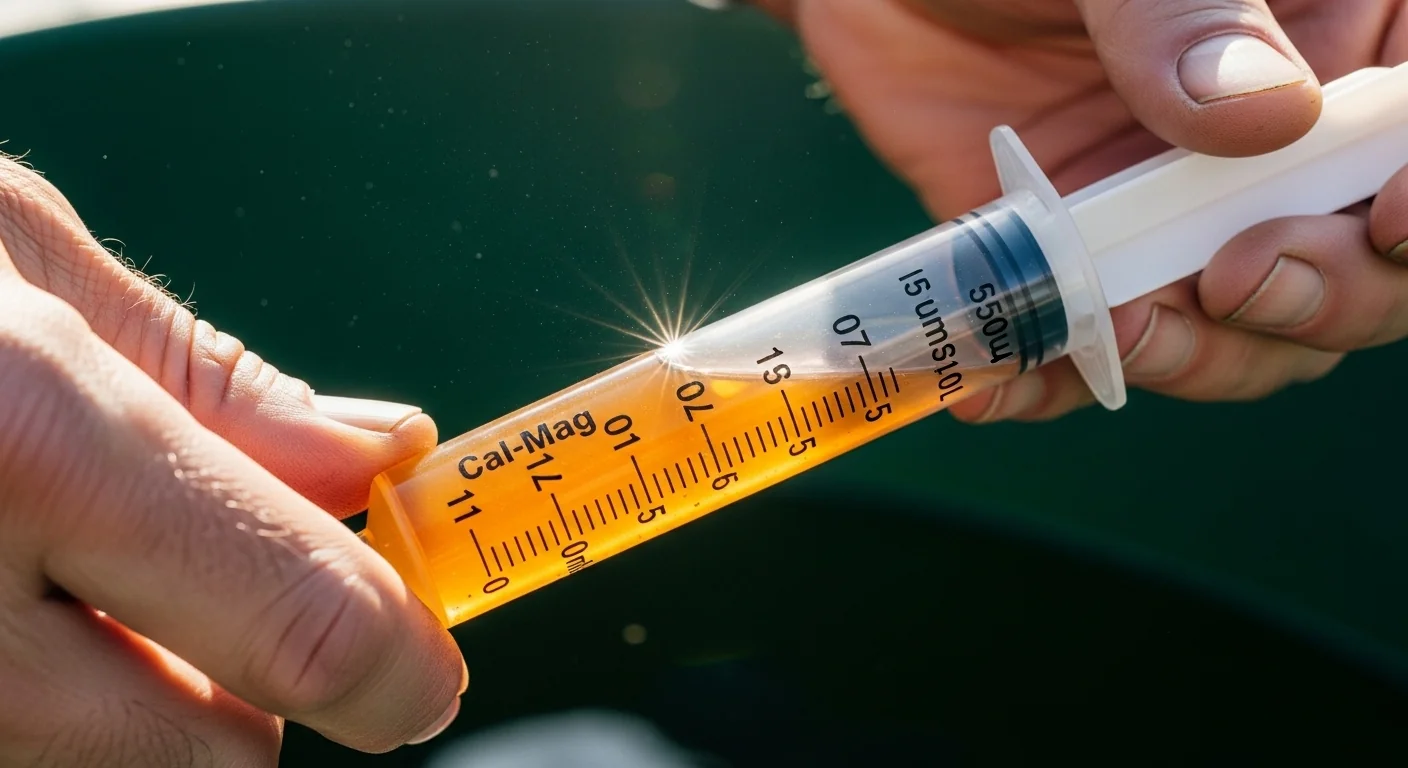
- RO Water Starting PPM: Take a fresh TDS reading of your source water before adding anything. True RO output typically reads 0 to 10 PPM. Enter this number as measured — do not estimate. Even 5 PPM matters when checking against the critical 50 PPM threshold.
- Target Base PPM: This is not your final nutrient solution PPM — it is the mineral baseline you are building before nutrients go in. Most hydroponic growers target 150 to 200 PPM for this baseline. The target must be higher than your starting PPM or the tool will flag an error.
- Calcium to Magnesium Ratio: Select the ratio for your crop type. Do not guess — calcium excess at high ratios competes with magnesium uptake. Use 3:1 as your default if you are unsure, and adjust based on observed crop response.
- Reservoir Size (Gallons): Enter your actual mixing volume in US gallons. Mix in the full tank, not a fraction of it. Dosing a concentrated batch and then diluting introduces measurement error.
- Review the gauge before acting: A red gauge reading means your starting PPM is below 50 — the critical tissue necrosis threshold. This is not a style warning; it changes what you must do before adding any other nutrients.
- Check the mL per gallon figure: This is useful for topping off partial reservoirs between full changes without re-running the full calculation.
- Cross-reference the reference table: The table at the bottom of the results recalculates common scenarios for your specific reservoir size so you can see how your result compares to typical setups.
Inputs and Outputs (What Each Field Means)
| Field | Unit | What It Means | Common Mistake | Safe Entry Guidance |
|---|---|---|---|---|
| RO Water Starting PPM | PPM (mg/L) | Total dissolved solids in your source water before any supplement is added. Represents ambient mineral content. | Using tap water PPM readings without verifying whether the source is actually RO or softened water. | Measure with a calibrated TDS pen. Valid range: 0 to 500. Values above 150 suggest non-RO water. |
| Target Base PPM | PPM (mg/L) | The mineral baseline PPM you want to reach before adding base or bloom nutrients. This is not your final solution PPM. | Confusing base PPM with total nutrient solution PPM. These are two separate measurements in a proper mixing sequence. | Valid range: 50 to 500. Recommended hydroponic base: 150 to 200. Must exceed starting PPM. |
| Calcium : Magnesium Ratio | Dimensionless ratio | The proportion of calcium to magnesium in the mineral supplement dose. Determines the Ca PPM and Mg PPM split in the output. | Using a high Ca:Mg ratio for leafy crops, causing magnesium competition and interveinal chlorosis symptoms identical to magnesium deficiency. | Select from the dropdown. Use 2:1 for leafy greens, 3:1 standard, 4:1 for tomatoes, 5:1 for peppers and heavy-calcium crops. |
| Reservoir Size (Gallons) | US Gallons | Total volume of the mixing reservoir or tank being prepared. Drives the total mL output and the per-gallon rate. | Entering net water volume instead of gross tank volume, or mixing in a partial tank and extrapolating dosage. | Valid range: 0.5 to 5,000 gallons. Mix in the full tank for accuracy. |
| Total Cal-Mag (mL) [Output] | Milliliters | Total volume of calcium-magnesium supplement to add to the reservoir to reach the target base PPM. | Adding the dose to an already-nutrient-loaded reservoir. Cal-mag must go in before other nutrients. | Measure with a graduated syringe or measuring cylinder. Do not estimate by eye. |
| Missing PPM [Output] | PPM | The mineral deficit: how many PPM of calcium and magnesium combined must be added to close the gap between starting and target. | Treating this as equivalent to nutrient PPM. Missing PPM is only the cal-mag mineral gap, not full nutrient demand. | Review only. Used internally to compute the dose. A value above 150 PPM signals a large deficit requiring careful mixing. |
| Target Ca / Mg PPM [Output] | PPM each | The individual calcium and magnesium PPM contributions from the supplement dose, split according to the selected ratio. | Assuming these values represent the total Ca/Mg in the finished nutrient solution. Base nutrients contribute additional Ca and Mg on top of this. | Review for ratio verification. Cross-reference with your nutrient line’s guaranteed analysis if available. |
| mL per Gallon [Output] | mL/gallon | Normalized dosage rate useful for topping off partial reservoirs without recalculating the full dose. | Using this figure for a top-off without accounting for the PPM of the water being added for the top-off (which may differ from the original source). | Use only when topping off with the same source water at the same starting PPM. |
If your mixing sequence involves full nutrient programs beyond calcium and magnesium, the hydroponic nutrient dosing calculator covers the broader solution build-up steps after this baseline is established.
Worked Examples (Real Numbers)
Scenario 1: Home DWC Grower, Pure RO Water, 5-Gallon Reservoir
- Starting PPM: 0 (true RO output)
- Target base PPM: 150
- Ca:Mg ratio: 3:1
- Reservoir: 5 gallons
Missing PPM = 150 minus 0 = 150 PPM
Total dose = (150 x 5) / 5 = 150 mL
Ca target = 150 x (3/4) = 112.5 PPM
Mg target = 150 x (1/4) = 37.5 PPM
Result: 150 mL of cal-mag supplement into the 5-gallon reservoir before any base or bloom nutrients.
At 0 PPM starting, the tissue necrosis danger flag is active. This grower must complete this step before adding any other inputs — adding bloom nutrients to unmineralized RO water at this reservoir size will produce visible blossom end rot on fruiting crops within 5 to 7 days.
Scenario 2: Greenhouse Tomato Operation, Large Reservoir
- Starting PPM: 8 (light RO pass-through)
- Target base PPM: 175
- Ca:Mg ratio: 4:1 (tomato crop)
- Reservoir: 50 gallons
Missing PPM = 175 minus 8 = 167 PPM
Total dose = (167 x 50) / 5 = 1,670 mL
Ca target = 167 x (4/5) = 133.6 PPM
Mg target = 167 x (1/5) = 33.4 PPM
Result: 1,670 mL (approximately 1.67 liters) of cal-mag into the 50-gallon reservoir.
The 4:1 ratio shifts a larger share of the mineral dose toward calcium, which tomatoes require in greater quantities for cell wall development. The 8 PPM starting reading keeps this grower in the danger zone below 50 PPM, so this step is still critical before nutrients are added.
Scenario 3: Coco Coir Grower, Partial Tap Water Mineral Content
- Starting PPM: 50 (light tap or partially filtered water)
- Target base PPM: 200
- Ca:Mg ratio: 3:1
- Reservoir: 20 gallons
Missing PPM = 200 minus 50 = 150 PPM
Total dose = (150 x 20) / 5 = 600 mL
Ca target = 150 x (3/4) = 112.5 PPM
Mg target = 150 x (1/4) = 37.5 PPM
Result: 600 mL of cal-mag supplement into the 20-gallon reservoir.
At 50 PPM starting, this grower clears the critical danger threshold by the minimum margin. The 200 PPM target is appropriate for coco coir, which actively holds and buffers calcium ions and benefits from a higher base mineral loading before nutrients are introduced.
Reference Table (Fast Lookup)
All dosage values below assume a 10-gallon reservoir and a 3:1 Ca:Mg ratio using a concentration factor of 5 (Botanicare Cal-Mag Plus standard). Scale linearly for different reservoir sizes.
| Scenario | Starting PPM | Target PPM | Missing PPM | Cal-Mag (mL, 10 gal) | Ca Target PPM | Mg Target PPM | Status |
|---|---|---|---|---|---|---|---|
| True RO, standard target | 0 | 150 | 150 | 300 mL | 112.5 | 37.5 | DANGER |
| True RO, high target | 0 | 200 | 200 | 400 mL | 150 | 50 | DANGER |
| Near-zero RO, standard target | 5 | 150 | 145 | 290 mL | 108.75 | 36.25 | DANGER |
| Good RO, standard target | 10 | 150 | 140 | 280 mL | 105 | 35 | DANGER |
| Good RO, higher target | 10 | 175 | 165 | 330 mL | 123.75 | 41.25 | DANGER |
| Light tap water, standard target | 50 | 150 | 100 | 200 mL | 75 | 25 | Safe |
| Light tap water, high target | 50 | 200 | 150 | 300 mL | 112.5 | 37.5 | Safe |
| Moderate tap water | 100 | 175 | 75 | 150 mL | 56.25 | 18.75 | Safe |
| Moderate tap water, high target | 100 | 200 | 100 | 200 mL | 75 | 25 | Safe |
| Hard tap water, minimum gap | 150 | 200 | 50 | 100 mL | 37.5 | 12.5 | Safe |
The DANGER designation applies to any starting PPM below 50, regardless of target. Growers in those rows must complete cal-mag dosing before adding any base or bloom nutrients to avoid calcium and magnesium starvation.
How the Calculation Works (Formula + Assumptions)
Show the calculation steps
-
Step 1 — Compute Missing PPM
Missing PPM = Target Base PPM minus RO Starting PPM
This is the mineral deficit in parts per million that the supplement must fill. If your source water is already at or above the target, no supplementation is needed — but that scenario indicates non-RO or very hard tap water, which has its own separate considerations. -
Step 2 — Compute Total Cal-Mag Volume
Total mL = (Missing PPM x Reservoir Gallons) / Concentration Factor
The concentration factor used by this calculator is 5, which is the industry-standard approximation for Botanicare Cal-Mag Plus and similar products at 3 to 5 mL per gallon per 150 PPM rise. Results are rounded to one decimal place. -
Step 3 — Split Calcium and Magnesium by Ratio
Ca PPM = Missing PPM x (Ratio / (Ratio + 1))
Mg PPM = Missing PPM x (1 / (Ratio + 1))
For a 3:1 ratio: Ca gets 75% of the missing PPM; Mg gets 25%. For a 4:1 ratio: Ca gets 80%, Mg gets 20%. -
Step 4 — Normalize to Per-Gallon Rate
mL per Gallon = Missing PPM / Concentration Factor
This figure is constant for a given missing PPM and does not change with reservoir size.
Assumptions and Limits
- Concentration factor fixed at 5: This approximates Botanicare Cal-Mag Plus. Products with different formulations will have different concentration factors. Always verify against your product label and adjust the mL/gallon rate if the actual result on a calibrated meter differs.
- RO or near-zero water assumed: The tool is calibrated for source water in the 0 to 50 PPM range. Using it for water above 150 PPM starting PPM may produce reasonable outputs, but the real mineral composition of tap water (hardness type, sulfate content, sodium) is not accounted for and can affect nutrient interactions beyond simple PPM.
- pH not modeled: Adding calcium-magnesium supplements raises solution pH. The tool does not predict pH shift. Always measure and adjust pH to 5.8 to 6.2 after dosing.
- Soilless media buffering excluded: Coco coir holds and exchanges calcium ions. The base PPM delivered to the root zone in coco will differ from reservoir PPM. This tool calculates reservoir concentration only.
- Ca/Mg from base nutrients not included: Base hydroponic nutrient formulas contribute additional calcium and magnesium above this baseline. This tool calculates only the pre-treatment mineral correction, not the full nutrient solution mineral load.
- Gallons are US gallons: UK and Canadian growers must convert Imperial gallons (1 Imperial gallon = 1.2 US gallons) before entering reservoir volume.
- 50 PPM threshold is precautionary: The tissue necrosis risk alert at below 50 PPM is based on published agronomic thresholds for RO water hydroponic systems. Growers using specialty buffered nutrient lines may operate at lower base PPM without deficiency — always verify against your nutrient manufacturer’s RO water guidance.
Standards, Safety Checks, and “Secret Sauce” Warnings
Critical Warnings
- The zero-PPM assumption failure: Base hydroponic nutrients — grow, bloom, and micro formulas sold by every major nutrient brand — are formulated for tap water. Their mineral guarantee analysis assumes the grower’s source water provides 50 to 150 PPM of ambient calcium and magnesium. An RO filter removes that assumption. Mixing these formulas directly into RO water does not trigger a warning on the label; it just creates a deficiency that does not become visible until cell damage is already underway.
- Blossom End Rot is not a disease: In RO-fed hydroponic systems, Blossom End Rot in tomatoes, peppers, and squash is almost always calcium starvation caused by missing base mineral content — not pathogen infection. By the time the lesions appear on fruit, the deficiency has been running for at least several days. Applying fungicides or disease treatments will not resolve it. The calculator’s DANGER alert at below 50 PPM starting PPM is specifically designed to catch this failure point before it reaches the fruit.
- Ratio imbalance creates lockout: Using a very high calcium-to-magnesium ratio (above 5:1) depresses magnesium availability through competitive ion uptake. Symptoms resemble magnesium deficiency — interveinal chlorosis on older leaves — even when there is technically enough magnesium in solution. The ratio selector in this tool caps at 5:1 for this reason.
- Order of addition matters: Cal-mag must be added to the reservoir before base or bloom nutrients. Adding it after other nutrients have already been mixed can create localized precipitation points and reduce the bioavailability of the dose. Mix with aeration running, then verify PPM, then proceed with the nutrient program.
Minimum Standards
- Target base PPM before nutrient addition: 150 to 200 PPM for most hydroponic crops.
- Minimum starting PPM to avoid tissue necrosis risk in RO systems: 50 PPM (with cal-mag addition factored in).
- Post-dosing pH target: 5.8 to 6.2 for most hydroponic crops. Calcium and magnesium addition typically raises pH. Always verify with a calibrated pH meter. The hydroponic pH down calculator can help determine the acid volume needed to restore your target pH range after cal-mag is added.
- TDS verification: After dosing, measure the reservoir with a calibrated TDS meter. The actual reading should be within 10 PPM of your target base PPM. Larger deviations suggest a measurement error in the starting PPM input or a product concentration factor that differs from the default.
Competitor Trap: Most “cal mag calculator” tools on the web ask for target PPM and gallons and output a single mL number based on a fixed per-gallon rate found on the product label. That approach ignores starting PPM entirely. A grower with 80 PPM tap water who uses the same per-gallon rate as a grower with 0 PPM RO water will chronically overdose calcium and magnesium, creating antagonistic nutrient interactions. This calculator requires a starting PPM input precisely because the mineral gap — not the target alone — determines the correct dose. Growers migrating from coco-specific nutrient programs should also review the coco coir buffering math page, since coco introduces additional calcium and magnesium dynamics that a simple reservoir calculator does not capture.
Common Mistakes and Fixes
Mistake: Adding Cal-Mag After Base Nutrients
When calcium and magnesium supplements are added to a solution that already contains base nutrients — particularly formulas with sulfates and phosphates — localized precipitation can occur at the mixing point. This binds a portion of the supplement into insoluble compounds before it fully disperses, reducing the effective dose below what the calculator predicts.
Fix: Always add cal-mag to plain source water first, confirm PPM with a meter, then introduce base and bloom nutrients in the sequence specified by your nutrient line manufacturer.
Mistake: Using the Label Per-Gallon Rate Without Accounting for Starting PPM
Cal-mag product labels typically recommend a flat rate of 2 to 5 mL per gallon regardless of source water mineral content. For a grower with 100 PPM tap water, that flat rate delivers far more calcium and magnesium than the crop needs at a 150 PPM target. The excess competes with potassium and iron uptake and can cause secondary deficiencies that appear visually as iron or manganese lockout.
Fix: Calculate the missing PPM first, then dose to close the gap — not to hit a label’s recommended rate. The label rate is calibrated for near-zero water.
Mistake: Confusing Base PPM with Final Nutrient Solution PPM
Growers sometimes enter their target full-strength nutrient PPM (400 to 1,200 PPM depending on crop and stage) as the target base PPM in this calculator. That produces a dramatically oversized cal-mag dose and will create toxic magnesium concentrations in the reservoir.
Fix: The target in this calculator is the mineral baseline established by cal-mag alone — 150 to 200 PPM — before any base or bloom nutrients are added. Full nutrient solution PPM is built on top of this foundation.
Mistake: Skipping TDS Verification After Dosing
Entering inputs into a calculator and adding the computed dose does not guarantee the reservoir is at target PPM. TDS meters require calibration; reservoir volumes can be estimated incorrectly; product concentration can vary between lots. Running the math and assuming the output without a physical verification step is a single-point failure in the mixing process.
Fix: Measure TDS with a calibrated meter after each dose. If the reading is more than 10 PPM off from target, do not add nutrients until the discrepancy is resolved. A growing program’s crop steering parameters depend on accurate EC and PPM baselines throughout the growth phase.
Mistake: Applying RO Remineralization Protocols to Softened Water
Water softeners replace calcium and magnesium ions with sodium. Softened water can read near-zero PPM on a TDS meter but contains sodium levels that are incompatible with hydroponic systems. Applying an RO remineralization dose on top of softened water adds calcium and magnesium without displacing the sodium, producing a mineral-rich but sodium-contaminated solution.
Fix: Confirm your source water is true RO output, not softened water. RO systems produce water with near-zero TDS by membrane filtration without ion exchange. If sodium contamination is suspected, use a water report from your local utility or test with a sodium-specific test kit before proceeding.
Next Steps in Your Workflow
Once the reservoir has been dosed with cal-mag and the TDS meter confirms you are at target base PPM, the next step is adding your base and bloom nutrients in the manufacturer’s specified sequence. After full mixing, re-check total PPM and then verify pH. In most hydroponic environments, the mineral addition from cal-mag will push pH upward, requiring a small dose of pH down acid to return to the 5.8 to 6.2 target range. Water temperature at the time of mixing also affects TDS meter accuracy — cold water reads slightly higher, warm water slightly lower — so running the water temperature calculator alongside your nutrient mixing session can flag temperature-related reading drift before it skews your final numbers.
Beyond the reservoir build, consider the environmental conditions in which the nutrient solution will be delivered and transpired by the crop. Vapor pressure deficit directly controls how aggressively plants transpire and uptake dissolved minerals. A reservoir that is correctly mineralized but delivered into a growing environment with out-of-range VPD can still produce calcium deficiency, because the transpiration stream that drives calcium movement through the plant slows dramatically under low-VPD conditions. The VPD calculator provides a separate check on that environmental variable and pairs naturally with a proper nutrient solution routine.
FAQ
What does cal-mag do in hydroponics?
Calcium and magnesium are secondary macronutrients that support cell wall integrity, chlorophyll production, and enzyme activation. In RO-water hydroponic systems, these minerals are absent or near-zero in the source water. Cal-mag supplements add them back before base nutrients are introduced, restoring the mineral foundation that nutrient formulas assume is already present from tap water.
Why does RO water cause blossom end rot?
RO water removes virtually all dissolved minerals, including calcium. Standard hydroponic nutrient formulas are designed for tap water that naturally contains 50 to 150 PPM of ambient calcium. When those formulas are mixed into RO water, calcium demand by fruiting crops exceeds available supply. Blossom end rot — the black rotting lesion at the base of fruit — is the visible result of calcium starvation in cells that could not access sufficient calcium during rapid growth periods.
How do I know if my water is truly RO output?
A calibrated TDS meter will read 0 to 10 PPM on genuine RO output. Readings between 10 and 50 PPM typically indicate a partially degraded membrane or a blending valve that mixes some tap water back in. Readings above 50 PPM suggest the membrane needs replacement or the source is not true RO. Softened water can read near-zero TDS but contains sodium — a water utility report or sodium test can confirm the distinction.
What calcium to magnesium ratio should I use for tomatoes?
A 4:1 calcium-to-magnesium ratio is widely used for tomatoes and peppers because fruiting crops require elevated calcium for cell wall strength during fruit set and expansion. Using a 3:1 ratio is not harmful but delivers proportionally less calcium per dose. The difference becomes significant in high-density fruiting systems where calcium demand is high and even small deficits can trigger Blossom End Rot in the fastest-growing fruit.
Can I use this calculator for tap water?
Yes, with important caveats. Enter your tap water TDS as the starting PPM. The calculator will compute the mineral gap and dose correctly. However, tap water mineral composition varies significantly — high-hardness tap water may already contain sufficient calcium and magnesium, making supplementation unnecessary. If your starting PPM is already at or above your target base PPM, the calculator will flag an error and no dosing is needed.
Does cal-mag affect pH?
Yes. Calcium and magnesium supplements are typically alkaline and will raise solution pH after addition. The degree of rise depends on the product formulation, the dose size, and the buffering capacity of the source water. Always measure pH after adding cal-mag and before adding base nutrients. Most hydroponic crops perform best with a pH between 5.8 and 6.2. Adjust down with a dilute acid solution if pH rises above that range.
Conclusion
The core problem this calculator addresses is invisible: RO water looks and behaves like water, but it lacks the foundational mineral content that hydroponic nutrient systems depend on. The math is straightforward once the missing-PPM gap is identified, but most growers skip this step or rely on flat per-gallon rates that ignore starting mineral content entirely. Accurate cal mag dosage requires knowing both where your water starts and where it needs to go before any nutrients are introduced.
The single most consequential mistake in RO hydroponic systems is adding bloom or base nutrients before establishing the calcium-magnesium baseline. By the time Blossom End Rot appears on fruit, the crop has been calcium-deficient for days and the affected fruit cannot recover. Use this calculator at each reservoir fill, verify the result with a calibrated TDS meter, and treat the base PPM target as a non-negotiable first step in your nutrient mixing sequence. For growers managing complex growing environments alongside nutrient programs, the DWC air pump calculator covers dissolved oxygen delivery, which works in tandem with calcium availability for optimal root zone performance.