
Where Garden Strategy Meets Structured Soil

Compost Tea Dilution Calculator: Get Your Dilution Ratio Right Before You Kill Your Microbes

Compost Tea Dilution Calculator
  • 【7-in-1 Complete Analysis】Go beyond basic pH and moisture. This professional tool measures pH, Moisture, Temperature, EC…
  • 【Ultra-High Precision & Fast Response】Advanced sensor technology with 4 stainless steel 316 anti-corrosion probes delive…
  • 【Massive Data Storage & Export】Built-in massive storage saves every test. Review real-time and historical data anytime. …

Aerated compost tea (AACT) delivers billions of beneficial microorganisms to plant roots and leaf surfaces, but those microbes die within minutes of contact with chlorinated water or incorrect dilution. The difference between a thriving soil food web and an expensive bucket of dead bacteria comes down to two numbers: your dilution ratio and your water preparation time.

This calculator determines the exact water volume needed for your compost tea concentrate based on three inputs: your tea volume, concentrate strength, and application method. It does not estimate microbial counts, guarantee plant outcomes, or replace soil testing. The calculator assumes you have already brewed aerated compost tea using standard methods (24-36 hour brew with continuous aeration).

After using this tool, you will know precisely how many gallons of dechlorinated water to mix with your tea concentrate and whether your dilution is appropriate for foliar application or root drenching.

Use the Tool

  • Biologically Rich Compost Tea Starter Ensures Quality Results
  • Made with Organic Compost, Worm Castings, Kelp, Azomite, Bokashi & Biochar
  • One Gallon of Tea Treats up to 20 of Water
:root { –composttea_accent: #2D5A27; –composttea_accent2: #E67E22; –composttea_bg: #FFFFFF; –composttea_text: #595959; –composttea_muted: #F4F7F0; –composttea_border: #E0E0E0; –composttea_danger: #D32F2F; –composttea_warn: #F9A825; –composttea_safe: #2E7D32; } .composttea_wrap * { box-sizing: border-box; margin: 0; padding: 0; } .composttea_wrap { font-family: system-ui, -apple-system, Segoe UI, Roboto, Arial, sans-serif; max-width: 680px; margin: 0 auto; background: var(–composttea_bg); border-radius: 12px; box-shadow: 0 10px 30px rgba(0,0,0,.08); border-top: 5px solid var(–composttea_accent); padding: 0; color: var(–composttea_text); } .composttea_header { padding: 24px 24px 16px; border-bottom: 1px solid var(–composttea_border); display: flex; align-items: center; gap: 14px; } .composttea_icon { width: 48px; height: 48px; background: var(–composttea_muted); border-radius: 10px; display: flex; align-items: center; justify-content: center; flex-shrink: 0; } .composttea_icon svg { width: 28px; height: 28px; fill: var(–composttea_accent); } .composttea_title { font-size: 22px; font-weight: 700; color: var(–composttea_accent); line-height: 1.2; } .composttea_subtitle { font-size: 14px; color: var(–composttea_text); margin-top: 4px; } .composttea_body { padding: 24px; } .composttea_form { display: grid; grid-template-columns: 1fr; gap: 20px; } @media (min-width: 720px) { .composttea_form { grid-template-columns: 1fr 1fr; } .composttea_field.full { grid-column: 1 / -1; } } .composttea_field { display: flex; flex-direction: column; gap: 6px; } .composttea_label { font-size: 14px; font-weight: 600; color: var(–composttea_text); display: flex; align-items: center; gap: 6px; } .composttea_hint { font-size: 12px; color: #888; font-weight: 400; } .composttea_input, .composttea_select { min-height: 48px; font-size: 16px; padding: 12px 14px; border: 2px solid var(–composttea_border); border-radius: 8px; background: var(–composttea_bg); color: var(–composttea_text); transition: border-color 0.2s, box-shadow 0.2s; width: 100%; } .composttea_input:focus, .composttea_select:focus { outline: none; border-color: var(–composttea_accent); box-shadow: 0 0 0 3px rgba(45,90,39,0.12); } .composttea_input.error, .composttea_select.error { border-color: var(–composttea_danger); } .composttea_error { font-size: 12px; color: var(–composttea_danger); min-height: 16px; display: none; } .composttea_error.show { display: block; } .composttea_radio_group { display: flex; gap: 12px; flex-wrap: wrap; } .composttea_radio_label { display: flex; align-items: center; gap: 8px; padding: 12px 16px; border: 2px solid var(–composttea_border); border-radius: 8px; cursor: pointer; transition: border-color 0.2s, background 0.2s; flex: 1; min-width: 140px; } .composttea_radio_label:hover { border-color: var(–composttea_accent); background: var(–composttea_muted); } .composttea_radio_label.selected { border-color: var(–composttea_accent); background: var(–composttea_muted); } .composttea_radio_label input { accent-color: var(–composttea_accent); width: 18px; height: 18px; } .composttea_btns { display: flex; gap: 12px; margin-top: 8px; } .composttea_btn { min-height: 52px; font-size: 16px; font-weight: 600; border: none; border-radius: 8px; cursor: pointer; transition: background 0.2s, transform 0.1s; flex: 1; } .composttea_btn:active { transform: scale(0.98); } .composttea_btn_primary { background: var(–composttea_accent); color: #fff; } .composttea_btn_primary:hover { background: var(–composttea_safe); } .composttea_btn_secondary { background: var(–composttea_muted); color: var(–composttea_text); border: 2px solid var(–composttea_border); } .composttea_btn_secondary:hover { background: #e8ede5; } .composttea_results { margin-top: 28px; padding: 24px; background: var(–composttea_muted); border-radius: 10px; min-height: 220px; display: none; } .composttea_results.show { display: block; } .composttea_result_primary { text-align: center; padding: 20px 0; } .composttea_result_num { font-size: 48px; font-weight: 700; color: var(–composttea_accent); line-height: 1; } .composttea_result_unit { font-size: 18px; color: var(–composttea_text); margin-top: 4px; } .composttea_result_sentence { font-size: 15px; color: var(–composttea_text); text-align: center; margin-top: 8px; line-height: 1.5; } .composttea_viz { margin: 20px 0; } .composttea_viz_label { font-size: 13px; color: var(–composttea_text); margin-bottom: 8px; display: flex; justify-content: space-between; } .composttea_bar_wrap { height: 32px; background: #ddd; border-radius: 6px; overflow: hidden; display: flex; } .composttea_bar_tea { background: var(–composttea_accent); height: 100%; display: flex; align-items: center; justify-content: center; color: #fff; font-size: 12px; font-weight: 600; transition: width 0.4s; } .composttea_bar_water { background: var(–composttea_accent2); height: 100%; display: flex; align-items: center; justify-content: center; color: #fff; font-size: 12px; font-weight: 600; transition: width 0.4s; } .composttea_breakdown { margin-top: 16px; } .composttea_breakdown table { width: 100%; border-collapse: collapse; font-size: 14px; } .composttea_breakdown th, .composttea_breakdown td { padding: 10px 12px; text-align: left; border-bottom: 1px solid var(–composttea_border); } .composttea_breakdown th { background: var(–composttea_accent); color: #fff; font-weight: 600; } .composttea_breakdown tr:last-child td { border-bottom: none; } .composttea_breakdown tr:nth-child(even) { background: rgba(45,90,39,0.04); } .composttea_warnings { margin-top: 20px; padding: 14px 16px; border-radius: 8px; font-size: 14px; line-height: 1.5; } .composttea_warnings.warn { background: #FFF3E0; border-left: 4px solid var(–composttea_warn); } .composttea_warnings.danger { background: #FFEBEE; border-left: 4px solid var(–composttea_danger); } .composttea_warnings.safe { background: #E8F5E9; border-left: 4px solid var(–composttea_safe); } .composttea_warnings_title { font-weight: 700; margin-bottom: 6px; display: flex; align-items: center; gap: 6px; } .composttea_additives { margin-top: 16px; padding: 16px; background: var(–composttea_bg); border-radius: 8px; border: 1px solid var(–composttea_border); } .composttea_additives_title { font-weight: 600; margin-bottom: 10px; color: var(–composttea_accent); } .composttea_additives_list { display: flex; flex-wrap: wrap; gap: 12px; } .composttea_additive_item { background: var(–composttea_muted); padding: 10px 14px; border-radius: 6px; font-size: 14px; flex: 1; min-width: 140px; } .composttea_additive_item strong { display: block; color: var(–composttea_accent); font-size: 18px; } .composttea_ref { margin-top: 20px; } .composttea_ref summary { cursor: pointer; font-weight: 600; color: var(–composttea_accent); padding: 10px 0; } .composttea_ref_table { margin-top: 10px; } .composttea_ref_table table { width: 100%; border-collapse: collapse; font-size: 13px; } .composttea_ref_table th, .composttea_ref_table td { padding: 8px 10px; text-align: left; border: 1px solid var(–composttea_border); } .composttea_ref_table th { background: var(–composttea_accent); color: #fff; } .composttea_details { margin-top: 20px; border: 1px solid var(–composttea_border); border-radius: 8px; overflow: hidden; } .composttea_details summary { cursor: pointer; font-weight: 600; color: var(–composttea_accent); padding: 14px 16px; background: var(–composttea_muted); } .composttea_details_content { padding: 16px; font-size: 14px; line-height: 1.6; } .composttea_details_content p { margin-bottom: 10px; } .composttea_details_content ul { margin-left: 20px; margin-bottom: 10px; } .composttea_details_content li { margin-bottom: 6px; }

Compost Tea Dilution Calculator

Calculate the perfect water-to-tea ratio for foliar sprays & root drenches

Select strength… Strong (24+ hr brew) Weak (12-18 hr brew)
Application Method
0
Gallons of Water Needed

Dilution Ratio Visualization 1:10
Tea
Water
ComponentAmount
Recommended Additives (per gallon of tea)
Quick Reference Table
Tea VolFoliar (1:10)Root Weak (1:20)Root Strong (1:5)
1 gal10 gal20 gal5 gal
2 gal20 gal40 gal10 gal
3 gal30 gal60 gal15 gal
5 gal50 gal100 gal25 gal
10 gal100 gal200 gal50 gal
How This Calculator Works

Formula: Water Needed = Tea Volume × Dilution Ratio

Dilution Ratios:

  • Foliar Spray: 1:10 (1 part tea to 10 parts water) – gentler for leaf absorption
  • Root Drench (Strong Concentrate): 1:5 – more potent for established plants
  • Root Drench (Weak Concentrate): 1:20 – safer dilution for seedlings or weaker brews

Assumptions & Limits:

  • Assumes aerated compost tea (AACT) brewed for 12-36 hours
  • Tea should be used within 4-6 hours of brewing for maximum microbial activity
  • Water must be dechlorinated (let tap water sit 24+ hours or use rainwater)
  • Molasses: 1-2 tbsp per gallon during brewing feeds beneficial microbes
  • Kelp: 1 tsp per gallon adds trace minerals and growth hormones
(function(){ document.addEventListener(‘DOMContentLoaded’, function(){ var volInput = document.getElementById(‘composttea_volume’); var strengthSel = document.getElementById(‘composttea_strength’); var appFoliar = document.getElementById(‘composttea_app_foliar’); var appRoot = document.getElementById(‘composttea_app_root’); var calcBtn = document.getElementById(‘composttea_calcbtn’); var resetBtn = document.getElementById(‘composttea_resetbtn’); var resultsDiv = document.getElementById(‘composttea_results’); var outPrimary = document.getElementById(‘composttea_out_primary’); var sentence = document.getElementById(‘composttea_sentence’); var ratioLabel = document.getElementById(‘composttea_ratio_label’); var barTea = document.getElementById(‘composttea_bar_tea’); var barWater = document.getElementById(‘composttea_bar_water’); var breakdownBody = document.getElementById(‘composttea_breakdown_body’); var additivesDiv = document.getElementById(‘composttea_additives’); var additivesList = document.getElementById(‘composttea_additives_list’); var warningsDiv = document.getElementById(‘composttea_warnings’); var volErr = document.getElementById(‘composttea_volume_err’); var strengthErr = document.getElementById(‘composttea_strength_err’); var appErr = document.getElementById(‘composttea_app_err’); var foliarLbl = document.getElementById(‘composttea_app_foliar_lbl’); var rootLbl = document.getElementById(‘composttea_app_root_lbl’); function clearErrors(){ volErr.textContent = ”; volErr.classList.remove(‘show’); strengthErr.textContent = ”; strengthErr.classList.remove(‘show’); appErr.textContent = ”; appErr.classList.remove(‘show’); volInput.classList.remove(‘error’); strengthSel.classList.remove(‘error’); } function showError(el, errEl, msg){ el.classList.add(‘error’); errEl.textContent = msg; errEl.classList.add(‘show’); } function getApp(){ if(appFoliar.checked) return ‘foliar’; if(appRoot.checked) return ‘root’; return ”; } function updateRadioStyles(){ foliarLbl.classList.toggle(‘selected’, appFoliar.checked); rootLbl.classList.toggle(‘selected’, appRoot.checked); } appFoliar.addEventListener(‘change’, updateRadioStyles); appRoot.addEventListener(‘change’, updateRadioStyles); window.compostteaCalculate = function(){ clearErrors(); var valid = true; var vol = parseFloat(volInput.value); var strength = strengthSel.value; var app = getApp(); if(volInput.value.trim() === ”){ showError(volInput, volErr, ‘Required’); valid = false; } else if(isNaN(vol)){ showError(volInput, volErr, ‘Enter a number’); valid = false; } else if(vol 1000){ showError(volInput, volErr, ‘Must be between 0.1 and 1000’); valid = false; } if(!strength){ showError(strengthSel, strengthErr, ‘Required’); valid = false; } if(!app){ appErr.textContent = ‘Required’; appErr.classList.add(‘show’); valid = false; } if(!valid){ return; } var ratio = 10; var ratioText = ‘1:10’; var appText = ‘foliar spray’; if(app === ‘foliar’){ ratio = 10; ratioText = ‘1:10’; appText = ‘foliar spray’; } else if(app === ‘root’){ if(strength === ‘strong’){ ratio = 5; ratioText = ‘1:5’; } else { ratio = 20; ratioText = ‘1:20’; } appText = ‘root drench’; } var waterNeeded = vol * ratio; var totalMix = vol + waterNeeded; outPrimary.textContent = waterNeeded.toFixed(1); sentence.textContent = ‘Mix ‘ + vol.toFixed(1) + ‘ gallon(s) of compost tea with ‘ + waterNeeded.toFixed(1) + ‘ gallon(s) of dechlorinated water for a ‘ + ratioText + ‘ ‘ + appText + ‘ application (‘ + totalMix.toFixed(1) + ‘ gal total).’; ratioLabel.textContent = ratioText; var teaPct = (1 / (ratio + 1)) * 100; var waterPct = (ratio / (ratio + 1)) * 100; barTea.style.width = teaPct.toFixed(1) + ‘%’; barWater.style.width = waterPct.toFixed(1) + ‘%’; barTea.textContent = ‘Tea ‘ + teaPct.toFixed(0) + ‘%’; barWater.textContent = ‘Water ‘ + waterPct.toFixed(0) + ‘%’; breakdownBody.innerHTML = ‘Compost Tea‘ + vol.toFixed(1) + ‘ gal‘ + ‘Dechlorinated Water‘ + waterNeeded.toFixed(1) + ‘ gal‘ + ‘Total Mix‘ + totalMix.toFixed(1) + ‘ gal‘; var molassesOz = vol * 2; var kelpTsp = vol * 1; additivesList.innerHTML = ‘
‘ + molassesOz.toFixed(1) + ‘ tbspUnsulfured Molasses
‘ + ‘
‘ + kelpTsp.toFixed(1) + ‘ tspKelp Meal/Extract
‘; var warnHtml = ”; warnHtml += ‘
Chlorine Warning
‘; warnHtml += ‘

Do NOT use tap water unless it has sat for at least 24 hours to off-gas chlorine. Chlorine kills the beneficial microbes in compost tea. Use rainwater or filtered water for best results.

‘; if(app === ‘root’ && strength === ‘strong’){ warnHtml += ‘

Strong concentrate: Avoid using 1:5 ratio on seedlings or stressed plants. Consider 1:20 for sensitive plants.

‘; warningsDiv.className = ‘composttea_warnings warn’; } else if(app === ‘foliar’){ warnHtml += ‘

Foliar tip: Apply early morning or late evening to prevent leaf burn and maximize absorption.

‘; warningsDiv.className = ‘composttea_warnings safe’; } else { warningsDiv.className = ‘composttea_warnings warn’; } warningsDiv.innerHTML = warnHtml; resultsDiv.classList.add(‘show’); resultsDiv.scrollIntoView({behavior:’smooth’, block:’nearest’}); }; calcBtn.addEventListener(‘click’, window.compostteaCalculate); resetBtn.addEventListener(‘click’, function(){ volInput.value = ”; strengthSel.value = ”; appFoliar.checked = false; appRoot.checked = false; updateRadioStyles(); clearErrors(); resultsDiv.classList.remove(‘show’); }); }); })();

Before calculating, have these ready: the volume of finished compost tea concentrate (measured in gallons), whether your brew is strong (24+ hours with active bubbling) or weak (12-18 hours or reduced aeration), and your intended application method. If you are unsure whether to use foliar spray or root drench, root drenching is generally safer for beginners since it tolerates wider dilution ranges.

For mixing and applying fertilizer solutions at precise concentrations, the fertilizer dilution calculator uses similar ratio-based math that complements compost tea preparation.

Quick Start (60 Seconds)

  • Biologically Rich Compost Tea Starter Ensures Quality Results
  • Made with Organic Compost, Worm Castings, Kelp, Azomite, Bokashi & Biochar
  • One Gallon of Tea Treats up to 20 of Water
  • Tea Volume field: Enter the gallons of concentrate you brewed. Measure from your brewing vessel, not the final mixed volume. Accepts values from 0.1 to 1000 gallons.
  • Concentrate Strength: Select “Strong” if your tea brewed for 24+ hours with vigorous aeration and visible foam. Select “Weak” for shorter brews (12-18 hours) or if aeration was intermittent.
  • Application Method – Foliar Spray: Choose this for leaf application. Uses a 1:10 ratio (gentler concentration to avoid leaf burn).
  • Application Method – Root Drench: Choose this for soil application. Strong concentrates use 1:5 ratio; weak concentrates use 1:20 ratio for safety.
  • Calculate button: Click only after all three fields are completed. The tool will not run with missing inputs.
  • Results panel: Shows water needed, total mix volume, visual ratio bar, and additive recommendations (molasses and kelp per gallon).
  • Common input mistake: Entering your desired final volume instead of your concentrate volume. The calculator adds water to your concentrate, not the reverse.

Inputs and Outputs (What Each Field Means)

Field NameTypeUnitWhat It MeansCommon MistakeSafe Entry Guidance
Tea VolumeInput (number)GallonsThe volume of finished compost tea concentrate before dilutionEntering desired final volume instead of concentrate amountMeasure directly from your brew bucket after removing the aerator
Concentrate StrengthInput (select)N/AIndicates brew duration and aeration quality, which affects microbial densitySelecting “Strong” for a brew that lost aeration mid-cycleChoose “Weak” if unsure; the higher dilution ratio provides a safety margin
Application MethodInput (radio)N/ADetermines the dilution ratio: foliar needs more dilution than root drenchUsing root drench ratios for foliar spray, causing leaf damageDefault to foliar (1:10) if applying to both leaves and soil
Water NeededOutputGallonsThe volume of dechlorinated water to add to your concentrateUsing chlorinated tap water directlyPrepare water 24+ hours ahead or use collected rainwater
Total MixOutputGallonsFinal volume after combining tea and waterExpecting this number to match your original tea volumeTotal mix = tea volume + water needed
Molasses (Additive)OutputTablespoonsRecommended unsulfured molasses to feed microbes during brewingAdding molasses after dilution instead of during brewingAdd during the brew, not at dilution time
Kelp (Additive)OutputTeaspoonsRecommended kelp meal or extract for trace mineralsUsing kelp fertilizer instead of kelp meal/extractUse kelp extract or finely ground kelp meal only

Worked Examples (Real Numbers)

Scenario 1: Small Garden Foliar Spray

  • Effortless Automatic Operation: Say goodbye to tiring manual pumping and finger fatigue. With a single button press, thi…
  • Adjustable Nozzle & Leak-Proof Design: Designed to address common leakage issues, this electric sprayer features a tight…
  • Powerful Battery & Type-C Charging: This battery powered sprayer features a high-efficiency rechargeable battery that sp…
  • Tea Volume: 2 gallons
  • Concentrate Strength: Strong (24+ hour brew)
  • Application Method: Foliar Spray

Result: 20 gallons of water needed. Total mix: 22 gallons at 1:10 dilution.

This volume covers approximately 2,000-3,000 square feet of leaf surface when applied with a pump sprayer until leaves glisten but do not drip.

Gardener hands applying diluted compost tea as foliar spray using pump sprayer on tomato leaves
Once the calculator determines your water volume, application becomes straightforward: spray until leaves glisten without dripping, then move to the next section.

Apply in early morning or late evening to prevent rapid evaporation.

Scenario 2: Raised Bed Root Drench with Strong Concentrate

  • Effortless Automatic Operation: Say goodbye to tiring manual pumping and finger fatigue. With a single button press, thi…
  • Adjustable Nozzle & Leak-Proof Design: Designed to address common leakage issues, this electric sprayer features a tight…
  • Powerful Battery & Type-C Charging: This battery powered sprayer features a high-efficiency rechargeable battery that sp…
  • Tea Volume: 5 gallons
  • Concentrate Strength: Strong
  • Application Method: Root Drench

Result: 25 gallons of water needed. Total mix: 30 gallons at 1:5 dilution.

The 1:5 ratio delivers a potent microbial dose suitable for established plants. Apply 1-2 gallons of diluted tea per 10 square feet of soil surface. For help calculating soil volumes in raised beds, see the raised bed soil calculator.

Scenario 3: Seedling Application with Weak Concentrate

  • 【Complete Planting Set】The set includes 5 seed trays (without drainage holes), 60 nursery pots (with drainage holes), an…
  • 【Dimensions and Weight】Tray dimensions: 15.4 × 11.4 × 2.6 inches. Weight of a single tray: 6.2 ounces. Square seed pots …
  • 【Flexible Plastic】 These seedling trays and pots are made from flexible durable plastic material to ensure the safety of…
  • Tea Volume: 1 gallon
  • Concentrate Strength: Weak (14 hour brew)
  • Application Method: Root Drench

Result: 20 gallons of water needed. Total mix: 21 gallons at 1:20 dilution.

The 1:20 ratio protects tender seedling roots from potential nutrient or microbial overload. This conservative dilution is appropriate when brew quality is uncertain or when treating young transplants.

Reference Table (Fast Lookup)

Tea Concentrate (gal)Foliar 1:10 Water (gal)Root Strong 1:5 Water (gal)Root Weak 1:20 Water (gal)Foliar Total Mix (gal)Root Strong Total (gal)Root Weak Total (gal)
0.552.5105.5310.5
11052011621
2201040221242
3301560331863
550251005530105
101005020011060210
151507530016590315
20200100400220120420

How the Calculation Works (Formula + Assumptions)

  • 【Complete Planting Set】The set includes 5 seed trays (without drainage holes), 60 nursery pots (with drainage holes), an…
  • 【Dimensions and Weight】Tray dimensions: 15.4 × 11.4 × 2.6 inches. Weight of a single tray: 6.2 ounces. Square seed pots …
  • 【Flexible Plastic】 These seedling trays and pots are made from flexible durable plastic material to ensure the safety of…

Show the calculation steps

Step 1: Determine the dilution ratio based on inputs

  • Foliar spray (any strength): Ratio = 1:10
  • Root drench + Strong concentrate: Ratio = 1:5
  • Root drench + Weak concentrate: Ratio = 1:20

Step 2: Calculate water needed

Water Needed = Tea Volume x Ratio Number

Example: 5 gallons tea x 10 (for foliar) = 50 gallons water

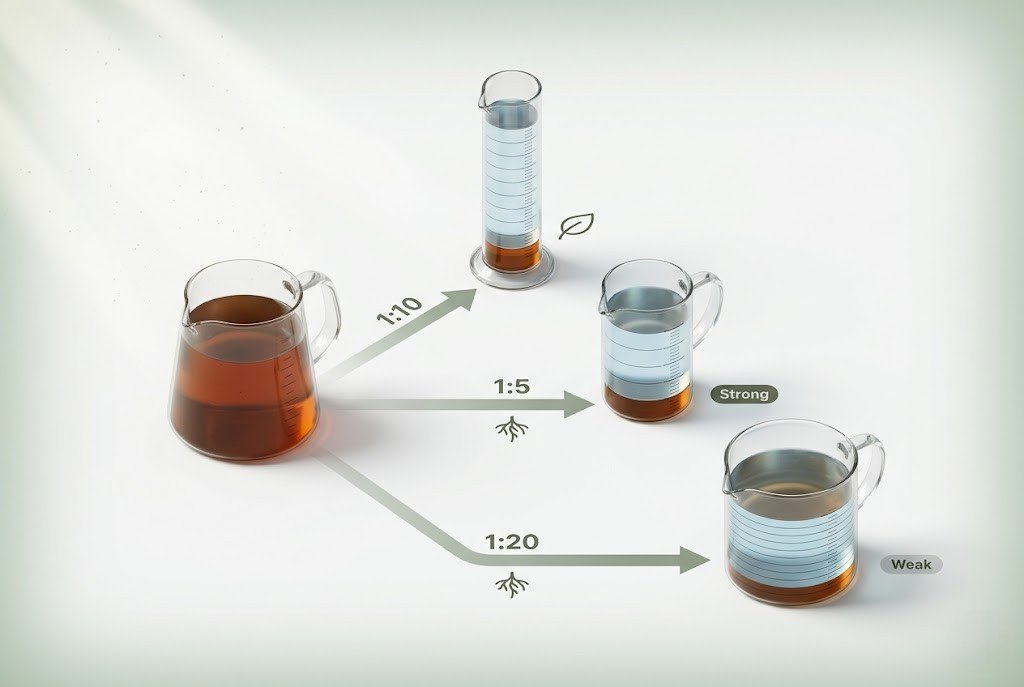
Isometric diagram showing compost tea dilution calculator ratios of 1:10, 1:5, and 1:20 for different application methods
The calculator selects between three fixed ratios based on your inputs, ensuring foliar sprays stay gentle while root drenches deliver appropriate microbial density.

Step 3: Calculate total mix volume

Total Mix = Tea Volume + Water Needed

Example: 5 + 50 = 55 gallons total

Step 4: Calculate additive recommendations

Molasses = Tea Volume x 2 tablespoons per gallon

Kelp = Tea Volume x 1 teaspoon per gallon

Rounding: All outputs display one decimal place. Gallons are not converted to other units.

Assumptions and Limits

  • The calculator assumes you have brewed aerated compost tea (AACT) using the standard method: compost in a mesh bag, submerged in water, with continuous air bubbling for 12-36 hours.
  • Ratios are based on commonly cited AACT application guidelines, not laboratory-verified microbial counts for your specific tea.
  • The tool does not account for tea age. Compost tea should be used within 4-6 hours of stopping aeration; microbial populations decline rapidly after that.
  • Water temperature is not factored in. Ideal brewing and mixing temperatures range from 55-75 degrees F; cold water slows microbial activity, hot water kills microbes.
  • Additive amounts (molasses, kelp) are recommendations for the brewing phase, not for post-dilution addition.
  • The calculator assumes static brewing conditions. Variables like compost source quality, aeration rate, and ambient temperature significantly affect actual microbial density.
  • Results apply to liquid application only. This tool does not calculate compost tea for soil injection or drip irrigation systems that may require different concentrations.
  • For adjusting soil chemistry before application, the soil pH lime calculator or soil pH sulfur calculator can help establish optimal growing conditions.

Standards, Safety Checks, and Critical Warnings

  • 🌱 Take the Guesswork Out of Plant Care Monitor soil moisture, pH levels, and sunlight intensity with one convenient 3-in…
  • 💧 Prevent Overwatering & Underwatering Check soil moisture before watering to help maintain the right balance for your p…
  • 🔋 No Batteries Needed – Simple & Convenient No batteries, charging, or complicated setup required. Simply insert the pro…

Critical Warnings:

  • Chlorine destroys compost tea. Municipal tap water contains chlorine or chloramine that kills beneficial microbes on contact. Let tap water sit uncovered for 24+ hours to allow chlorine to off-gas, or use collected rainwater, well water, or dechlorinated water from an aquarium supply.
  • Do not store diluted tea. Use the entire batch within 4-6 hours of mixing. Diluted tea without aeration becomes anaerobic and can harbor harmful pathogens.
  • Foliar application on edibles requires timing. Stop foliar spraying at least 2 weeks before harvest to allow microbial residue to dissipate.
  • Over-concentration causes damage. Using ratios stronger than 1:5 can overwhelm plant roots or cause foliar burn. When in doubt, dilute more.

Minimum Standards:

  • Brew time minimum: 12 hours with active aeration (visible bubbling throughout)
  • Aeration requirement: Continuous air supply producing at least 0.05 CFM per gallon of tea
  • Compost-to-water ratio for brewing: Approximately 1:5 to 1:10 (compost to water by volume)
  • Application frequency: No more than once per week for most plants; biweekly for sensitive species

Competitor Trap: Many compost tea guides omit the critical distinction between strong and weak concentrates when recommending root drench ratios. A 1:5 dilution applied to a weak tea delivers insufficient microbes, while a 1:20 dilution applied to a strong tea wastes potency. This calculator adjusts the ratio based on your actual brew strength, preventing both under-application and resource waste.

Common Mistakes and Fixes

Mistake: Using Chlorinated Water Directly from the Tap

  • SAD PLANTS? Weak growth, brown spots, leaf curling, wilting, yellowing, red stems, can all be signs of water pH or nutri…
  • Balances and maintains pH in water and media, supporting stronger cell walls, enhanced nutrient uptake, prevention of de…
  • Neutralizes chlorine & chloramines without producing formaldehyde or ammonium. Specifically designed for tap water, reve…

Chlorine and chloramine are added to municipal water specifically to kill microorganisms.

Split image showing wilted plant with undiluted tea versus thriving plant after proper compost tea dilution calculator use
The difference between guessing at ratios and calculating precise dilution shows in plant vigor within two weeks of consistent application.

Mixing fresh tap water with compost tea defeats the entire purpose of brewing: you are adding billions of beneficial microbes and then immediately killing them.

Fix: Fill your mixing container with tap water at least 24 hours before you plan to dilute. Aerate the water if possible to speed chlorine off-gassing.

Mistake: Entering Desired Final Volume Instead of Concentrate Volume

If you want 50 gallons of diluted tea and enter “50” in the tea volume field, the calculator will tell you to add 500 gallons of water (at 1:10 ratio). The tea volume field requires your actual concentrate amount, not your target output.

Fix: Measure your brewed concentrate first. If you need a specific final volume, work backward: divide your target by (ratio + 1) to find the concentrate needed.

Mistake: Applying Strong Root Drench Concentration to Seedlings

  • Supporting Exceptional Plant Growth: Root drops for plant cuttings is made from Ecklonia maxima extract. Its seaweed ext…
  • Rapid and Visible Results: Liquid root stimulator is a low-odor organic liquid fertilizer that significantly improves th…
  • One Bottle for All Needs: Propagation booster for houseplants delivers excellent results on a wide range of plants, incl…

The 1:5 ratio is designed for established plants with developed root systems. Young seedlings, cuttings, and recently transplanted plants can experience root shock from concentrated microbial applications.

Fix: Always select “Weak” concentrate setting when treating plants less than 4 weeks old, regardless of your actual brew strength. The 1:20 ratio provides a safe introduction.

Mistake: Storing Diluted Tea for Later Use

  • Made To Handle More: Tackle bulk storage with a sturdy plastic bucket made from durable 90 mil HDPE plastic, lid not inc…
  • Safe For Food Storage: This food-safe bucket is BPA-free, making it a practical choice for dry ingredients, brewing proj…
  • Easy To Stack And Store: A reinforced stacking ring helps these food storage buckets stay organized and easy to manage. …

Unlike concentrated tea under active aeration, diluted tea has no oxygen supply. Beneficial aerobic microbes die within hours, and anaerobic bacteria begin producing compounds that harm plants and may contain pathogens.

Fix: Calculate only the volume you can apply within 4-6 hours. If you have excess concentrate, continue aerating it until you are ready for the next application.

Mistake: Spraying Foliar Tea in Direct Midday Sun

  • Smart Timed Watering with LCD Control—The included programmable water timer supports 8 custom watering schedules with ad…
  • Complete 82.4FT Automatic Drip Kit with Built-In Filter—Includes 66ft 1/2″ PE mainline, 16.4ft 1/4″ tubing, water timer,…
  • Quick-Connect, Two-Zone Layout—Attach the timer to a standard outdoor faucet, connect the Y splitter, and run two separa…

Water droplets on leaves act as magnifying lenses, intensifying sunlight and causing leaf burn. The heat also accelerates microbial death before absorption can occur.

Fix: Apply foliar spray in early morning (before 9 AM) or late evening (after 6 PM) when temperatures are cooler and sunlight is indirect.

Related Tools and Next Steps

Bestseller #1
  • The organic compounds and particulates of compost tea leach into the soil and provide improved pathways for nutrients to…
  • Enriched Super Compost Tea is an amended version of Gardenersbud Super Compost Tea. It has added Nitrogen (from not full…
  • Formulated specifically for hydroponic feeding, but can be used in any application where NPK feeding is desired.
Bestseller #2
  • Hop Containment: This beer dry filter uses a fine mesh stainless steel filter to hold hops during brewing, helping keep …
  • 304 Steel Build: Made from 304 stainless steel, this stainless steel filter is designed for repeated use in beer brewing…
  • Kettle size Fit: Measuring 11.81 x 2.75 x 2.75 in, this hop strainer basket is sized for kettle systems and home brewing…
Bestseller #3
  • Patented Compost Tea System design in a convenient 10 gallon size
  • Uses Fine Bubble Diffusion technology
  • Built with industrial grade components

Calculate the base compost volume needed before brewing tea with the compost calculator for general composting needs.

Optimize your carbon-to-nitrogen ratio for faster compost breakdown using the compost C:N ratio calculator.

Determine proper NPK fertilizer rates to complement compost tea applications with the NPK calculator.

For container gardening, calculate exact potting soil volumes before adding compost tea to the mix using the potting soil calculator.

Ensure your lawn receives balanced nutrition alongside microbial inoculants with the lawn fertilizer calculator.

When diluting concentrated pesticides for integrated pest management, the pesticide dilution calculator follows similar ratio principles.

FAQ

Can I use compost tea on all plants?

Compost tea benefits most garden plants, vegetables, fruit trees, and ornamentals. However, some plants adapted to low-nutrient soils (like many native wildflowers and succulents) may not need microbial supplementation. Avoid applying to plants showing signs of fungal disease, as the added moisture and organic material can worsen certain conditions.

How often should I apply compost tea?

For most garden applications, once every 1-2 weeks during the growing season provides consistent microbial support. High-demand crops like tomatoes and peppers can receive weekly applications. Reduce frequency for established perennials and native plantings that have developed their own soil ecosystems.

What if my compost tea smells bad?

Healthy compost tea should smell earthy and slightly sweet, similar to forest soil after rain. A foul, sulfurous, or ammonia odor indicates anaerobic conditions from inadequate aeration. Discard bad-smelling tea immediately and do not apply it to plants. Check your aerator and increase bubbling for the next batch.

Does water temperature matter when diluting?

Yes. Use water between 55-75 degrees F for optimal microbial survival. Cold water (below 50 degrees F) slows microbe activity and reduces effectiveness. Hot water (above 85 degrees F) can kill beneficial organisms. Room temperature dechlorinated water is ideal for most applications.

Can I add other fertilizers to diluted compost tea?

Adding synthetic fertilizers, especially those containing salts, can harm the beneficial microorganisms in compost tea. If you want to boost nutrition, add organic amendments like fish emulsion or seaweed extract during brewing, not after dilution. Keep synthetic fertilizers as a separate application.

Is compost tea the same as compost extract?

No. Compost tea is actively brewed with aeration to multiply beneficial microorganisms. Compost extract is simply compost soaked in water without aeration, which releases nutrients but does not significantly increase microbial populations. This calculator is designed for aerated compost tea only.

Conclusion

The biggest mistake to avoid is not the math itself but the water source. Twenty-four hours of off-gassing time costs nothing and determines whether your diluted tea delivers living microbes or expensive dead water. Plan your water preparation before you start brewing, and your soil biology will thank you.

Related articles

[tyg_related]
Umer Hayiat, founder of THE Yield Grid, standing in a greenhouse holding a small potted seedling.

Umer Hayiat

Gardening Expert

Hi, I’m Umer. I got tired of vague gardening advice, so I started building tools instead. I turn verified agricultural data into free calculators for your soil, spacing, and yields. Skip the guesswork and get the exact math.

Umer Hayiat

My personal favorites

TheYieldGrid is a participant in the Amazon Services LLC Associates Program, an affiliate advertising program designed to provide a means for sites to earn advertising fees by advertising and linking to Amazon.com. As an Amazon Associate, we earn from qualifying purchases.