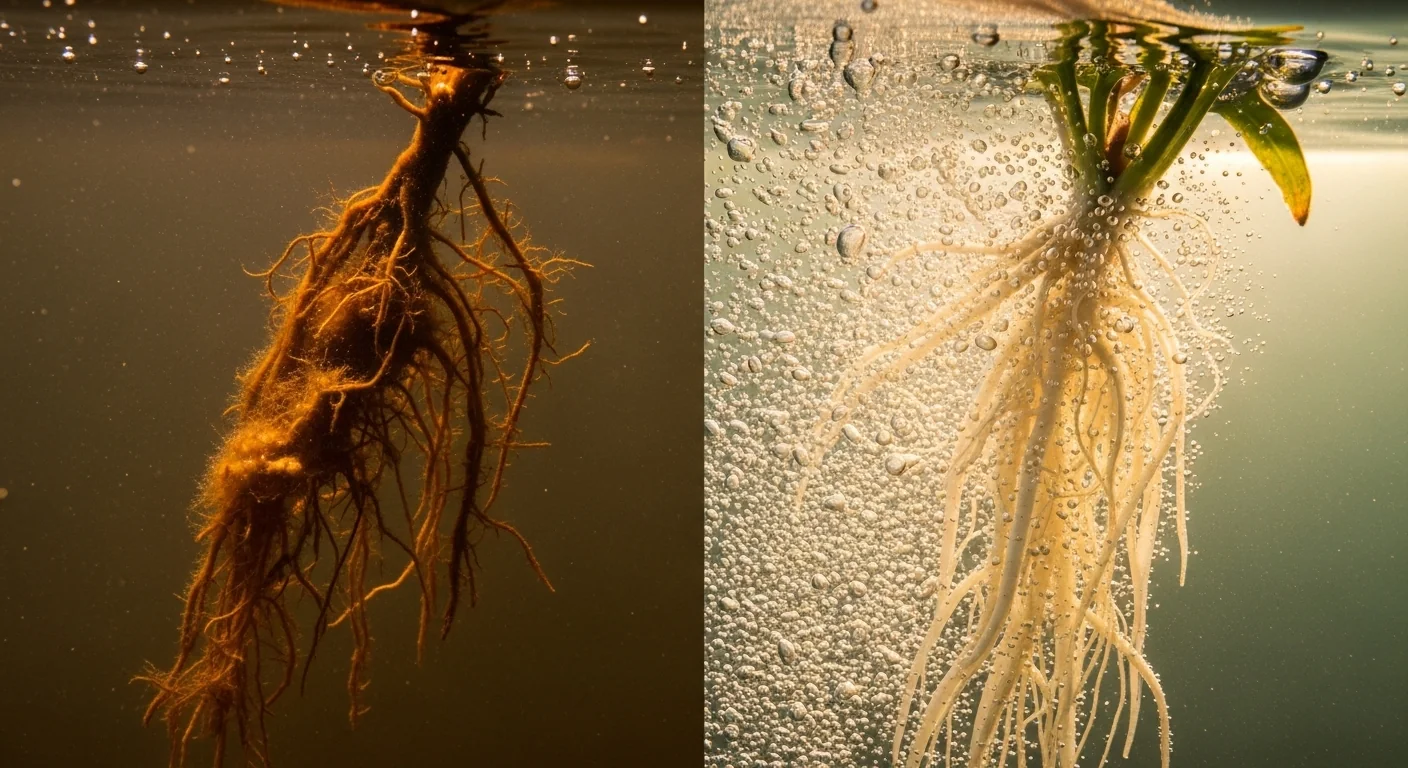
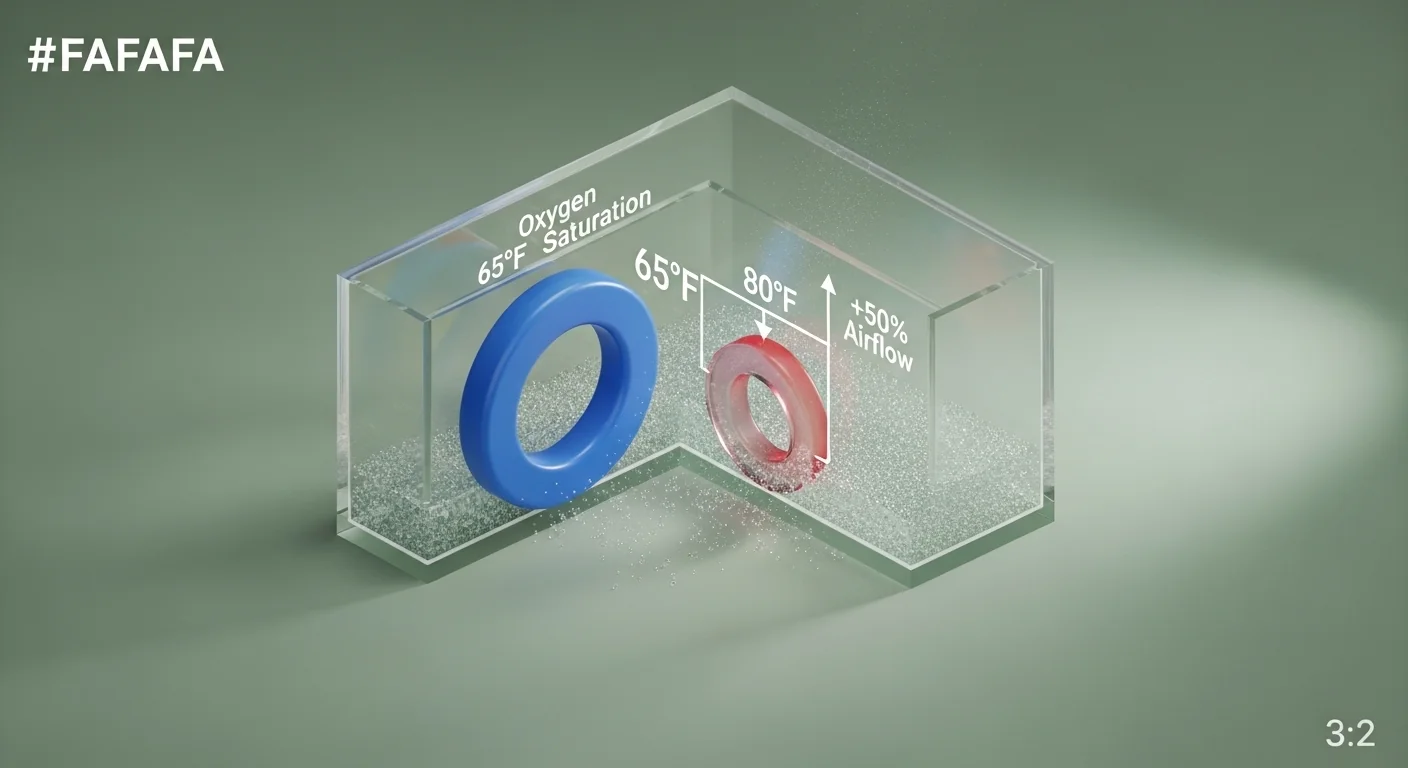
Deep water culture fails quietly at first. Roots begin browning at the tips. Growth stalls. The instinct is to add more air. But the actual failure mode is almost never the pump itself: it is the relationship between water temperature and the physical ceiling on how much dissolved oxygen water can hold. That ceiling is governed by Henry’s Law, and no amount of additional airflow can raise it once temperature has pushed it down far enough.
This calculator takes your reservoir volume (in gallons), current water temperature (in °F), number of grow sites, and air stone type to produce a minimum required airflow in liters per minute (LPM), a real-time dissolved oxygen saturation estimate, and a traffic-light safety check tied to the temperature thresholds where root asphyxiation risk becomes acute. It does not estimate plant yield, diagnose existing root problems, or replace direct dissolved oxygen probe readings in a commercial setting.
After using this tool, you will know the minimum LPM your pump must deliver, whether your water temperature is undermining oxygenation regardless of pump size, and specifically when you need a water chiller rather than a bigger air pump.
Use the Tool
Your DWC system needs approximately — liters per minute of airflow to sustain healthy dissolved oxygen levels and prevent root asphyxiation.
| Reservoir | Temp °F | Min LPM (1×) | Rec. LPM (1.5×) | Max DO | Status |
|---|
How This Calculator Works
Step 1 — Base LPM
Step 2 — Temperature Penalty
Step 3 — Air Stone Efficiency Multiplier
Step 4 — Max Dissolved Oxygen (Henry’s Law)
Assumptions & Limits (U5)
- Freshwater only. Saltwater has different DO saturation curves — this calculator does not account for salinity.
- Altitude not included. At high elevations (>2,000 ft), atmospheric pressure is lower and DO saturation is reduced by an additional 2–8%. Add ~10% LPM for every 1,000 ft above sea level.
- Assumes 1 air stone per bucket/site. Multi-stone configurations per site will increase efficiency beyond the estimates shown.
- The Hot Water Asphyxiation Wall: At temperatures above 78–82°F, the maximum possible DO drops below 7 mg/L. Plant roots require 5–8 mg/L minimum. Even a commercial 200 LPM pump cannot force oxygen into water above its physical saturation ceiling (Henry’s Law). The solution is always water temperature reduction — not more air.
- LPM ratings on pump boxes are at zero back-pressure. Real-world output through tubing, check valves, and air stones is typically 20–30% lower. Overspec your pump by at least 25%.
- Ideal DWC water temperature: 62–68°F (16.7–20°C) for maximum DO and root health.
Understanding the “Hot Water Asphyxiation Wall”
This is the most misunderstood concept in DWC growing. When a reservoir hits 78°F+, growers often see brown, slimy roots (root rot / Pythium) and assume they need more air. They buy larger pumps. The roots don’t improve. Here’s why:
Henry’s Law of gas solubility states that the amount of gas (oxygen) that can dissolve in a liquid is proportional to the partial pressure of that gas above the liquid — and is inversely proportional to temperature. Warm water physically cannot hold as much dissolved oxygen as cold water, regardless of how many bubbles you push through it.
At 78°F, the DO ceiling is ~7.8 mg/L. At 85°F, it drops to ~7.0 mg/L. Cannabis and most hydroponic crops need 5.5–8 mg/L to thrive. In warm water, the oxygen simply escapes into the air faster than roots can absorb it.
The only real fix is cooling your reservoir. Recommended solutions:
- Active Aqua water chiller (sized to your reservoir volume)
- Wrapping reservoir in reflective insulation
- Keeping grow room temps below 75°F ambient
- Adding Hydroguard (Bacillus amyloliquefaciens) as a biological buffer while you cool down
Before running the calculator, have four numbers ready: total reservoir volume across all connected buckets (in gallons, not liters), the actual measured water temperature at root level (not ambient air temperature), the number of individual grow sites or buckets, and your air stone type. If you are sizing a new build, use your planned reservoir volume. For existing systems, a water temperature reference can help you convert between Fahrenheit and Celsius if your thermometer reads in Celsius.
Quick Start (60 Seconds)
- Total Reservoir Volume: Enter the combined gallons across all buckets or the central reservoir. Do not estimate; measure or check your container specs. A 5-gallon bucket typically holds 3.5 to 4 gallons of solution once a net pot and root mass occupy the lid area.
- Water Temperature (°F): Measure at root depth, not at the surface. Surface temperature can read 2 to 4 degrees cooler than mid-reservoir. The critical threshold is 72°F; at 78°F or above, the tool will fire a danger warning.
- Number of DWC Sites: Count individual bucket or site positions, not plants per bucket. A 4-bucket RDWC system connected to a central reservoir still counts as 4 sites for air stone distribution purposes.
- Air Stone Type: Select by physical size and pore rating. If your stone is a generic 2 to 3 inch cylinder from a pet store, select Small. A plate or disk diffuser made from compressed mineral material qualifies as Disk/Plate.
- Run the calculation: All four fields must be filled before the result appears. The calculator will not produce an output on incomplete input.
- Read the warning bar first: The aeration adequacy gauge and the colored warning box are more actionable than the raw LPM number for many growers. A green result with a high LPM is still good. An orange or red result at any LPM means airflow is not the core problem.
- Check the DO metrics: The Max Possible DO and Effective DO figures tell you what the physics of your water temperature allow, independent of pump choice.
Inputs and Outputs (What Each Field Means)
| Field | Unit | What It Measures | Common Mistake | Safe Entry Guidance |
|---|---|---|---|---|
| Total Reservoir Volume | Gallons | The total liquid volume that must be actively oxygenated across your system | Entering bucket capacity rather than actual solution volume, which overstates needs by 20 to 30% | Measure actual fill level; 5-gallon buckets typically hold 3.5 to 4 gallons of solution |
| Water Temperature | °F | Current reservoir temperature at root depth; determines the physical DO saturation ceiling | Measuring surface or ambient temperature instead of mid-reservoir temperature at root zone | Use a submersible probe thermometer at least 6 inches below water surface; ideal range 62 to 68°F |
| Number of DWC Sites | Count (integer) | Individual bucket or site positions that each require air stone placement and airflow delivery | Counting plants instead of buckets, or forgetting that RDWC central reservoirs need their own air stone | Count every container receiving nutrient solution, including the central reservoir in recirculating systems |
| Air Stone Type | Category | The size and pore rating of the diffuser; finer pores produce smaller bubbles with higher surface-area-to-volume ratio | Selecting a larger stone category than actually installed, which underestimates required pump LPM | When uncertain, select one size down (more conservative); disk/plate stones require the finest pore material to qualify |
| Required LPM (output) | LPM | Minimum adjusted airflow your pump must deliver through the entire system, after temperature and stone efficiency corrections | Comparing this figure to the box rating on a pump without accounting for real-world back-pressure losses of 20 to 30% | Overspec your pump by at least 25% above this figure to compensate for tubing, valves, and stone resistance |
| Max Possible DO (output) | mg/L | The physical oxygen saturation ceiling at your water temperature; cannot be exceeded regardless of pump size | Assuming a larger pump can push this number higher; it cannot | Target water temperature below 68°F to achieve Max DO above 9 mg/L, which most hydroponic crops require for peak root function |
| Effective DO Estimate (output) | mg/L | Estimated real-world dissolved oxygen at the root zone, accounting for transfer efficiency of the stone type chosen | Treating this as a probe reading; it is a model estimate, not a measurement | If Effective DO reads below 5 mg/L, root health is at risk regardless of apparent airflow |
Worked Examples (Real Numbers)
Scenario 1: Small Home DWC Bucket, Cool Water
- Reservoir volume: 10 gallons
- Water temperature: 65°F
- Sites: 1
- Air stone: Medium (4 to 6 inch, fine pore, 1.15x efficiency)
Result: Base LPM = 10.0. Temperature multiplier = 1.0 (below 72°F). Adjusted LPM = 10.0 / 1.15 = 8.7 LPM. Max DO at 65°F = 9.42 mg/L.
At 65°F with a mid-size fine-pore stone, a single-bucket system is straightforward to oxygenate. A pump rated 12 to 15 LPM provides comfortable headroom once back-pressure losses are factored in.
Scenario 2: 4-Bucket RDWC System, Elevated Temperature
- Reservoir volume: 40 gallons (central reservoir plus 4 buckets combined)
- Water temperature: 74°F
- Sites: 4
- Air stone: Large (8 inch ceramic, 1.30x efficiency)
Result: Base LPM = 40.0. Temperature multiplier = 1.25 (above 72°F). Adjusted LPM = 40.0 × 1.25 / 1.30 = 38.5 LPM. Max DO at 74°F = 8.57 mg/L.
Temperature has already trimmed the oxygen ceiling from the ideal range. The 25% airflow penalty partially compensates, but the best single investment at this temperature is not a larger pump. It is reducing reservoir temperature by 4 to 6 degrees. See the Standards section for why.
Scenario 3: Commercial Deep Water Culture at Critical Temperature
- Reservoir volume: 100 gallons
- Water temperature: 80°F
- Sites: 10
- Air stone: Disk/plate ultra-fine (1.40x efficiency)
Result: Base LPM = 100.0. Temperature multiplier = 1.50 (above 78°F). Adjusted LPM = 100.0 × 1.50 / 1.40 = 107.2 LPM. Max DO at 80°F = 8.06 mg/L.
The tool correctly fires a critical asphyxiation warning here. Even with the most efficient diffuser and a correctly sized pump, the physical DO ceiling at 80°F is already within the marginal zone for root health. No pump can solve this. The grower needs a chiller before a pump upgrade will have any meaningful effect.
Reference Table (Fast Lookup)
| Reservoir | Temp (°F) | Temp Multiplier | Base LPM (1 LPM/gal) | Adj. LPM (Med Stone, 1.15x) | Max DO (mg/L) | Pump to Buy (25% headroom) | Status |
|---|---|---|---|---|---|---|---|
| 10 gal | 65°F | 1.0x | 10.0 | 8.7 | 9.42 | 11+ LPM | Safe |
| 10 gal | 75°F | 1.25x | 10.0 | 10.9 | 8.49 | 14+ LPM | Warning |
| 20 gal | 65°F | 1.0x | 20.0 | 17.4 | 9.42 | 22+ LPM | Safe |
| 20 gal | 78°F | 1.25x | 20.0 | 21.7 | 8.22 | 27+ LPM | Warning |
| 40 gal | 68°F | 1.0x | 40.0 | 34.8 | 9.14 | 44+ LPM | Safe |
| 40 gal | 74°F | 1.25x | 40.0 | 43.5 | 8.57 | 54+ LPM | Warning |
| 100 gal | 72°F | 1.0x | 100.0 | 87.0 | 8.77 | 109+ LPM | Borderline |
| 100 gal | 80°F | 1.50x | 100.0 | 107.1 | 8.06 | 134+ LPM | Critical |
| 200 gal | 65°F | 1.0x | 200.0 | 174.0 | 9.42 | 218+ LPM | Safe |
| 200 gal | 82°F | 1.50x | 200.0 | 214.3 | 7.90 | 268+ LPM | Critical |
The "Pump to Buy" column adds 25% to the adjusted LPM to compensate for real-world back-pressure losses through tubing, check valves, and diffuser resistance. Ratings printed on pump packaging are measured at zero back-pressure in laboratory conditions.
How the Calculation Works (Formula + Assumptions)
Show the calculation steps
Step 1: Base LPM
The DWC standard is 1 liter per minute of airflow for every gallon of reservoir volume. This establishes complete water column circulation and prevents stratification.
Base LPM = Total Gallons × 1.0
Step 2: Temperature Multiplier
Warm water holds less dissolved oxygen, so the system must push more air to achieve the same effective oxygenation at the root zone. The multiplier is applied before the stone efficiency divisor.
- Water temp at or below 72°F: multiplier = 1.0 (no penalty)
- Water temp above 72°F and at or below 78°F: multiplier = 1.25
- Water temp above 78°F: multiplier = 1.50 (critical zone)
Penalized LPM = Base LPM × Temperature Multiplier
Step 3: Air Stone Efficiency Divisor
Finer-pore stones produce smaller bubbles. Smaller bubbles have a higher surface-area-to-volume ratio, which increases oxygen transfer rate per liter of air moved. This means a more efficient stone requires slightly less raw LPM to achieve the same DO delivery.
- Small (2 to 3 inch, standard): 1.0x (no adjustment)
- Medium (4 to 6 inch, fine pore): 1.15x
- Large (8 inch ceramic): 1.30x
- Disk/plate (ultra-fine): 1.40x
Adjusted LPM = Penalized LPM ÷ Stone Efficiency Multiplier
Step 4: Max Dissolved Oxygen (Henry's Law Polynomial)
The saturation ceiling is calculated from water temperature using a polynomial approximation of the standard DO solubility curve:
Max DO (mg/L) = 14.62 - (0.3898 × Tc) + (0.006969 × Tc²) - (0.00005897 × Tc³)
Where Tc is temperature in Celsius: Tc = (°F - 32) × 5/9
Effective DO is then estimated at 85 to 90% of Max DO under properly sized aeration, or lower when temperature penalty multipliers are active.
Assumptions and Limits
- Freshwater only. Saltwater systems have lower DO saturation at equivalent temperatures; this calculator does not account for salinity or dissolved solids effects on gas solubility.
- Altitude is not included. At elevations above 2,000 feet, reduced atmospheric pressure lowers the DO saturation ceiling. Add approximately 10% LPM for every 1,000 feet above sea level as a conservative buffer.
- The stone efficiency multipliers (1.0 to 1.40) represent oxygen transfer improvement from micro-bubble formation, not flow volume change. A disk stone still requires the pump to deliver the full rated output; the divisor reflects that the pump can be modestly smaller for the same DO result.
- Pump ratings on retail packaging are measured at zero back-pressure. Real-world output through tubing, check valves, manifolds, and stones typically runs 20 to 30% below the stated rating. Size up accordingly.
- Above 82°F, the polynomial DO model produces values that are technically above the root asphyxiation threshold on paper, but pathogen pressure from Pythium and related water molds becomes severe at these temperatures independently of DO level.
- Effective DO is a model estimate, not a probe measurement. Growers managing critical crops should verify with a calibrated dissolved oxygen meter rather than relying solely on calculated estimates.
- This tool assumes one air stone per site. Multi-stone configurations per bucket will produce more even DO distribution but do not change the total LPM requirement significantly.
Standards, Safety Checks, and "Secret Sauce" Warnings
Critical Warnings
- The Hot Water Asphyxiation Wall: When reservoir temperature exceeds 78°F, the Max DO ceiling drops into the marginal zone for root health. Henry's Law governs this physically: warm water cannot hold as much dissolved gas as cold water, regardless of how many bubbles pass through it. Adding a larger pump at this temperature produces diminishing returns. Roots turn brown, Pythium pressure increases, and the oxygen simply outgasses back into the atmosphere before roots can absorb it. The hydroponic water chiller calculator can help you size a chiller appropriately for your reservoir volume.
- Pump Box Ratings Are Not Real-World Ratings: LPM figures printed on aquatic and hydroponics air pumps are always measured under no-load conditions. The moment you attach tubing, T-splitters, check valves, and a submerged air stone, back-pressure reduces actual delivery. The 25% headroom built into the reference table above is a minimum buffer, not a luxury. For systems with long tubing runs or multiple splits, size for 35 to 40% headroom.
- DO Below 5 mg/L Causes Root Asphyxiation: Most hydroponic crops require a minimum of 5 to 6 mg/L of dissolved oxygen at the root surface for healthy aerobic metabolism. When Effective DO drops below this range, roots switch to anaerobic pathways, which creates conditions that accelerate Pythium colonization and produce the characteristic brown slime associated with DWC root rot. Measuring with a calibrated DO probe is the only way to confirm actual levels.
Minimum Standards
- 1.0 LPM per gallon is the accepted minimum for deep water culture. Growers targeting vigorous vegetative growth or using high-density plantings should target 1.5 LPM per gallon before temperature and stone corrections.
- Reservoir temperature should remain between 62°F and 68°F (16.7°C to 20°C) for maximum DO availability and to minimize pathogen pressure. This range allows Max DO values consistently above 9 mg/L.
- Each site must have its own dedicated air stone. Splitting a single stone feed to supply multiple buckets reduces the effective LPM delivered to each site and creates uneven oxygenation across the system. Understanding nutrient concentration alongside DO is also important since root oxygen demand increases as nutrient solution EC rises.
Competitor Trap: Most DWC air pump guides recommend a specific pump model by brand name and stop there. The LPM recommendation is usually derived from a fixed rule of thumb (often 1 LPM per gallon) applied without any temperature correction or stone efficiency factor. This creates a structurally dangerous recommendation: a grower with a 20-gallon reservoir at 76°F who follows a simple "get a 20 LPM pump" guide is systematically under-aerated relative to what their temperature-penalized water actually needs, and they receive no warning that the pump size is not the relevant variable once temperature exceeds the critical threshold.
Common Mistakes and Fixes
Mistake: Upgrading the Pump When Roots Turn Brown
This is the single most common and costly mistake in DWC troubleshooting. Brown roots at water temperatures above 74°F are almost always a temperature and DO ceiling problem, not an airflow volume problem. Spending on a larger pump when the Max DO ceiling is physically limited by temperature is wasted. The pump cannot push DO above the temperature-determined ceiling no matter how powerful it is.
Fix: Check temperature before ordering any equipment. If it reads above 72°F, prioritize reservoir cooling over pump selection.
Mistake: Sizing the Pump to the Bucket Capacity, Not the Solution Volume
A 5-gallon bucket label describes the container's total volume. Once a net pot, net pot lid, root ball, and headspace are accounted for, the actual nutrient solution volume is closer to 3.5 to 4 gallons. Entering 5 gallons per bucket overstates reservoir volume and inflates the LPM calculation by a meaningful margin in small systems.
Fix: Measure the actual fill line in gallons using a marked pitcher, or estimate 3.5 gallons per standard 5-gallon DWC bucket and adjust the calculator input accordingly.
Mistake: Using a Single Pump with a Manifold and Assuming Equal Air Distribution
Air follows the path of least resistance. In a manifold system where some tubing runs are shorter or some air stones have lower resistance than others, the closest and least-restricted sites receive disproportionately more airflow. Sites further along the manifold may be severely under-aerated even when the total system LPM looks adequate on paper. This is a common failure mode in systems with 4 or more buckets fed from a single pump and manifold. The pump distribution calculator for flood-and-drain systems illustrates similar pressure-drop logic that applies equally to air delivery systems.
Fix: Use individual pump outputs per bucket, or install individual flow-control valves on each manifold outlet and verify airflow at each stone using a flow meter or by direct observation of bubble output uniformity.
Mistake: Not Accounting for Altitude When Setting LPM Targets
At elevations above 2,000 feet, atmospheric pressure is lower. This reduces the partial pressure of oxygen above the water surface, which in turn lowers the DO saturation ceiling even at the same water temperature. Growers at high altitude using a standard 1 LPM per gallon rule are structurally under-targeting dissolved oxygen compared to their sea-level equivalents. Fluctuations in vapor pressure deficit also interact with root zone moisture dynamics at altitude, compounding environmental stress.
Fix: Add approximately 10% to the adjusted LPM figure for every 1,000 feet of elevation above sea level as a conservative working buffer.
Mistake: Running Airline Tubing in Loops or Coils Near the Pump
Soft silicone or vinyl airline tubing that coils back on itself near the pump outlet creates micro-kinks that substantially increase back-pressure, reducing actual air delivery at the stone. This compounds the gap between rated pump output and real-world delivery, which already runs 20 to 30% below the box specification. Growers who install a pump, see adequate bubbling initially, and then notice reduced output weeks later often have this problem developing as tubing warps from heat proximity to the pump motor.
Fix: Route tubing in continuous runs without loops or sharp bends; keep the pump away from heat sources, and use rigid PVC airline distribution pipe for multi-bucket manifolds longer than 6 feet.
Next Steps in Your Workflow
Once you have your required LPM figure, the immediate next action is matching it to a pump that can deliver that airflow at the actual back-pressure your system creates. For most home DWC setups, a commercial-grade piston pump significantly outperforms a diaphragm pump in sustained output and longevity under continuous operation. If your calculation flagged a temperature warning, sizing a chiller before a pump is the correct sequencing. Use the hydroponic water chiller calculator to determine the BTU capacity needed to maintain 65 to 68°F in your specific reservoir volume at your ambient room temperature.
Aeration is one subsystem within a larger environmental control problem. Once DO and temperature are managed, the next constraint in DWC systems is typically nutrient delivery accuracy. Verifying your solution concentration using an EC meter and then comparing it against nutrient dosing targets for your specific crop stage ensures that the roots receiving well-oxygenated water are also receiving appropriately balanced mineral nutrition. These two factors, DO and nutrient concentration, are the primary levers for DWC performance after temperature is controlled.
FAQ
What is the minimum LPM for a DWC system?
The accepted minimum is 1 liter per minute for every gallon of reservoir volume. This baseline assumes water temperature is within the ideal range of 62 to 68°F. At temperatures above 72°F, the effective minimum rises because the water's physical capacity to hold dissolved oxygen decreases, requiring more airflow to compensate. The calculator applies this correction automatically.
Can I use an aquarium pump for DWC?
Small aquarium diaphragm pumps can work for single-bucket home DWC systems with reservoirs under 5 gallons at cool temperatures. They generally lack the sustained output and back-pressure tolerance needed for multi-bucket or larger systems. Commercial DWC setups typically require piston-driven pumps, which maintain their rated flow more consistently when pushing air through manifolds, long tubing runs, and multiple fine-pore diffusers.
What dissolved oxygen level do I need for healthy roots?
Most hydroponic crops function well with dissolved oxygen between 6 and 9 mg/L at the root zone. Below 5 mg/L, roots begin switching to anaerobic metabolic pathways. Below 4 mg/L, Pythium and related water molds gain a significant competitive advantage over root tissue. The maximum achievable level is set by water temperature and cannot be raised by additional aeration once the saturation ceiling is reached.
Why does water temperature affect dissolved oxygen so much?
Gas solubility in liquids is inversely related to temperature. This relationship is described by Henry's Law: as water temperature rises, gas molecules have more kinetic energy and escape the liquid phase more readily. At 65°F, water can hold approximately 9.4 mg/L of dissolved oxygen at saturation. By 80°F, that ceiling drops to roughly 8 mg/L. The physics of this relationship cannot be altered by pump selection.
What is the best air stone type for DWC?
Larger ceramic or disk-style diffusers with fine or ultra-fine pore ratings produce smaller bubbles, which have significantly more surface area per unit of air volume. More surface area means faster gas exchange at the water-air boundary, translating to higher DO delivery efficiency per liter of airflow. For most DWC systems, an 8-inch cylindrical ceramic stone or a compressed mineral plate diffuser offers the best balance of efficiency and longevity.
How often should I check dissolved oxygen in my DWC reservoir?
During the first few weeks of a grow cycle, checking DO daily allows you to catch temperature drift or equipment issues early. Once the system is stable and temperature is consistently within the safe range, checking two to three times per week is sufficient. During heat waves or periods when ambient temperatures spike, checking twice daily protects against the rapid DO decline that occurs when reservoir temperature climbs even a few degrees above the critical threshold.
Conclusion
The DWC air pump sizing problem is misunderstood because it looks like an airflow problem when it is, in most failure cases, a water temperature problem. This calculator brings the temperature-DO relationship into the sizing workflow explicitly, rather than treating reservoir volume as the only variable. When the tool fires an orange or red warning, the message is specific: the physics of your water temperature are limiting dissolved oxygen to a ceiling that no pump can raise. At that point, sizing for more LPM is secondary to managing reservoir temperature.
The most avoidable and most common DWC mistake remains the same: buying a larger air pump in response to root browning at warm water temperatures, without first addressing the temperature itself. Use the result from this calculator as a starting spec, oversize your pump by at least 25% to account for back-pressure losses, and if your temperature reading was above 72°F when you ran the numbers, treat the hydroponic system type comparison as a secondary resource for understanding how different growing systems manage root zone oxygenation differently before your next build decision.