

A pressure tank failure rarely announces itself in advance. What happens instead is a pump that runs for eight seconds, stops, then runs again three minutes later, repeatedly cycling through the night while the motor windings heat beyond their thermal rating. The tank itself is not the failure, it is the signal: a tank sized for the wrong pump flow rate, or a bladder that has lost its pre-charge, leaves no buffer between the water demand and the pressure switch. The pump fills the gap and pays the price.
This calculator determines the minimum pressure tank volume for a residential or light-commercial well pump system using the drawdown capacity method. Enter your pump’s flow rate in gallons per minute, your pressure switch setting, and the minimum run time you want the pump to achieve per cycle. The tool outputs the required total tank volume and a breakdown of how much of that volume is usable water versus air pre-charge. It does not account for simultaneous fixture demand, household population, or storage buffer for power outages. Those are separate sizing decisions.
After running this calculator, you will know the smallest tank your system can accept without short-cycling the pump at normal single-fixture demand. If the result is larger than the tank currently installed, that gap explains most unexplained pump failures. Pairing accurate GPM data with the right pressure switch setting is critical; if you are unsure of your pump’s actual output, check your well log or test with a flow meter before accepting a nameplate rating. For context on how pump selection interacts with system pressure, the irrigation pump sizing calculator walks through the broader pump-to-system matching process.
Use the Tool
| Value | Result | Notes |
|---|
| Pump GPM | Target Run (min) | Drawdown (gal) | Min Tank Size (gal) | Cycle Time | Risk Flag |
|---|---|---|---|---|---|
| 3 | 1.5 | 4.5 | 16.1 | ~27 s fill | Check run time |
| 5 | 1.5 | 7.5 | 26.8 | ~45 s fill | Acceptable |
| 10 | 1.0 | 10 | 35.7 | ~1 min fill | Standard |
| 10 | 2.0 | 20 | 71.4 | ~2 min fill | Best practice |
| 15 | 1.0 | 15 | 53.6 | ~1 min fill | Standard |
| 15 | 2.0 | 30 | 107 | ~2 min fill | Best practice |
| 20 | 2.0 | 40 | 143 | ~2 min fill | Best practice |
- Pressure Tank: Amtrol Well-X-Trol pre-charged bladder tanks — the gold standard for residential well systems
- Pressure Switch: Square D Pumptrol pressure switches — reliable, field-proven, easy to adjust
- Gauge: Liquid-filled pressure gauge — absorbs vibration, reads accurately under pump cycling
- Pump: Goulds submersible well pumps — engineered for long service life in residential systems
How This Calculator Works
This calculator sizes the minimum pressure tank for your well pump system so the pump runs long enough each cycle to avoid damaging short-cycling. It uses the Drawdown Capacity method, which is the industry standard for residential pressure tank selection.
Step 1 — Calculate Drawdown (usable gallons):
This is the volume of water your pump must deliver in one cycle to achieve the minimum run time you specified.
Step 2 — Determine the drawdown multiplier for your pressure switch:
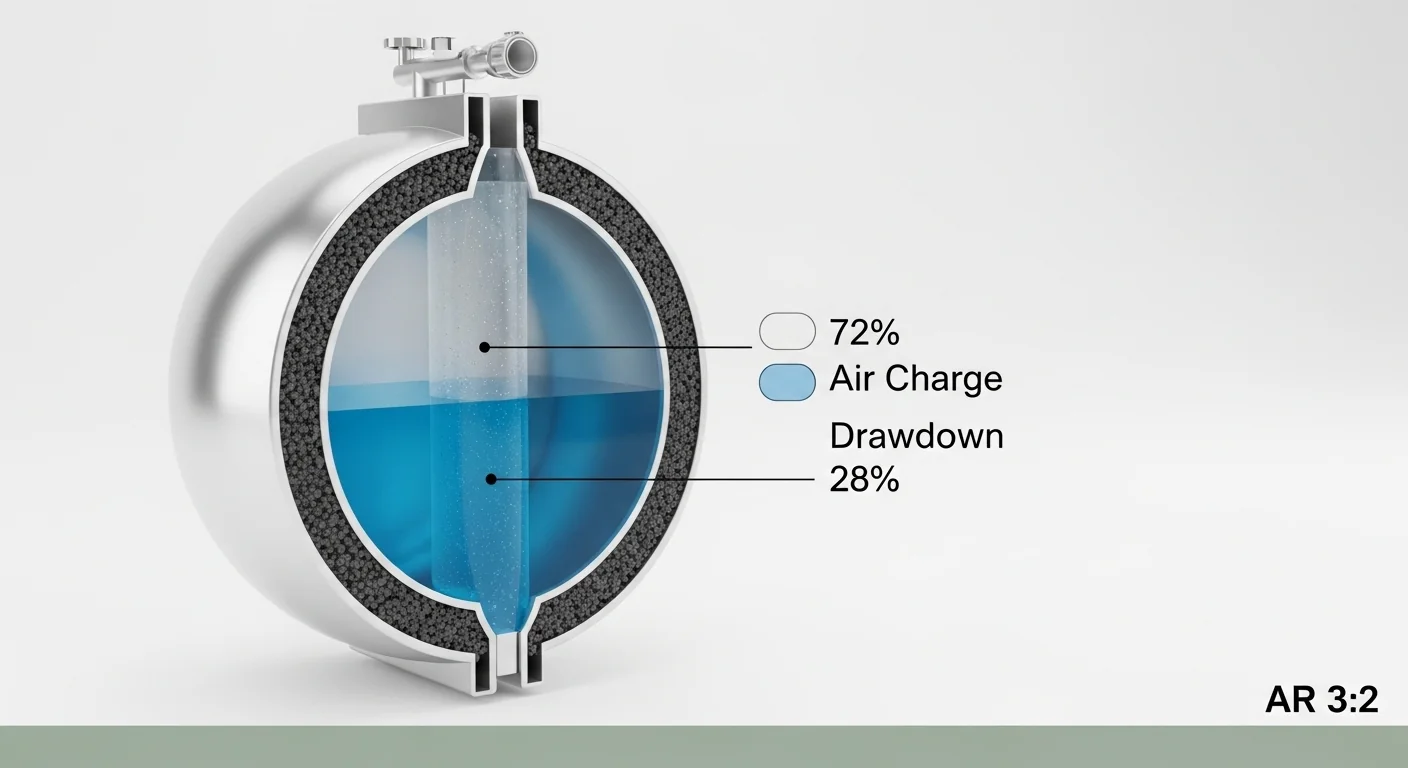
Due to Boyle’s Law, not all the tank volume can be used as water storage. A bladder pre-charged at ~2/3 of cut-in PSI takes up the rest. Higher pressure ranges = less usable fraction.
Step 3 — Calculate Total Tank Volume:
This is the minimum tank volume you need. Always round up to the nearest standard tank size (e.g., 20, 32, 44, 85, 119 gallons).
Assumptions & Limits:
- Assumes a standard pre-charged bladder/diaphragm tank (not a waterlogged galvanized tank)
- Pre-charge pressure set to ~2 PSI below cut-in PSI per manufacturer instructions
- Multipliers are industry-standard estimates; actual drawdown may vary ±5% by brand
- Does not account for simultaneous fixture demand or household size — size up if demand is high
- Minimum recommended pump run time is 1 minute; 2 minutes is best practice for motors ≥1 HP
- Maximum supported pump flow rate in this calculator: 100 GPM (commercial systems need licensed engineer)
Before you start, have three pieces of information ready. First, your pump’s rated flow rate in GPM, found on the pump nameplate, the well driller’s completion report, or a recent flow test. Second, the PSI setting printed on your pressure switch, which is typically a two-number pair such as 30/50 or 40/60, corresponding to cut-in and cut-out pressures. Third, decide on a target minimum run time, usually between one and two minutes. If you are unsure, start with 1.5 minutes as a conservative default.
Quick Start (60 Seconds)
- Pump Flow Rate (GPM): Enter gallons per minute, not gallons per hour. A common mistake is pulling the nameplate horsepower instead. A 1 HP pump is not automatically 10 GPM; the actual output depends on pump curve and head pressure.
- Pressure Switch Setting: Select the PSI pair that matches the label on your Square D Pumptrol or equivalent switch. If the label is worn, the most common residential setting is 40/60. Do not guess 30/50 if you actually run 40/60 or the tank will be undersized.
- Target Run Time: Enter minutes, not seconds. One minute (1.0) is the industry minimum for motor protection. For 1 HP motors and above, 2.0 minutes is best practice. Do not enter values below 0.5 or the result is unlikely to reflect real-world benefit.
- Read the result in total gallons: The output is the minimum tank volume, not the drawdown volume. Select the next standard tank size above this number when shopping.
- Check the status badge: The calculator flags whether your inputs produce a danger, warning, or acceptable result. A red flag means the configuration will still short-cycle even with the correctly sized tank; revisit your inputs.
Inputs and Outputs (What Each Field Means)
| Field Name | Unit | What It Means | Common Mistake | Safe Entry Guidance |
|---|---|---|---|---|
| Well Pump Flow Rate | GPM | The actual volume of water the pump delivers per minute at operating head pressure | Using nameplate horsepower or maximum rated GPM instead of real-world output at system head | Use well log flow test value. If unavailable, perform a timed bucket test or hire a pump contractor. Enter 0.5 to 100. |
| Pressure Switch Setting | PSI (pair) | The cut-in and cut-out pressures that tell the pump when to start and stop | Selecting 30/50 when the installed switch is 40/60, which overstates the drawdown fraction and undersizes the tank | Read the label on the physical switch. If unreadable, shut off power and inspect the spring adjustment. |
| Target Minimum Pump Run Time | Minutes | How long each pump cycle must last to protect motor windings from heat buildup | Entering 0.5 min to save tank cost; this is below the absolute minimum for motor longevity | 1.0 min minimum, 2.0 min recommended for motors 1 HP and above. Enter 0.5 to 10. |
| Drawdown (output) | Gallons | The volume of usable water the tank delivers between cut-in and cut-out pressure | Confusing drawdown with total tank volume; the tank must be larger than the drawdown by the inverse of the multiplier | Read-only output. This is the volume your pump must deliver each cycle. |
| Minimum Tank Size (output) | Gallons | Total tank volume required so the drawdown equals the pump’s output over the target run time | Purchasing the calculated size exactly; always round up to the next standard catalog size | Read-only output. Round up to 20, 32, 44, 85, or 119 gal as appropriate. |
If you need to measure your pump’s flow rate before using this tool, a straightforward approach is timing how long the pump takes to fill a known container. The hose flow rate calculator provides a method for measuring flow through a pipe or hose outlet that translates directly to a GPM figure.
Worked Examples (Real Numbers)
Example 1: Light-Use Cabin with a Small Pump
- Pump Flow Rate: 5 GPM
- Pressure Switch: 40/60 PSI (multiplier: 0.28)
- Target Run Time: 1.0 minute
Calculation: Drawdown = 5 GPM x 1.0 min = 5.0 gallons. Total tank = 5.0 / 0.28 = 17.9 gallons.
Result: Minimum 17.9-gallon tank. The next standard size is a 20-gallon pre-charged bladder tank. This is the smallest reasonable installation for this pump; any smaller tank will produce run times under 50 seconds per cycle.
Example 2: High-Flow Submersible on a Working Farm
- Pump Flow Rate: 15 GPM
- Pressure Switch: 40/60 PSI (multiplier: 0.28)
- Target Run Time: 2.0 minutes
Calculation: Drawdown = 15 GPM x 2.0 min = 30.0 gallons. Total tank = 30.0 / 0.28 = 107.1 gallons.
Result: Minimum 107.1-gallon tank. The nearest standard size is a 119-gallon tank. Installing a 44-gallon tank on this pump, a common cost-cutting move, would produce a run time of roughly 22 seconds per cycle and destroy the motor within months.
Example 3: Older Shallow-Well System on 30/50 PSI
- Pump Flow Rate: 8 GPM
- Pressure Switch: 30/50 PSI (multiplier: 0.31)
- Target Run Time: 1.5 minutes
Calculation: Drawdown = 8 GPM x 1.5 min = 12.0 gallons. Total tank = 12.0 / 0.31 = 38.7 gallons.
Result: Minimum 38.7-gallon tank. The next standard size is a 44-gallon tank. The 30/50 switch setting provides a slightly higher drawdown fraction than 40/60, so the required tank volume is modestly lower for equivalent protection.
Reference Table (Fast Lookup)
All values below use the calculator’s formula. The “Nearest Standard Tank” column shows the smallest commonly available bladder tank size that meets or exceeds the minimum. Standard sizes referenced: 14, 20, 32, 44, 85, 119, and 132 gallons.
| Pump GPM | Switch PSI | Run Time (min) | Drawdown (gal) | Minimum Tank (gal) | Nearest Standard Tank |
|---|---|---|---|---|---|
| 3 | 30/50 | 1.0 | 3.0 | 9.7 | 14 gal |
| 5 | 30/50 | 1.5 | 7.5 | 24.2 | 32 gal |
| 5 | 40/60 | 2.0 | 10.0 | 35.7 | 44 gal |
| 8 | 40/60 | 1.5 | 12.0 | 42.9 | 44 gal |
| 10 | 40/60 | 1.0 | 10.0 | 35.7 | 44 gal |
| 10 | 40/60 | 2.0 | 20.0 | 71.4 | 85 gal |
| 15 | 40/60 | 2.0 | 30.0 | 107.1 | 119 gal |
| 15 | 50/70 | 2.0 | 30.0 | 120.0 | 132 gal |
| 20 | 40/60 | 2.0 | 40.0 | 142.9 | 2 x 85 gal (parallel) |
How the Calculation Works (Formula + Assumptions)
Show the calculation steps
Step 1: Calculate drawdown (usable gallons)
Drawdown (gallons) = Pump Flow Rate (GPM) x Target Run Time (minutes)
This is straightforward unit multiplication. A 10 GPM pump running for 2 minutes delivers 20 gallons per cycle. That 20 gallons must fit within the tank’s usable volume, which is the drawdown window.
Step 2: Apply the pressure-switch multiplier
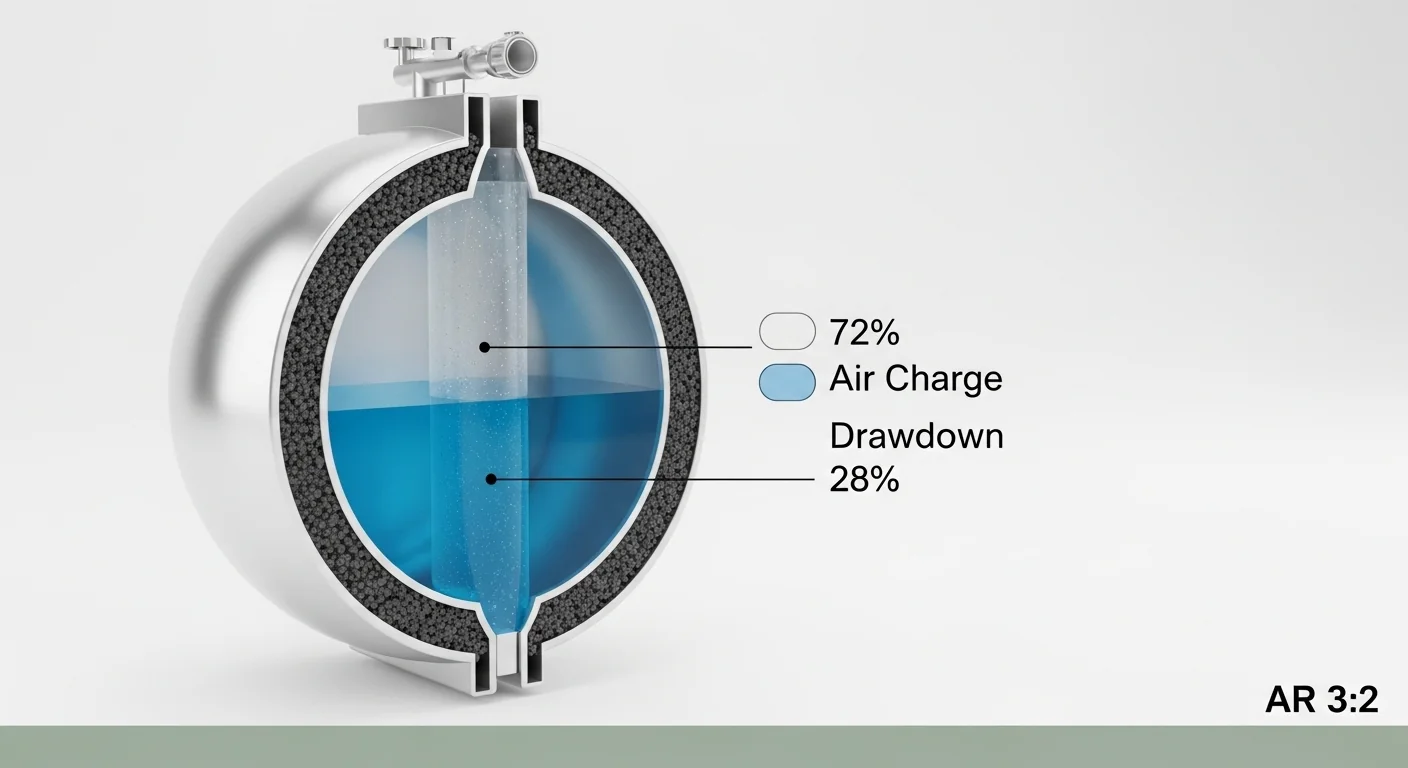
A pre-charged bladder tank does not store all of its volume as water. The remaining space holds compressed air at a pre-charge pressure set just below the cut-in PSI. As water enters, the air compresses. As water exits, the air expands. The fraction of total tank volume available as water storage depends on the pressure ratio between cut-in and cut-out pressures, governed by Boyle’s Law.
- 30/50 PSI switch: multiplier 0.31 (31 of every 100 gallons of tank volume is usable water)
- 40/60 PSI switch: multiplier 0.28
- 50/70 PSI switch: multiplier 0.25
Higher operating pressures reduce the usable fraction because the pressure ratio between cut-in and cut-out is a smaller percentage of absolute pressure, leaving less room for water expansion.
Step 3: Calculate required total tank volume
Total Tank Volume (gallons) = Drawdown (gallons) / Multiplier
Rounding rule: always round up to the next standard catalog size. Never round down. A tank that is 5 gallons short will produce a run time 10 to 25 seconds shorter than designed depending on pump GPM.
Assumptions and Limits
- The multipliers (0.31, 0.28, 0.25) are industry-standard estimates for pre-charged bladder tanks with air pre-charge set 2 PSI below cut-in. Actual drawdown may differ up to 5% by manufacturer and bladder condition.
- This calculator assumes a functioning bladder or diaphragm tank. A waterlogged galvanized tank, one where the bladder has ruptured, has near-zero drawdown regardless of tank volume and cannot be corrected by resizing.
- Pre-charge pressure is assumed to be correctly set. If the pre-charge is higher than cut-in PSI minus 2, the usable drawdown shrinks and the pump will short-cycle even with an appropriately sized tank.
- The tool does not account for multiple simultaneous fixtures drawing water at the same time. If two showers run simultaneously, the effective demand may exceed drawdown and the pump will run longer than one cycle continuously, which is generally acceptable and preferable to short-cycling.
- Single-family residential systems typically run pumps rated 5 to 25 GPM. Values above 25 GPM on this calculator suggest a commercial or agricultural application where a licensed pump engineer should verify the full system design.
- The calculator does not model waterlogged tank diagnosis, bladder replacement intervals, or storage volume for emergency water supply during power outages.
Standards, Safety Checks, and “Secret Sauce” Warnings
The drawdown sizing method is the established standard used by pump manufacturers, pressure tank manufacturers, and the Hydraulic Institute for residential well system design. The following checks are derived from the formula itself and from known failure modes documented by pump service contractors.
Critical Warnings:
- Short-cycle bladder rupture cascade: Replacing a correctly sized tank with a smaller one to reduce cost while keeping the same high-GPM pump is the single most common cause of premature submersible pump failure. A 20-gallon tank on a 15 GPM pump at 40/60 PSI delivers only 5.6 gallons of drawdown, filling in roughly 22 seconds. The pump starts and stops dozens of times per hour, overheating the motor and slamming the pressure switch contacts. A replacement submersible pump costs between $800 and $3,000 installed. The tank upgrade to prevent this costs a fraction of that.
- Waterlogged tank illusion: A tank that has lost its air pre-charge through bladder rupture or a failed Schrader valve may physically hold 44 gallons but deliver near-zero usable drawdown. The symptom is a pressure gauge needle that bounces rapidly and a pump that runs in very short bursts. Sizing a new tank using this calculator will only solve the problem if the replacement tank has a functioning bladder and correctly set pre-charge. A waterlogged galvanized steel tank cannot be recharged; it must be replaced with a bladder-style unit.
Minimum Standards:
- Minimum pump run time per cycle: 1.0 minute. Below this threshold, heat from motor starting accumulates faster than the motor can dissipate it between cycles.
- Best practice run time for motors rated 1 HP and above: 2.0 minutes per cycle.
- Pre-charge pressure must be set to cut-in PSI minus 2 (for a 40/60 switch, pre-charge at 38 PSI). This setting should be verified whenever a tank is drained, replaced, or moved.
Competitor Trap: Many online tank sizing guides present a simplified rule of thumb such as “one gallon of tank per GPM” or “size the tank at 10 times the pump’s GPM.” These heuristics were derived for older galvanized tanks with unpredictable air-water ratios and do not apply to modern pre-charged bladder tanks. They also ignore the pressure switch setting entirely, which shifts the usable fraction by several percentage points depending on operating range. A 40/60 PSI system sized using the “1x GPM” rule will typically produce a tank 25 to 40 gallons too small for a 10 GPM pump on a 2-minute target run time.
Pressure spikes from short-cycling can cause secondary problems beyond motor damage. Rapid pump starts create hydraulic shocks throughout the supply piping. The water hammer calculator can help estimate surge pressures in systems that experience these repeated start events, particularly where copper or CPVC piping runs long distances to fixtures.
If your well has been recently serviced, chemically treated, or had any service work involving the casing, cross-reference your maintenance log. The well shock chlorination calculator provides volume and dosing figures for disinfecting well casings, which is typically required after pump replacement or any work inside the casing.
Common Mistakes and Fixes
Mistake: Using Nameplate HP to Estimate GPM
A 1 HP submersible pump might produce anywhere from 7 to 18 GPM depending on its pump curve and the total head it is working against. Using horsepower as a proxy for flow rate consistently produces inaccurate drawdown calculations. The pump curve at the operating head is the correct input, not the rated maximum from the label.
Fix: Obtain the well driller’s completion report, which typically includes a flow test result, or perform a timed fill test using a calibrated container at the point of use.
Mistake: Ignoring Pre-Charge Pressure After Tank Replacement
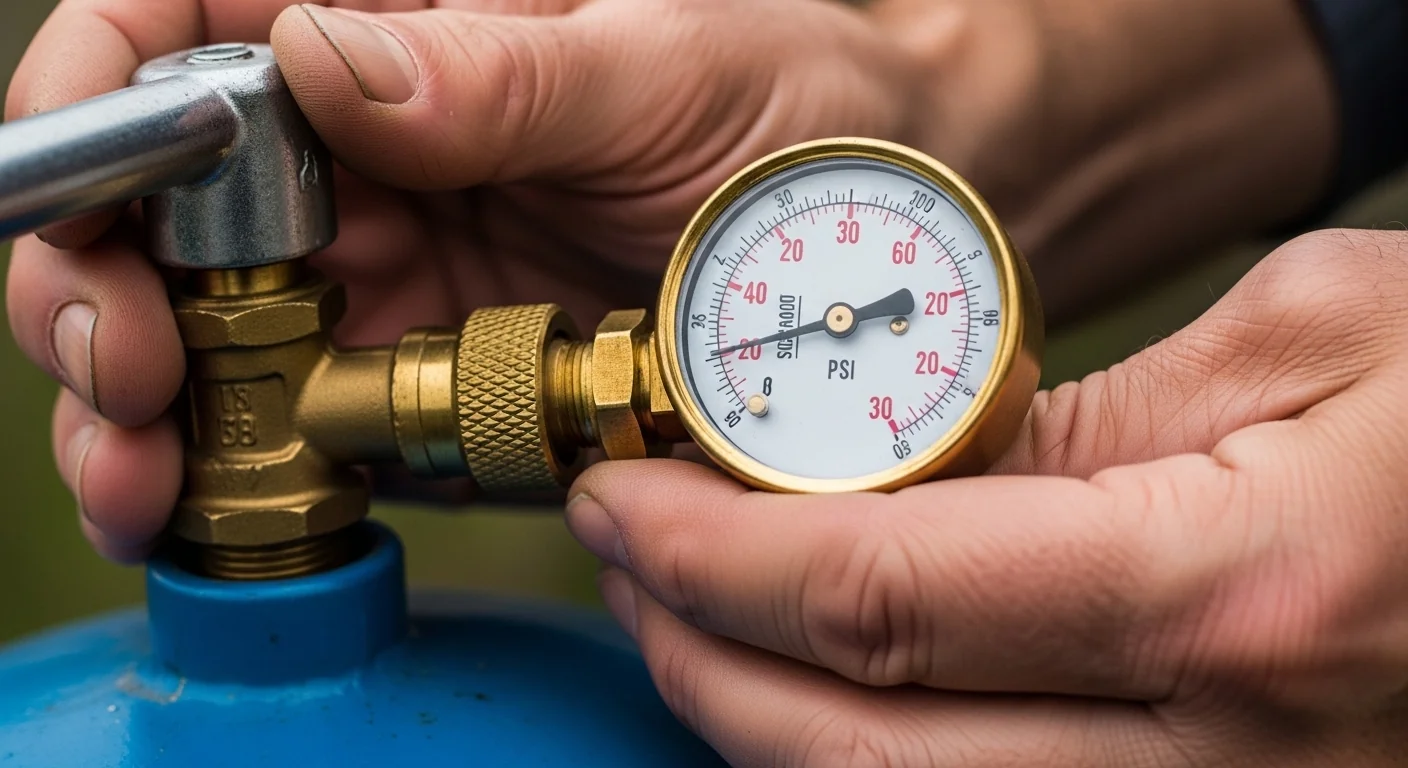
A new bladder tank ships pre-charged at the factory, often at 38 PSI regardless of the purchaser’s pressure switch setting. If a homeowner installs a tank on a 30/50 switch without adjusting the pre-charge down to 28 PSI, the effective drawdown shrinks and the pump still short-cycles despite the correctly sized tank.
Fix: With the tank empty and the pump off, check air pressure at the Schrader valve using a low-pressure tire gauge. Adjust to 2 PSI below the cut-in pressure before filling.
Mistake: Sizing the Tank for the Quietest Moment Instead of the Peak Demand
Calculating based on a single fixture running at low flow and then finding that two showers running simultaneously produce rapid cycling is a common outcome when the target run time is set to the minimum rather than best practice. The calculator output is a minimum, not an optimum.
Fix: For households with three or more bathrooms, or for any system where simultaneous fixture use is common, increase the target run time input to 2.0 minutes and size to that result.
Mistake: Keeping a Galvanized Tank and Adding a Bladder Tank in Parallel
Adding a new bladder tank alongside an existing waterlogged galvanized tank does not solve the problem. The galvanized tank continues to absorb air from the bladder tank over time through its waterlogged volume, eventually waterlogging both. The overall system drawdown may improve temporarily but degrades within months.
Fix: Remove and dispose of any waterlogged galvanized tank before installing a replacement. Do not install them in parallel. If a sump or secondary pump is part of the system, the sump pump calculator can help size those systems independently.
Mistake: Confusing Tank Size with Drawdown Volume
Ordering a tank labeled “35 gallons” and expecting 35 gallons of usable water storage leads to an undersized installation. At 40/60 PSI, only 28% of a 35-gallon tank is available as drawdown, which is roughly 9.8 gallons of usable water. The remaining volume is permanently occupied by the pre-charged air bladder.
Fix: Always use the formula output as the total tank size requirement, not the drawdown volume. The calculator’s breakdown table makes this distinction explicit in the output.
Next Steps in Your Workflow
Once you have the minimum tank size, the next decision is physical installation geometry. Vertical bladder tanks are the most common residential choice and occupy less floor space; horizontal tanks fit in tight crawl spaces but require saddle mounting. Either configuration functions identically for drawdown purposes. After installation, verify the pre-charge pressure with the tank drained and unpressurized, confirm the pressure switch contacts are clean, and check the gauge for accuracy. A liquid-filled gauge is strongly preferred over a dry gauge in applications with pump cycling because the glycerin fill absorbs vibration that would otherwise destroy the movement in a dry-type gauge within a year or two.
If this well supplies an irrigation system or serves a household with significant seasonal water demand, the tank sizing you just calculated covers domestic supply cycling only. Irrigation demand can be addressed separately; the net positive suction head calculator helps verify that submersible pumps in deep wells maintain adequate suction characteristics under varying demand, and the pipe volume calculator is useful when sizing distribution lines from the pressure tank to field outlets or storage cisterns.
FAQ
What happens if my pressure tank is too small?
A pressure tank that is undersized for the pump’s flow rate causes short-cycling: the pump starts, fills the small tank quickly, and shuts off within seconds. Each start-stop cycle stresses the motor windings with heat that cannot dissipate fast enough before the next start. Over weeks or months, this degrades winding insulation and leads to motor failure. Submersible pump replacement typically costs between $800 and $3,000 installed, depending on well depth and pump type.
Can I use two smaller tanks instead of one large tank?
Yes. Two tanks plumbed in parallel add their drawdown capacities together, so two 44-gallon tanks at 40/60 PSI provide roughly the same drawdown as one 85-gallon tank. Both tanks must have matching pre-charge pressure settings. This approach works well in tight spaces where a large single tank cannot be maneuvered, and it adds redundancy since one tank can be isolated for service while the other remains in service.
What is the difference between a bladder tank and a diaphragm tank?
Both types use a flexible membrane to separate the water from the air charge, which prevents waterlogging. A bladder tank uses a free-floating balloon-style bladder; a diaphragm tank uses a membrane bonded to the tank wall at the center. For residential well sizing purposes, the drawdown multipliers used in this calculator apply equally to both types. The functional difference is that diaphragm tanks are more compact for a given volume, while bladder tanks are easier to bladder-replace in the field.
Why does the pressure switch setting affect tank size?
The usable water fraction in a pre-charged tank is determined by Boyle’s Law applied to the pressure ratio between cut-in and cut-out. A 30/50 PSI switch has a 20 PSI differential across a lower absolute pressure range, which allows a slightly larger fraction of the tank to fill with water. A 50/70 PSI switch operates at higher absolute pressures, compressing the air less per unit of water volume, and yields a smaller usable fraction. This is why the multiplier changes from 0.31 to 0.25 across the three standard settings.
How often should I check my pressure tank’s pre-charge?
Checking pre-charge annually is a reasonable maintenance interval for most residential systems. Check it any time the tank is drained, moved, or serviced. The correct pre-charge is 2 PSI below the cut-in pressure setting on the pressure switch. Use a standard low-pressure tire gauge on the Schrader valve located at the top or bottom of the tank, with the pump off and the tank pressure bled to zero first. A pre-charge that is too high reduces drawdown; one that is too low allows the bladder to contact the tank walls repeatedly under pressure.
Does a larger pressure tank save electricity?
A larger tank reduces the number of pump starts per hour, which slightly reduces the inrush current associated with motor starting. The energy savings from fewer starts are modest in most residential systems; the primary benefit of correct sizing is motor longevity, not electricity cost. That said, a pump that runs for 2 minutes twice per hour instead of 20 seconds twelve times per hour will accumulate significantly fewer start cycles over its service life, which is the primary driver of winding and capacitor wear.
Conclusion
Pressure tank sizing reduces to one core question: does the tank hold enough usable water to keep the pump running for a minimum of one full minute per cycle? The drawdown method answers that question precisely, using only three inputs. The result is not a suggestion; it is a hydraulic minimum derived from pump flow rate and pressure physics. Every gallon short of that minimum translates directly into reduced motor life.
The single most avoidable mistake in residential well system maintenance is choosing a smaller tank to lower upfront cost while keeping the same pump. The short-cycle failure that follows is predictable and calculable using this tool before it happens. Use the calculator, round up to the next standard tank size, verify pre-charge after installation, and the system will protect itself. For those managing larger irrigation supply systems, the gravity-fed drip irrigation calculator connects the pressure and flow concepts from well system design into field-level distribution planning.