
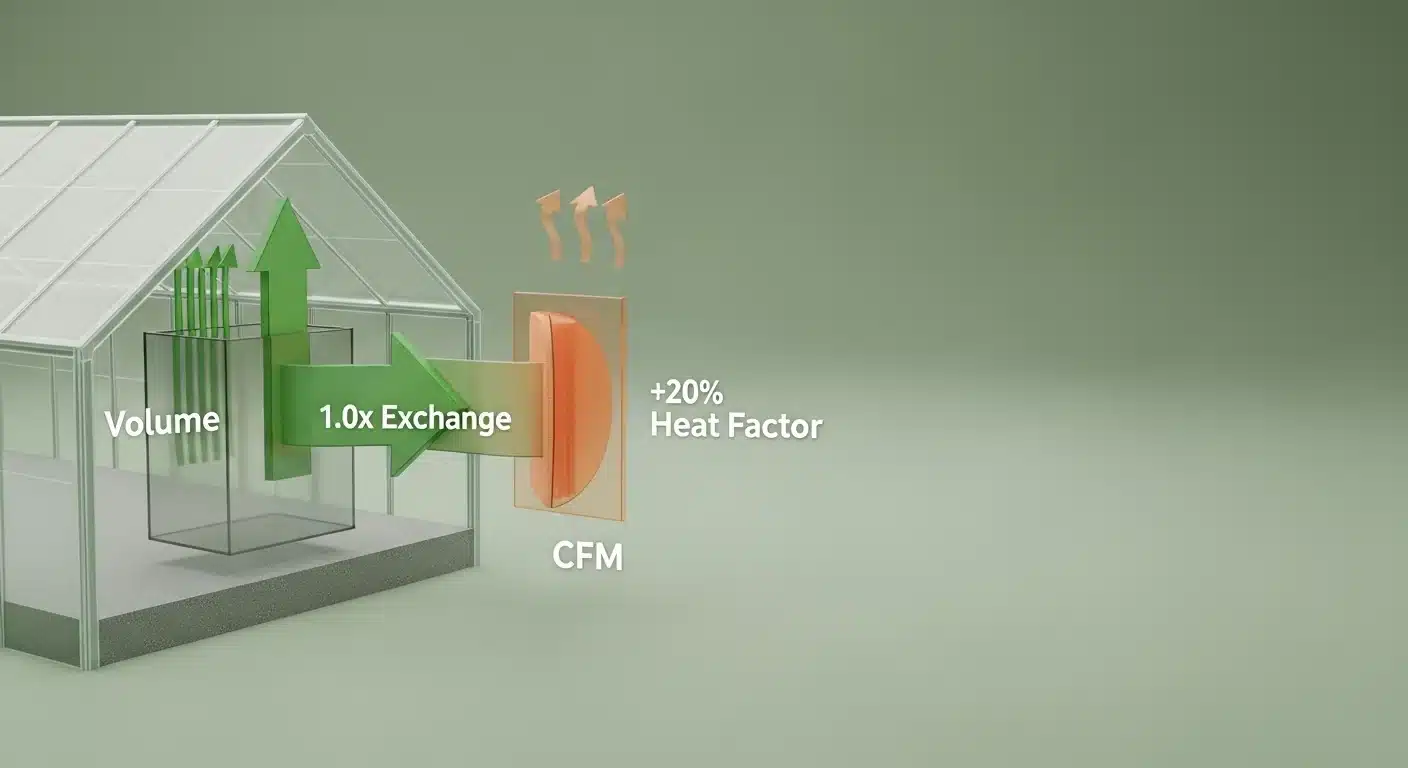
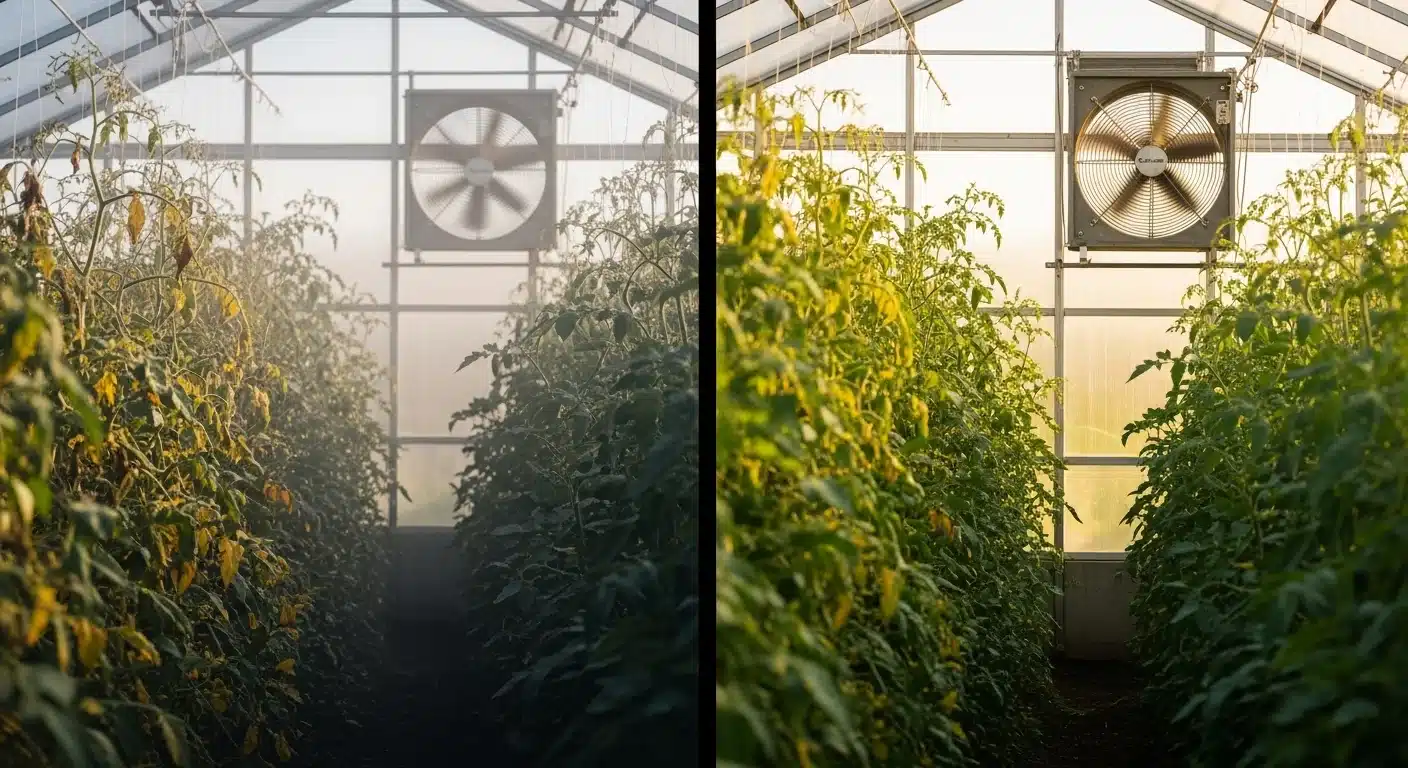
Greenhouse ventilation fails in a specific, predictable way: growers size their exhaust fan for the square footage of the floor and ignore the full air volume of the space. A 20 ft long structure with an 8 ft peak holds nearly twice the air that its footprint suggests. Add unshaded polycarbonate or glass panels on a summer afternoon and you have a compounding heat load that a floor-area estimate will not catch. This is where the calculation falls apart before the fan is ever purchased.
This greenhouse fan calculator computes the minimum required fan airflow in CFM (cubic feet per minute) based on your greenhouse’s interior volume and whether shade cloth is present. It tells you what size exhaust fan your structure needs to achieve one complete air exchange per minute, which is the industry standard for controlled-environment growing. It does not account for multi-zone airflow modeling, crop-specific transpiration loads, or custom duct routing losses, and it makes no claims about specific equipment brands or energy efficiency ratings.
After entering your dimensions and shade cloth status, you will have a defensible minimum CFM figure you can use to filter fan products, quote equipment, or verify whether an existing fan is undersized. If you also run heating equipment in winter, pairing this result with the greenhouse heater size calculator gives you a complete year-round climate picture for the same structure.
Use the Tool
Greenhouse Fan Size (CFM) Calculator
Size your exhaust fan for proper greenhouse ventilation — The Yield Grid
Greenhouse Dimensions
Airflow Demand Scale
Warnings & Standards
Reference: Typical CFM Ranges by Greenhouse Size
| Size (L × W × H) | Volume (ft³) | Base CFM (1× exchange) |
With Heat Factor (×1.2, no shade) |
|---|
How this calculator works
This greenhouse fan size calculator follows the ASHRAE and industry-standard method for exhaust fan sizing in controlled growing environments.
- Calculate volume:
Volume (ft³) = Length × Width × Height - Apply air exchange rate: The standard is 1 complete air exchange per minute, so
Base CFM = Volume × 1 - Apply heat factor (if no shade cloth): Without shade cloth, solar heat gain significantly increases cooling load. Multiply by 1.2:
Adjusted CFM = Base CFM × 1.2 - Result: The final CFM is the minimum rated airflow your exhaust fan must deliver. Always size up to the next available fan model.
Note: Target temperature is used for advisory warnings (high heat load flags) but does not alter the CFM formula. CFM is governed by volume and air exchange rate.
Assumptions & Limits
- Assumes a single exhaust fan drawing air through passive intake vents (cross-ventilation). Multiple fans may be needed for large or multi-span structures.
- Air exchange rate of 1 per minute is the ASHRAE/industry baseline. Higher-density crops or artificial lighting may require 1.5–2 exchanges per minute.
- The 1.2× heat factor applies specifically when no shade cloth is present. Shade cloth typically reduces solar gain by 30–70%.
- CFM rating on fans is measured at 0 static pressure. Real-world system resistance (vents, screens, ducting) reduces effective CFM — size up by 10–15% for systems with significant restrictions.
- Formula:
CFM = L × W × H × AirExchangeRate × HeatFactor - Inputs: Length 1–2000 ft, Width 1–2000 ft, Height 1–100 ft, Target temperature 50–120 °F.
- This tool is for sizing guidance only. Consult a licensed HVAC or agricultural engineer for regulated or commercial projects.
Before entering values, have a tape measure or building plan ready. You need the interior length, width, and average height of the growing space, not the exterior shell dimensions. For gable-style structures, average height is typically calculated as the sidewall height plus the ridge height divided by two. Target temperature is the maximum air temperature you want to maintain inside the greenhouse during peak heat conditions. If you work with grow tents or indoor rooms and want a parallel calculation, the grow tent fan size calculator uses the same volume-based method for enclosed indoor spaces.
Quick Start (60 Seconds)
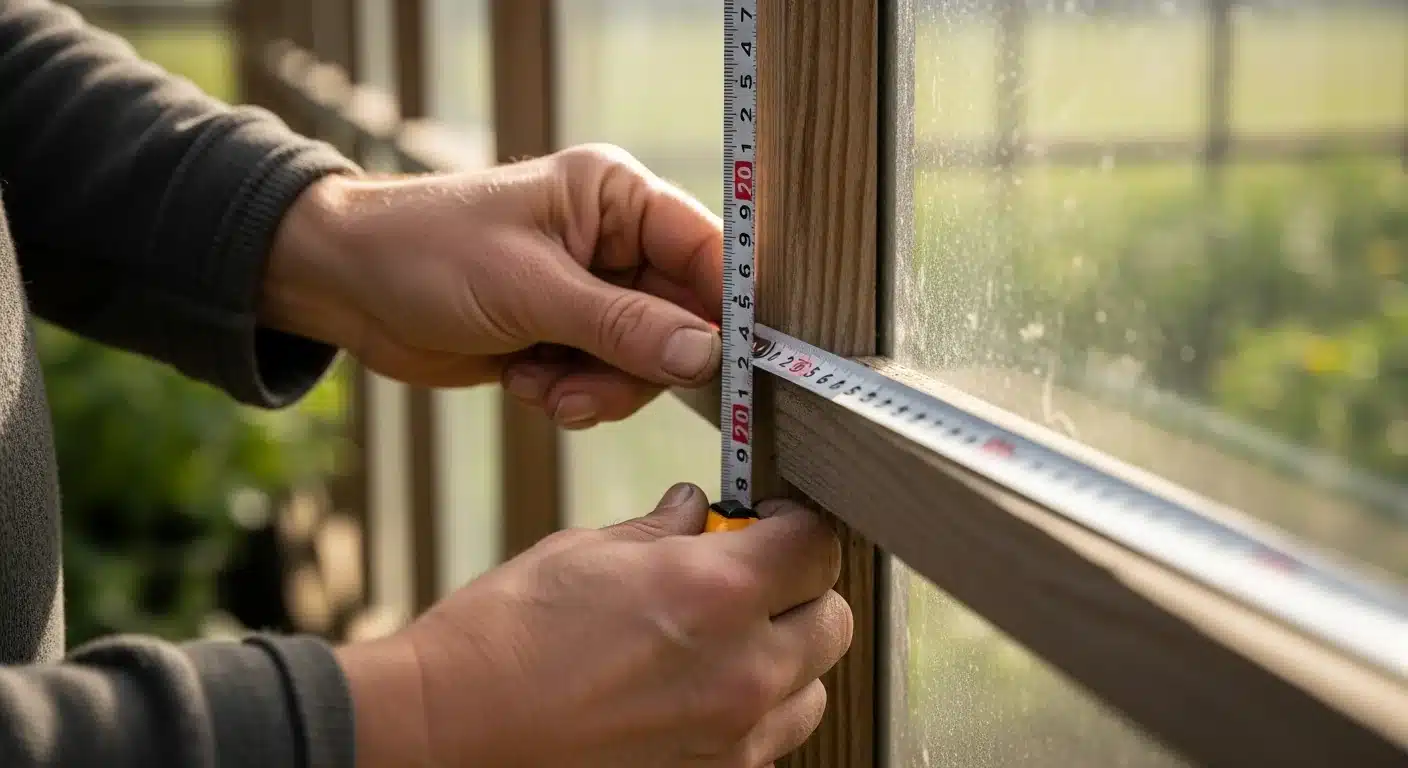
- Length (ft): Measure the interior length along the longest axis of the structure. Do not use the exterior wall-to-wall distance, which adds frame thickness that does not hold air.
- Width (ft): Interior width, perpendicular to length. For multi-span greenhouses, use the total combined interior width, not a single bay width.
- Average Height (ft): For flat-roof or quonset structures, use the actual peak height. For gable roofs, add sidewall height and ridge height, then divide by 2. Using peak height alone overestimates volume and leads to an oversized result.
- Target Max Temperature (°F): Enter the highest temperature the growing environment should reach, typically 80 to 90 degrees F for most vegetable and flower crops. This field drives advisory warnings; it does not change the CFM formula directly.
- No shade cloth checkbox: Check this if your greenhouse covering has no shade cloth or external shading system installed. This applies the 1.2x heat factor to the result. Leave it unchecked if you use shade cloth, whitewash, or reflective film.
- Units: All dimensions must be in feet. If your measurements are in inches, divide by 12 before entering. If in meters, multiply by 3.281.
- Read the output as a minimum: The result is the floor of acceptable fan capacity, not an ideal operating point. Always select a fan rated at or above this number.
Inputs and Outputs (What Each Field Means)
| Field | Unit | What It Means | Common Mistake | Safe Entry Guidance |
|---|---|---|---|---|
| Length | ft | Interior length of the greenhouse along its longest axis | Using exterior measurement, which inflates volume by the wall thickness | Measure from interior wall face to interior wall face. Accepted range: 1 to 2,000 ft. |
| Width | ft | Interior width, perpendicular to length | Using a single bay width in a multi-span house instead of total combined width | For multi-span, sum all interior bay widths. Accepted range: 1 to 2,000 ft. |
| Average Height | ft | Average interior ceiling height across the cross-section | Using peak height for gable structures, which overestimates actual air volume by up to 40% | For gable roofs: (sidewall height + ridge height) / 2. Accepted range: 1 to 100 ft. |
| Target Max Temperature | °F | Highest acceptable air temperature inside the greenhouse | Entering outdoor ambient temperature instead of the desired interior setpoint | Typical growing range is 75 to 90 °F. Accepted range: 50 to 120 °F. |
| No shade cloth (checkbox) | Boolean | Whether the structure lacks shade cloth or equivalent shading | Leaving this unchecked on a greenhouse with clear glazing and no external shading | Check this box for any clear glass, clear polycarbonate, or uncoated poly film structure with no shade layer. See the shade cloth percentage calculator if you are evaluating partial shading options. |
| CFM (output) | CFM | Minimum rated airflow the exhaust fan must deliver | Treating the output as a target RPM or duct velocity rather than fan airflow rating | Match this number against the fan’s CFM rating at 0 in. W.G. static pressure. Real-world efficiency is lower; size up accordingly. |
Worked Examples (Real Numbers)
Example 1: Hobby Greenhouse, No Shade Cloth
- Length: 10 ft
- Width: 8 ft
- Average height: 7 ft
- Target temperature: 85 °F
- Shade cloth: None (heat factor applies)
Calculation: Volume = 10 × 8 × 7 = 560 ft³. Base CFM = 560 × 1 (one air exchange per minute) = 560 CFM. With heat factor: 560 × 1.2 = 672 CFM.
Result: 672 CFM minimum.
A standard 670 to 750 CFM wall-mount exhaust fan is the correct class for this space. At 560 CFM without the heat factor, the fan would be undersized on any sunny afternoon without shade cloth present.
Example 2: Mid-Size Growing House, Shade Cloth Installed
- Length: 20 ft
- Width: 14 ft
- Average height: 9 ft
- Target temperature: 82 °F
- Shade cloth: Yes (no heat factor)
Calculation: Volume = 20 × 14 × 9 = 2,520 ft³. Base CFM = 2,520 × 1 = 2,520 CFM. No heat factor applied.
Result: 2,520 CFM minimum.
With shade cloth reducing solar heat gain, a single large wall exhaust fan rated around 2,600 CFM is sufficient. Removing the shade cloth without upgrading the fan would require a minimum of 3,024 CFM to maintain the same air exchange standard.
Example 3: Large Commercial Greenhouse, No Shade Cloth
- Length: 48 ft
- Width: 24 ft
- Average height: 12 ft
- Target temperature: 88 °F
- Shade cloth: None (heat factor applies)
Calculation: Volume = 48 × 24 × 12 = 13,824 ft³. Base CFM = 13,824. With heat factor: 13,824 × 1.2 = 16,589 CFM.
Result: 16,589 CFM minimum.
At this scale, a single exhaust fan is rarely the right solution. Multiple fans positioned at one end of the house with intake louvers at the opposite end distribute airflow more evenly. Total fan capacity across all units must meet or exceed 16,589 CFM.
Reference Table (Fast Lookup)
| Greenhouse (L × W × H ft) | Volume (ft³) | Base CFM (1×/min) | CFM w/ Heat Factor (1.2×) | Min. Intake Louver Area | Typical Fan Configuration |
|---|---|---|---|---|---|
| 8 × 6 × 6 | 288 | 288 | 346 | ~2.5 ft² | Small wall-mount exhaust fan |
| 10 × 10 × 7 | 700 | 700 | 840 | ~6 ft² | Single wall or roof exhaust fan |
| 16 × 12 × 8 | 1,536 | 1,536 | 1,843 | ~12 ft² | Single large exhaust fan |
| 20 × 12 × 8 | 1,920 | 1,920 | 2,304 | ~15 ft² | Single or dual exhaust fan |
| 24 × 14 × 9 | 3,024 | 3,024 | 3,629 | ~24 ft² | Dual exhaust fans |
| 30 × 16 × 10 | 4,800 | 4,800 | 5,760 | ~38 ft² | Dual large exhaust fans |
| 48 × 24 × 12 | 13,824 | 13,824 | 16,589 | ~111 ft² | Multiple fans, staged operation |
| 96 × 30 × 14 | 40,320 | 40,320 | 48,384 | ~323 ft² | Commercial multi-fan system |
Minimum intake louver area calculated at 150 CFM per square foot of louver, which is the conservative end of the 150 to 200 CFM/ft² industry guidance. Use this column to size passive intake vents, not supply fan inlets. Heat factor column assumes no shade cloth.
How the Calculation Works (Formula and Assumptions)
Show the calculation steps
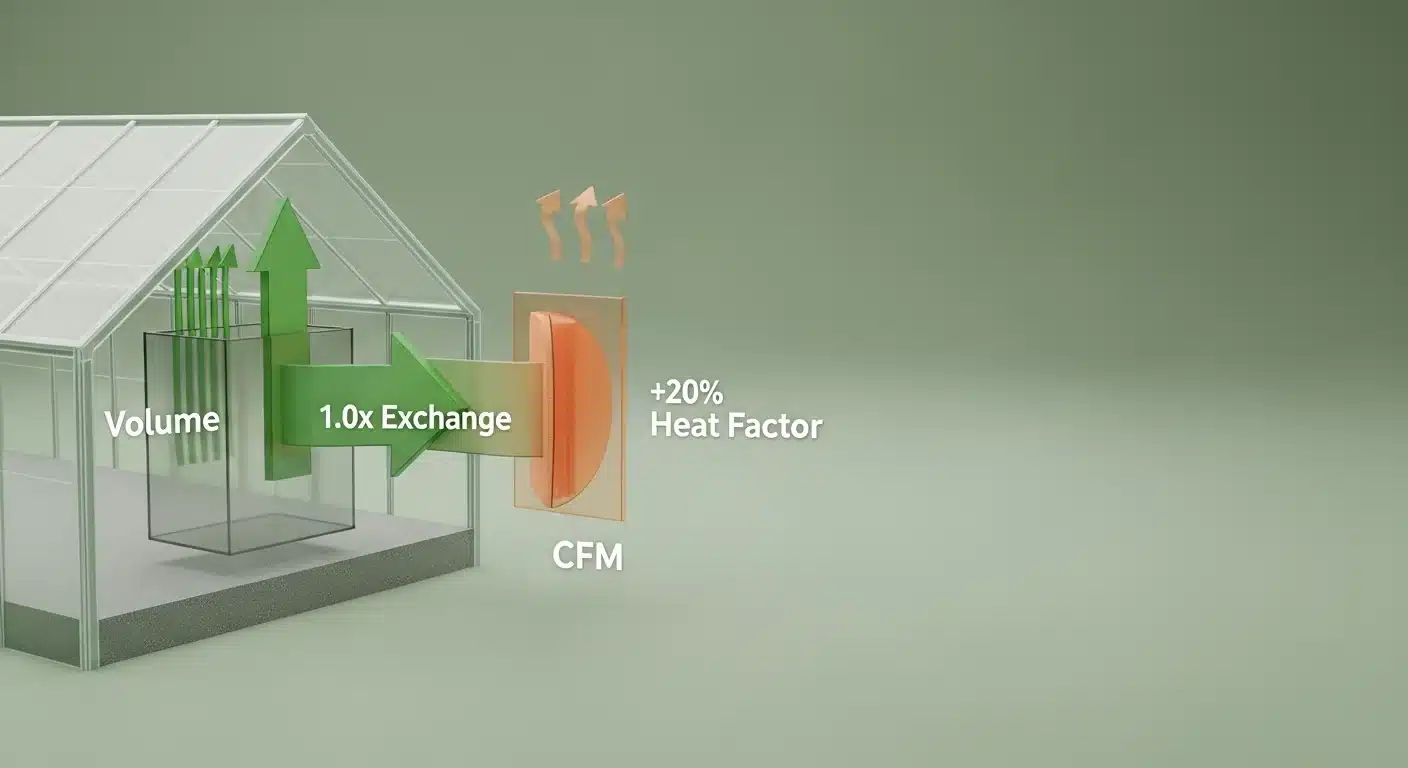
- Calculate interior volume: Volume (ft³) = Length (ft) × Width (ft) × Average Height (ft). All three dimensions must be in the same unit (feet).
- Set air exchange rate: The standard rate is 1 complete volume change per minute, so the multiplier is 1. Base CFM = Volume × 1.
- Apply heat factor if no shade cloth: If the greenhouse covering transmits full solar radiation without shading, multiply Base CFM by 1.2. This accounts for increased sensible heat load. Adjusted CFM = Base CFM × 1.2.
- Rounding: The final result is rounded to the nearest whole CFM. No further conversion is needed; CFM is already the standard unit for exhaust fan ratings in North America.
- Interpret the output: The result is a minimum floor value. Fan rated capacity should be at or above this number. At low static pressure conditions, fans operate closer to rated CFM; at higher resistance (long duct runs, fine mesh screens), derate by 10 to 15%.
Assumptions and Limits
- The formula assumes a single-zone, single-level growing space with uniform temperature distribution. Multi-story or compartmentalized structures require zone-by-zone calculations.
- Air exchange rate of 1 per minute is the baseline standard. High-density crop loads, supplemental lighting, or CO2 burners add thermal mass and may require 1.5 to 2 exchanges per minute. This tool does not model those additional loads.
- The 1.2x heat factor applies to fully unshaded structures. Partial shading (whitewash, 30% shade cloth) may reduce the correction but does not eliminate it. This tool treats the condition as binary: shaded or not.
- Fan CFM ratings published by manufacturers are measured at 0 inches W.G. static pressure. System resistance from intake screens, louvers, bends, and duct runs reduces effective airflow. Size up by at least 10% for any installation with restricted intake or long duct runs.
- Target temperature is used for advisory flag logic only. It does not change the CFM computation. The formula is governed entirely by volume and the air exchange rate, not by temperature differential between inside and outside air.
- This tool does not size evaporative coolers, pad-and-fan systems, or mechanical refrigeration. Those systems require a separate BTU analysis. For cooling systems that go beyond fan-only ventilation, refer to a dedicated BTU load calculator.
- Inputs are bounded at realistic growing structure limits: length and width up to 2,000 ft, height up to 100 ft. Results beyond 50,000 CFM should be validated with an agricultural mechanical engineer before equipment procurement.
Standards, Safety Checks, and Secret Sauce Warnings
Critical Warnings
- The heat factor is not optional on unshaded glass or polycarbonate. Clear double-wall polycarbonate transmits a large share of solar radiation directly into the growing space. On a sunny summer day, interior air temperature can climb 20 to 30 degrees above outdoor ambient within minutes if ventilation is insufficient. Skipping the 1.2x multiplier on an unshaded structure means your calculated CFM is already 17% below the actual required capacity before accounting for system losses.
- Fan ratings and real-world performance are not the same number. A fan labeled 2,400 CFM delivers that airflow at zero resistance. Install it against a louver, a 20-mesh insect screen, and a 4-foot duct section and effective delivery drops significantly. Always apply a real-world derate when selecting equipment, especially for structures where intake area is constrained.
- High target temperatures signal a deeper problem. If the goal temperature is 90 °F or above for most crops, ventilation alone cannot solve the cooling problem on a hot day. Fan sizing ensures air exchange; it does not guarantee temperature control when outdoor air is already 95 °F. At that point, evaporative cooling or refrigeration is required, and the greenhouse misting calculator or a BTU-based tool becomes the next calculation to run.
- Intake area is not an afterthought. An exhaust fan pulling against inadequate intake area creates negative pressure that reduces the fan’s effective airflow and can buckle flexible poly film walls. Match intake louver area to exhaust capacity using the 150 to 200 CFM per square foot rule shown in the reference table above.
Minimum Standards
- One complete air exchange per minute is the widely accepted baseline for active greenhouse ventilation. This corresponds to 60 air changes per hour (ACH). Some high-production operations target 1.5 to 2 exchanges per minute during peak summer loads.
- Intake area must be at least equal to the net free area of the exhaust fan opening. Passive intake louvers typically have a free area of 50 to 75% of their gross dimensions, so the physical louver must be oversized relative to the fan opening.
- Fan placement matters for standard compliance: exhaust fans at one end (typically the prevailing downwind end) with intakes at the opposite end produces true cross-ventilation. Fans and intakes on the same wall create short-circuit airflow that bypasses most of the growing volume.
For structures where heating capacity is just as important as cooling capacity, the greenhouse heater size calculator is the companion calculation to run for winter months.
Competitor Trap: Many online greenhouse CFM calculators use a single formula with no heat factor input and no warning logic. They compute Base CFM = Volume and stop. On any unshaded greenhouse, that output is structurally incorrect because it ignores solar heat gain, which is the dominant driver of cooling load on clear-glazed structures. A correctly sized fan for an unshaded 20 x 14 x 9 ft greenhouse is 3,024 CFM, not 2,520 CFM. The 504 CFM difference is not marginal; it represents the gap between a fan that keeps up on a sunny day and one that falls behind by mid-morning.
Common Mistakes and Fixes
Mistake: Using Peak Height Instead of Average Height for Gable Structures
Gable and gothic-arch greenhouses taper significantly from ridge to sidewall. Using the peak height treats the entire cross-section as if it were a rectangle at the tallest point, which inflates the calculated volume and leads to purchasing a larger fan than is actually needed. This wastes both capital cost and operating energy. For a greenhouse with a 6 ft sidewall and a 10 ft ridge, the correct average height is 8 ft, not 10 ft.
Fix: Always use (sidewall height + ridge height) / 2 for gable structures before entering the value into the height field.
Mistake: Ignoring How Airflow Affects Humidity and VPD
Growers who focus only on temperature often set their fan to run at minimum speed outside of heat events. Stagnant air raises relative humidity at the leaf boundary layer, which suppresses transpiration and creates conditions for fungal disease. Proper air exchange rate is as much a humidity management tool as it is a cooling tool. Running the fan at the calculated CFM continuously, not just during temperature spikes, is the correct operating practice.
Fix: Use the VPD calculator alongside your fan sizing result to verify that your target temperature and humidity combination stays within the optimal vapor pressure deficit range for your crop.
Mistake: Treating the Calculated CFM as the Purchase Target, Not the Floor
The output of any CFM formula is a minimum, not an optimal operating point. Real-world system losses from screens, louvers, and duct bends reduce effective fan airflow below the nameplate rating. Purchasing a fan rated exactly at the calculated CFM means the system is already undersized once installed.
Fix: Add 10 to 15% to the calculated CFM before searching for equipment. For a calculated requirement of 1,920 CFM, look for fans rated at 2,100 to 2,200 CFM or above.
Mistake: Skipping the Shade Cloth Check on Partial Shade Structures
Growers who use shade cloth on only part of the roof (one side, or only the south-facing slope) often leave the heat factor checkbox unchecked because they technically have shade cloth. But partial shading still allows substantial direct solar gain through unshaded sections. Leaving the heat factor off on a partially shaded structure underestimates the CFM requirement.
Fix: Apply the 1.2x heat factor unless shade cloth covers the full overhead glazing area. For help choosing the right shade density, the shade cloth percentage calculator can quantify how much coverage is needed for your specific conditions. Check the box if in doubt.
Mistake: Not Checking Dew Point After Sizing the Fan
Increasing ventilation rate brings outdoor air inside the greenhouse. In humid climates, that incoming air carries moisture that can condense on cold surfaces, glazing, and plant tissue when nighttime temperatures drop. A correctly sized exhaust fan can inadvertently create condensation problems if the incoming air’s dew point is close to the surface temperature of the greenhouse structure.
Fix: After calculating your fan requirement, run your outdoor temperature and humidity through the dew point calculator to verify that overnight ventilation rates will not push surface temperatures below dew point on cold nights.
Next Steps in Your Workflow
Once you have your CFM figure, the immediate next decision is whether fan-only ventilation is sufficient for your cooling goal or whether supplemental cooling is needed. In humid climates, running maximum airflow during peak heat while maintaining plant health may also require active dehumidification. The grow room dehumidifier calculator uses space volume and target humidity to size a dehumidifier that works alongside your exhaust fan rather than fighting it.
For growers who supplement with CO2 enrichment, fan sizing has a direct operational consequence: high ventilation rates purge injected CO2 out of the space faster than it can accumulate to useful concentrations. Running the greenhouse CO2 calculator after fan sizing lets you see whether CO2 supplementation is viable at your air exchange rate or whether you need a staged ventilation strategy that closes the intake loop during enrichment periods.
FAQ
What does CFM stand for in greenhouse fan sizing?
CFM stands for cubic feet per minute. It is the standard unit for measuring the volumetric airflow rate of an exhaust fan. In greenhouse ventilation, the goal is to move a volume of air equal to the entire interior volume of the structure at least once every 60 seconds, which sets the minimum CFM requirement directly from the space’s dimensions.
Why is 1 air exchange per minute the standard, not per hour?
Active greenhouse ventilation operates on a much faster cycle than building HVAC. The combination of solar heat gain through glazing, plant transpiration, and restricted volume means air temperature can rise several degrees in under a minute without active air movement. Per-hour exchange rates are used for passive natural ventilation in large multi-span commercial structures, not for fan-driven systems.
What is the 1.2x heat factor and when does it apply?
The 1.2 heat factor is a correction multiplier applied when no shade cloth or equivalent shading system is present. Solar radiation passing through unshaded glass or polycarbonate creates a sensible heat load beyond what simple volume replacement can handle. Multiplying the base CFM by 1.2 adds capacity to compensate for that additional heat input. Apply it whenever the overhead glazing is clear and unshaded.
Should I size the intake vents at the same CFM as the exhaust fan?
Intake louver area, not airflow rate, is what you size for intake. The rule of thumb is one square foot of free intake area per 150 to 200 CFM of exhaust fan capacity. Because louvers have a free area of only 50 to 75% of their gross dimensions, the physical louver needs to be larger than the calculated free area. Undersized intake creates back pressure that reduces fan output significantly.
Can I use this calculator for a polyethylene tunnel house?
Yes. Enter the interior dimensions using the same method as any other structure. For a tunnel or quonset shape, average height is the height at the center divided by approximately 1.57 (pi over 2) to account for the curved cross-section, or you can use half the diameter as a reasonable approximation. The heat factor applies to clear poly film the same way it applies to polycarbonate or glass.
What if my calculated CFM is higher than any available single fan?
For results above roughly 10,000 to 15,000 CFM, a single fan installation is rarely practical or advisable from an airflow distribution standpoint. Use multiple fans whose combined rated CFM meets or exceeds the calculated total. Distribute them evenly along one end wall or in the roof, with intakes on the opposite end, to achieve consistent airflow across the full length of the space.
Conclusion
Greenhouse fan sizing reduces to two numbers: the interior air volume and whether unshaded glazing demands an additional heat load correction. The formula is straightforward. The errors are in the inputs, specifically using exterior dimensions, treating peak height as average height, or skipping the 1.2x factor on unshaded structures. Each of those mistakes produces a CFM that looks plausible on paper but leaves the growing environment undersupported during the hours when it matters most.
Use the calculated CFM as a purchase floor, not a purchase target. Factor in real-world system losses, size intake louvers to match exhaust capacity, and revisit the number any time the structure changes, whether that means adding glazing, removing shade cloth, or expanding the footprint. For growers building out a full climate control strategy, the grow room AC sizing calculator covers the refrigerant-based cooling side when ventilation alone cannot close the temperature gap on the hottest days of the year.