
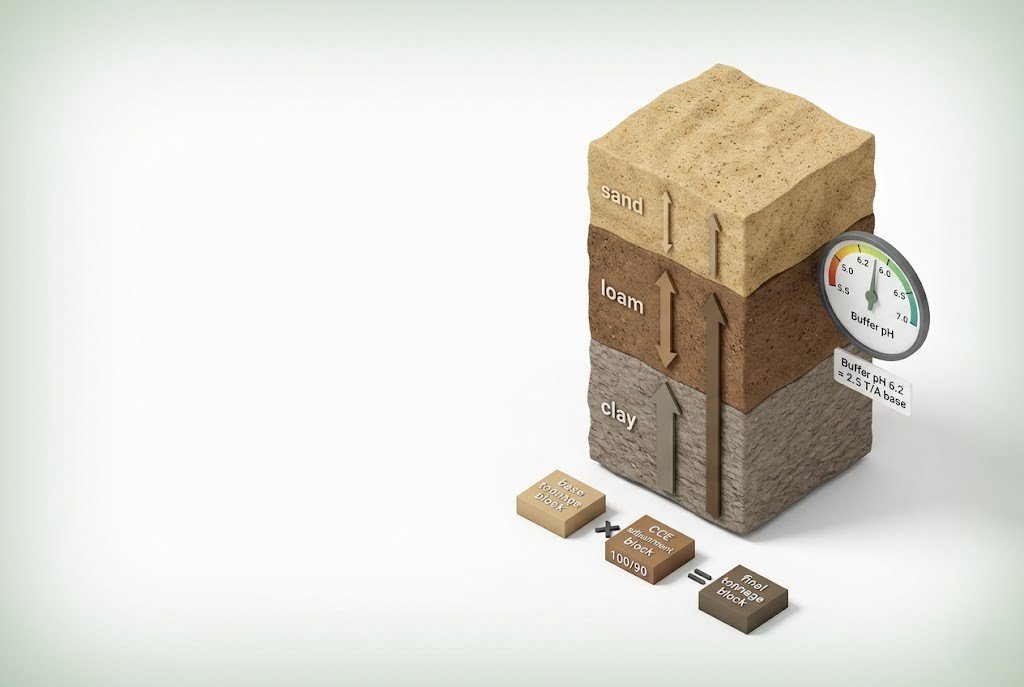
Raising soil pH without accounting for buffer capacity leads to under-liming or over-liming, both of which waste money and delay crop establishment.
| Buffer pH | Base Req (T/A) | Buffering |
|---|
How This Calculator Works
Step 1: Determine the pH change needed: Target pH − Current pH.
Step 2: Calculate the Buffer Index from your Buffer pH (SMP/Sikora). Lower buffer pH = higher buffering capacity = more lime needed.
Step 3: Compute Base Lime Requirement using the buffer index formula:Base Req = (Target pH − Current pH) × Buffer Factor
where Buffer Factor increases as Buffer pH decreases.
Step 4: Adjust for actual lime quality:Adjusted Req = Base Req × (100 ÷ CCE%)
Assumptions & Limits:
- Assumes 6-inch incorporation depth
- CCE (Calcium Carbonate Equivalent) of 100% is pure calcium carbonate
- Buffer pH below 6.0 indicates high clay/organic matter
- Mg threshold of 100 ppm triggers calcitic lime recommendation
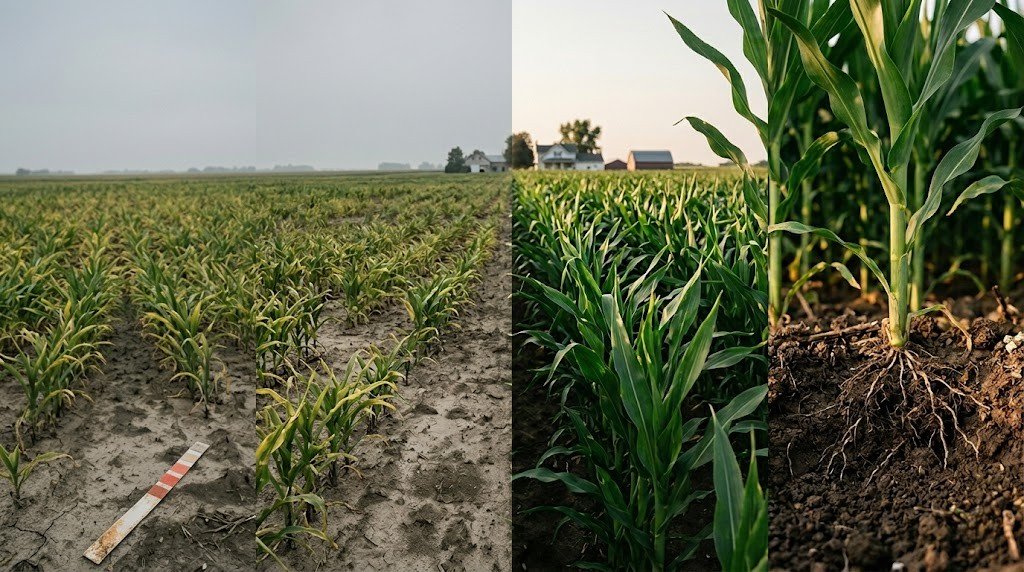
The core problem is not knowing how much resistance your soil puts up against pH change. Sandy soils shift easily; clay-heavy or organic-rich soils fight back hard.
This agricultural lime calculator computes the adjusted lime requirement in tons per acre using your soil’s buffer pH (SMP or Sikora method), current pH, target pH, lime CCE percentage, and magnesium level. It does not predict how long the pH change will take, nor does it account for subsoil acidity below the standard 6-inch incorporation depth.
After running this calculation, you will know exactly how many tons of lime to order and whether your soil’s magnesium level requires calcitic lime instead of the commonly sold dolomitic products.
Use the Tool
Before using the calculator, gather these items from your soil test report: water pH (current pH), buffer pH from an SMP or Sikora test, and exchangeable magnesium in ppm. You will also need the CCE percentage from your lime supplier’s product sheet. If you are working with multiple fields, run each field separately since buffer capacity varies significantly across soil types.
For fields with variable soil texture, consider using a soil texture calculator to understand how clay content affects your buffering behavior.
Quick Start (60 Seconds)
- Current Soil pH: Enter the water pH from your soil test (range 4.0 to 7.5). This is sometimes labeled “soil pH” or “1:1 water pH” on lab reports.
- Target Soil pH: Enter your goal pH (range 5.5 to 7.0). Most field crops perform best at 6.2 to 6.8. Do not enter a target lower than your current pH.
- Buffer pH: Enter the SMP or Sikora buffer pH from your soil test (range 5.5 to 7.0). This value measures how strongly your soil resists pH change. Lower buffer pH means higher lime requirement.
- Lime CCE %: Enter the Calcium Carbonate Equivalent from your lime product label (range 50% to 120%). Pure calcium carbonate equals 100%. Pelletized lime products often exceed 90%.
- Soil Magnesium (ppm): Enter the exchangeable magnesium level from your soil test. Values above 100 ppm trigger a critical warning about lime type selection.
- Common input mistake: Confusing buffer pH with water pH. Buffer pH is always closer to neutral (typically 5.5 to 7.0) while acidic soils show water pH values below 5.5.
- Unit check: Ensure magnesium is in ppm (parts per million), not meq/100g or lb/acre.
Inputs and Outputs (What Each Field Means)
| Field Name | Unit | What It Means | Common Mistake | Safe Entry Guidance |
|---|---|---|---|---|
| Current Soil pH | pH units | The measured acidity of your soil in water suspension | Using CaCl2 pH instead of water pH (CaCl2 reads 0.5 lower) | Use the 1:1 water pH value from your lab report |
| Target Soil pH | pH units | The pH level you want to achieve for your crop | Setting target too high for acid-loving crops like blueberries | Check crop-specific pH requirements before entering |
| Buffer pH | pH units | Measures soil’s resistance to pH change (buffering capacity) | Leaving blank or confusing with water pH | Look for “SMP” or “Sikora” or “Buffer Index” on your report |
| Lime CCE % | Percentage | Neutralizing power of lime relative to pure calcium carbite | Using fineness rating instead of CCE | Request CCE from your lime supplier; ag-lime typically 80-95% |
| Soil Magnesium | ppm | Exchangeable magnesium available in soil | Using total Mg instead of exchangeable Mg | Confirm units are ppm; convert if reported in lb/acre |
| Adjusted Lime Rate (Output) | Tons/Acre | The actual tonnage needed after CCE adjustment | Applying without splitting high rates | Split applications over 3 T/A into multiple passes |
Worked Examples (Real Numbers)
Example 1: Moderate Acidity with Standard Ag-Lime
- Current Soil pH: 5.4
- Target Soil pH: 6.5
- Buffer pH: 6.2
- Lime CCE: 90%
- Soil Magnesium: 80 ppm
Result: 3.06 tons per acre (adjusted)
The buffer pH of 6.2 indicates medium buffering capacity. With a 1.1 pH unit increase needed and 90% CCE lime, the adjusted rate is just over 3 tons per acre. Since magnesium is below 100 ppm, either calcitic or dolomitic lime is acceptable.
Example 2: High-Clay Soil with Strong Buffering
- Current Soil pH: 5.0
- Target Soil pH: 6.5
- Buffer pH: 5.6
- Lime CCE: 85%
- Soil Magnesium: 180 ppm
Result: 7.94 tons per acre (adjusted)
The low buffer pH of 5.6 signals high clay or organic matter content, requiring substantially more lime. The elevated magnesium level triggers a critical warning: use calcitic lime only. This rate should be split into at least three applications of 2.5 to 3 tons each over 12 to 18 months.
Example 3: Sandy Soil with Low Buffering
- Current Soil pH: 5.8
- Target Soil pH: 6.5
- Buffer pH: 6.8
- Lime CCE: 95%
- Soil Magnesium: 45 ppm
Result: 0.37 tons per acre (adjusted)
The high buffer pH of 6.8 indicates sandy soil with minimal resistance to pH change. Less than half a ton per acre will achieve the target. Low magnesium suggests dolomitic lime could add beneficial Mg, but calcitic remains the safer choice for soil structure.
Reference Table (Fast Lookup)
This table shows base lime requirements to reach pH 6.5 from pH 5.5 (1.0 pH unit increase) at 100% CCE. Adjust proportionally for different pH changes and CCE values.
| Buffer pH | Base Req (T/A) | Buffering Level | Soil Type Indicator | Adj. for 90% CCE | Adj. for 80% CCE |
|---|---|---|---|---|---|
| 7.0 | 0.0 | Very Low | Pure sand, no organic matter | 0.0 | 0.0 |
| 6.8 | 0.5 | Low | Sandy loam | 0.56 | 0.63 |
| 6.5 | 1.5 | Low-Medium | Loam | 1.67 | 1.88 |
| 6.2 | 2.5 | Medium | Silt loam | 2.78 | 3.13 |
| 6.0 | 3.5 | Medium-High | Clay loam | 3.89 | 4.38 |
| 5.8 | 4.5 | High | Clay or high organic matter | 5.00 | 5.63 |
| 5.5 | 6.0 | Very High | Heavy clay or peat-influenced | 6.67 | 7.50 |
| 5.3 | 7.0 | Extreme | Muck or highly weathered clay | 7.78 | 8.75 |
Understanding your soil’s cation exchange capacity (CEC) provides additional context for why buffer pH values vary so dramatically between soil types.
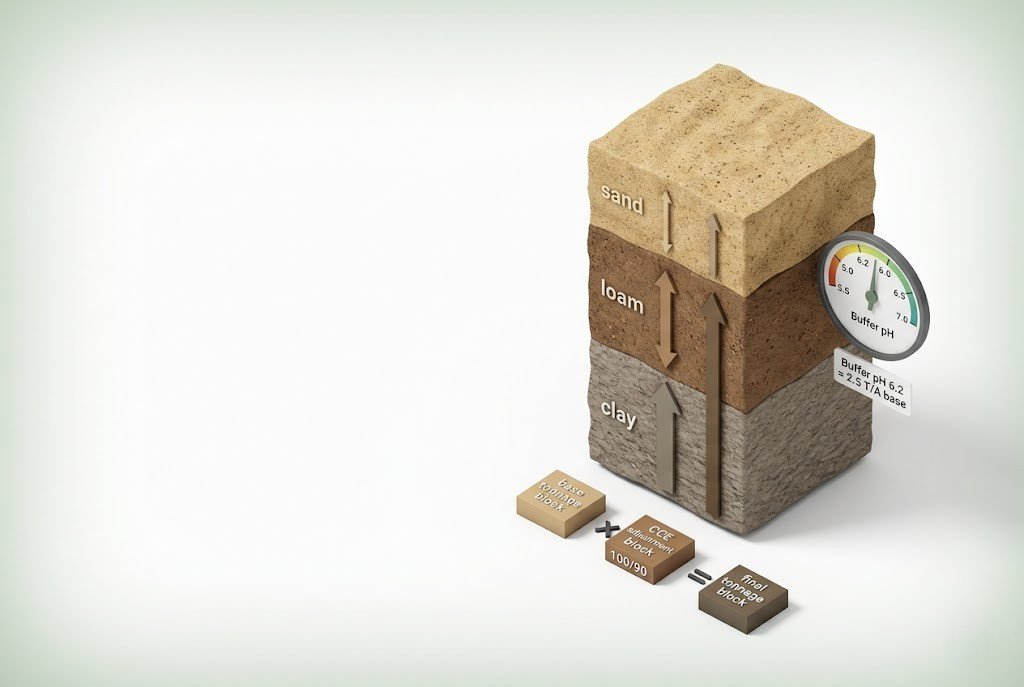
How the Calculation Works (Formula + Assumptions)
Show the calculation steps
Step 1: Calculate pH Change Needed
pH Change = Target pH – Current pH
Step 2: Determine Buffer Factor from Buffer pH
The buffer factor increases as buffer pH decreases, reflecting higher soil resistance:
- Buffer pH 7.0 or higher: Factor = 0
- Buffer pH 6.5 to 6.99: Factor = (7.0 – Buffer pH) x 3
- Buffer pH 6.0 to 6.49: Factor = 1.5 + (6.5 – Buffer pH) x 4
- Buffer pH 5.5 to 5.99: Factor = 3.5 + (6.0 – Buffer pH) x 5
- Buffer pH below 5.5: Factor = 6.0
Step 3: Calculate Base Lime Requirement
Base Requirement (T/A) = Buffer Factor x (pH Change / 1.0)
Step 4: Adjust for Lime Quality (CCE)
Adjusted Requirement = Base Requirement x (100 / CCE%)
Rounding: Results are rounded to two decimal places for practical application.
Assumptions and Limits
- Assumes standard 6-inch tillage depth for lime incorporation. Deeper incorporation requires proportionally more lime.
- CCE of 100% represents pure calcium carbonate. Most agricultural lime ranges from 80% to 95% CCE.
- Buffer pH values are calibrated for SMP and Sikora buffer methods. Other buffer systems may not produce accurate results.
- The formula does not account for soil aluminum toxicity, which can persist even after pH correction in highly weathered soils.
- Lime reactivity (fineness) is not factored. Coarse lime products may take 2 to 3 years to fully react.
- Results assume uniform lime distribution. Poor spreading equipment creates pH variability across the field.
- Subsoil acidity below 6 inches is not addressed. Deep-rooted crops may still encounter acid conditions.
- The calculator does not predict the time required to achieve target pH. Expect 6 to 18 months for full reaction.
Standards, Safety Checks, and Critical Warnings
Critical Warnings
- High Magnesium Alert (over 100 ppm): Do not use dolomitic lime. Dolomitic lime adds magnesium, which binds clay particles and creates compacted, poorly draining soil. Use high-calcium calcitic lime exclusively when Mg exceeds 100 ppm.
- Split Application Threshold: Never apply more than 3 tons per acre in a single pass. Higher rates create uneven pH zones and can temporarily over-lime the surface while leaving subsurface acidity unchanged.
- Buffer pH Below 6.0: Soils with buffer pH under 6.0 contain high clay or organic matter and resist pH change aggressively. Plan for re-testing 6 to 12 months after application to verify progress before additional applications.
- Target pH Verification: The calculator prevents entering a target pH lower than current pH. If you need to lower pH, use a sulfur-based pH reduction calculator instead.
Minimum Standards
- Always use a soil test less than 12 months old. Buffer pH values shift as organic matter decomposes.
- Confirm CCE with your lime supplier before ordering. Product labels may list ENV (Effective Neutralizing Value) instead of CCE.
- For fields with pH below 5.0, address aluminum toxicity concerns with your agronomist before liming.
- Retest soil pH 6 to 12 months after lime application to confirm progress toward target.
Competitor Trap: Many lime calculators online ignore buffer pH entirely and use only current pH with generic “soil type” dropdowns. These produce wildly inaccurate results because a clay soil and a sandy soil at the same water pH may require 5x different lime rates. If a calculator does not ask for buffer pH from an actual soil test, its output is essentially a guess. This tool requires SMP or Sikora buffer pH specifically because that measurement directly quantifies your soil’s resistance to pH change.
Understanding base saturation percentages can help explain why soils with similar pH values respond differently to lime applications.
Common Mistakes and Fixes
Mistake: Using Dolomitic Lime When Magnesium Is Already High
Dolomitic lime is cheaper and widely available at retail stores, leading many growers to use it without checking soil magnesium levels. In soils with Mg above 100 ppm, adding more magnesium degrades soil structure over time, creating drainage problems and compaction.
Fix: Always check exchangeable Mg before selecting lime type. Source calcitic lime from agricultural suppliers if Mg exceeds 100 ppm.
Mistake: Confusing Buffer pH with Water pH
Both values appear on most soil test reports, and both are measured in pH units. Entering water pH in the buffer pH field produces dramatically incorrect results because the calculator interprets the low value as extreme buffering capacity.
Fix: Look for “SMP,” “Sikora,” or “Buffer Index” labels on your report. Buffer pH is always higher than water pH in acid soils.
Mistake: Applying Full Rate in One Pass
Large lime applications (over 3 T/A) applied at once do not incorporate evenly. The surface becomes alkaline while the root zone remains acidic. Nutrient availability becomes erratic, and crop response disappoints.
Fix: Split rates above 3 T/A into multiple applications spaced 6 to 12 months apart. Incorporate each application before adding more.
Mistake: Ignoring Lime Fineness
Two products with identical CCE values can react at very different speeds. Coarse agricultural lime may take 2 to 3 years to fully neutralize acidity, while pelletized or pulverized lime reacts within months.
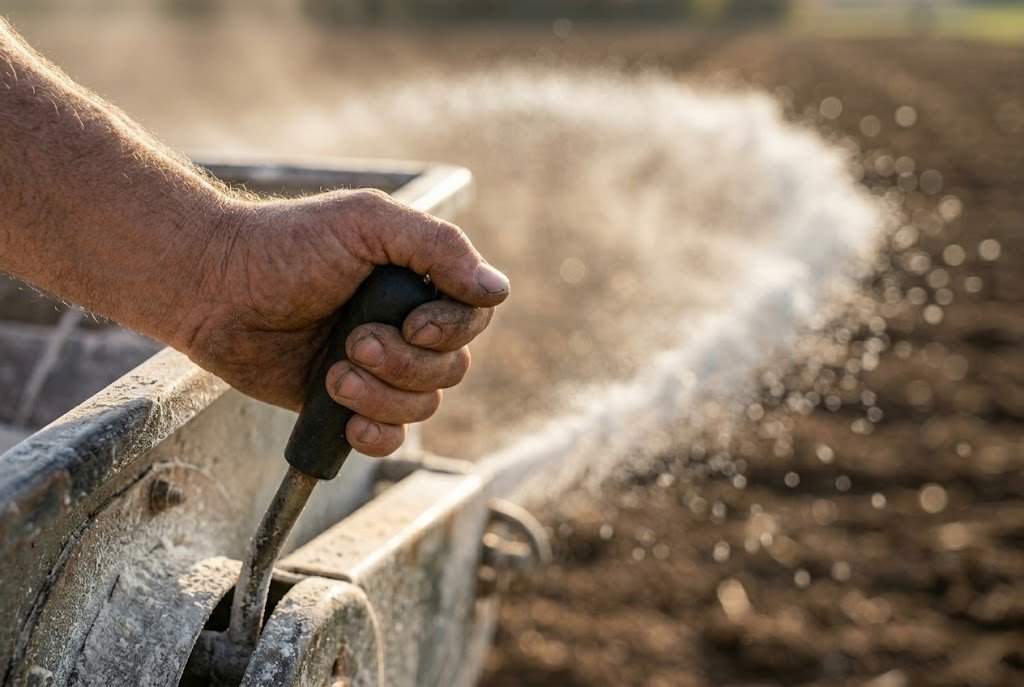
Fix: Request particle size distribution from your supplier. For rapid pH correction, choose products with at least 50% passing a 100-mesh screen.
Mistake: Liming Without Addressing Drainage
In waterlogged soils, lime reactions slow dramatically because water displaces air needed for calcium carbonate dissolution. Applying lime to poorly drained fields often produces minimal pH change.
Fix: Correct drainage issues before or alongside liming. Tile drainage, grading, or cover cropping to improve structure should precede major lime investments.
Related Tools and Next Steps
After determining your lime requirement, these related calculators help complete your soil amendment plan:
- Soil pH Lime Calculator provides a simplified approach for quick estimates when buffer pH is unavailable.
- NPK Calculator helps plan fertilizer applications after pH correction, when nutrient availability improves.
- Fertilizer Spreader Calibration Calculator ensures your equipment delivers the correct lime rate per acre.
- Compost Calculator assists with organic matter additions that affect long-term buffer capacity.
- Lawn Fertilizer Calculator helps plan maintenance fertilization for turf areas after liming.
FAQ
What is buffer pH and why does it matter for lime calculations?
Buffer pH measures how strongly your soil resists changes in acidity. It reflects the combined effect of clay content, organic matter, and mineral composition. Two soils at the same water pH can require vastly different lime amounts depending on their buffer pH. A clay soil with buffer pH of 5.8 needs roughly 9 times more lime than a sandy soil with buffer pH of 6.8 to achieve the same pH increase.
Can I use this calculator without a buffer pH value?
No. Without buffer pH, any lime recommendation is an estimate at best. Contact your soil testing laboratory and request SMP or Sikora buffer pH. Most comprehensive soil tests include this measurement. If your current test lacks buffer pH, resubmit a sample with a request for buffer analysis.
What is CCE and where do I find it?
CCE stands for Calcium Carbonate Equivalent, expressing lime’s neutralizing power relative to pure calcium carbonate (which equals 100%). Your lime supplier’s product specification sheet lists CCE. Agricultural lime typically ranges from 80% to 95% CCE. Pelletized products may reach 90% to 100%. Some labels show ENV (Effective Neutralizing Value) instead, which factors in both CCE and particle size.
Why does the calculator warn about dolomitic lime?
Dolomitic lime contains 10% to 13% magnesium alongside calcium. In soils already high in magnesium (above 100 ppm), adding more Mg through dolomitic lime degrades soil structure. Excess magnesium tightens clay particles, reducing drainage and aeration. Calcitic lime raises pH without adding significant magnesium, preserving or improving soil physical properties.
How long does lime take to work?
Lime reaction speed depends on particle fineness, soil moisture, and incorporation depth. Finely ground lime (pulverized or pelletized) begins reacting within weeks and reaches 80% to 90% effectiveness in 6 to 12 months. Coarse agricultural lime may take 2 to 3 years for full reaction. Retest soil pH after 12 months to assess progress.
Should I apply all the lime at once?
For rates under 3 tons per acre, single applications work well with thorough incorporation. For higher rates, split the total into applications of 2 to 3 tons per acre, spaced 6 to 12 months apart. This approach prevents surface over-liming, improves incorporation uniformity, and allows monitoring of pH response between applications.
Conclusion
The single most important takeaway: if your soil test shows magnesium above 100 ppm, use calcitic lime exclusively. Dolomitic products, despite being cheaper and more available, will damage soil structure over repeated applications. Run your numbers through this calculator, verify your lime source provides calcitic material when needed, and split any application exceeding 3 tons per acre.