| Diameter (in) | Gallons/run | lbs of water | ft³ |
|---|
⚙ How This Calculator Works
- Radius (ft): R = (Diameter_in / 2) / 12 — converts diameter from inches to a radius in feet
- Volume per run (ft³): V = π × R² × Length_ft — standard cylinder volume formula
- Gallons per run: gal = V × 7.48052 — US conversion factor (1 ft³ = 7.48052 US gallons)
- Total (multiple runs): Total_gal = gal × Quantity
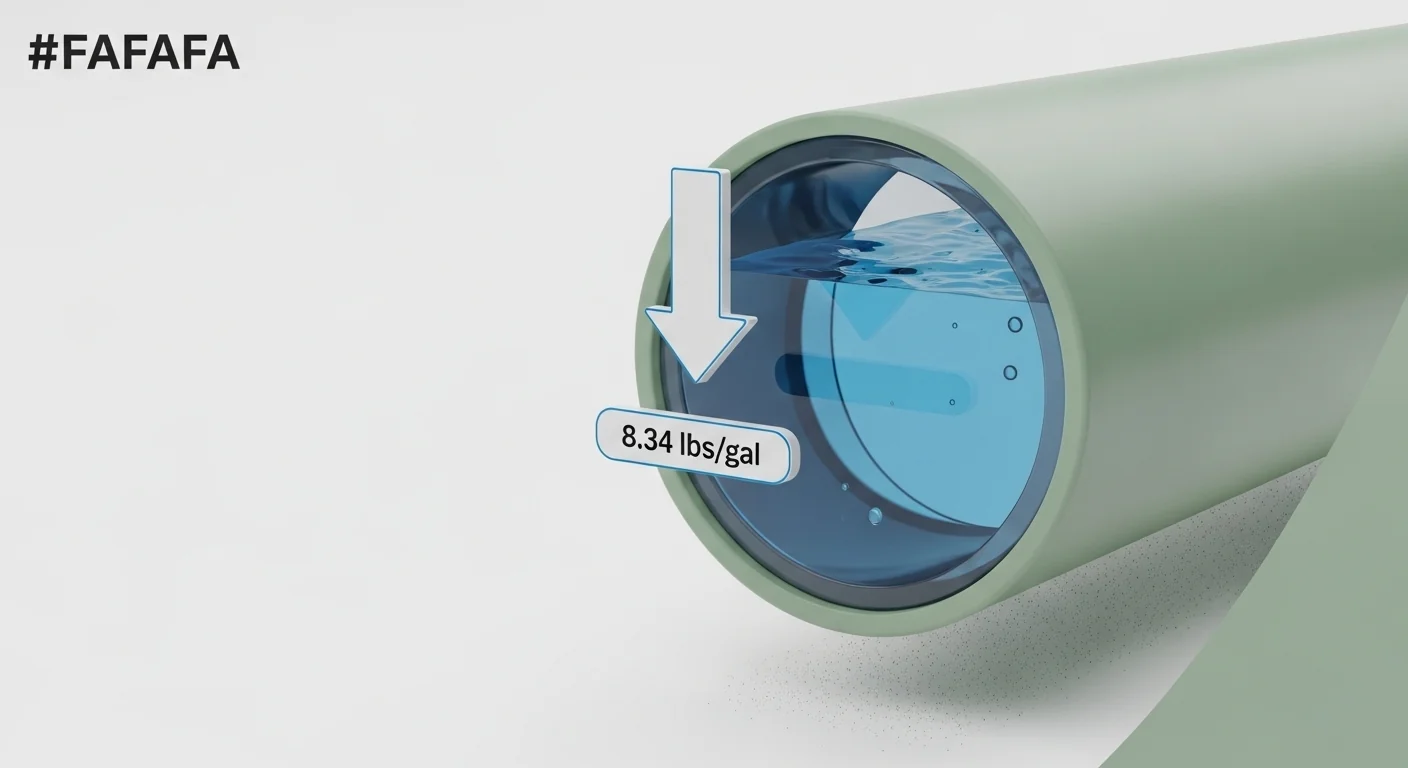
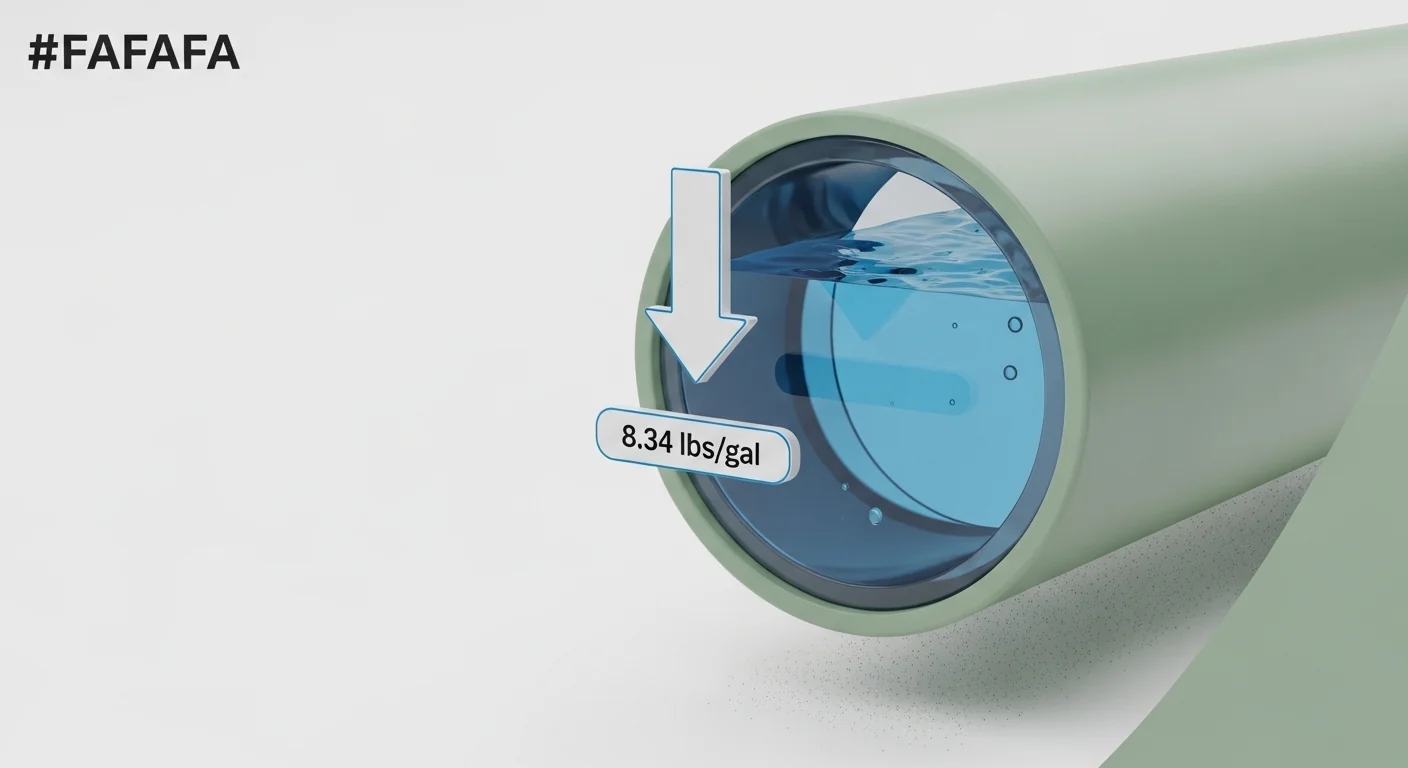
- Water weight (lbs): Weight = Total_gal × 8.34 — weight of water at ~60°F (8.34 lbs/gal)
- Diameter is the inside (bore) diameter — not the outside or nominal. For schedule 40 PVC, the inside diameter is slightly smaller than nominal.
- Pipe is assumed to be completely full of water. Partially filled pipes will hold less.
- Water density used: 8.34 lbs per US gallon (fresh water at ~60°F / 15.5°C). Salt or nutrient solution is slightly heavier.
- Maximum sensible inputs: pipe length ≤ 10,000 ft, diameter ≤ 120 in, quantity ≤ 500 runs.
- This tool does not account for fittings, valves, or dead-legs — add 5–10% for complex systems.
ⓘ Irrigation & Hydroponic Context
This calculator is commonly used for:
- Hydroponic NFT & DWC systems — knowing total reservoir demand before top-off
- Irrigation mains & laterals — sizing pumps and pressure tanks correctly
- Hanging grow pipes — structural load planning (water weight × gravity = design load)
- PVC, HDPE, and aluminum conduit — works for any cylindrical pipe material
Keywords: pipe volume calculator, calculate pipe volume, pipe gallons calculator, pvc pipe volume, water pipe capacity, pipe water weight, irrigation pipe volume, hydroponic pipe volume
Pipe volume is not just a measurement of capacity. It is a structural load number, a reservoir sizing constraint, and a pump selection variable all at once. A 4-inch Schedule 40 PVC pipe 50 feet long sounds modest until you calculate that three of those runs, fully flooded, carry more than 800 pounds of water. That weight number determines whether your overhead framing, your hanging hardware, and your support spacing are adequate before the first drop goes in. Knowing the gallons alone is not enough. Flow rate calculations for sizing headers and valves only make sense once you know the total volume the system must hold and supply.
This pipe volume calculator computes total gallons, cubic feet, total water weight, and per-run breakdowns for any cylindrical pipe given its length, inside diameter, and the number of identical runs. It does not calculate flow velocity, friction losses, or discharge rates. It assumes the pipe is fully flooded with fresh water at standard temperature. Those are deliberate constraints, not oversights, and the Assumptions section explains the boundaries in detail.
After using this tool, you can decide whether your support structure can carry the filled weight, whether your reservoir volume is matched to your pipe system, and what pump flow rate you need to fill or drain the system within a target time window.
Use the Tool
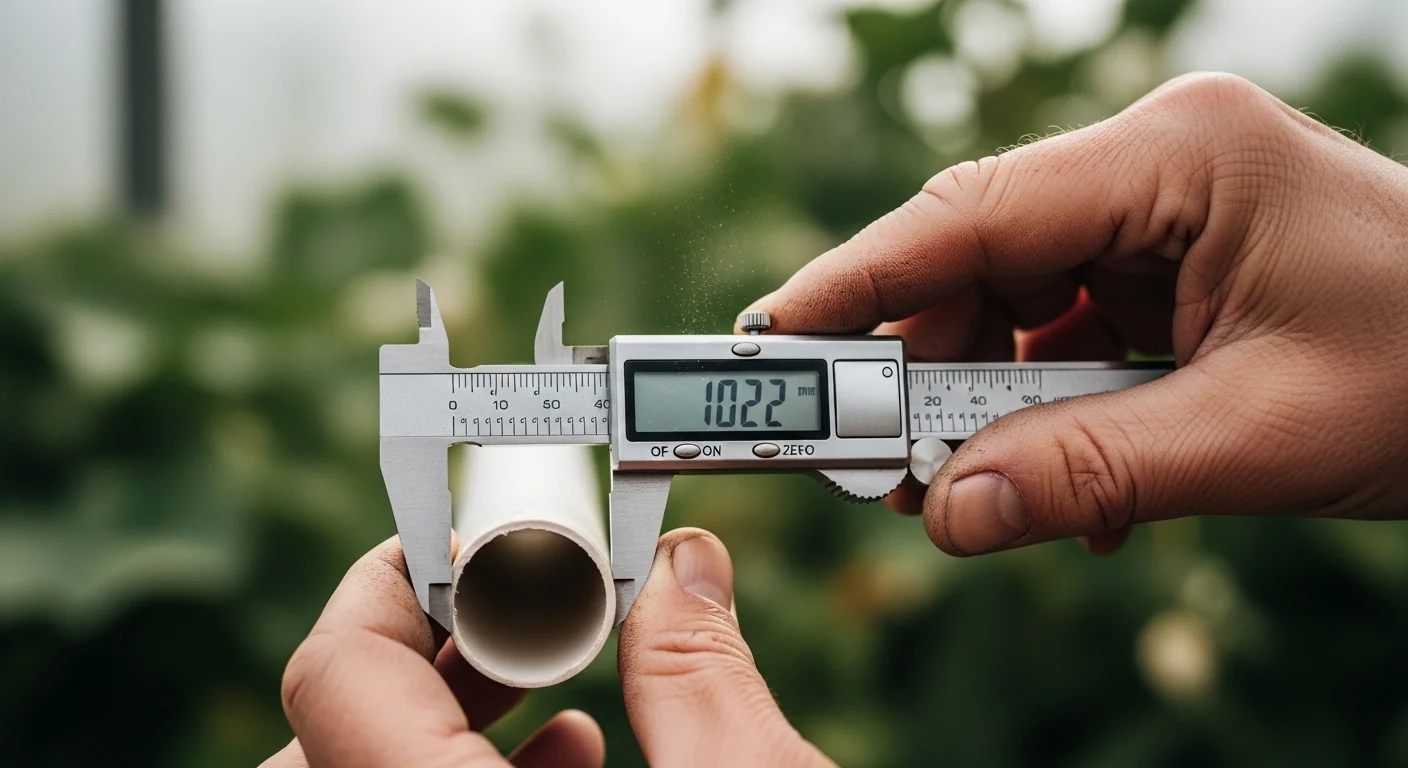
Before entering values, have three pieces of information ready: the inside (bore) diameter of your pipe in inches, the length of a single run in feet, and the count of identical runs in the system. For Schedule 40 PVC, the inside diameter is always smaller than the nominal size printed on the pipe, so check the specification sheet or measure the bore directly. Metric pipe users should convert millimeters to inches before entering values. If your runs differ in length or diameter, calculate each group separately and add the results. Systems that include gravity-fed lines may also need to cross-reference the gravity-fed drip irrigation calculator to confirm that head pressure is sufficient across the pipe volume being served.
Quick Start (60 Seconds)
- Pipe Length (ft): Enter the length of a single pipe run in feet. Do not enter total feet for all runs combined. The calculator multiplies by quantity automatically.
- Pipe Diameter (in): Enter the inside diameter, not the outside diameter, and not the nominal trade size. A 2-inch nominal PVC pipe has an inside diameter closer to 2.049 inches for Schedule 40. When in doubt, measure.
- Number of Runs: Enter the count of identical pipes running in parallel. If runs differ in size or length, calculate each group separately. Whole numbers only.
- Unit check: Length must be in feet. Diameter must be in inches. If your specs are in meters or millimeters, convert first. (1 meter = 3.281 ft; 1 mm = 0.03937 in)
- Read the weight output first: Total water weight is the figure most installers ignore. Check it before reading gallons.
- Per-run breakdowns: Use the “Per Run” outputs when verifying individual support hangers or calculating fill time for a single line.
- Run the reference table: After calculation, compare your diameter against the quick-lookup table on this page to sanity-check the result against neighboring pipe sizes.
Inputs and Outputs (What Each Field Means)
| Field | Unit | What It Means | Common Mistake | Safe Entry Guidance |
|---|---|---|---|---|
| Pipe Length | feet (ft) | The length of a single pipe run from end to end | Entering total combined length of all runs instead of one run’s length | Measure or read the cut-list length for one piece; enter only that |
| Pipe Diameter | inches (in) | The inside bore diameter of the pipe, not the outside or nominal trade size | Using nominal trade size (e.g. “4 inch”) when the actual bore is smaller | Check the pipe specification sheet; for Schedule 40 PVC use tabulated inside diameters |
| Number of Runs | whole number | How many identical pipe segments run in parallel or in series as a system | Entering 0 or fractional runs; forgetting to count return lines in recirculating systems | Count physical pipe pieces of the same length and diameter; enter as an integer |
| Total Volume (Gallons) | US gallons | Total liquid capacity of all runs combined, assuming full flooding | Treating this as a flow rate; it is a static capacity, not gallons per minute | Use to size reservoirs, top-off tanks, and chemical dosing volumes |
| Volume (ft³) | cubic feet | Total volume in cubic feet before unit conversion; useful for structural calculations | Confusing ft³ with gallons; 1 ft³ = 7.48 US gallons | Use this figure for structural or civil engineering calculations that require SI-adjacent units |
| Water Weight (lbs) | pounds (lbs) | Total hydrostatic load when the system is fully flooded with fresh water at 60°F | Ignoring this output entirely; most structural failures in grow systems trace to neglected water weight | Add pipe dead weight and hardware weight on top of this figure for total hanger load |
| Per Run (gal) | US gallons | Gallons held by a single pipe run | Using total gallons instead of per-run gallons when sizing individual zone valves or drippers | Use per-run figures when each run has its own valve, pump, or flow meter |
| Weight per Run (lbs) | pounds (lbs) | Water weight carried by a single run; critical for point-load hanger sizing | Dividing total weight evenly across hangers without accounting for run count | Design each hanger to carry at least the per-run weight plus the pipe’s own dead load |
Worked Examples (Real Numbers)
Example 1: Single 2-Inch Irrigation Lateral, 100 Feet
- Pipe Length: 100 ft
- Pipe Diameter: 2 in (inside bore; Schedule 40 nominal 2″ is approximately 2.049″, rounded to 2 in here for illustration)
- Number of Runs: 1
Radius = (2 / 2) / 12 = 0.0833 ft
Volume = 3.14159 x 0.0833² x 100 = 3.14159 x 0.006944 x 100 = 2.182 ft³
Gallons = 2.182 x 7.48052 = 16.32 gal
Water Weight = 16.32 x 8.34 = 136.1 lbs
Result: 16.32 gallons, 2.182 ft³, 136.1 lbs
A 100-foot run of 2-inch pipe holds just over 16 gallons, weighing 136 pounds fully flooded. That load on a single overhead support line requires at minimum a rated pipe hanger plus verification of the substrate anchor pull-out strength.
Example 2: Hydroponic NFT System, 4-Inch PVC, Three 50-Foot Runs
- Pipe Length: 50 ft per run
- Pipe Diameter: 4 in
- Number of Runs: 3
Radius = (4 / 2) / 12 = 0.1667 ft
Volume per run = 3.14159 x 0.1667² x 50 = 3.14159 x 0.02779 x 50 = 4.363 ft³
Gallons per run = 4.363 x 7.48052 = 32.64 gal
Total gallons = 32.64 x 3 = 97.92 gal
Total water weight = 97.92 x 8.34 = 816.7 lbs
Result: 97.92 gallons total, 816.7 lbs total water weight (32.64 gal and 272.2 lbs per run)
Three 4-inch NFT channels at 50 feet each hold nearly 100 gallons of nutrient solution. At 816 pounds of hydrostatic load alone, the racking and overhead framing must be engineered for this point load well before installation. The reservoir must hold at least 98 gallons at channel capacity, plus a working buffer for pump submersion and evaporation losses.
Example 3: Large Irrigation Main, 6-Inch Pipe, Two 200-Foot Runs
- Pipe Length: 200 ft per run
- Pipe Diameter: 6 in
- Number of Runs: 2
Radius = (6 / 2) / 12 = 0.25 ft
Volume per run = 3.14159 x 0.25² x 200 = 3.14159 x 0.0625 x 200 = 39.27 ft³
Gallons per run = 39.27 x 7.48052 = 293.8 gal
Total gallons = 293.8 x 2 = 587.6 gal
Total water weight = 587.6 x 8.34 = 4,900.6 lbs
Result: 587.6 gallons total, 4,900.6 lbs total water weight
Two runs of 6-inch main at 200 feet each hold nearly 590 gallons and almost 2.5 tons of water. This scale changes the analysis entirely. Pressure surge calculations become mandatory for valve closure events, and the trench or support structure must account for the combined dead and live load across the full pipe run.
Reference Table (Fast Lookup)
All values below are computed for a 100-foot single pipe run fully flooded with fresh water. The “Gal per 10 ft” column is derived for quick mental scaling to any length.
| Inside Diameter (in) | Radius (ft) | Volume per 100 ft (ft³) | Gallons per 100 ft | Water Weight per 100 ft (lbs) | Gallons per 10 ft (derived) |
|---|---|---|---|---|---|
| 0.5 | 0.0208 | 0.136 | 1.02 | 8.5 | 0.10 |
| 1 | 0.0417 | 0.545 | 4.08 | 34.0 | 0.41 |
| 1.5 | 0.0625 | 1.227 | 9.18 | 76.6 | 0.92 |
| 2 | 0.0833 | 2.182 | 16.32 | 136.1 | 1.63 |
| 3 | 0.1250 | 4.909 | 36.72 | 306.3 | 3.67 |
| 4 | 0.1667 | 8.727 | 65.27 | 544.5 | 6.53 |
| 6 | 0.2500 | 19.635 | 146.88 | 1,224.9 | 14.69 |
| 8 | 0.3333 | 34.907 | 261.12 | 2,177.7 | 26.11 |
| 10 | 0.4167 | 54.542 | 408.00 | 3,402.7 | 40.80 |
| 12 | 0.5000 | 78.540 | 587.52 | 4,899.9 | 58.75 |
To use this table for any length other than 100 ft: multiply the gallons figure by (your length / 100). For example, 4-inch pipe at 75 ft = 65.27 x 0.75 = 48.95 gallons per run.
How the Calculation Works (Formula and Assumptions)
Show the calculation steps
Step 1: Convert diameter to radius in feet
The input diameter is in inches. Dividing by 2 gives the radius in inches. Dividing again by 12 converts to feet, which is the unit required to produce cubic feet in the final formula.
Radius (ft) = (Diameter_inches / 2) / 12
Step 2: Compute cylinder volume per run
A pipe is a cylinder. The volume formula is the cross-sectional area of a circle (pi times radius squared) multiplied by the length.
Volume_per_run (ft³) = π × Radius² × Length_ft
Pi is used at full double-precision (3.14159265…) with no rounding until the final output display.
Step 3: Convert cubic feet to US gallons
One US gallon equals exactly 231 cubic inches, which converts to 0.133681 cubic feet. The inverse is 7.48052 US gallons per cubic foot. This is the exact conversion factor used.
Gallons_per_run = Volume_per_run × 7.48052
Step 4: Scale by number of runs
Total_gallons = Gallons_per_run × Quantity
Total_ft3 = Volume_per_run × Quantity
Step 5: Compute water weight
Fresh water at approximately 60 degrees Fahrenheit weighs 8.34 pounds per US gallon. This is a common engineering constant used in plumbing and irrigation design.
Total_weight_lbs = Total_gallons × 8.34
Rounding rules: All intermediate calculations are kept at full floating-point precision. Displayed outputs are rounded to 2 decimal places for gallons and pounds, 3 decimal places for cubic feet.
Assumptions and Limits
- Inside diameter only. The formula uses the bore (inside) diameter. For Schedule 40 PVC, the inside diameter is consistently smaller than the nominal trade size. Using outside diameter will significantly overstate volume, especially at small diameters.
- Fully flooded assumption. The tool calculates the maximum static volume. Pipes that are only partially full, flowing at slope, or running under suction hold less. NFT channels, for example, carry a thin film rather than full bore flow.
- Fresh water density. The 8.34 lbs/gallon constant is accurate for fresh water near 60 degrees Fahrenheit. Nutrient solutions, salt water, and chemicals are measurably denser. A 5-nutrient EC solution at typical concentrations adds roughly 0.1 to 0.3 lbs per gallon depending on formulation.
- No fittings or dead-legs. The volume of elbows, tees, unions, and trapped sections is not included. For complex systems, adding 5 to 10 additional gallons as a buffer is reasonable practice.
- Cylindrical geometry only. The formula does not apply to oval, rectangular, or corrugated pipe profiles. It is accurate for round pipe and round tubing only.
- Input limits. The calculator accepts pipe lengths up to 10,000 feet, diameters up to 120 inches, and up to 500 runs. Inputs outside those ranges produce a validation error and no calculation is performed.
- Temperature effects. Water expands slightly at higher temperatures. At 140 degrees Fahrenheit, water density drops to roughly 8.17 lbs/gallon. For hot-water pipe systems, the weight output will be a small overestimate.
- No dynamic pressure. Water weight under pressure is the same as at atmospheric pressure for incompressible fluids at system-design pressures. The static weight figure is appropriate for structural load calculations.
Standards, Safety Checks, and Secret Sauce Warnings
Critical Warnings

- Hanging pipe hanger load threshold: The tool flags a warning when a single pipe run exceeds 50 pounds of water weight. Standard pipe hanger spacing tables for PVC and HDPE are designed around the combined dead load (pipe weight) and live load (fluid weight). A single 4-inch pipe run at 100 feet of length carries 65.27 gallons and 544 pounds of water. That live load alone exceeds the rated load for many residential anchor types. Before hanging any system where the per-run weight exceeds 50 lbs, verify hanger spacing, anchor type, and substrate pull-out ratings against the actual load.
- Total system weight over 200 lbs requires engineering review: When the full system water weight exceeds 200 pounds, the supporting structure should be reviewed by someone who can confirm that floor framing, roof structure, or wall-mounted racking is adequate. This applies equally to greenhouse NFT racks, rooftop irrigation mains, and raised-bed header assemblies mounted to unverified lumber or steel.
- Nutrient solution is heavier than fresh water: Hydroponic systems using concentrated nutrient solutions carry fluid denser than the 8.34 lbs/gallon constant. The water weight output in this tool is a minimum estimate for solution-filled systems. Add a safety margin when sizing structural support for grow rooms.
- Pressure surges are not accounted for: The static volume and weight calculation does not capture water hammer effects, which can multiply instantaneous pipe stress severalfold. For systems with fast-closing solenoid valves or pump startup events, the water hammer calculator should be used alongside this tool to assess surge pressure risk.
Minimum Standards
- Schedule 40 PVC inside diameters must be sourced from ASTM D1785 specification tables, not from pipe packaging or nominal labels. The difference between nominal and actual inside diameter ranges from 0.049 inches at 0.5-inch pipe to 0.374 inches at 6-inch pipe.
- For HDPE pipe, use the inside diameter corresponding to the Dimension Ratio (DR) rating of the specific pipe. DR 11 and DR 17 pipe of the same nominal size have different wall thicknesses and therefore different bore diameters.
- Irrigation system designers using this tool for pump selection should add at minimum a 20-gallon reservoir buffer above the computed pipe volume to ensure the pump impeller remains submerged at all operating conditions. Friction losses in the pipe itself must be evaluated separately using the PVC friction loss calculator before finalizing pump specifications.
Competitor Trap: Most online pipe volume calculators output only gallons or only cubic feet and stop there. The decision a designer actually needs is not “how many gallons fit” but “can my structure hold the weight and can my pump move that volume in the target time window.” Skipping the water weight output, as most competing tools do, systematically leads installers to undersize hangers and omit the weight load from their structural assumptions. This is the category’s most common avoidable failure mode, and it is why the weight output in this tool is displayed prominently alongside the volume figure.
Common Mistakes and Fixes
Mistake: Using Nominal Pipe Size Instead of Inside Diameter
Nominal pipe sizes are trade designations, not actual measurements. A 4-inch nominal Schedule 40 PVC pipe has an inside diameter of 4.026 inches, and an 8-inch nominal Schedule 40 pipe has an inside diameter of 7.981 inches. Using the nominal size produces volume errors ranging from small at large diameters to material at small diameters. A 1-inch nominal pipe entered as 1 inch vs. the actual 1.049 inside diameter produces a nearly 10-point discrepancy in computed volume.
Fix: Look up the inside diameter from the ASTM specification sheet or the pipe manufacturer’s published dimension table before entering any value into this calculator.
Mistake: Entering Total System Length Instead of Per-Run Length
If you have three pipe runs each 40 feet long and enter 120 feet into the length field with a quantity of 3, the calculator returns nine times the correct volume. The length field expects a single run’s length. Quantity handles the multiplication.
Fix: Enter the length of one pipe segment. Enter the count of identical segments in the Quantity field.
Mistake: Ignoring Water Weight When Planning Run Times
Volume is also a fill-time variable. A 97-gallon system requires a pump to move 97 gallons from the reservoir to full pipe capacity before any solution reaches the far end of the run. Planners who calculate only gallons and not weight often also miss the fill-time implication for timed systems. If the timer activates a pump for only 60 seconds but it takes 90 seconds to flood the pipe fully, the far end of the run is never adequately irrigated. Accurate volume data is a prerequisite for drip irrigation run-time calculations in any timed system.
Fix: Divide total gallons by your pump’s flow rate (in gallons per minute) to find the minimum flood time before solution can be delivered at the far end of any run.
Mistake: Sizing the Pump to Flow Rate Without Accounting for System
Volume
A pump rated for 10 gallons per minute may seem adequate for a system with 100 gallons of pipe volume, but that figure tells you nothing about head pressure requirements, velocity constraints, or whether the pump can sustain output under the actual suction and discharge conditions of the installed system. Volume and pump performance interact: more pipe volume generally means more head loss and longer fill cycles. Mismatches between pipe volume and pump capacity are a primary source of uneven irrigation and zone starvation. The irrigation pump sizing calculator takes volume and system head into account together.
Fix: Use the volume figure from this tool as one input into a pump sizing workflow, not as a standalone pump selection criterion.
Mistake: Treating the Volume Output as a Flow Rate
Gallons computed here represent static capacity, the volume of liquid the pipe holds when stationary and full. This is not the same as gallons per minute, which describes how much liquid passes a point over time. Confusing the two leads to reservoir sizing errors and mismatch between what the pipe holds and what the pump must deliver in a cycle.
Fix: Label outputs clearly in your system design notes. “Pipe system holds 97 gallons” is a capacity figure. “Pump delivers 8 gallons per minute” is a flow rate. These numbers belong in different parts of your system calculation.
Next Steps in Your Workflow
Once you have the volume and weight figures in hand, the immediate next decision is usually pump sizing or reservoir sizing. For pump sizing, take the total gallons from this tool and combine it with the static head (vertical lift from reservoir to highest point in the system) to select a pump that delivers adequate flow at the required pressure. For reservoir sizing, a common rule of thumb for recirculating hydroponic systems is that the reservoir should hold at least the total pipe system volume plus an additional working volume to keep the pump submerged and account for evapotranspiration. If the system involves timed overhead sprinkler zones, use the computed per-run gallons to feed a sprinkler run-time calculation so that each zone receives adequate application before the timer cycles off.
For systems that collect or recirculate water from rooftops, catchment areas, or holding tanks, the pipe volume figure feeds directly into total system capacity planning. A 587-gallon main pipe system paired with a 300-gallon storage tank has a total system hold of nearly 900 gallons, which changes the sizing requirements for filtration, treatment, and distribution infrastructure. That kind of whole-system accounting is where the rainwater collection calculator becomes a natural companion to this tool.
FAQ
Does this calculator work for HDPE, aluminum, or copper pipe?
Yes, for any round cylindrical pipe, regardless of material. The formula depends only on inside diameter and length. HDPE, copper, galvanized steel, aluminum irrigation tube, and PVC all use the same cylinder volume equation. The only variable that changes by material is the actual inside diameter relative to nominal size, so always use the measured or specification-table bore diameter rather than the trade size label.
What is the difference between US gallons and imperial gallons?
This tool uses US gallons exclusively. One US gallon equals 231 cubic inches. One imperial (UK) gallon equals approximately 277.4 cubic inches, making it about 20 percent larger. If you are working with UK-based pipe sizing standards or importing equipment specified in imperial gallons, multiply the tool’s output by 0.833 to convert to imperial gallons.
How do I find the inside diameter of a PVC pipe if the spec sheet is
unavailable?
For Schedule 40 PVC, inside diameters follow ASTM D1785 and are widely published. Common values: 0.5-inch nominal = 0.622 in ID; 1-inch = 1.049 in ID; 2-inch = 2.049 in ID; 4-inch = 4.026 in ID; 6-inch = 6.065 in ID. For schedule 80, the outside diameter is the same but the wall is thicker, reducing the bore. If the pipe is unmarked, a caliper measurement of the bore is more reliable than any approximation.
Can I use this for drip tape or emitter tubing?
The cylinder volume formula applies to drip tape and small-bore tubing, but the volumes involved at typical drip tape diameters (0.5 to 1 inch ID) are very small. A 100-foot run of half-inch drip tape holds roughly 1 gallon. For most drip system planning, the pipe volume in the supply header is more relevant to calculate than the volume in individual drip lines. The emitter output rate, not header volume, typically governs run-time decisions in drip systems.
Why does water weight matter for above-ground systems but not
underground ones?
Underground pipes transfer their water load directly into the surrounding soil and bedding material, so the structure above grade does not carry that load. Above-grade systems, including overhead irrigation headers, hanging NFT channels, and rooftop mains, suspend the full water weight through hangers, brackets, or framing. The structural implications of water weight only become a design variable when the support structure must carry that load rather than the ground.
What if my pipe runs are not all the same length or diameter?
Calculate each group of identical runs separately, then add the results manually. Enter the length and diameter for group one, note the total gallons and weight, reset, and repeat for group two. The final system totals are the sum of each group’s outputs. There is no built-in multi-segment feature; the tool is intentionally simplified for single-configuration calculations.
Conclusion
The single most avoidable mistake in this workflow is using the nominal trade size instead of the measured inside bore diameter. That error compounds with length and run count, and it propagates into every downstream calculation, from reservoir sizing to pump selection to hanger load ratings. Double-check the bore diameter before entering any value. For drainage and subsurface applications where pipe sizing intersects with soil and slope parameters, the French drain calculator covers those calculations with the same level of structural and hydraulic detail.