
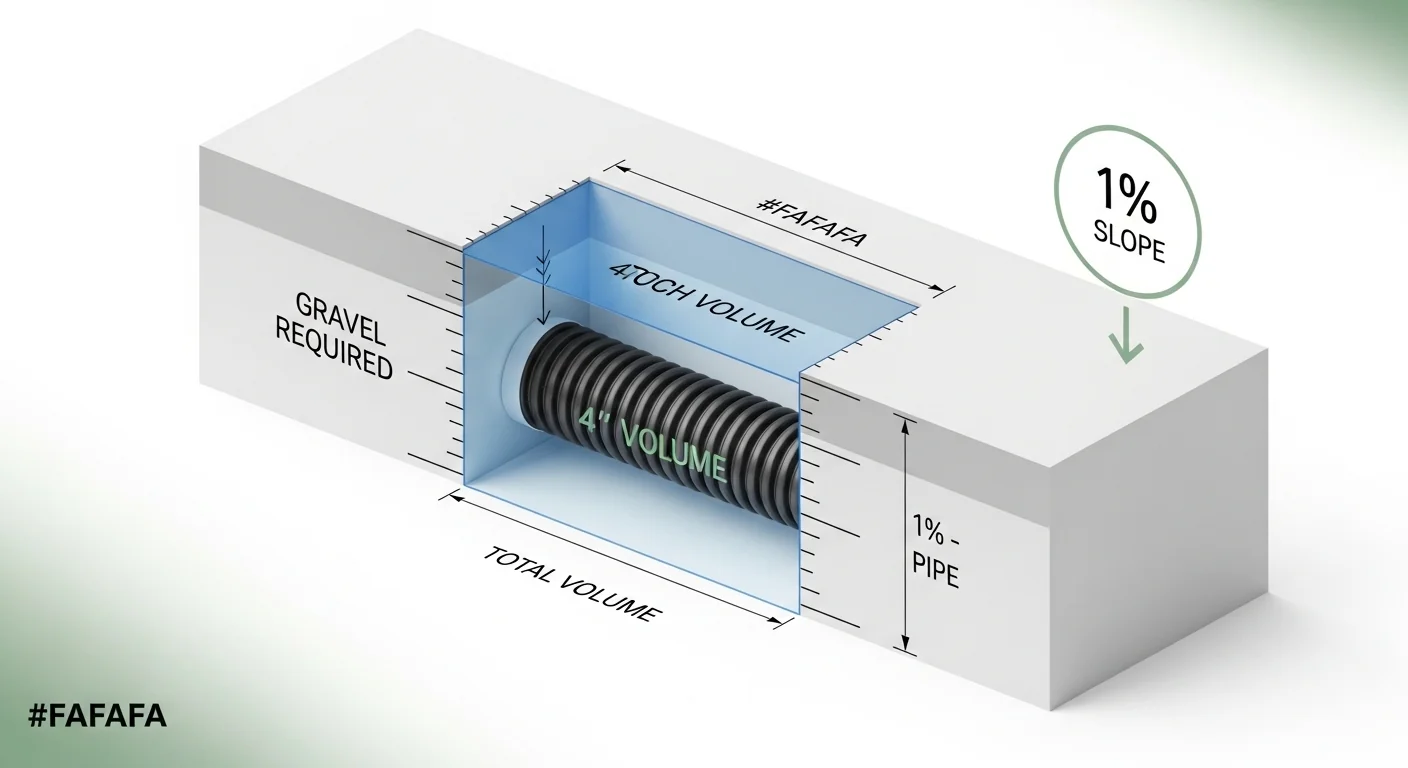
A french drain fails for one of two reasons: the wrong slope, or the wrong fabric strategy. Most homeowners dig the trench, drop in a pre-socked corrugated pipe, backfill with gravel, and declare the job done. Within two years, the system is fully blocked. Silt migrates through the gravel column and plugs the fine pores of the factory-wrapped sock from the outside in. No inspection reveals it until the water is back in the basement. The failure is structural, not accidental.
This french drain calculator handles four critical outputs that most online tools skip entirely: trench volume in cubic yards, pipe displacement, the exact square footage of 4-oz non-woven geotextile fabric needed to wrap the gravel trench using the Burrito Method, and total slope drop in inches across the full run. It does not model soil permeability, peak storm flow, or outlet hydraulics. Those require site-specific engineering data this tool cannot provide.
After entering your trench dimensions and desired slope, you will know exactly how much gravel to order, whether your grade meets the 1% minimum standard, and how many linear feet of geotextile fabric roll to purchase before the crew arrives.
Use the Tool
| Measurement | Value |
|---|---|
| Total Trench Volume | |
| Pipe Displacement | |
| Gravel Required | |
| Slope Drop (total) | |
| Geotextile Fabric Needed |
| Length (ft) | Width × Depth | Gravel (yd³) | Slope Drop (in) | Fabric (sq ft) |
|---|
How This Calculator Works
Step 1 — Slope Drop
The total elevation change your pipe needs across the trench run:
Example: 50 ft trench at 1% slope → 50 × 12 × 0.01 = 6 inches of drop.
Step 2 — Trench Volume
Total excavated space in cubic yards:
Step 3 — Pipe Displacement
Volume the pipe occupies (cylinder formula), converted to cubic yards:
Note: Diameter is halved to get radius, then divided by 12 to convert inches to feet, giving feet for the radius. Then divided by 27 to get cubic yards.
Step 4 — Gravel Required
Step 5 — Geotextile Fabric
The Burrito Method requires fabric wrapping the entire outside of the trench. Fabric area = perimeter of the trench cross-section × length, plus 20% overlap:
Where Depth′ and Width′ are in feet. The 20% accounts for side laps and overlap at the top fold.
Assumptions & Limits
Fabric Method (Critical): This calculator assumes the professional “Burrito Method” — bare corrugated pipe with 4-oz non-woven geotextile fabric wrapping the entire gravel trench from the outside. Do NOT use fabric-socked pipe; silt passes through gravel and clogs the sock instantly.
Gravel type: Calculations assume clean, washed drainage gravel or river rock (no fines). Crushed stone with fines will reduce void space and is not recommended.
Pipe assumption: Single run of pipe, circular cross-section. Perforated corrugated HDPE is assumed.
Slope minimum: The International Residential Code (IRC) recommends a minimum 1% slope (1 inch per 8 feet) for surface drainage. Sub-surface drains should also maintain ≥1% to prevent sediment settling inside the pipe.
Fabric overlap: A 20% area addition is included for edge laps and the top fold. Buy in 6-ft wide rolls for a standard 12–18″ trench.
Compaction: Gravel volume does not account for compaction. Add 5–10% buffer when ordering.
Unit limits: Trench length: 1–5000 ft. Width: 4–72 in. Depth: 4–120 in. Slope: 0.5–20%. Pipe: 2–24 in diameter.
Before you start, have your trench plan in hand. You need the total run length in feet, the planned trench width and depth in inches, your target slope as a percentage, and the diameter of the pipe you intend to install. If you are sizing a driveway channel or roadside swale alongside this project, the driveway culvert size calculator handles the inlet and pipe sizing separately from the trench fill volume covered here.
Quick Start (60 Seconds)
- Trench Length (ft): Measure the full horizontal run from the inlet point to the outlet. Do not measure along the slope; measure the flat ground distance. Accepted range: 1 to 5,000 ft.
- Trench Width (inches): Enter the planned excavation width, not the pipe diameter. A 4-inch pipe typically sits in a 12-inch-wide trench. Minimum 4 inches, maximum 72 inches. Common mistake: entering pipe diameter here instead of trench width.
- Trench Depth (inches): Measure from finished grade to the bottom of the trench. Typical residential installs run 12 to 24 inches deep. Do not account for slope change here; enter the average or maximum depth.
- Desired Slope (%): The grade of the pipe run. Enter 1 for 1%, which is the minimum. The tool will flag any value below 1% as a failure. For flat lots with no natural grade, this is the number your laser level is set to achieve.
- Pipe Diameter (inches): The outside diameter of the corrugated HDPE pipe you will install. Standard residential installs use 4-inch pipe. Enter 6 for heavier-duty commercial applications. The pipe diameter must be smaller than the trench width or the calculator will not run.
Inputs and Outputs (What Each Field Means)
| Name | Unit | What It Means | Common Mistake | Safe Entry Guidance |
|---|---|---|---|---|
| Trench Length | feet | Total horizontal run of the trench from inlet to outlet | Measuring along the slope instead of the horizontal ground | Use a measuring tape flat along the surface; 1 to 5,000 ft |
| Trench Width | inches | Interior excavation width; the gravel fill and pipe both sit inside this dimension | Entering pipe diameter (4 in) instead of trench width (12 in) | Width must exceed pipe diameter; typical residential: 8 to 18 inches |
| Trench Depth | inches | Distance from finished grade to the bottom of the excavation | Forgetting to account for the 2-inch gravel bed below the pipe | Add 2 to 3 inches to your intended pipe depth; typical: 12 to 30 inches |
| Desired Slope | percent (%) | Grade of the pipe run; controls slope drop calculation and pass/fail status | Entering 0 or leaving it blank on flat lots, then burying pipe level | Minimum 1%; 0.5 to 20% accepted; use a laser transit level to verify on site |
| Pipe Diameter | inches | Outside diameter of the corrugated HDPE pipe being installed | Using inside diameter from the pipe spec sheet instead of outside diameter | Standard residential: 4 in; heavier applications: 6 in; must be less than trench width |
| Total Trench Volume | yd³ | Total excavated space; useful for estimating spoil disposal and equipment needs | Ordering gravel equal to trench volume, ignoring pipe displacement | Output only; verify against your gravel supplier’s minimum delivery quantity |
| Pipe Displacement | yd³ | Volume the pipe physically occupies inside the trench; subtracted from gravel order | Ignoring this value and over-ordering gravel by 5 to 15% | Output only; displacement grows significantly with 6-inch pipe on long runs |
| Gravel Required | yd³ | Net clean drainage gravel needed to fill the trench around and above the pipe | Not adding a 5 to 10% buffer for compaction and spillage | Add at least 10% when calling your supplier; primary output for ordering |
| Slope Drop | inches (and feet) | Total elevation change from the high inlet end to the outlet over the full run | Assuming slope drop is small; a 100-ft run at 1% drops a full foot | Use this value to verify your outlet is actually lower than your inlet before digging |
| Geotextile Fabric | sq ft | Total 4-oz non-woven geotextile fabric area needed to wrap the entire gravel trench using the Burrito Method | Buying pre-socked pipe instead of separate fabric rolls | Includes 20% overlap allowance; divide by roll square footage to get number of rolls |
For a deeper look at pipe geometry and how pipe cross-section affects displacement calculations, the pipe volume calculator covers cylindrical volume across a range of diameters and lengths.
Worked Examples (Real Numbers)
Example 1: Standard Backyard Swale (50-ft Run)
- Trench Length: 50 ft
- Trench Width: 12 in
- Trench Depth: 18 in
- Desired Slope: 1%
- Pipe Diameter: 4 in
Result: Trench Volume = 2.78 yd³, Pipe Displacement = 0.16 yd³, Gravel Required = 2.62 yd³, Slope Drop = 6.0 inches, Geotextile Fabric = 240 sq ft.
A single cubic yard delivery plus a partial second yard covers the gravel. At 1%, the outlet sits exactly 6 inches lower than the inlet, which is a manageable excavation challenge on most residential lots. Two standard 6-ft wide by 50-ft fabric rolls provide more than enough material with overlap.
Example 2: Long Driveway Perimeter Run (150-ft at 1.5%)
- Trench Length: 150 ft
- Trench Width: 18 in
- Trench Depth: 24 in
- Desired Slope: 1.5%
- Pipe Diameter: 4 in
Result: Trench Volume = 16.67 yd³, Pipe Displacement = 0.49 yd³, Gravel Required = 16.18 yd³, Slope Drop = 27.0 inches (2.25 ft), Geotextile Fabric = 990 sq ft.
The slope drop of 27 inches over 150 feet is significant. Confirm that the outlet end of the trench does not daylight too shallow to be covered or, alternatively, too deep to connect to an existing storm inlet. This is precisely the scenario where running a laser transit level across the full run before excavation prevents a costly elevation mismatch.
Example 3: Foundation Perimeter Drain (100-ft, 6-inch Pipe)
- Trench Length: 100 ft
- Trench Width: 12 in
- Trench Depth: 30 in
- Desired Slope: 1%
- Pipe Diameter: 6 in
Result: Trench Volume = 9.26 yd³, Pipe Displacement = 0.73 yd³, Gravel Required = 8.53 yd³, Slope Drop = 12.0 inches (1.0 ft), Geotextile Fabric = 720 sq ft.
A 6-inch pipe on a 12-inch-wide trench is a tight fit; the tool will flag this because there is less than 3 inches of gravel clearance on either side of the pipe. In practice, widening to an 18-inch trench for a 6-inch pipe is strongly recommended by most drainage contractors. This example illustrates why pipe-to-trench ratio matters, not just gravel volume.
Reference Table (Fast Lookup)
All rows below assume 4-oz non-woven geotextile fabric and 4-inch corrugated HDPE pipe unless noted. Fabric area includes a 20% overlap allowance.
| Length (ft) | Width (in) | Depth (in) | Slope (%) | Trench Vol (yd³) | Gravel Req. (yd³) | Slope Drop (in) | Fabric (sq ft) |
|---|---|---|---|---|---|---|---|
| 25 | 12 | 18 | 1 | 1.39 | 1.23 | 3.0 | 120 |
| 50 | 12 | 18 | 1 | 2.78 | 2.62 | 6.0 | 240 |
| 50 | 12 | 18 | 2 | 2.78 | 2.62 | 12.0 | 240 |
| 100 | 12 | 18 | 1 | 5.56 | 5.23 | 12.0 | 480 |
| 100 | 18 | 24 | 1 | 11.11 | 10.79 | 12.0 | 660 |
| 150 | 12 | 18 | 1 | 8.33 | 7.85 | 18.0 | 720 |
| 150 | 18 | 24 | 1.5 | 16.67 | 16.18 | 27.0 | 990 |
| 200 | 12 | 18 | 1 | 11.11 | 10.46 | 24.0 | 960 |
| 200 | 18 | 24 | 1 | 22.22 | 20.77* | 24.0 | 1320 |
*Row 9 uses 6-inch pipe. Pipe displacement increases to 1.45 yd³ at this diameter and length.
How the Calculation Works (Formula + Assumptions)
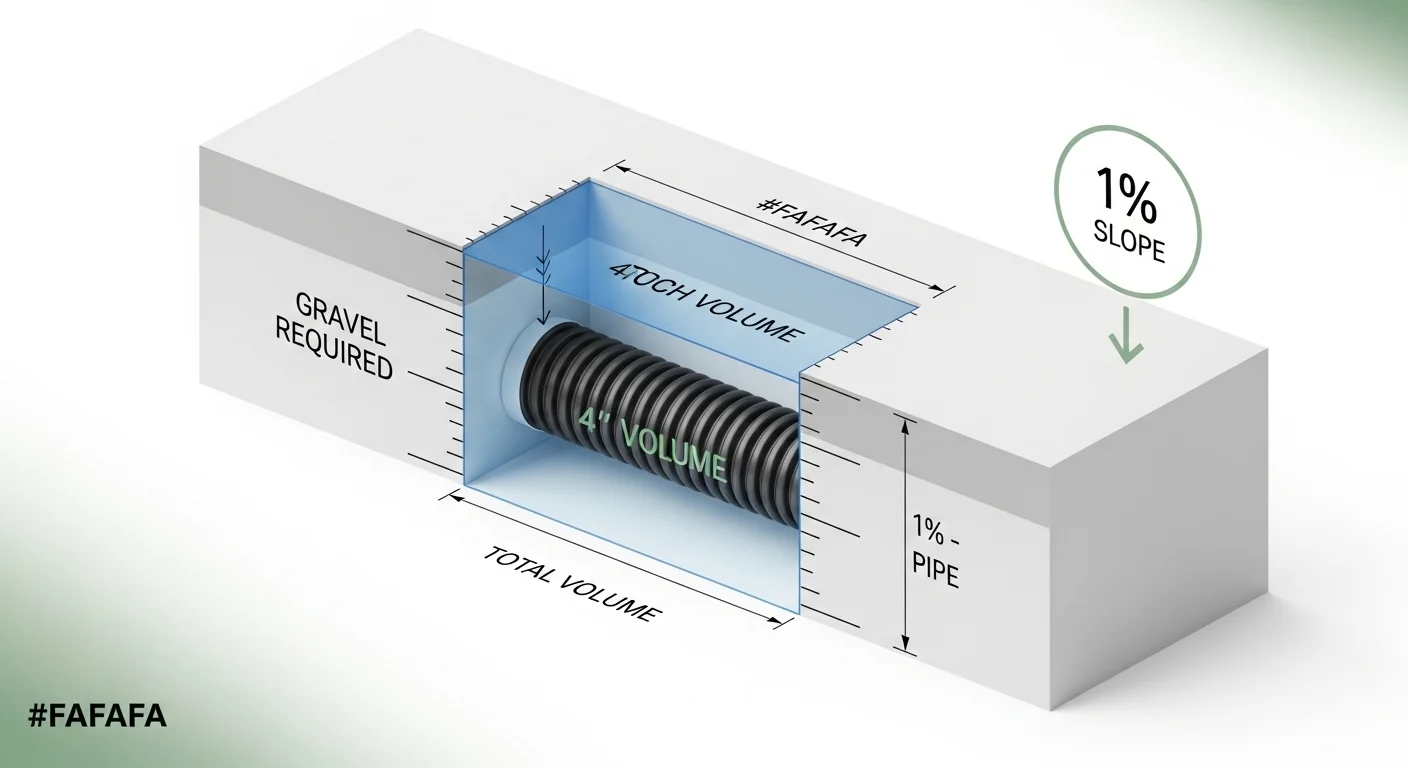
Show the calculation steps
Step 1: Slope Drop
Converts your percentage grade into a concrete elevation change in inches across the full run.
SlopeDrop (in) = Length (ft) x 12 x (Slope% / 100)
A 100-ft run at 1% grade drops exactly 12 inches. At 2%, it drops 24 inches. This number tells you how much lower your outlet needs to be compared to your inlet before a single shovel of dirt is moved.
Step 2: Trench Volume
Calculates the total excavated space in cubic yards, which is the unit your gravel supplier quotes in.
TrenchVol (yd³) = [Length (ft) x (Width (in) / 12) x (Depth (in) / 12)] / 27
Dividing width and depth by 12 converts inches to feet. Dividing the result by 27 converts cubic feet to cubic yards. No compaction factor is applied at this stage.
Step 3: Pipe Displacement
Applies the cylinder volume formula to the pipe cross-section over the run length.
PipeVol (yd³) = pi x (PipeDiameter (in) / 24)² x Length (ft) / 27
Dividing diameter by 24 converts to radius in feet (diameter divided by 2 gives radius in inches, divided by 12 converts to feet). The result is divided by 27 to reach cubic yards. For a standard 4-inch pipe at 100 feet, displacement is approximately 0.32 yd³, which is meaningful at scale.
Step 4: Gravel Required
GravelRequired (yd³) = TrenchVol - PipeVol
This is the net fill volume. Add 10% when placing your order to account for uneven compaction, minor spillage, and gravel settlement over the first season.
Step 5: Geotextile Fabric Area
Calculates the fabric needed to line the trench walls and bottom using the Burrito Method, with a 20% area addition for laps and top fold.
FabricSqFt = [(2 x Depth (ft)) + Width (ft)] x Length (ft) x 1.20
The factor 1.20 adds 20% for edge overlaps where the fabric sheets meet and for the top fold that closes the gravel bundle. Purchase fabric in 6-ft wide rolls for trenches up to 18 inches wide; 8-ft wide rolls for deeper or wider excavations.
Assumptions and Limits
- Fabric method: All fabric area calculations assume the Burrito Method, meaning a single continuous wrap around the outside of the entire gravel column. Pre-socked pipe is excluded from this model.
- Gravel type: Assumes clean, washed drainage gravel or river rock with negligible fines. Crushed stone with fine material reduces effective void space and will cause the drain to underperform relative to this calculation.
- Single pipe run: The pipe displacement formula applies to one continuous pipe. Branching configurations require separate calculations for each segment.
- Uniform cross-section: The calculator assumes a rectangular trench cross-section of constant width and depth. Trapezoidal trench walls (typical of backhoe excavation) will produce slightly more spoil volume than shown.
- No compaction factor in primary result: Order at least 10% more gravel than the calculated figure. Pea gravel and river rock settle differently; larger stone settles less.
- Slope check is advisory: The 1% minimum threshold reflects widely cited drainage practice and is consistent with IRC surface drainage guidance. Sub-surface perforated pipe drainage on very flat sites may require additional engineering review beyond what this tool provides.
- Fabric overlap is estimated: The 20% area buffer is a reasonable field estimate. Sites with tight corners, multiple direction changes, or wide trenches may require additional fabric.
- Input limits: Length 1 to 5,000 ft; width 4 to 72 inches; depth 4 to 120 inches; slope 0.5 to 20%; pipe diameter 2 to 24 inches.
Standards, Safety Checks, and “Secret Sauce” Warnings
Critical Warnings
- The Fabric Sock is a Structural Failure, Not a Feature: Pre-wrapped corrugated pipe (the kind sold with a black fabric sock already attached) is designed for situations where the pipe is buried directly in native soil, with no gravel envelope. When you bury a socked pipe inside a gravel-filled trench, silt from the surrounding soil washes through the coarse gravel, reaches the sock, and clogs its fine pores from the outside. The gravel does not stop silt. The sock cannot self-clean. The pipe becomes inoperable, typically within one to three seasons.
- Sub-1% Slope Creates Sedimentation Inside the Pipe: Corrugated pipe has internal ridges that trap silt when water velocity is insufficient to carry it through. A slope below 1% produces slow-moving water that drops its sediment load inside the pipe rather than flushing it to the outlet. The tool flags this as a hard failure. Verify grade with a laser transit level, not a visual estimate or a standard bubble level.
- Outlet Elevation Must Be Verified Before Excavation: The slope drop output gives you the elevation difference between inlet and outlet. If your lot does not have enough vertical relief to achieve that drop at the outlet location you have in mind, no amount of careful installation will make the system work. Check outlet feasibility before committing to a trench route.
Minimum Standards
- Maintain a minimum 1% grade along the full pipe run. Verify with a laser transit level, not estimation.
- Use 4-oz non-woven geotextile fabric wrapping the entire outside of the gravel column. Do not use woven geotextile; woven fabric has larger pores and passes more fine sediment.
- Leave a minimum 3 inches of gravel clearance on all sides of the pipe. A 4-inch pipe requires at least a 10-inch-wide trench; 12 inches is the practical standard.
- Use only clean, washed drainage gravel or river rock. Avoid limestone screenings, concrete gravel, or any crushed stone with dust or fines content.
Competitor Trap: Nearly every other french drain calculator online asks you for trench dimensions and outputs a single gravel volume number. None of them address the fabric question at all. That omission is expensive: a homeowner who reads “order 6 cubic yards of gravel” and then goes to the hardware store and buys socked pipe because it is sold right next to the drainage gravel has just set up a system that will fail within two years. The burrito method, the pipe selection guidance, and the exact fabric square footage are not optional commentary. They are the part of the calculation that determines whether the project works.
Understanding how surface water reaches your french drain helps right-size the entire system. The yard drainage catch basin calculator handles the inlet sizing problem, which is the upstream companion to the trench volume calculation here. For sites where pipe flow capacity is the design constraint rather than volume, Manning’s equation quantifies how pipe diameter, slope, and roughness combine to set maximum flow rate.
Common Mistakes and Fixes
Mistake: Buying Pre-Socked Corrugated Pipe
The black fabric sock factory-wrapped around corrugated pipe is marketed as a convenience feature. In a gravel-envelope french drain, it functions as a sediment trap on the exterior of the pipe. Silt passes through the coarse gravel and lodges in the sock’s fine pores; water flow drops, and within a few seasons the system stops draining.
Fix: Purchase bare corrugated perforated pipe and purchase 4-oz non-woven geotextile fabric rolls separately. Wrap the fabric around the entire outside of the gravel-filled trench, not around the pipe.
Mistake: Using Felt or Woven Geotextile Instead of Non-Woven
Woven geotextile fabric has a more open mesh structure that allows fine particles to pass through over time. Felt-style landscape fabric is rated for weed suppression, not drainage filtration, and degrades rapidly in wet conditions. Both fail at the primary job: filtering silt out of the drainage gravel while permitting water flow.
Fix: Specify 4-oz non-woven needle-punched geotextile fabric. It is available at landscape supply wholesalers and online in rolls sized for typical trench widths.
Mistake: Ignoring Soil Infiltration Rate When Sizing the Trench
A french drain collects water from the surrounding soil and surface, then moves it. If the native soil has very low permeability, it delivers water to the trench slowly. If soil is highly permeable, the trench can receive large inflows quickly. Sizing only based on trench volume without understanding the soil’s delivery rate can result in an undersized or oversized system.
Fix: Run a basic soil percolation test before finalizing trench dimensions. The soil infiltration rate calculator provides the math for converting perc test results into drainage design parameters.
Mistake: Ordering Gravel Equal to the Raw Trench Volume
Trench volume and gravel required are not the same number. Pipe displacement reduces the void space in the trench, and gravel settlement after installation reduces effective volume further. Ordering by raw trench volume routinely leaves contractors a half-yard short on delivery day.
Fix: Use the gravel required output from this calculator (which already subtracts pipe displacement), then add a 10% buffer when calling the supplier. For large projects, order in split deliveries to avoid excess material on site.
Mistake: Assuming a Flat Lot Can Support a French Drain Without Engineered Grade
On genuinely flat lots, homeowners sometimes install french drains with a 0% slope because there is no visible grade change. Pipe laid level collects standing water, which breeds mosquitoes and deposits sediment. After a few seasons, the system is a buried mud log.
Fix: Flat lots require engineered grade using a laser transit level. The trench outlet must be lower than the inlet by the slope drop value shown in the calculator. On very flat sites, this may require connecting to a sump system or a gravity outlet at a significant depth. The sump pump calculator covers outlet sizing when gravity drainage alone cannot achieve the required slope drop.
Next Steps in Your Workflow
Once you have your gravel volume and fabric square footage from the calculator, the next step is confirming outlet feasibility. Walk the full trench route from the high inlet point to the planned outlet and note any obstructions: tree roots, utilities, foundation footings, or changes in lot elevation that could block the outlet path. Use the slope drop figure from the calculator as your minimum required elevation difference between the two endpoints. If your outlet is a daylight point on a slope, the calculation confirms exactly how far down that slope your pipe needs to exit.
For sites with agricultural tile drainage or large-scale field drainage adjacent to the project area, coordinating your french drain outlet with the tile system prevents backpressure and cross-system interference. The farm tile drainage calculator handles the sizing math for larger-diameter agricultural tile systems. If your project is part of a broader stormwater management plan that includes water collection upstream of the french drain, the rainwater collection calculator can help balance inflow estimates against the drainage capacity you are building here.
FAQ
What is the minimum slope for a french drain?
The widely cited standard for perforated pipe drainage is 1%, which equals 1 inch of vertical drop for every 100 inches of horizontal run. At this slope, water moves through the pipe fast enough to carry fine sediment to the outlet rather than depositing it inside the corrugations. Some sources cite 1 inch per 8 feet as the practical minimum for surface drainage applications. This calculator flags any slope below 1% as a failure condition.
How do I calculate how much gravel I need for a french drain?
Multiply the trench length in feet by the trench width in feet by the trench depth in feet, divide by 27 to convert to cubic yards, then subtract the pipe displacement volume. The pipe displacement is calculated using the cylinder volume formula: pi times the pipe radius in feet squared, times the length, divided by 27. This calculator performs all four steps and displays the result directly.
What is the Burrito Method for french drain installation?
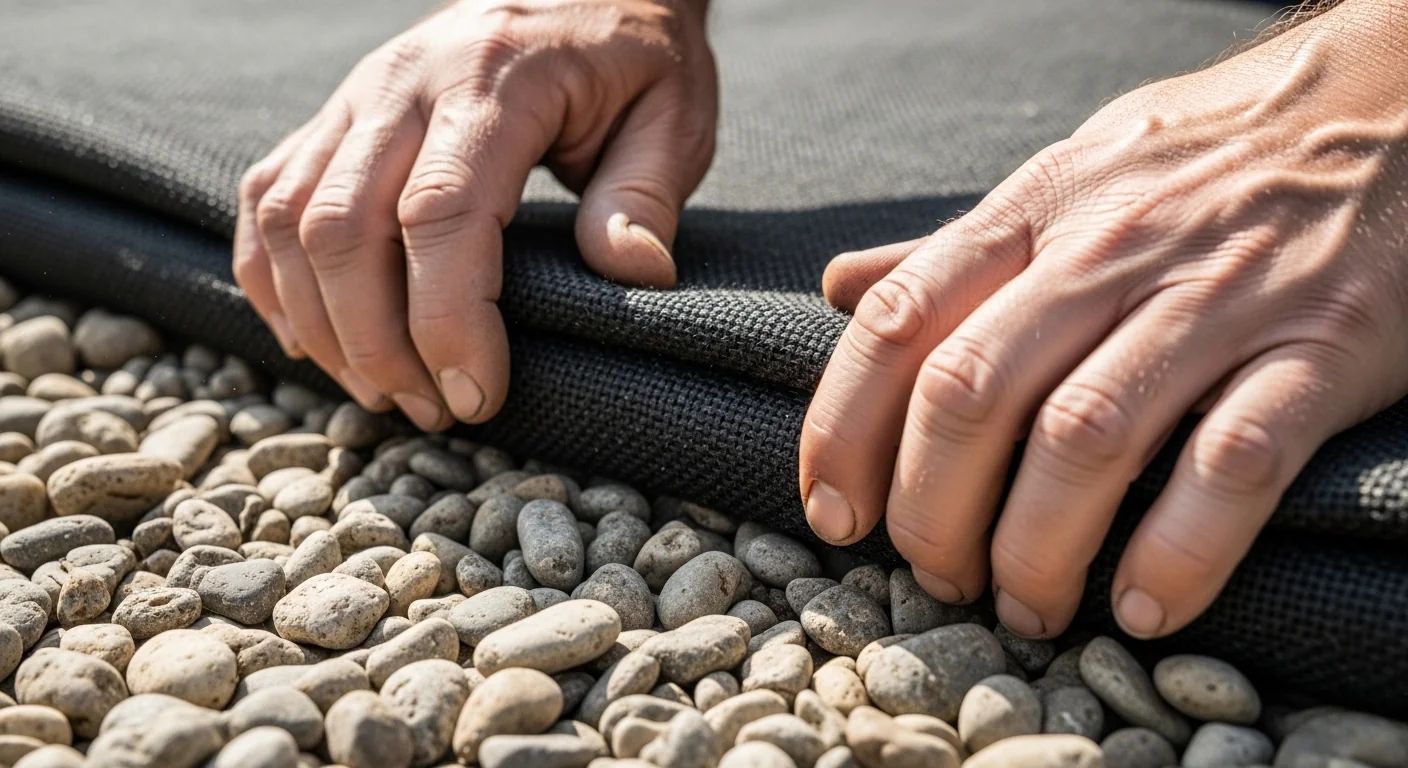
The Burrito Method refers to wrapping the entire gravel-filled trench in geotextile fabric, rather than wrapping the pipe alone. The fabric is laid in the bottom of the open trench, the gravel and pipe are placed, and then the fabric sides are folded over the top of the gravel before backfilling. This prevents silt from migrating from native soil into the gravel column while allowing groundwater to pass through freely.
Can I use crushed stone instead of washed river rock for french drain gravel?
Crushed stone with significant fine particle content is not suitable because fines reduce the void space available for water storage and movement. Clean crushed stone with minimal dust content can work, but washed rounded river rock or pea gravel is preferred because the rounded particles pack less tightly, maintaining higher void space. Whatever material you choose, specify “clean” or “washed” when ordering from a supplier.
Why does pipe diameter matter in a french drain gravel calculation?
The pipe physically occupies space inside the trench. For a standard 4-inch pipe over a 50-foot run, the displacement is modest, around 0.16 cubic yards. At 6-inch pipe over 200 feet, displacement exceeds 1.4 cubic yards. Ignoring this leads to under-ordering gravel. Additionally, large pipe in a narrow trench leaves insufficient gravel clearance on the sides, reducing the filter capacity of the system.
How much geotextile fabric do I need for a french drain?
Using the Burrito Method, fabric area equals the trench perimeter (two depths plus one width, in feet) multiplied by the run length, plus a 20% addition for overlap and the top fold. For a 100-foot trench that is 12 inches wide and 18 inches deep, the calculation produces approximately 480 square feet. This calculator outputs the exact figure based on your dimensions. Divide by the roll square footage to determine how many rolls to purchase.
Conclusion
The french drain calculator on this page gives you the four numbers that determine project success: gravel in cubic yards, geotextile fabric in square feet, slope drop in inches, and a pass or fail on your grade. The distinction between raw trench volume and net gravel volume is not cosmetic; it is the difference between the right delivery and a return trip to the supplier. The slope check is not optional commentary; a drain installed below 1% grade will sediment-fill and fail within a few years regardless of how carefully everything else is done.
The single most important takeaway from this page is the pipe selection decision. Pre-socked corrugated pipe is sold in the same aisle as drainage gravel at most home centers, which makes it easy to buy the wrong product by default. Bare pipe and a separately purchased roll of 4-oz non-woven geotextile fabric, installed using the Burrito Method, is not a more complicated installation. It is a fundamentally different one that does not fail by design. Run the numbers here, verify your outlet elevation on site, and buy the right materials before excavation begins.