
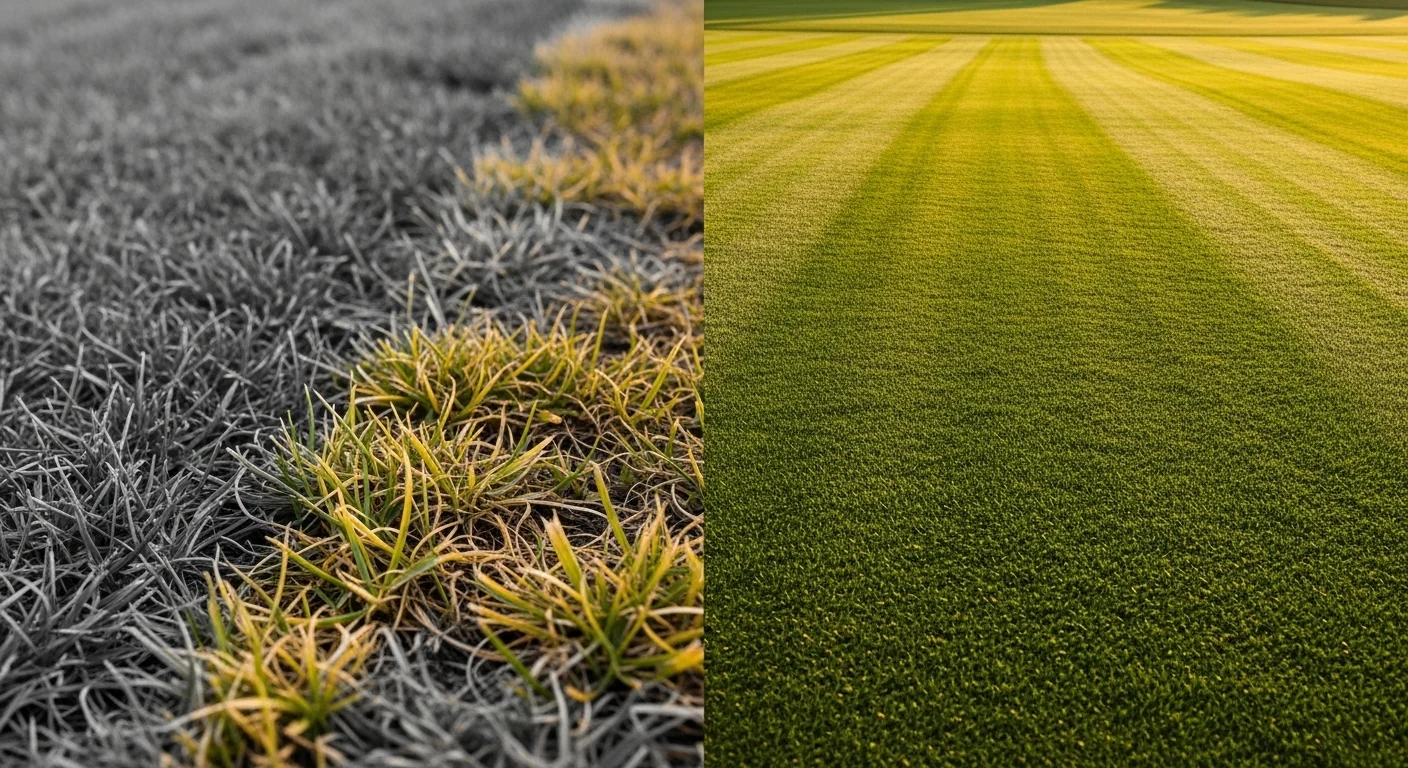
Effective lawn striping is a geometry problem disguised as an aesthetic one. The visual effect depends entirely on bending grass blades at a consistent angle so they reflect sunlight in alternating directions across your mowing passes. A roller accomplishes that bend through ground pressure measured in pounds per linear inch of contact, and that number, not the total weight of the roller, is the variable that determines whether your lawn looks like a ballpark or spends the rest of summer fighting off fungal disease.
This calculator computes the volumetric capacity of a cylindrical lawn roller, converts the chosen fill material’s density into total weight, and divides that weight across the full contact width to produce ground pressure in lbs per linear inch. It then compares that pressure against species-specific crown crush thresholds for both cool-season and warm-season grasses. What it does not claim to predict is actual stripe visibility, which depends on mowing height, blade condition, ambient light angle, and turf density, variables that are outside any weight calculation.
After running this tool you will know whether your roller setup falls below, near, or above the pressure range where vascular crown damage becomes a documented risk. If you are also optimizing the rest of your mowing routine, the mowing time calculator can help you estimate how long each striped pass will take across a given lawn area.
Use the Tool
Lawn Striping Weight Calculator
Before you open the calculator, have four pieces of information ready: your mower’s cutting deck width in inches (stamped on the mower deck or listed in your owner’s manual), the outer diameter of your striping roller in inches (measure across the widest point of the barrel, not the mounting arms), the fill material you plan to use, and the dominant grass species on your lawn. All measurements are in U.S. customary units. If your roller is narrower than your mowing deck, enter the actual roller width rather than the deck width to keep pressure calculations accurate.
High-lift mower blades stand grass blades upright before the roller contacts them and meaningfully improve stripe depth. If you are evaluating blade performance alongside your roller setup, the mower blade tip speed calculator can help you verify that your blade is operating within an effective cutting range.
Quick Start (60 Seconds)
- Mower Deck Width: Enter the cut width in inches, not the overall mower width. A 42-inch riding mower cuts 42 inches per pass. Do not measure the mower housing.
- Roller Outer Diameter: Measure across the outside of the barrel only. Exclude any mounting flanges or end caps. A 6-inch roller has a 3-inch radius used in the volume formula.
- Fill Material: Select what is physically inside the roller. Air means the roller is hollow or empty. Wet silica sand is the heaviest option and the most likely to exceed safe pressure limits.
- Grass Type: Cool-season grasses (Kentucky Bluegrass, Tall Fescue, Perennial Ryegrass) tolerate slightly more pressure than warm-season varieties. If your lawn contains a mixture, select warm-season to apply the stricter threshold.
- Read the pressure output first: The lbs per linear inch figure matters more than total roller weight. A 200-lb roller on a 60-inch deck produces less ground pressure than a 100-lb roller on a 24-inch deck.
- Check the traffic light: Green means you are safely below the species threshold. Yellow means you are within 80% of the limit and should avoid rolling during peak summer temperatures. Red means crown damage is likely.
- If you get a red result: The fix is almost always switching to a lighter fill material or supplementing with liquid chelated iron rather than relying on mechanical pressure for stripe contrast.
Inputs and Outputs (What Each Field Means)
| Field | Unit | What It Measures | Common Mistake | Safe Entry Guidance |
|---|---|---|---|---|
| Mower Deck Width | inches | The cutting swath width, used as the roller contact length across the turf | Entering overall mower housing width instead of cutting width | Check mower spec sheet; acceptable range is 10 to 120 inches |
| Roller Outer Diameter | inches | The external barrel diameter, halved into radius for the volume formula | Measuring inner fill chamber instead of outer barrel | Acceptable range is 2 to 36 inches; measure across barrel midpoint |
| Roller Fill Material | category | Sets the density constant (lbs per cubic inch) applied to calculated volume | Selecting “water” when the roller contains damp packed sand | Wet/packed silica sand uses the higher density value of 0.0694 lbs/in³ |
| Grass Type | category | Sets the crown crush pressure threshold for the safety check | Selecting cool-season when the lawn contains Bermuda or Zoysia | Choose warm-season for mixed lawns to apply the stricter 4.0 lbs/in limit |
| Total Roller Weight (output) | lbs | Fill weight calculated from volume times material density | Treating this as the only relevant number; it is not | Use this to compare across fill options, not as a standalone safety metric |
| Lbs per Linear Inch (output) | lbs/in | Ground pressure distributed across roller contact width; the actual safety metric | Ignoring this figure entirely when purchasing a roller | Below 4.0 is safe for all turf; 4.0 to 5.0 is caution range; above 5.0 is high risk |
| Safety Status (output) | Green / Yellow / Red | Traffic light result comparing lbs/in to the grass-specific threshold | Assuming green means the roller is light enough for any season or condition | Green is conditional on soil moisture and temperature; still avoid rolling during heat stress |
Worked Examples (Real Numbers)
Example 1: Push Mower with a Small Water-Filled Roller
- Mower Deck Width: 21 inches
- Roller Outer Diameter: 4 inches (radius = 2 inches)
- Fill Material: Water (density = 0.0361 lbs/in³)
- Grass Type: Cool-Season
Volume = 3.1416 x (2)² x 21 = 263.9 in³
Fill Weight = 0.0361 x 263.9 = 9.5 lbs
Lbs per Linear Inch = 9.5 / 21 = 0.45 lbs/in
Result: 9.5 lbs total, 0.45 lbs/in ground pressure. Status: Safe.
This is the typical push-mower kit scenario. The pressure is so low that the roller’s primary job is aesthetic, not structural. Water fill on a small roller produces a stripe effect through blade contact alone, not through meaningful compression. Stripe depth will be modest and will require consistent mowing direction across multiple cuts to become visible.
Example 2: Riding Mower with a Mid-Size Dry Sand Roller
- Mower Deck Width: 42 inches
- Roller Outer Diameter: 6 inches (radius = 3 inches)
- Fill Material: Silica Sand, Dry (density = 0.0578 lbs/in³)
- Grass Type: Cool-Season (Kentucky Bluegrass)
Volume = 3.1416 x (3)² x 42 = 1,130.97 in³
Fill Weight = 0.0578 x 1,130.97 = 65.4 lbs
Lbs per Linear Inch = 65.4 / 42 = 1.56 lbs/in
Result: 65.4 lbs total, 1.56 lbs/in ground pressure. Status: Safe.
This is a well-proportioned setup for a mid-range residential riding mower. The 42-inch deck distributes the 65-lb load effectively, keeping pressure well below the cool-season threshold of 5.0 lbs/in. Stripe definition at this pressure will be noticeably sharper than a water-filled small roller, especially on taller Bluegrass cut at 3.5 to 4 inches.
Example 3: Tow-Behind Roller with Wet Silica Sand (Danger Scenario)
- Mower Deck Width: 54 inches
- Roller Outer Diameter: 10 inches (radius = 5 inches)
- Fill Material: Silica Sand, Wet / Packed (density = 0.0694 lbs/in³)
- Grass Type: Warm-Season (Bermuda)
Volume = 3.1416 x (5)² x 54 = 4,241.15 in³
Fill Weight = 0.0694 x 4,241.15 = 294.3 lbs
Lbs per Linear Inch = 294.3 / 54 = 5.45 lbs/in
Result: 294.3 lbs total, 5.45 lbs/in ground pressure. Status: Danger.
This combination exceeds the warm-season threshold of 4.0 lbs/in by 36% and crosses the cool-season threshold of 5.0 lbs/in as well. A homeowner attracted to major league baseball visuals and filling a large tow-behind with wet sand would land exactly here, where the roller stops bending grass blades and begins physically crushing the vascular crown. Fungal entry points created by this damage can lead to Brown Patch or Dollar Spot outbreaks within days during high-humidity summer conditions.
Reference Table (Fast Lookup)
| Roller Diameter | Deck Width | Fill Material | Volume (in³) | Total Weight (lbs) | Lbs / Linear Inch | Cool-Season Status | Warm-Season Status |
|---|---|---|---|---|---|---|---|
| 4 in | 21 in | Water | 263.9 | 9.5 | 0.45 | Safe | Safe |
| 4 in | 21 in | Dry Sand | 263.9 | 15.3 | 0.73 | Safe | Safe |
| 6 in | 42 in | Water | 1,131.0 | 40.8 | 0.97 | Safe | Safe |
| 6 in | 42 in | Dry Sand | 1,131.0 | 65.4 | 1.56 | Safe | Safe |
| 6 in | 42 in | Wet Sand | 1,131.0 | 78.5 | 1.87 | Safe | Safe |
| 8 in | 48 in | Water | 2,412.7 | 87.1 | 1.81 | Safe | Safe |
| 8 in | 48 in | Wet Sand | 2,412.7 | 167.4 | 3.49 | Safe | Caution |
| 10 in | 54 in | Water | 4,241.2 | 153.1 | 2.84 | Safe | Safe |
| 10 in | 54 in | Wet Sand | 4,241.2 | 294.3 | 5.45 | Danger | Danger |
| 12 in | 60 in | Wet Sand | 6,786.0 | 470.9 | 7.85 | Danger | Danger |
Caution = within 80% of species threshold. Danger = pressure exceeds species crown crush threshold. All weights assume solid-fill cylinder; actual weights may be 5 to 15% lower depending on shell thickness and construction.
How the Calculation Works (Formula and Assumptions)
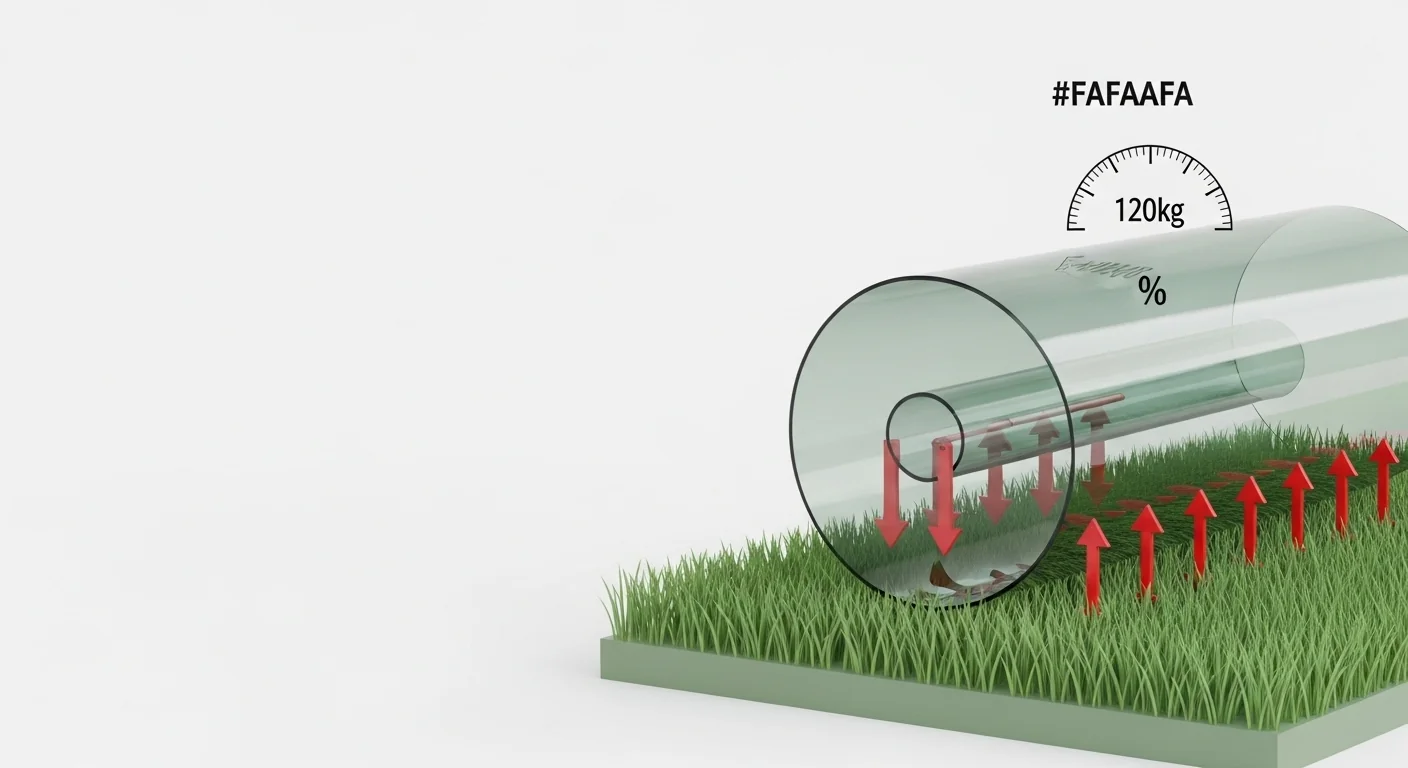
Show the calculation steps
Step 1: Roller Volume (cubic inches)
The roller barrel is modeled as a solid cylinder. Volume = pi x radius squared x width, where radius equals outer diameter divided by 2. Example: a 6-inch diameter roller on a 42-inch deck gives radius = 3 inches, volume = 3.1416 x 9 x 42 = 1,130.97 cubic inches. No unit conversion is needed at this stage.
Step 2: Fill Weight (lbs)
Each fill material has an assigned density constant in lbs per cubic inch derived from standard material bulk density values:
Air = 0.0 lbs/in³ (effectively zero; shell weight not included)
Water = 0.0361 lbs/in³ (62.4 lbs/ft³ converted)
Dry Silica Sand = 0.0578 lbs/in³ (100 lbs/ft³ converted)
Wet Packed Silica Sand = 0.0694 lbs/in³ (120 lbs/ft³ converted)
Fill Weight = density constant x volume. Result is rounded to one decimal place.
Step 3: Ground Pressure (lbs per linear inch)
Lbs per Linear Inch = Fill Weight / Deck Width. This expresses how much of the fill weight presses down on each inch of the roller’s contact line with the turf surface. It is the key metric for comparing safety across different roller configurations.
Step 4: Safety Classification
The calculated lbs/in value is compared against the grass-type threshold. Cool-season threshold = 5.0 lbs/in. Warm-season threshold = 4.0 lbs/in. Values below 80% of the threshold display as Safe (green). Values between 80% and 100% of threshold display as Caution (yellow). Values at or above the threshold display as Danger (red).
Assumptions and Limits
- The roller is treated as a completely solid-fill cylinder. Real rollers have a shell wall with finite thickness; actual interior volume and fill weight will typically be 5 to 15% lower than calculated.
- Sand density varies significantly with compaction and moisture. The wet sand value of 120 lbs/ft³ represents tightly packed, saturated silica sand. Loosely poured dry sand may be closer to 90 lbs/ft³, which is lower than the 100 lbs/ft³ default used here.
- Shell weight (steel vs. poly vs. cast iron) is not included in the calculation. Steel shells add 5 to 25 lbs depending on gauge and size; this shifts actual ground pressure higher than the computed estimate.
- Crown crush thresholds of 4.0 lbs/in (warm-season) and 5.0 lbs/in (cool-season) are based on turfgrass management guidelines. Actual damage depends on soil moisture, ambient temperature, mowing height, turf density, and time of season. Rolling on drought-stressed or heat-stressed turf carries higher risk at lower pressures.
- The deck width is used as the roller contact width. If your striping roller is shorter than your mowing deck, substitute the actual roller length in the deck width field for a more accurate pressure calculation.
- This calculator does not account for forward motion dynamics or traction forces. Ground pressure on slopes may effectively increase due to rearward weight transfer.
- Stripe visibility is not calculated here. Visibility depends on mowing height, blade sharpness, sunlight angle, and turf species, none of which are inputs to a weight calculator.
Standards, Safety Checks, and Secret Sauce Warnings
The turfgrass management principle underlying this tool is straightforward: striping works by bending, not compressing. Professional groundskeepers on MLB and NFL fields achieve deep stripe contrast with rollers calibrated well below crown crush limits, supplemented by liquid chelated iron applications that chemically darken the turf without any mechanical pressure increase.
Before rolling, consider whether your soil has adequate aeration. Compacted soil transmits roller pressure more directly to root zones than aerated soil. If your lawn has not been aerated recently, the lawn aeration calculator can help you plan adequate coverage before beginning a striping regimen.
Critical Warnings:
- A roller exceeding 4.0 lbs per linear inch on warm-season grass during summer does not simply flatten blades temporarily. At that pressure, the roller physically collapses the thin-walled vascular cells of the crown, the narrow band of tissue at soil level where the grass stores energy and initiates new growth. Crushed crown tissue creates open entry points for fungal pathogens including Brown Patch and Dollar Spot.
- Wet silica sand fills rapidly. A 10-inch diameter roller on a 54-inch deck holds roughly 4,241 cubic inches of fill volume. Fully packed with wet sand, that roller weighs nearly 295 lbs and produces 5.45 lbs/in of ground pressure, crossing the danger threshold for every grass type covered by this tool.
- Summer is the highest-risk rolling season for warm-season grasses. Bermuda and Zoysia push much of their active growth through stolon runners close to the soil surface, making the crown especially vulnerable to mechanical pressure during peak heat. Fall and early spring are the practical seasons for heavier rolling on warm-season lawns.
- Cool-season grasses are not immune. Kentucky Bluegrass in particular is sensitive to compaction under heat stress even at pressures below the 5.0 lbs/in threshold. Soil moisture on the day of rolling matters as much as the weight figure.
Minimum Standards for Safe Rolling Practice:
- Keep lbs per linear inch below the grass-specific threshold at all times. For mixed or unknown turf, apply the warm-season limit of 4.0 lbs/in.
- Roll in the morning when temperatures are below 80°F and turf has recovered from overnight moisture loss.
- Never roll drought-stressed turf. Mow first, irrigate lightly if needed, and allow at least 24 hours before rolling if the soil was bone dry.
- Use the lightest fill material that still achieves your aesthetic goal. Water fill at sub-1.0 lbs/in ground pressure is sufficient to create visible stripes when combined with consistent mowing direction.
Competitor Trap: The vast majority of lawn striping guides on the internet focus exclusively on roller weight as a purchase specification. They list “heavier is better for darker stripes” without ever calculating what that weight means in ground pressure across a specific deck width, or what that pressure means for the species of grass underneath. A 150-lb roller is perfectly safe on a 60-inch deck (2.5 lbs/in) and potentially damaging on a 30-inch deck (5.0 lbs/in on cool-season, dangerous on warm-season). Buying by weight alone without running the pressure math first is the most common single mistake in residential lawn striping.
Soil moisture on the day of rolling also affects how pressure propagates into the root zone. Saturated soil transmits compressive force downward more efficiently than moist, well-drained soil. If you are managing irrigation timing around your rolling schedule, the turf watering calculator can help you dial in soil moisture in the 24 hours before rolling.
Common Mistakes and Fixes
Mistake: Maximizing Roller Weight Without Checking Contact Pressure
Buyers compare roller weights in product listings and assume the heaviest option produces the best stripes. The contact width never enters the decision. A 120-lb roller on a 24-inch deck produces 5.0 lbs/in, which is at the cool-season danger threshold and above the warm-season limit, while the same roller on a 48-inch deck produces only 2.5 lbs/in.
Fix: Always divide total roller weight by your deck width to get lbs/in before purchasing. Match the result against your grass type’s threshold, not against a generic “heavier is better” rule.
Mistake: Filling with Wet Silica Sand Without Measuring Roller Volume
First
Wet silica sand is roughly 2.5 times denser than water by cubic inch. Homeowners who choose it expecting modest extra weight are often surprised to discover their roller now weighs 200 to 400 lbs. Large tow-behind barrels hold enormous volumes, and the fill weight calculation is not intuitive without running the cylinder volume formula.
Fix: Run this calculator before filling. If the wet sand result produces a red status, switch to water or use partial fill.
Mistake: Rolling Bermuda or Zoysia in July at Midday
Timing errors account for a significant share of lawn striping damage reports. Warm-season grasses under peak summer heat have reduced crown resilience compared to spring or fall. Even a roller within the 4.0 lbs/in threshold can cause disproportionate damage when ambient temperatures are high and the turf is under thermal stress.
Fix: Restrict heavier rolling on warm-season turf to spring (before peak heat) or fall (after temperatures drop below 85°F consistently). Use water-filled or lightly filled rollers during summer months.
Mistake: Measuring Roller Housing Width Instead of Cutting Deck Width
On some mowers the deck housing extends several inches beyond the actual blade cutting arc on each side. Users measure the total housing width and enter a number 4 to 8 inches wider than the actual cut, which understates the real ground pressure by distributing the weight across a wider-than-actual contact area.
Fix: Use the cutting width printed in the mower specification sheet or manual, not a tape measure across the deck housing.
Mistake: Substituting Chelated Iron for Proper Mowing Technique and
Expecting Stripe Contrast
Chelated iron is a chemical darkening agent, not a stripe creator. It deepens the green color of grass blades across the entire lawn, which can make existing stripes more vivid. Applied without proper directional mowing technique, it simply produces a uniformly darker lawn with no stripe pattern.
Fix: Establish consistent mowing direction first, maintain it across at least three to four mowing cycles, and then add chelated iron to chemically enhance the contrast that directional bending has already created.
Next Steps in Your Workflow
Once you have confirmed that your roller configuration produces a safe pressure reading, the practical sequence is to mow the lawn first at your target height with sharp high-lift blades, then make a single roller pass immediately following each mowing session in the same directional pattern. Stripe depth compounds over three to four consecutive mowing-plus-rolling cycles as the grass blades develop a positional memory from repeated directional bending. If the calculator showed a yellow caution result and you want to reduce pressure without replacing your roller, partial fill is your simplest lever: draining water from a partially full roller or removing some fill sand is faster than buying new equipment.
If the roller produced a red result because you discovered the damage after the fact and are now dealing with thinning or dead turf in the roller path, recovery planning is the next step. The grass seed calculator can help you determine how much seed you need to overseed damaged zones. For lawns using a regular fertilization program alongside striping, the grass clippings nitrogen calculator can help you account for nitrogen returned through clippings when you are also applying iron supplements for color enhancement.
FAQ
What is the ideal roller weight for lawn striping?
There is no single ideal weight because the relevant metric is lbs per linear inch, not total weight. A light roller on a narrow deck can produce more ground pressure than a heavier roller on a wide deck. For most residential cool-season lawns, keeping ground pressure between 1.0 and 3.0 lbs per linear inch is sufficient to produce clean, visible stripes without approaching crown damage territory.
Can you stripe warm-season grass like Bermuda?
Bermuda can be striped, but it is less naturally inclined to hold a stripe than cool-season grasses because its horizontal stolon growth pattern returns blades to an upright position quickly. Stripe contrast on Bermuda is typically shorter-lived, lasting one to two days versus four to five days on Bluegrass. Lower roller pressure and more frequent mowing passes are the practical approach for Bermuda striping.
Is silica sand or water better for lawn roller fill?
Water is the safer default for most residential applications because it allows easy partial fill adjustment, drains completely when not in use, and is unlikely to exceed crown pressure limits on a properly sized roller. Silica sand adds more weight per volume but dramatically increases the risk of exceeding safe pressure thresholds on smaller deck widths. Sand-filled rollers require the pressure calculation before use, not after.
Does rolling damage turf roots or just the crown?
The primary documented damage site from excess roller pressure is the vascular crown located at or just above soil level. Root systems extending below the crown are less directly affected by surface rolling pressure, though repeated over-rolling on compacted soils can restrict oxygen and water infiltration into the root zone indirectly. Crown tissue is the most vulnerable structure because it is the narrowest physiological bottleneck in the plant.
How often should you roll a lawn for striping?
Rolling once per mowing session, aligned with each mow, produces progressive stripe definition without the cumulative compaction risk of rolling independently of mowing. Rolling more frequently than you mow adds mechanical pressure without allowing the turf recovery time that mowing requires. One roll per mowing pass is the practical maximum for residential maintenance.
Can liquid chelated iron replace lawn rolling for stripe contrast?
Chelated iron does not create stripes on its own. It deepens the green pigmentation uniformly across treated turf, which makes existing directional blade patterns more visually distinct. The combination of proper mowing direction plus chelated iron produces deeper visual contrast than rolling alone at low pressure, and removes crown damage risk entirely. It is the preferred method on high-value sports turf where crown integrity is non-negotiable.
Conclusion
The single most important takeaway from this tool is that heavier is not categorically better. A roller optimized for your specific deck width, grass type, and season can produce professional stripe results at a fraction of the pressure that causes crown damage. If your turf is in a condition where striping has thinned the turf and you are evaluating repair or replacement options, the sod calculator can give you a fast material estimate for patching damaged areas before resuming a rolling program with a better-calibrated setup.