
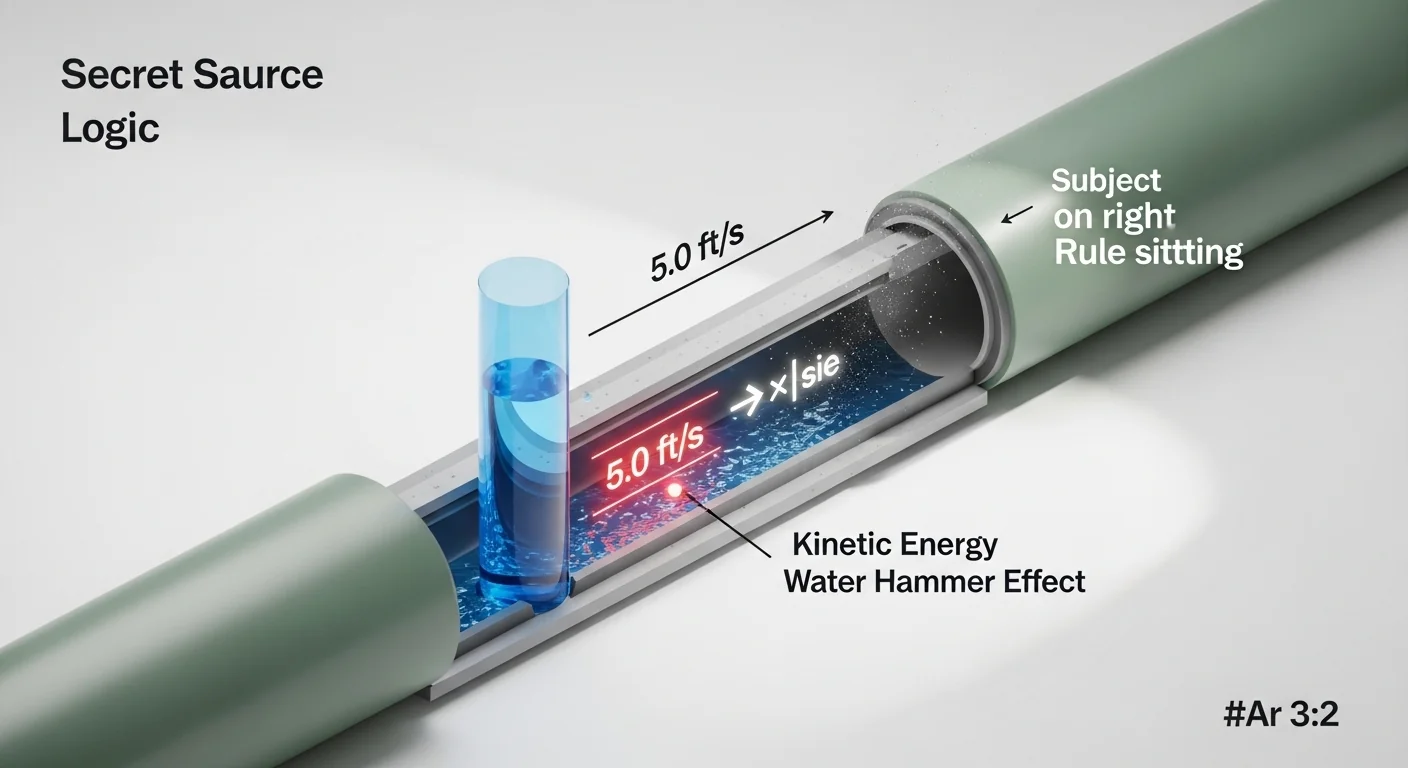

Friction loss in PVC irrigation pipe is rarely the number that breaks a system. The velocity that produces it is. Designers who focus only on the head loss figure miss the critical failure mode: water moving too fast through PVC does not just reduce pressure, it stores kinetic energy that, when a valve closes, slams back through the system as a pressure spike. That spike does not weaken joints gradually. It shatters them.
This calculator applies the Hazen-Williams equation to compute total head loss in feet, fluid velocity in feet per second, and friction loss normalized to 100-foot pipe segments. It does not account for fittings, elevation changes, or minor losses from valves and tees. Those components require equivalent-length additions to your pipe measurement before entering the tool. The outputs assume fully turbulent, pressurized flow at standard water temperature.
After running your numbers, if the velocity result exceeds 5 ft/s, do not proceed with that pipe size. Upsize the inner diameter until velocity drops into the safe zone, then use the head loss figure to verify your pump or supply pressure can handle the run.
Use the Tool
PVC Pipe Friction Loss & Velocity
Hazen-Williams equation — Water, Irrigation & Drainage
| GPM | Velocity (ft/s) | Head Loss (ft) | Loss / 100 ft | Status |
|---|
How This Calculator Works — Formula & Assumptions
Step 1 — Fluid Velocity (V)
where ID is the pipe inner diameter in inches. This determines how fast water is moving inside the pipe.
Step 2 — Hazen-Williams Head Loss
C is the Hazen-Williams roughness coefficient (Schedule 40 PVC = 150, Poly/PEX ≈ 140–150). Higher C = smoother pipe = less friction.
Step 3 — Safety Check (Secret Sauce)
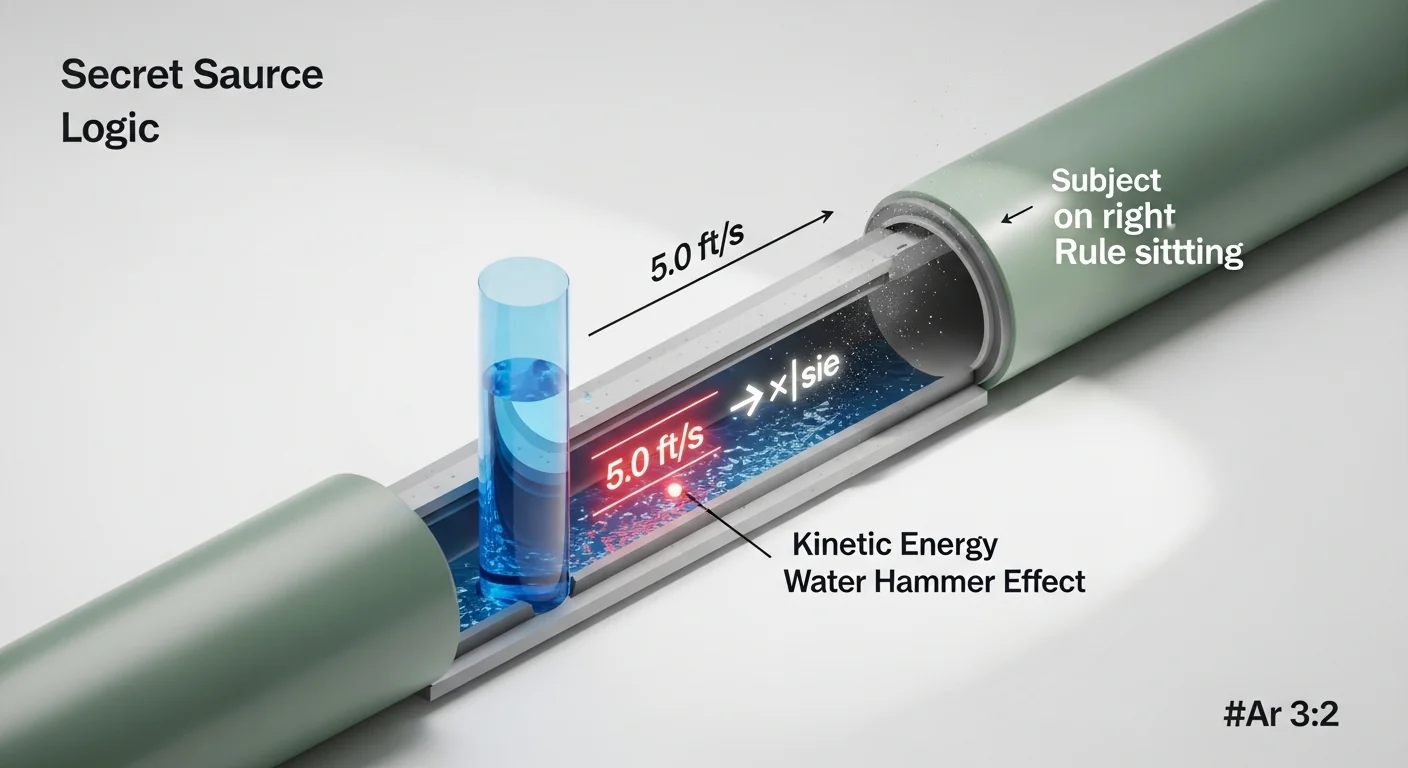
When water moving faster than 5 ft/s is suddenly stopped by a valve, the kinetic energy converts to a pressure spike that can shatter PVC joints underground. Industry standard recommends keeping velocity below 5 ft/s.
Assumptions & Limits
- Water at standard temperature (~60°F / 15.5°C); viscosity not adjusted
- Fully turbulent flow assumed (Hazen-Williams is valid for turbulent flow in pressurized systems)
- Straight pipe only — add 10–30% for fittings & bends (equivalent length method)
- C values: Sch 40 PVC = 150, Sch 80 PVC = 140, Poly = 140, PEX = 150
- Hazen-Williams is an empirical formula; for GPM < 1 or very large pipes, use Darcy-Weisbach for greater accuracy
- Head loss is in feet of water (1 psi ≈ 2.31 ft of head)
Before calculating, have the following ready: the pipe’s actual inner diameter (ID) in inches, not the nominal trade size printed on the label; the total flow rate in GPM at peak demand; and the full run length of the pipe segment you are sizing. If you are working from a pump curve or sizing a system mainline, confirm your GPM against peak zone demand before entering it. For a related measurement, the hose flow rate calculator can help you determine GPM from a timed fill test when metered flow data is not available.
Quick Start (60 Seconds)

- Flow Rate (GPM): Enter gallons per minute at the design flow condition, not a maximum fixture rating. Overestimating GPM inflates your friction loss calculation and may lead you to oversize pipe unnecessarily.
- Pipe Inner Diameter (in): Use the actual inside diameter, not the nominal size. A 1-inch Schedule 40 PVC pipe has an ID of 1.049 inches, not 1.000 inch. Using nominal size will produce meaningfully incorrect velocity and head loss values.
- Pipe Length (ft): Measure the straight pipe run. Add equivalent lengths for fittings (typically 10 to 30 additional feet for elbows, tees, and couplings) before entering this field if you want total system loss.
- Pipe Material: Select the material that matches your pipe. Hazen-Williams C coefficients differ: Schedule 40 PVC and PEX carry a C of 150 (smoother); Schedule 80 PVC and polyethylene pipe use C = 140. Selecting the wrong material shifts your head loss result.
- Read velocity first: Before interpreting head loss, check the velocity output. If it reads above 5.0 ft/s, the head loss number is irrelevant until you resize the pipe.
- Units check: This tool works in US customary units only. Length in feet, diameter in inches, flow in GPM. Metric inputs will produce incorrect results.
Inputs and Outputs (What Each Field Means)
| Field | Unit | What It Means | Common Mistake | Safe Entry Guidance |
|---|---|---|---|---|
| Flow Rate | GPM | Volume of water moving through the pipe per minute at peak design conditions | Using total system GPM instead of the flow through this specific segment | Use the GPM for the zone or branch this pipe serves, not the whole system |
| Pipe Inner Diameter | inches | The measured inside dimension of the pipe bore, which controls both velocity and friction | Entering the nominal trade size (e.g., “1 inch”) instead of the actual ID (1.049 in) | Look up the published ID for your pipe schedule in manufacturer spec sheets |
| Pipe Length | feet | Total straight-run length of the pipe segment being analyzed | Forgetting to add equivalent lengths for fittings, resulting in underestimated loss | Measure actual run, then add equivalent lengths: typically 1.5 ft per 90-degree elbow for 1″ pipe |
| Pipe Material | selection | Determines the Hazen-Williams C coefficient, which represents internal surface smoothness | Using Schedule 40 settings for aged or corroded pipe, which has a lower effective C | For new PVC use C = 150; for polyethylene or aged pipe, C = 140 is more conservative |
| Head Loss (output) | feet | Total pressure energy lost to friction over the full pipe length, expressed in feet of water column | Confusing feet of head with PSI (1 PSI = 2.31 ft of head) | Divide by 2.31 to convert to PSI for comparing against pump or supply pressure ratings |
| Velocity (output) | ft/s | The speed of water flow inside the pipe bore; the primary safety indicator for water hammer risk | Ignoring velocity and only optimizing for head loss | Keep below 5.0 ft/s for PVC; below 4.0 ft/s for conservative designs near valve banks |
| Loss per 100 ft (output) | ft/100 ft | Normalized friction gradient useful for comparing pipe sizes across different run lengths | Using this figure alone without checking total head loss for the full run | Multiply by (length / 100) to get total head loss; useful for extending estimates to longer runs |
If you are sizing a drip system lateral, the drip irrigation run time calculator uses similar flow rate inputs and can help you cross-check your zone GPM against emitter counts before feeding numbers into a friction loss calculation.
Worked Examples (Real Numbers)
Example 1: Residential Irrigation Mainline (Safe Zone)
- Flow Rate: 10 GPM
- Pipe: 3/4″ Schedule 40 PVC, actual ID = 1.049 in, C = 150
- Length: 150 ft
Result: Velocity = 3.71 ft/s (safe). Head Loss = 8.27 ft over 150 ft (5.51 ft per 100 ft).
At 10 GPM through a 3/4-inch mainline, the system operates safely within velocity limits. The 8.27 ft head loss needs to be subtracted from available supply pressure when sizing downstream sprinkler heads. At 2.31 ft per PSI, this equals approximately 3.6 PSI of friction loss for this segment.
Example 2: Danger Zone — 1-Inch Pipe at 20 GPM
- Flow Rate: 20 GPM
- Pipe: 1″ Schedule 40 PVC, actual ID = 1.049 in, C = 150
- Length: 100 ft
Result: Velocity = 7.43 ft/s (DANGER). Head Loss = 19.86 ft over 100 ft.
This is the scenario the 5 ft/s rule exists to catch. At 7.43 ft/s, any rapid valve closure generates a water hammer pressure spike that exceeds PVC’s dynamic pressure tolerance. The pipe may survive one closure, but repeated cycles fatigue the joints. The head loss of nearly 20 ft is also impractical for most residential supply pressures. Upsizing to 1.5-inch ID (1.610 in) at 20 GPM drops velocity to 3.15 ft/s and reduces head loss to roughly 2.5 ft per 100 ft.
Example 3: Large-Diameter Mainline, Low Velocity
- Flow Rate: 15 GPM
- Pipe: 2″ Schedule 40 PVC, actual ID = 2.067 in, C = 150
- Length: 300 ft
Result: Velocity = 1.43 ft/s (safe). Head Loss = 1.29 ft over 300 ft (0.43 ft per 100 ft).
Oversizing pipe to 2 inches for a 15 GPM run produces very low friction loss, which is ideal for long irrigation mainlines supplying multiple zones. The trade-off is material cost and the fact that slow-moving water in large pipe takes longer to pressurize when a zone valve opens, which matters for timer-controlled systems.
Reference Table (Fast Lookup)
All values below use 1.5″ Schedule 40 PVC (actual ID = 1.610 in, C = 150) over a 100-foot run. This is the most common irrigation mainline size for residential and light commercial systems.
| Flow (GPM) | Velocity (ft/s) | Head Loss / 100 ft (ft) | Equivalent PSI Loss | Status |
|---|---|---|---|---|
| 5 | 0.79 | 0.19 | 0.08 PSI | Safe |
| 8 | 1.26 | 0.45 | 0.20 PSI | Safe |
| 10 | 1.58 | 0.68 | 0.29 PSI | Safe |
| 12 | 1.89 | 0.96 | 0.42 PSI | Safe |
| 15 | 2.36 | 1.45 | 0.63 PSI | Safe |
| 18 | 2.84 | 2.03 | 0.88 PSI | Safe |
| 20 | 3.15 | 2.47 | 1.07 PSI | Safe |
| 25 | 3.94 | 3.73 | 1.61 PSI | Safe |
| 30 | 4.73 | 5.23 | 2.26 PSI | Caution |
| 35 | 5.52 | 6.93 | 3.00 PSI | Danger |
PSI loss computed at 1 PSI = 2.31 ft of head. Head loss values computed from the Hazen-Williams formula for this specific pipe ID and C value only. Do not apply these figures to other pipe sizes.
How the Calculation Works (Formula + Assumptions)
Show the calculation steps
Step 1: Compute Fluid Velocity
The velocity formula is a simplified continuity equation for circular pipe cross-sections in US customary units:
V (ft/s) = (0.4085 x GPM) / ID²
where ID is the inner diameter in inches. The constant 0.4085 derives from the unit conversion between GPM and cubic feet per second, divided by the pipe cross-sectional area formula (pi/4). Round velocity to two decimal places for field decisions.
Step 2: Compute Hazen-Williams Head Loss
The Hazen-Williams equation for head loss in US customary units:
HeadLoss (ft) = 10.44 x Length x GPM¹·&sup8;&sup5; / (C¹·&sup8;&sup5; x ID&sup4;·&sup8;&sup7;)
The exponents 1.85 and 4.87 are empirically derived coefficients from hydraulic testing on pipes under fully turbulent flow. C is the Hazen-Williams roughness coefficient. Head loss scales non-linearly with flow: doubling the GPM increases head loss by a factor of roughly 3.6, not 2. Round head loss to two decimal places.
Step 3: Normalize to 100-Foot Gradient
Loss per 100 ft = (HeadLoss / Length) x 100
This normalized value lets you compare friction characteristics across different pipe sizes and materials without recalculating for a specific run length.
Step 4: Safety Check
If V exceeds 5.0 ft/s, the tool flags a water hammer danger condition. If V is between 4.0 and 5.0 ft/s, a caution state is displayed.
Assumptions and Limits
- Water temperature assumed at approximately 60 degrees F (15.5 degrees C). Warmer water is slightly less viscous; this tool does not adjust C for temperature variation.
- Hazen-Williams is an empirical formula valid for fully turbulent flow in pressurized circular pipe. It is not appropriate for very low flow rates (under approximately 1 GPM) or for partially full pipes.
- The formula assumes straight, new pipe with consistent internal surface condition. Aged pipe, pipe with mineral deposits, or pipe with corroded interior will have a lower effective C value, meaning actual head loss will exceed the calculated result.
- Fittings, valves, tees, and elbows are not included. Add equivalent pipe lengths for all fittings before entering total length. A standard 1-inch 90-degree ell adds roughly 2.5 ft of equivalent length.
- C coefficients used: Schedule 40 PVC = 150, Schedule 80 PVC = 140, Polyethylene = 140, PEX = 150. These are standard reference values and may differ from manufacturer-specific data sheets for specialty products.
- The tool does not account for elevation head changes between the pipe inlet and outlet. Add or subtract elevation difference in feet to the head loss result for non-horizontal runs.
- For very large pipe diameters (above 8 inches) or low-velocity laminar flow regimes, the Darcy-Weisbach equation with a Moody friction factor provides greater accuracy.
Standards, Safety Checks, and “Secret Sauce” Warnings
Critical Warnings
- The 5 ft/s Water Hammer Threshold: When water moving above 5 ft/s is suddenly stopped by a solenoid valve closing in milliseconds, the kinetic energy of the water column converts to a pressure transient. In PVC systems, this spike can exceed the pipe’s pressure rating instantaneously, fracturing fittings, blowing apart glued joints, or splitting the pipe barrel itself. This failure happens underground where it goes unnoticed until a zone floods or system pressure drops. The water hammer calculator can quantify the pressure spike magnitude if you need to analyze a specific valve-closure scenario.
- Nominal Pipe Size Is Not Inner Diameter: A label reading “1-inch PVC” identifies the nominal trade size, not the bore. The actual inner diameter depends on the schedule: Schedule 40 gives ID = 1.049 in, Schedule 80 gives ID = 0.957 in. Using the nominal size of 1.000 inch in the velocity formula produces a velocity reading that understates actual flow speed. For a pump-fed system, this error propagates into every downstream pressure calculation, including net positive suction head (NPSH) analysis — see the NPSH calculator if cavitation risk is a concern for your pump.
- Hazen-Williams Breaks Down at Low Flow: Below approximately 1 GPM or in very large pipe, the formula’s accuracy degrades because the laminar/turbulent flow assumption no longer holds. Do not use these results for gravity drip systems operating at very low pressure.
- Head Loss Is Not PSI Directly: The output is in feet of water head. Convert to PSI by dividing by 2.31. Confusing these units leads to pump undersizing or PRV misconfiguration.
Minimum Standards
- Keep design velocity below 5.0 ft/s for all pressurized PVC pipe runs. For systems with fast-closing solenoid valves, staying below 4.0 ft/s provides additional safety margin.
- Size mainlines so that total head loss across the longest zone run does not exceed available pressure after subtracting minimum operating pressure at the last head or emitter.
- Use Schedule 80 PVC (C = 140) for buried risers, fittings under concrete, and any run subject to mechanical stress or ultraviolet exposure. Its lower C value means slightly higher head loss, which this tool accounts for when you select it.
Competitor Trap: Most online friction loss calculators return a head loss value and stop there, which leads users to optimize only for pressure, not for velocity. A pipe can produce an acceptable head loss number while simultaneously operating at 7 or 8 ft/s, deep into water hammer territory. The velocity check is not a secondary feature. It is the primary safety gate for PVC system design, and any tool that omits it gives the user a false sense of a correctly sized system.
Common Mistakes and Fixes
Mistake: Entering Nominal Pipe Size Instead of Inner Diameter
A 1-inch Schedule 40 PVC pipe has an inner diameter of 1.049 inches, not 1.000 inch. The ID appears in the pipe manufacturer’s dimensional data, not on the label. Because velocity scales with ID squared, a 5% error in diameter produces a roughly 10% error in velocity and a compounding error in head loss. For less common pipe sizes, always verify the actual ID against published spec sheets before entering the value.
Fix: Look up the ASTM D1785 or D2241 dimensional table for your specific pipe schedule and use the tabulated ID value.
Mistake: Analyzing Only One Pipe Segment Instead of the Longest Run
Friction loss is cumulative. Running the calculator on the mainline alone and ignoring lateral runs, risers, and connecting tees means your pressure budget analysis is incomplete. A lateral that adds another 8 ft of head loss will push the system below minimum operating pressure at the last head, even if the mainline calculation looked fine.
Fix: Calculate each segment separately and sum the losses. The pipe volume calculator can help you map segment dimensions before working through friction loss for each one.
Mistake: Ignoring Fitting Losses and Calling It Conservative
It is common to assume that “ignoring fittings adds a safety margin.” That reasoning only applies if you are overestimating head loss elsewhere. If your straight-pipe calculation already shows a tight pressure budget, ignoring 15 to 30 additional feet of equivalent pipe length from fittings will produce a system that fails to deliver adequate pressure at the endpoints. Fittings are not optional corrections — they are part of the hydraulic run.
Fix: Add equivalent pipe lengths for all major fittings (elbows, tees, gate valves, check valves) to your length input before calculating.
Mistake: Using Total System GPM for a Branch Pipe Segment
A mainline that supplies three zones does not carry the total system GPM through every segment. The mainline from the meter to the first tee carries zone 1 + zone 2 + zone 3 flow. The branch to zone 3 only carries zone 3 flow. Entering total system GPM into a lateral segment calculation overstates both velocity and friction loss for that branch, which may cause you to oversize it unnecessarily while the mainline remains undersized.
Fix: Draw a simple flow diagram showing which GPM travels through each pipe segment, then run a separate calculation for each segment with its correct flow rate.
Mistake: Using a High C Value for Old or Field-Repaired Pipe
Hazen-Williams C = 150 is appropriate for new, clean-bore Schedule 40 PVC. Pipe that has been in service for years, repaired with couplings, or contaminated with mineral buildup from hard water will have a lower effective C. Using 150 for degraded pipe underestimates friction loss, which means your pump or supply pressure may not deliver the flow you expect. Gravity-fed systems are especially sensitive to this — the gravity-fed drip irrigation calculator illustrates how small head losses become critical when working with limited static pressure.
Fix: For pipe older than five to seven years or with visible mineral deposits, use C = 130 to 140 as a more realistic coefficient and accept a higher calculated head loss as the design basis.
Next Steps in Your Workflow
Once you have confirmed that velocity is below 5 ft/s and have your head loss figure, the next step is matching that loss against your available pressure. Subtract the calculated head loss from your static supply pressure (converted to feet of head), then check whether the remaining pressure meets the minimum operating requirement of your sprinkler heads, drip emitters, or valve bodies. If the margin is thin, revisit the pipe diameter before purchasing materials. For systems driven by a pump rather than municipal supply, that residual pressure needs to fall within the pump’s operating curve — the irrigation pump sizing calculator can help you match pump selection to the head loss and flow rate you just calculated.
For zone-level runtime planning once your pipe is confirmed to be sized correctly, the sprinkler run time calculator takes the same GPM inputs and converts them into irrigation schedules based on precipitation rate and target application depth. The pipe sizing and the runtime calculation are two separate but connected steps — get the hydraulics right first, then plan the schedule around the confirmed flow rate.
FAQ
What is the Hazen-Williams C coefficient and how do I choose the right one?
The C coefficient represents a pipe material’s internal smoothness. Higher values indicate less friction per unit of flow. New Schedule 40 PVC and PEX use C = 150. Polyethylene and Schedule 80 PVC use C = 140. For aged, internally corroded, or field-repaired pipe, C values as low as 120 to 130 are more realistic. When in doubt, use the lower C value — it gives a conservatively higher head loss estimate, which is safer for design purposes.
How do I convert head loss in feet to PSI?
Divide feet of head by 2.31 to get PSI. One PSI of pressure supports a column of water 2.31 feet tall. So if your calculated head loss is 11.55 feet, that equals 5 PSI of friction loss. This conversion applies to water at standard temperature. Use it to compare your friction loss against pump pressure ratings or pressure-reducing valve settings, which are typically specified in PSI.
Why does the calculator use inner diameter instead of pipe size?
The velocity and friction loss formulas depend on the actual bore of the pipe, not the nominal trade designation. A “1-inch” PVC pipe does not have a 1-inch bore. Schedule 40 gives ID = 1.049 inches; Schedule 80 gives ID = 0.957 inches. These differences matter significantly in the velocity formula because ID appears squared. Using nominal size produces a systematically biased result that can mask dangerous flow conditions.
What happens if I calculate friction loss for fittings and the total seems high?
High total head loss from fittings usually indicates a design with too many direction changes or a pipe that is undersized for the flow. The fix is almost always to upsize the pipe diameter. A larger bore reduces velocity nonlinearly — doubling the diameter cuts velocity by a factor of four, which reduces head loss by roughly an order of magnitude for the same flow rate. Avoid adding more fittings to compensate for high friction; that compounds the problem.
Can this calculator be used for well or pump discharge lines?
Yes, with one important caveat: the pump discharge line calculation requires you to account for the pump’s shutoff head, operating head, and efficiency curve, not just the pipe friction loss. The pipe friction loss output from this tool is one input into the total dynamic head (TDH) equation that governs pump selection. Calculate pipe friction loss first, then add elevation change and fitting losses to arrive at TDH. Use that figure alongside your required GPM to select a pump from a performance curve.
Is the 5 ft/s rule a code requirement or just a guideline?
The 5 ft/s limit for PVC pipe is an industry design guideline derived from hydraulic engineering practice and PVC pressure ratings, not a universally codified requirement. Some municipal codes and irrigation industry standards (including guidelines from the Irrigation Association) reference it explicitly. For copper or HDPE pipe, different velocity limits apply. Regardless of whether your local code mandates it, treating 5 ft/s as a hard limit for pressurized PVC is the conservative and professionally defensible design standard.
Conclusion
The PVC friction loss calculator gives you two critical numbers: head loss to verify your pressure budget, and velocity to verify your system will not destroy itself when a valve closes. Of the two, velocity is the non-negotiable gate. No amount of acceptable head loss makes a 7 ft/s design safe for PVC. The Hazen-Williams equation has been the standard friction loss method in irrigation and plumbing for over a century because it is accurate, fast, and reliable for the pressurized, turbulent-flow conditions that PVC mainlines operate under. The formulas behind this tool are the same ones used by professional hydraulic engineers — the difference is that this calculator applies the velocity threshold check automatically so the decision is explicit rather than buried in a row of numbers.
The single most preventable design error in PVC irrigation systems remains the pipe-size-looks-right assumption. A 1-inch fitting connection does not mean a 1-inch pipe is the right size for the flow you are putting through it. Run the velocity calculation before committing to a pipe size, and if the result shows caution or danger, upsize before digging. For those planning systems that combine pressure management with this flow sizing work, the well pressure tank calculator addresses how tank sizing interacts with pump cycle frequency and system pressure stability — a directly related consideration once pipe sizing is complete.