
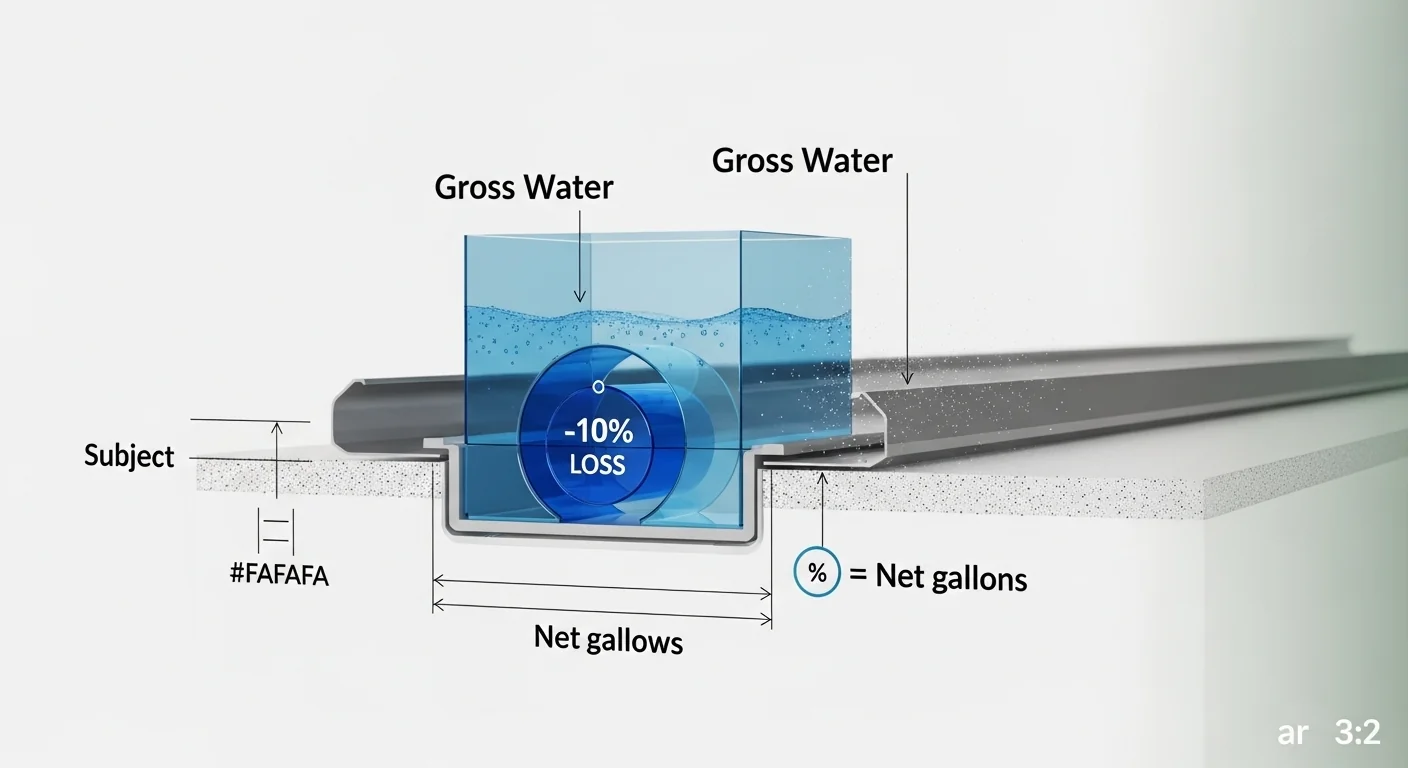
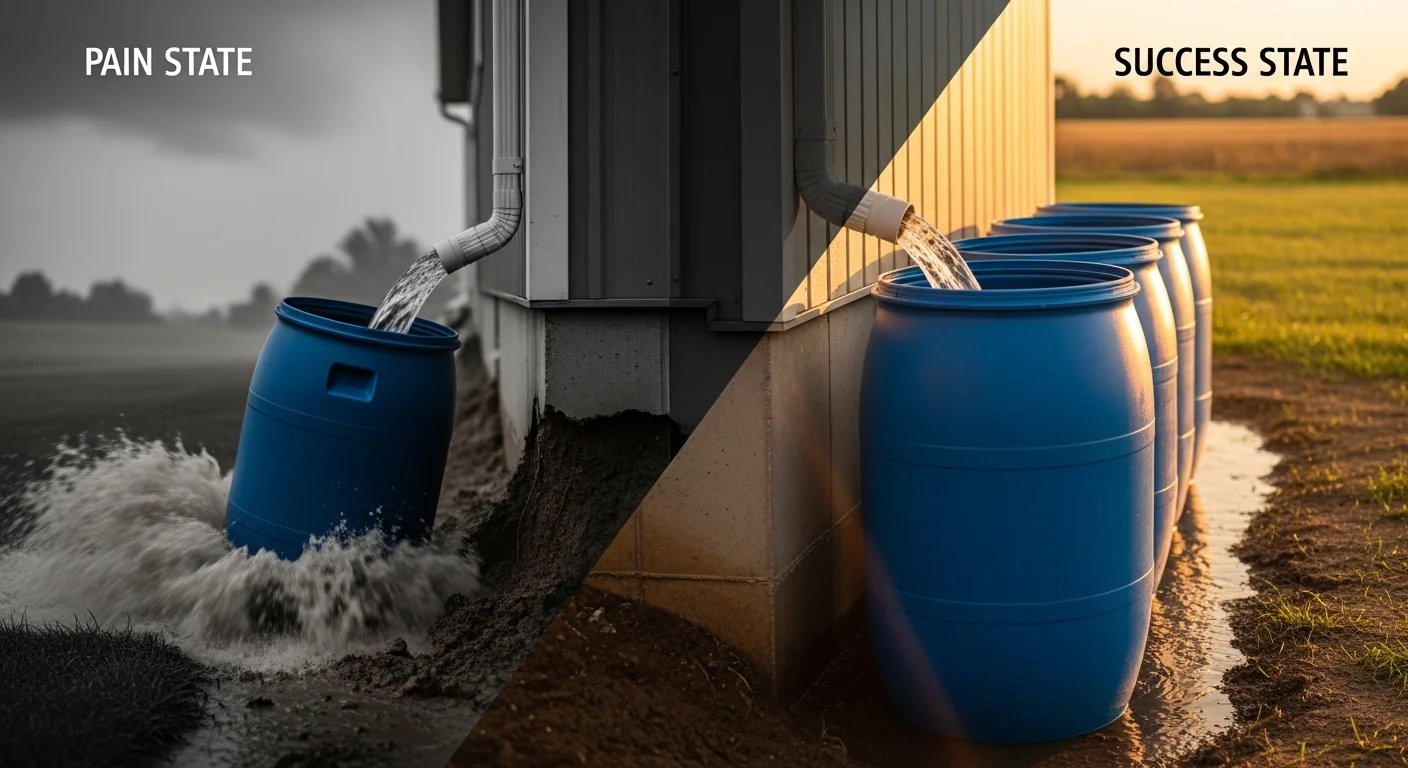
Most rooftop collection guides quote a simple area-times-rainfall figure and call it done. The problem is that raw number overstates what actually reaches your storage tank by a consistent margin because it ignores splash, evaporation, and the losses introduced by first-flush diversion. A system sized on the gross number risks overflow on the first moderate storm or a tank that runs dry faster than expected because the margin was never accounted for.
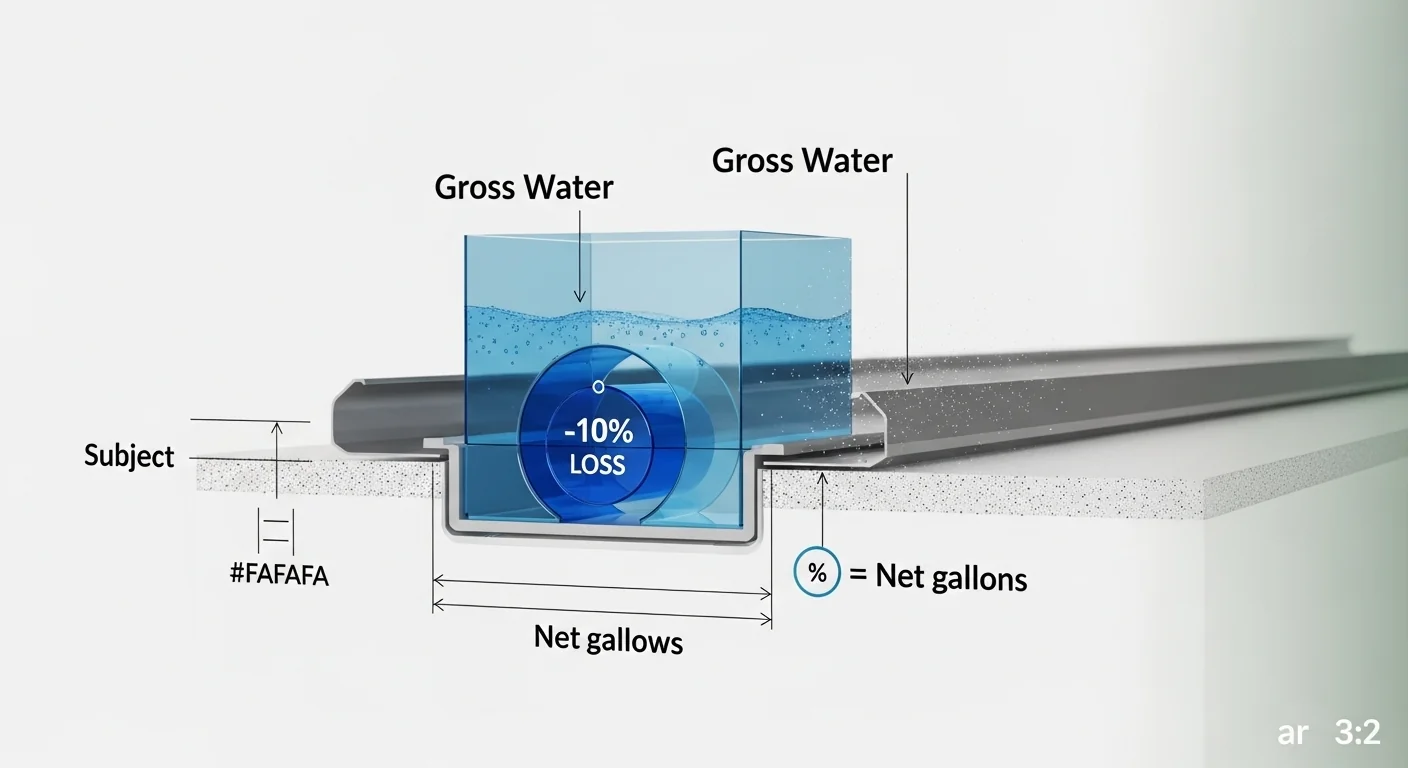
This tool calculates two figures: the gross theoretical volume your roof can intercept and the net collectable volume after applying a 10-point efficiency reduction. It uses horizontal projected roof area (not sloped surface area) multiplied by rainfall depth and a unit-conversion factor of 0.623, which converts square-foot-inch units into US gallons. The tool does not predict your actual harvesting outcome, which depends on gutter condition, tank inlet design, and local evaporation rates that vary by climate zone.
Once you see your net gallon figure, you can divide it by 55 to determine how many standard barrels you need to capture an event without overflow, and decide whether your planned storage capacity matches your roof’s actual yield potential.
Use the Tool
| Roof Size | Area (sq ft) | Gross (gal) | Net (gal, −10%) | 55-gal Drums |
|---|
How this calculator works
Formula: Gallons = Roof Area × Rainfall × Conversion factor × Efficiency
The 0.623 factor converts square feet × inches of rain to US gallons (derived from 1 ft³ = 7.48 gal and unit conversions).
The 0.90 efficiency accounts for 10% typical loss due to splash, evaporation, first-flush diversion, and gutter overflow during heavy rainfall.
Assumptions & Limits
- Roof dimensions entered are the horizontal projected footprint (not actual sloped area).
- Rainfall figure should be total event depth in inches, not intensity.
- Efficiency assumes a standard asphalt shingle or metal roof (0.90). Clay tile or green roofs may yield less.
- Results do not account for gutter capacity, tank overflow, sediment filtering, or local restrictions on rainwater harvesting.
- Input ranges: Length/Width 1–10,000 ft; Rainfall 0.01–60 inches.
- Always check local ordinances before installing a collection system.
Before you enter any values, have three measurements ready: the horizontal footprint length of your roof section in feet, the width of that same section in feet, and the rainfall depth in inches for the storm event or design storm you want to plan around. If your roof drains to more than one collection point, run the calculator separately for each catchment zone and add the results. For context on how collected volume translates into runtime for drip or overhead irrigation, the sprinkler run-time calculator can help bridge the gap between storage volume and application rate.
Quick Start (60 Seconds)
- Roof Length (ft): Measure the horizontal ground-level footprint, not the sloped rafter length. A 40-ft rafter on a steep pitch may project only 35 ft horizontally. Use the shorter projected dimension.
- Roof Width (ft): Same rule as length. Measure perpendicular to the ridge along the ground plane. Enter only the width of the section draining to your collection system, not the full building width if you are only collecting from one side.
- Rainfall Amount (inches): Use total event depth, not intensity (inches per hour). Check NOAA’s precipitation frequency data or a local rain gauge for your design storm. A 1-inch event is a common planning baseline in moderate climates.
- Avoid entering sloped area: The 0.623 conversion factor is calibrated for horizontal projected area. Using sloped surface area will overstate your collection volume.
- Partial roof sections: If gutters drain only one side of a gable roof, enter dimensions for that half only. Adding both halves when only one drains to the tank is a frequent sizing error.
- Check the barrel count output: The result rounds up to whole drums. Plan for that ceiling number of 55-gallon containers, not the exact gallon figure, when ordering storage.
- Rainfall entry range: The tool accepts values from 0.01 to 60 inches. For daily planning, values between 0.25 and 4 inches cover the vast majority of typical storm events in the continental US.
Inputs and Outputs (What Each Field Means)
| Field | Unit | What It Means | Common Mistake | Safe Entry Guidance |
|---|---|---|---|---|
| Roof Length | feet | Horizontal projected length of the roof section draining to the collection system | Using the actual rafter or ridge length instead of horizontal ground projection | Measure directly on the ground or use building floor plan dimensions; 1 to 10,000 ft accepted |
| Roof Width | feet | Horizontal projected width perpendicular to the length dimension | Including both sides of a gable when only one gutter drains to the tank | Use only the footprint of the catchment zone feeding your storage; 1 to 10,000 ft accepted |
| Rainfall Amount | inches | Total depth of precipitation for the event being modeled, not hourly rate | Entering intensity (in/hr) instead of cumulative event depth | Pull from a rain gauge, weather station record, or NOAA design storm tables; 0.01 to 60 in accepted |
| Net Collectable Gallons (output) | US gallons | Volume reaching your tank after a 10-point efficiency reduction from the gross figure | Treating this as a guaranteed yield rather than a planning estimate | Use for storage sizing; actual yield may be lower depending on system design and roof material |
| Barrels Needed (output) | count (55-gal drums) | Number of standard 55-gallon containers required to hold the net volume without overflow | Using the fractional barrel figure instead of rounding up to a whole container | Always order the ceiling number; a partial barrel still takes up a full footprint and must be vented |
Worked Examples (Real Numbers)
Scenario 1: Backyard Garden Shed (Light Rain)
- Roof Length: 10 ft
- Roof Width: 12 ft
- Rainfall: 1.0 inch
Area = 10 × 12 = 120 sq ft
Gross = 120 × 1.0 × 0.623 = 74.76 gal
Net = 74.76 × 0.90 = 67.28 gal
Result: 68 gallons, requiring 2 standard 55-gallon barrels to capture without overflow.
A small shed catchment during a 1-inch event yields enough water for several deep-watering cycles on a raised bed garden. Two linked barrels are the minimum practical setup for this roof size if you want to capture an average storm event without loss.
Scenario 2: Single-Car Garage (Heavy Rain)
- Roof Length: 20 ft
- Roof Width: 20 ft
- Rainfall: 2.0 inches
Area = 20 × 20 = 400 sq ft
Gross = 400 × 2.0 × 0.623 = 498.4 gal
Net = 498.4 × 0.90 = 448.6 gal
Result: 449 gallons, requiring 9 standard 55-gallon barrels.
A 2-inch event on a modest garage roof produces enough volume to stress any typical single-barrel residential setup. This scenario illustrates why gutter sizing and overflow routing become critical design considerations at storm depths above 1.5 inches.
Scenario 3: Medium Home Roof Section (Moderate Rain)
- Roof Length: 40 ft
- Roof Width: 50 ft
- Rainfall: 0.75 inches
Area = 40 × 50 = 2,000 sq ft
Gross = 2,000 × 0.75 × 0.623 = 934.5 gal
Net = 934.5 × 0.90 = 841.1 gal
Result: 842 gallons, requiring 16 standard 55-gallon barrels.
Even a sub-1-inch storm on a mid-size residential roof generates a volume that exceeds most off-the-shelf rain barrel kits. This result makes the case for a dedicated cistern or a manifolded series of large-volume containers rather than standard 55-gallon drums, which become impractical at 16 units.
Reference Table (Fast Lookup)
| Roof Area (sq ft) | Rainfall (in) | Gross Volume (gal) | Net Volume -10% (gal) | 55-Gal Drums Needed | Approx. Cistern Size |
|---|---|---|---|---|---|
| 120 | 0.5 | 37.4 | 33.6 | 1 | Single 40-gal barrel |
| 120 | 1.0 | 74.8 | 67.3 | 2 | Two linked 55-gal drums |
| 400 | 0.5 | 124.6 | 112.1 | 3 | Three 55-gal drums or one 150-gal tank |
| 400 | 1.0 | 249.2 | 224.3 | 5 | Five 55-gal drums or one 250-gal IBC |
| 400 | 2.0 | 498.4 | 448.6 | 9 | One 500-gal cistern or nine 55-gal drums |
| 1,200 | 0.5 | 373.8 | 336.4 | 7 | One 350-gal tank |
| 1,200 | 1.0 | 747.6 | 672.8 | 13 | One 750-gal cistern |
| 1,200 | 2.0 | 1,495.2 | 1,345.7 | 25 | One 1,500-gal buried cistern |
| 2,000 | 1.0 | 1,246.0 | 1,121.4 | 21 | One 1,200-gal above-ground poly tank |
| 2,000 | 2.0 | 2,492.0 | 2,242.8 | 41 | Two 1,200-gal tanks or one 2,500-gal cistern |
The “Approx. Cistern Size” column is a practical purchasing guide. Drum counts above 10 become logistically difficult; at that threshold, transitioning to an intermediate bulk container (IBC tote, 275 or 330 gal) or a poly cistern is generally more cost-effective per gallon of storage.
How the Calculation Works (Formula + Assumptions)
Show the calculation steps
Step 1 – Compute roof catchment area:
Area (sq ft) = Roof Length (ft) × Roof Width (ft)
Step 2 – Compute gross volume in gallons:
Gross Gallons = Area × Rainfall (in) × 0.623
The factor 0.623 is a unit conversion derived from the relationship between cubic feet and US gallons (1 cubic foot = 7.48 gallons) divided by 12 inches per foot. Multiplying square feet by inches of rain gives cubic feet times (1/12), so: (Area × Rain/12) × 7.48 = Area × Rain × 0.6233. The tool rounds this to 0.623.
Step 3 – Apply efficiency factor:
Net Gallons = Gross Gallons × 0.90
The 0.90 multiplier accounts for a combined 10-point loss from splash at gutter edges, evaporation from the roof surface before runoff begins, and water retained in first-flush diverters. This is a conservative default for standard asphalt shingle and metal roofs in temperate climates.
Step 4 – Calculate barrel count:
Drums = ceiling(Net Gallons / 55)
Ceiling rounding means fractional barrels are always rounded up to the next whole container. A result of 5.2 becomes 6 drums, not 5.
Rounding rules: Net gallons are displayed rounded to the nearest whole gallon (ceiling). Barrel count always rounds up.
Assumptions and Limits
- Roof dimensions represent the horizontal projected footprint, not the actual sloped roof surface. Sloped surface is always larger than projected area; using it will overestimate collection.
- The 0.90 efficiency factor is a single-point estimate. Systems with clay tile roofs, heavy moss growth, or long gutter runs may see lower efficiency. Green or vegetated roofs typically retain far more rainfall and should not be modeled with this tool.
- Rainfall input is total event depth, not duration or intensity. This tool does not account for rainfall intensity exceeding gutter flow capacity, which causes overflow loss independent of roof area.
- The tool models a single homogeneous catchment zone. Buildings with multiple roof pitches draining to separate collection points should be run as separate calculations and summed.
- No allowance is made for the dry period between storms. Tank capacity from a prior event may reduce what can be captured in the next one unless the tank was drawn down in the interval.
- Local ordinances in some US states and municipalities restrict or prohibit rainwater harvesting from rooftops for certain uses. This tool produces engineering estimates only and does not assess regulatory compliance.
- First-flush diverter volume varies by system design. The 10-point efficiency reduction is an aggregate default; if your system has a large first-flush chamber, actual losses may be slightly higher on small events and lower on large ones.
Standards, Safety Checks, and “Secret Sauce” Warnings
Critical Warnings
- The gross volume is not your collection target. Every calculation starts with a theoretical maximum that assumes all rain reaching the roof makes it to the tank. The 10-point efficiency adjustment is the minimum correction. Systems with clogged gutters, undersized downspouts, or poorly fitted first-flush devices will underperform even the net figure.
- Rainfall intensity creates a hard physical limit. A 2-inch storm that delivers most of its volume in 30 minutes can exceed the flow capacity of a standard 4-inch gutter, causing overflow that bypasses the collection inlet entirely. The net gallon figure will overstate actual capture in high-intensity events unless your gutters and downspouts are sized for the peak flow rate. The rainwater harvesting calculator can help model full-system capacity including inlet constraints.
- Barrel count must be a ceiling integer. Ordering storage based on the fractional gallon output without rounding up guarantees overflow on the last fraction of every storm that meets the design depth.
- Roof material affects real-world efficiency. Treated or painted metal roofs, cedar shingles, and roofs with chemical coatings can introduce contaminants that affect water quality for irrigation use, independently of the volume calculation.
Minimum Standards
- Size storage to the net collectable volume for your local 2-year, 24-hour design storm at minimum. Sizing only to a 1-inch event in a climate that regularly delivers 3-inch events results in chronic overflow and collection losses.
- Install an overflow outlet at or below the tank’s maximum capacity level and route it to an area that can absorb discharge without erosion. For sites with clay soils or high water tables, an assessment of the soil infiltration rate should inform where overflow is directed.
- First-flush diverters should be sized at 1 gallon per 100 square feet of catchment area as a baseline, though local guidance may specify different ratios based on pollutant loading.
- All collection containers must be opaque or otherwise shielded from light to prevent algae growth in stored water.
Competitor Trap: Many rainwater calculators online present only the gross volume figure without any efficiency reduction and without the barrel count output. A homeowner reading 500 gallons of gross collection on a garage roof buys one IBC tote (275 gallons) and wonders why it overflows constantly. The issue is not the tote size; it is the missing translation step from theoretical collection to storage requirement. Always verify whether a calculator you are using applies a system efficiency factor before you act on the number it produces.
Common Mistakes and Fixes
Mistake: Measuring Sloped Roof Length Instead of Horizontal Projection
Roof pitch adds surface area that does not translate to additional rainfall capture because rain falls vertically. A 12/12 pitch roof with a 50-ft rafter has a horizontal projection of roughly 35 ft. Entering 50 ft overstates catchment area significantly on steep roofs. Always measure along the ground or use building footprint plans, not the actual roofing material length.
Fix: Use the building’s floor plan dimensions or measure the shadow footprint of the roof from the ground.
Mistake: Including Both Gable Sides When Only One Drains to the Tank
A gable roof with a centered ridge splits drainage left and right. If downspouts exist on both sides but only one routes to the collection tank, entering the full building width counts rainfall that bypasses storage entirely. This produces a collection estimate roughly twice the system’s actual capacity to capture.
Fix: Identify which downspouts connect to the storage inlet and enter only the roof dimensions for those drainage zones. Run the tool again for each connected zone and sum the outputs if needed.
Mistake: Using a Single-Barrel Setup on a Roof Larger Than 200 Square Feet

A standard 55-gallon drum fills from a 200 sq ft roof in under 0.5 inches of rain. Any storm larger than that produces overflow if no secondary storage or overflow routing exists. Many first-time installations place a single barrel under a downspout and discover it overflows within minutes of a moderate rain. Without a plan for that overflow, it can erode the foundation perimeter or saturate an area with poor drainage. A French drain sizing check is worth running if overflow must be routed across a long run to daylight.
Fix: Use the barrel count output of this tool and plan linked storage or an overflow bypass from the outset.
Mistake: Applying the Rainwater Volume to Potable Use Without Treatment
Rooftop runoff collects particulates, bird droppings, atmospheric pollutants, and roof material leachate. The efficiency factor in this tool addresses volumetric losses only, not water quality. Treating a net gallon figure as safe drinking water without filtration, disinfection, and possibly treatment for heavy metals is a safety error that the calculator has no way to flag.
Fix: Reserve rooftop collection for non-potable uses (irrigation, toilet flushing, outdoor washing) unless a certified treatment train has been engineered and tested for your specific roof material and local air quality conditions.
Mistake: Ignoring Tank Drawdown Between Storms
If the previous storm half-filled the tank and no water was used before the next event, the effective additional storage capacity for the next storm is only the remaining empty volume, not the full tank size. Planners who calculate total annual collection potential by summing individual storm events without accounting for drawdown intervals consistently overstate how much water their system can actually capture over a season. The yard drainage catch basin calculator can help model sites where tank overflow needs to integrate with a wider drainage network.
Fix: Model your tank inventory as a dynamic balance: inflow from each storm event minus consumption since the last event equals available storage headroom for the next storm.
Next Steps in Your Workflow
Once the net gallon figure is in hand, the immediate next decision is storage sizing. For volumes under 300 gallons, linked 55-gallon drums are a common and cost-effective option. Above that threshold, intermediate bulk containers or poly cisterns typically offer better cost per gallon of storage and easier installation. After storage is sized, the next planning layer is demand matching: how much water does the intended end use actually require, and how does that compare to what the roof generates across a typical season? An evapotranspiration estimate for your site and crop type gives you a realistic picture of seasonal irrigation demand, which you can compare against collection projections to assess self-sufficiency potential.
On the distribution side, the collection volume only has value if the delivery system is sized to use it efficiently. Gravity-fed drip systems work well with above-ground tanks at low head pressure, but the flow rate available at the emitter level depends on tank elevation and pipe diameter. For planned irrigation applications, a drip irrigation run-time calculation translates your stored volume into the actual area you can irrigate per session, which is the number that drives irrigation scheduling decisions.
FAQ
What does the 0.623 factor represent in the rainwater collection formula?
It is a unit conversion constant. Multiplying square feet of roof area by inches of rainfall gives a result in cubic feet divided by 12. Converting that to US gallons requires multiplying by 7.48 gallons per cubic foot and dividing by 12 inches per foot, which produces 0.6233. The tool rounds this to 0.623 for practical calculation purposes.
Why does the calculator use horizontal roof area instead of actual sloped area?
Rain falls vertically. The volume intercepted by a surface depends on the vertical cross-section of that surface, not the surface area itself. A 45-degree pitched roof presents the same horizontal interception area as a flat roof of the same footprint. Using sloped area overstates collection and is the single most common input error in manual rainwater estimates.
Can I use this tool for a green or vegetated roof?
No. Green roofs retain a substantial portion of rainfall through plant uptake and growing media storage. The efficiency factor of 0.90 applied here is calibrated for impervious or near-impervious surfaces like asphalt shingles and standing seam metal. A vegetated roof may retain 50 to 90 points of an event depending on media depth and saturation state, making this tool unsuitable for that application.
What is first-flush diversion and why does it reduce collection volume?
First-flush diversion is a design feature that discards the initial portion of a rainfall event, typically the first gallon per 100 square feet, because that fraction carries the highest concentration of roof-surface pollutants. The diverted volume never reaches the storage tank. The 10-point efficiency reduction in this tool includes a generic allowance for first-flush loss, among other factors, rather than modeling it as a discrete calculable event.
How does rainfall intensity affect actual collection compared to this tool’s output?
This tool models total event depth, not rate. If rainfall intensity exceeds your gutter system’s drainage capacity, water overflows the gutter and never reaches the downspout. High-intensity events, such as convective summer storms that deliver 2 inches in under an hour, routinely exceed standard residential gutter flow capacity. The tool’s net figure may overstate real capture in those conditions by a material amount.
Are there legal restrictions on rainwater collection I should know about?
Yes, in some jurisdictions. A handful of US states historically restricted rooftop rainwater collection based on prior appropriation water rights doctrines. Most have since modified those laws to allow residential collection with volume limits, but requirements vary. Some municipalities also impose permit requirements for cisterns above a certain capacity. Always verify current local ordinances before purchasing storage equipment or connecting a collection system to a building’s plumbing.
Conclusion
The central value of this calculator is the conversion from a theoretical roof-intercept figure to a storage-ready net volume with a barrel count attached. That translation step, applying the 10-point efficiency factor and rounding barrel count upward, is what makes the output actionable rather than decorative. Skipping it, as many simplified online calculators do, leads to storage systems that overflow on the first significant event and give the impression that rainwater collection does not work, when the actual problem was the sizing methodology.
The most consequential mistake to avoid is treating net gallons as a fixed yield guarantee rather than a planning estimate. Real system performance depends on gutter condition, roof cleanliness, first-flush device sizing, and storm intensity patterns that a single formula cannot capture. Use the output to set a storage capacity floor, then build in margin. For sites where collected water feeds into a larger water management plan, including pipe sizing and flow rate work, the pipe volume calculator is a useful companion for sizing the conveyance between tank and point of use.