
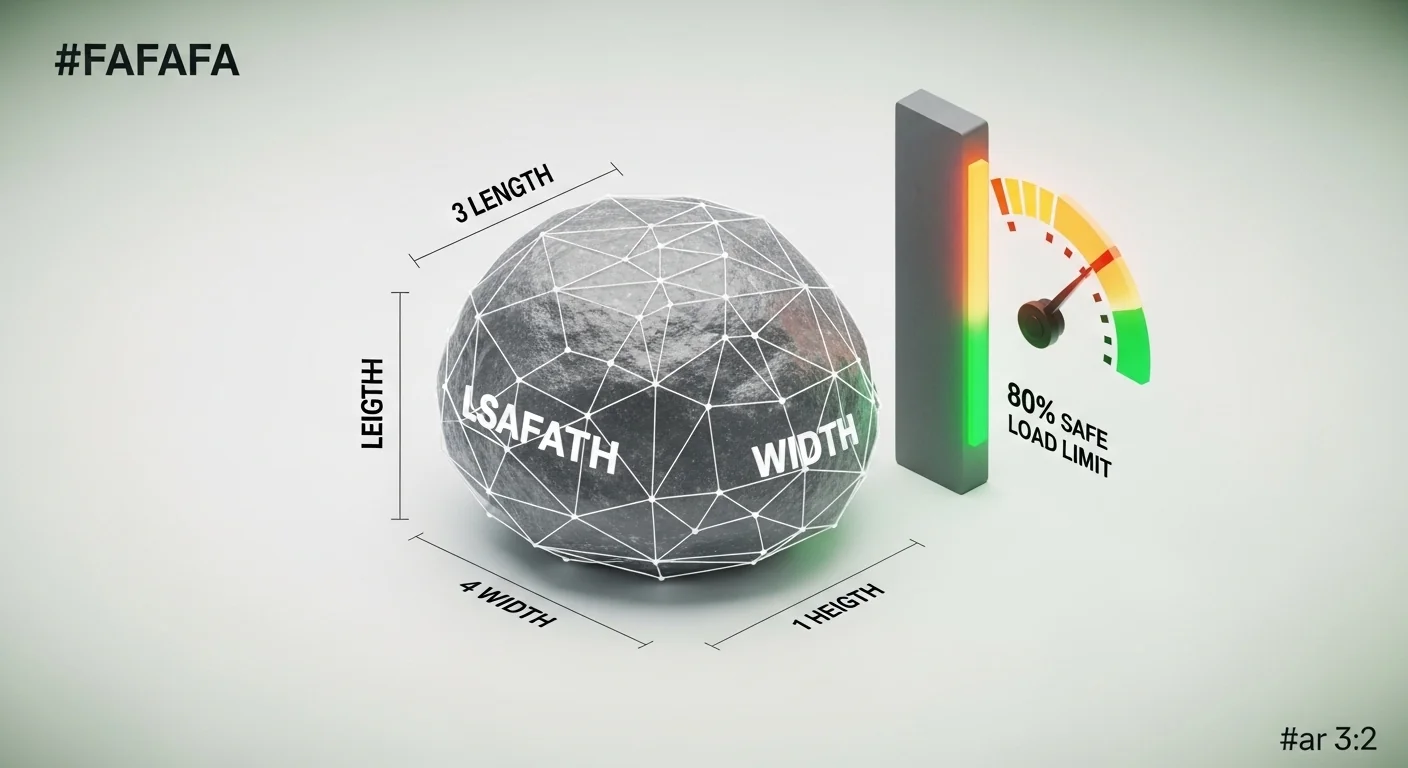
Landscape Boulder Weight & Lift Capacity Sizer
Calculate boulder weight by dimensions and check machine lift safety
Common Boulder Weights Reference
| Size (ft) | Shape | Rock | Weight (lbs) |
|---|
Recommended Safety Equipment
- Heavy-duty nylon lifting slings — minimum 10,000 lb rated working load limit
- Forged steel rock bar (San Angelo bar) for prying and positioning
- Steel-toe work boots (ASTM F2413 rated) for crush protection
- Log peavey / cant hook for controlled rolling of large rounds
- High-visibility safety vest when working near machinery
Assumptions & Limits
Volume assumptions: Boulders are approximated as geometric shapes. Actual boulders are irregular; real weight may vary ±15–25% depending on shape, fractures, and moisture content.
Density values: Average dry densities are used. Wet or porous stone can differ significantly. Granite: 165 lbs/ft³, Limestone: 155 lbs/ft³, Sandstone: 145 lbs/ft³, Basalt: 180 lbs/ft³, Slate: 170 lbs/ft³, Fieldstone: 150 lbs/ft³.
Machine capacity: The 80% safety threshold follows OSHA and manufacturer recommendations. Never load equipment to 100% of rated capacity. Ground conditions, slope, and attachment type affect actual safe limits.
Oval shape: Calculated as an ellipsoid using the formula (4/3) × π × (L/2) × (W/2) × (H/2).
Dimension limits: Length and width: 0.5–12 ft. Height: 0.5–10 ft. Boulders outside these ranges require engineered lifting plans.
How This Calculator Works
Step 1 — Calculate Volume:
For Sphere: Compute average radius as r = (L + W + H) / 6, then volume = (4/3) × π × r³ in cubic feet.
For Oval (Ellipsoid): Volume = (4/3) × π × (L/2) × (W/2) × (H/2) in cubic feet.
For Block: Volume = L × W × H in cubic feet.
Step 2 — Look Up Density: Each rock type has a known average density in lbs/ft³ (e.g., Granite = 165, Limestone = 155, Sandstone = 145).
Step 3 — Calculate Weight: Weight (lbs) = Volume (ft³) × Density (lbs/ft³)
Step 4 — Safety Check: If machine lift capacity is provided, compare boulder weight to 80% of the machine’s rated capacity. If the boulder exceeds this threshold, a tip-over warning is triggered. This 80% rule follows standard safe-load practice for skid steers and compact loaders.
A boulder does not announce its weight. A 3-foot round granite boulder sitting in a field looks manageable. The geometry says otherwise: at roughly 14 cubic feet and 165 pounds per cubic foot, that single stone weighs over 2,300 pounds. The gap between what looks liftable and what is actually liftable is where equipment tips, injuries happen, and projects stall. The problem is not effort or equipment size alone; it is the absence of a calculation before the lift.
This boulder weight calculator uses geometric volume formulas specific to each stone shape (sphere, oval, and rectangular block) combined with published density values for common landscape rock types. It outputs estimated weight in pounds, calculates what share of your machine’s rated lift capacity that weight represents, and triggers a deterministic tip-over warning when the 80-percent safety threshold is crossed. The tool does not account for irregular fractures, embedded soil mass, or wet-saturated stone, all of which can add weight beyond the estimate.
After using this tool, you will know whether your equipment can safely move a given boulder, and if it cannot, you will have the minimum machine capacity needed to do the job. For projects involving multiple large stones, pairing this result with a retaining wall layout calculation ensures both the structural placement and the logistics make sense before any stone moves.
Use the Tool
Before entering values, have the following ready: a tape measure giving you length, width, and height of the boulder in feet (measure to the nearest tenth), the rock type if known (ask your supplier or use the geological description on the delivery ticket), and your machine’s rated operating capacity in pounds from the equipment manual or the placard inside the cab. If you are working with a rented machine, the rental company is required to provide the rated capacity on request. Machine lift capacity and boulder weight must both be in pounds for the comparison to be meaningful.
Quick Start (60 Seconds)
- Boulder Shape: Choose Sphere for round, roughly symmetrical boulders. Use Oval for egg-shaped or elongated stones. Block covers flat slabs and rectangular cut stone. When in doubt between Sphere and Oval, use Oval; it produces a slightly lower volume estimate, which is the more conservative choice for irregular natural rock.
- Rock Type: Select the geological material. Granite is the densest common option at 165 lbs/ft³. Sandstone is the lightest at 145 lbs/ft³. If your supplier lists a different rock type, choose the closest match by density. Do not guess granite for everything; a fieldstone that is actually porous limestone will be meaningfully lighter.
- Length: The longest horizontal measurement in feet, not inches. If your tape reads 38 inches, enter 3.2 feet. Accepted range is 0.5 to 12 feet.
- Width: The perpendicular horizontal measurement. For a sphere or oval, this is the widest point measured at 90 degrees from the length axis.
- Height: The vertical measurement from the ground contact point to the highest point of the stone. Accepted range is 0.5 to 10 feet. A boulder taller than 3 feet will trigger an additional center-of-gravity caution in the results.
- Machine Lift Capacity: Enter the rated operating capacity in pounds exactly as printed in the equipment manual. Do not use the tipping load figure; that is a different (and much higher) number that describes when the machine physically begins to tip, not the safe working load.
- Press Calculate only after all six fields are filled. The tool validates inputs before running any math; incomplete entries will show inline errors rather than a result.
Inputs and Outputs (What Each Field Means)
| Field | Unit | What It Means | Common Mistake | Safe Entry Guidance |
|---|---|---|---|---|
| Boulder Shape | Category | Determines which geometric volume formula is applied. Sphere uses average radius; Oval uses three semi-axes; Block multiplies three linear dimensions. | Using Block for rounded boulders, which overestimates volume and inflates the weight estimate. | Choose the shape closest to the actual stone. Natural boulders are rarely perfect blocks. |
| Rock Type | Category | Sets the density constant (lbs/ft³) used to convert volume to weight. Granite = 165, Basalt = 180, Slate = 170, Limestone = 155, Fieldstone = 150, Sandstone = 145. | Defaulting to granite for all stone, which overstates weight for softer sedimentary types. | Ask your quarry or landscaper for the material name. Most delivery tickets include it. |
| Length (L) | Feet | Longest horizontal dimension of the boulder. | Entering inches instead of feet (e.g., 36 instead of 3.0). | Convert inches to feet by dividing by 12. Accepted range: 0.5 to 12 ft. |
| Width (W) | Feet | Widest horizontal measurement perpendicular to the length axis. | Measuring at the same angle as length, effectively re-measuring the same dimension. | Rotate the tape 90 degrees from the length measurement before reading width. |
| Height (H) | Feet | Vertical measurement from base contact point to the highest point of the stone. | Measuring the buried portion of a partially set boulder, which includes non-liftable mass. | If the boulder is already partially buried, measure only the exposed portion for lift planning. |
| Machine Lift Capacity | Pounds (lbs) | The rated operating capacity of the equipment from the manufacturer. The tool uses 80% of this as the safe working threshold. | Using the tipping load specification instead of the rated operating capacity. Tipping load is 1.5 to 2 times higher and is not a safe working limit. | Look for “Rated Operating Capacity” in the operator’s manual or the cab placard. Never use the tipping load figure. |
| Estimated Weight (output) | Pounds (lbs) | Calculated result: volume multiplied by rock density. | Treating the output as exact. Natural stone weight varies with moisture, voids, and irregular geometry. | Add a 10-15% safety buffer to the output when sizing rigging or slings. |
| Capacity Usage (output) | Ratio (displayed as fraction of rated capacity) | Shows boulder weight as a share of rated lift capacity. Results above 80% trigger the tip-over danger status. | Ignoring this output and proceeding based on gut feel about whether the machine “seems” powerful enough. | Always check this output before attaching any sling or bucket to the stone. |
For stone projects involving consistent smaller material rather than single large boulders, the river rock calculator handles coverage-based volume math with similar density logic.
Worked Examples (Real Numbers)
Example 1: The Classic Tip-Over Scenario, 3-Foot Round Granite Boulder
- Shape: Sphere
- Dimensions: L 3 ft, W 3 ft, H 3 ft
- Rock Type: Granite (165 lbs/ft³)
- Machine Lift Capacity: 1,000 lbs (typical compact mini skid steer)
Result: Average radius = (3+3+3)/6 = 1.5 ft. Volume = (4/3) x 3.14159 x 1.5³ = 14.14 ft³. Weight = 14.14 x 165 = 2,333 lbs. Safe machine limit = 1,000 x 0.80 = 800 lbs. Capacity usage exceeds the threshold by a factor of 2.9. DANGER status triggered.
This boulder requires a machine rated for at least 2,916 lbs operating capacity to lift safely. A contractor using a 1,000-pound-rated mini skid steer to move this stone risks a violent forward tip-over that can crush the operator cab and anyone standing in front of the machine.
Example 2: Limestone Block for a Retaining Feature
- Shape: Block
- Dimensions: L 4 ft, W 3 ft, H 2 ft
- Rock Type: Limestone (155 lbs/ft³)
- Machine Lift Capacity: 6,000 lbs (full-size skid steer or compact track loader)
Result: Volume = 4 x 3 x 2 = 24 ft³. Weight = 24 x 155 = 3,720 lbs. Safe machine limit = 6,000 x 0.80 = 4,800 lbs. Capacity usage is about 62%. CAUTION status.
The machine is rated for this lift, but the boulder weight puts the loader in the caution range. Operators should avoid grades steeper than 5 degrees and keep the load as low to the ground as possible during transport across the site.
Example 3: Small Oval Sandstone Accent Boulder
- Shape: Oval
- Dimensions: L 2 ft, W 2 ft, H 1.5 ft
- Rock Type: Sandstone (145 lbs/ft³)
- Machine Lift Capacity: 1,500 lbs (mid-size mini skid steer)
Result: Volume = (4/3) x 3.14159 x 1.0 x 1.0 x 0.75 = 3.14 ft³. Weight = 3.14 x 145 = 455 lbs. Safe machine limit = 1,500 x 0.80 = 1,200 lbs. Capacity usage is approximately 38%. SAFE status.
A 455-pound stone is within reach of hand-placing or rolling techniques in some circumstances, but for speed and safety at a productive job site, the mid-size skid steer handles this load comfortably. Lifting slings rated for the load should still be used; chains and ropes are not rated substitutes.
Reference Table (Fast Lookup)
| Shape | Dimensions L x W x H (ft) | Rock Type | Volume (ft³) | Estimated Weight (lbs) | Minimum Machine Capacity Needed (lbs) |
|---|---|---|---|---|---|
| Sphere | 2 x 2 x 2 | Granite | 4.19 | 691 | 864 |
| Sphere | 3 x 3 x 3 | Granite | 14.14 | 2,333 | 2,916 |
| Sphere | 4 x 4 x 4 | Granite | 33.51 | 5,529 | 6,911 |
| Oval | 3 x 2 x 2 | Limestone | 6.28 | 973 | 1,216 |
| Oval | 4 x 3 x 2 | Sandstone | 12.57 | 1,823 | 2,279 |
| Block | 2 x 2 x 1 | Basalt | 4.00 | 720 | 900 |
| Block | 4 x 3 x 2 | Granite | 24.00 | 3,960 | 4,950 |
| Block | 3 x 3 x 3 | Fieldstone | 27.00 | 4,050 | 5,063 |
| Sphere | 2.5 x 2.5 x 2.5 | Slate | 8.18 | 1,391 | 1,739 |
| Oval | 5 x 4 x 3 | Granite | 31.42 | 5,184 | 6,480 |
The minimum machine capacity column is derived by dividing the estimated weight by 0.80, representing the minimum rated operating capacity required to keep the lift within the safe working threshold. Any machine rated below this number should not attempt the lift without additional rigging engineering.
How the Calculation Works (Formula + Assumptions)
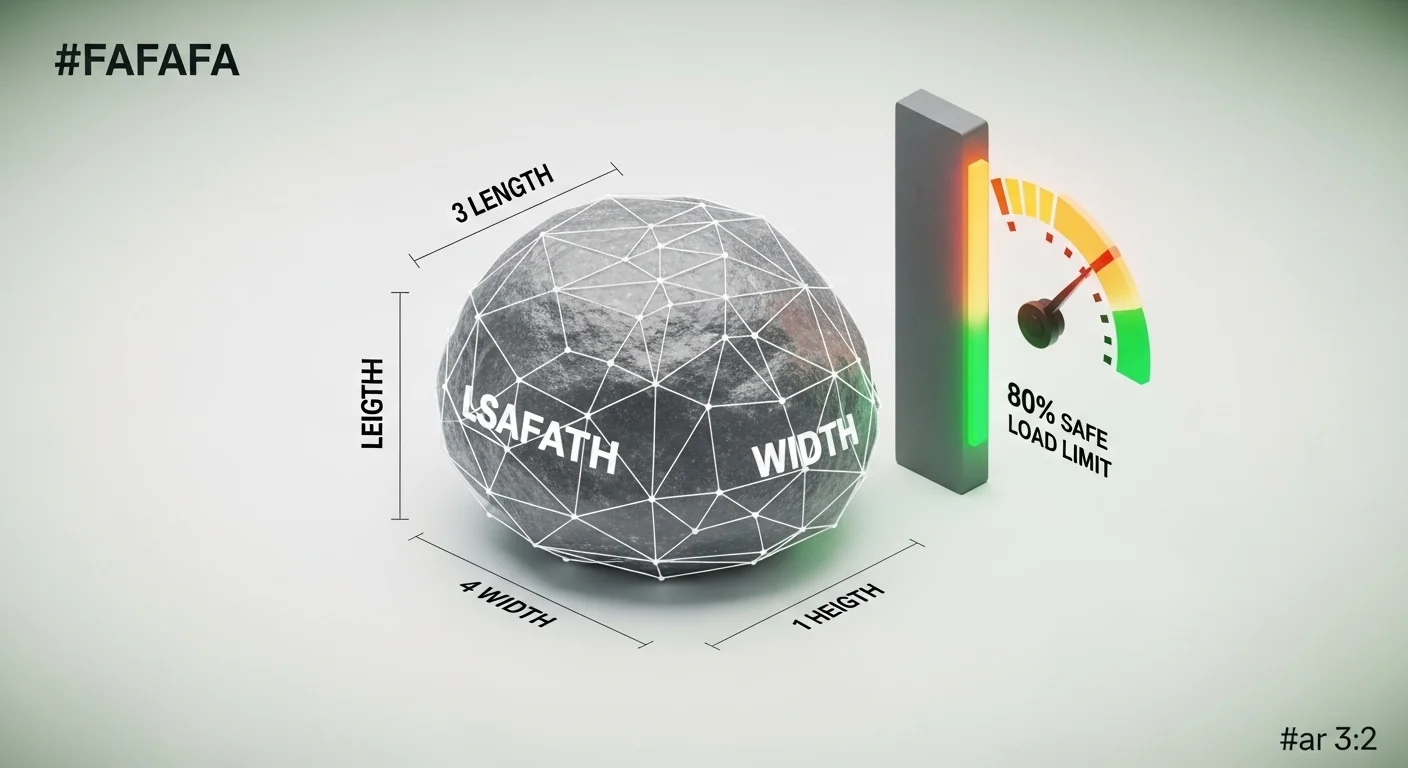
Show the calculation steps
Step 1: Volume calculation
The formula applied depends on the selected shape:
- Sphere: Average radius r = (L + W + H) / 6. Volume = (4/3) x π x r³. This treats the boulder as a sphere whose radius is the mean of the three dimension-halves.
- Oval (Ellipsoid): Volume = (4/3) x π x (L/2) x (W/2) x (H/2). Each dimension contributes its semi-axis to the ellipsoid formula. This is more accurate than the sphere formula for elongated stones.
- Block (Rectangular prism): Volume = L x W x H. Straightforward multiplication of three linear measurements. Best for cut stone, large slabs, and flat retaining boulders.
All dimensions must be in feet. Volume output is in cubic feet (ft³).
Step 2: Weight calculation
Weight (lbs) = Volume (ft³) x Density (lbs/ft³)
Density is a fixed lookup value based on the selected rock type. Results are rounded to the nearest whole pound in the displayed output.
Step 3: Safety threshold evaluation
Safe limit = Machine Lift Capacity x 0.80. If the calculated boulder weight exceeds this safe limit, the tool triggers a DANGER status and displays the tip-over warning. Capacity usage between 50 and 80 percent triggers a CAUTION status. Usage below 50 percent returns SAFE status.
Rounding: Volume is calculated to full floating-point precision internally. The displayed volume rounds to two decimal places. Weight rounds to the nearest whole pound. Capacity percentage rounds to one decimal place.
Assumptions and Limits
- Boulders are approximated as idealized geometric shapes. Natural stone is irregular; actual weight can vary roughly 15 to 25 percent above or below the estimate depending on how closely the real shape matches the selected geometry.
- Density values represent average dry weight for each rock type. Saturated stone (after rain or irrigation) can be meaningfully heavier, particularly for porous sandstone and fieldstone.
- The tool assumes a solid boulder with no significant internal voids. Hollow pockets, fracture planes, or embedded soil reduce actual weight below the estimate.
- The 80-percent safe load threshold is applied uniformly. Some manufacturer guidelines and site conditions (slopes, soft ground, extended reach positions) require a lower threshold. Always consult the equipment operator’s manual for site-specific limits.
- Dimension inputs are assumed to be the true maximum extents of the stone, not an average. If you measure at an irregular point, the estimate will be skewed.
- The tool does not account for rigging weight (slings, hooks, hardware), which can add 20 to 100 or more pounds to the load. Subtract rigging weight from the machine’s safe limit when precision matters.
- Boulder height inputs over 3 feet trigger an additional center-of-gravity warning in results. However, the tool does not compute dynamic stability; that requires site-specific engineering assessment.
Standards, Safety Checks, and “Secret Sauce” Warnings
Critical Warnings
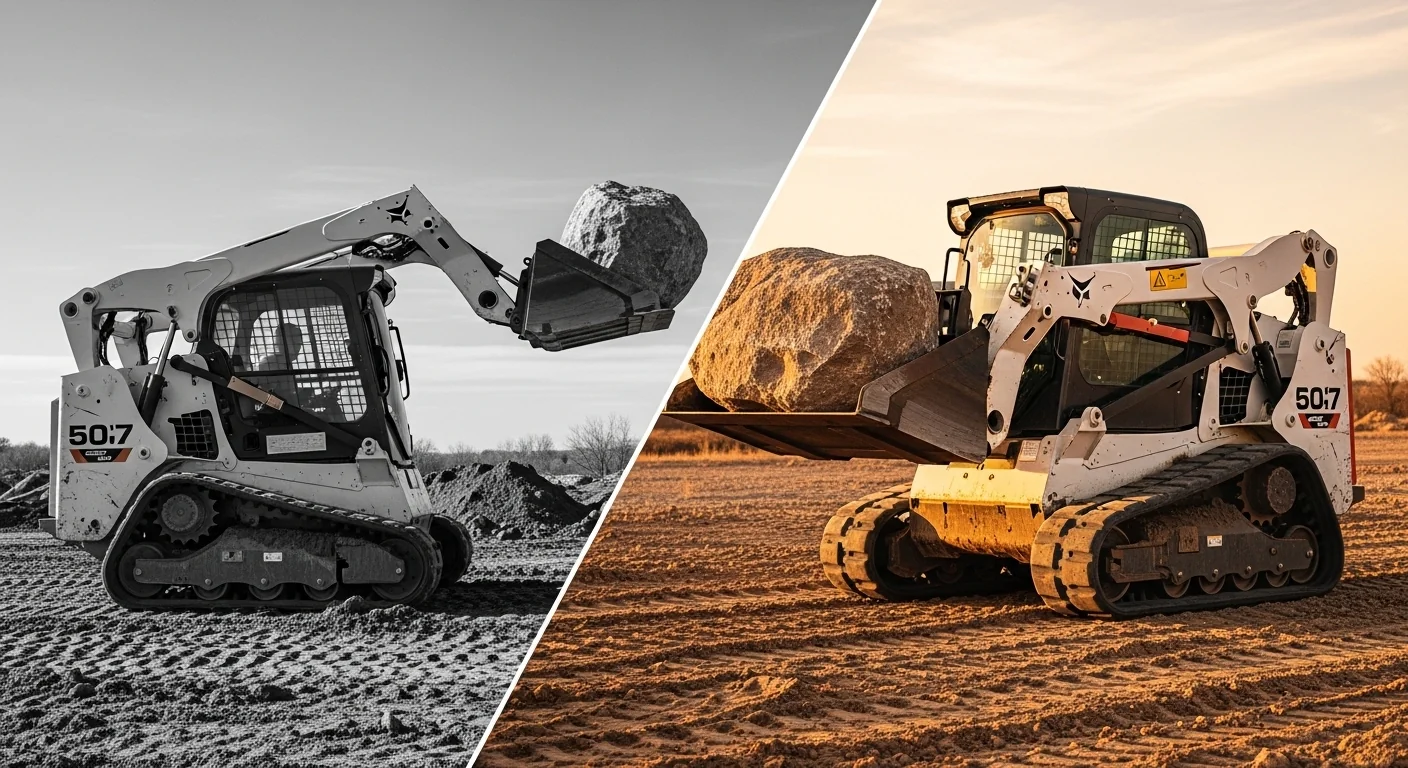
- The Skid-Steer Tipper: The most dangerous scenario in boulder moving is a homeowner or contractor renting a compact mini skid steer with a 1,000-pound rated capacity and attempting to lift a round boulder that looks manageable. A 3-foot spherical granite boulder weighs over 2,300 pounds. The machine does not gradually struggle; it tips forward violently, with the rear wheels lifting off the ground, threatening to pin anyone standing at the attachment end. This is not a hypothetical; it is the dominant injury mode in landscape boulder operations.
- Rigging rating mismatch: Boulders over 2,000 pounds require rated rigging components, specifically heavy-duty nylon slings with a minimum 10,000-pound working load limit and forged steel attachment hardware. Rope, chain, or ratchet straps are not substitutes for rated rigging. A 4,000-pound stone dropped from a failed strap does not give warning.
- Tipping load versus operating capacity confusion: Equipment spec sheets list both “tipping load” and “rated operating capacity.” These are not interchangeable. Tipping load is 1.5 to 2 times the operating capacity and describes the physical point at which the machine begins to tip, not a safe working load. Using the tipping load number as the capacity input to this tool will produce a dangerously misleading result.
- Boulders over 5,000 pounds: Any boulder the tool calculates as exceeding 5,000 pounds should be considered outside the scope of rental equipment and standard landscape crew operations. A professional crane service with a site-specific rigging plan is required at this weight class.
Minimum Standards
- Never load equipment above 80 percent of the manufacturer’s rated operating capacity. This follows standard safe-load practice consistent with equipment manufacturer guidelines for compact loaders and skid steers.
- All lifting slings used for boulders must be rated for at least 1.5 times the estimated boulder weight to account for dynamic loading (swing, acceleration, uneven lift).
- Steel-toe footwear rated to ASTM F2413 is required for any crew member within the working radius of boulder-moving operations.
- A San Angelo (forged steel) bar or similar rated pry bar should be on site for any boulder over 500 pounds for repositioning and directing the load.
Competitor Trap: Many boulder weight guides online calculate weight using a simple “diameter cubed divided by 10” shortcut rule. That formula was designed for quick mental math on spherical fieldstone and produces results that are 20 to 40 percent low for dense granite and basalt boulders of non-spherical shapes. A contractor relying on that shortcut for machine sizing when working with an irregularly shaped basalt boulder at 180 lbs/ft³ will consistently underestimate the actual weight, sometimes enough to put the lift into the danger zone. This tool uses the full geometric formula for each selected shape and the correct density constant for each rock type.
Larger engineered retaining structures that combine boulders with geogrid reinforcement require a separate structural analysis. The geogrid retaining wall calculator addresses that category of project where individual boulder weight is only one factor in the overall load path. For projects where stone must also resist lateral soil pressure, the retaining wall calculator provides the complementary structural sizing logic.
Common Mistakes and Fixes
Mistake: Measuring the Buried Depth Instead of the Liftable Height
When a boulder is already partially set in the ground, some operators measure the total height including the buried portion. That buried mass is compacted into soil and adds considerable weight to the lift. The machine is lifting the full stone, including the buried section, not just what is visible above grade.
Fix: For partially buried boulders, use the full height from the lowest visible base edge to the top of the stone, then add an estimated additional depth for the buried portion by probing around the perimeter with a steel rod before entering the height value.
Mistake: Treating Oval and Sphere as Interchangeable Shapes
For elongated boulders, using the Sphere formula instead of Oval produces a higher volume estimate because the sphere formula averages all three dimensions equally, inflating the result when two dimensions are smaller than the longest one. For a 4x2x2 foot stone, the sphere formula gives 14.14 ft³ while the correct oval (ellipsoid) formula gives 8.38 ft³, a difference of nearly 70 percent.
Fix: If the longest dimension is more than 1.5 times either of the other two, select Oval. If all three dimensions are roughly equal (within 20 percent of each other), Sphere is appropriate.
Mistake: Using Rated Capacity from the Machine Model Number Lookup
Instead of the Cab Placard
Machine capacity varies by attachment, configuration, and optional ballast. A skid steer model listed at 1,600 pounds operating capacity in a spec database may have a different rating when equipped with a rock bucket versus a standard bucket, and capacity is reduced further on inclines. An operator Googling the model number gets a generic figure that may not reflect the actual configured machine on the site.
Fix: Use only the rated operating capacity from the physical placard inside the cab or from the machine’s own operator’s manual for that specific serial number and attachment configuration.
Mistake: Ignoring the Height Warning for Tall Boulders
A tall boulder with a high center of gravity introduces instability risks during transport that are separate from the pure weight calculation. Even if a 4-foot-tall boulder is within the machine’s safe weight capacity, carrying it at elevation across uneven terrain shifts the combined center of gravity of the machine-load system in ways that can cause tipping even within the rated weight limit.
Fix: Keep all boulder lifts as low to the ground as safely possible during transport. Travel with the load at the lowest position the attachment allows, not at a raised carry height. When the tool displays the height warning, treat it as a travel protocol flag, not just a note.
Mistake: Skipping the Rigging Weight Deduction
Rated capacity covers the total suspended load, which includes not only the boulder but also the slings, hooks, shackles, and spreader bars used to secure it. On large lifts with heavy rigging hardware, this can add 50 to 150 pounds to the load. For stones near the machine’s safe threshold, this margin matters. For stone selection and landscape edging decisions adjacent to boulder features, the dry creek bed stone size calculator provides reference weights for smaller accent stone that flanks main boulders.
Fix: Weigh or look up the combined weight of all rigging hardware before the lift. Subtract that weight from the machine’s safe limit before comparing to the boulder weight output.
Next Steps in Your Workflow
Once you have the boulder weight and a confirmed machine capacity match, the next decision is site preparation: ground bearing capacity and access path. A machine carrying a 3,000-pound boulder on saturated soil can sink, tip, or destroy irrigation lines and hardscape. Mark your travel path, check for buried utilities using a locating service, and confirm that any slopes on the travel path are within the machine manufacturer’s grade limits for loaded travel. For projects where boulder placement is adjacent to existing hardscape or planter structures, the planter weight calculator can verify that the supporting structure or wall beneath or beside the placement zone can handle the static load once the boulder is set.
After placement, note the final boulder dimensions in your project documentation for any future maintenance, relocation, or inspection. Boulder weight becomes relevant again any time a structure is modified around it. For paved or base-prepared surfaces near boulder features, the paver base calculator accounts for compressive load requirements in the subbase layer, which changes when boulders are positioned at or near the edge of a paved field.
FAQ
How accurate is a boulder weight calculator for natural stone?
Geometric volume formulas applied to natural boulders are approximations, typically within 15 to 25 percent of actual weight for well-measured stones. The primary sources of error are irregular shape, internal voids, embedded soil or clay, and moisture content. Treat the output as a planning number, not a certified load rating. For rigging specifications, add a minimum 15 percent margin above the calculated weight.
What is the safe lift capacity rule for skid steers and compact loaders?
The widely observed standard is 80 percent of the manufacturer’s rated operating capacity. Rated operating capacity is typically set at 35 or 50 percent of the machine’s tipping load depending on the standard the manufacturer uses. Operating at full rated capacity leaves minimal margin; operating above 80 percent of rated capacity substantially increases the risk of tipping, especially on grades or when the load is not centered in the bucket or attachment.
Why does rock type matter so much for boulder weight calculations?
Density variation across common landscape rock types spans roughly 35 pounds per cubic foot from the lightest (sandstone at 145 lbs/ft³) to the heaviest (basalt at 180 lbs/ft³). For a 10-cubic-foot boulder, that is 350 pounds of difference, enough to shift a borderline-safe lift into the danger zone or vice versa. Rock type identification is not decorative input; it directly changes the weight output in a meaningful way.
What is the minimum sling rating I should use for lifting boulders?
Lifting slings should be rated for the total load including dynamic factors, a minimum of 1.5 times the static weight of the boulder for routine lifts. For a 2,000-pound boulder, that means a sling rated for at least 3,000 pounds working load limit. The equipment safety recommendation cited by the tool is a 10,000-pound rated nylon sling as a practical baseline for large landscape boulders, providing substantial margin above typical boulder weights in residential and commercial landscaping.
Can I use this calculator for retaining wall boulders?
Yes. The calculation applies to any natural or cut stone regardless of its intended use. For retaining wall planning specifically, the boulder weight output is useful for equipment sizing during installation and for estimating the dead load the wall contributes to the subgrade. However, the structural performance of a retaining wall depends on many additional factors (soil pressure, drainage, batter, and footing depth) that are outside the scope of this tool.
Why does the tool warn about boulder height separately from weight?
Weight determines whether the machine can physically lift the stone. Height affects the stability of the combined machine-load system during transport. A tall boulder carried at any elevation raises the center of gravity of the total system, increasing rollover risk even when the weight is within the rated capacity. The height warning at 3 feet or above is a travel and positioning flag, prompting operators to keep the load at the lowest safe carry height across the entire travel path.
Conclusion
Landscape boulder projects fail at the lift, not at the design. The geometry of round stone is non-intuitive; a boulder that looks half the size of something manageable can weigh three times as much because volume scales with the cube of dimension. This boulder weight calculator makes the math instant and ties it directly to the machine capacity comparison that prevents tip-overs. The single most dangerous assumption in boulder moving is that a rental compact loader can handle any stone that can be seen fully in its bucket. The tool’s DANGER output exists to replace that assumption with a number.
For any boulder above 2,000 pounds, treat the output as a trigger to plan rigging rather than just a weight figure. Certified slings, a forged pry bar, and steel-toe boots are not optional at that weight class; they are minimum equipment for a safe operation. For projects involving both heavy stone and fine gravel or crushed material in the same layout, the gravel calculator handles volume and weight math for the surrounding material so the full site plan uses verified numbers from start to finish.