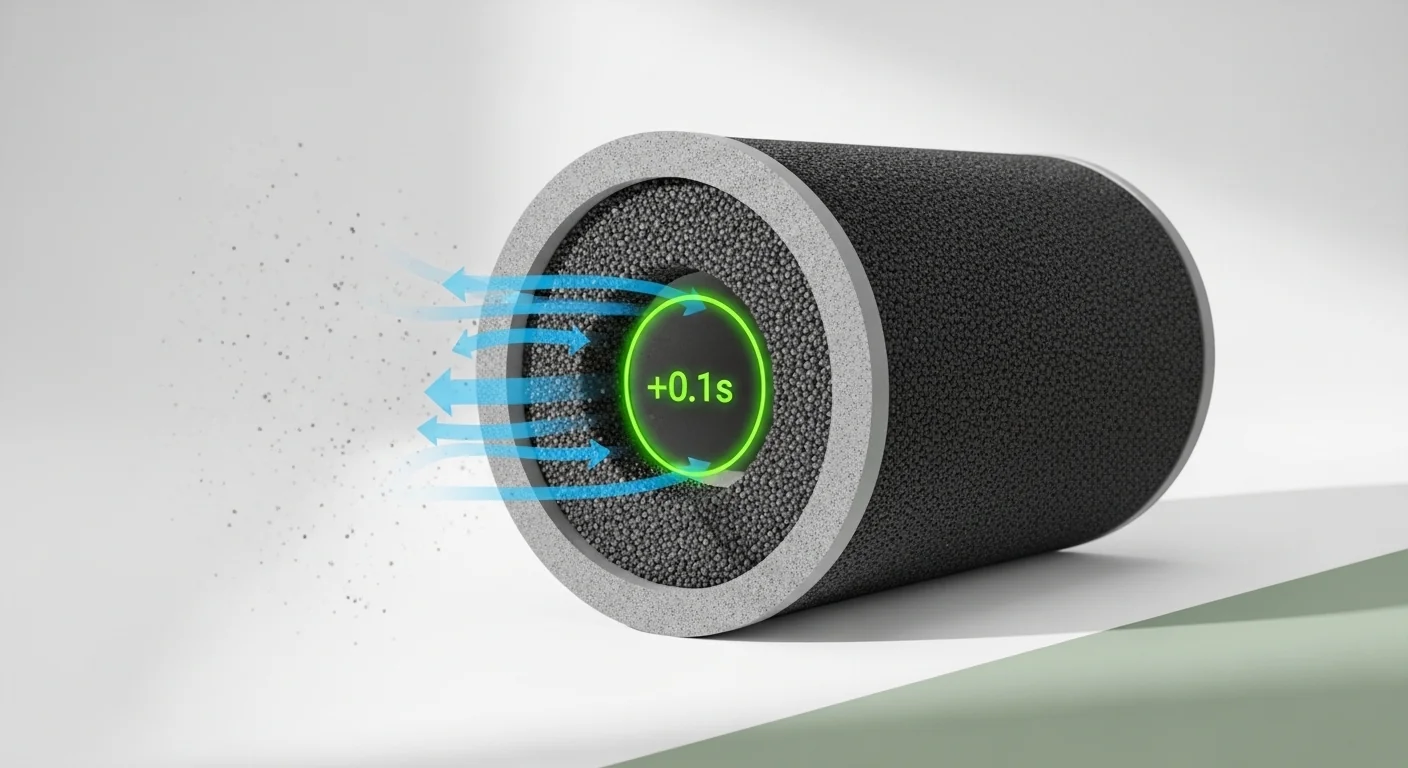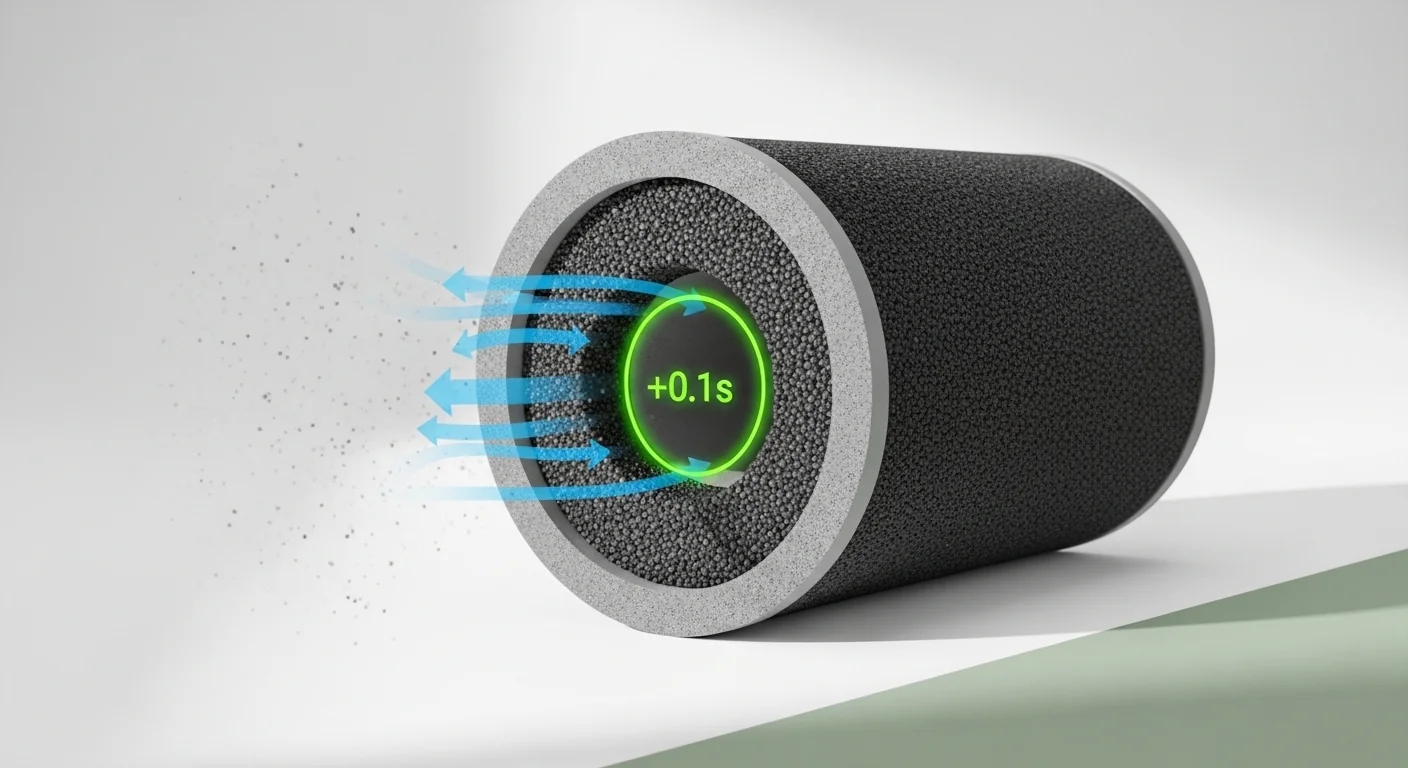
Every grow room guide tells you to match your carbon filter’s duct size to your inline fan. That advice misses the physics entirely. Odor molecules are not captured by the duct diameter or even by the filter’s rated CFM ceiling. They are captured by time: the fraction of a second that air spends in contact with activated carbon pores before exiting the filter. That window is called dwell time, and when it falls below 0.10 seconds, terpenes pass through the carbon bed unreacted regardless of how much the filter cost or how thick the carbon layer looks from the outside.
This calculator computes dwell time from first principles using the actual geometry of your filter (outer diameter, inner core diameter, and bed length) and your measured fan airflow in CFM. It outputs contact time in seconds, filter carbon volume in cubic feet, and air velocity through the annular bed. It does not account for carbon age, humidity above 75% relative humidity, or variance in activated carbon surface area between brands. Those factors affect real-world performance but cannot be derived from geometry alone.
After running the calculator, you will know whether your current fan-and-filter combination provides sufficient dwell time for your odor intensity level, and if not, whether you need a larger filter, a slower fan, or both. If your grow room airflow is already planned but the fan size is not locked in yet, the greenhouse fan airflow guide covers how to derive target CFM from room volume and air-change rate before you run this dwell time check.
Use the Tool
Carbon Filter Contact Time Calculator
Grow room carbon filter sizing — dwell time & odor scrubbing analysis
| CFM | Dwell Time | Air Speed | Rating |
|---|
- Phresh or AC Infinity virgin Australian activated carbon filters — highest bed density available
- Variable-speed fan controller (AC Infinity CLOUDLINE T series) — dial in exact CFM
- Duct silencer / sound attenuator — reduce turbulence and improve contact uniformity
- Foil HVAC tape — seal all duct connections to prevent odor bypass
How This Calculator Works — Formula & Assumptions
This tool calculates how long air molecules dwell inside your activated carbon bed — a critical metric for effective odor elimination. Terpene molecules (the source of grow room smell) must physically contact activated carbon pores for a minimum of 0.1 seconds to be adsorbed and trapped.
Step 1 — Carbon Bed Volume (cubic feet)
Step 2 — Contact Time (seconds)
Step 3 — Safety Thresholds
Key Physics: Why Dwell Time Matters
Activated carbon adsorbs odor molecules via Van der Waals forces — a physical attraction between the carbon pore surface and volatile organic compounds (VOCs). This reaction takes time. When air velocity is too high (dwell time too short), molecules pass through before adsorption can occur. This is why a 1,200 CFM fan on a 6″ filter will push air through at ~40 mph — the smell shoots right through.
Assumptions & Limits
- Assumes uniform airflow distribution through the carbon bed
- Does not account for carbon saturation / filter age (replace every 12–18 months)
- Assumes virgin Australian activated carbon with ≥ 1,200 m²/g surface area
- Bed depth must be ≥ 1.5″ for meaningful terpene capture at any airspeed
- Results apply to standard cylindrical inline filters, not flat panel or V-bank designs
- Humidity above 75% RH reduces carbon effectiveness — use dehumidification
- This tool is for guidance only — actual performance varies by strain, temperature, and filter age
Before entering values, have your filter's spec sheet or physical measurements ready. You need the outer diameter and inner core (mesh tube) diameter in inches, the active carbon bed length in inches (measure only the carbon section, not any plastic flanges or end caps), your fan's actual operating CFM at your duct static pressure, and your carbon bed depth. If you are sizing for the first time and have not yet chosen a fan speed, start with a trial CFM and use the reference table in the results to compare multiple airflow scenarios side by side. Growers planning a tent system may also find the grow tent fan size calculator useful for establishing the CFM target before checking dwell time.
Quick Start (60 Seconds)
- Exhaust Fan Airflow Rate (CFM): Use the fan's rated CFM at its actual operating static pressure, not the no-load maximum printed on the box. Running at 80% of rated output is a common and conservative assumption if you lack measured data.
- Filter Outer Diameter (inches): Measure the widest point of the carbon shell itself, not the duct flange. A "6-inch filter" typically has an outer shell diameter of 10 to 14 inches depending on brand.
- Filter Inner Diameter (inches): This is the perforated metal or mesh core tube through which air travels before entering the carbon bed. Measure the inside edge of the carbon layer, not the outer shell.
- Carbon Bed Length (inches): Measure only the section packed with carbon. Exclude plastic end caps, flanges, and any blank sections. Over-estimating this number overstates your filter volume and produces an optimistic (inaccurate) dwell time result.
- Carbon Bed Depth (inches): This is the radial thickness of the activated carbon layer, calculated as (Outer Diameter minus Inner Diameter) divided by 2. Typical values are 1.5 to 2.5 inches for quality inline carbon filters. Entering a value below 1.5 triggers a separate bed-depth warning in the output.
- Target Odor Intensity: Select based on growth stage. Vegetative plants with low terpene production qualify as mild. Late-flower high-odor strains (OG Kush, Sour Diesel, and similar cultivars) require the heavy terpene setting, which raises the minimum dwell threshold to 0.15 seconds.
Inputs and Outputs (What Each Field Means)
| Field | Unit | What It Represents | Common Mistake | Safe Entry Guidance |
|---|---|---|---|---|
| Exhaust Fan Airflow Rate | CFM | Volume of air moved per minute by the exhaust fan under actual duct load | Using the maximum no-load CFM from the box instead of the operating CFM at real duct resistance | Use measured CFM or reduce rated CFM by 15 to 25% for typical duct and filter resistance |
| Filter Outer Diameter | inches | Full external diameter of the carbon shell casing | Confusing duct connection size (e.g., 6") with actual filter body diameter (often 12" or more) | Measure with a tape measure across the widest point of the cylindrical body |
| Filter Inner Diameter | inches | Diameter of the perforated inner core tube (the hollow center air channel) | Measuring the duct flange instead of the inner mesh tube | Should match or closely match your duct diameter; measure the inside edge of the carbon layer |
| Carbon Bed Length | inches | Active length of the carbon-packed annular section | Including plastic end caps or blank duct sections in the length measurement | Measure only the packed carbon region; when in doubt, subtract 1 to 2 inches from total filter length |
| Carbon Bed Depth | inches | Radial thickness of the activated carbon layer from inner to outer shell | Entering total filter radius instead of just the carbon layer thickness | Calculate as (Outer Diameter minus Inner Diameter) / 2; typical range is 1.5 to 2.5 inches |
| Target Odor Intensity | selection | Growth stage and strain terpene output level, which sets the minimum required dwell time | Using "mild" for flowering plants to get a passing result when the calculation actually fails at the correct threshold | Select "Heavy Terpenes" for any plant in weeks 4 through harvest; use "Mild Veg" only for seedling and early vegetative stages |
| Contact Time (output) | seconds | Calculated dwell time of air inside the carbon bed | N/A | Target: 0.10 to 0.20 seconds; 0.15 seconds minimum for heavy terpene strains |
| Filter Carbon Volume (output) | cubic feet | Total volume of the activated carbon annular bed based on filter geometry | N/A | Larger volume means more contact surface and longer dwell time at a given CFM |
| Air Velocity (output) | ft/min | Speed at which air travels through the annular carbon cross-section | N/A | High velocities (above 200 ft/min in the bed) are associated with short dwell times and odor leakage |
Worked Examples (Real Numbers)
Example 1: Small Filter, Oversized Fan (Odor Leak Scenario)
- Fan airflow: 400 CFM
- Filter outer diameter: 8 inches
- Filter inner diameter: 4 inches
- Carbon bed length: 20 inches
- Carbon bed depth: 2 inches
- Odor intensity: Heavy Terpenes
Filter volume: pi x ((8^2 - 4^2) / 4) x 20 / 1728 = pi x (48/4) x 20 / 1728 = pi x 12 x 20 / 1728 = 3.14159 x 0.13889 = 0.436 cubic feet
Result: Contact time = (0.436 x 60) / 400 = 0.065 seconds. Status: ODOR LEAK WARNING.
At 0.065 seconds, air is moving through this small filter far faster than activated carbon can adsorb terpene molecules. A 400 CFM fan is more than six times too powerful for this filter geometry at the heavy terpene threshold. The grow room will smell. Upgrading to a larger filter body or throttling the fan to approximately 60 CFM (not practical for ventilation) are the only solutions.
Example 2: Correctly Matched Filter and Fan (Optimal Scenario)
- Fan airflow: 400 CFM
- Filter outer diameter: 12 inches
- Filter inner diameter: 6 inches
- Carbon bed length: 24 inches
- Carbon bed depth: 3 inches
- Odor intensity: Heavy Terpenes
Filter volume: pi x ((12^2 - 6^2) / 4) x 24 / 1728 = pi x (108/4) x 24 / 1728 = pi x 27 x 24 / 1728 = pi x 0.375 = 1.178 cubic feet
Result: Contact time = (1.178 x 60) / 400 = 0.177 seconds. Status: OPTIMAL.
This configuration sits comfortably in the 0.10 to 0.20 second optimal window, with margin above the 0.15 second threshold required for heavy terpene strains. The filter geometry provides more than enough carbon contact surface for a 400 CFM fan.
Example 3: Large Filter, High-Output Fan (Commercial Scale)
- Fan airflow: 800 CFM
- Filter outer diameter: 16 inches
- Filter inner diameter: 8 inches
- Carbon bed length: 30 inches
- Carbon bed depth: 4 inches
- Odor intensity: Heavy Terpenes
Filter volume: pi x ((16^2 - 8^2) / 4) x 30 / 1728 = pi x (192/4) x 30 / 1728 = pi x 48 x 30 / 1728 = pi x 0.8333 = 2.618 cubic feet
Result: Contact time = (2.618 x 60) / 800 = 0.196 seconds. Status: OPTIMAL.
An 800 CFM fan paired with a large commercial-grade filter body maintains a dwell time of 0.196 seconds, just inside the optimal ceiling. Increasing fan output to 900 CFM would push contact time to 0.175 seconds, still acceptable. At 1,000 CFM, dwell time drops to 0.157 seconds, borderline for heavy terpene loads.
Reference Table (Fast Lookup)
The table below uses a 12-inch outer diameter, 6-inch inner diameter, 24-inch bed length filter (carbon volume = 1.178 cubic feet) as the reference geometry. This represents a common mid-range inline carbon filter used with 4-inch and 6-inch duct systems.
| Fan CFM | Dwell Time (sec) | Air Velocity (ft/min) | Mild Veg Pass? | Heavy Flower Pass? | Rating |
|---|---|---|---|---|---|
| 100 | 0.707 | 37 | Yes | Yes | Excessive back-pressure (fan undersized) |
| 200 | 0.354 | 74 | Yes | Yes | Caution: carbon resistance is high |
| 300 | 0.236 | 111 | Yes | Yes | Caution: approaching back-pressure zone |
| 400 | 0.177 | 148 | Yes | Yes | Optimal |
| 500 | 0.141 | 185 | Yes | Yes | Optimal (borderline for heavy strains) |
| 600 | 0.118 | 222 | Yes | No (below 0.15s) | Marginal for heavy terpene loads |
| 700 | 0.101 | 259 | Yes (barely) | No | Borderline for mild; failing for heavy |
| 800 | 0.088 | 296 | No | No | Odor Leak Warning |
| 1000 | 0.071 | 370 | No | No | Odor Leak Warning (severe) |
| 1200 | 0.059 | 444 | No | No | Odor Leak Warning (severe) |
Key takeaway from this table: the same filter that comfortably handles 400 CFM in optimal range fails completely at 800 CFM and above. Fan-to-filter mismatches at this scale are not edge cases; they are one of the most common causes of odor complaints in otherwise well-designed grow rooms.
How the Calculation Works (Formula + Assumptions)
Show the calculation steps
Step 1: Calculate Filter Carbon Volume (cubic feet)
The activated carbon sits in the ring-shaped (annular) space between the outer shell and the inner mesh core. The volume of this annular cylinder is:
FilterVol (ft3) = pi x ((OD^2 - ID^2) / 4) x Length_inches / 1728
Where OD is outer diameter in inches, ID is inner diameter in inches, and Length is the active carbon bed length in inches. Dividing by 1728 converts cubic inches to cubic feet (since 12^3 = 1728).
Step 2: Calculate Contact Time (seconds)
CFM is cubic feet per minute. Multiplying filter volume by 60 converts the denominator from minutes to seconds:
ContactTime (sec) = (FilterVol_ft3 x 60) / CFM
This gives the average time that a parcel of air spends inside the carbon bed before exiting the filter.
Step 3: Apply Thresholds
- Below 0.10 seconds: odor leak zone; terpene adsorption is incomplete regardless of carbon quality
- 0.10 to 0.20 seconds: optimal window for most grow room applications
- 0.15 seconds minimum: required for late-flower, high-terpene cultivars
- 0.20 to 0.30 seconds: fan may be undersized; carbon resistance causes elevated static pressure
- Above 0.30 seconds: excessive back-pressure risk; actual fan CFM output is reduced below rated spec
Step 4: Air Velocity Through the Bed (ft/min)
Air velocity is derived from the annular cross-sectional area of the filter:
Area (ft2) = pi x ((OD/24)^2 - (ID/24)^2) (converting inches to feet by dividing by 12)
Velocity (ft/min) = CFM / Area_ft2
This value is informational. High velocity reinforces a low dwell time finding but does not add new information beyond what dwell time already shows.
Rounding Rules
Contact time is displayed to three decimal places. Carbon volume is displayed to four decimal places. Air velocity is rounded to the nearest whole number in feet per minute.
Assumptions and Limits
- Airflow is assumed to be uniformly distributed across the annular carbon bed. In practice, channeling near the inner core or outer shell reduces effective contact.
- Activated carbon is assumed to be virgin Australian-origin carbon with a surface area of at least 1,000 square meters per gram. Recycled or lower-grade carbon performs differently.
- The formula does not account for carbon saturation. A filter approaching end-of-life adsorbs molecules more slowly than a fresh filter at the same geometry and airflow.
- Relative humidity above 75% reduces activated carbon effectiveness by filling pores with water molecules. The calculator does not adjust dwell time thresholds for humidity.
- Results apply to standard cylindrical inline carbon filters only. Flat-panel, V-bank, and radial-flow filter designs have different airflow geometries and require separate calculations.
- Fan CFM input should reflect real operating CFM under duct and filter load, not no-load rated CFM. Duct resistance can reduce actual airflow by 15 to 30% in typical grow room configurations.
- The minimum dwell time thresholds (0.10 seconds for mild, 0.15 seconds for heavy terpenes) are industry-derived standards for activated carbon odor control. Individual terpene profiles, temperature, and carbon brand affect actual adsorption rates.
Standards, Safety Checks, and "Secret Sauce" Warnings
Critical Warnings
- The High-Velocity Stink Leak: Pairing a high-CFM fan with a small or medium carbon filter is the single most common cause of odor breakthrough. At 1,200 CFM through a filter with a carbon volume below 0.8 cubic feet, dwell time drops below 0.06 seconds, which means air is moving at roughly 400 to 500 feet per minute through the bed. Van der Waals forces between terpene molecules and carbon pores require a minimum exposure window that simply does not exist at that speed. No amount of carbon bed quality compensates for insufficient contact time.
- Bed Depth Below 1.5 Inches: Carbon bed depth is the radial thickness of the activated carbon layer. Filters with a bed depth under 1.5 inches have limited mass transfer zone length, which means even correct dwell time does not guarantee full adsorption. This is common in economy filters marketed by duct size rather than carbon geometry. Always verify bed depth before purchasing. Monitoring vapor pressure deficit is a related environmental check, because growers running high VPD to control smell often also run aggressive airflow that conflicts with dwell time requirements.
- Fan Speed Dials and Dwell Time: Variable-speed controllers allow CFM reduction after calculating dwell time. However, reducing fan speed also reduces room air changes per hour, which can allow temperature, humidity, and CO2 to rise above safe thresholds. Adjusting fan speed always requires rechecking the grow room's thermal and moisture balance, particularly in sealed or semi-sealed environments.
- Humidity Kills Carbon Efficiency: At relative humidity above 70 to 75%, activated carbon pores fill with water vapor instead of terpene molecules. A filter operating correctly at dwell time thresholds in a 50% RH environment may begin leaking odor in the same room at 80% RH. The solution is dehumidification upstream, not a larger filter. If humidity management is part of your workflow, the dew point calculator can help identify the ambient conditions at which condensation risk and carbon performance degradation converge.
Minimum Standards
- Minimum dwell time: 0.10 seconds for any grow room exhaust application.
- Minimum dwell time for heavy late-flower terpene loads: 0.15 seconds.
- Minimum carbon bed depth: 1.5 inches for meaningful terpene capture. Below this threshold, dwell time calculations are less predictive of real-world performance.
- Carbon filter replacement cycle: typically 12 to 18 months under continuous operation, or when odor breakthrough occurs even at correct dwell time settings.
Competitor Trap
Most grow room odor control guides size carbon filters by matching the filter's duct connection diameter to the fan's outlet size. A 6-inch fan gets a 6-inch filter; a 8-inch fan gets an 8-inch filter. This approach completely ignores carbon bed volume, bed depth, and the actual dwell time calculation. Two filters with identical 6-inch flange connections can have carbon bed volumes that differ by a factor of three, producing dwell times that differ by a factor of three at the same CFM. The duct diameter tells you nothing about whether air is in contact with carbon long enough for adsorption to occur. Sizing by duct diameter alone is not conservative; it is simply unrelated to the underlying physics of odor capture.
Common Mistakes and Fixes
Mistake: Using Maximum Rated CFM Instead of Operating CFM
Fan manufacturers rate CFM at zero static pressure, but real grow room exhaust systems include duct runs, bends, a carbon filter, and sometimes a silencer, all of which impose resistance. Operating CFM can be 15 to 30% lower than the rated figure. Entering the no-load maximum CFM into the calculator produces a dwell time that is lower than what actually occurs, making the system appear worse than it is. The reverse error, entering an optimistically low CFM to pass the dwell check, is equally dangerous. Monitoring actual airflow with a handheld anemometer at the duct outlet is more reliable than spec-sheet figures, particularly if the dehumidifier is sharing the same exhaust circuit and adding to static pressure.
Fix: Measure or conservatively estimate operating CFM at your actual duct configuration; subtract 20% from rated CFM as a starting default if no measurement is available.
Mistake: Measuring Duct Flange Diameter as the Filter Inner Diameter
The inner diameter input requires the diameter of the perforated mesh core tube, not the duct connection flange. These are the same size in some filters but differ by up to two inches in others, where the flange is necked down or expanded from the core diameter. Entering the flange size instead of the core size produces an incorrect carbon volume calculation, usually overstating inner diameter and understating the annular cross-section.
Fix: Remove the filter from the duct temporarily and measure the inner mesh cylinder directly with a tape measure.
Mistake: Including End Cap Length in the Bed Length Measurement
Some filters have plastic end caps, foam seals, or blank duct sections that add two to four inches to total filter length without contributing any carbon volume. Including these sections in the bed length input overstates filter volume and produces an artificially long (optimistic) dwell time. The actual carbon-packed region is shorter than the filter's physical length in almost every commercial inline carbon filter design.
Fix: Measure only the section where carbon is visibly packed, or subtract the combined end cap lengths from the overall filter length.
Mistake: Selecting "Mild Veg" for Flowering Plants to Force a Passing Result
The odor intensity selection changes the minimum dwell time threshold against which your result is evaluated. Selecting a lower intensity setting to avoid a warning does not change actual terpene output or airspeed through the filter. A flowering plant in week six of a high-terpene cultivar produces terpene concentrations that require at least 0.15 seconds of contact time for reliable capture. Misrepresenting odor intensity to the calculator produces a false pass result while the grow room continues to leak smell.
Fix: Select odor intensity based on actual growth stage and cultivar; use heavy terpene for any plant past week four of flower.
Mistake: Assuming a New Filter Will Always Perform Better Than an Old One at the Same Dwell Time
A fresh filter with a dwell time of 0.12 seconds may outperform a saturated filter with a dwell time of 0.18 seconds. Carbon saturation is not visible from outside the filter and is not captured by the geometry-based calculation. Growers who replace a filter because odor is escaping and then size the replacement based on the old filter's dimensions often repeat the same selection error, because the issue was saturation rather than dwell time. Filter age and replacement cycle are external variables the calculator cannot address. Managing your room's environmental control alongside odor control is key; an out-of-spec air conditioning system that allows temperature spikes also accelerates carbon off-gassing and reduces filter lifespan.
Fix: Track filter hours of operation and replace on a fixed cycle (typically 12 to 18 months under continuous use), independent of whether odor is perceptible.
Next Steps in Your Workflow
Once you confirm that your filter geometry and CFM combination produces a dwell time in the 0.10 to 0.20 second range, the next decision point is fan speed control. If your calculated dwell time is optimal at full fan speed, you have the option to dial back to the minimum speed that keeps dwell time above your threshold while also maintaining adequate air changes per hour for temperature and humidity control. A variable-speed fan controller is the most practical tool for this, but setting the speed correctly requires knowing your room's thermal load and moisture generation rate. The CO2 calculator is a useful companion step at this stage because sealed or semi-sealed rooms with supplemental CO2 need to balance CO2 enrichment against the exhaust rate required to maintain dwell time.
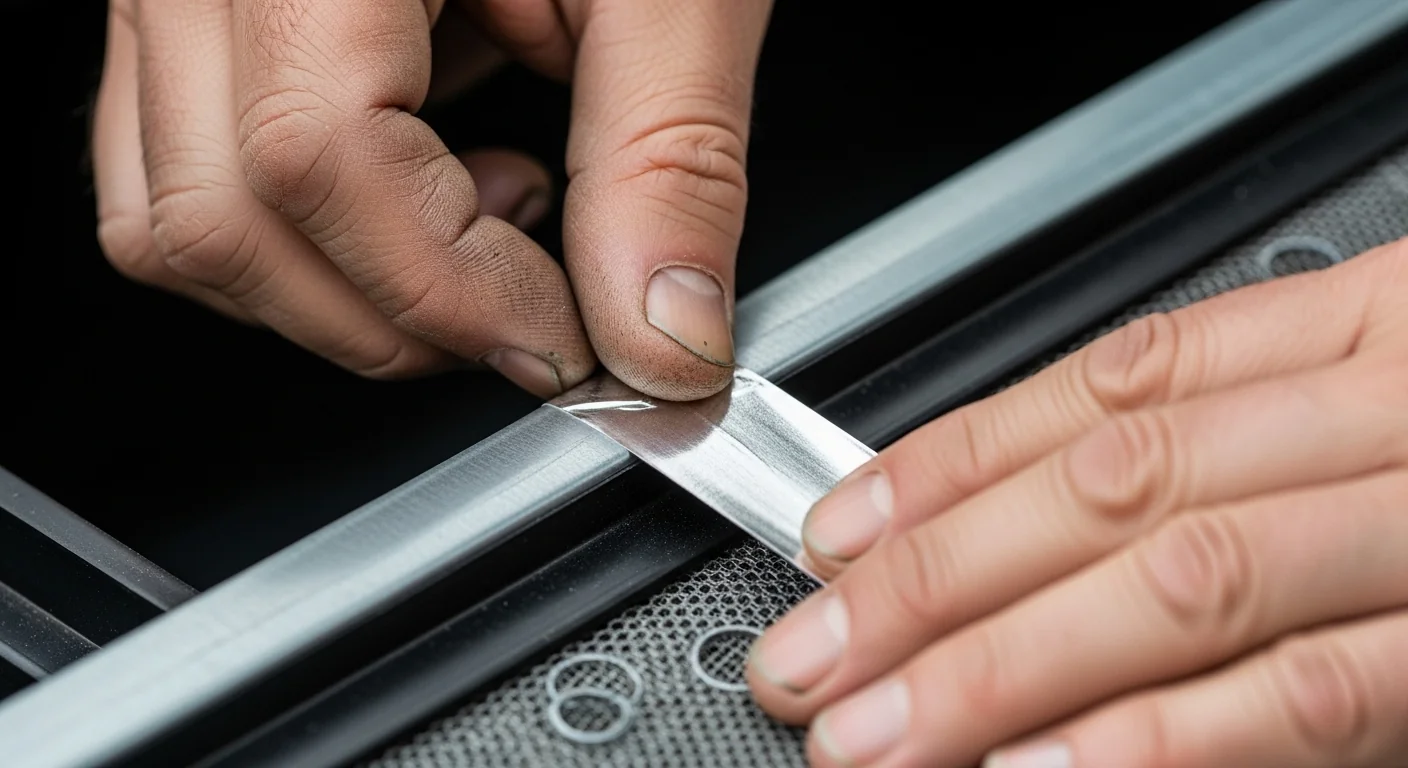
Sealing the exhaust duct system is the step that most growers skip after correctly sizing the filter. Even a correctly matched filter with optimal dwell time will allow odor to bypass if there are gaps in the duct connections, un-taped flanges, or unsealed duct collars. Use aluminum foil HVAC tape (not standard duct tape) on every connection from the fan outlet through the filter and out the exhaust port. Any air that exits without passing through the carbon bed is a leak path, regardless of how much carbon is in the filter itself.
FAQ
What is the minimum contact time needed for a carbon filter to eliminate grow room odors?
The minimum dwell time for activated carbon to adsorb terpene molecules from grow room exhaust air is 0.10 seconds. For late-flower plants with heavy terpene output, the practical minimum rises to 0.15 seconds. Below these thresholds, air velocity through the carbon bed is too high for Van der Waals adsorption forces to capture a sufficient fraction of odor molecules before the air exits the filter.
Why does my carbon filter smell even though I just replaced it?
A new filter can still leak odor if the fan airflow rate is too high for the filter's carbon bed volume. A fresh filter does not compensate for insufficient dwell time. Calculate the contact time using this tool with your actual CFM and filter dimensions. If dwell time is below 0.10 seconds, the filter is too small for that fan, regardless of whether it is new or old.
Does carbon bed depth matter separately from the dwell time calculation?
Yes. Carbon bed depth (the radial thickness of the carbon layer) affects the mass transfer zone length, which is the distance over which terpene concentration in the air drops from inlet to outlet. Filters with bed depths below 1.5 inches have a shorter transfer zone, which means some terpene molecules reach the outer shell before being adsorbed even when overall dwell time looks acceptable. Bed depth below 1.5 inches triggers a separate warning in this calculator's output.
Can I run two carbon filters in series to get longer contact time?
Yes. Two filters connected in series (one feeding the other) effectively double the carbon bed volume that air passes through at a given CFM. This is a legitimate solution when a single correctly sized filter is unavailable or when a high-power fan is necessary for adequate room air changes. Running in series adds static pressure resistance, so measure or estimate the actual CFM reduction and recalculate dwell time using the combined volume of both filters.
How does humidity affect carbon filter performance beyond what this calculator shows?
Activated carbon adsorbs water vapor competitively with terpene molecules. Above approximately 70 to 75% relative humidity, a growing portion of adsorption sites fill with water instead of VOCs. The practical result is a reduction in effective odor capture that does not appear in a dwell time calculation because the geometry has not changed. Keeping exhaust air below 70% relative humidity before it enters the filter is the most reliable way to preserve adsorption capacity throughout the filter's life cycle.
What is the difference between a filter's rated CFM and actual operating CFM?
Rated CFM is measured with no duct resistance attached, in laboratory conditions. Actual operating CFM is what the fan moves when pulling air through a carbon filter, duct runs, bends, and any other resistance elements in the exhaust circuit. Static pressure from a typical inline carbon filter alone reduces fan output by 10 to 20%. Combined with duct resistance, actual CFM is commonly 15 to 30% below the rated maximum shown on the fan's label or specification sheet.
Conclusion
Grow room carbon filter sizing comes down to a single calculation that most guides and product listings never show: dwell time. The geometry of your filter, not its duct diameter or price point, determines whether terpene molecules have enough time to bind to activated carbon before exiting into living spaces. A filter producing less than 0.10 seconds of contact time is not filtering odor; it is redirecting it. The calculator on this page derives that number directly from your filter's physical dimensions and your fan's operating CFM, and it applies odor-intensity-specific thresholds rather than a single generic standard.
The most important mistake to avoid is sizing by duct connection diameter and assuming that a matched flange means a matched filter. Two filters with identical 6-inch flanges can have carbon volumes that differ by a factor of three. Verify dwell time before finalizing your equipment selection, not after the room is operational and smelling. Once your exhaust system is confirmed to be within the optimal range, reviewing your room's full airflow balance including oscillating air circulation can help ensure that odor control does not conflict with plant canopy management; the oscillating fan size guide covers internal air movement independent of the exhaust system.