Most irrigation runoff problems are not caused by broken heads, clogged filters, or bad timers. They happen because someone set a 30-minute zone run time on a sprinkler that applies water 10 to 15 times faster than the soil underneath can absorb it. The physics of that mismatch plays out the same way every time: the soil surface saturates within the first few minutes, and every drop applied after that point flows downhill rather than into the root zone.
This soil infiltration rate calculator compares your sprinkler system’s precipitation rate (PR) against your soil texture’s actual absorption capacity at a given slope, then computes the maximum safe run time per cycle and the full Cycle and Soak schedule needed to deliver your target watering depth without triggering runoff. It does not calculate evapotranspiration, adjust for current soil moisture, or model subsurface drainage. Those are separate calculations. This tool answers one specific question: how long can you run a zone before the water stops going into the ground?
After using this calculator, you will know whether a Cycle and Soak schedule is required for your specific soil-slope-PR combination, exactly how many cycles to run and how long to soak between them, and whether your nozzle type is fundamentally incompatible with your landscape conditions.
Use the Tool
Primary Result
—
Key Outputs
Warnings & Standards
Soil Infiltration Rate Reference Table
| Soil Type | Flat (0–2%) | Gentle (3–5%) | Moderate (6–10%) | Steep (11%+) |
|---|
How This Calculator Works
This tool determines whether your sprinkler’s precipitation rate (PR) will exceed your soil’s ability to absorb water — and calculates a safe Cycle & Soak schedule to prevent runoff.
- Look up soil infiltration rate (Infil): Based on your soil texture and slope, the tool retrieves the effective infiltration rate in in/hr from an agronomic lookup table. Clay soils on steep slopes can absorb as little as 0.08 in/hr; sandy flat soils up to 1.8 in/hr.
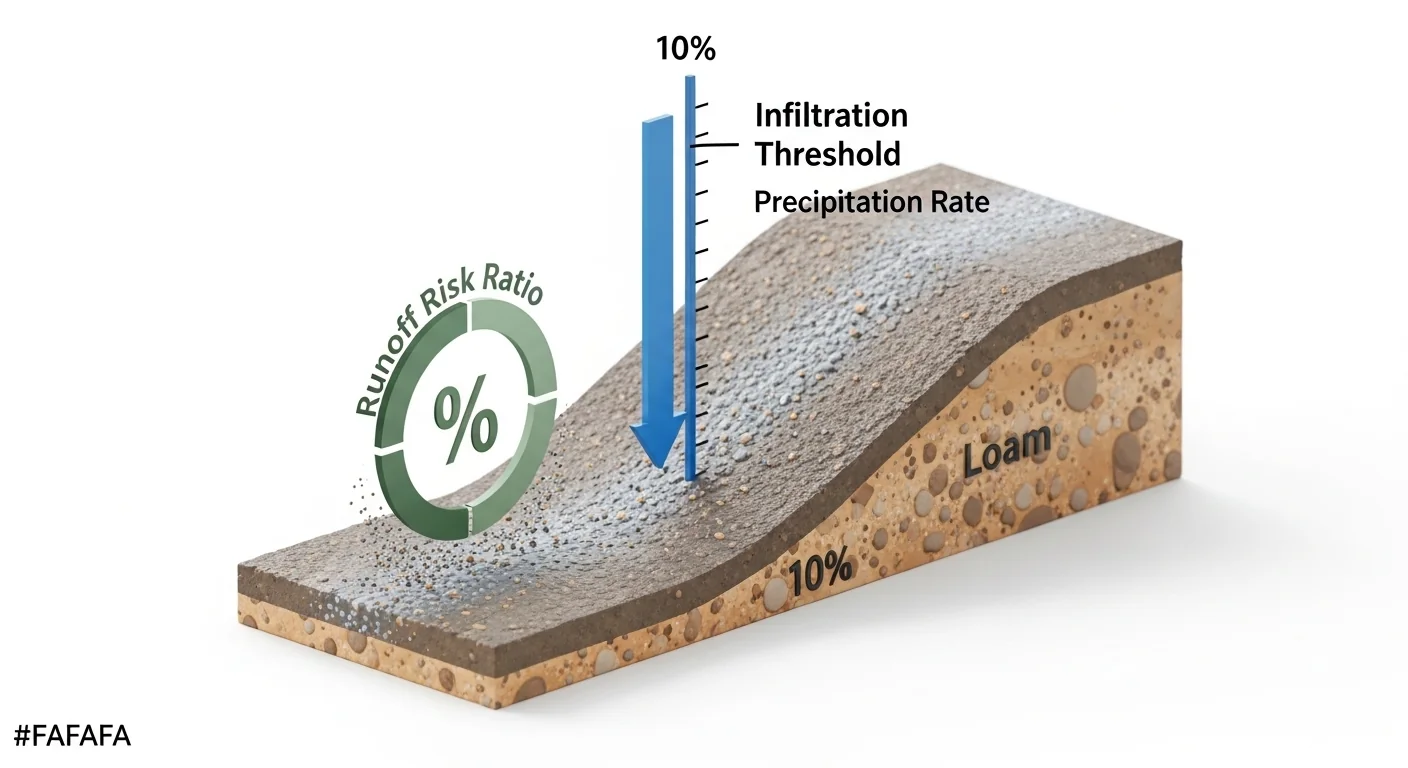
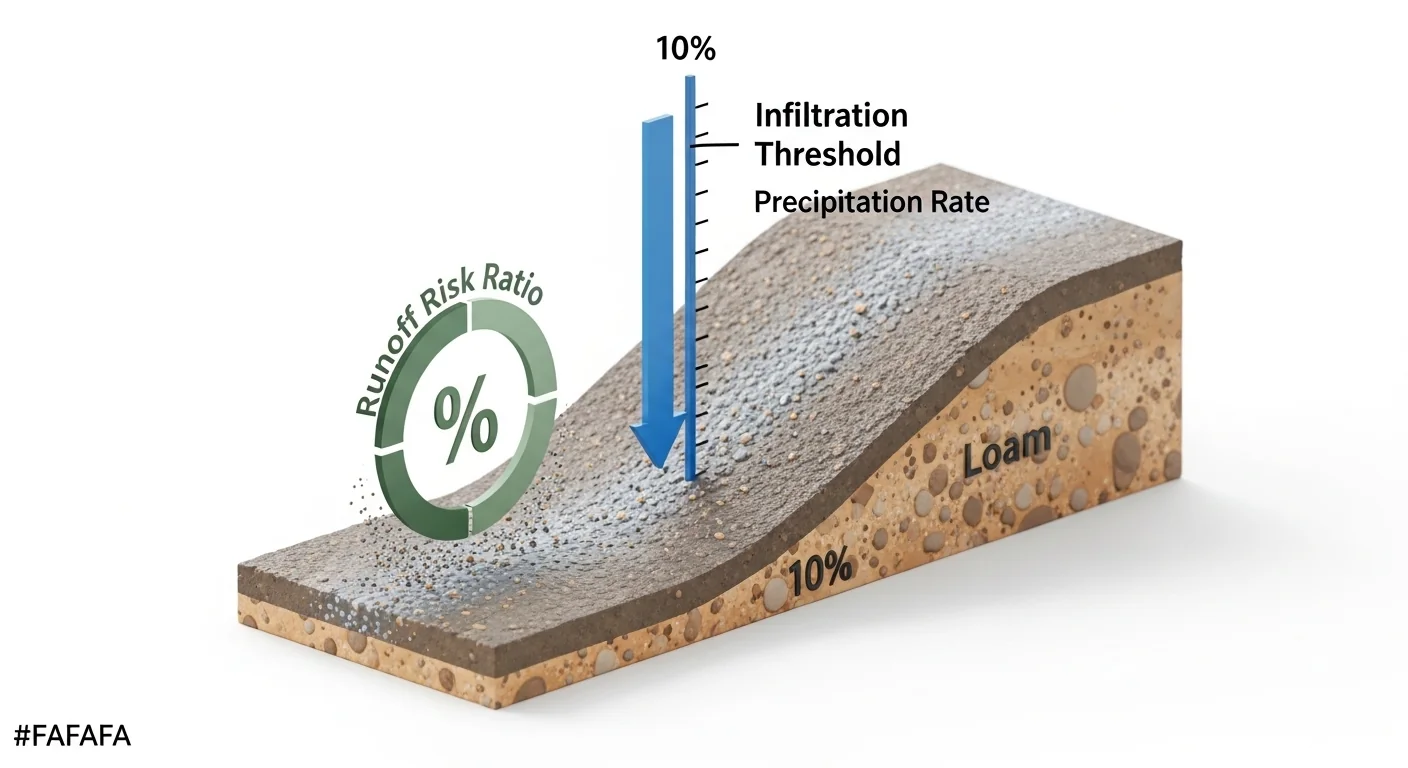
- Compare PR vs. Infil: If PR > Infil, runoff will occur. The ratio PR ÷ Infil tells you how much faster water is applied than absorbed.
Runoff Risk Ratio = PR ÷ Infil_rate
- Calculate Max Safe Run Time: The maximum number of minutes per cycle before the soil is saturated and runoff begins:
MaxRuntime_min = (Infil_rate ÷ PR) × 60
- Calculate Total Water Time Needed: Time required to deliver your target depth at the actual PR:
TotalTime_min = (Target_depth ÷ PR) × 60
- Determine number of cycles:
Cycles = ceil(TotalTime_min ÷ MaxRuntime_min)
- Recommend soak time: Allow soil to absorb applied water before the next cycle. Heavier clay soils need 30–60 min; loam 20–30 min; sandy soils 10–15 min.
Assumptions & Limits:
- Infiltration rates are typical agronomic values; actual rates vary with organic matter, compaction, and moisture content.
- PR input should match your sprinkler’s manufacturer spec sheet for the installed arc and spacing.
- Slope modifier is applied by reducing effective infiltration by 15–40% per slope tier.
- Maximum PR modeled: 4.0 in/hr (high-output flood nozzle). Maximum depth: 6 in.
- Results assume uniform distribution efficiency. Head-to-head coverage assumed.
- This calculator does not account for ET (evapotranspiration), current soil moisture, or weather adjustments — use a smart controller for those.
Soil Infiltration Lookup Tables & Source Notes
Infiltration rate values are based on USDA-NRCS texture class data and irrigation engineering literature (Irrigation Association, Hunter Industries, Rain Bird agronomic references). Slope reduction factors reflect empirical field data showing compacted surface runoff accelerates beyond 10% grade.
- Heavy Clay: Base infil 0.15 in/hr (flat), reducing to 0.06 in/hr on very steep slopes.
- Clay/Clay-Loam: Base infil 0.25 in/hr, reducing to 0.10 in/hr on steep slopes.
- Silty Clay Loam: Base infil 0.40 in/hr, reducing to 0.18 in/hr on steep slopes.
- Loam: Base infil 0.70 in/hr, reducing to 0.35 in/hr on steep slopes.
- Sandy Loam: Base infil 1.10 in/hr, reducing to 0.65 in/hr on steep slopes.
- Sand: Base infil 1.80 in/hr, reducing to 1.10 in/hr on steep slopes.
Soak time recommendations are conservative to ensure full percolation to the root zone before the next cycle.
Before calculating, have three pieces of information ready: your sprinkler head’s precipitation rate (check the manufacturer spec sheet for the installed arc and spacing, not the generic product page), your soil texture category (a simple ribbon test or your local county extension soil map works), and the slope percentage of the zone in question. If you have not yet run a catch can test to verify your system’s actual PR, the irrigation catch can test calculator will give you a measured rate rather than relying on the nozzle spec alone.
Quick Start (60 Seconds)

- Sprinkler Precipitation Rate: Enter the value from your nozzle’s specification sheet in inches per hour (in/hr). Pop-up spray heads typically range from 1.0 to 2.5 in/hr. MP Rotators and rotor heads run between 0.3 and 0.7 in/hr. Using the wrong value here invalidates every output.
- Soil Texture: Select the texture that best describes your dominant soil. Heavy clay clumps when wet and cracks when dry; loam crumbles easily and holds moderate moisture; sandy soil feels gritty, drains immediately, and rarely forms a ball when squeezed. If you have layered soils, select the texture of the top 6 to 8 inches.
- Degree of Slope: Estimate as the rise over run, expressed as a percentage. A 5% slope means 5 feet of vertical rise for every 100 feet of horizontal distance. Slope is not decorative input here; it directly reduces the effective infiltration rate.
- Target Watering Depth: Enter the depth of water you want to deliver to the root zone per session, in inches. Lawn turf typically targets 0.75 to 1.0 inches. Shrub beds and deep-rooted perennials often use 1.25 to 1.5 inches. Do not confuse run time with depth.
- Unit check: All depth values use inches and all rates use in/hr. Do not enter millimeters or mm/hr; the formulas will produce incorrect results silently.
- Click Calculate: The tool will not run until all four fields are filled. If any field shows a red error, correct it before proceeding.
- Read the schedule output first: The primary result is the maximum safe run time per cycle, not the total session length. The total session time (cycles multiplied by run time plus soak intervals) appears in the schedule strip below.
Inputs and Outputs (What Each Field Means)
| Field | Unit | What It Measures | Common Entry Mistake | Safe Entry Guidance |
|---|---|---|---|---|
| Sprinkler Precipitation Rate (PR) | in/hr | The rate at which your sprinkler applies water to the soil surface, expressed as equivalent depth per hour | Using the nozzle’s maximum rated PR instead of the actual installed PR at the specific arc and radius settings | Use catch can test data when possible; otherwise use the manufacturer table for your exact arc and head spacing |
| Soil Texture | Category | The dominant particle size distribution of your topsoil, which determines the base infiltration rate | Selecting “Loam” by default without checking; most urban lots in arid regions have compacted clay or clay-loam profiles | If unsure, assume one category heavier than your best guess (err toward Clay rather than Loam) |
| Degree of Slope | % gradient | The vertical rise divided by horizontal run of the irrigated area, multiplied by 100 | Treating slope as a cosmetic field; even a “gentle” 5% slope meaningfully reduces effective infiltration on clay | Measure with a smartphone level app over a 10-foot run if unsure; do not round down |
| Target Watering Depth | inches | The total depth of water you want applied per irrigation session, intended to reach the root zone | Entering run time in minutes instead of a depth in inches | Consult your plant’s recommended watering depth; turf: 0.75 to 1.0 in; shrubs: 1.0 to 1.5 in |
| Soil Infiltration Rate (output) | in/hr | The effective soil absorption rate after applying the slope reduction factor to the base texture rate | Assuming this matches the published flat-ground rate for your soil type | Read-only. Cross-reference with the reference table to confirm it looks reasonable for your conditions |
| Max Safe Run Time (output) | minutes | The longest single uninterrupted run before the soil surface saturates and runoff begins | Treating this as the target run time; it is a ceiling, not a target | Program cycles at or below this value; programming even slightly above it produces surface saturation at the end of each cycle |
| Recommended Cycles (output) | count | Number of separate irrigation intervals needed to deliver the full target depth within the safe absorption window | Running all cycles back-to-back without the soak interval; this defeats the entire purpose | Space cycles using the soak time output; each cycle must allow full percolation before the next application |
| Soak Time Between Cycles (output) | minutes | The recommended pause between cycles to allow applied water to percolate past the surface before the next cycle begins | Using a fixed 15-minute soak for all soil types; clay soils require 45 to 60 minutes | The tool assigns soak time based on soil texture; heavier soils need more time regardless of slope |
Worked Examples (Real Numbers)
Example 1: Standard Spray Heads on a Sloped Clay Backyard
- Precipitation Rate: 1.5 in/hr (standard pop-up spray, 180-degree arc)
- Soil Texture: Heavy Clay
- Slope: Moderate (6 to 10%)
- Target Depth: 1.0 inch
Effective infiltration rate for Heavy Clay on a Moderate slope: 0.10 in/hr
Maximum safe run time: (0.10 / 1.5) x 60 = 4 minutes per cycle
Total water time needed: (1.0 / 1.5) x 60 = 40 minutes
Cycles required: ceil(40 / 4) = 10 cycles
Result: 10 cycles of 4 minutes each, with 60-minute soak intervals between them. Total session spans several hours across one morning.
This is the canonical “Sloped Clay Washout” scenario. The soil saturates in the 4th minute of every cycle. Without the cycle-soak approach, every minute of the remaining 36 minutes of a standard 40-minute program produces surface runoff rather than root-zone infiltration.
Example 2: Rotor Heads on Loam with a Gentle Slope
- Precipitation Rate: 0.8 in/hr (gear-driven rotor)
- Soil Texture: Loam
- Slope: Gentle (3 to 5%)
- Target Depth: 0.75 inches
Effective infiltration rate for Loam on a Gentle slope: 0.58 in/hr
Maximum safe run time: (0.58 / 0.8) x 60 = 43 minutes per cycle
Total water time needed: (0.75 / 0.8) x 60 = 57 minutes (rounded up)
Cycles required: ceil(57 / 43) = 2 cycles
Result: 2 cycles of 29 minutes each (splitting the 57 minutes evenly across the 2 required cycles), with a 25-minute soak between them.
Runoff risk exists but is modest. Splitting into two cycles with a short soak is manageable and compatible with most smart controller scheduling features.
Example 3: MP Rotator Nozzles on Sandy Soil, Flat Grade
- Precipitation Rate: 0.45 in/hr (MP Rotator, 360-degree arc)
- Soil Texture: Sand
- Slope: Flat (0 to 2%)
- Target Depth: 1.0 inch
Effective infiltration rate for Sand on Flat grade: 1.80 in/hr
PR (0.45) is well below infiltration rate (1.80). No runoff risk.
Total water time needed: (1.0 / 0.45) x 60 = 134 minutes (single cycle)
Result: Single 134-minute cycle. No soak interval required. Soil absorbs water faster than it is applied throughout the entire run.
This combination represents best-case irrigation efficiency. The longer run time is a function of the low PR nozzle, not a problem. Sandy soils also drain quickly, so deep percolation past the root zone is a greater concern than runoff in this scenario.
Reference Table (Fast Lookup)
All values assume a target watering depth of 1.0 inch. Max safe run time is calculated as (Infiltration Rate / PR) x 60, floored to the nearest minute. Cycles required uses the calculated max run time as the ceiling per cycle. Values marked “Safe” indicate PR is below infiltration rate; no cycle-soak scheduling is required.
| Soil Type | Slope | Infiltration Rate (in/hr) | Max Run @ PR 1.5 in/hr (min) | Max Run @ PR 0.5 in/hr (min) | Cycles for 1 in @ PR 1.5 | Recommended Soak (min) |
|---|---|---|---|---|---|---|
| Heavy Clay | Flat (0-2%) | 0.15 | 6 | 18 | 7 | 60 |
| Heavy Clay | Moderate (6-10%) | 0.10 | 4 | 12 | 10 | 60 |
| Clay / Clay-Loam | Flat (0-2%) | 0.25 | 10 | 30 | 4 | 45 |
| Clay / Clay-Loam | Moderate (6-10%) | 0.16 | 6 | 19 | 7 | 45 |
| Silty Clay Loam | Flat (0-2%) | 0.40 | 16 | 48 | 3 | 35 |
| Loam | Flat (0-2%) | 0.70 | 28 | 84 | 2 | 25 |
| Loam | Steep (11-15%) | 0.40 | 16 | 48 | 3 | 25 |
| Sandy Loam | Flat (0-2%) | 1.10 | 44 | Safe | 1 | 15 |
| Sandy Loam | Steep (11-15%) | 0.70 | 28 | 84 | 2 | 15 |
| Sand | Flat (0-2%) | 1.80 | Safe | Safe | 1 | None |
How the Calculation Works (Formula and Assumptions)
Show the calculation steps
Step 1: Retrieve effective infiltration rate. The tool uses a lookup table indexed by soil texture and slope category. The flat-ground base rate for each soil texture is drawn from USDA-NRCS texture class data and Irrigation Association engineering references. A slope reduction factor is then applied: gentle slopes (3 to 5%) reduce base infiltration by roughly 15 to 17%; moderate slopes (6 to 10%) by 30 to 33%; steep slopes (11 to 15%) by 40 to 43%; very steep slopes (16% and above) by 55 to 60%. This yields the effective infiltration rate for the given combination.
Step 2: Calculate maximum safe run time per cycle.
MaxRuntime_min = floor( (Infil_rate / PR) x 60 )
This is floored (rounded down) to the nearest whole minute and forced to a minimum of 1 minute. The floor function is used rather than rounding because exceeding the safe limit causes runoff, and exceeding by even a partial minute matters on heavy clay.
Step 3: Determine if runoff occurs. If PR is greater than Infil_rate, the system operates above the absorption threshold and runoff will occur without schedule modification. If PR is less than or equal to Infil_rate, no cycle-soak is required.
Step 4: Calculate total water time needed.
TotalTime_min = ceil( (Target_depth / PR) x 60 )
Rounded up to the nearest whole minute to ensure the full target depth is always delivered.
Step 5: Compute number of cycles.
Cycles = ceil( TotalTime_min / MaxRuntime_min )
Step 6: Assign soak time. Soak times are assigned per soil texture (not computed dynamically): Heavy Clay = 60 min; Clay/Clay-Loam = 45 min; Silty Clay Loam = 35 min; Loam = 25 min; Sandy Loam = 15 min; Sand = 10 min. These are conservative values drawn from irrigation scheduling literature to ensure full surface percolation before the next cycle.
Assumptions and Limits
- Infiltration rate values represent typical agronomic conditions. Actual rates are reduced by compaction, thatch accumulation, low organic matter, hydrophobic soil conditions (dry soil repelling water), and long-term irrigation-induced surface sealing.
- The slope reduction factors are empirical approximations derived from field irrigation literature. They do not model surface roughness, vegetative cover, or the hydraulic conductivity changes that occur as soil moisture increases during an irrigation event.
- The tool assumes steady-state precipitation rate across the entire zone. Head-to-head coverage overlap is assumed but not modeled. If distribution uniformity (DU) is below 70%, actual effective PR at dry spots will be lower and wet spots will already be saturating before the average PR figure is reached.
- Soak time recommendations are conservative fixed values per soil texture. In practice, hotter weather, drier antecedent conditions, or stronger solar radiation on dark mulched beds can affect how quickly surface water percolates.
- The calculator does not account for ET-based scheduling, current soil moisture content, or rainfall in the previous 24 to 48 hours. Using the output as a fixed schedule without weather adjustment will over-water during wet periods.
- Maximum modeled PR is 4.0 in/hr. Maximum target depth is 6 inches. Inputs outside these ranges are rejected with inline validation errors.
- The tool does not model layered soils (e.g., a clay layer beneath sandy topsoil). In that case, the restrictive layer governs and you should select the heavier texture category.
Standards, Safety Checks, and “Secret Sauce” Warnings
Critical Warnings
- The 4-Minute Saturation Threshold: A standard pop-up spray head running at 1.5 in/hr on heavy clay soil with a 10% slope reaches the surface absorption limit in approximately 4 minutes. This is not a worst-case estimate; it is arithmetic. Every minute beyond minute 4 in a 30-minute zone run time produces surface runoff, not root-zone irrigation. The fertilizer, amendments, and topsoil applied to that slope leave with the water.
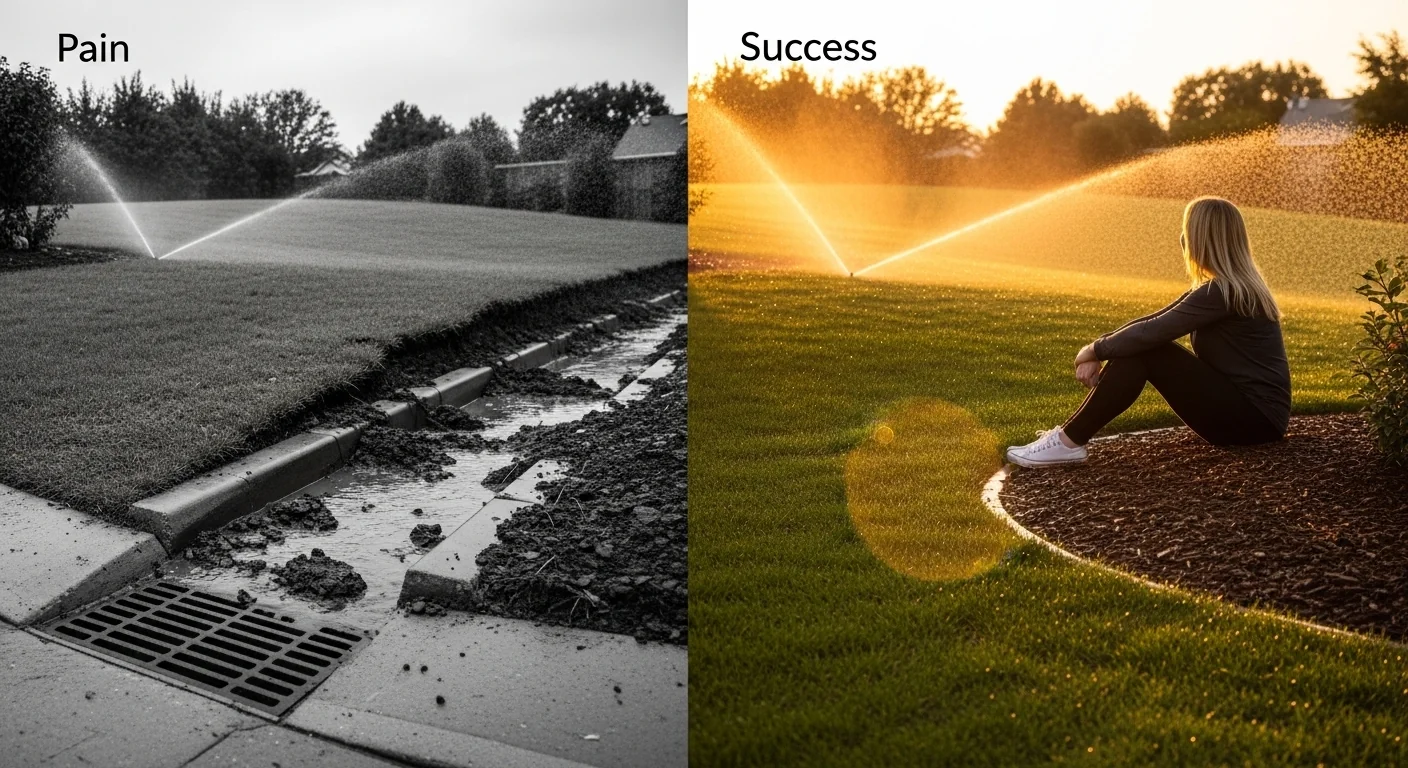
- Slope Multiplies the Problem: The infiltration rate for heavy clay on flat ground (0.15 in/hr) is already far below the PR of standard spray heads. A 10% slope cuts that rate to 0.10 in/hr. The combination of clay texture and meaningful slope is the most common scenario where irrigation systems cause visible erosion and persistent wet areas at the downhill boundary of a zone.
- Cycle-Soak Defeats Itself Without Correct Intervals: Programming cycle-soak without a true soak interval between runs is a common controller setup error. Running two 10-minute cycles back-to-back with a 2-minute pause on heavy clay does not allow percolation and produces the same runoff outcome as a single 20-minute cycle. The soak interval must be long enough for the applied water to move below the surface before the next cycle begins.
- Compaction Degrades Infiltration Over Time: The infiltration rates used in this calculator reflect un-compacted or lightly compacted soil. High foot traffic, vehicle use, and long-term surface irrigation without aeration can reduce clay soil infiltration by a substantial margin over several seasons, meaning schedules calibrated today may produce runoff within a few years without adjustment.
Minimum Standards
- The Irrigation Association’s scheduling guidelines specify that precipitation rate must not exceed the effective soil infiltration rate. This is the foundational standard that the Cycle and Soak method enforces in practice.
- USDA-NRCS soil surveys recommend that slope-adjusted infiltration values always be used for scheduling on grades above 3%; flat-ground rates are not transferable to sloped terrain.
- For professional irrigation audits, distribution uniformity (DU) should be verified by catch can test before infiltration-based scheduling decisions are applied. A measured PR value is always preferable to a nozzle spec. The matched precipitation rate calculator helps determine whether heads across a mixed zone are applying water at compatible rates.
Competitor Trap: Many irrigation run-time calculators online accept a PR input and a target depth and output a single run time in minutes. That output is technically correct only for soils where infiltration rate exceeds PR (typically sandy or loamy soils on flat ground). Applied to a clay zone on a slope, that same output is a runoff schedule disguised as an irrigation schedule. The calculator has no way to know it is producing a harmful result because it never evaluates whether the computed run time exceeds the soil’s absorption capacity. This tool’s primary function is to flag exactly that failure condition before the schedule is ever programmed. For drip-based systems where PR and infiltration interact differently, the drip irrigation run time calculator handles the separate scheduling logic that applies to emitter-based delivery.
Common Mistakes and Fixes
Mistake: Using the Manufacturer’s Listed PR Without Checking the Installed Arc and Spacing
Nozzle manufacturers publish PR values for a specific arc (commonly 180 or 360 degrees) at a specific head spacing. A head installed at a different arc, at a closer or wider spacing, or in a triangular versus square pattern will produce a different actual PR. The difference can be significant: a 360-degree head installed at 10-foot spacing applies water at roughly twice the rate of the same head at 14-foot spacing.
Fix: Either run a catch can test to measure actual PR, or use the manufacturer’s PR table for the exact arc and radius combination installed in the field.
Mistake: Treating Soil Type as Fixed When It Has Changed Through Compaction or Amendment
A soil classified as “Loam” in a landscape plan five years ago may have compacted under foot traffic, thatch buildup, or surface sealing from irrigation to the point where its effective infiltration rate resembles clay. Conversely, a clay soil that has received repeated organic amendment applications may now absorb water measurably faster than the lookup table suggests.
Using outdated or assumed soil data produces a schedule that either over-waters (compacted loam treated as loam) or under-waters (amended clay treated as heavy clay). Checking the field capacity and soil moisture calculator alongside this tool can help identify whether soil conditions have shifted from the original texture classification.
Fix: Verify current soil texture with a simple ribbon test or jar test before relying on a historical classification.
Mistake: Setting the Same Schedule for All Zones Regardless of Soil or Exposure
A property with a south-facing clay slope in full sun, a shaded north-facing loam bed, and a flat sandy lawn in an open area will have three completely different infiltration-based run time ceilings. Programming all three zones with the same 20-minute run time produces runoff on the clay slope and under-watering on the sandy lawn simultaneously.
Fix: Run this calculator separately for each zone, entering the PR, soil type, and slope specific to that zone. Each zone gets its own schedule parameters.
Mistake: Ignoring the Soak Interval When Programming a Smart Controller
Smart controllers that offer cycle-soak features typically allow programming of the run time and the soak interval per zone. A frequent programming error is setting the soak interval to the default (often 0 or 5 minutes) without adjusting it for soil type. On heavy clay, a 5-minute soak does not allow surface water to percolate meaningfully; the next cycle begins on an already-saturated surface and runoff begins immediately.
Fix: Set the soak interval in the controller to match the “Soak Time Between Cycles” output from this calculator. For heavy clay soils this will be 45 to 60 minutes per break, which requires scheduling the full irrigation session across a longer early-morning window.
Mistake: Calculating Infiltration Rate from a Single-Point Observation After Rain
Soil absorbs water faster when it is very dry (the initial infiltration rate) and slows significantly as it approaches field capacity (the steady-state or “basic” infiltration rate). A quick visual observation of water absorption right after a dry spell may suggest the soil has no runoff problem, when in reality the steady-state rate it maintains during a 30-minute irrigation cycle is far lower. This tool uses steady-state infiltration rates, which is the appropriate value for irrigation scheduling.
Fix: Base soil texture selection on the soil’s typical texture category, not on a single post-drought absorption observation.
Next Steps in Your Workflow
Once you have a confirmed Cycle and Soak schedule from this calculator, the next decision is whether the schedule is operationally practical. A heavy clay slope requiring 10 cycles with 60-minute soak intervals produces a total session window of several hours. That is physically achievable on a smart controller with an early start time, but it is not achievable if the zone is programmed on a simple mechanical timer with a single daily start. If the schedule requires more flexibility than your current controller provides, this is the practical trigger point for upgrading to a smart Wi-Fi controller with per-zone cycle-soak programming. It is also worth revisiting the precipitation rate input: switching to low-PR MP Rotator nozzles (which apply at 0.3 to 0.5 in/hr) often eliminates the need for cycle-soak scheduling entirely by bringing PR below the infiltration rate. Re-running this calculator with a lower PR after a nozzle upgrade will show whether the schedule collapses back to a single cycle.
The other variable worth adjusting after getting your schedule is the target watering depth. Delivering 1.0 inch to a clay slope in one session is a meaningful scheduling burden. Many agronomists recommend splitting seasonal water budgets into more frequent, shallower applications (0.5 inch every two to three days rather than 1.0 inch weekly) on heavy clay landscapes, which reduces the number of cycles per session and the total session window length. For a complete picture of how water application frequency interacts with actual crop and turf needs, the evapotranspiration calculator provides daily ET-based targets that can replace fixed-depth inputs entirely. If you are designing or resizing the pump or mainline that feeds the zones you are scheduling, the irrigation pump sizing calculator handles that downstream sizing step.
FAQ
What is a typical soil infiltration rate for clay soil?
Undisturbed heavy clay soil on flat ground typically has a steady-state infiltration rate of around 0.10 to 0.20 in/hr. Clay-loam runs 0.20 to 0.30 in/hr. These rates drop significantly on sloped terrain: a heavy clay soil on a 10% slope may have an effective infiltration rate as low as 0.08 to 0.10 in/hr. Compaction and surface sealing from long-term irrigation can push these values lower over time.
How do I find my sprinkler’s precipitation rate?
The most accurate method is a catch can test: place uniform containers across the zone, run the system for a timed interval, and measure the average collected depth. Dividing that depth by the run time in hours gives PR in in/hr. The second method is the manufacturer’s PR table, which provides rates for specific arc-and-radius combinations. Never use the generic product listing PR; it applies only to one specific configuration.
What does “cycle and soak” mean in irrigation scheduling?
Cycle and Soak is a scheduling method that splits a single long irrigation run into multiple shorter cycles separated by rest (soak) intervals. The goal is to keep each cycle’s run time below the point where the soil surface saturates and runoff begins. Between cycles, the soak interval allows applied water to percolate into the root zone, restoring some surface absorption capacity before the next cycle starts.
Can a smart controller automatically calculate cycle and soak for me?
Most modern smart controllers (Rachio, Rain Bird ESP-Me, Hunter HC) include a Cycle and Soak programming feature that lets you set a maximum run time and a soak interval per zone. However, the controller does not calculate the correct values automatically. You must supply the run time ceiling and soak interval from an infiltration-based calculation. This tool provides those values; the controller executes the schedule.
Does slope really affect how quickly soil absorbs water?
Slope does not change the soil’s intrinsic infiltration capacity at the pore level, but it dramatically affects how water behaves at the surface. On steeper grades, water moves laterally across the surface faster than it can enter vertical pores, which functionally reduces how much water enters the soil per unit time. The steeper the grade and the lower the initial infiltration rate, the more pronounced this effect becomes. This is why slope is treated as a separate input variable rather than folded into the soil texture selection.
What is the difference between infiltration rate and percolation rate?
Infiltration rate refers to the speed at which water enters the soil surface, measured in in/hr or mm/hr. Percolation rate refers to the speed at which water moves downward through the soil profile after it has entered, measured in minutes per inch. Irrigation scheduling uses infiltration rate (this calculator) to prevent surface runoff. Drainage design and septic system planning use percolation rate to determine how quickly the soil can drain. Both concepts involve water movement, but they address different parts of the soil-water pathway.
Conclusion
The central insight behind this calculator is that standard spray-head irrigation and clay soil are a physically incompatible pairing on sloped terrain unless scheduling accounts for the infiltration ceiling. The arithmetic is straightforward: a soil that absorbs water at 0.10 in/hr cannot keep pace with a nozzle applying 1.5 in/hr, and a 30-minute run time on that zone produces roughly 26 minutes of runoff per cycle regardless of how the controller is labeled or what the zone is supposed to be watering. The Cycle and Soak method corrects the schedule; the correct nozzle selection eliminates the constraint entirely.
The single most consequential mistake to avoid is treating a basic run-time calculation as sufficient when the zone involves clay soil, meaningful slope, or both. A run-time calculator that does not evaluate infiltration rate will produce a confident-looking schedule that systematically fails to irrigate the root zone while draining water, fertilizer, and topsoil downhill. Use the outputs from this calculator to set per-zone parameters in your controller, and revisit the schedule any time nozzles, soil conditions, or the slope profile of a zone changes.