
Boron Toxicity & PPM Dosing Calculator
Precision micronutrient math — boron fertilizer application rates, toxicity detection, and foliar spray planning.
| Deficit (ppm) | Lbs B / Acre | Lbs Solubor / Acre | Oz / 1,000 sq ft | Status |
|---|
How This Calculator Works
Deficit (ppm) = Target ppm − Current ppm
This is the gap you need to fill. If the deficit is zero or negative, no application is needed.
Lbs B / Acre = Deficit × 2
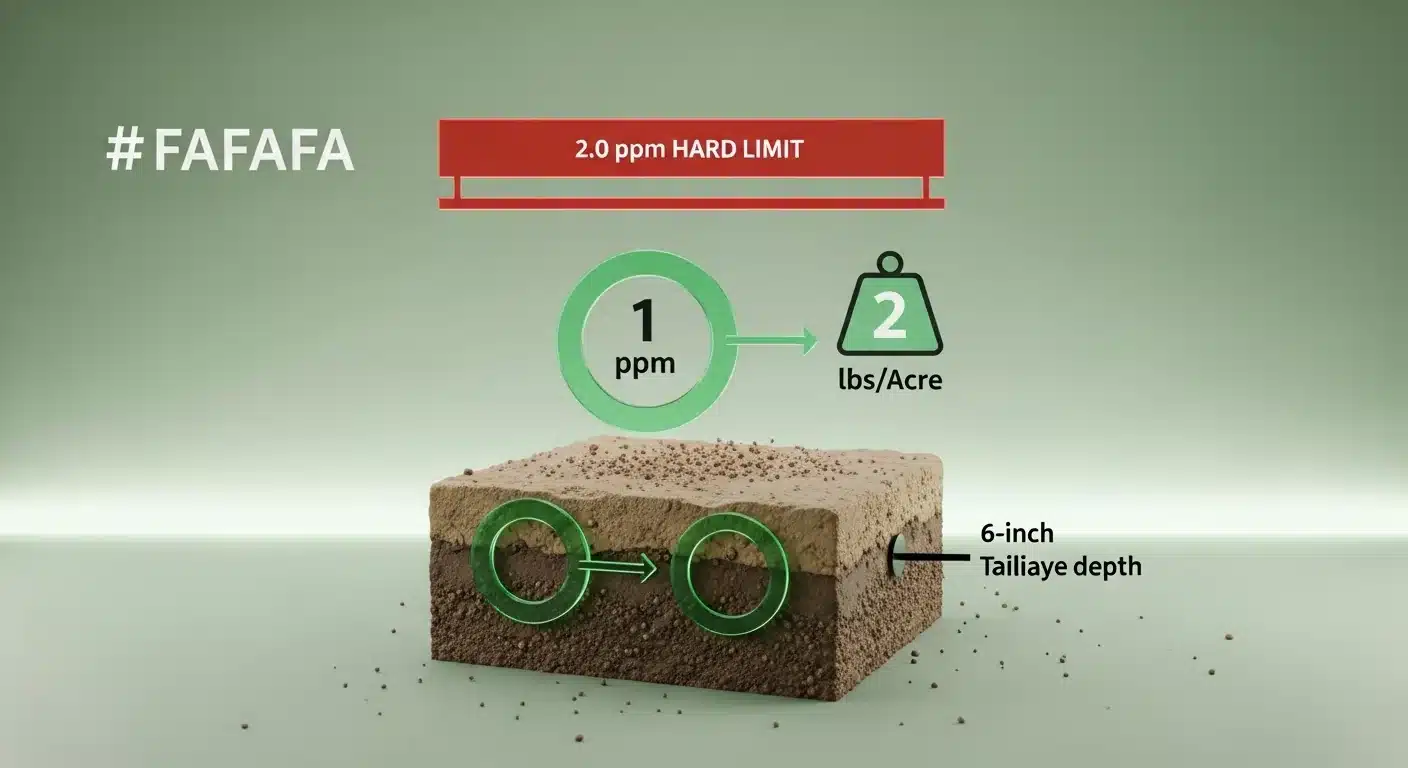
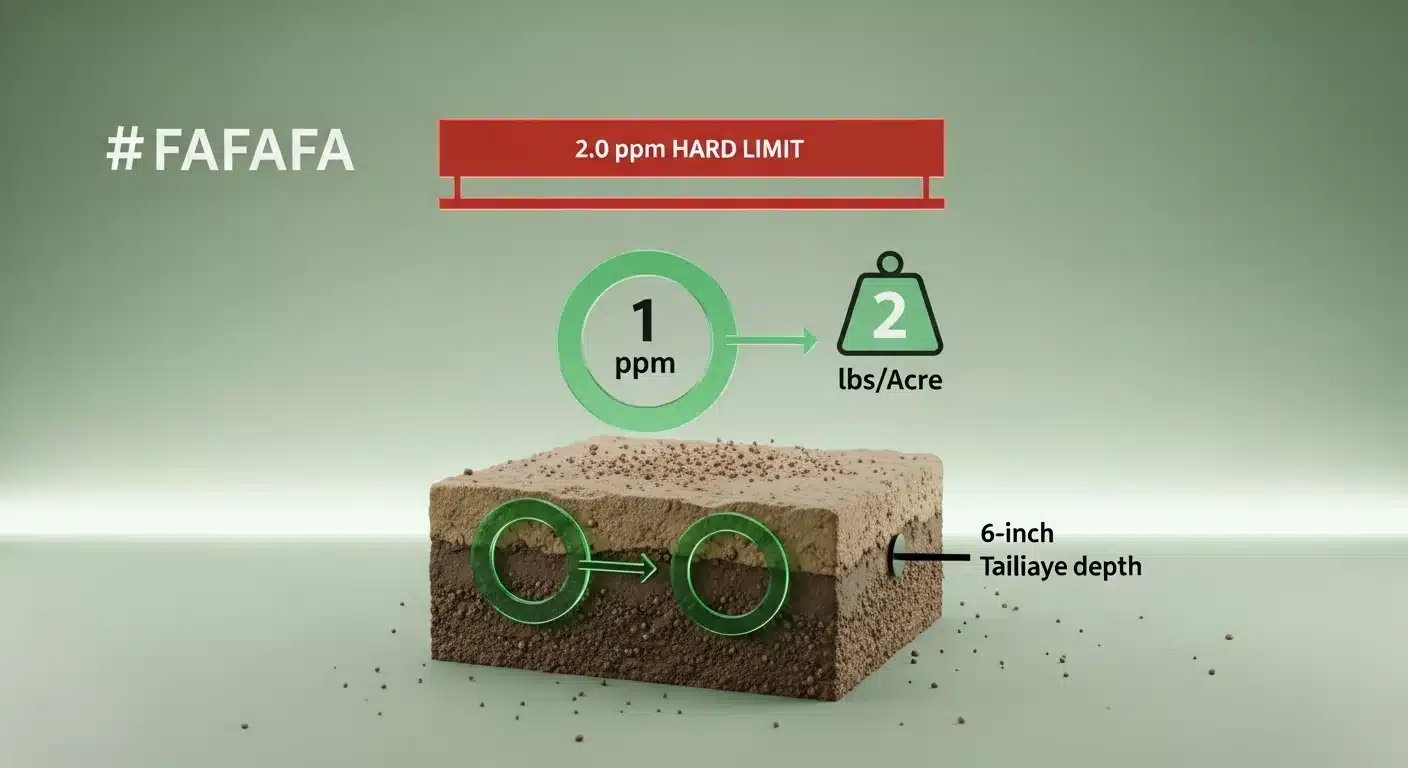
One part per million (1 ppm) of boron in the top 6 inches of soil ≈ 2 lbs elemental boron per acre. This is the standard agronomic conversion for a standard plow layer (~2 million lbs of soil/acre).
Lbs Product / Acre = Lbs B / Acre ÷ (B% ÷ 100)
Different products (Solubor, Borax, Granubor) carry different percentages of elemental boron. This step converts pure boron needs into product weight.
Oz / 1,000 sq ft = (Lbs Product / Acre × 16) ÷ 43.56
There are 43,560 sq ft per acre. Multiply product lbs by 16 (oz/lb) and divide by 43.56 to get oz per 1,000 sq ft for precision micro-dosing.
If Target > 2.0 ppm → LOCKED (calculation blocked)
Any target above 2.0 ppm is categorically dangerous. Even for boron-tolerant crops like alfalfa (max 2.0 ppm), exceeding this permanently sterilizes soil for sensitive crops (beans, corn) for 3+ years. Calculation is hard-blocked above this threshold.
Assumptions & Limits
- Soil conversion factor of 2 lbs/ppm/acre assumes a standard 6-inch tillage depth and soil bulk density of ~1.35 g/cm³.
- Maximum permissible target is hard-locked at 2.0 ppm — this matches the absolute tolerance ceiling for alfalfa and sugar beet (the most boron-tolerant common crops). Beans and corn are toxic at 0.5 ppm+.
- Foliar application rates shown are approximate and assume a 20-gallon-per-acre spray volume for water dilution guidance.
- Boron mobility in soil is high — leaching risk is real in sandy or low-CEC soils. Split applications are recommended for sandy soils.
- All rates assume broadcast soil application. Band application may allow lower rates; consult your local extension service.
- This tool provides estimates based on published agronomic formulas. Always confirm with a certified Crop Advisor (CCA) before field application.
- Soil test must be from Waypoint Analytical or equivalent NAPT-accredited lab for accurate ppm readings.
- Formula source: University extension guidelines (Purdue, UC Davis, MSU). 1 ppm B = 2 lbs B/acre is a widely accepted agronomic approximation.
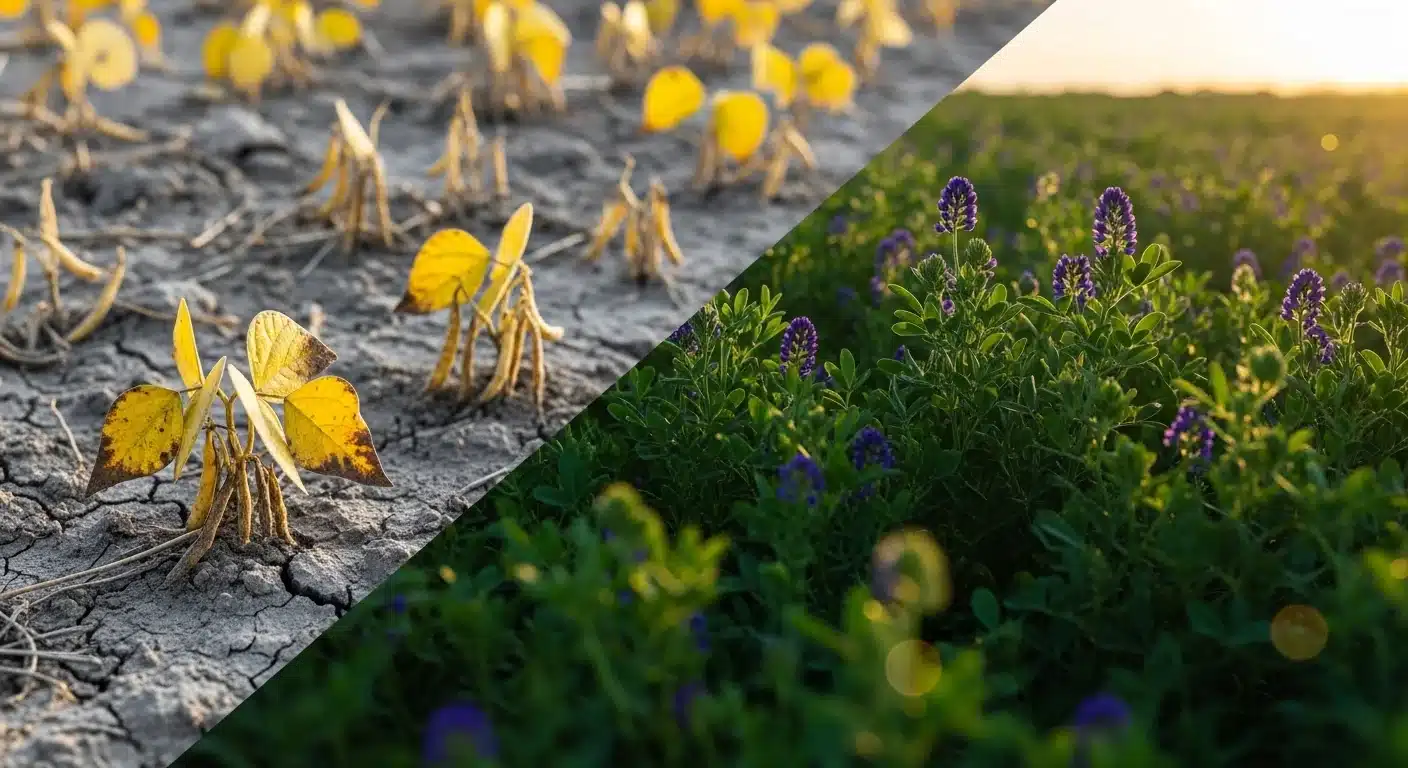
Boron occupies a narrow corridor between deficiency and irreversible toxicity that no other soil amendment comes close to. A field deficient at 0.2 ppm can fail to set seed in alfalfa. The same field pushed past 0.5 ppm will sterilize the soil for beans and corn for years, with no practical remediation available once the element is bound or mobile in the profile. The math is simple; the consequences of getting it wrong are not.
This boron fertilizer calculator takes your soil test reading, your crop’s actual tolerance ceiling, and your fertilizer source’s elemental boron content, and returns the exact product rate per acre, the granular ounce rate per 1,000 square feet, and a foliar dilution guide. It does not predict yield response, account for irrigation timing, or substitute for a lab-certified soil test. It calculates a defensible starting rate from published agronomic conversions and enforces hard safety gates that prevent entries above the 2.0 ppm absolute maximum. If your complete nutrient program involves macronutrient work alongside this micronutrient correction, the NPK fertilizer calculator covers nitrogen, phosphorus, and potassium rates in the same unit framework.
After using this tool, you will know exactly how many pounds of your chosen boron product to broadcast per acre and how many ounces to weigh per 1,000 square feet for small-plot precision, with a clear pass-or-block decision based on crop-specific toxicity thresholds.
Use the Tool
Before entering values, have three things ready: a recent soil test report showing elemental boron in ppm from a NAPT-accredited laboratory (Waypoint Analytical and similar services report this directly), the product label for your chosen boron fertilizer showing the elemental B percentage, and your target boron level for the specific crop rotation you are running. If you enter a target above 2.0 ppm, the calculator will block the result entirely. That is intentional.
Quick Start (60 Seconds)
- Crop Type: Select your primary crop from the dropdown. Each crop has a different boron tolerance ceiling hardcoded in the calculator. Alfalfa and sugar beet tolerate up to 2.0 ppm; dry beans become toxic above 0.3 ppm. Choosing the wrong crop produces an incorrect safety rating even if the ppm math is correct.
- Fertilizer Source: Select by product name. Solubor (sodium octaborate) carries 20.5% elemental boron; standard borax (sodium tetraborate) carries 14.3%. Entering the wrong product shifts your product rate by 30 to 40%, which is the most common calculation error in field practice.
- Current Soil Boron (ppm): Enter the value directly from your soil test. Use the lab’s reported “hot water extractable boron” figure. Do not estimate or use values from a neighboring field. Enter in decimal ppm only (e.g., 0.35, not 0.35 mg/kg if your lab uses different notation).
- Target Soil Boron (ppm): Enter your agronomic target, not the crop maximum. For corn at 0.5 ppm max, a realistic target is 0.35 to 0.45 ppm. Do not enter the ceiling as the target unless your advisor has confirmed this is appropriate for your soil type and CEC level.
- Maximum entry is 2.0 ppm. The calculator will not process any target above this value. If your agronomist recommends a higher level, verify that recommendation in writing against published university extension tables before proceeding.
- Unit consistency: All boron values are in ppm (parts per million by mass, equivalent to mg/kg). All product rates output in pounds per acre and ounces per 1,000 square feet. Foliar rates are in ounces of product per gallon of carrier water, assuming a 20-gallon-per-acre spray volume.
- Negative deficit: If your current level already exceeds your target, the deficit is zero and no application is recommended. The calculator will tell you this explicitly.
Inputs and Outputs (What Each Field Means)
| Field Name | Unit | What It Means | Common Mistake | Safe Entry Guidance |
|---|---|---|---|---|
| Crop Type | Category (select) | Sets the crop-specific boron toxicity ceiling used for the warning and safety rating | Selecting the most tolerant crop to “unlock” higher rates for a sensitive rotation crop | Select the most sensitive crop that will occupy the field within the next 3 years, not just the current season’s crop |
| Fertilizer Source | Product name (select) | Determines the elemental boron percentage used to convert pure boron need into product weight | Using a Solubor rate table to dose borax, causing a 43% product over-application | Confirm the B% on the actual product label; manufacturer reformulations sometimes change percentages |
| Current Soil Boron | ppm | Hot water extractable boron reading from a certified soil test | Using a neighbor’s test or an old test from a different season or tillage depth | Test within the current growing season; boron levels shift with rainfall and irrigation history |
| Target Soil Boron | ppm (max 2.0) | The agronomic optimum you are trying to achieve, not the crop toxicity ceiling | Setting the target equal to the crop maximum rather than the optimum midpoint | For most broadacre crops, the agronomic optimum sits 25 to 40% below the toxicity ceiling |
| Boron Deficit | ppm (output) | The gap between current and target: Target minus Current | Treating a zero or negative deficit as reason to apply a “maintenance” dose | If the deficit is zero or negative, no application is warranted; further addition risks toxicity |
| Pure Boron Needed | lbs elemental B per acre (output) | Deficit converted to elemental boron weight using the 1 ppm = 2 lbs/acre conversion for a 6-inch tillage layer | Using this figure to dose a foliar product without correcting for spray volume dilution | This value is an intermediate calculation; use the product-rate outputs for actual application decisions |
| Lbs Product per Acre | lbs/acre (output, primary) | Weight of your selected fertilizer product to apply per acre by broadcast | Confusing product weight with elemental boron weight | Weigh product on a precision scale; do not estimate volume equivalents for soluble products |
| Oz per 1,000 sq ft | oz/1,000 sq ft (output) | Small-area rate for garden plots, research plots, or precision strip trials | Scaling from ounces to acres by a simple 43.56x multiplier without adjusting for coverage uniformity | Use a calibrated digital milligram scale for quantities below 5 oz; volume measurement is unreliable for soluble boron powders |
| Foliar Rate | oz product per gallon carrier (output) | Dilution rate for foliar application assuming 20 gallons of water per acre spray volume | Applying foliar boron at soil-correction rates, causing acute phytotoxicity on leaf surfaces | Foliar application is a supplement, not a soil-level correction; use this rate only as a mid-season rescue treatment |
Worked Examples (Real Numbers)
Example 1: Alfalfa Stand with Moderate Boron Deficiency Using Solubor
- Crop: Alfalfa
- Current soil boron: 0.3 ppm
- Target: 1.2 ppm
- Fertilizer: Solubor at 20.5% elemental B
Result: Deficit = 0.9 ppm. Pure boron needed = 1.8 lbs/acre. Solubor required = 8.78 lbs/acre. Small-plot rate = 3.22 oz per 1,000 square feet. Foliar dilution = 1.44 oz product per gallon of water.
This is a straightforward mid-range correction for alfalfa, a crop that can tolerate the 1.2 ppm target comfortably. At this deficit, uniform broadcast incorporation is recommended; surface-only application on established stands leaves boron concentrated in the top inch where rainfall leaching is highest.
Example 2: Corn Field with Trace Boron Deficiency Using Borax
- Crop: Corn
- Current soil boron: 0.1 ppm
- Target: 0.4 ppm
- Fertilizer: Borax (sodium tetraborate) at 14.3% elemental B
Result: Deficit = 0.3 ppm. Pure boron needed = 0.6 lbs/acre. Borax required = 4.20 lbs/acre. Small-plot rate = 1.54 oz per 1,000 square feet. Foliar dilution = 0.48 oz product per gallon of water.
Corn’s toxicity ceiling is 0.5 ppm. This application targets 0.4 ppm, leaving a 0.1 ppm buffer. Because borax dissolves more slowly than Solubor, pre-plant broadcast with tillage incorporation is strongly preferred over in-season surface applications for this crop and product combination.
Example 3: Wheat Correcting a Sub-Optimal Boron Level with Granubor
- Crop: Wheat
- Current soil boron: 0.5 ppm
- Target: 0.9 ppm
- Fertilizer: Granubor (granular) at 10.0% elemental B
Result: Deficit = 0.4 ppm. Pure boron needed = 0.8 lbs/acre. Granubor required = 8.0 lbs/acre. Small-plot rate = 2.94 oz per 1,000 square feet. Foliar dilution = 0.64 oz product per gallon of water.
Granubor’s lower elemental B percentage (10.0%) compared to Solubor (20.5%) means the product volume required is roughly twice as high for the same elemental need. This is where product selection errors compound: a grower referencing a Solubor rate card would apply half the needed product and achieve no meaningful correction.
Reference Table (Fast Lookup)
All values assume broadcast soil application to a 6-inch tillage layer. Solubor = 20.5% B; Borax = 14.3% B. Oz/1,000 sq ft columns are derived from the lbs/acre values using the 43,560 sq ft per acre conversion.
| Deficit (ppm) | Lbs Elemental B / Acre | Lbs Solubor / Acre | Oz Solubor / 1,000 sq ft | Lbs Borax / Acre | Oz Borax / 1,000 sq ft | Safety Classification |
|---|---|---|---|---|---|---|
| 0.1 ppm | 0.20 | 0.98 | 0.36 | 1.40 | 0.51 | Safe for all crops |
| 0.2 ppm | 0.40 | 1.95 | 0.72 | 2.80 | 1.03 | Safe for all crops |
| 0.3 ppm | 0.60 | 2.93 | 1.07 | 4.20 | 1.54 | Safe; near bean ceiling |
| 0.5 ppm | 1.00 | 4.88 | 1.79 | 6.99 | 2.57 | Caution for corn, soy |
| 0.8 ppm | 1.60 | 7.80 | 2.86 | 11.19 | 4.11 | Caution; monitor closely |
| 1.0 ppm | 2.00 | 9.76 | 3.58 | 13.99 | 5.14 | Near limit for wheat, canola |
| 1.5 ppm | 3.00 | 14.63 | 5.37 | 20.98 | 7.70 | Danger zone; alfalfa/beet only |
| 2.0 ppm | 4.00 | 19.51 | 7.16 | 27.97 | 10.27 | Absolute maximum; no exceptions |
How the Calculation Works (Formula + Assumptions)
Show the calculation steps
Step 1: Deficit (ppm)
Deficit = Target ppm minus Current ppm. If the result is zero or negative, no application is computed. The deficit is the agronomic gap that drives every downstream value.
Step 2: Pure Boron Needed (lbs per acre)
Lbs elemental B per acre = Deficit x 2. The factor of 2 comes from the agronomic standard that 1 ppm of boron in the top 6 inches of soil equals approximately 2 pounds of elemental boron per acre. This is derived from an estimated 2 million pounds of soil per acre per 6-inch depth at a bulk density near 1.35 g/cm3.
Step 3: Product Rate (lbs per acre)
Lbs Product per Acre = Lbs elemental B / (Elemental B% / 100). This converts pure boron need into the actual fertilizer weight you need to handle, weigh, and apply. Each product’s percentage comes from its registered label.
Step 4: Small-Area Rate (oz per 1,000 sq ft)
Oz per 1,000 sq ft = (Lbs Product per Acre x 16) / 43.56. There are 43,560 square feet in one acre; dividing the acre-basis rate by 43.56 gives the per-1,000 sq ft rate. Multiplying by 16 converts pounds to ounces. Rounding is to two decimal places throughout.
Step 5: Foliar Rate (oz per gallon)
Foliar oz per gallon = (Lbs elemental B x 16) / 20. This assumes a standard spray volume of 20 gallons of water per acre. If your equipment delivers a different volume, scale this value proportionally.
Step 6: Safety Gate
Any target entry above 2.0 ppm blocks the entire calculation. Any result that brings the total soil boron above the selected crop’s toxicity ceiling triggers a danger-level warning. These are deterministic checks, not advisory suggestions.
Assumptions and Limits
- The 2 lbs/ppm/acre conversion assumes a 6-inch tillage depth. Shallow cultivation zones (3-4 inches) or deep ripping operations (10-12 inches) change the soil mass significantly and would require adjusted factors.
- Soil bulk density is assumed at approximately 1.35 g/cm3. Sandy soils commonly run 1.5-1.6 g/cm3; heavy clay soils can run 1.1-1.2 g/cm3. Neither extreme invalidates the formula for field decision-making, but precision agronomists may want to adjust.
- Hot water extractable boron (the standard NAPT method) is the correct test for this calculator. Total boron or DTPA-extractable boron figures are not interchangeable with HWE-boron values.
- Foliar rates assume 20 gallons per acre spray volume. Coverage uniformity, nozzle type, and spray timing (temperature, humidity) affect actual foliar uptake and are outside the calculator’s scope.
- Boron mobility in soil is high, particularly in sandy profiles with low organic matter or low cation exchange capacity. A single calculated application may leach below the root zone before uptake; split applications are a risk-reduction strategy on such soils that the calculator does not automatically flag.
- This tool does not account for boron supplied by irrigation water, manure, or compost, all of which contribute measurable boron loads in some systems. Where these inputs are significant, adjust the “current soil boron” value upward or subtract known irrigation contributions before entering values.
- The elemental B percentages used for each product match published nominal specifications. Confirm the actual percentage on the product you have in hand, as some formulations vary slightly by lot or manufacturer.
Standards, Safety Checks, and Secret Sauce Warnings
Critical Warnings
- The 3-year sterilization risk is real and non-reversible. When soil boron exceeds 0.5 ppm in fields that will host beans, corn, or other sensitive crops within three growing seasons, the resulting phytotoxicity can persist through leaching cycles and crop rotations. No chelation, no tillage depth manipulation, and no subsequent liming will accelerate boron removal from a profile. Time and rainfall are the only remediation mechanisms, and they are slow.
- Toxicity symptoms lag the damage. Boron toxicity in the soil does not always produce immediate visible leaf scorch or necrosis in the current season’s crop. Root-zone accumulation above crop tolerance thresholds can suppress germination, reduce nitrogen fixation in legumes, and cut seed set without producing a clear field diagnostic for weeks after application.
- Foliar application rates are not interchangeable with soil correction rates. Applying a soil-correction dose as a foliar spray will produce acute leaf-edge burn and tip necrosis within 48 to 96 hours. Soluble boron products like Solubor are particularly concentrated; foliar use requires dilution to the oz-per-gallon rates the calculator provides, not the lbs-per-acre soil rates.
- pH controls boron availability. Soil pH above 7.5 to 8.0 can lock boron into insoluble forms that soil tests may underreport as available. If you are working in high-pH soils, correcting pH before applying boron prevents wasted product and possible toxicity later as pH is adjusted downward. The soil pH sulfur calculator covers sulfur-based acidification rates if your soil is alkaline.
Minimum Standards
- All boron soil tests used as inputs must originate from NAPT-accredited laboratories using the hot water extraction method. State extension lab directories confirm NAPT membership.
- Applications above 0.5 lbs elemental B per acre on soils with CEC below 10 meq/100g should be split into at least two applications to reduce leaching loss. The soil leaching requirement calculator can help quantify leaching risk in your specific soil and irrigation scenario.
- Boom sprayer calibration for foliar boron applications must be verified before use. At the ounce-per-gallon dilutions used for foliar boron, a 10% nozzle flow error doubles the leaf concentration risk.
- No boron application should target a soil level within 0.1 ppm of the crop’s published toxicity ceiling without written agronomist sign-off.
Competitor Trap
Most boron rate guides published online list a single rate in “pounds of borax per acre” without specifying which borax product (14.3% B vs. 10% granular vs. technical grade), without crop-specific toxicity ceilings, and without differentiating between soil broadcast and foliar application rates. A farmer using a generic table and applying Solubor at a borax rate will over-apply elemental boron by approximately 43% because Solubor carries a higher elemental B percentage than standard borax. This single source-product confusion is responsible for a significant share of boron toxicity events that follow “by the book” applications. This calculator eliminates that class of error by requiring the user to select the exact product and computing the rate from its certified elemental B percentage.
Common Mistakes and Fixes
Mistake: Selecting the Current Season’s Crop Instead of the Most
Sensitive Rotation Crop
A grower raising alfalfa in year one followed by dry beans in year two who selects “Alfalfa” in the calculator will receive approval for a rate that would be catastrophically toxic to the subsequent bean crop. Alfalfa tolerates up to 2.0 ppm; beans become phytotoxic above 0.3 ppm. The calculator rates safety against the selected crop only. If beans, corn, or soybeans appear anywhere in your rotation within three years, their toxicity ceiling governs the safe application rate, not the current season’s crop.
Fix: Always select the most boron-sensitive crop in your planned rotation, regardless of which crop is in the ground today.
Mistake: Using a Rate Table from One Product to Dose a Different
Product
Rate tables printed on borax (sodium tetraborate, 14.3% B) bags and extension bulletins are frequently applied by growers who purchase Solubor (20.5% B) because they assume all “boron fertilizers” behave identically. The elemental B percentage drives the entire product calculation; a 43% difference in B content produces a 43% difference in required product weight. The error is invisible until tissue testing reveals excessive boron accumulation mid-season. Boron deficiency and toxicity produce superficially similar symptoms in some crops, which further delays correct diagnosis. Consulting the CEC soil calculator before application can also flag soils where boron mobility and accumulation risk are elevated due to low buffer capacity.
Fix: Enter the exact product you purchased into the fertilizer selector, not the product listed in a historical rate guide.
Mistake: Entering the Crop Toxicity Ceiling as the Target
Entering 2.0 ppm as the target for alfalfa, or 0.5 ppm as the target for corn, leaves zero buffer for application non-uniformity, soil spatial variability, and measurement error from the test itself. Soil test results for boron carry confidence intervals; the reported value is a sample mean, not an exact field-wide reading. Applying to the ceiling means half the field may statistically exceed it.
Fix: Set the target at 75 to 85% of the crop’s published toxicity ceiling and recalculate application rates with that adjusted figure.
Mistake: Applying Granular Boron Without Spreader Calibration
The dose rates for boron are measured in single-digit pounds per acre for most situations. A granular spreader set for 200 lbs/acre of lime is entirely unsuitable for boron at 3 to 8 lbs/acre without recalibration. Over-application by a factor of 10 through a mis-set spreader is not a theoretical concern; it is documented in extension damage reports. For spreader-specific calibration procedures across fertilizer product types, the fertilizer spreader calibration calculator walks through the full catch-and-weigh method.
Fix: Calibrate the spreader using the specific boron product at the calculated rate, not a proxy material. Use a digital scale to verify catch-tray output before field application.
Mistake: Treating a Zero-Deficit Result as an Opportunity for
Maintenance Application
When the calculator returns a zero deficit (current boron equals or exceeds the target), some growers apply a reduced “maintenance” dose on the assumption that some boron was lost to leaching since the test. This logic is not supported by the agronomic data and is explicitly dangerous. Boron accumulates; it does not disappear between seasons in most temperate soils unless rainfall is extreme. An unprovoked maintenance application on a field already at adequate levels is one of the most common pathways to gradual soil toxicity.
Fix: Re-test the soil in the current season before applying any boron to a field with a prior adequate reading. Do not apply without a fresh deficit to correct.
Next Steps in Your Workflow
Once you have a confirmed lbs-per-acre rate from this calculator, the next decision is application method and timing. For pre-plant broadcast, the goal is mechanical incorporation to the full tillage depth so the applied boron distributes through the root zone rather than concentrating at the surface where rainfall leaching is most aggressive. For foliar rescue applications mid-season, use the oz-per-gallon dilution rate and confirm your spray volume matches the 20-gallon-per-acre assumption; if your sprayer delivers 15 or 30 gallons per acre, scale the dilution rate accordingly. Mixing foliar boron into a multi-nutrient foliar program requires checking compatibility with other materials in the tank, and the fertilizer dilution calculator can help confirm carrier volume requirements across multiple inputs.
Boron is one piece of a complete soil nutrition picture. After boron is corrected, reviewing your nitrogen status is the natural next step because nitrogen use efficiency is partially dependent on micronutrient balance in the root zone, particularly for legumes where boron affects nodule formation and nitrogen fixation. The nitrogen calculator covers elemental N rates, product sources, and timing recommendations to build out the rest of your fertility program alongside the micronutrient correction you have just calculated.
FAQ
What is the correct soil test method for boron to use with this calculator?
Hot water extractable boron (HWE-B) is the method this calculator is designed around. It is the standard reported by most NAPT-accredited soil labs and the method referenced in university extension boron rate tables. Total boron and DTPA-extractable boron values are not interchangeable with HWE-B results and will produce incorrect deficit calculations if substituted directly.
Can I use this calculator for greenhouse or container growing?
The formula is based on a 6-inch soil depth and 2 million pounds of soil per acre, assumptions that do not apply to container media. Container growing substrates have different bulk densities and volumes entirely, and boron toxicity thresholds for container-grown plants can differ from field-grown equivalents. This calculator is designed for field soil applications only.
Why does the calculator block inputs above 2.0 ppm?
No published agronomic standard or university extension bulletin recommends any boron application that brings soil levels above 2.0 ppm for any common field crop. Alfalfa and sugar beet, the most tolerant common crops, have their ceiling at exactly 2.0 ppm. Above this level, toxic conditions are probable for most rotation crops. The block is not adjustable by design.
Is Solubor better than borax for field applications?
Solubor dissolves in water at a much higher rate than standard borax and is typically preferred for foliar applications and injection systems. Borax is slower to dissolve and is commonly used for granular broadcast applications. Neither is categorically superior; product selection depends on application method, equipment, and whether you need rapid soil availability or slower-release behavior. Both are supported in this calculator with their respective elemental B percentages.
What happens if I accidentally apply too much boron to a field?
There is no approved in-field remediation for boron over-application beyond time and leaching. Gypsum, lime, and organic matter additions do not meaningfully chelate or immobilize soil boron at field scale. Deep tillage can dilute surface-concentrated boron in some cases, but it does not remove boron from the profile. The practical response is to avoid planting boron-sensitive crops on the affected area for at least 3 to 5 seasons and re-test annually.
Does organic matter level in the soil affect how I should adjust this calculation?
Organic matter binds boron through adsorption, meaning high-OM soils buffer boron availability and may require slightly higher application rates to achieve the same plant-available boron as a low-OM soil at the same ppm reading. This calculator does not include an OM correction factor. In high-OM soils above 5 to 6%, consult your local extension service’s boron availability tables for OM-specific adjustment factors before finalizing your rate.
Conclusion
The boron fertilizer calculator addresses the single most consequential calculation gap in micronutrient agronomy: the need for a crop-specific, product-specific, ppm-accurate rate that refuses to process inputs that would cause irreversible field damage. Generic boron rate tables, product confusion between Solubor and borax, and the absence of crop toxicity ceiling checks in most online tools are the combination of errors that convert well-intentioned boron corrections into multi-year yield losses. This tool closes those gaps with enforced safety logic rather than advisory footnotes.
The number-one mistake to avoid is selecting the current season’s crop rather than the most sensitive crop in your upcoming rotation. A single season of alfalfa does not reset a field’s boron tolerance for the beans or corn that follow. Soil texture is the underlying variable that determines how long an applied boron dose persists in the root zone versus leaches below it; understanding your field’s texture class before finalizing application timing is worth a separate analysis using the soil texture calculator, particularly on light sandy soils where boron behavior and residual risk differ substantially from heavier profiles.