
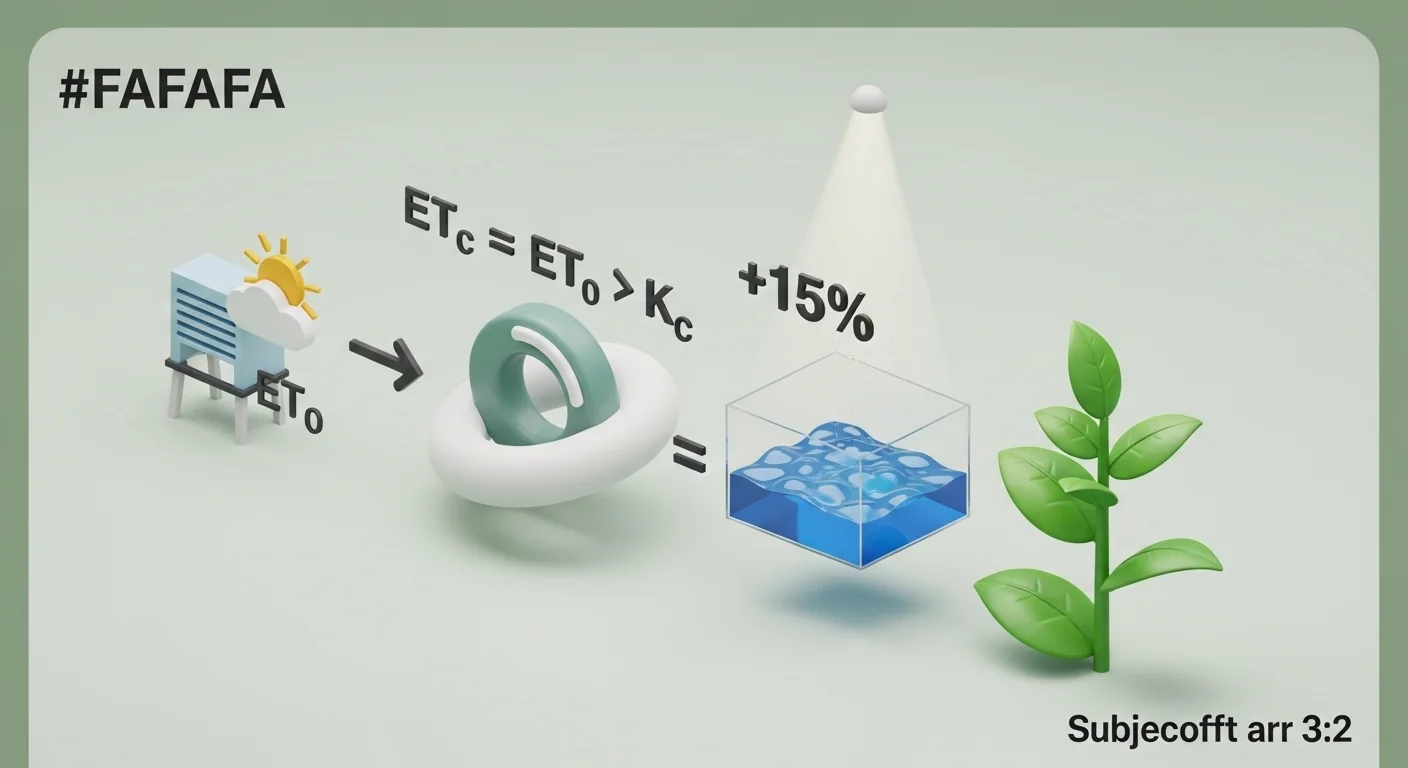
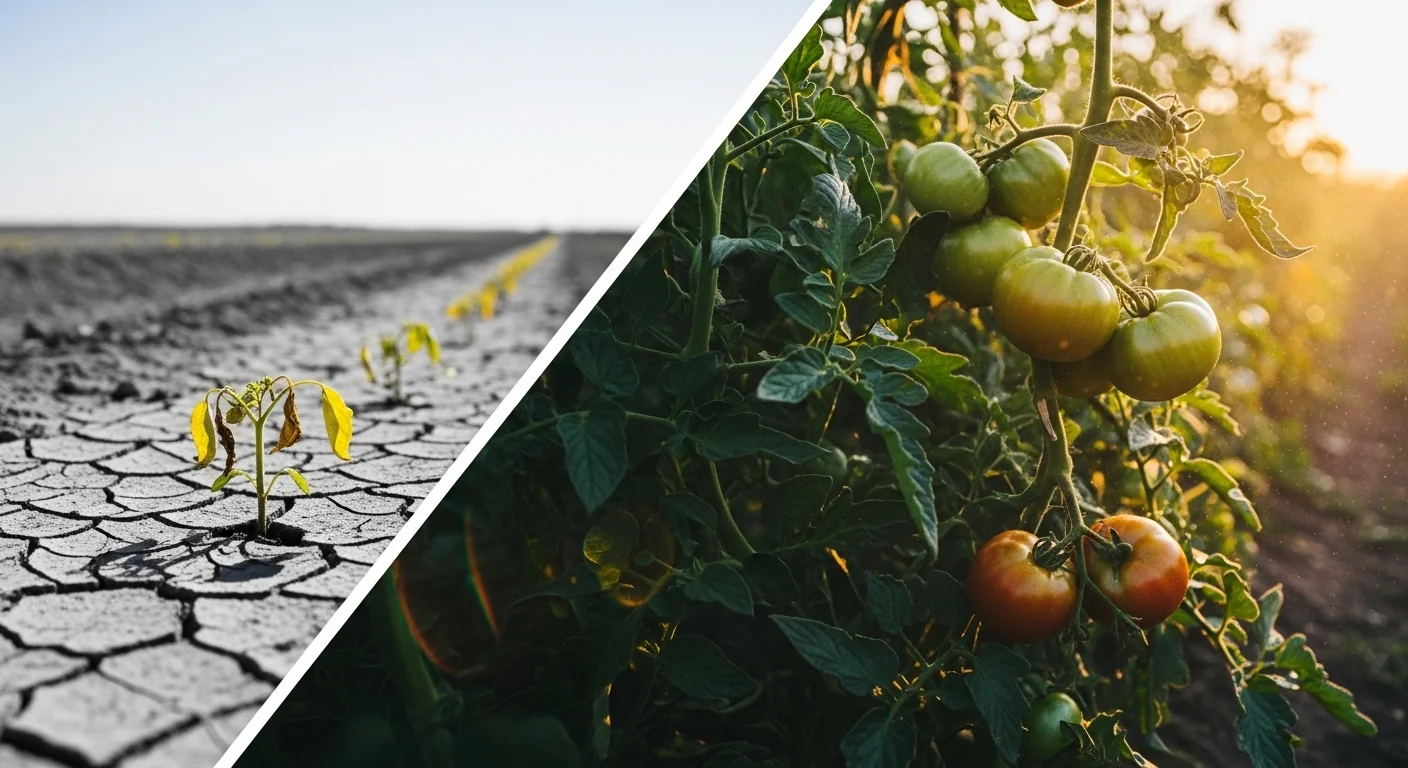
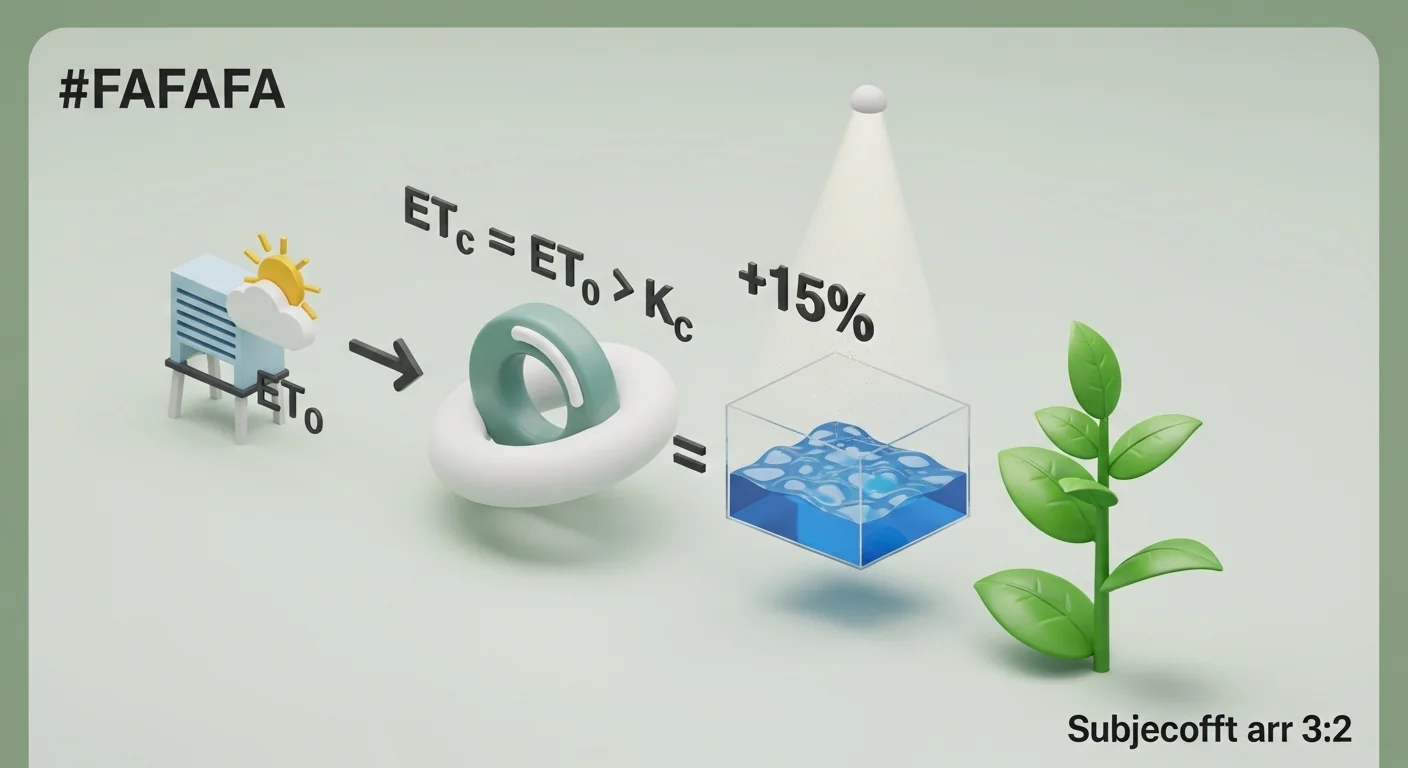
A flat weekly irrigation schedule treats a tiny seedling the same as a fully canopied, fruiting plant. That mismatch is not a minor calibration error; it is a fundamental misreading of plant biology. Evapotranspiration-based irrigation works by translating a single local weather measurement, the reference ET (ET₀), into a crop-specific water demand figure that shifts every few weeks as the plant’s canopy size, root depth, and metabolic rate change. The crop coefficient (Kc) is the bridge between those two numbers.
This tool calculates two things: the actual crop ET demand (ET₮) in inches per day, and the applied irrigation volume required to meet that demand after accounting for system delivery losses. It does not model rainfall credits, soil water holding capacity, or subsurface losses below the root zone. For those variables, consult a licensed agronomist or integrate this output with a soil moisture monitoring workflow.
After running this calculator for each growth stage of your crop, you will have a concrete, biologically grounded weekly irrigation target that you can program directly into a smart controller or timer, instead of guessing from a neighbor’s schedule.
Use the Tool
ET Crop Coefficient Sizer
Evapotranspiration calculator — precise crop water demand for smart irrigation
| Stage | Kc Value | ET꜀ (in/day) | Weekly Req. (in) | Demand vs ET₀ |
|---|
How This Calculator Works — Formula & Assumptions
Formula Steps:
Kc Values (FAO-56 Standard, Penman-Monteith basis):
- Kc is dimensionless — multiplied by reference ET to get actual crop demand.
- A seedling tomato (Kc ≈ 0.50) needs half the water of turf. A peak tomato (Kc ≈ 1.15) needs more than turf — this is the “Drowning Tomatoes” problem if you apply a flat schedule.
- Values sourced from FAO Irrigation and Drainage Paper No. 56 (Allen et al., 1998).
Assumptions & Limits:
- ET₀ is assumed to be measured or closely estimated from a local weather station.
- Typical ET₀ range: 0.05 – 0.55 in/day (winter–peak summer). Values outside 0.01–1.5 in/day are flagged.
- Irrigation efficiency accounts for system uniformity and distribution losses only.
- Gallons conversion uses the factor: 1 inch over 1 sq ft = 0.6233 gallons.
- This tool does not account for rainfall, soil water holding capacity, or crop stress thresholds.
Before you start, have your local Reference ET (ET₀) value ready in inches per day; most CIMIS stations, weather networks, and smart controller apps report this directly. You will also need your irrigation system’s delivery efficiency, which is the fraction of applied water that actually reaches the root zone. If you have completed a catch-can audit, use that measured figure. If your system design specifies a distribution uniformity rating, that is the right number to enter here. Area in square feet is optional but required to convert the output to a weekly gallon volume. If you use a matched-precipitation-rate design, verify your precipitation rate assumptions with the matched precipitation rate calculator before setting the efficiency field.
Quick Start (60 Seconds)

- Reference ET (ET₀): Enter the value in inches per day, not inches per week. A typical summer value in a warm climate ranges from 0.20 to 0.45 in/day. If your source reports weekly totals, divide by 7 before entering.
- Crop Type: Select the plant or turf category closest to your situation. Warm-season and cool-season turf have meaningfully different Kc values; do not use a generic “turf” entry if your species matters.
- Growth Stage: This is the most commonly skipped input. Initial means newly seeded or transplanted with less than 10 to 20 percent ground cover. Mid-Season means full canopy and active growth or fruiting. Late Season means ripening, senescence, or dormancy prep.
- System Efficiency: Enter a whole number between 40 and 100. Drip systems typically run 88 to 95. Rotor sprinklers typically run 70 to 80. Flood or furrow irrigation commonly falls in the 55 to 65 range.
- Irrigated Area: Optional. Enter square feet only if you want the gallon-per-week output. Leave blank to get the inches-per-week result only.
- Read the fill bar: The visualization shows your crop’s demand as a percentage of the reference ET. A bar pushing past 100 percent means this crop, at this stage, evapotranspires faster than open water on a weather station reference surface.
- Check the stage table: The reference table below your result shows what the same crop demands in the other two stages. If mid-season demand is dramatically higher than your current entry, plan your schedule updates in advance.
Inputs and Outputs (What Each Field Means)
| Field | Unit | What It Represents | Common Entry Mistake | Safe Entry Guidance |
|---|---|---|---|---|
| Reference ET (ET₀) | inches/day | Evapotranspiration from a standardized short grass reference surface, measured or modeled by a local weather station using the Penman-Monteith method | Entering a weekly or monthly total without dividing by 7 or 30 | Verify that your weather data source reports daily values; CIMIS, WeatherLink, and most smart controller apps do |
| Crop Type | Category (select) | The plant or turf species group, which determines which FAO-56 Kc lookup row is used across all three stages | Using “cool season turf” Kc values for a warm-season lawn, or selecting “tomatoes” when growing a different fruiting vegetable | When in doubt, select the closest category and note that peppers and tomatoes have similar late-season Kc profiles |
| Growth Stage | Stage (select) | The plant’s canopy development phase, which directly determines the Kc multiplier applied to ET₀ | Leaving the stage at Initial throughout the season because it was set at transplant and never updated | Update the stage input every 3 to 4 weeks for annual crops; mid-season typically begins when canopy covers roughly 70 to 80 percent of ground area |
| System Efficiency | Percent (whole number) | The fraction of applied water that reaches the root zone, accounting for evaporation, wind drift, runoff, and distribution nonuniformity | Using the manufacturer’s rated efficiency rather than a field-measured value; lab ratings do not reflect real installation conditions | If you have never run a catch-can test, use conservative defaults: 70 for rotors, 65 for fixed spray, 90 for drip |
| Irrigated Area | Square feet (optional) | The total surface area receiving irrigation, used only to convert the inches-per-week result into a gallon-per-week volume | Including non-irrigated hardscape or areas served by a different zone | Measure each irrigation zone separately; summing zones with different crops or efficiencies will produce a blended number that is accurate for neither |
| ET₮ (Crop ET) | inches/day | Actual crop water demand, computed as ET₀ multiplied by the stage-specific Kc; this is the water the plant needs regardless of irrigation losses | Confusing ET₮ with the irrigation requirement; ET₮ is biological demand, not the water you must apply | Use ET₮ to compare crop types directly; use the irrigation requirement for scheduling |
| Kc (Crop Coefficient) | Unitless multiplier | A dimensionless ratio from FAO-56 tables that scales reference ET to crop-specific demand based on canopy size, stomatal behavior, and growth stage | Assuming Kc is fixed for a crop species; it changes substantially across the three growth stages | Treat Kc as a season-long variable, not a property of the species alone |
| Weekly Irrigation Req. | inches/week | The total applied water depth needed per week to replace ET₮ losses, after dividing by system efficiency | Programming this value directly into a controller set to daily runtime without dividing by the number of run days per week | Divide the weekly inches by the number of irrigation days planned, then use your sprinkler run time calculator to convert depth to minutes |
| Gallons/Week | Gallons | Total volume applied over the week across the specified area, using the conversion factor of 0.6233 gallons per inch per square foot | Forgetting that gallons scale linearly with area; doubling the irrigated area exactly doubles the gallon output | Cross-check this figure against your pump or meter capacity to ensure the total weekly volume is physically deliverable |
Worked Examples (Real Numbers)
Example 1: Cool Season Turf in Peak Summer
- Reference ET₀: 0.28 in/day
- Crop: Cool Season Turf (Fescue/Bluegrass)
- Stage: Mid-Season
- System Efficiency: 75%
- Area: 8,000 sq ft
Kc = 0.85. ET₮ = 0.28 x 0.85 = 0.238 in/day. Weekly ET₮ = 0.238 x 7 = 1.666 in. Irrigation required = 1.666 / 0.75 = 2.221 in/week. Gallons = 2.221 x 8,000 x 0.6233 = 11,075 gal/week.
Result: 2.22 inches per week, approximately 11,075 gallons
This is a typical late-July demand for tall fescue in a mild inland climate. A homeowner running a rotor system at 75% efficiency needs to apply 2.22 inches of water across that 8,000 sq ft to replace what the turf is losing to the atmosphere each week.
Example 2: Tomato Seedlings in May (The Under-Watering Trap)
- Reference ET₀: 0.22 in/day
- Crop: Tomatoes
- Stage: Initial (seedling)
- System Efficiency: 75%
- Area: 2,000 sq ft
Kc = 0.50. ET₮ = 0.22 x 0.50 = 0.11 in/day. Weekly ET₮ = 0.11 x 7 = 0.77 in. Irrigation required = 0.77 / 0.75 = 1.027 in/week. Gallons = 1.027 x 2,000 x 0.6233 = 1,281 gal/week.
Result: 1.03 inches per week, approximately 1,281 gallons
Early-season tomatoes have a small root mass and minimal canopy. Applying turf-level schedules at this stage saturates the soil around undeveloped roots, which is a common cause of early-season root rot and stunted establishment.
Example 3: Peak-Season Tomatoes Switched to Drip
- Reference ET₀: 0.35 in/day
- Crop: Tomatoes
- Stage: Mid-Season (fruiting)
- System Efficiency: 90% (drip)
- Area: 2,000 sq ft
Kc = 1.15. ET₮ = 0.35 x 1.15 = 0.4025 in/day. Weekly ET₮ = 0.4025 x 7 = 2.818 in. Irrigation required = 2.818 / 0.90 = 3.131 in/week. Gallons = 3.131 x 2,000 x 0.6233 = 3,904 gal/week.
Result: 3.13 inches per week, approximately 3,904 gallons
The same 2,000 sq ft plot that needed 1,281 gallons in May now demands more than 3,900 gallons in August. This is the Kc biology in action: a mature, fruiting tomato plant has a fully developed canopy transpiring at a rate 15% above the reference grass. Missing this upward shift is the single most common cause of late-season blossom drop and yield loss from water stress.
Reference Table (Fast Lookup)
All values computed using ET₀ = 0.25 in/day and 75% system efficiency. The weekly irrigation requirement column is the derived output; it reflects actual applied water depth, not crop demand alone.
| Crop | Stage | Kc | ET₮ (in/day) | Weekly ET₮ (in) | Weekly Irrigation Req. at 75% Eff. (in) |
|---|---|---|---|---|---|
| Cool Season Turf | Initial | 0.70 | 0.175 | 1.225 | 1.633 |
| Cool Season Turf | Mid-Season | 0.85 | 0.213 | 1.488 | 1.984 |
| Warm Season Turf | Mid-Season | 0.70 | 0.175 | 1.225 | 1.633 |
| Tomatoes | Initial | 0.50 | 0.125 | 0.875 | 1.167 |
| Tomatoes | Mid-Season | 1.15 | 0.288 | 2.013 | 2.683 |
| Tomatoes | Late Season | 0.80 | 0.200 | 1.400 | 1.867 |
| Citrus | Mid-Season | 0.70 | 0.175 | 1.225 | 1.633 |
| Field Corn | Mid-Season | 1.20 | 0.300 | 2.100 | 2.800 |
| Bell Peppers | Mid-Season | 1.05 | 0.263 | 1.838 | 2.450 |
| Lettuce / Leafy Greens | Mid-Season | 1.00 | 0.250 | 1.750 | 2.333 |
How the Calculation Works (Formula + Assumptions)
Show the calculation steps
Step 1: Look up the Kc value
The crop coefficient is pulled from a lookup table indexed by crop type and growth stage. The values in this tool follow FAO Irrigation and Drainage Paper No. 56 (Allen et al., 1998), the internationally recognized standard for Penman-Monteith-based ET calculations. Kc is dimensionless; it has no units.
Step 2: Calculate crop ET demand (ET₮)
ET₮ (in/day) = ET₀ (in/day) x Kc
This is the water the crop is removing from the soil and atmosphere per day, adjusted for canopy size and physiology. It is not the irrigation volume yet.
Step 3: Scale to a weekly demand
Weekly ET₮ (in/week) = ET₮ (in/day) x 7
This assumes ET₀ is approximately constant across the week. For more accuracy, average ET₀ over the actual forecast period.
Step 4: Adjust for system efficiency
Irrigation Requirement (in/week) = Weekly ET₮ / (Efficiency / 100)
Dividing by the efficiency fraction inflates the required application depth to compensate for delivery losses. At 75% efficiency, you must apply 1.33 inches for every 1.00 inch of crop demand.
Step 5: Convert to gallons (if area is provided)
Gallons/week = Irrigation Requirement (in/week) x Area (sq ft) x 0.6233
The conversion factor 0.6233 gallons per inch-foot-squared is derived from the volumetric relationship: 1 acre-inch = 27,154 gallons, and 1 acre = 43,560 sq ft, giving 27,154 / 43,560 = 0.6233 gallons per square foot per inch.
Rounding rules used in this tool: ET₮ is displayed to 3 decimal places to preserve precision. The weekly irrigation requirement is displayed to 2 decimal places. Gallons are rounded to the nearest whole number.
Assumptions and Limits
- ET₀ must come from a Penman-Monteith calculation or a calibrated weather station reporting standardized reference ET. Using pan evaporation data without a pan coefficient adjustment will overestimate demand.
- The Kc values in this tool are the FAO-56 “standard” values for well-watered crops under non-stressed conditions. If your crop is already water-stressed, Kc will be lower; the tool will over-predict demand in that case.
- System efficiency is assumed uniform across the entire irrigated area. In zones with significant slope, pressure variation, or clogged emitters, actual distribution uniformity will differ from the entered value. Consider a soil infiltration rate check if runoff is observed before the run cycle ends.
- This tool does not subtract rainfall or soil water credits. If significant rain has occurred, the calculated irrigation requirement will overstate your actual need for that week.
- The Kc stage boundaries (Initial, Mid-Season, Late Season) are user-defined. In practice, stage transitions are gradual. The tool assumes you have correctly identified the dominant stage at the time of calculation.
- Gallons output assumes that the entire entered area is served by the same crop type, stage, and system efficiency. Mixed-use zones should be calculated separately.
- This calculator is a planning and scheduling tool. It does not replace a licensed irrigation designer for system sizing, hydraulics, or large-scale agricultural design work.
Standards, Safety Checks, and “Secret Sauce” Warnings
Critical Warnings
- The single-schedule trap: Applying one fixed weekly irrigation depth from planting through harvest ignores the fact that Kc can shift by a factor of 2 or more across a crop’s life. A tomato plant’s Kc moves from 0.50 at seedling stage to 1.15 at peak fruiting. Irrigating at mid-season rates during the initial stage will over-water young root systems; under-irrigating at peak canopy causes fruit stress and yield loss. Update your schedule every three to four weeks for annual crops.
- Efficiency inflation: Growers and landscapers frequently enter system efficiency values that reflect design intent rather than measured reality. An aging rotor system rated at 80% may deliver distribution uniformity closer to 60% due to head misalignment, pressure variation, and nozzle wear. If you are entering a number you have not verified with a catch-can audit, treat your result as a minimum volume estimate, not a precise target. Use the catch-can test calculator to get a real field number before relying on this output for a programmed schedule.
- High ET₀ with overhead irrigation: When ET₀ exceeds 0.40 in/day, the atmospheric vapor pressure deficit is high and wind speeds are often elevated. Under these conditions, overhead sprinkler systems lose a larger fraction of applied water to direct evaporation before it reaches the soil. The calculated irrigation requirement does not model this additional atmospheric loss. Irrigating in the early morning reduces this effect.
- Late-season under-watering: Many growers reduce irrigation aggressively in late season, assuming senescence means low demand. For crops like tomatoes (late Kc = 0.80) and bell peppers (late Kc = 0.90), demand remains substantial through ripening. Premature reduction causes blossom end rot in tomatoes and tip burn in peppers.
Minimum Standards
- ET₀ inputs below 0.05 in/day should trigger a source verification check; values that low are unusual except in coastal, foggy, or winter conditions.
- System efficiency inputs below 60% indicate a system that needs redesign or rehabilitation before ET-based scheduling is meaningful; the irrigation requirement will be so inflated by losses that the calculation loses practical precision.
- For commercial vegetable production, updating the growth stage designation at least three times per crop cycle (at transplant, at canopy closure, and at the start of fruit ripening) is the minimum standard for ET-based irrigation management.
Competitor Trap: Most ET calculators online provide a single Kc number for a crop species and call it done. That approach is only accurate at peak canopy. It systematically over-waters every crop in its early stage and under-waters any crop in a high-Kc mid-season phase. The stage-specific Kc lookup in this tool is not a refinement; it is the core of what makes ET-based scheduling different from calendar-based guessing. A calculator that skips stage selection is solving the wrong problem.
Common Mistakes and Fixes
Mistake: Using the Same Kc Value for the Entire Season
Growers often pull a single Kc number from a crop guide, enter it once, and never revisit it. For annual vegetables, the Kc at seedling stage is routinely 40 to 50% lower than at peak canopy. Running a static Kc through July on a crop planted in April means the irrigation schedule is wrong for most of the season.
Fix: Treat the growth stage field as a calendar reminder. Set a recurring event every three to four weeks to re-enter the calculator with the updated stage.
Mistake: Confusing ET₮ (Crop Demand) With Irrigation Requirement
ET₮ is how much water the plant is biologically using. The irrigation requirement is always higher because it must compensate for the water that the delivery system wastes or loses before reaching the roots. Growers who program ET₮ directly into their controllers are systematically under-watering, because they are not accounting for system losses.
Fix: Always use the “Weekly Irrigation Requirement” output, not the ET₮ value, when setting controller runtimes. For drip systems running at 90%, the difference is modest. For flood or furrow at 60%, the difference is substantial.
Mistake: Not Adjusting Efficiency After a System Change
A grower converts one zone from rotors to drip, which changes that zone’s effective efficiency from 75% to approximately 90%, but leaves the efficiency field unchanged in their scheduling tool. The result is a significant over-application of water in the converted zone, defeating part of the purpose of switching to drip. Reviewing the drip irrigation run time calculator after any system change will help recalibrate the runtime to match the new efficiency.
Fix: Any time a zone’s hardware changes, re-enter this calculator with the new efficiency value and re-derive the weekly schedule from scratch.
Mistake: Ignoring Soil Field Capacity When Scheduling Frequency
This tool calculates how much water to apply per week, not how often to apply it. Growers who use the weekly total as a single deep irrigation event may exceed field capacity in the upper soil layer, causing runoff or percolation losses that are not captured in the efficiency figure they entered. Shallow-rooted crops like lettuce and cool-season turf cannot absorb large single applications efficiently. Knowing your soil’s water-holding capacity from the field capacity soil moisture calculator helps determine how to split the weekly volume across multiple run days.
Fix: Divide the weekly irrigation requirement by the number of planned irrigation days to get a per-event depth, then verify that depth does not exceed your soil’s field capacity for the active root depth.
Mistake: Applying a Turf ET Schedule to Adjacent Annual Crops
In mixed landscapes with turf and garden beds sharing a controller, the turf Kc is often used as the master schedule because it represents the largest irrigated area. This systematically over-waters young annuals in the initial stage and may under-water high-Kc fruiting crops like corn or soybeans at peak canopy. The biological demands of turf and vegetable crops diverge sharply by mid-season.
Fix: Run each zone type through this calculator separately and program separate schedules for turf and annual crop zones. A single-zone controller serving mixed plant types will never be accurate for both.
Next Steps in Your Workflow
Once you have your weekly irrigation requirement in hand, the next step is converting that depth to a runtime your controller can use. The depth-to-minutes conversion depends on your system’s precipitation rate, which is determined by nozzle output and head spacing, not just the crop’s ET demand. For center-pivot or large-scale agricultural systems, the center pivot irrigation calculator can help you verify whether the system’s application rate is compatible with the ET-derived weekly depth you are targeting.
For smaller residential or commercial landscape zones, confirming your pump or mainline can deliver the required weekly gallon volume across all zones within your available irrigation window is the critical check before programming a new schedule. If the total volume exceeds what your system can physically move in the available hours, you will need to either extend your irrigation window, stage the zones differently, or revisit efficiency improvements. The irrigation pump sizing calculator can help you confirm that your supply side matches the new demand-side targets you have just calculated.
FAQ
What is the difference between ET₀ and ET₮?
ET₀ is the reference evapotranspiration, which measures water loss from a standardized short-grass surface under measured weather conditions. It represents atmospheric demand. ET₮ is the actual crop evapotranspiration, which multiplies ET₀ by the crop coefficient (Kc) to account for the specific canopy size, root depth, and physiology of the plant you are irrigating. ET₮ is always the number you schedule around.
Where do I get a reliable ET₀ value?
CIMIS (California Irrigation Management Information System) covers California stations. The National Weather Service and many state university extension services publish daily ET₀ data. Many smart irrigation controllers (Rachio, Hunter Hydrawise) pull ET₀ from weather networks automatically and display it in their apps. The key is confirming the data source uses the Penman-Monteith method, which is the FAO-56 standard.
Can I use this calculator for trees and perennial shrubs?
The Kc values in this tool are specific to the eight crop and turf types listed. Perennial shrubs and trees have Kc profiles that are not well-represented by annual-crop stage boundaries. Mature woody plants typically show less seasonal Kc variation than annuals. For trees, consult species-specific Kc tables from your local cooperative extension service and enter a custom ET₀ times Kc result as a manual check.
My system is drip, so do I still lose water to inefficiency?
Yes, but far less than overhead systems. Drip system losses come from emitter clogging (reducing actual output), pressure irregularities across the zone (causing uneven distribution), and flushing or filter backwash volumes. A well-maintained drip system in flat terrain with good pressure regulation typically operates at 88 to 95% efficiency. A poorly maintained system with clogged emitters on a sloped site can drop considerably lower.
What does a Kc above 1.0 actually mean?
A Kc greater than 1.0 means the crop is evapotranspiring faster than the reference grass surface. This happens when the crop has a large, fully developed canopy with high leaf area index and active transpiration, combined with atmospheric conditions that drive strong vapor pressure deficit. Field corn and mid-season tomatoes regularly exceed Kc 1.15 during peak growth because their canopy architecture promotes rapid moisture exchange with the atmosphere.
How often should I recalculate during the growing season?
For annual vegetables, recalculate at each major growth stage transition, roughly every three to four weeks, or whenever local ET₀ values shift significantly due to seasonal temperature changes. For turf, update at minimum twice per year (spring green-up and peak summer) and consider monthly recalculation during periods of rapidly changing ET₀. A 0.05 in/day shift in ET₀ translates to a meaningful difference in weekly irrigation volume at any Kc above 0.80.
Conclusion
Evapotranspiration-based irrigation is not a more complicated form of calendar scheduling. It is a direct reading of atmospheric demand translated into crop-specific water need through the Kc lookup. The differentiator this tool surfaces is the stage-specific nature of that translation: a crop is not one Kc value, it is three sequential ones, and conflating them produces systematic errors in both directions depending on the season. The fill bar and stage comparison table in the tool are designed to make that seasonal shift visible before you set a schedule, not after you notice stress symptoms in the field.
The most consequential mistake to avoid is applying a single Kc from a generic crop guide without stage adjustment, particularly in the initial and late-season phases where the gap between that static number and the biologically correct value is largest. The worked examples above show a factor-of-three swing in gallon demand for the same crop across its growing season. Getting that right, every four weeks, is the core discipline of ET-based irrigation management. If you are working on a more complex multi-zone setup and want to verify your soil is absorbing what you are applying, the sprinkler run time calculator is a useful companion check for converting your weekly depth target into actual zone runtimes.