
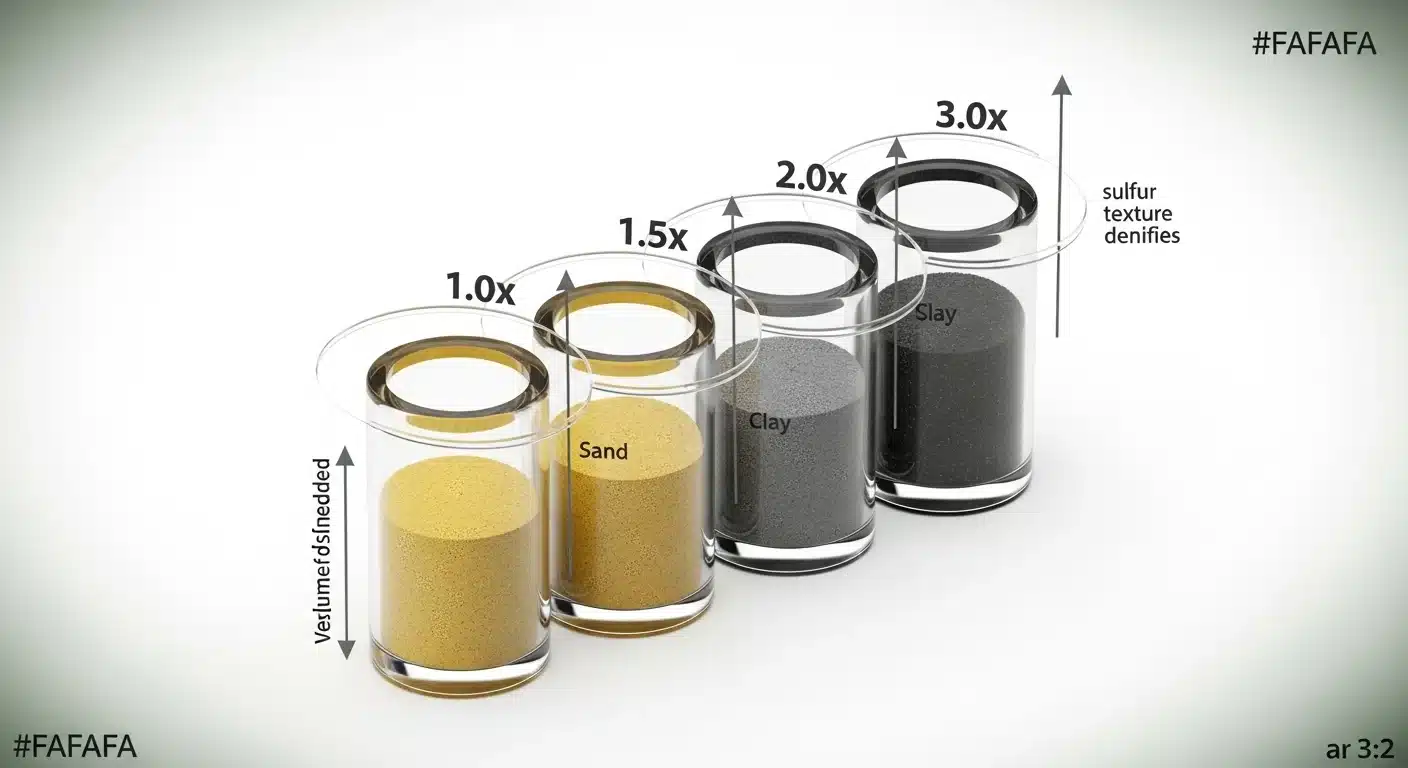
Lowering soil pH is not a straightforward arithmetic problem. The same one-unit drop that costs 10 lbs of elemental sulfur in a sandy bed can demand 30 lbs in heavy clay — because clay minerals carry a high Cation Exchange Capacity (CEC), and that buffering capacity chemically resists pH change. Most application charts skip this entirely, leaving growers short on product and wondering why the soil test came back unchanged six months later.
This calculator combines a pH gap measurement with a soil-texture buffer multiplier to produce a per-1,000-sq-ft rate for elemental sulfur. It also flags when a pH shift is large enough to require split applications rather than a single dose. What the tool does not do: it cannot replace a certified soil test, it does not account for organic matter percentages above a loam baseline, and it does not model fertilizer salt interactions. Use it to size a project and build an application schedule.
After running your numbers, you will know either that a single application is feasible or that you are looking at a multi-season acidification project — and you can plan your planting timeline around the 3-to-6-month bacterial conversion window accordingly.
Use the Tool
Lower Soil pH Calculator
Calculates how much elemental sulfur or aluminum sulfate you need to acidify your soil — including CEC buffer adjustments for clay vs. sand and critical split-application safety warnings.
| ΔpH Drop | Sandy Soil | Loam Soil | Silt/Clay Loam | Heavy Clay |
|---|
How this calculator works
Step 1 — Measure your pH Gap
ΔpH = Current pH − Target pH
This is the total number of pH units you need to lower your soil. Larger drops require proportionally more sulfur.
Step 2 — Apply the CEC Buffer Multiplier
Clay soils have a much higher Cation Exchange Capacity (CEC), which means they “resist” pH change and require more sulfur to shift. We use a soil-texture multiplier:
- Sand/Loamy Sand: ×1.0 (baseline)
- Sandy Loam / Loam: ×1.5
- Silt Loam / Clay Loam: ×2.0
- Clay / Heavy Clay: ×3.0 (up to 3× more sulfur than sand)
Step 3 — Calculate Base Elemental Sulfur Rate
Base Rate = ΔpH × 10 lbs/1,000 sq ft/unit
The coefficient 10 lbs per pH unit is the USDA Cooperative Extension baseline for sandy soil to a 6-inch incorporation depth.
Step 4 — Multiply by CEC Buffer
Sulfur (lbs/1,000 sq ft) = Base Rate × CEC Multiplier
Step 5 — Split Application Check
If ΔpH > 1.0, the total sulfur dose exceeds safe single-application thresholds. We mandate split applications — typically 2–3 applications spaced 3–4 months apart.
Assumptions & Limits
- Rates apply to 6-inch (15 cm) incorporation depth. Deeper tilling requires proportionally more product.
- Elemental sulfur requires Thiobacillus bacteria oxidation — allow 3–6 months before expecting pH change. Do not plant acid-sensitive crops immediately.
- Formula is calibrated for USDA Extension guidelines; always confirm with a certified soil lab report.
- Rates assume well-drained soil in the 50°F–85°F (10°C–29°C) range for optimal bacterial activity.
- Maximum safe single application: 5 lbs/1,000 sq ft of elemental sulfur (USDA guidance). This calculator flags amounts above this threshold.
- Aluminum sulfate acts faster (no bacterial step needed) but should be limited to <5 lbs/100 sq ft per application to avoid aluminum toxicity.
The Biology: Why Sulfur Takes Months to Work
The Microbial Time-Delay Explained
Elemental sulfur (S⁰) is not acidic by itself. It is a solid, oxidized mineral that sits in the soil until soil bacteria — primarily Thiobacillus thiooxidans and Thiobacillus thioparus — consume it and excrete sulfuric acid (H₂SO₄) as a byproduct.
- 3–6 months is the minimum wait time for meaningful pH change in warm, moist soils.
- Cold soil (below 50°F / 10°C) nearly halts bacterial activity — apply in spring or fall for summer results.
- If you plant acid-sensitive crops immediately after applying elemental sulfur, the soil is still alkaline and the plant will suffer alkaline shock — not from the sulfur, but from the unchanged pH.
Aluminum Sulfate — The Fast Option
Aluminum sulfate [Al₂(SO₄)₃] acidifies immediately upon dissolving — no bacterial wait. It is ideal for quick Hydrangea color changes (blue flowers at pH 5.5) or emergency pH correction. However:
- Limit to <5 lbs per 100 sq ft per application to avoid aluminum toxicity.
- More expensive per unit of pH change than elemental sulfur.
- Not suitable for very large areas — use elemental sulfur for garden-scale projects.
The Classic Mistake
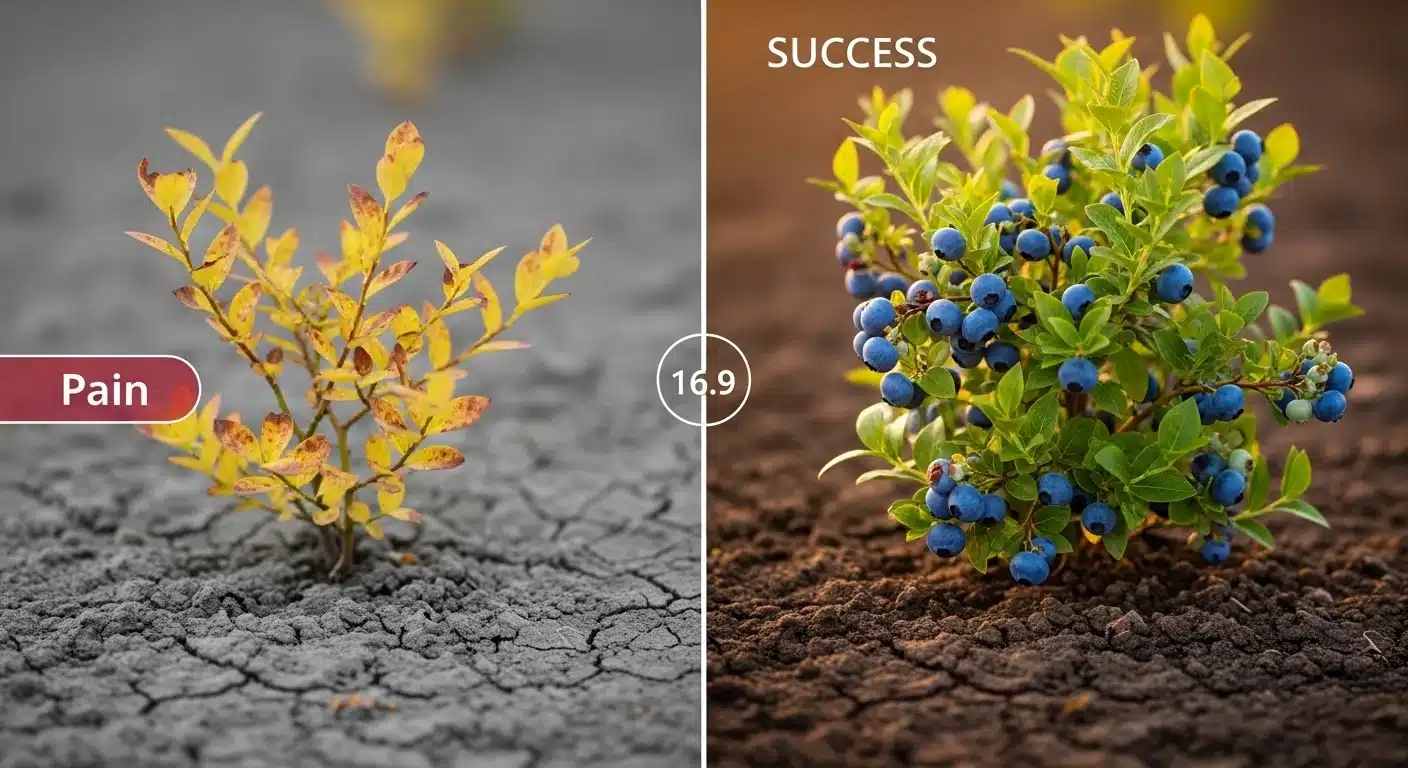
A gardener wants Blueberries (pH 4.5) in alkaline clay soil (pH 7.5). They dump 50 lbs of elemental sulfur in the planting hole and plant the bush immediately. The bush dies. The soil was still pH 7.5 — the sulfur had not yet been converted to acid. Always acidify the soil 6+ months before planting.
Before entering values, have three things ready: a recent soil test result showing your current pH (not a visual estimate), a clear crop selection so the target pH auto-fills correctly, and a realistic sense of your soil texture — dig a handful when damp and squeeze it; if it ribbons between your fingers, you are in clay territory, not loam. Area measurements should be in square feet; divide the result proportionally if your bed is smaller or larger than 1,000 sq ft. For a companion tool covering the lime side of the pH equation, the soil pH lime calculator handles alkalizing amendments on the opposite end of the scale.
Quick Start (60 Seconds)
- Target Crop: Select from the dropdown. The target pH fills automatically for common acid-loving plants. Choose “Custom” and enter your own if your crop is not listed. Do not guess at the target — even a 0.5-unit error changes the sulfur rate materially.
- Soil Texture / CEC Class: This is the most under-specified input on competing calculators. Sandy loam and clay loam are not interchangeable — the buffer multiplier spans ×1.0 to ×3.0 across texture classes. If unsure, default to the heavier class and plan accordingly.
- Current Soil pH: Enter the reading directly from a lab test or calibrated pH meter. Acceptable range is 4.0 to 9.5. A cheap paper strip reading is not accurate enough to drive a sulfur application decision.
- Target Soil pH: Auto-filled from crop selection, but fully editable. The tool requires the target to be lower than the current value — if it is not, you need lime, not sulfur.
- Decimal inputs: Enter one decimal place (e.g., 7.2, not 7). The formula uses tenths of a pH unit and rounding to whole numbers introduces meaningful error over large areas.
- Click Calculate only when all four fields are filled. The results panel does not appear on partial input, and no result is produced until validation passes.
- Note the split-application badge: If your pH drop exceeds 1.0 units, a red badge appears indicating that a single application is not appropriate regardless of soil type. Plan for two to three staggered treatments.
Inputs and Outputs (What Each Field Means)
| Field | Unit | What It Means | Common Mistake | Safe Entry Guidance |
|---|---|---|---|---|
| Target Crop | Selection | Determines the agronomically appropriate target pH for the plant family | Using a general “berries” target instead of species-specific values (blueberries need pH 4.5, strawberries 5.8) | Select the specific crop; use Custom only if yours is not listed |
| Soil Texture / CEC Class | Selection | Sets the buffer multiplier (×1.0 to ×3.0) that scales the base sulfur rate for your soil’s resistance to pH change | Selecting “Loam” for a silt-loam or clay-loam soil — the multiplier underestimates actual demand by up to 33% | When in doubt, select the heavier class; over-applying slightly is safer than under-applying |
| Current Soil pH | pH units (4.0 to 9.5) | The measured hydrogen ion concentration in your soil at the time of testing | Using an estimated or visually guessed pH rather than a calibrated instrument or lab reading | Use a recent soil test (within 12 months) or a professional-grade electrode probe |
| Target Soil pH | pH units (3.5 to 8.0) | The end-state acidity required for your selected crop’s optimal nutrient uptake window | Setting the target to the midpoint of a range rather than the recommended optimal (blueberries thrive at 4.5, not 5.2) | Use published university extension targets for your crop, not nursery tag ranges |
| Sulfur Rate (Output) | lbs per 1,000 sq ft | Total elemental sulfur needed to achieve the target pH shift in the given soil texture, calculated to 6-inch incorporation depth | Applying the full calculated rate as a single application when split applications are required | Divide by the number of applications shown if the split badge is active |
| Risk Level Gauge (Output) | Visual / qualitative | Traffic-light indicator showing whether the acidification project is low-demand, moderate, or a long multi-season undertaking | Treating a “high” gauge reading as a reason to abandon the project rather than as a planning cue | High gauge = phase the project over 2 to 3 growing seasons with soil tests between applications |
| Split Application Badge (Output) | Flag (shown/hidden) | Appears whenever the pH drop exceeds 1.0 units; indicates the dose must be divided to avoid nutrient imbalance and plant damage | Ignoring the badge and applying the full dose at planting time | Plan applications 3 to 4 months apart, and retest pH before each subsequent round |
Your soil’s actual CEC — a lab-measured value in milliequivalents per 100 grams — determines exactly how much of a chemical “sponge” your soil is. If you have a detailed lab report with a CEC value, the CEC soil calculator can help you interpret it in the context of fertilizer and amendment planning.
Worked Examples (Real Numbers)
Scenario 1: Blueberries in Sandy Backyard Soil
- Target Crop: Blueberries (target pH 4.5)
- Current Soil pH: 6.5
- Soil Texture: Sandy / Loamy Sand (CEC multiplier ×1.0)
- pH Gap (dPh): 6.5 – 4.5 = 2.0 units
Result: 20 lbs of elemental sulfur per 1,000 sq ft.
Because the pH gap exceeds 1.0 units, split into two applications of 10 lbs each, spaced 3 to 4 months apart. Sandy soils have low buffering, so bacterial conversion should be measurable within 3 months during warm weather. Retest before the second application to confirm progress.
Scenario 2: Azaleas in Heavy Clay Soil
- Target Crop: Azaleas / Rhododendrons (target pH 5.0)
- Current Soil pH: 7.0
- Soil Texture: Clay / Heavy Clay (CEC multiplier ×3.0)
- pH Gap (dPh): 7.0 – 5.0 = 2.0 units
Result: 60 lbs of elemental sulfur per 1,000 sq ft.
The same 2.0-unit drop that costs 20 lbs in sand costs 60 lbs in clay — a direct consequence of the CEC buffer. Distribute across three applications of 20 lbs each over 9 to 12 months. Clay also slows bacterial activity due to reduced aeration, so allow extra time between applications before retesting.
Scenario 3: Hydrangeas in Sandy Loam for Blue Flower Color
- Target Crop: Hydrangeas – Blue (target pH 5.5)
- Current Soil pH: 6.8
- Soil Texture: Sandy Loam / Loam (CEC multiplier ×1.5)
- pH Gap (dPh): 6.8 – 5.5 = 1.3 units
Result: 19.5 lbs of elemental sulfur per 1,000 sq ft.
The split badge activates because dPh exceeds 1.0. Two applications of approximately 9.75 lbs each are appropriate. Note: for hydrangeas specifically, aluminum sulfate is often a faster route to color change since it acidifies without the bacterial conversion delay — the tool’s warning panel flags this alternative.
Reference Table (Fast Lookup)
Computed from the formula: Sulfur (lbs/1,000 sq ft) = pH Gap x 10 x CEC Multiplier. Split Required column is derived from the 1.0-unit threshold rule.
| pH Drop (units) | Sandy Soil (x1.0) | Sandy Loam (x1.5) | Silt/Clay Loam (x2.0) | Heavy Clay (x3.0) | Split Application Required? |
|---|---|---|---|---|---|
| 0.5 | 5 lbs | 7.5 lbs | 10 lbs | 15 lbs | No |
| 0.8 | 8 lbs | 12 lbs | 16 lbs | 24 lbs | No |
| 1.0 | 10 lbs | 15 lbs | 20 lbs | 30 lbs | Borderline — one dose maximum |
| 1.5 | 15 lbs | 22.5 lbs | 30 lbs | 45 lbs | Yes — 2 applications |
| 2.0 | 20 lbs | 30 lbs | 40 lbs | 60 lbs | Yes — 2 applications |
| 2.5 | 25 lbs | 37.5 lbs | 50 lbs | 75 lbs | Yes — 3 applications |
| 3.0 | 30 lbs | 45 lbs | 60 lbs | 90 lbs | Yes — 3 applications |
| 3.5 | 35 lbs | 52.5 lbs | 70 lbs | 105 lbs | Yes — 3+ applications; consider raised bed strategy |
| 4.0 | 40 lbs | 60 lbs | 80 lbs | 120 lbs | Yes — multi-season project; raised beds recommended |
How the Calculation Works (Formula + Assumptions)
Show the calculation steps
Step 1 — Measure the pH gap:
pH Gap (dPh) = Current Soil pH – Target Soil pH
This is the raw number of pH units the soil must shift downward. Because pH is a logarithmic scale, each full unit represents a tenfold change in hydrogen ion concentration — but for amendment purposes, the formula treats the gap as linear within the typical acidification range.
Step 2 — Apply the CEC buffer multiplier:
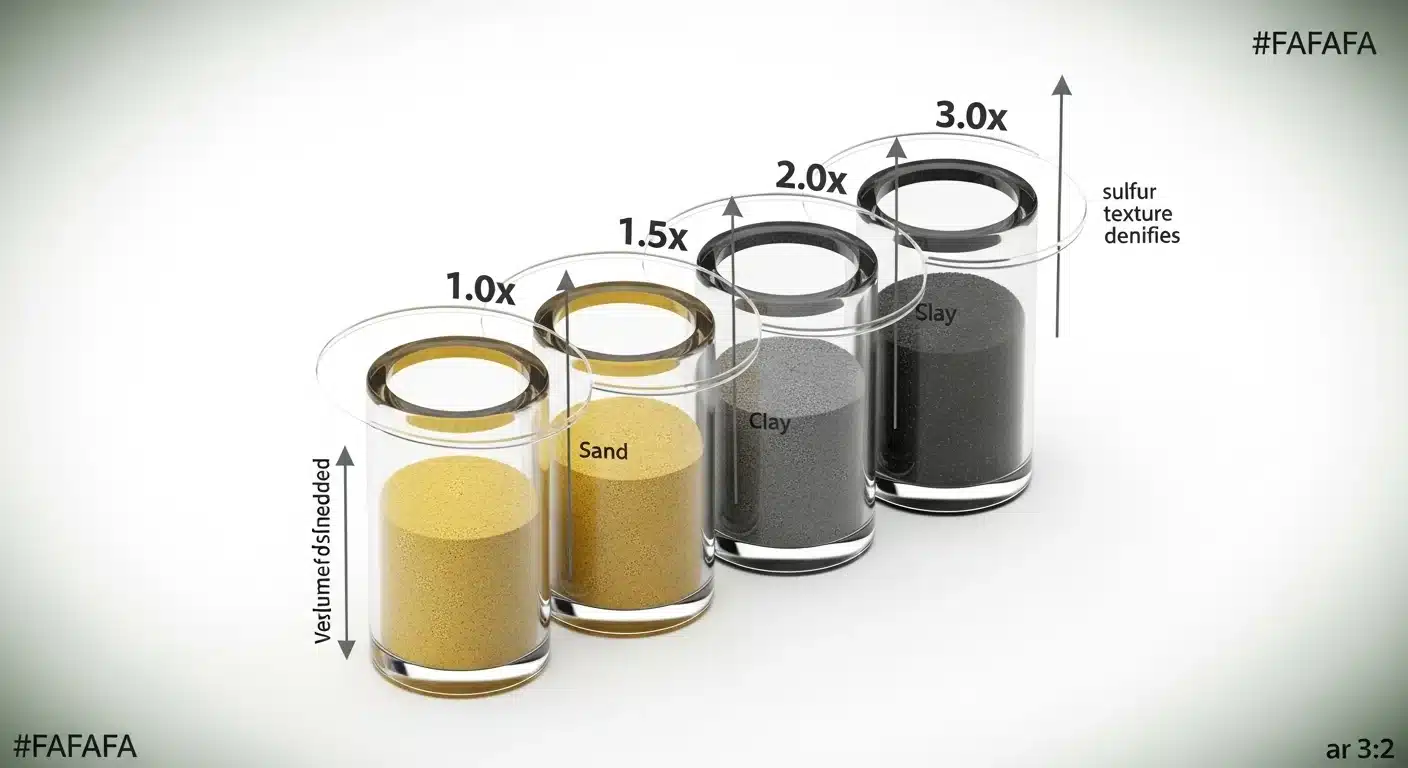
The multiplier scales the base rate for your soil’s chemical resistance to pH change:
- Sandy / Loamy Sand: x1.0 (baseline, low CEC)
- Sandy Loam / Loam: x1.5 (moderate CEC)
- Silt Loam / Clay Loam: x2.0 (medium-high CEC)
- Clay / Heavy Clay: x3.0 (high CEC — up to three times the sandy baseline)
Step 3 — Calculate base rate from the sandy-soil coefficient:
Base Rate = pH Gap x 10 lbs per 1,000 sq ft
The coefficient of 10 lbs per pH unit per 1,000 sq ft is derived from USDA Cooperative Extension guidelines calibrated for a 6-inch incorporation depth in sandy soil. Deeper incorporation — 8 to 12 inches — requires proportionally more product to achieve the same pH shift throughout the target root zone.
Step 4 — Apply the buffer multiplier:
Final Rate = Base Rate x CEC Multiplier
Result is rounded to one decimal place. No further rounding is applied internally; the displayed value is the computed result to one decimal.
Step 5 — Check the split-application threshold:
If pH Gap is greater than 1.0 units, the tool activates a mandatory split-application warning. For gaps between 1.0 and 2.0, two applications are recommended. For gaps above 2.0, three applications are flagged.
Assumptions and Limits
- Rates are calibrated to a 6-inch (15 cm) tilling depth. Shallower surface applications reduce effectiveness; deeper incorporation requires recalculation.
- The formula assumes elemental sulfur prills or granules with a purity of 90% or higher. Lower-purity blended products require proportional rate adjustments that this tool does not perform.
- Bacterial oxidation of sulfur to sulfuric acid requires soil temperatures above 50 degrees Fahrenheit (10 degrees Celsius) and adequate soil moisture. In cold or dry conditions, the conversion timeline extends well beyond 6 months.
- The model does not account for organic matter content above the baseline assumed for each texture class. High-organic soils within a clay class can have CEC values significantly above the class average, meaning the tool may underestimate demand.
- Aluminum sulfate application rates and outcomes are not computed by this tool; only elemental sulfur is modeled. Aluminum sulfate operates via a different chemical pathway and has tighter per-application safety limits.
- The tool treats pH as stable at the measured value. Soils with active calcium carbonate (free lime) will rebound toward alkalinity over time, requiring maintenance applications that the one-time calculation does not address.
- Results apply to mineral soils. Peat-dominant or coir-amended media have very different buffering behavior and should not be sized using this tool. Knowing how to calculate how much soil texture influences amendment decisions can help you characterize your starting material more precisely.
Standards, Safety Checks, and “Secret Sauce” Warnings
Critical Warnings
- The Microbial Delay Is Not Optional: Elemental sulfur (S0) carries no acidity in solid form. The acidification reaction only occurs after Thiobacillus thiooxidans and related soil bacteria oxidize the sulfur to sulfuric acid (H2SO4). This process requires a minimum of 3 months under ideal conditions and commonly takes 4 to 6 months. Planting acid-sensitive crops immediately after sulfur application exposes roots to the original, unchanged alkaline pH — not the target pH. The result is alkaline shock and often plant death, even though the sulfur was applied at the correct rate.
- Single-Application Overload: The USDA Cooperative Extension guidance caps elemental sulfur applications at 5 lbs per 1,000 sq ft for sandy soils in a single event. Scaled for texture, this limit shifts proportionally with the CEC multiplier. Exceeding safe single-application rates risks salt stress, nutrient lock-out (particularly phosphorus and molybdenum), and direct root damage from localized acid hot spots before the soil buffers the concentration. The tool enforces the split threshold at a pH gap of 1.0 units as the standard safety trigger.
- Clay Soil Rebound Risk: In calcareous (lime-rich) clay soils, the soil’s calcium carbonate reserve will chemically neutralize added acidity over 12 to 24 months. A pH reading taken 3 months after application may look correct, but the soil can drift back toward 7.0 without maintenance acidification. This is not modeled; plan annual retesting.
- Aluminum Sulfate Toxicity Threshold: Aluminum sulfate acts without the bacterial delay, making it attractive for fast color changes in Hydrangeas. However, aluminum toxicity to plant roots begins at concentrations achievable with moderate over-application. Do not exceed 5 lbs per 100 sq ft per application, and never use aluminum sulfate on blueberries, where the total aluminum load can reach phytotoxic levels across multiple seasons.
Minimum Standards
- Always base the current pH input on a calibrated instrument or certified lab report taken within the past 12 months. Test from multiple spots in the bed and average the readings.
- For pH drops greater than 1.5 units in clay soil, consider raised bed construction with an acidic growing medium as a parallel or alternative strategy. In-ground acidification at that scale is a multi-season commitment with uncertain uniformity. The raised bed soil calculator can help size the acidic media volume if a raised structure is the more practical path.
- Retest soil pH before each subsequent split application. Do not apply a second or third dose on a fixed schedule without confirming the first application is performing as expected — over-acidification is a real risk in thin sandy soils.
Competitor Trap: Most published sulfur application charts give a single rate per pH unit with no mention of soil texture. A gardener in a sandy region follows a chart calibrated for loam, applies too little sulfur, and sees no pH change after months of waiting — then concludes that elemental sulfur “does not work.” The opposite happens in clay: a grower follows a sandy-soil chart and grossly under-applies, burning money and delaying a project by an additional season. The texture buffer multiplier is not a refinement; it is the core variable that makes the calculation accurate in the first place.
Common Mistakes and Fixes
Mistake: Planting Immediately After Sulfur Application
Elemental sulfur does nothing chemically to the soil until Thiobacillus bacteria oxidize it into sulfuric acid. This process takes a minimum of 3 months under favorable conditions. Growers who apply sulfur and plant in the same week are putting roots into unchanged alkaline soil while the conversion reaction has not yet started. The plant does not benefit from the sulfur that will eventually be released — it simply suffers the wrong pH until the conversion completes.
Fix: Apply sulfur at least 3 to 6 months before planting. In regions with cold winters, apply in early fall for spring planting.
Mistake: Treating All Soil Textures as Loam
Application charts on bag labels and basic online calculators commonly list a single rate for “average garden soil” — implicitly calibrated to loam. A clay gardener following that rate will under-apply by a factor of two, and a sandy gardener may over-apply relative to what the soil can absorb safely before a retest. Both outcomes waste time and money.
Fix: Identify your soil texture before calculating. If you are unsure, get a peat moss amendment ratio from a known-texture baseline and use the texture multiplier in this tool honestly.
Mistake: Applying the Full Calculated Rate as a Single Dose
For pH gaps above 1.0 units, the total sulfur rate exceeds safe single-application limits in most soil types. Dumping the full calculated quantity at once creates localized acid concentration, deprives soil bacteria of time to distribute the conversion reaction, and risks both nutrient lock-out and direct root damage from pH hot spots around sulfur granules.
Fix: When the split-application badge appears in the tool, treat it as a hard rule, not a suggestion. Divide the total dose and schedule applications 3 to 4 months apart with a pH retest between each.
Mistake: Confusing Aluminum Sulfate and Elemental Sulfur Timelines
Both products lower pH but through fundamentally different reactions. Aluminum sulfate dissolves and acidifies within days. Elemental sulfur acidifies over months. Growers who buy elemental sulfur expecting the instant blue-flower effect they have seen advertised for hydrangea treatments are comparing two different products. The confusion leads to premature conclusions that the application “failed.”
Fix: For immediate results (small areas, ornamental color control), use aluminum sulfate within its safety limits. For large-scale, long-term soil acidification, elemental sulfur is more economical but requires patience. The tool notes which scenario applies based on your crop selection.
Mistake: Ignoring Calcareous Soil Rebound
Soils with free calcium carbonate (common in arid regions and many suburban fill soils) have an alkalinity reserve that will chemically neutralize added acidity over time. A grower achieves the target pH in spring, skips testing the following year, and returns to find the soil drifting back toward 7.0. The sulfur “worked” — but the underlying soil chemistry reversed it.
Fix: Test pH annually in calcareous soils. Plan for maintenance applications on a recurring schedule rather than treating acidification as a one-time project.
Next Steps in Your Workflow
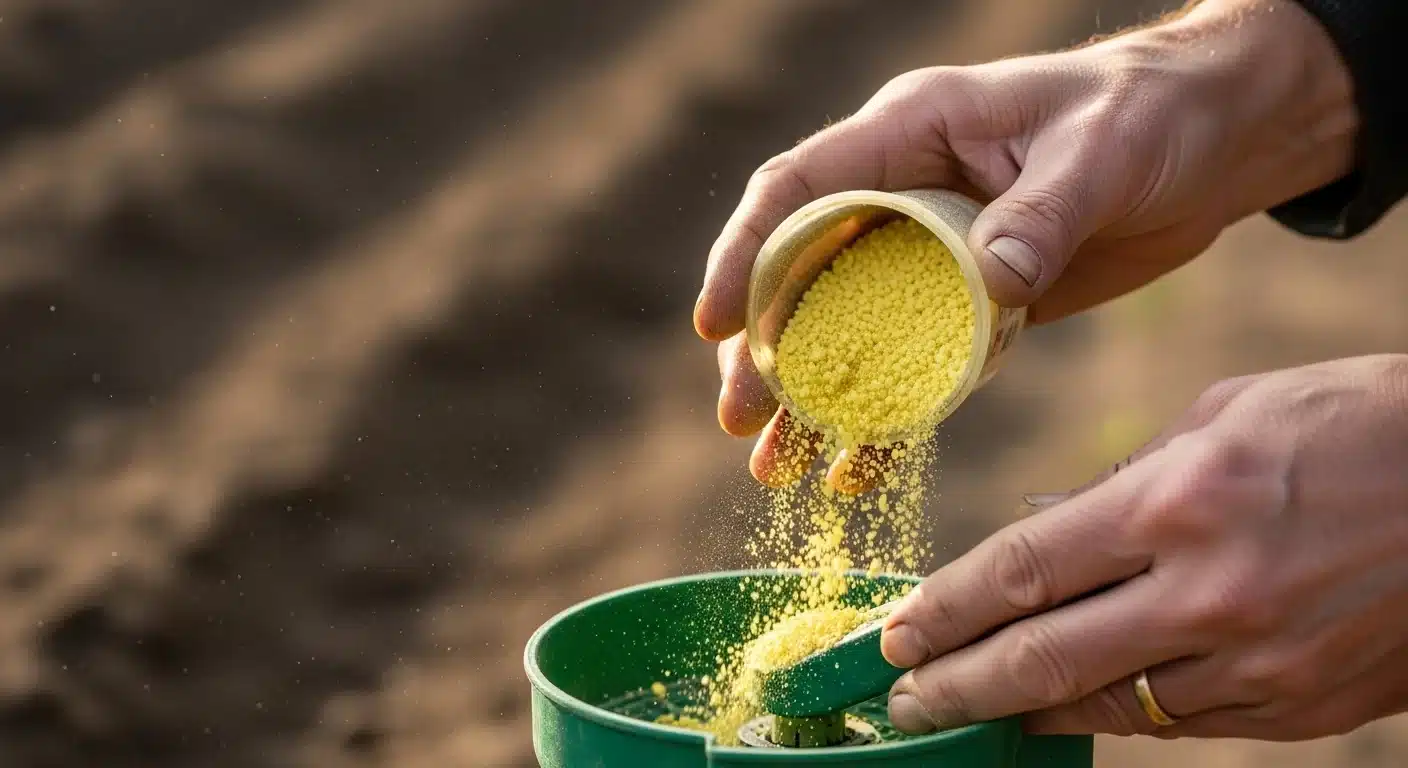
Once you have your sulfur rate and a split-application schedule mapped out, the immediate next step is sourcing product and confirming the bed area. Purchase elemental sulfur prills or granules rather than powder for garden-scale work — powder is harder to apply uniformly and can cause respiratory irritation during handling. Weigh out each application dose before you begin; a bathroom scale and a bucket are sufficient for small beds. Apply with a broadcast spreader or by hand-broadcasting in overlapping passes, then water in thoroughly to begin the contact between sulfur and soil bacteria. Mark your application date and set a calendar reminder to retest pH in 12 to 14 weeks.
After acidification is underway, revisit your overall soil fertility plan. pH affects nutrient availability across the entire profile — as your soil drops below 6.0, phosphorus solubility shifts and some micronutrient uptake windows open while others narrow. Running a nutrient balance assessment alongside your pH project helps avoid correcting one variable while inadvertently creating a new deficiency. The base saturation calculator connects CEC, pH, and macronutrient balance in a single analysis, and the compost calculator can help you estimate how organic matter additions will interact with your acidification timeline.
FAQ
How long does elemental sulfur take to lower soil pH?
Under warm (above 60 degrees F), moist conditions, Thiobacillus bacteria can produce a measurable pH drop within 8 to 12 weeks. Realistically, 3 to 6 months is the typical window for a meaningful change. Cold soil below 50 degrees F halts bacterial activity almost completely, extending the timeline through the full winter season in northern climates.
Can I use aluminum sulfate instead of elemental sulfur?
Yes, for small areas and situations where speed matters, aluminum sulfate is effective and acts within days rather than months. The tradeoffs are cost per pH unit and aluminum accumulation risk over repeated applications. Elemental sulfur is more economical for large beds and for long-term management. Do not use aluminum sulfate on blueberries, where aluminum toxicity across multiple seasons is a documented concern.
Why does clay soil need so much more sulfur than sandy soil?
Clay minerals carry a high Cation Exchange Capacity — they hold onto positively charged ions (including hydrogen ions that define acidity) with much greater force than sand particles. This buffering effect means the soil chemically “absorbs” added acidity before the pH reading shifts, requiring proportionally more input to achieve the same numeric change. The CEC multiplier in this calculator quantifies that resistance.
Is it possible to over-acidify soil?
Yes. Sandy soils with low CEC have little buffering capacity to resist pH change, making them vulnerable to over-acidification if the full rate is applied at once or if applications are repeated without retesting. Soil pH below 4.0 begins to release aluminum and manganese into the soil solution at concentrations toxic to most plants. Always retest before subsequent split applications.
What is the elemental sulfur application rate limit per application?
USDA Cooperative Extension guidance sets a conservative limit of 5 lbs per 1,000 sq ft for a single application in sandy soil. For heavier soils, the safe single-dose limit scales with the CEC multiplier. The split-application flag in this calculator activates before that limit is approached, providing a safety margin rather than a hard ceiling.
Can I add peat moss along with sulfur to lower pH faster?
Peat moss has an inherently low pH (typically 3.5 to 4.5) and acts as a direct acidic amendment when incorporated into planting holes or raised bed media. It does not depend on bacterial conversion and provides an immediate local pH reduction around the root zone. For large-scale in-ground beds, sulfur remains more economical, but combining peat moss into planting holes is a standard practice for blueberries and rhododendrons in alkaline soils.
Conclusion
The central insight this calculator enforces is the one most standard application charts ignore: the same pH target demands dramatically different sulfur quantities depending on what your soil is made of. Sandy soil and heavy clay are not variations on a theme — they are different buffering systems that require different treatment volumes. The texture multiplier is not an optional refinement; it is the variable that determines whether your calculation is in the right order of magnitude at all.
The single most important mistake to avoid is planting immediately after sulfur application and expecting the target pH to already be in effect. The microbial conversion window is non-negotiable and cannot be compressed by applying more product. Build your planting timeline around the bacterial process, not around the calendar date you bought the sulfur. For ongoing soil health beyond the pH project, exploring how soil organic matter affects nitrogen release gives context for the nutrient shifts that accompany acidification — and helps you avoid treating pH as an isolated variable when the whole soil system is interdependent.