
Albrecht Base Saturation Cation Balancer
The Yield Grid · Soil, Fertilizer & Amendments Math · base saturation calculator
Calculated Amendment Recommendations
| Scenario | Ca% | Mg% | K% | Ca:Mg | Soil Status |
|---|---|---|---|---|---|
| Ideal (Albrecht) | 68–75 | 10–15 | 3–5 | ~5:1 | Optimal |
| High-Mg Concrete | 60 | 22 | 4 | ~2.7:1 | Tight Soil |
| Ca Deficiency | 52 | 14 | 4 | ~3.7:1 | Low Ca |
| K Lockout Risk | 68 | 14 | 1.5 | ~4.9:1 | K Low |
| Excess Ca / Sandy | 82 | 8 | 3 | ~10.3:1 | Ca Excess |
| Low CEC (Sandy) | 70 | 12 | 4 | ~5.8:1 | Balanced |
| Heavy Clay / High CEC | 65 | 20 | 3 | ~3.3:1 | Tight Soil |
- Pelletized Gypsum (CaSO₄) — Raises Ca without raising pH; ideal for tight soils
- K-Mag / Sul-Po-Mag — Supplies K, Mg, and S simultaneously; reduces K lockout risk
- Stainless Steel Soil Core Probe — Essential for accurate multi-depth sampling
- Deep-Ripping Tractor Implements — Mechanically breaks concrete Mg-sealed layers
How This Calculator Works — Formula & Assumptions
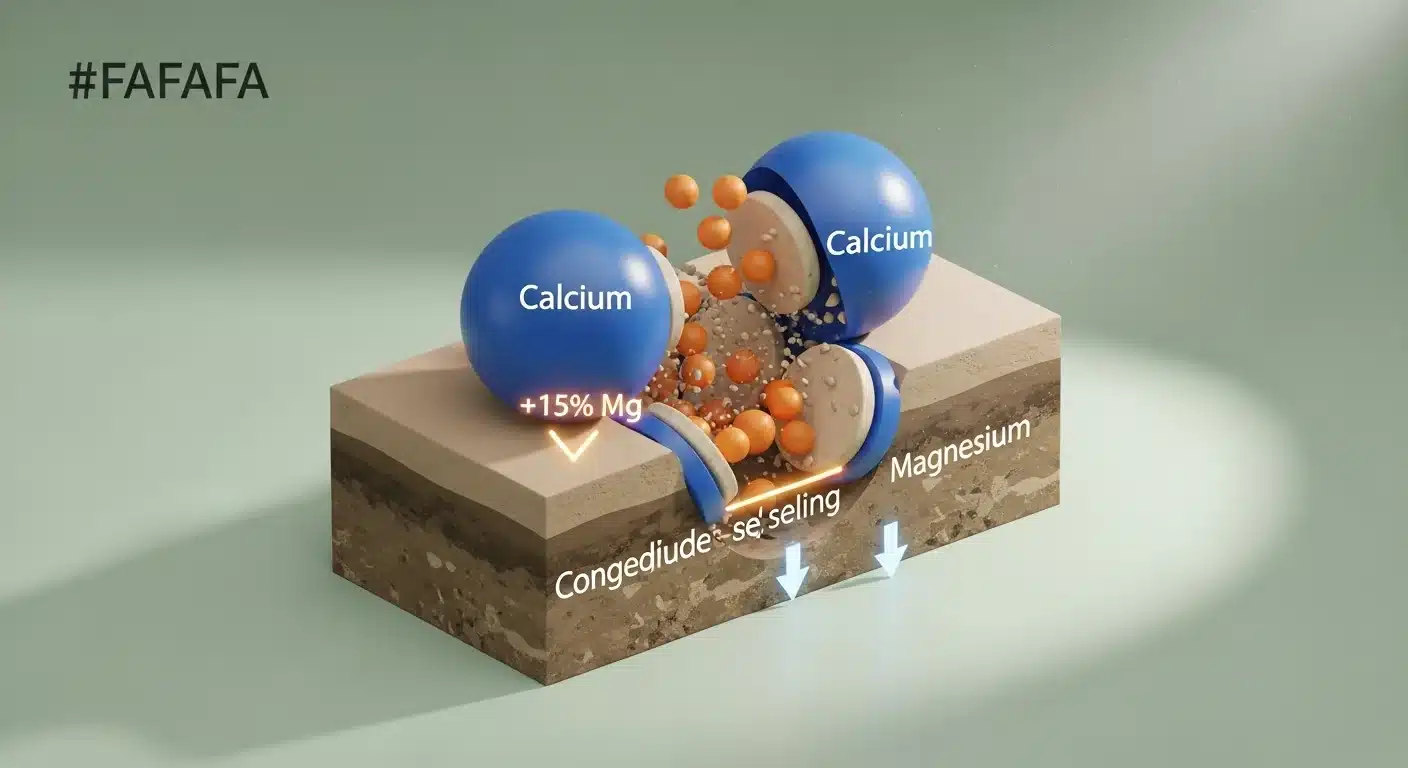
The Albrecht Kinematics Method models soil physical structure through cation balance. Calcium physically pushes soil particles apart (improves tilth), while Magnesium draws them tightly together. When Mg dominates, soil seals itself — water infiltration drops, roots can’t penetrate, and even perfect NPK levels fail.
- Input your soil test values: CEC (meq/100g), Ca%, Mg%, and K% from a standard lab analysis.
- Ca:Mg Ratio is computed:
Ratio_Ca:Mg = Ca% ÷ Mg%
- Target ranges (Albrecht ideal):
Calcium: 68% – 75% of CEC
Magnesium: 10% – 15% of CEC
Potassium: 3% – 5% of CEC
Ca:Mg Ratio: 4:1 – 7:1 (ideal ~5:1) - “Tight Soil” Concrete Warning: Triggered when Mg% > 15% OR Ca:Mg < 4:1. This indicates physical soil sealing. The calculator prescribes Gypsum tonnage to correct it.
Ca deficit (lbs/ac) = (Target_Ca% − Current_Ca%) × CEC × 400
Gypsum tons/ac = Ca deficit ÷ 380 (lbs Ca per ton pelletized gypsum) ÷ 2000
[400 = meq conversion factor; 380 lbs Ca per ton gypsum ≈ 19% Ca] - K Lockout Check: When K% < 3%, plants cannot uptake potassium regardless of soil K levels. K-Mag is recommended.
Assumptions & Limits: Based on William Albrecht’s base saturation model (University of Missouri). Targets are guidelines — sandy soils may tolerate lower Ca%, heavy clays benefit from tighter Mg control. CEC range assumed 1–100 meq/100g. Ca + Mg + K need not equal 100% (other cations like Na, H, Al occupy remaining CEC). Amendment rates are estimates; always consult a certified agronomist. This tool does not replace a certified soil lab report.
A soil test that shows adequate calcium and magnesium numbers can still describe a field with the water infiltration of a parking lot. That is the core failure mode the Albrecht kinematics model was designed to catch. Raw elemental values do not tell you whether calcium and magnesium are in the right proportion to keep soil particles physically separated, and that ratio determines whether your soil breathes, drains, and allows root penetration at all.
This base saturation calculator takes four values from a standard laboratory soil report: Cation Exchange Capacity (CEC), and the percentage of that capacity occupied by calcium, magnesium, and potassium. From those inputs it computes the Ca:Mg ratio, checks each nutrient against Albrecht ideal ranges, triggers a “tight soil” concrete warning when warranted, and calculates how much pelletized gypsum or K-Mag would be required to correct the deficit. It does not predict yield, diagnose pest pressure, or substitute for a certified agronomist’s site-specific recommendation. Soil texture, organic matter level, and climate variables all affect how amendments behave in the field. For a full picture of your soil’s physical architecture, running a soil texture analysis alongside cation balance data gives a much more complete diagnostic picture.
After running this calculator you will know whether your Ca:Mg ratio is physically sealing the soil, which cation is out of range, and the estimated tonnage of the single amendment most likely to correct the imbalance before your next crop cycle.
Use the Tool
Before entering values, locate your laboratory soil report and confirm you have the CEC expressed in milliequivalents per 100 grams (meq/100g), not parts per million. The Ca%, Mg%, and K% fields require the base saturation percentages reported by the lab, not the elemental weights. If your report shows pounds per acre for each cation, divide by the appropriate equivalent weight and the field weight to convert, or ask your lab to provide base saturation percentages directly. If you want to understand how CEC itself is measured and what influences it, the CEC soil calculator on this site walks through the underlying calculations.
Quick Start (60 Seconds)
- CEC (meq/100g): Enter the number from the “Cation Exchange Capacity” line of your lab report. Most agricultural soils range from 5 to 40 meq/100g. Sandy soils cluster at the low end; heavy clays can exceed 30. Do not enter the CEC in ppm or lbs/acre.
- Calcium %: Enter the base saturation percentage for Ca, not the calcium ppm or lbs/acre. The target range is 68% to 75% of CEC. Values below 60% are a consistent signal of structural deficiency.
- Magnesium %: Enter Mg base saturation percentage. The target window is 10% to 15%. Entering Mg above 15% will trigger the tight-soil concrete warning even if your Ca number looks acceptable.
- Potassium %: Enter K base saturation percentage. Target is 3% to 5%. Potassium below 3% constitutes a lockout condition: the plant cannot extract K regardless of how much is present in the soil.
- Ca + Mg + K must not exceed 100%: These three cations share CEC capacity with hydrogen, sodium, and aluminum. If your three values sum past 100%, your report numbers are likely in ppm, not percentages.
- Click Calculate only after all four fields are filled. The tool will not run on partial inputs and will display inline field-level errors rather than silently producing a wrong ratio.
- Use Reset between soil samples. Running multiple samples without resetting can cause visual artifacts in the gauge and bar displays even if the number output updates correctly.
Inputs and Outputs (What Each Field Means)
| Field | Unit | What It Represents | Common Mistake | Safe Entry Guidance |
|---|---|---|---|---|
| CEC | meq/100g | The soil’s total cation-holding capacity; determines how much of each cation is physically present at a given percentage | Entering CEC from a report that uses cmol/kg (numerically identical to meq/100g but labeled differently, causing confusion) | Accepted range: 0.1 to 100. Typical agricultural soils: 5 to 40. |
| Calcium % | % of CEC | The fraction of CEC exchange sites occupied by Ca2+ ions; drives soil particle separation and structural openness | Using calcium ppm from the report instead of converting to base saturation percentage | Ideal: 68% to 75%. Values above 85% indicate possible excess that suppresses Mg and K uptake. |
| Magnesium % | % of CEC | The fraction of CEC occupied by Mg2+ ions; at high levels draws soil platelets together and physically seals structure | Treating Mg% above 15% as a positive sign of fertility rather than a structural risk indicator | Ideal: 10% to 15%. Exceeding 15% triggers the tight-soil warning regardless of the Ca value. |
| Potassium % | % of CEC | The fraction of CEC occupied by K+ ions; below 3%, uptake is blocked at the root exchange site | Assuming that high soil K ppm automatically means adequate K base saturation percentage | Ideal: 3% to 5%. Above 5%, excess K can competitively suppress both Mg and Ca uptake. |
| Ca:Mg Ratio (output) | ratio : 1 | The computed relationship between Ca% and Mg%; the primary diagnostic for soil physical structure | Ignoring this ratio when individual Ca and Mg values appear to pass individual thresholds | Safe zone: 4:1 to 7:1. Below 4:1, soil sealing is indicated. Above 7:1, Mg deficiency risk rises. |
| Gypsum recommendation (output) | tons per acre | Estimated pelletized gypsum application required to raise Ca% to the 68% minimum without altering soil pH | Applying agricultural lime to correct Ca deficiency when Mg is already high, which worsens the Ca:Mg imbalance | This is an estimate. Actual rates depend on incorporation depth, rainfall timing, and existing soil pH. |
| K-Mag recommendation (output) | tons per acre | Estimated Sul-Po-Mag (K-Mag) needed to raise K% to the 3% minimum; also supplies sulfur | Using muriate of potash (KCl) when sulfur deficiency is also present, missing K-Mag’s multi-nutrient benefit | Verify soil sulfur status before choosing potassium source; K-Mag is preferred on magnesium-sensitive soils. |
Worked Examples (Real Numbers)
Scenario 1: Classic High-Magnesium Concrete Soil
- CEC: 18 meq/100g
- Calcium: 60% of CEC
- Magnesium: 22% of CEC
- Potassium: 4% of CEC
Result: Ca:Mg ratio = 2.73:1. Tight-soil concrete warning activated. Estimated gypsum requirement = 1.52 tons per acre of pelletized gypsum (CaSO4).
Both triggers fire here: Mg exceeds 15% and the Ca:Mg ratio falls well below the 4:1 floor. This is the profile that produces a field with acceptable N-P-K values and genuinely poor water infiltration. Gypsum supplies calcium without raising pH, which avoids further displacing magnesium from exchange sites.
Scenario 2: K Lockout with Balanced Ca:Mg
- CEC: 12 meq/100g
- Calcium: 68% of CEC
- Magnesium: 11% of CEC
- Potassium: 1.8% of CEC
Result: Ca:Mg ratio = 6.18:1 (within safe range). K lockout warning activated. Estimated K-Mag requirement = 0.13 tons per acre.
The Ca:Mg ratio is healthy, meaning soil structure is not the bottleneck. However, potassium at 1.8% of a 12 meq/100g CEC soil means exchange sites are not available for K uptake. Applying additional potassium fertilizer without correcting the base saturation percentage first would be largely ineffective.
Scenario 3: Ideal Albrecht Balance (Verification Pass)
- CEC: 22 meq/100g
- Calcium: 71% of CEC
- Magnesium: 13% of CEC
- Potassium: 4% of CEC
Result: Ca:Mg ratio = 5.46:1. All three cations within Albrecht target ranges. No amendments flagged.
This is the reference state the Albrecht model describes as structurally optimal. Soil particles should be pushed apart by calcium while magnesium provides adequate density without sealing. No gypsum or K-Mag is indicated at this profile.
Reference Table (Fast Lookup)
| Soil Scenario | CEC (meq/100g) | Ca% | Mg% | K% | Ca:Mg Ratio | Structural Status | Gypsum Est. (tons/acre) |
|---|---|---|---|---|---|---|---|
| Albrecht ideal (loam) | 18 | 71 | 12 | 4 | 5.92:1 | Optimal | 0 |
| High-Mg heavy clay | 28 | 58 | 24 | 3 | 2.42:1 | Tight / Concrete | 4.42 |
| Moderate-Mg silty clay | 22 | 63 | 18 | 4 | 3.50:1 | Tight / Concrete | 2.18 |
| Low-Ca sandy loam | 9 | 52 | 13 | 4 | 4.00:1 | Ca Deficient | 0.67 |
| K lockout (low K%) | 14 | 70 | 12 | 1.5 | 5.83:1 | K Lockout Risk | 0 |
| Excess Ca, low Mg | 16 | 82 | 7 | 3 | 11.71:1 | Mg Deficient | 0 |
| Excess K (K>5%) | 20 | 68 | 12 | 7 | 5.67:1 | K Suppression Risk | 0 |
| Low CEC sandy soil | 5 | 70 | 11 | 4 | 6.36:1 | Balanced | 0 |
| Multi-deficiency profile | 20 | 55 | 20 | 2 | 2.75:1 | Tight + K Lockout | 2.95 |
| High-CEC organic-rich soil | 35 | 69 | 14 | 4 | 4.93:1 | Optimal | 0 |
The gypsum estimates in the final column are computed using the formula: Ca deficit (lbs/acre) = (68 minus current Ca%) multiplied by CEC multiplied by 400, divided by 100; then divided by 380 (pounds of calcium per ton of pelletized gypsum). Rows where Ca% is already at or above 68% show zero because no Ca deficit exists.
How the Calculation Works (Formula + Assumptions)
Show the calculation steps
Step 1: Validate inputs. The tool checks that CEC is between 0.1 and 100 meq/100g, that each percentage is between 0 and 100, and that Ca + Mg + K does not sum to more than 100. If any check fails, the calculation halts and the relevant field displays an inline error.
Step 2: Compute Ca:Mg ratio.
Ca:Mg Ratio = Ca% divided by Mg%
If Mg% is zero, the ratio is treated as positive infinity and all ratio-dependent checks default to the excess-Ca branch. The ratio is displayed rounded to two decimal places.
Step 3: Evaluate structural status. Two thresholds determine whether the tight-soil concrete warning fires:
- Mg% greater than 15% (Albrecht’s absolute Mg ceiling)
- Ca:Mg ratio less than 4:1 (the minimum structural ratio)
Either condition alone is sufficient to trigger the warning. Both conditions firing together indicates a severe structural problem.
Step 4: Calculate gypsum requirement.
Ca deficit (lbs/acre) = (68 - Ca%) x CEC x 400 / 100
Gypsum tons/acre = Ca deficit / 380
The factor 400 is a field-weight conversion expressing meq/100g CEC to approximate pounds of cation per acre at a standard plow-layer depth. The factor 380 represents the pounds of elemental calcium delivered per ton of pelletized gypsum at approximately 19% Ca content. The division by 2000 to convert pounds to tons is incorporated into the 380 denominator by expressing it directly in lbs-per-ton terms. If Ca% is already at or above 68%, gypsum equals zero; the formula does not compute negative application rates.
Step 5: Calculate K-Mag requirement.
K deficit (lbs/acre) = (3 - K%) x CEC x 400 / 100
K-Mag tons/acre = K deficit / 440
The factor 440 represents the pounds of elemental potassium per ton of K-Mag (Sul-Po-Mag) at approximately 22% K content. If K% is at or above 3%, no K-Mag is recommended.
Rounding: All output ratios display two decimal places. Amendment tonnage displays two decimal places. Bar chart widths are clamped to the visual range of the gauge and do not extrapolate beyond the display limits.
Assumptions and Limits
- The Albrecht target ranges (Ca 68-75%, Mg 10-15%, K 3-5%) are guidelines calibrated primarily for temperate North American agricultural soils. Tropical soils, sodic soils, and highly weathered Ultisols may operate under different optimal profiles.
- The CEC conversion factor of 400 assumes a standard 6-inch plow layer at approximately 2 million pounds of soil per acre. Different tillage depths or soil bulk densities will produce proportionally different actual amendment requirements.
- The gypsum Ca content is assumed at 19% (380 lbs Ca per ton). Actual product purity varies; always verify the guaranteed analysis on the gypsum bag or delivery ticket.
- The K-Mag K content is assumed at 22% (440 lbs K per ton). Granular and powdered K-Mag products have similar analyses but different solubility curves; adjust application timing accordingly.
- The tool does not account for soil pH interactions. Calcium carbonate from liming can also raise Ca base saturation, but lime simultaneously raises pH and may exacerbate Mg release from clay minerals. For soils where pH adjustment is also needed, consult a soil pH lime calculator before deciding between gypsum and calcitic lime as the Ca source.
- Hydrogen, sodium, and aluminum cations can occupy substantial CEC capacity, particularly in acidic soils. The Ca + Mg + K sum reported by this tool may leave a large unaccounted fraction; that fraction does not mean the tool result is wrong, it means other cations are competing for exchange sites and should be addressed separately.
- Amendment response rate depends on rainfall, irrigation, and incorporation method. A deep-ripping pass after gypsum application accelerates Ca penetration into a physically sealed layer in ways that surface broadcasting alone cannot achieve.
Standards, Safety Checks, and “Secret Sauce” Warnings
The Albrecht base saturation model treats soil fertility as a physical and chemical system, not merely a nutrient inventory. The most important distinction it draws is between a soil that has enough calcium and one that has calcium in the right ratio to magnesium to remain structurally open. These two conditions are not the same, and many soil programs that focus only on elemental sufficiency miss the structural failure entirely.
Critical Warnings
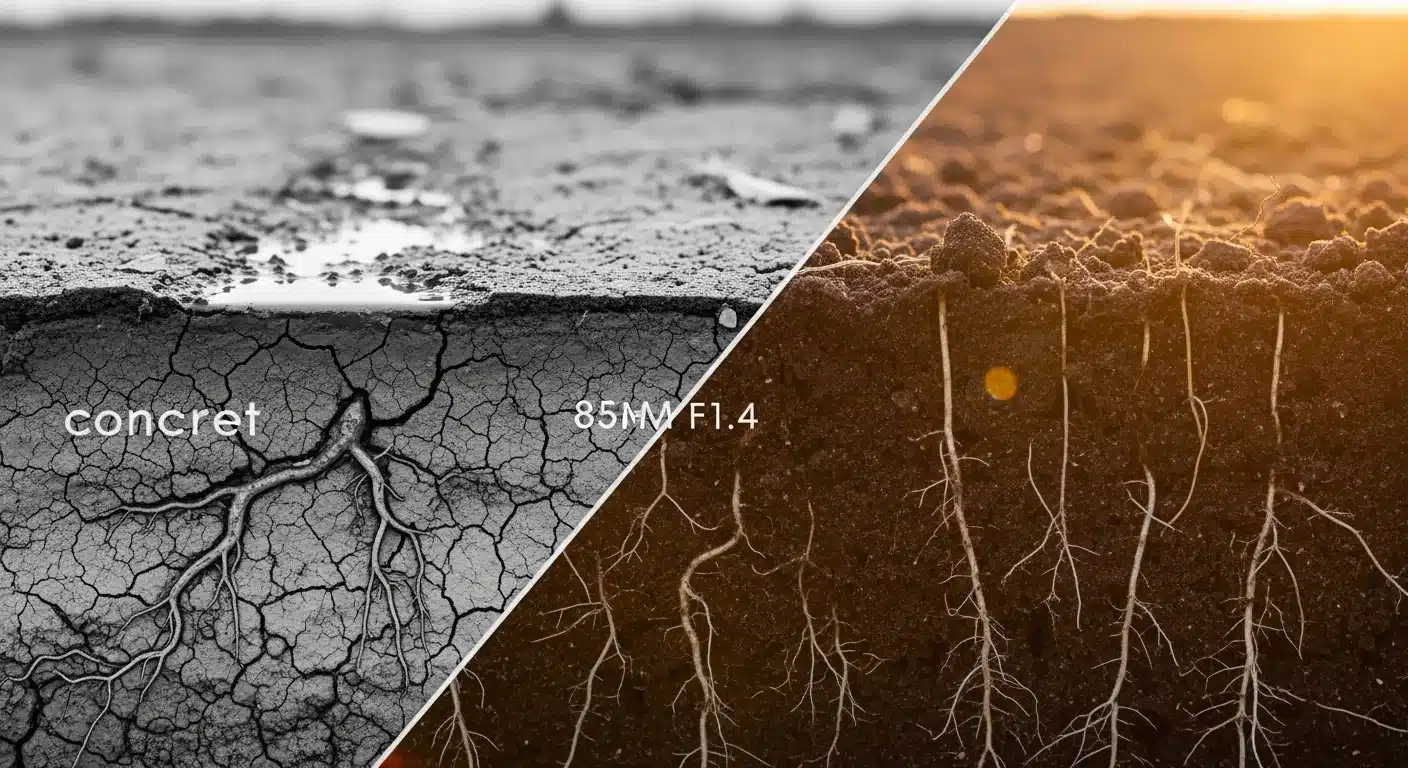
- The Ca:Mg ratio below 4:1 is a structural emergency, not a mild deficiency. Magnesium ions draw aluminosilicate clay platelets together through electrostatic attraction, and when Mg occupies too large a fraction of CEC, those platelets physically pack against each other. The result is reduced macro-porosity, poor water infiltration, and roots that cannot penetrate the sealed zone regardless of how nutritionally complete the soil analysis appears.
- Potassium below 3% of CEC is a lockout event, not a deficiency level to manage slowly. Below this threshold, the root-zone concentration gradient required for K uptake through cation exchange cannot be maintained. Applying more potassium fertilizer to a soil in K lockout adds to the total K pool but does not correct the exchange-site deficit that prevents uptake.
- Excess magnesium above 15% persists for multiple growing seasons after amendment. Gypsum displaces Mg from exchange sites slowly through leaching. A single gypsum application that is correct in tonnage may still require two to three seasons to fully express in the Ca:Mg ratio depending on rainfall and soil depth. Testing annually after application is essential. For sites where soil sulfur accumulation is a concern, cross-referencing with a fertilizer salt index calculation helps confirm that repeated gypsum applications are not introducing secondary salinity stress.
- A Ca% within the 68-75% target range does not confirm the Ca:Mg ratio is safe. Ca at 70% and Mg at 20% produces a 3.5:1 ratio, which falls below the tight-soil threshold despite Ca being within range. Always evaluate both the individual percentages and the ratio output before concluding the profile is balanced.
Minimum Standards
- Ca:Mg ratio must be at or above 4:1 for soil to maintain open physical structure. The Albrecht ideal is approximately 5:1.
- Mg% must remain below 15% to prevent structural sealing regardless of the absolute Ca level.
- K% must be at or above 3% for potassium exchange uptake to function. This is a hard floor, not a guideline range.
- CEC should be measured at consistent pH (typically buffered at pH 7) to allow comparison across test dates. Labs using different pH buffers may report CEC values that are not directly comparable year over year.
Competitor Trap: Most online base saturation calculators check whether each cation falls within a target percentage range and report a pass or fail for each individually. They do not compute the Ca:Mg ratio as a separate diagnostic. This matters because a soil can pass all three individual percentage checks simultaneously and still carry a 3.8:1 Ca:Mg ratio, which is below the structural threshold. A farmer using a pass/fail checklist tool would see three green lights on the report while their field is actively sealing. The ratio test is not a refinement of the percentage test; it is a different test that catches failures the percentage check cannot detect.
Common Mistakes and Fixes
Mistake: Entering ppm values from the soil report instead of base saturation percentages
Many laboratory reports list calcium and magnesium in pounds per acre or parts per million alongside base saturation percentages, and the two sets of numbers are printed in adjacent columns. Using ppm values in the percentage fields will produce ratios that appear valid numerically but have no relationship to the actual base saturation balance. The Ca% field in this calculator must contain the base saturation percentage, typically a two-digit number labeled “BS%” or “% Sat.” on the report.
Fix: Locate the column on your report labeled “Base Saturation %” or “% of CEC” and use those values exclusively.
Mistake: Choosing agricultural lime to correct Ca deficiency when Mg is already elevated
Calcitic lime raises Ca but it also raises soil pH, which can trigger additional release of magnesium from clay mineral lattices into the exchange pool. On soils already carrying Mg above 15%, a lime application can temporarily worsen the Ca:Mg ratio during the first season after application. This is counterproductive when structural sealing is the problem being solved. Using a agricultural lime calculator to model pH-driven Mg release before selecting lime over gypsum prevents this common overcorrection.
Fix: On tight soils with high Mg, use pelletized gypsum as the Ca source; it raises Ca without pH effects and does not stimulate additional Mg release.
Mistake: Applying potassium fertilizer to correct K% without first checking CEC
The percentage of CEC occupied by potassium depends on how much K is present relative to the total holding capacity. A soil with a low CEC, say 6 meq/100g, requires far less elemental K to reach 3% base saturation than a soil with CEC of 25 meq/100g. Farmers who apply K at a fixed lb/acre rate regardless of CEC will chronically under-apply on high-CEC soils and over-apply on low-CEC soils. Understanding this relationship also connects to how sulfur interacts with cation availability; the soil pH sulfur calculator can help model how sulfur applications affect the broader cation environment.
Fix: Use the CEC-adjusted K deficit formula to determine the pounds of elemental K needed to move K% from its current level to 3%, then back-calculate from the chosen fertilizer’s K content.
Mistake: Treating a single soil test as a permanent baseline
Base saturation percentages shift with every amendment application, crop removal, and rainfall event. A Ca:Mg ratio measured in the spring before gypsum application will be materially different from the ratio measured the following spring after leaching has displaced Mg from exchange sites. Farmers who test once every three to five years may be making amendment decisions based on a profile that no longer represents current field conditions.
Fix: Test annually on fields receiving active cation balance correction; reduce testing frequency only after achieving stable optimal ratios across two consecutive seasons.
Mistake: Assuming that a tight-soil warning can be resolved with surface
amendment alone
Pelletized gypsum applied to the surface must dissolve, move downward with water, and displace Mg from exchange sites at depth. On severely compacted soils where the physical sealing is already well established below the plow layer, gypsum movement through the soil profile is itself restricted by the poor porosity being corrected. Amendment alone applied to the surface may take multiple seasons to reach the problematic zone.
Fix: Pair gypsum application with a mechanical deep-ripping pass to fracture the sealed layer first, creating pathways for the gypsum solution to reach the exchange sites that need correction.
Next Steps in Your Workflow

Once the calculator confirms your Ca:Mg ratio and amendment requirements, the immediate decision is whether structural correction or nutrient balance is the binding constraint. If the tight-soil warning fired, structural correction comes first; no amount of fertilizer additions will perform well through a sealed profile. Order gypsum based on the calculator’s tonnage estimate, schedule a deep-ripping pass if the sealing is well established, and plan a follow-up soil test for the same calendar date the following year to measure displacement progress. After structural issues are addressed, reviewing your broader fertility inputs through an NPK calculator helps quantify what macronutrient applications are appropriate on a now-accessible soil.
For fields where Ca:Mg is already in range and only potassium or another secondary nutrient showed up as deficient, the workflow is more straightforward: correct the specific base saturation gap, re-test the season following application, and then move on to building the complete fertility program. Because nitrogen management interacts with overall root health and nutrient uptake efficiency, running the numbers through a nitrogen rate calculator after cation balance is restored often reveals that N applications were previously higher than necessary to compensate for restricted roots in a tight soil.
FAQ
What is base saturation and why does it matter for soil health?
Base saturation describes the percentage of a soil’s cation exchange capacity occupied by positively charged nutrient ions: primarily calcium, magnesium, potassium, and sodium. The remaining capacity holds hydrogen and aluminum. High base saturation means more exchange sites carry plant-available nutrients. The ratio between cations, particularly Ca and Mg, determines whether soil structure remains physically open or collapses into a compacted, water-repelling state.
What is the Albrecht method of cation balancing?
William Albrecht, former chairman of the soils department at the University of Missouri, developed a framework proposing that soil fertility is not just a question of elemental sufficiency but of proportional balance among cations. His research identified the Ca:Mg ratio as a primary driver of soil physical structure. A ratio below 4:1 indicates magnesium dominance, which physically draws clay platelets together, sealing the soil. His recommended Ca range of 68 to 75 percent of CEC reflects the balance point where calcium keeps soil particles separated without suppressing other cations.
Can the Ca:Mg ratio be too high?
Yes. A Ca:Mg ratio above 7:1 indicates that magnesium is underrepresented on exchange sites relative to calcium. While this does not produce the concrete-sealing effect of a low ratio, it does reduce the availability of magnesium to plants through competitive exclusion. Very sandy soils with low CEC are particularly susceptible to this condition because their inherently low nutrient-holding capacity amplifies any cation imbalance. This calculator flags ratios above 7:1 with a separate warning distinct from the tight-soil alert.
Why is gypsum recommended over lime when Ca is deficient on tight
soils?
Calcitic and dolomitic limes raise Ca and Mg levels while simultaneously increasing soil pH. On soils where Mg already exceeds 15% of CEC, the pH increase triggered by lime can stimulate further release of Mg from clay mineral structures into the exchange pool, potentially worsening the Ca:Mg ratio during the first season. Gypsum supplies calcium as a neutral salt without pH effects, specifically addressing the Ca deficit without disturbing the Mg equilibrium that is already problematic.
How often should a base saturation test be run?
On fields under active cation balance correction with gypsum or K-Mag, annual testing is necessary to track Ca:Mg ratio progress across seasons. Gypsum-driven Mg displacement is a gradual process that depends on rainfall, CEC, and soil depth. Fields that have achieved stable ratios within the Albrecht optimal range for two or more consecutive seasons can generally shift to testing every two to three years, provided no major amendments or land-use changes occur between tests.
What does potassium lockout mean practically for a growing crop?
When potassium occupies less than 3% of CEC, the concentration gradient at root exchange sites is insufficient for uptake to proceed at agronomically meaningful rates. A crop growing on a K-locked soil may show classic K deficiency symptoms on older leaves: marginal leaf scorch, poor stalk quality, and reduced stress tolerance, even if a soil test shows elevated total K in pounds per acre. The total K number reflects K held in non-exchangeable forms; the base saturation percentage reflects the K actually available at the plant-root interface.
Conclusion
The single most consequential mistake this tool is designed to catch is the assumption that individual cation pass/fail checks equal a structurally sound soil. Run the ratio. If it is below 4:1, address the physical structure before building the fertility program on top of it. For soils where pH management overlaps with cation balance work, the soil pH lime calculator helps model how liming choices interact with Ca and Mg base saturation before commitments are made at the spreader.