
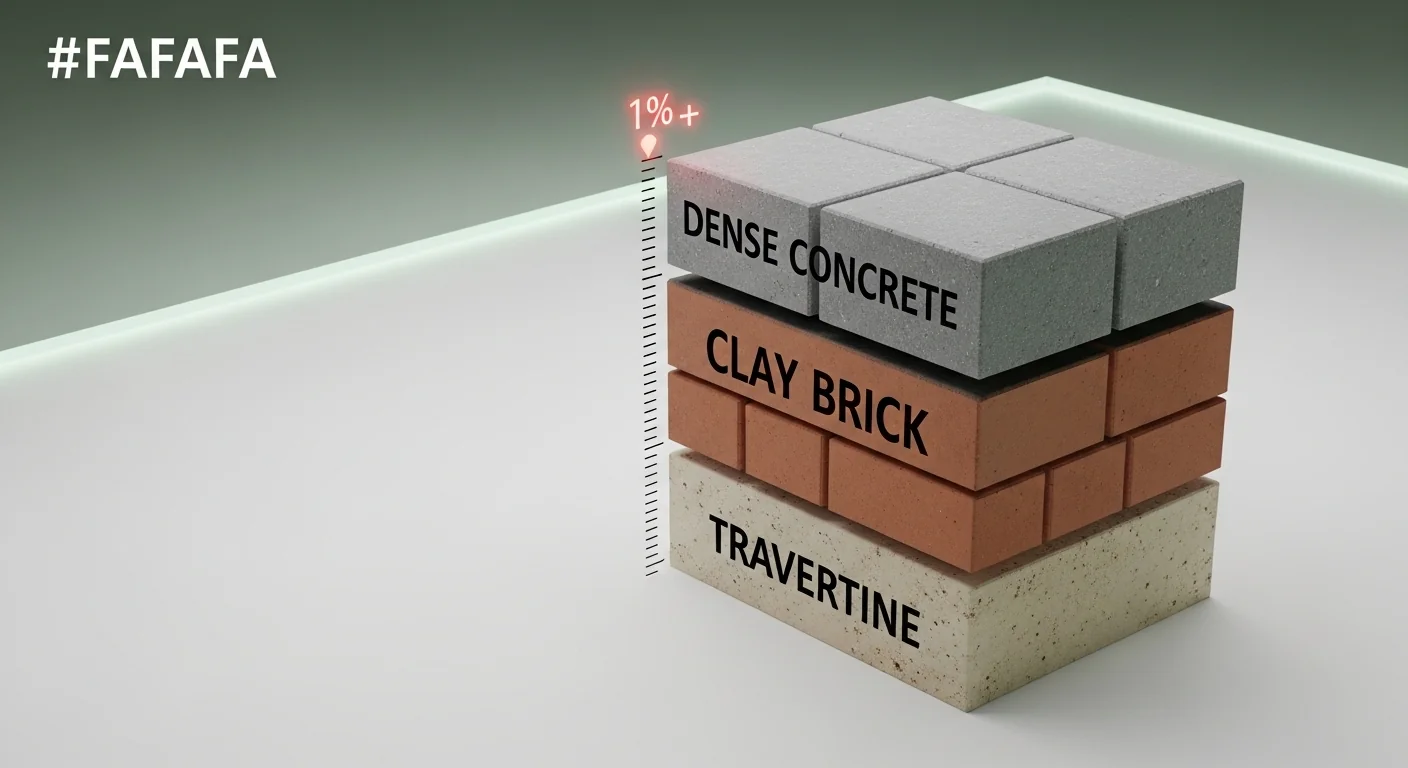
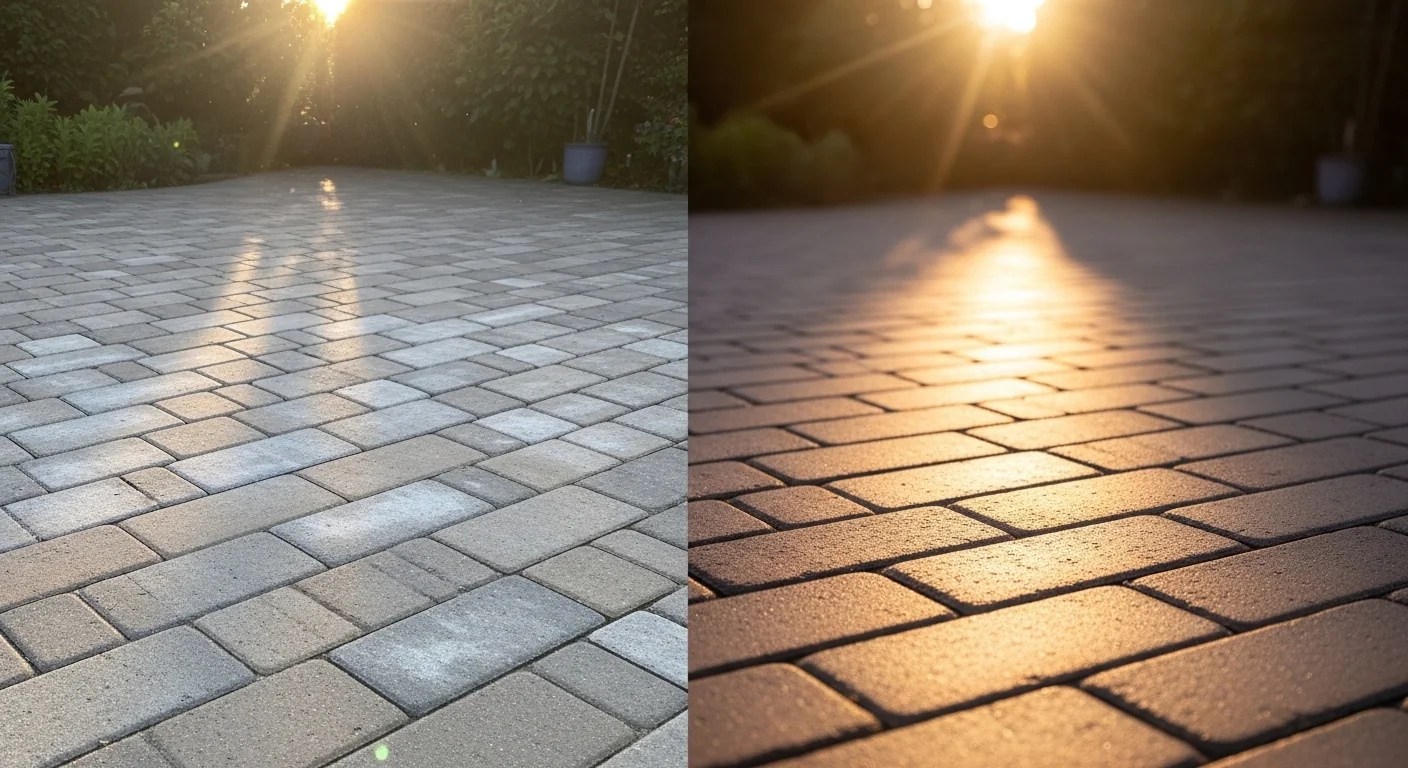
The standard advice for sealing pavers is deceptively simple: check the label, spread at the listed rate, apply two coats. That guidance collapses the moment you factor in material porosity, joint width, and the single condition that sends solvent-based acrylic sealers milky white overnight. A dense concrete paver and a travertine tile can differ by 70 percent in sealer absorption at the same surface area. Using a flat gallon estimate across both materials is how projects get half-finished at the hardware store and how coatings blister within the first summer.
This paver sealer calculator computes gallons based on surface area, material porosity, joint width, sealer chemistry, and coat count. It outputs a coverage estimate adjusted for real-world absorption variables, flags a moisture threshold warning specific to solvent-based acrylics, and estimates the extra volume your joint sand will pull from each coat. What it does not do: it cannot account for damaged or previously sealed surfaces that have altered porosity, and it does not replace the manufacturer coverage chart on the product label.
After running the calculator, you will know whether your moisture reading clears the threshold for solvent-based sealer, how many gallons to purchase including coat count and joint absorption, and whether water-based acrylic is a safer choice for your specific material.
Use the Tool
Paver Sealer Coverage & Penetration Rate Calculator
Calculate exactly how many gallons you need — with moisture warnings, joint-sand absorption estimates, and coating recommendations.
| Area (sq ft) | Dense Concrete | Std Concrete | Brick/Clay | Travertine |
|---|
How This Calculator Works
Formula steps (matching the JS exactly):
- Base coverage rate — Water-based acrylic:
150 sq ft / gal. Solvent-based acrylic:100 sq ft / gal. Solvent-based penetrates faster but has a lower spread rate because it soaks in deeper on porous surfaces. - Porosity penalty multiplier — Dense concrete =
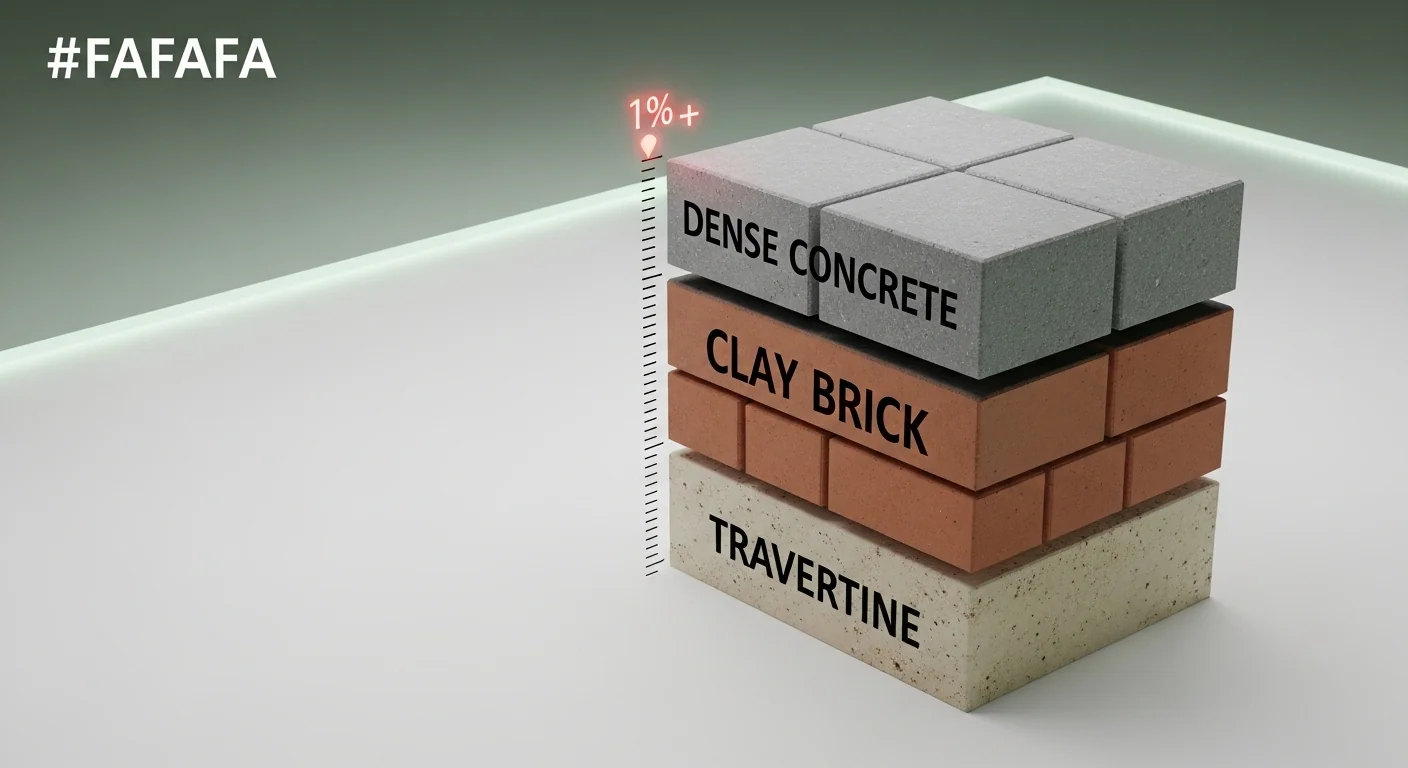
1.0×(baseline). Standard concrete =1.15×. Brick/clay =1.35×. Travertine =1.70×. More porous materials absorb more sealer per gallon, so you need more. - Adjusted coverage —
Adjusted Coverage = Base Rate ÷ Porosity Factor(sq ft / gal). - Gallons per coat —
Gallons per coat = Area ÷ Adjusted Coverage. - Joint absorption penalty — Wider joints hold more sand, which sucks up additional sealer. Estimated as
Area × 0.0004 × Joint Width (in)extra gallons per coat. This is a conservative estimate for standard 1-inch-deep joints. - Total gallons —
Total = (Gallons per coat + Joint Penalty) × Coats. - Moisture blushing threshold — If paver moisture retention > 1% AND sealer is solvent-based, a critical “Milky Blushing” warning triggers. Solvent-based sealers form an impermeable film that traps rising moisture, causing a white, cloudy appearance. Always wait 72 h minimum after any washing or rain.
Assumptions & Limits:
- Coverage rates assume single-pass roller or pump sprayer application on a clean, dry surface.
- Joint depth is assumed to be 1 inch standard. Deeper joints on thick pavers will increase absorption beyond the estimate.
- Porosity factors are industry averages; actual absorption varies by brand, age, and previous sealant history.
- Results do not include overage for waste. Always purchase 10–15% extra.
- This calculator does not replace a manufacturer’s coverage chart — always check the product label.
- Maximum surface area supported: 100,000 sq ft (commercial projects).
The “Milky Blushing” Moisture Trap — What It Is & How to Avoid It
What happens: You pressure-wash your patio, wait 4 hours until the surface looks dry, then roll on solvent-based acrylic sealer. The next morning the entire patio turns white and cloudy.
The chemistry: Concrete and pavers are porous sponges. Even when the surface looks dry, the interior can hold 2–8% moisture for 24–72 hours. Solvent-based sealers cure into a rigid, impermeable plastic film. When the sun heats the pavers, the trapped moisture converts to vapor and rises — but it cannot escape through the film. It condenses in micro-pockets under the coating, scattering light and turning the sealer opaque white (called “blushing”).
The fix: Strip the blushed sealer with an efflorescence cleaner or solvent-based stripper, allow the surface to dry for 72 hours minimum (or until a moisture meter reads below 1%), then re-seal on a warm day above 50°F.
Prevention:
- Always use a pin-type moisture meter before applying solvent-based sealer.
- Wait 72 h minimum after pressure washing or rain — not just until “it looks dry.”
- On travertine or highly porous stone, consider water-based sealer, which is breathable and far more forgiving of residual moisture.
- Apply in temperatures between 50°F and 90°F, with low humidity.
[PUT TOOL WIDGET HERE]
Before entering your numbers, have the following ready: the measured square footage of your paver surface (length x width for rectangular areas, or section-by-section for irregular layouts), the paver species or product name so you can identify the porosity category, a joint width measurement in inches using a standard tape measure or feeler gauge, and a moisture meter reading if you are applying solvent-based sealer within 72 hours of rainfall or pressure washing.
If you have not yet planned the paver base layer beneath your installation, the paver base calculator covers gravel depth and compaction volume before the surface work begins.
Quick Start (60 Seconds)
- Surface Area (sq ft): Multiply length by width for each rectangular zone and sum the totals. Do not subtract the joint area; the tool accounts for joint absorption separately. Maximum supported: 100,000 sq ft.
- Paver Porosity / Material: Select the closest match. When in doubt between two categories, choose the more porous option; under-buying sealer mid-job is more disruptive than having a small surplus.
- Joint Width (inches): Measure the widest gap between pavers, not the average. Wider joints hold more polymeric or stabilizing sand that pulls sealer from the coat. Entry range: 0.1 to 3 inches.
- Sealer Type: If your surface was pressure-washed or rained on within 72 hours, select water-based acrylic regardless of the finish preference. Solvent-based requires confirmed dry conditions.
- Moisture Retention (optional but critical): Enter the reading from a pin-type moisture meter. The field accepts 0 to 20. At 0, no blushing warning triggers. Above 1, a critical alert appears for solvent-based sealer.
- Number of Coats: New installations typically require two coats. Re-sealing over a sound existing coat often requires one. Three coats is appropriate for highly porous travertine or heavy foot traffic zones.
- Run the calculator: All required fields must be filled before the result appears. Errors display inline next to the field that needs correction.
Inputs and Outputs (What Each Field Means)
| Field | Unit | What It Means | Common Mistake | Safe Entry Guidance |
|---|---|---|---|---|
| Paver Surface Area | sq ft | Total paved area to receive sealer, excluding structures, planters, and drains | Including vertical risers or step faces in the flat area count | Measure each zone separately; add sections; enter whole number |
| Paver Porosity / Material | Category | Material porosity class that sets the absorption multiplier | Selecting “dense concrete” for a porous tumbled concrete unit | When uncertain, choose one step more porous than you think |
| Joint Width | inches | Gap width between pavers that holds stabilizing sand; wider joints absorb more sealer | Entering the paver thickness instead of the gap width | Use feeler gauge or folded tape; typical range 0.1 to 1 inch |
| Sealer Type | Category | Sealer chemistry that sets the base spread rate and blushing risk profile | Choosing solvent-based for its wet-look finish without confirming dry conditions | Confirm moisture reading below 1 percent before selecting solvent-based |
| Moisture Retention | percent | Residual moisture in the paver body that triggers the blushing safety check | Skipping this field because the surface “looks dry” | Use pin-type meter; read at 3 locations; enter the highest reading |
| Number of Coats | Count | Application passes that multiply the per-coat volume | Applying a heavy single coat to save time; excess sealer peels instead of bonding | Two thin coats outperform one thick coat on every material category |
| OUTPUT: Total Gallons | gallons | Total sealer volume needed including joint absorption penalty across all coats | Buying exactly this number without a buffer; add 10 to 15 percent for waste | Round up to the nearest commercial container size |
| OUTPUT: Coverage Rate | sq ft/gal | Adjusted spread rate after the porosity multiplier is applied | Using the label spread rate without adjusting for porous materials | Use this figure to cross-check the product label; large discrepancies suggest a wrong material category |
| OUTPUT: Joint Absorption Penalty | gallons | Estimated extra volume pulled into stabilizing joint sand across all coats | Treating wide joints identically to tight joints in the gallon estimate | Wide joints on travertine (0.5 in or more) can add a meaningful volume at large surface areas |
Worked Examples (Real Numbers)
Example 1: Small Backyard Concrete Patio (300 sq ft)
- Surface area: 300 sq ft
- Material: Dense concrete (porosity factor 1.0)
- Joint width: 0.25 in
- Sealer type: Water-based acrylic (base rate 150 sq ft/gal)
- Coats: 2
- Moisture reading: 0.4 percent (no warning triggered)
Result: 4.1 gallons total
Adjusted coverage is 150 sq ft/gal. Per-coat need is 2.0 gal. Joint absorption adds 0.03 gal per coat. Two coats: (2.0 + 0.03) x 2 = 4.06 gal, rounded to 4.1. Purchasing two 1-gallon cans plus one 2.5-gallon container covers the job with a small buffer for touch-ups.
Example 2: Travertine Pool Deck (800 sq ft)
- Surface area: 800 sq ft
- Material: Travertine / natural stone (porosity factor 1.70)
- Joint width: 0.5 in
- Sealer type: Water-based acrylic (recommended for travertine; base rate 150 sq ft/gal)
- Coats: 2
Result: 18.5 gallons total
Adjusted coverage drops to 88.2 sq ft/gal after the travertine multiplier. Per-coat need is 9.07 gal. Joint absorption at 0.5-inch width adds 0.16 gal per coat. Total: (9.07 + 0.16) x 2 = 18.46 gal. Two 5-gallon pails and two 1-gallon cans give 12 gal; a third 5-gallon pail brings the total to a practical purchase of 20 gal, leaving a small reserve.
Example 3: Brick Driveway With Solvent-Based Wet-Look Finish (1,200
sq ft)
- Surface area: 1,200 sq ft
- Material: Brick / clay (porosity factor 1.35)
- Joint width: 0.375 in (3/8 in)
- Sealer type: Solvent-based acrylic (base rate 100 sq ft/gal)
- Coats: 2
- Moisture reading: 0.7 percent (below 1 percent threshold; no blushing warning)
Result: 32.8 gallons total
Adjusted coverage for brick with solvent base: 100 / 1.35 = 74.1 sq ft/gal. Per-coat gallons: 1200 / 74.1 = 16.2 gal. Joint absorption: 1200 x 0.0004 x 0.375 = 0.18 gal per coat. Total: (16.2 + 0.18) x 2 = 32.76 gal. Practical purchase is four 5-gallon pails (20 gal) plus two 5-gallon pails (10 gal) plus three 1-gallon cans = 33 gal. Note: if the moisture reading had exceeded 1 percent, switching to water-based would be required.
Reference Table (Fast Lookup)
All values below assume 2 coats and 0.25-inch joint width. WB = water-based acrylic (base 150 sq ft/gal). SB = solvent-based acrylic (base 100 sq ft/gal). Values are total gallons including joint absorption, rounded to one decimal place.
| Area (sq ft) | Dense Concrete WB | Std Concrete WB | Brick / Clay WB | Travertine WB | Dense Concrete SB | Travertine SB |
|---|---|---|---|---|---|---|
| 100 | 1.4 | 1.6 | 1.8 | 2.3 | 2.0 | 3.4 |
| 250 | 3.4 | 3.9 | 4.6 | 5.7 | 5.1 | 8.6 |
| 500 | 6.8 | 7.8 | 9.1 | 11.4 | 10.1 | 17.1 |
| 750 | 10.2 | 11.6 | 13.7 | 17.2 | 15.2 | 25.7 |
| 1,000 | 13.5 | 15.5 | 18.2 | 22.9 | 20.2 | 34.2 |
| 1,500 | 20.3 | 23.3 | 27.3 | 34.3 | 30.3 | 51.3 |
| 2,000 | 27.1 | 31.1 | 36.4 | 45.7 | 40.4 | 68.4 |
| 3,000 | 40.6 | 46.6 | 54.6 | 68.6 | 60.6 | 102.6 |
Note: Travertine with solvent-based sealer should only be used when moisture readings are confirmed below 1 percent and an inconspicuous test section has cured without blushing.
How the Calculation Works (Formula + Assumptions)
Show the calculation steps
- Base coverage rate by sealer type: Water-based acrylic starts at 150 sq ft per gallon. Solvent-based acrylic starts at 100 sq ft per gallon. The solvent formula delivers a more saturating penetration, which is why the base rate is lower despite the wet-look premium.
- Porosity multiplier lookup: Dense concrete = 1.00 (baseline). Standard concrete = 1.15. Brick/clay = 1.35. Travertine/natural stone = 1.70. These multipliers are applied as divisors against the base rate.
- Adjusted coverage rate: Adjusted Coverage = Base Rate / Porosity Factor. For travertine with water-based sealer: 150 / 1.70 = 88.2 sq ft per gallon. This is the operative spread rate for purchasing.
- Gallons per coat: Gallons per coat = Area / Adjusted Coverage. For 800 sq ft of travertine: 800 / 88.2 = 9.07 gallons per coat.
- Joint absorption penalty per coat: Joint Penalty = Area x 0.0004 x Joint Width (in). This models sealer volume absorbed by the sand-filled joint channel. At 0.5-inch joints over 800 sq ft: 800 x 0.0004 x 0.5 = 0.16 gallons per coat.
- Total gallons: Total = (Gallons per coat + Joint Penalty) x Coats. Quantities are computed in decimal gallons; the output rounds to one decimal place. Always purchase the next commercial container size up.
- Moisture blushing trigger: If the sealer type is solvent-based AND the moisture retention input exceeds 1 percent, the tool triggers a critical red warning. The threshold of 1 percent is the operative safety boundary below which solvent-based acrylic film formation proceeds without blushing risk under standard conditions.
Assumptions and Limits
- Coverage rates assume single-pass roller or pump sprayer application on a clean, dry, unsealed surface. Previously sealed surfaces with intact existing coats will absorb less and may require fewer gallons.
- Joint depth is modeled at a standard 1 inch. Pavers thicker than 2.375 inches, or joints that have been deeply swept with extra sand, will have deeper effective channels and absorb more than the penalty estimate.
- Porosity factors represent industry averages for product categories, not individual product formulations. Aged, weathered, or acid-washed pavers may fall into a higher porosity category than their original classification suggests.
- The formula does not include overage for waste, spillage, or application error. A 10 to 15 percent buffer above the calculated total is standard practice.
- Results assume ambient temperature between 50 degrees F and 90 degrees F. Applications outside this range alter open time, penetration depth, and film formation.
- The moisture threshold trigger fires at any reading above 1 percent for solvent-based sealer only. Water-based acrylic is coded as low-risk for moisture because the water-miscible formula does not trap rising vapor behind an impermeable film.
- This tool does not model multiple material zones on the same surface. If your patio includes both concrete pavers and travertine accents, calculate each zone separately and sum the totals.
Standards, Safety Checks, and “Secret Sauce” Warnings
Critical Warnings
- The 1 Percent Moisture Rule: Solvent-based acrylic sealer requires confirmed moisture retention below 1 percent at the time of application. Concrete and pavers are porous internally, and surface appearance is not a reliable moisture indicator. A surface that looks dry four hours after pressure washing can still carry significant interior moisture. When that moisture converts to vapor in the sun, it rises through the still-curing film and produces the white, cloudy “blushing” failure. The only reliable check is a calibrated pin-type or probe moisture meter.
- Over-Application and Peeling: Applying too heavy a single coat or skipping the dry-time window between coats traps solvent in the lower film layer. The solvent eventually off-gasses by pushing upward through the wet top layer, producing bubbles, peels, and delamination. The correct approach is two thin, even coats with full solvent flash-off between applications, typically 1 to 4 hours depending on temperature.
- Efflorescence Under the Sealer: Sealing over active efflorescence (the white mineral salt deposits that migrate outward through concrete) locks the salts against the face of the paver. The film then debonds from below as salt pressure builds. Efflorescence must be treated with an appropriate chemical cleaner and fully rinsed before any sealer is applied.
- Joint Sand Condition: Sealer applied over dry, unconsolidated joint sand will wick deeply into the sand mass, consuming significantly more product than the calculator’s penalty estimate accounts for. If joint sand is loose and depleted, re-topping with polymeric sand and allowing it to cure before sealing is the correct sequence.
Minimum Standards
- Surface must be free of standing water, visible moisture, oils, tire marks, algae, moss, and efflorescence before sealer contact.
- Ambient temperature must be confirmed between 50 degrees F and 90 degrees F for the entire cure window, not just at application time.
- Joint sand must be at or above the manufacturer-specified fill level and must not be dusty or loose at the surface.
- Adequate patio slope toward a drainage outlet is required to prevent standing water from compromising the cured film long-term. If slope is in question, the patio slope calculator can help verify minimum grade before you seal in a drainage problem.
Competitor Trap: Most gallon-estimate guides for paver sealer spread rate per gallon use the manufacturer label rate as-is and stop there. They do not adjust for material porosity, do not model joint absorption, and do not flag moisture conditions at all. A guide that tells a travertine pool deck owner to budget 6 gallons for 800 square feet based on a 150 sq ft/gal label rate is off by roughly two thirds of the actual requirement after porosity adjustment. The gap between a generic flat-rate estimate and a material-specific calculation is where projects run out of sealer on a Saturday afternoon with no matching product available locally.
Common Mistakes and Fixes
Mistake: Treating “It Looks Dry” as a Moisture Clearance
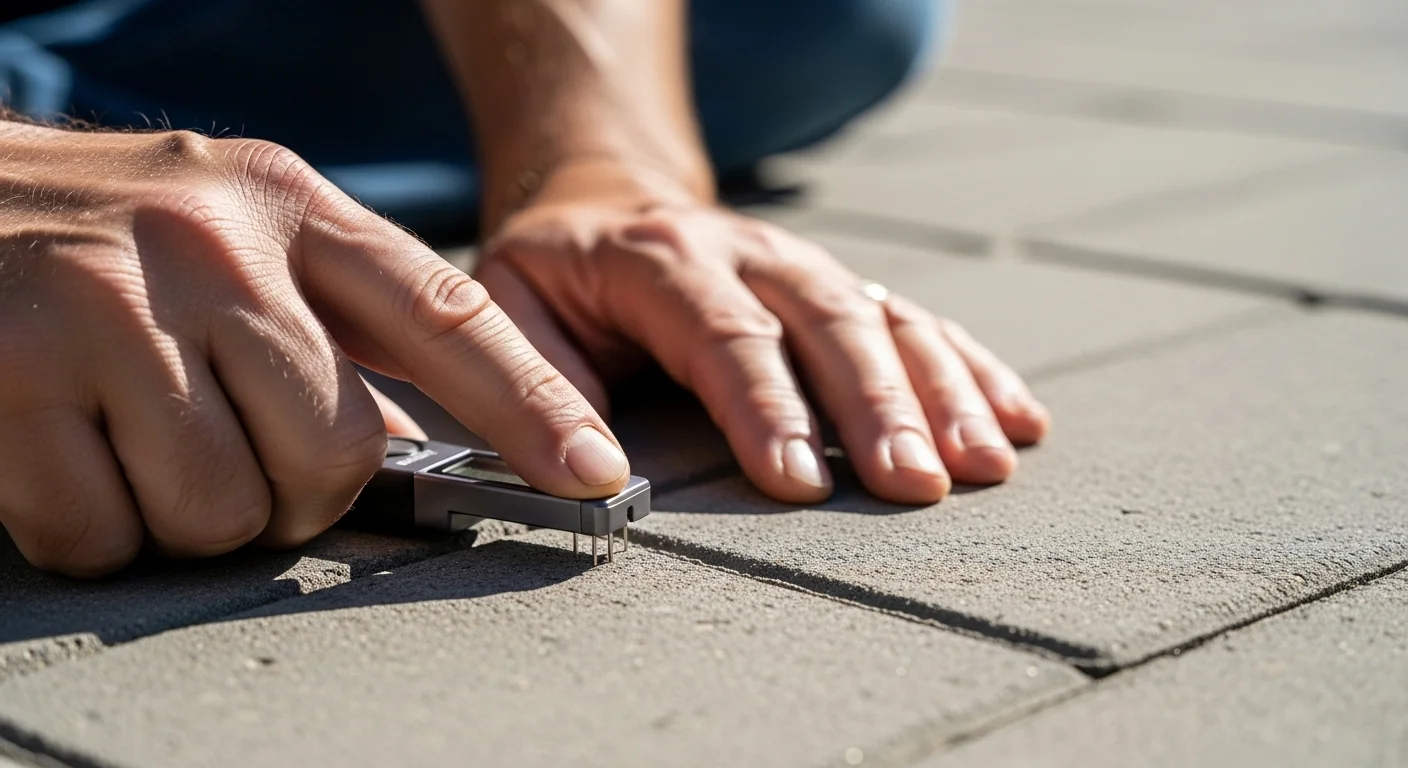
Visual dryness of the paver surface is not a meaningful moisture indicator. The interior pore network can hold residual moisture well beyond when the surface color returns to normal. This is the primary cause of blushing failures on surfaces sealed the same day as pressure washing. Use a calibrated pin-type moisture meter and take readings at three or more locations before committing to solvent-based acrylic.
Fix: Wait a minimum of 72 hours after any water exposure and confirm moisture below 1 percent with a meter before applying solvent-based sealer.
Mistake: Using the Label Spread Rate on Porous Materials
Product label coverage rates are typically calculated on a reference substrate, often smooth concrete or a controlled test surface. Travertine, aged brick, and highly porous concrete pavers absorb significantly more sealer per square foot. Applying the label rate as a purchase quantity will leave porous surfaces with a starved, uneven film.
Fix: Use the material-adjusted coverage rate from the calculator. For travertine specifically, expect the effective spread rate to be substantially lower than label guidance.
Mistake: Ignoring Joint Width When Estimating Gallons
Joint sand is an active sealer absorber. Wide joints on large surface areas pull a measurable volume of sealer away from the face coat during the first pass. Projects with joints at 0.5 inches or wider over 1,000 sq ft or more can absorb a full additional gallon or more across two coats.
Fix: Measure joint width with a feeler gauge and enter the correct value in the calculator. Do not leave the field at its minimum if your joints are substantially wider.
Mistake: Applying a Single Heavy Coat Instead of Two Thin Ones
Doubling the application volume in a single pass does not double protection. Excess sealer pools in surface texture, remains uncured beneath the top skin, and eventually lifts as trapped solvent off-gasses. The result is bubbling and delamination within one to two seasons. Two thin coats give the lower coat time to penetrate and begin curing before the second is applied.
Fix: Follow the two-coat sequence. Allow a complete flash-off window between coats, typically confirmed by the sealer surface losing its wet sheen and appearing uniformly matte or slightly glossy but not tacky.
Mistake: Sealing Over Active Efflorescence or Dirty Joints
Sealing over surface contamination does not lock it in place permanently; it locks it in place temporarily before it breaks through and lifts the coating. Mineral salts, algae residue, and organic material all compromise adhesion at the interface. Sealer failure over efflorescence is particularly dramatic because the crystalline salt growth continues to expand after the film is in place. Surface preparation is not optional.
Fix: Apply an appropriate efflorescence chemical cleaner, rinse thoroughly, and confirm the surface is chemically neutral before sealing. If unsure about prep sequence and surface compatibility, consult the sealer manufacturer’s technical data sheet for the specific paver combination.
Related Tools and Next Steps
- Planning the structural base before the paver surface goes in: the paver base calculator determines gravel depth and compaction volume by load type.
- Sizing joint sand for a new installation or re-sanding project: the polymeric sand calculator computes bags needed by area and joint dimensions.
- Verifying your patio slope drains correctly before sealing locks in a drainage problem: the patio slope calculator checks minimum grade toward the drain outlet.
- Adding stepping stones through a planted area to connect paved zones: the stepping stone calculator spaces and quantities stone by stride length.
- Calculating gravel fill or base material for surrounding landscape beds and borders: the gravel calculator converts area and depth into tons and cubic yards.
- Designing a retaining structure adjacent to a raised patio: the retaining wall calculator estimates block count and batter angle by wall height.
- Finishing paved area edges with clean border definition: the landscape edging calculator sizes linear edging by perimeter shape.
- Sizing drainage capacity for a paved surface that feeds into a rain garden or infiltration zone: the drainage calculator provides runoff flow rate guidance by surface area and slope.
- Building steps from the patio level up to a structure or grade change: the outdoor stair riser calculator determines riser height, run depth, and total step count from the rise measurement.
FAQ
How many square feet does 1 gallon of paver sealer cover?
On dense concrete pavers with water-based acrylic, the adjusted coverage is approximately 150 sq ft per gallon before joint absorption. On travertine with water-based sealer, that drops to roughly 88 sq ft per gallon due to the higher porosity multiplier. Solvent-based formulas start at 100 sq ft per gallon on dense concrete and go lower on porous materials. There is no universal answer; material category controls the effective rate.
What causes paver sealer to turn white and milky?
The milky or cloudy appearance is called “blushing” and results from moisture trapped under an impermeable solvent-based acrylic film. When the sun heats the pavers, residual interior moisture converts to vapor and rises, but the cured film does not allow it to escape. The vapor condenses in micro-pockets beneath the coating and scatters light, producing the white appearance. The surface “looked dry” at application, but the interior pore network still held moisture above the safe threshold.
Can I use solvent-based sealer on travertine?
Technically yes, but the risk profile is high. Travertine has naturally high porosity, which means moisture absorption and retention are elevated compared to concrete. A confirmed moisture reading below 1 percent, an inconspicuous test section cured for 24 hours without blushing, and ambient conditions between 50 and 90 degrees F are all required before full application. Water-based acrylic is the lower-risk choice for travertine because its breathable chemistry does not trap rising vapor behind an impermeable film.
How long should I wait to seal pavers after pressure washing?
A minimum of 72 hours is the industry standard waiting period after pressure washing before applying solvent-based sealer, assuming dry ambient conditions. In cool, humid weather the wait should be extended further. The correct verification is not visual inspection; it is a pin-type moisture meter reading below 1 percent at multiple locations across the surface. A surface that appears dry in 4 hours can still read elevated moisture in the paver body.
How do I fix paver sealer that is peeling or delaminating?
Peeling typically results from over-application, moisture under the film, or sealing over contamination. The repair sequence is to strip the failed coating using a solvent-based sealer stripper or chemical remover rated for the existing product, allow the surface to fully dry and off-gas, address any efflorescence or joint issues, and re-seal in proper thin-coat sequence. Attempting to apply new sealer over a peeling existing coat always fails; the adhesion problem is at the interface, not at the surface.
Does joint width significantly change how much sealer I need?
At small surface areas and narrow joints, the difference is minor. At larger surface areas with joints at 0.5 inches or wider, the joint absorption penalty accumulates. Over 2,000 square feet with 0.5-inch joints and two coats, the joint absorption adds roughly 0.8 gallons. The effect is more significant when the joint sand is dry, loose, or newly applied and has not yet been consolidated, which can cause sealer to wick deep into the joint channel.
Conclusion
The single most preventable failure in residential paver sealing is applying solvent-based acrylic to pavers that look dry but have not cleared the 1 percent moisture threshold. A 15-dollar moisture meter prevents a several-hundred-dollar stripping and re-sealing job. For projects where standing water accumulation is a concern after sealing, reviewing the surface drainage setup with the patio slope calculator before committing to a finish coat is a reasonable precaution that competitors rarely mention.