
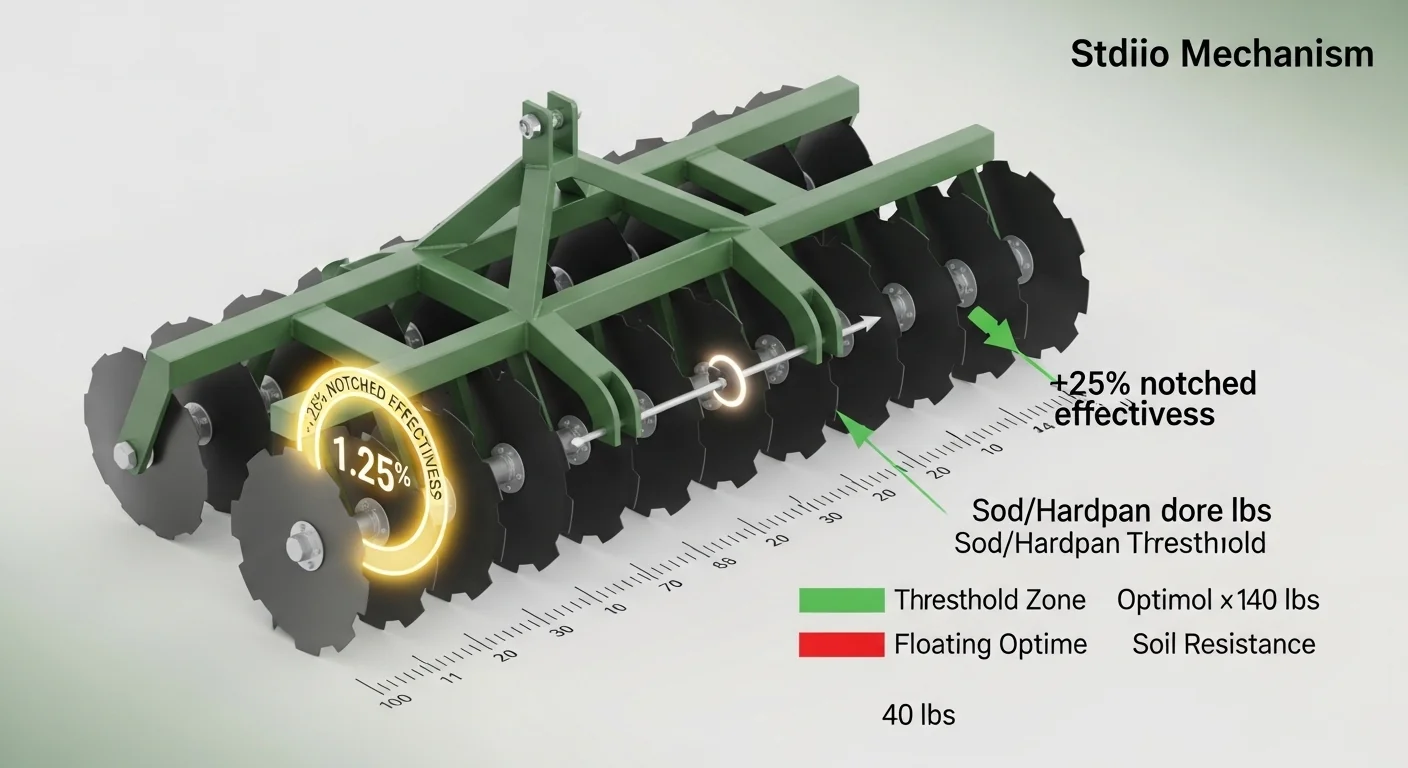
A disc harrow that bounces across the top of a field is not a tillage problem. It is a physics problem, and the specific number that governs it is weight per blade. Every pound your harrow puts on the ground gets divided among however many disc blades you are running. If that quotient falls below what your soil demands, the blades skim over the surface no matter how many passes you make, how fast you go, or what angle your gangs are set to. The weight-per-blade figure is the single most diagnostic measurement a farmer can pull from a disc harrow spec sheet, yet it is almost never printed on one.
This calculator takes your harrow’s total weight, blade count, blade diameter, blade type, and soil condition and returns the weight each blade is carrying as a downward cutting force. It applies a conservative notched-blade effectiveness factor and compares your result against published sod-and-hardpan penetration thresholds. What it does not do: it does not model blade angle, soil moisture variability, or tractor draft resistance. Those factors matter, but they cannot be calculated without field sensors. Weight per blade is what you can know before you unhook the PTO.
After running your numbers, you will know immediately whether your disc is mechanically capable of cutting sod and crop residue at its current weight, or whether you need to add ballast, reduce your blade count, or switch blade types before your next pass.
Use the Tool
Disc Harrow Weight-Per-Blade Calculator
Calculate cutting penetration force & expose the Floating Disc problem — by The Yield Grid
| Harrow Weight (lbs) | Blades | Lbs / Blade | Sod/Hardpan? |
|---|---|---|---|
| 600 | 20 | 30 | ✘ Floating |
| 800 | 20 | 40 | ✘ Barely |
| 1,200 | 20 | 60 | ✘ Marginal |
| 1,500 | 20 | 75 | ✘ Marginal |
| 2,000 | 20 | 100 | ✔ Minimum OK |
| 2,400 | 20 | 120 | ✔ Good |
| 3,000 | 24 | 125 | ✔ Excellent |
How this calculator works
Formula: Weight Per Blade
Weight Per Blade = Total Harrow Weight (lbs) ÷ Number of BladesThis represents the downward cutting force each blade exerts on the soil surface. More force = deeper penetration through sod and residue.
Notched blades cut crop residue approximately 20–30% more effectively than smooth blades at the same weight. The calculator applies a
×1.25 effective factor for notched blades when evaluating thresholds — the raw lbs/blade figure shown is always the true mechanical value.
Sod / Hardpan target: > 100 lbs per bladeTilled Loam target: 40–60 lbs per bladeBelow 40 lbs/blade on hardpan = Floating Disc condition (bouncing, zero penetration). The tool flags this as a critical failure and surfaces fix options.
Larger blades (20–36″) cut a wider path but require more force per blade to penetrate at the same depth. Smaller blades (12–16″) carry less individual weight but penetrate more easily in light soils. Diameter is used here as a contextual flag — actual force physics are governed primarily by lbs/blade.
Assumptions & Limits
- Weight is assumed to be distributed evenly across all blades — this holds for most tandem disc harrow designs.
- The 100 lbs/blade sod threshold is based on industry-standard penetration physics for grass root mats and hardpan soils. Extreme rocky hardpan may require 120–150+ lbs/blade.
- Blade wear is not modeled. A worn smooth blade may require 15–25% more weight to achieve the same cut as a new notched blade.
- Soil moisture content significantly affects required force. This tool assumes typical field conditions for each soil type — very wet soils reduce required force; very dry/sunbaked hardpan increases it.
- Tractor operating speed affects penetration. Slower speeds (2–3 mph) increase effective penetration; higher speeds can cause the disc to skip. This tool assumes typical discing speed of 4–6 mph.
- This calculator is for planning and diagnostic purposes. Always verify with field observation on the first pass.
Before you start, have your harrow's rated weight in pounds (from the manufacturer's spec sheet or a scale ticket), the blade count from your operator's manual, and the blade diameter stamped or listed on your replacement blade packaging. If you have recently added suitcase weights or a water-filled ballast box, include that added mass in the total weight figure. For tractor lift capacity context while you are thinking about hitch weights, the 3-point lift capacity calculator is a useful companion.
Quick Start (60 Seconds)
- Total Disc Harrow Weight (lbs): Use the manufacturer's published transport weight, not the implement weight shown on the ROPS certification sticker. Include any added suitcase weights or ballast boxes already mounted to the frame before you enter the number.
- Total Number of Disc Blades: Count every blade across both front and rear gangs. On a tandem disc harrow this is typically between 16 and 40. Do not count gang axle bolts or spacer discs as blades.
- Disc Blade Diameter (inches): Measure the full blade diameter edge-to-edge, or find it on the replacement blade packaging. Typical field cultivator discs run 18 to 24 inches. Enter a whole number or one decimal place.
- Blade Type: Notched blades have scalloped edges that tear through crop residue and sod root mats. Smooth blades are plain-edged and better suited to already-worked ground. If you are unsure, inspect the blade edge: notches are obvious and intentional, not signs of wear damage.
- Soil Condition: Sod and hardpan means established grass cover, compacted subsoil, or old pasture that has not been tilled in years. Tilled loam means the field has been worked within the past season and has loose, workable soil. When in doubt, choose the harder condition.
- Common entry mistake: Entering harrow width in feet instead of total weight in pounds. The weight field expects pounds only; a 10-foot disc harrow weighs roughly 800 to 2,500 lbs depending on manufacturer and frame gauge.
- Unit note: All weight inputs must be in pounds. If your spec sheet lists weight in kilograms, multiply by 2.205 before entering.
Inputs and Outputs (What Each Field Means)
| Field | Unit | What It Means | Common Mistake | Safe Entry Guidance |
|---|---|---|---|---|
| Total Disc Harrow Weight | lbs | The full weight of the implement pressing down through the disc blades onto the soil surface | Using rated capacity or field width instead of actual implement weight | Use scale ticket or manufacturer transport weight; include any ballast already mounted |
| Total Number of Disc Blades | Count (whole number) | The number of individual cutting blades across all gangs; total weight is divided evenly among this count | Counting only the front gang, or counting spacer plates as blades | Count all blades front and rear; check the operator's manual blade count specification |
| Disc Blade Diameter | inches | The full edge-to-edge diameter of each cutting disc; larger blades cut a wider path but require more downward force to penetrate at depth | Entering the gang width or harrow width instead of individual blade diameter | Find the diameter on replacement blade packaging or measure with a tape across the blade face |
| Blade Type | Notched / Smooth | Notched blades have scalloped cutting edges that increase sod and residue cutting ability; the calculator applies a 1.25x effective factor for notched blades when evaluating thresholds | Selecting smooth when blades have significant wear notches, which are not the same as manufactured notch profiles | If blades were purchased as "notched" or "scalloped" from a supplier, select Notched |
| Soil Condition | Hardpan or Loam | Determines which weight-per-blade threshold is applied: 100+ lbs for sod/hardpan, 40 to 60 lbs for tilled loam | Selecting Loam for a field that has not been tilled in several seasons | When field history is unknown, default to Sod/Hardpan for a conservative diagnostic |
| Weight Per Blade (output) | lbs per blade | The calculated downward force each cutting disc exerts; the primary diagnostic number | Treating this number as a minimum rather than the actual value; adding weight only to reach the threshold, not exceed it | For hardpan, aim at least 10 to 15 lbs above the 100-lb threshold to account for soil variability across the field |
Worked Examples (Real Numbers)
Scenario 1: The Hobby Farm Bounce
- Total harrow weight: 600 lbs
- Number of blades: 20
- Blade diameter: 18 inches
- Blade type: Smooth
- Soil condition: Sod / Hardpan (old pasture)
Result: 30 lbs per blade
At 30 lbs of downward force per blade, this disc harrow will skip across the sod surface. The root mat of established pasture grass requires a minimum of 100 lbs per blade to be physically cut. No amount of additional passes will compensate for this deficit. The implement is mechanically undersized for this soil condition.
Scenario 2: Mid-Size Operation on Stubble Ground
- Total harrow weight: 1,500 lbs
- Number of blades: 20
- Blade diameter: 20 inches
- Blade type: Notched
- Soil condition: Sod / Hardpan
Result: 75 lbs per blade (notched effective equivalent: 93.75 lbs)
Even with notched blades adding cutting effectiveness, this setup falls short of the 100 lbs per blade sod threshold. On light sod or end-of-season crop stubble it may perform adequately. On established pasture or compacted clay hardpan, expect incomplete penetration and significant residue left standing between passes.
Scenario 3: Properly Ballasted Tandem Disc
- Total harrow weight: 2,400 lbs (including 300 lbs of added suitcase weights)
- Number of blades: 24
- Blade diameter: 22 inches
- Blade type: Notched
- Soil condition: Sod / Hardpan
Result: 100 lbs per blade (notched effective equivalent: 125 lbs)
This configuration meets the minimum sod threshold exactly, and the notched blade effectiveness pushes the practical cutting force comfortably past it. This setup should reliably penetrate established sod and work down crop residue in a single pass at field speed. The added ballast weight was the critical variable that moved this harrow from marginal to functional.
Reference Table (Fast Lookup)
| Harrow Weight (lbs) | Blade Count | lbs / Blade (calculated) | Notched Effective (x1.25) | Cuts Sod/Hardpan? | Cuts Tilled Loam? |
|---|---|---|---|---|---|
| 600 | 20 | 30.0 | 37.5 | No (Floating) | Marginal |
| 800 | 20 | 40.0 | 50.0 | No (Floating) | Adequate |
| 1,000 | 20 | 50.0 | 62.5 | No (Below Threshold) | Ideal |
| 1,200 | 20 | 60.0 | 75.0 | No (Below Threshold) | Ideal |
| 1,500 | 20 | 75.0 | 93.8 | Marginal (Near Threshold) | Heavier than needed |
| 1,800 | 20 | 90.0 | 112.5 | Near Threshold (Smooth); OK (Notched) | Heavy |
| 2,000 | 20 | 100.0 | 125.0 | Minimum OK (Smooth); Good (Notched) | Heavy |
| 2,400 | 24 | 100.0 | 125.0 | Good | Heavy |
| 3,000 | 24 | 125.0 | 156.3 | Excellent | Very Heavy (check depth stops) |
| 3,600 | 30 | 120.0 | 150.0 | Excellent | Very Heavy (check depth stops) |
How the Calculation Works (Formula + Assumptions)
Show the calculation steps
Step 1: Base weight per blade
Weight Per Blade = Total Harrow Weight (lbs) divided by Number of Blades
This is the foundational calculation. It represents the downward mechanical force each blade applies to the soil. The formula assumes weight is distributed evenly across all blades, which holds for standard tandem disc harrow designs operating on level or near-level ground.
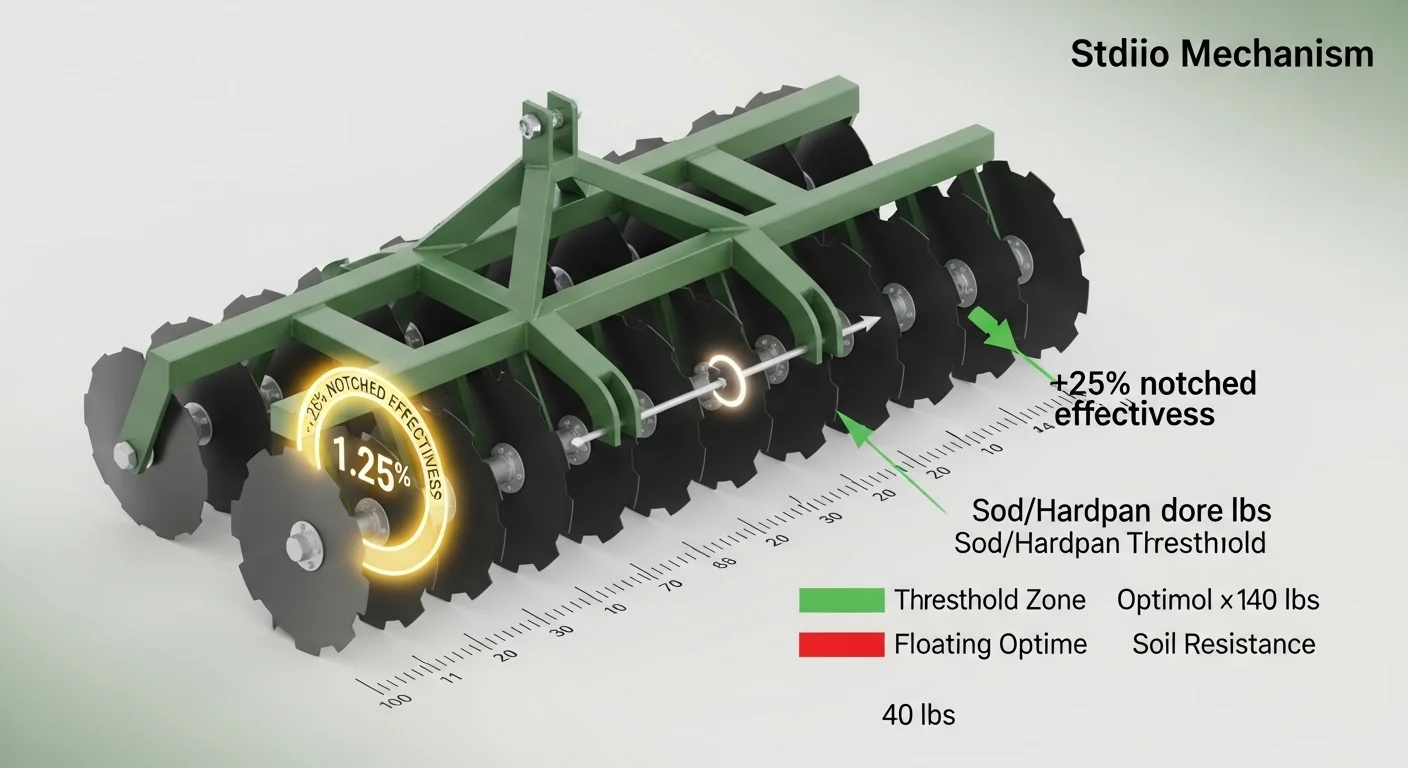
Step 2: Blade type effectiveness factor
Notched blades are assigned an effective multiplier of 1.25 when evaluated against penetration thresholds. This factor reflects the documented cutting advantage of scalloped edges over smooth edges in sod and residue conditions. The raw lbs-per-blade number displayed is always the true mechanical weight, not the adjusted figure. The effectiveness factor is applied only when determining whether your setup passes or fails the soil-condition thresholds.
Step 3: Soil-condition threshold comparison
Sod and hardpan requires a minimum of 100 lbs per blade for reliable penetration of the root mat. Tilled loam operates in an ideal range of 40 to 60 lbs per blade. Below 40 lbs per blade on any soil type is considered a floating-disc condition: the blades will not generate enough downward impulse to overcome surface resistance.
Step 4: Gauge position calculation
The visual needle maps your result onto a four-zone gauge scaled from 0 to 160 lbs per blade. Zone boundaries are set at 40 lbs (end of floating zone), 60 lbs (end of marginal zone), and 100 lbs (start of sod-capable zone). Values above 160 lbs per blade are displayed at the far end of the gauge without a discrete upper cap.
Rounding: Results are rounded to one decimal place for display. Internal comparisons use unrounded floating-point values.
Assumptions and Limits
- Weight distribution is assumed perfectly even across all blades. Significant gang misalignment, frame twist, or heavily worn bearings can shift weight to one gang and reduce effective penetration on the opposite side.
- The 100 lbs per blade threshold for hardpan is based on standard penetration physics for grass root mats and clay-dense compacted soils. Extreme rocky caliche or sun-baked hardpan clay can require 120 to 150 lbs per blade or more.
- The 1.25x notched blade effectiveness factor is a conservative midpoint. Field conditions and residue density can cause this factor to vary from roughly 1.15 to 1.35 depending on blade sharpness and standing crop type.
- Blade wear is not modeled. A smooth blade worn to a rounded edge from seasons of use will perform worse than a new smooth blade. Worn blades may require 15 to 20 lbs per blade of additional weight to achieve comparable penetration.
- Soil moisture content is not an input variable. Very wet soils reduce required penetration force significantly; very dry, sunbaked hardpan increases it substantially. This tool assumes typical seasonal field conditions for each selected soil type.
- Operating speed is assumed to be 4 to 6 mph. Slower passes increase dwell time and effective penetration; higher speeds increase the tendency for blades to skip over surface resistance. Speed is not modeled numerically in this calculator.
- Gang angle is not an input. Steeper gang angles increase the lateral cutting action of each blade and can improve residue incorporation, but they also increase draft resistance. Weight per blade governs vertical penetration; gang angle governs the horizontal cut path.
Standards, Safety Checks, and "Secret Sauce" Warnings
Critical Warnings
- The 40 lbs per blade floor is absolute. Below 40 lbs per blade, no disc harrow will generate enough downward impulse to penetrate established sod or hardpan regardless of blade type, gang angle, or tractor horsepower applied to draft. This is a physics constraint, not an operator error that can be corrected with technique.
- Adding tractor horsepower does not fix a weight-per-blade deficit. Draft horsepower pulls the implement forward through the soil; it does not increase the downward force each blade carries. Running a heavier tractor does nothing to change the weight distribution across your blade count. The only variables that raise weight per blade are adding mass to the implement frame or reducing the number of blades in use.
- Smooth blades on sod are a compounding failure. A smooth-bladed disc harrow that is already below the 100 lbs per blade sod threshold loses the only mechanical advantage that could partially compensate: the scalloped cutting edge. Below-threshold smooth setups on hardpan effectively produce zero tillage value and significant fuel waste.
- Very high weight on tilled loam can damage soil structure. At 120+ lbs per blade on loose, worked loam, heavy disc harrows can over-cut the profile and destroy aggregate structure in soils that were previously conditioned. On tilled fields, check that your weight per blade does not dramatically exceed the 60 lbs upper end of the ideal loam range without using hydraulic depth stops to limit penetration depth.
Minimum Standards
- Sod and hardpan: 100 lbs per blade minimum (smooth blades); 80 lbs per blade minimum with notched blades at the 1.25x effectiveness factor
- Tilled loam: 40 lbs per blade minimum; 60 lbs per blade is the optimal upper end before diminishing returns set in
- Any disc harrow below 40 lbs per blade should be considered unsuitable for primary tillage on any soil type and appropriate only for light secondary cultivation on already-worked sandy or sandy-loam soils
Competitor Trap: Most disc harrow buying guides compare implements by working width in feet, horsepower requirement, and price per blade. None of those figures tell you whether the implement can physically cut the soil you have. A 12-foot harrow with 40 blades at 1,600 lbs works out to 40 lbs per blade: adequate for tilled loam, completely inadequate for sod. A 7-foot harrow with 18 blades at 2,100 lbs delivers 116 lbs per blade and will cut hardpan reliably. Width and horsepower are productivity metrics. Weight per blade is the penetration metric. Buying on width without checking weight per blade is how farmers end up with implements that cover ground but do not till it.
For related force-per-point calculations that follow similar physics, the subsoiler horsepower requirements calculator applies comparable penetration mechanics to shanks operating at much greater depths. And if you are weighing whether to run a full-coverage primary tillage pass or a lighter secondary pass, understanding cultivator sweep overlap gives you a parallel framework for coverage efficiency on the secondary pass.
Common Mistakes and Fixes
Mistake: Using the Harrow's Listed Working Width as a Proxy for Weight
Working width in feet tells you how much ground the disc covers per pass. It has no direct relationship to the weight-per-blade figure. A 14-foot tandem disc can weigh anywhere from 1,400 to 4,200 lbs depending on frame gauge, gang style, and ballast. Using width as a substitute for actual implement weight produces wildly inaccurate weight-per-blade estimates. Fix: look up the manufacturer's transport weight or weigh the implement before calculating.
Mistake: Counting Gangs Instead of Individual Blades
A disc harrow described as having "4 gangs" might have anywhere from 16 to 48 individual blades depending on blade spacing. Gang count is a frame description; blade count is the divisor in the weight-per-blade formula. Using gangs instead of blades inflates your calculated result by a factor of 4 to 12. Fix: count every individual cutting blade on the implement, or locate the blade count in the operator's manual parts diagram.
Mistake: Ignoring the Blade Wear Condition When Selecting Blade Type
Selecting "Notched" for blades that were purchased as notched but are now worn smooth from multiple seasons of use misrepresents the actual cutting geometry. A worn notched blade can approach smooth-blade performance, negating the 1.25x effectiveness advantage. Fix: inspect the blade edge profile before selecting blade type. If the notches are no longer clearly defined, select Smooth for a conservative diagnostic result.
Mistake: Not Including Added Ballast in the Total Weight Entry
Suitcase weights, water-filled saddle tanks, and bolt-on ballast plates added to the harrow frame are part of the implement's effective weight. Entering only the bare frame weight from the spec sheet while running 400 lbs of attached ballast produces a result that underestimates your actual weight per blade. This is a conservative error in the right direction for safety, but it can lead you to add more ballast than necessary. Fix: weigh or calculate the mass of all attached ballast and add it to the base implement weight before entering the total. The tractor tire ballast calculator is a useful companion for understanding how front-end ballast affects your tractor's weight distribution when pulling a heavy implement.
Mistake: Assuming Multiple Passes Compensate for Inadequate Weight Per Blade
Running four passes over sod with a disc that generates 30 lbs per blade produces the same penetration result on each pass: zero. The blade either cuts the root mat or it does not. Multiple passes with an undersized implement add fuel cost and operator time without changing the mechanical outcome. If residue management before tillage is needed, consider a dedicated pass with a flail mower first: the flail mower RPM calculator can help optimize that pass before you disc. Fix: address the weight-per-blade deficit directly by adding ballast or reducing blade count before investing additional pass time.
Next Steps in Your Workflow
Once you know your weight-per-blade result, the immediate decision tree is simple. If you are above the threshold for your soil condition, proceed to adjust gang angle and set your hydraulic depth control before heading to the field. If you are below the threshold, ballast is the fastest corrective option: cast-iron suitcase weights mount directly to most harrow frames and are available from implement dealers in 42 lb and 75 lb increments, allowing incremental adjustment without structural modification. Before your tillage pass, verifying that your tractor is producing appropriate draft force for the implement is also worth checking: the drawbar horsepower calculator will tell you whether your tractor has the power to pull a properly weighted disc harrow at your target field speed.
After discing, your seedbed preparation workflow continues. Ground speed during subsequent field operations directly affects coverage quality, and the tractor ground speed calculator helps you confirm actual field speed from your tire and RPM data. Knowing your true speed matters for planting, seeding, and application passes where rate accuracy depends on verified travel speed, not just the speedometer reading on older equipment.
FAQ
What is the minimum disc harrow weight per blade for cutting sod?
The minimum for reliable sod penetration is 100 lbs per blade for smooth blades. With notched blades, the effective threshold drops to approximately 80 lbs of actual weight per blade due to the increased cutting efficiency of the scalloped edge. Below 40 lbs per blade on any blade type, penetration of established sod is not mechanically achievable regardless of other setup variables.
What causes a disc harrow to float across the top of a field without cutting?
The floating disc condition occurs when the downward force each blade carries falls below what the soil's surface resistance requires. Sod root mats and hardpan create a firm layer that resists blade entry unless sufficient weight per blade is present. Frame weight is the primary variable. Gang angle, tractor speed, and tractor horsepower do not solve a weight deficit.
Do notched blades actually perform better than smooth blades?
Yes, specifically in sod and residue cutting. The scalloped edge of a notched blade contacts the root mat or crop stem at a concentrated point rather than a broad edge, creating a slicing action rather than a compression force. This difference is most significant in standing or matted residue. In already-tilled loam, the performance difference between blade types is minimal and does not justify replacement cost.
How do I increase weight per blade without buying a new disc harrow?
The two options are adding mass to the frame or reducing the number of blades in use. Cast-iron suitcase weights bolt to most harrow frames in standard increments. Some operators remove a blade and spacer from each gang to reduce blade count and concentrate the existing frame weight among fewer cutting points. Hydraulic ballast boxes are a third option on larger implements.
Does disc blade diameter affect penetration depth?
Larger diameter blades require more downward force per blade to achieve the same penetration depth as smaller blades, because a larger disc presents more surface area against the soil. A 24-inch blade at 80 lbs per blade will not penetrate as deeply as an 18-inch blade at the same weight. Weight per blade is the primary driver; diameter sets the baseline force requirement for a given target depth.
What is a tandem disc harrow and how does blade count work?
A tandem disc harrow has two sets of gang pairs: front gangs angled outward and rear gangs angled inward. This design works the soil in both directions in a single pass. Blade count includes every blade on all four gangs. A standard 10-foot tandem disc might carry 20 to 28 blades depending on blade spacing, which is typically set at 7, 8, or 9 inches between blades on the gang axle.
Conclusion
Disc harrow weight per blade is not a specification most implement manufacturers advertise, and it is not a number most tillage guides discuss. It is, however, the single figure that determines whether a disc harrow performs primary tillage or wastes diesel fuel bouncing across a field. The gap between a 30 lbs per blade setup and a 100 lbs per blade setup is not a matter of technique or tractor size. It is mass, divided by blade count, compared against a physical threshold set by soil resistance.
The most expensive mistake in disc tillage is running an undersized implement through repeated passes on sod, accumulating fuel cost and field time while the root mat remains intact. Before the next season's tillage pass, run your harrow's numbers. If the result is below threshold, the fix is specific, measurable, and in most cases achievable without replacing the implement. For operators building a complete tillage program, the box blade draft force calculator extends the same force-physics framework to finish grading and land leveling passes that often follow primary disc tillage.