
Subsoiler HP & Hardpan Draft Force Calculator
Calculate required drawbar horsepower and draft force for subsoiling & deep ripping operations
📚 How This Calculator Works — Formula & Assumptions ▼
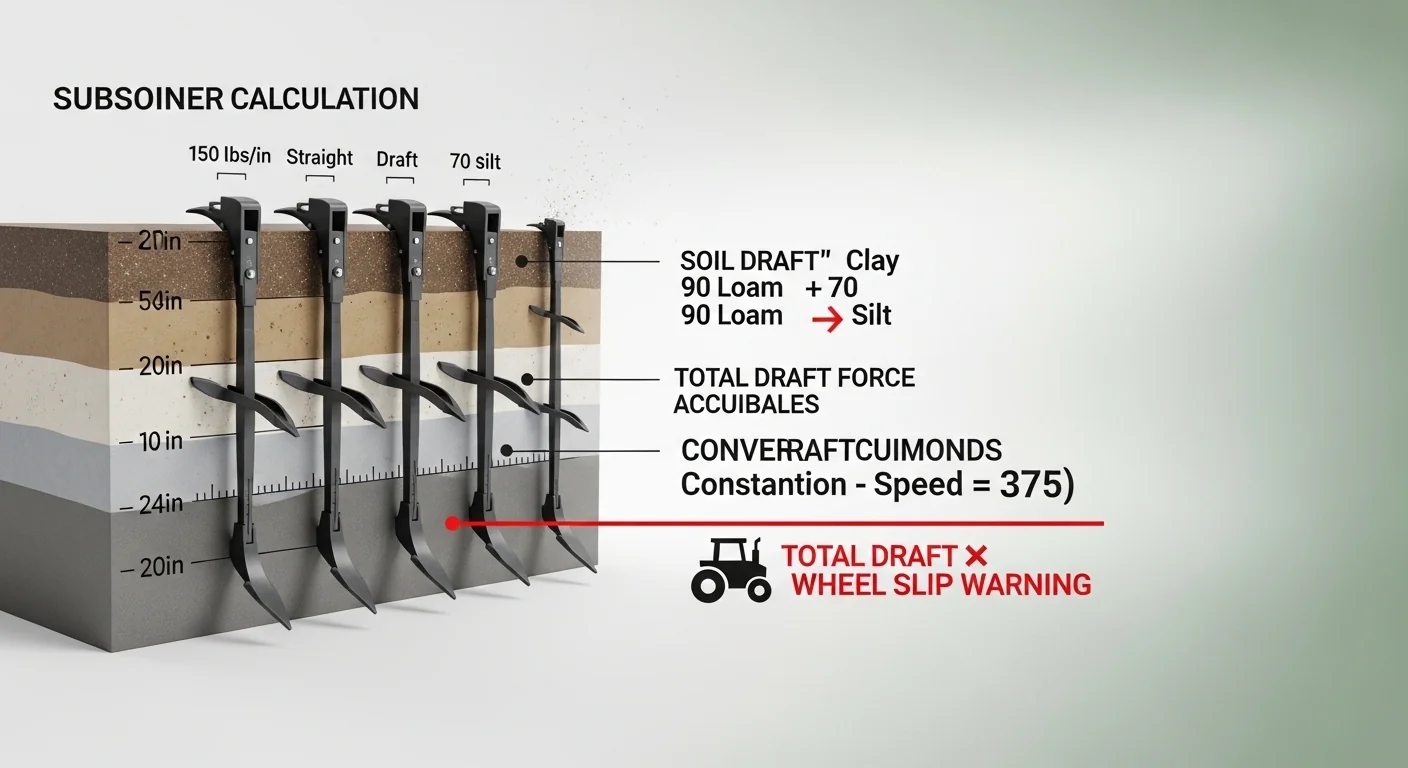
Draft Force Per Inch (Soil Lookup)
Different soils require different amounts of pulling force per inch of depth per shank:
Heavy Clay = 150 lbs / inch / shank
Loam = 90 lbs / inch / shank
Silt = 70 lbs / inch / shank
Step 1 — Total Draft Force
Example: 3 shanks × 18 inches × 90 lbs/in (Loam) = 4,860 lbs of draft resistance
Step 2 — Required Drawbar HP
The constant 375 converts foot-pounds/minute to horsepower (1 HP = 33,000 ft-lbs/min; at 1 mph = 88 ft/min, so 33,000 ÷ 88 ≈ 375).
Step 3 — Wheel Slip Safety Check
If the required pull force exceeds the tractor’s weight, the rear wheels cannot generate enough traction and will spin. This is the “Hardpan Anchor” stall scenario common with compact tractors.
Assumptions & Limits
- Draft coefficients are ASABE-referenced averages; actual field conditions vary ±20–30%.
- Formula assumes uniform soil profile at stated depth — layered soils may vary significantly.
- Speed assumes consistent travel; actual field variability can spike draft forces.
- Tractor weight used here is operating weight (no front ballast or fluid fill assumed). Add ballast weight if applicable.
- Drawbar HP is typically 80–88% of PTO HP; use your tractor spec sheet for accuracy.
- Penetration angle, shank wing width, and soil moisture content are not modeled.
- Valid for single-bar straight-shank subsoilers with standard narrow points.
The standard advice tells operators to match horsepower to implement size. That advice is incomplete for subsoiling. The real limiting factor in deep ripping operations is not horsepower on a spec sheet — it is the draft force generated at depth versus the tractor’s actual operating weight. A 25-horsepower compact tractor sinking a single shank 24 inches into heavy clay generates 3,600 pounds of pulling resistance. If that tractor weighs 2,500 pounds, no amount of throttle prevents the rear wheels from spinning. The tractor does not run out of power; it runs out of traction.
This calculator quantifies both sides of that equation. Enter your shank count, target ripping depth, soil type, operating speed, tractor weight, and drawbar horsepower. The tool returns your required drawbar HP, total draft force, draft per shank, and a direct slip-risk flag based on whether your calculated draft load exceeds your machine’s weight. It does not predict soil variability, account for shank angle deviation, or model tire inflation effects. Those variables require field testing.
After running your numbers, you will know whether your current tractor configuration physically can pull your subsoiler at the stated depth — or whether you need to reduce depth, add ballast, or size up before you hook up.
Use the Tool
Before entering values, gather your tractor’s operating weight from the spec sheet (not curb weight — include any loaded tires or wheel weights already mounted). Drawbar HP is typically 80 to 88 percent of PTO HP; check the horsepower rating on the drawbar line of your tractor’s performance test data rather than the engine rating. Have your target ripping depth in inches and your planned field speed ready. If you are unsure whether your soil is clay, loam, or silt, a county extension soil map or a basic ribbon test can narrow it down quickly. For a related check on rear axle loading before you start, the tractor tire ballast calculator can confirm whether your current fluid fill and wheel weight combination gives you adequate rear-axle mass for the draft load you are about to generate.
Quick Start (60 Seconds)
- Number of Shanks: Count the physical shanks on your implement, not the toolbar width. Enter a whole number from 1 to 9. A single-shank subsoiler is common on compact tractors; 3 and 5 shanks are typical on utility and row-crop machines.
- Target Ripping Depth: Enter in inches. Common depths are 16 to 24 inches for hardpan breaking. Do not enter your hitch height — measure the planned penetration depth at the shank tip.
- Soil Type: Select the dominant soil texture at the depth you are ripping, not the surface layer. Clay hardpan at 18 inches behaves very differently from surface clay.
- Operating Speed: Enter your planned travel speed in mph, not engine RPM. Most productive subsoiling occurs between 2.5 and 5 mph. Entering 6 or 7 mph is technically valid but triggers a high-speed caution because draft spikes unpredictably above 5 mph.
- Tractor Weight: Use operating weight — total machine weight on the ground including any ballast already installed. A common mistake is entering rated weight without accounting for a loaded front loader or rear wheel weights.
- Drawbar HP: This is not your engine horsepower or PTO rating. Use the drawbar horsepower figure from your tractor’s Nebraska or OECD test report if available, or multiply PTO HP by 0.85 as a conservative estimate.
Inputs and Outputs (What Each Field Means)
| Field | Unit | What It Means | Common Mistake | Safe Entry Guidance |
|---|---|---|---|---|
| Number of Shanks | Count | Physical working shanks on the implement | Counting toolbar slots instead of installed shanks | 1 to 9; integers only |
| Ripping Depth | Inches | Planned penetration depth at shank tip | Entering hitch position depth rather than actual tip depth | 6 to 36 inches; measure at the point |
| Soil Type | Category | Dominant texture at ripping depth (not surface layer) | Selecting surface texture when hardpan is clay at depth | Use county soil survey or ribbon test to verify |
| Operating Speed | mph | Planned travel speed during subsoiling pass | Using transport speed or GPS max speed instead of working speed | 1 to 8 mph; 3 to 5 mph is the productive range |
| Tractor Weight | lbs | Total operating weight on the ground including ballast | Using rated weight without ballast or with a loader attached but not weighed | 1,000 to 50,000 lbs; use scale reading if available |
| Tractor Drawbar HP | HP | Actual power available at the drawbar, not engine or PTO rating | Entering engine HP (overstates by 15 to 25 points typically) | Drawbar HP = PTO HP x 0.85 (conservative estimate); 10 to 500 HP |
| Output: Required Drawbar HP | HP | Minimum drawbar HP needed to pull at stated inputs without stalling | Treating this as a target rather than a floor — operation demands this as a minimum | Your tractor’s drawbar HP must exceed this value with margin |
| Output: Total Draft Force | lbs | Total horizontal pulling resistance of all shanks combined | Not comparing this to tractor weight — the slip check is the critical gate | Must be less than tractor operating weight for traction safety |
| Output: Slip Risk | Flag | Whether total draft exceeds tractor weight — if yes, wheel spin is unavoidable | Ignoring this flag and assuming the operator can “feel” when traction is low | Address with ballast before operating |
| Output: HP Headroom | HP | Difference between your tractor’s drawbar HP and the required HP | Treating zero headroom as acceptable — sustained max-load operation causes overheating | Aim for at least 15 to 20 HP of headroom for sustained pulls |
For additional context on what your tractor’s three-point system can handle in relation to implement weight, the 3-point lift capacity calculator can confirm whether your hitch can raise the subsoiler fully at the end of each pass.
Worked Examples (Real Numbers)
Scenario 1: The Compact Tractor Hardpan Halt
- Shanks: 1
- Ripping depth: 24 inches
- Soil type: Heavy Clay (150 lbs per inch per shank)
- Operating speed: 3.5 mph
- Tractor weight: 2,500 lbs
- Tractor drawbar HP: 25 HP
Calculation: Total Draft = 1 x 24 x 150 = 3,600 lbs. Required HP = (3,600 x 3.5) / 375 = 33.6 HP.
Result: 33.6 HP required; 3,600 lbs draft against 2,500 lbs tractor weight.
This is the classic stall scenario. The tractor is underpowered by 8.6 HP and the draft force exceeds the machine’s weight by 1,100 lbs, guaranteeing wheel spin before the engine can even approach its limit. The fix is not a larger engine — it is adding 1,200 or more pounds of rear ballast and reducing depth to 16 to 18 inches where a 25-HP tractor can operate without spinning.
Scenario 2: Utility Tractor with 3-Shank Subsoiler in Loam
- Shanks: 3
- Ripping depth: 18 inches
- Soil type: Loam (90 lbs per inch per shank)
- Operating speed: 4 mph
- Tractor weight: 6,200 lbs
- Tractor drawbar HP: 75 HP
Calculation: Total Draft = 3 x 18 x 90 = 4,860 lbs. Required HP = (4,860 x 4) / 375 = 51.8 HP.
Result: 51.8 HP required; 23.2 HP of headroom; draft force is 78 percent of tractor weight.
This combination is within safe operational limits. The draft-to-weight ratio leaves adequate traction margin, and the 23-HP headroom is sufficient for sustained pulling without thermal stress. At 5 mph the required HP rises to 64.8 HP, still within range but with reduced margin.
Scenario 3: Large Row-Crop Tractor with 5-Shank Subsoiler in Clay
- Shanks: 5
- Ripping depth: 18 inches
- Soil type: Heavy Clay (150 lbs per inch per shank)
- Operating speed: 3 mph
- Tractor weight: 11,500 lbs
- Tractor drawbar HP: 120 HP
Calculation: Total Draft = 5 x 18 x 150 = 13,500 lbs. Required HP = (13,500 x 3) / 375 = 108 HP.
Result: 108 HP required; 12 HP of headroom; draft force exceeds tractor weight by 2,000 lbs.
Despite having adequate horsepower, this configuration fails the slip check. The 13,500-lb draft load exceeds the 11,500-lb operating weight, meaning the rear tires will break traction before the drawbar reaches full pull. Adding 2,500 lbs of combined rear ballast (wheel weights plus fluid) resolves the traction deficit and allows the full 108-HP drawbar capability to be applied.
Reference Table (Fast Lookup)
All HP values calculated at 4 mph using the formula: Req HP = (Shanks x Depth x Draft_Per_Inch x Speed) / 375. Slip risk column compares total draft against a reference tractor weight in the notes column.
| Shanks | Depth (in) | Soil Type | Draft / Shank (lbs) | Total Draft (lbs) | Req. Drawbar HP @ 4 mph |
|---|---|---|---|---|---|
| 1 | 12 | Heavy Clay | 1,800 | 1,800 | 19.2 HP |
| 1 | 18 | Heavy Clay | 2,700 | 2,700 | 28.8 HP |
| 1 | 24 | Heavy Clay | 3,600 | 3,600 | 38.4 HP |
| 1 | 24 | Loam | 2,160 | 2,160 | 23.0 HP |
| 3 | 18 | Silt | 1,260 | 3,780 | 40.3 HP |
| 3 | 18 | Loam | 1,620 | 4,860 | 51.8 HP |
| 3 | 18 | Heavy Clay | 2,700 | 8,100 | 86.4 HP |
| 3 | 24 | Loam | 2,160 | 6,480 | 69.1 HP |
| 5 | 18 | Loam | 1,620 | 8,100 | 86.4 HP |
| 5 | 24 | Heavy Clay | 3,600 | 18,000 | 192.0 HP |
The final row (5 shanks, 24 inches, clay) illustrates why very large subsoilers require tracked or articulated machines: 18,000 lbs of draft force exceeds the operating weight of most wheeled tractors below 200 HP, making wheel slip a near-certainty without extreme ballasting.
How the Calculation Works (Formula + Assumptions)
Show the calculation steps
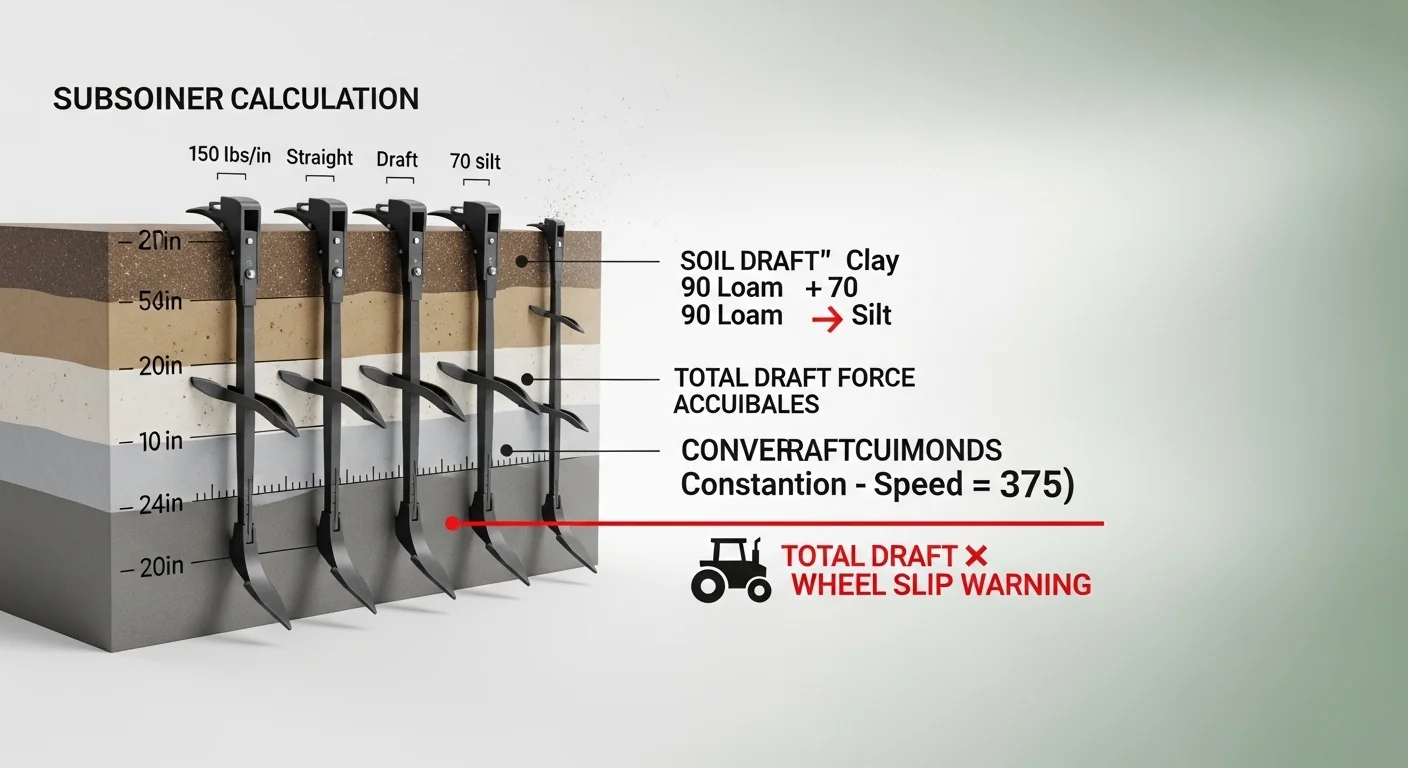
Step 1: Determine draft force per inch of depth (soil lookup)
Each soil type resists shank penetration at a different rate, measured in pounds of horizontal force per inch of depth per shank. This value is drawn from ASABE-referenced field averages:
- Heavy Clay: 150 lbs per inch per shank
- Loam: 90 lbs per inch per shank
- Silt: 70 lbs per inch per shank
Step 2: Calculate total draft force
Total Draft (lbs) = Number of Shanks x Ripping Depth (inches) x Draft_Per_Inch
This scales linearly with both shank count and depth. Doubling either doubles total draft.
Step 3: Convert draft force to required drawbar horsepower
Required Drawbar HP = (Total Draft x Speed in mph) / 375
The constant 375 is derived from the horsepower conversion: 1 HP = 33,000 foot-pounds per minute. At 1 mph, a machine travels 88 feet per minute (5,280 ft/mile / 60 min). Dividing 33,000 by 88 gives 375. Speed multiplies power demand directly — every additional mph adds proportionally to the HP requirement.
Step 4: Wheel slip check
If Total Draft exceeds Tractor Operating Weight: the rear wheels cannot generate sufficient ground reaction force to match the implement’s resistance. The result is wheel spin and forward motion stops regardless of engine power. This check is binary: either the tractor has sufficient mass or it does not.
Rounding: Draft force rounded to the nearest pound; HP rounded to one decimal place. Reference table HP values are rounded to one decimal place at 4 mph as stated.
Assumptions and Limits
- Draft coefficients (150, 90, 70 lbs/inch/shank) are mean values from ASABE agricultural engineering references. Actual field values can vary by plus or minus 20 to 30 percent depending on soil moisture, organic matter content, and tillage history.
- The formula assumes a uniform soil profile at the stated depth. A shallow clay lens above looser subsoil, or gravel inclusions, will produce different results than a homogeneous profile.
- Shank geometry (wing attachments, chisel point shape, tip wear) is not modeled. Worn points reduce penetration efficiency and effectively increase draft resistance beyond the calculated value.
- Tire inflation, tread pattern, and soil surface condition significantly affect traction — these are not modeled. The slip check uses a simplified threshold (draft vs. weight) and does not account for dynamic weight transfer, tire contact area, or rolling resistance.
- Front ballast, loader attachment weight, and implement tongue weight are not automatically included in the tractor weight field. The user must enter the true total operating weight including all ballast.
- The formula applies to straight-shank subsoilers with standard narrow points. Parabolic shanks, winged expanders, or ripper-disc combinations may have substantially different draft characteristics.
- Soil moisture is a major driver of actual draft. Dry hardpan clay can exceed the 150 lbs/inch coefficient significantly; very wet clay may be much lower.
Standards, Safety Checks, and “Secret Sauce” Warnings
Critical Warnings
- The Draft-Exceeds-Weight Stall: When total draft force exceeds tractor operating weight, rear-wheel traction collapses. This is not a recoverable situation by throttle adjustment. The physics are fixed: traction force is bounded by the vertical load on the drive wheels. A compact tractor attempting 24-inch clay subsoiling with a single shank can generate more than 3,500 lbs of draft — exceeding the machine’s weight by over 1,000 lbs. The wheel spin that follows causes tire damage, soil smearing at depth (defeating the purpose of subsoiling), and potential implement damage if the operator forces more throttle.
- The Horsepower Trap: Operators often size tractors by horsepower alone and ignore the weight-to-draft relationship. A 75-HP tractor weighing 5,500 lbs attempting 3-shank subsoiling in clay at 18 inches generates 8,100 lbs of draft. That machine has enough power on paper but only 68 percent of the draft requirement in tractor weight — making wheel slip the primary failure mode, not engine stall.
- High-Speed Draft Spike: Increasing subsoiling speed from 3 mph to 6 mph doubles horsepower demand exactly (HP is linear with speed in this formula). But real field draft at higher speeds often rises faster than the linear model predicts, due to soil inertia effects. Operating above 5 mph in clay is not recommended regardless of what the calculated HP value shows.
- Depth vs. Ballast Interaction: Adding 2 inches of depth in heavy clay adds 300 lbs of draft per shank. A 3-shank subsoiler going from 18 to 20 inches in clay adds 900 lbs of total draft — requiring a corresponding increase in rear ballast to maintain the weight-to-draft safety margin.
Minimum Standards
- Tractor operating weight should exceed total calculated draft force before operating. If it does not, add cast-iron wheel weights, fluid-filled tires, or a drawbar weight bracket until the margin is positive.
- Target a minimum of 15 HP of drawbar headroom above the calculated requirement. Running at the exact calculated HP minimum leaves no margin for soil density variations, terrain slope, or speed fluctuations.
- Category I hitch components are rated for lighter loads; 3-point hitch pins, top links, and lift arms should match or exceed the implement’s operating draft load rating. Verify the implement’s category matches the tractor’s category rating before use.
The Competitor Trap: Most subsoiler guides online lead with horsepower charts and stop there. They tell you a 60-HP tractor can run a 3-shank subsoiler and call it a day. What those guides consistently omit is the traction constraint. A 60-HP tractor that weighs 4,800 lbs generating 8,100 lbs of draft in clay is not “underpowered” — it is too light. No amount of additional engine horsepower solves a weight-to-draft mismatch. Operators who follow the HP-only advice end up with spinning tires, smeared hardpan, and unbroken soil profiles at depth, which is precisely the opposite of what subsoiling is meant to achieve.
If your tractor passes the draft force and HP checks but you are still seeing traction issues, the box blade draft force calculator covers related soil-resistance mechanics for comparison across implement types. For understanding exactly how your drawbar rating is derived from your engine rating, the drawbar horsepower calculator walks through the transmission and driveline loss factors that reduce engine output to actual pulling power.
Common Mistakes and Fixes
Mistake: Using Engine Horsepower Instead of Drawbar Horsepower
Engine horsepower is the rating at the crankshaft. By the time power travels through the transmission, rear axle, and tires, the actual pulling force at the drawbar is typically 80 to 88 percent of the engine figure. Entering 75 HP engine power when your drawbar rating is 63 HP gives a false sense of headroom — your real margin is 12 HP less than the calculator shows.
Fix: Find the drawbar horsepower line on your tractor’s performance test data, or multiply PTO HP by 0.85 as a conservative working estimate. If you are running a tractor at high hours with a worn drivetrain, assume the lower end of that range.
Mistake: Ignoring Soil Moisture When Selecting Soil Type
The draft coefficients in this tool — 150, 90, and 70 lbs per inch per shank for clay, loam, and silt — represent average field conditions. Dry summer clay hardpan after an extended drought can behave significantly harder than the model predicts. Conversely, recently rained-on loam may pull more easily than the 90 lbs per inch figure. Choosing “loam” because that is your field’s general soil type while subsoiling in mid-summer drought conditions understates the real draft requirement.
Fix: In dry conditions, consider selecting the next heavier soil category (loam to clay) as a conservative buffer. Run the tool with both options to see the range.
Mistake: Not Accounting for Implement Weight in Tractor Weight Field
The tractor weight field should reflect the total machine weight on the ground during operation, including rear wheel weights, fluid ballast, and the downward force component of any heavy implement on the three-point. A 500-lb rear subsoiler in the down position contributes additional rear-axle loading — but only if it is fully ground-engaged; if it is riding in transport, that weight is on the tractor’s rear axle, which helps traction. The direction of the error matters.
Fix: Use a rear-axle scale reading if available. If not, add the dry weight of any rear ballast already on the machine to the base tractor operating weight before entering the value. For speed calculations during operation, the tractor ground speed calculator can help verify that your planned gear and RPM actually produce the speed you entered.
Mistake: Planning to Subsoil at the Same Depth Across the Entire Field
Hardpan depth varies significantly across a field — sometimes by 6 inches or more over short distances. An operator who sets the subsoiler for 22 inches because that is the average hardpan depth may be ripping through very hard material in some areas and barely touching the pan in others. The draft variation that results can cause unpredictable load spikes.
Fix: Run a soil probe or penetrometer transect before setting depth. Identify the shallowest hardpan zones and target your operating depth to that shallower figure initially, then adjust after verifying traction and power.
Mistake: Treating the Calculated HP as the Maximum, Not the Minimum
The required drawbar HP from this tool is the floor, not the ceiling. It is the power needed to maintain the stated speed at the stated depth in ideal uniform soil. Any deviation — a wet spot, a harder clay lens, a slight uphill grade — requires more power instantly. An operator running at exactly the calculated HP minimum has no headroom for these real-world variations.
Fix: Target a tractor with at least 15 to 20 HP of drawbar headroom above the calculated required HP. If your current machine falls short of that margin, reduce either the shank count or the depth, not the speed (reducing speed reduces HP demand proportionally but does not help the draft-to-weight ratio at all).
Next Steps in Your Workflow
Once the calculator confirms your tractor-implement pairing is within safe parameters, the next decision is rear ballast configuration. If the slip-risk flag is green but the tractor-weight-to-draft ratio is below 1.2 to 1, adding rear ballast before operating is worth the setup time. Cast-iron wheel weights are the most straightforward addition; fluid ballast (calcium chloride solution) in the rear tires gives a larger mass increase per dollar but requires a ballast pump and proper handling. Both approaches increase the effective rear-axle load without raising the tractor’s center of gravity to the same degree as front ballast alone. Once ballast is sorted, check that your PTO-driven subsoiler’s driveline components are sized correctly for the torque loads involved using the PTO shaft sizing calculator — high draft loads can stress an undersized driveline even when the drawbar HP check passes.
After completing your subsoiling passes, the soil profile is open and vulnerable to recompaction from subsequent tillage passes. Limiting axle loads during the next field operation preserves the fracture zones you created. If you are moving from subsoiling to seeding, consider whether a lighter drill or an air seeder with flotation tires is more appropriate than a heavy conventional drill. For operations that require pulling significant loads across fields after subsoiling — such as log extraction or heavy material movement — confirming your tractor’s winch pull capacity relative to total weight on slope gives a parallel safety check using similar draft-and-traction principles.
FAQ
What is the difference between a subsoiler and a deep ripper?
The terms are used interchangeably in most contexts, but subsoilers typically refer to single or multi-shank implements designed primarily to fracture compacted subsoil layers without significant soil inversion. Deep rippers are often associated with heavier construction-grade machines or vineyard use. For agricultural draft-force and HP calculation purposes, the formula and coefficients apply to both implement types using straight shank geometry.
How deep can a compact tractor subsoil in clay?
In heavy clay at 150 lbs per inch per shank, a 25-HP compact tractor with a single shank and 2,500 lbs of operating weight is typically limited to 12 to 16 inches before draft force approaches or exceeds machine weight. At 16 inches, a single shank generates 2,400 lbs of draft — close to the weight limit. With adequate ballast added, 18 inches may be achievable, but 24 inches in solid clay hardpan is beyond the physics of that machine class without major ballast additions.
Does adding more weight always fix a wheel slip problem?
Adding rear weight directly increases the traction force available, which is bounded by the vertical load on the drive wheels. So yes, additional ballast expands the operational envelope. However, there are practical limits: overloading rear axles beyond their rated capacity causes bearing and axle damage, and excessive ballasting reduces front-axle steering control. The calculator’s slip check identifies the problem; ballasting solves it only up to the mechanical limits of the machine’s axle and tire ratings.
Why does subsoiling speed matter so much for horsepower?
HP is the product of force and velocity. Since the draft force is set by depth and soil type, speed scales power demand linearly. Going from 3 mph to 4 mph increases HP demand by 33 percent. Going from 3 mph to 6 mph doubles the HP requirement exactly. This is why reducing speed is the fastest way to bring an underpowered or borderline setup back within range — though it does nothing to improve the draft-to-weight traction ratio.
Can I run a subsoiler at maximum PTO HP?
A subsoiler loads the drawbar, not the PTO. PTO-driven components on a subsoiler (if any) are typically just depth-sensing electronics or coulters — not the primary power path. The formula here applies to drawbar pull only. If your subsoiler has a PTO-powered component such as a powered coulter disc, add its power requirement separately to the drawbar HP requirement to determine total tractor power demand.
What soil conditions give the most variable results in this calculator?
Heavy clay is the most variable. The 150 lbs per inch per shank coefficient is an average across a range of clay densities and moisture conditions. Dense, dry Vertisol-type clays in drought conditions can exceed this significantly. Highly organic clay soils (peaty clay) may fall below it. Loam and silt are more predictable in practice. For high-stakes commercial operations in clay, running the calculator with the clay coefficient and then comparing the result to observed drawbar gauge readings during initial passes gives the best calibration.
Conclusion
The most common mistake operators make is selecting implement size by horsepower spec alone without running the draft-to-weight check. That error sends compact tractor owners into clay hardpan at 24-inch depth with predictable results — spinning tires, frustrated operators, and unbroken soil. Run the numbers before you hook up, add ballast to the rear axle if the slip flag fires, and confirm your drawbar HP has meaningful headroom above the calculated minimum. For a paired check on how your tractor’s actual pulling force compares to rated output, the 3-point lift capacity calculator provides a complementary view of your hitch system’s limits within the same operational workflow.