
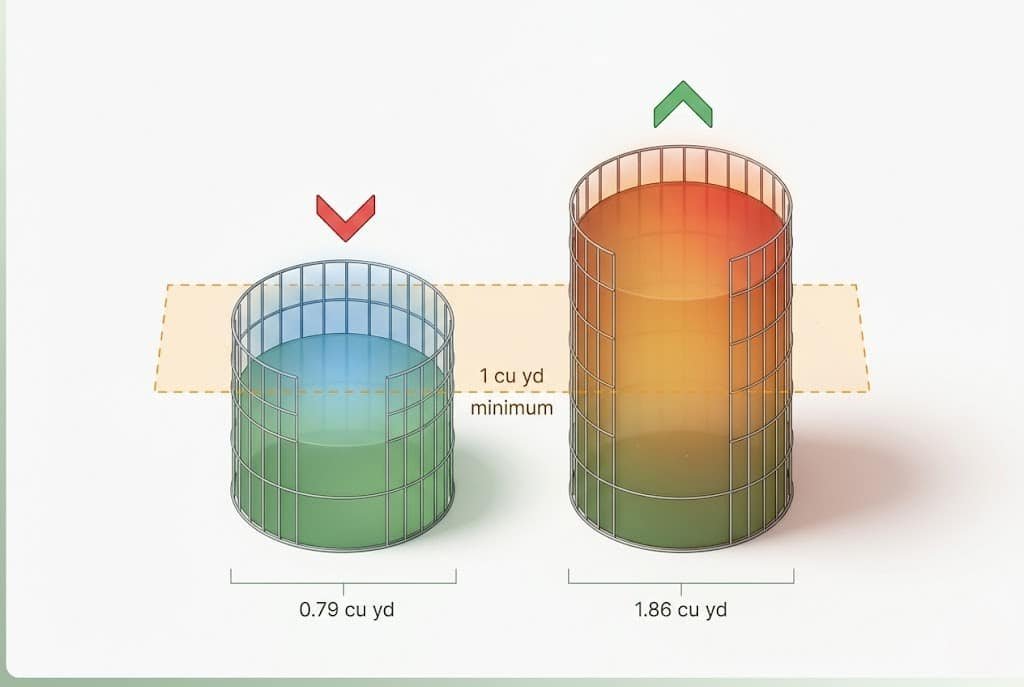
Volume is the variable most backyard composters never measure. They build a bin, fill it, and wonder why the pile stays cold and sluggish for months. The reason is almost always the same: the pile lacks the critical mass needed to trap metabolic heat. Size is not a preference in composting, it is a thermodynamic requirement, and the math is straightforward once you run it.
Compost Bin Volume Calculator The Yield Grid
Calculate cubic yards of compost capacity & check if your pile is big enough to heat up
| Bin Type | Dimensions (ft) | Volume (cu ft) | Volume (cu yd) | Hot Compost? |
|---|---|---|---|---|
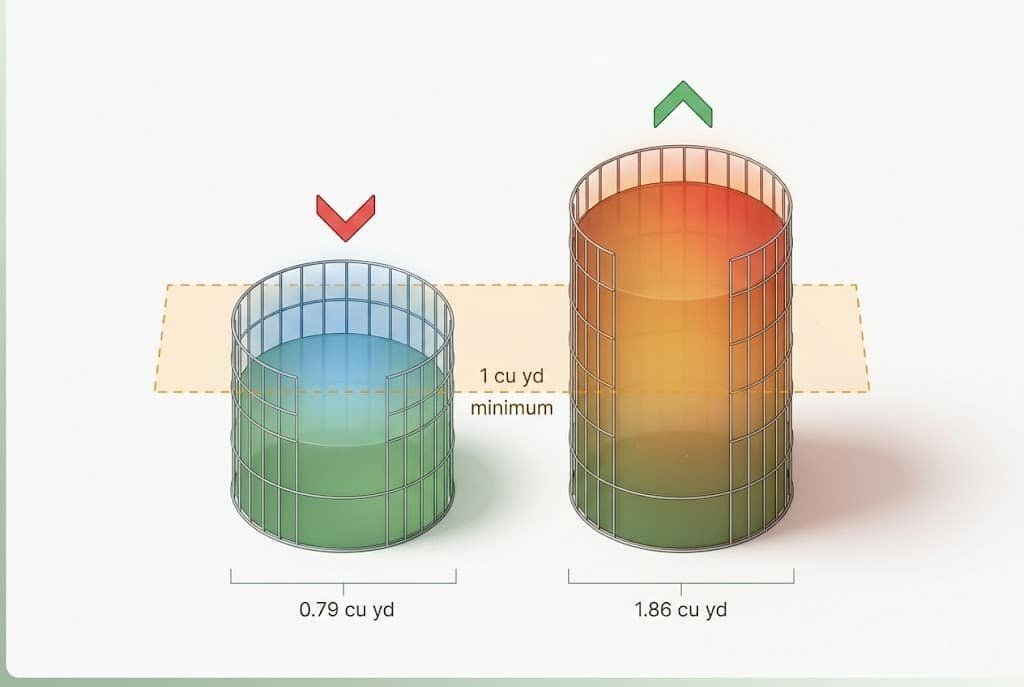
| Wire Cylinder | D=3, H=3 | 21.2 | 0.79 | ⚠️ Too small |
| Wire Cylinder | D=4, H=3 | 37.7 | 1.40 | ✅ Yes |
| Wire Cylinder | D=4, H=4 | 50.3 | 1.86 | ✅ Yes |
| Pallet Box | 3×3×3 | 27.0 | 1.00 | ✅ Min size |
| Pallet Box | 4×4×4 | 64.0 | 2.37 | ✅ Yes |
How This Calculator Works
Volume Formulas
- Cylinder (Wire Bin):
V (cu ft) = π × (Diameter ÷ 2)² × Height - Box (Pallet Bin):
V (cu ft) = Length × Width × Height - Convert to cubic yards:
V (cu yd) = V (cu ft) ÷ 27
C:N Material Capacity Estimate
Each material has an assumed bulk density and C:N ratio:
- Loose Leaves: ~3 lbs/cu ft, C:N ≈ 60:1
- Grass Clippings: ~15 lbs/cu ft, C:N ≈ 20:1
- Manure: ~35 lbs/cu ft, C:N ≈ 15:1
Capacity (lbs) = Bulk Density × Volume (cu ft)
“Hot” Pile Check (Secret Sauce)
Thermophilic (heat-generating) composting requires a minimum critical mass of 1 cubic yard (27 cu ft). Smaller piles cannot retain enough heat for pathogen kill and fast decomposition. A warning is shown if your bin is below this threshold.
Assumptions & Limits
- Volumes assume the bin is filled to its stated height.
- Bulk densities are approximate averages; actual values vary with moisture and compaction.
- C:N ratios are for pure material; real compost piles are mixed.
- Ideal composting C:N is 25–35:1; blending materials achieves this.
- Input dimensions: 0.5–50 ft per side.
This compost calculator computes the interior volume of a wire cylinder or pallet box bin in cubic yards and cubic feet, then estimates how many pounds of a given primary material that bin will hold based on published bulk density values. It does not predict actual decomposition speed, finished compost yield, or pathogen elimination — those outcomes depend on moisture, turning frequency, and feedstock blending that no volume calculator can capture.
After using this tool, you will know whether your bin is physically large enough to sustain thermophilic (heat-generating) composting, the condition that kills weed seeds and pathogens, or whether you are working with a passive cold pile that will take many more months to finish.
Use the Tool
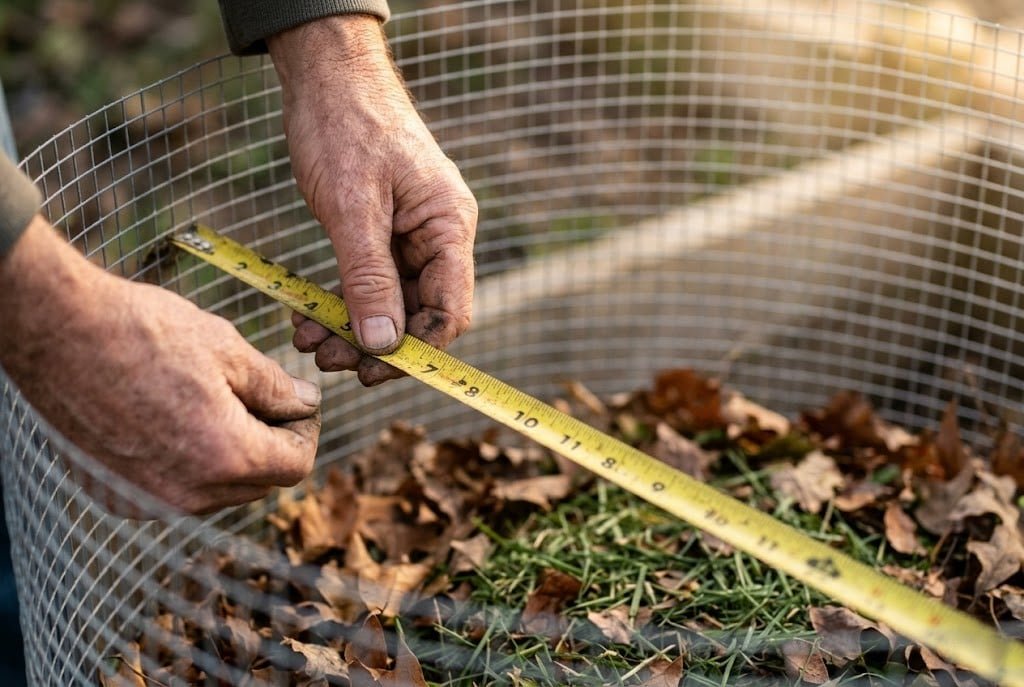
Before you start, have a tape measure handy. For a wire cylinder bin, measure the interior diameter (not the outside of the wire) and the height you typically fill it to, not the total bin height. For a pallet box bin, measure the interior length, width, and fill height. All inputs are in feet; decimal values are accepted (for example, 3.5 ft). If you blend materials, select the material that makes up the largest share of your current pile for the capacity estimate. For a detailed breakdown of how to blend browns and greens to hit an ideal carbon-to-nitrogen ratio, see the compost ratio calculator.
Quick Start (60 Seconds)
- Bin Shape: Choose “Cylinder / Wire Bin” for round wire or mesh bins; choose “Box / Pallet Bin” for any rectangular enclosure made from pallets, lumber, or cinder block. Mixing these up is the single most common input error.
- Diameter (cylinder only): Measure across the inside of the bin at its widest point, in feet. A standard 3-ring wire bin runs roughly 3 to 4 feet across. Do not measure the outside of the wire frame.
- Height: Enter the height you actually fill the bin, not the total structure height. A bin filled only 2 feet high has a very different volume from one filled to the rim.
- Length and Width (box only): Both in feet; interior dimensions only. A four-pallet square bin is typically 3.5 to 4 feet on each interior side.
- Primary Material: Select the dominant feedstock. Loose leaves have a very low bulk density (roughly 3 lbs per cubic foot), grass clippings are denser (roughly 15 lbs per cubic foot), and manure is denser still (roughly 35 lbs per cubic foot). Picking the wrong material skews the capacity estimate significantly.
- Unit discipline: All dimensions must be in feet, not inches. If you measured in inches, divide by 12 before entering the value.
- Run the calculation only when all fields are filled. The calculator will flag missing or out-of-range inputs inline before it runs.
Inputs and Outputs (What Each Field Means)
| Field | Unit | What It Measures | Common Mistake | Safe Entry Guidance |
|---|---|---|---|---|
| Bin Shape | Selection | Determines the volume formula used (cylinder vs. rectangular prism) | Selecting “Box” for a round wire bin, which overestimates volume | Round bins with mesh walls = Cylinder; any rectangular bin = Box |
| Diameter | Feet | Interior span of a cylinder bin at its widest point | Measuring the outside of wire framing adds 2 to 4 inches | 0.5 to 30 ft; typical wire bins: 3 to 4 ft |
| Height (cylinder) | Feet | Fill height, not total structure height | Using the bin’s full ring height when it is only half full | 0.5 to 30 ft; measure the actual material depth |
| Length | Feet | Interior length of a box bin | Measuring exterior pallet face instead of interior clearance | 0.5 to 50 ft; pallet bins typically 3.5 to 6 ft |
| Width | Feet | Interior width of a box bin | Assuming width equals length without measuring | 0.5 to 50 ft |
| Height (box) | Feet | Fill height inside the box bin | Entering total pallet height rather than filled depth | 0.5 to 50 ft; typical pallet bins: 3 to 4 ft |
| Primary Material | Selection | Dominant feedstock; used to compute bulk density and C:N ratio label | Selecting “Grass” for a mostly-leaf pile, overstating capacity weight | Choose whichever material makes up more than half of the pile by volume |
| Volume (cu ft) | Cubic feet | Raw geometric volume of the bin | Confusing cu ft with cu yd (factor of 27 difference) | Output only; used to cross-check against the 27 cu ft hot-pile minimum |
| Volume (cu yd) | Cubic yards | Primary result; the unit most composting standards reference | Treating 1 cu yd and 1 cu ft as similar in scale | Output only; 1 cu yd = 27 cu ft |
| Est. Material Capacity | Pounds | Approximate weight of the selected material that fills the bin | Using this number to predict finished compost weight (materials shrink by 50 to 70 cu during decomposition) | Output only; treat as a planning estimate, not a harvest forecast |
| C:N Ratio | Ratio | Reference carbon-to-nitrogen ratio for the selected material | Assuming a single-material bin has an ideal C:N for fast composting | Output only; ideal composting C:N is 25:1 to 35:1; most single materials fall outside this range |
Worked Examples (Real Numbers)
Example 1: Small Wire Bin, Loose Leaves
- Bin Shape: Cylinder
- Diameter: 3 ft
- Height: 3 ft (fill height)
- Primary Material: Loose Leaves
Volume = π × (1.5 ft)² × 3 ft = 3.14159 × 2.25 × 3 = 21.2 cu ft. Convert to cubic yards: 21.2 ÷ 27 = 0.79 cu yd. Capacity estimate: 21.2 × 3 lbs/cu ft = 64 lbs.
Result: 0.79 cubic yards, below the 1 cu yd hot-pile threshold.
This is the most common bin size sold at hardware stores. Its interior volume is not large enough to sustain thermophilic heat. The pile will decompose slowly over 12 to 18 months as a cold pile. Increasing the fill height to 4 feet raises volume to 28.3 cu ft (1.05 cu yd), which clears the minimum threshold.
Example 2: Medium Wire Bin, Grass Clippings
- Bin Shape: Cylinder
- Diameter: 4 ft
- Height: 4 ft (fill height)
- Primary Material: Grass Clippings
Volume = π × (2 ft)² × 4 ft = 3.14159 × 4 × 4 = 50.3 cu ft. Convert: 50.3 ÷ 27 = 1.86 cu yd. Capacity estimate: 50.3 × 15 lbs/cu ft = 754 lbs.
Result: 1.86 cubic yards — above threshold, hot composting is viable.
A 4-foot diameter wire bin filled to 4 feet is one of the smallest configurations that reliably supports thermophilic activity. Grass clippings have a low C:N ratio of 20:1, so blending with carbon-rich leaves will produce faster, more stable compost than using grass alone.
Example 3: Standard Four-Pallet Box, Manure
- Bin Shape: Box
- Length: 4 ft
- Width: 4 ft
- Height: 4 ft (fill height)
- Primary Material: Manure
Volume = 4 × 4 × 4 = 64 cu ft. Convert: 64 ÷ 27 = 2.37 cu yd. Capacity estimate: 64 × 35 lbs/cu ft = 2,240 lbs.
Result: 2.37 cubic yards — comfortably above threshold, hot composting is viable.
The four-pallet box is the most common homestead and small-farm composting structure. At this scale, the thermal mass is sufficient to generate internal temperatures above 130°F within a few days of building, provided the pile is properly moistened. The manure C:N of 15:1 means the pile is nitrogen-rich; adding straw or wood chips will improve structure and balance the ratio.
Reference Table (Fast Lookup)
All volumes computed from the calculator formulas. Bulk density used: Leaves = 3 lbs/cu ft, Grass = 15 lbs/cu ft. The “Hot?” column applies the 1 cu yd (27 cu ft) threshold.
| Bin Type | Dimensions (ft) | Volume (cu ft) | Volume (cu yd) | Hot Compost? | Leaves Capacity (lbs) | Grass Capacity (lbs) |
|---|---|---|---|---|---|---|
| Wire Cylinder | D=2, H=3 | 9.4 | 0.35 | No | 28 | 141 |
| Wire Cylinder | D=3, H=3 | 21.2 | 0.79 | No | 64 | 318 |
| Wire Cylinder | D=3.5, H=4 | 38.5 | 1.43 | Yes | 115 | 577 |
| Wire Cylinder | D=4, H=3 | 37.7 | 1.40 | Yes | 113 | 566 |
| Wire Cylinder | D=4, H=4 | 50.3 | 1.86 | Yes | 151 | 754 |
| Wire Cylinder | D=5, H=4 | 78.5 | 2.91 | Yes | 236 | 1,178 |
| Pallet Box | 3 × 3 × 3 | 27.0 | 1.00 | Yes (minimum) | 81 | 405 |
| Pallet Box | 4 × 4 × 3 | 48.0 | 1.78 | Yes | 144 | 720 |
| Pallet Box | 4 × 4 × 4 | 64.0 | 2.37 | Yes | 192 | 960 |
| Pallet Box | 5 × 5 × 4 | 100.0 | 3.70 | Yes | 300 | 1,500 |
How the Calculation Works (Formula + Assumptions)
Show the calculation steps
Step 1 : Choose the correct volume formula by bin shape.
For a cylinder (wire bin): Volume (cu ft) = π × (Diameter ÷ 2)² × Height
For a rectangular box (pallet bin): Volume (cu ft) = Length × Width × Height
Step 2 : Convert cubic feet to cubic yards.
Volume (cu yd) = Volume (cu ft) ÷ 27
There are exactly 27 cubic feet in one cubic yard. This conversion is fixed. Results are rounded to two decimal places for cubic yards and one decimal place for cubic feet.
Step 3 : Estimate material capacity.
Capacity (lbs) = Bulk Density (lbs/cu ft) × Volume (cu ft)
Bulk densities used (approximate averages, dry-to-fresh conditions):
- Loose Leaves: 3 lbs/cu ft, C:N ratio approximately 60:1
- Grass Clippings: 15 lbs/cu ft, C:N ratio approximately 20:1
- Manure: 35 lbs/cu ft, C:N ratio approximately 15:1
Capacity results are rounded to the nearest whole pound.
Step 4 : Apply the hot-pile threshold check.
If Volume (cu yd) < 1.00, a warning is displayed. If Volume (cu yd) ≥ 1.00, a pass is shown. The threshold of 1 cubic yard (27 cu ft) is the widely cited minimum critical mass for thermophilic heat retention in an open or semi-open bin system.
Assumptions and Limits
- The bin is assumed to be filled uniformly to the entered height. Conical piles or partially filled bins will have a lower actual volume than the formula computes.
- Bulk density values are static approximations. Actual density varies with material age, moisture content, and degree of initial compaction. Fresh grass clippings can range from 10 to 25 lbs/cu ft depending on moisture; the 15 lbs/cu ft value used here represents a mid-range estimate.
- The C:N ratios shown are for pure, single-material inputs. Real-world compost piles are blended; the displayed C:N is a reference, not a blended pile measurement. Use the compost carbon-to-nitrogen ratio calculator to model a blended pile’s actual C:N.
- The 1 cu yd hot-pile minimum assumes reasonable insulation (enclosed sides, not a flat open pile) and adequate moisture. An exposed windrow pile may need more mass to retain heat in cool climates.
- Material capacity in pounds reflects fill capacity, not finished compost yield. Organic materials lose 50 to 70 cu of their volume as they decompose; the output weight of finished compost will be substantially lower than the input weight estimated here.
- Dimensions are for the interior of the bin, not the exterior structure. Pallet boards, wire gauge, and framing members all reduce the effective interior volume relative to the exterior measurement.
- The calculator does not account for settling. A freshly filled bin may show 4 feet of height; after one week, the same materials may settle to 2.5 feet, reducing actual volume by a corresponding amount.
Standards, Safety Checks, and “Secret Sauce” Warnings
Critical Warnings
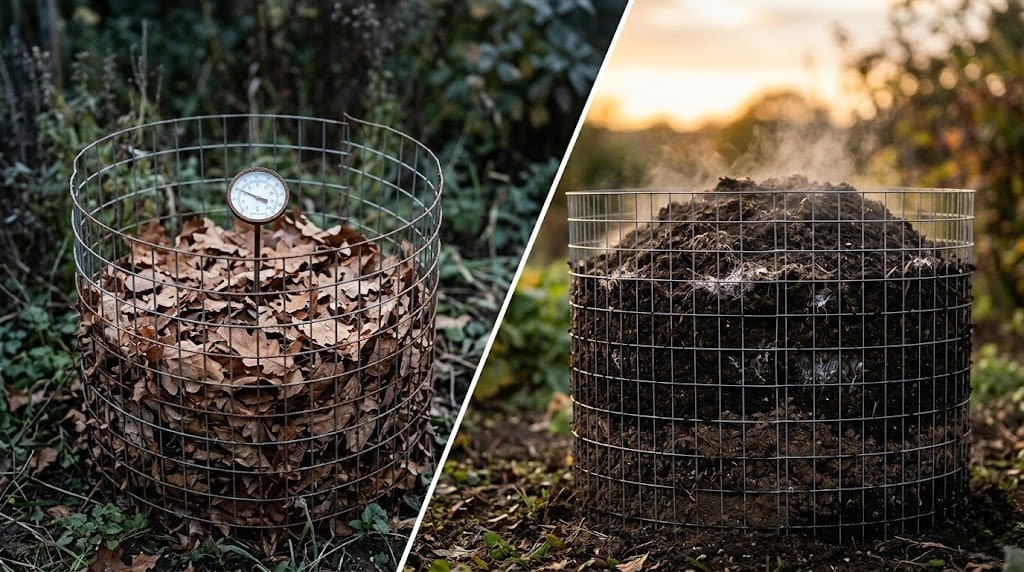
- Below 1 cubic yard, pathogen kill is not guaranteed. Thermophilic composting, the process that reliably eliminates E. coli, Salmonella, and viable weed seeds, requires sustained internal temperatures above 131°F (55°C) for several days. Piles smaller than 1 cubic yard in an enclosed bin lack the thermal mass to generate and hold that temperature. Do not apply cold-composted manure or kitchen scraps directly to root vegetables or beds intended for harvest-ready crops without understanding this risk. For a detailed look at how manure nitrogen behaves before and after composting, see the manure nitrogen availability calculator.
- Shape selection changes the result substantially. A bin labeled “4×4” by a pallet seller is a box. A “4-foot wire bin” from a garden center is a cylinder. Entering a 4 ft diameter cylinder as a 4×4 box inflates the computed volume by roughly 27 cu ft — the entire minimum threshold for hot composting. Always confirm the geometry before entering dimensions.
- Fill height is not bin height. The calculator requires the height to which the bin is currently filled, not the maximum height the structure can hold. Entering the bin’s structural height for a half-full pile overstates usable volume and may produce a false “hot pile” pass.
Minimum Standards
- The USDA Natural Resources Conservation Service and most university extension composting guidelines cite 1 cubic yard (27 cubic feet) as the practical minimum pile volume for thermophilic activity in a managed bin system.
- For pathogen reduction using active composting, the EPA Process to Further Reduce Pathogens (PFRP) standards require maintaining temperatures above 131°F (55°C) for at least 3 consecutive days for turned windrows, or 15 days for static pile systems. Volume is a prerequisite condition, not a guarantee that these temperatures are reached.
- Ideal composting C:N ratio: 25:1 to 35:1. None of the three materials in this calculator (leaves at 60:1, grass at 20:1, manure at 15:1) sit within the ideal range alone. Blending is required for optimal decomposition speed. See the compost ratio calculator for blending math.
Competitor Trap: Most compost size guides online recommend a “3x3x3 foot pile” without specifying whether that refers to a cylinder or a box, or whether it means exterior dimensions or fill dimensions. A 3x3x3 box has 27 cubic feet of volume. A 3-foot diameter cylinder filled to 3 feet has 21.2 cubic feet, 22 cu ft short of the same benchmark. These guides produce false confidence in undersized round bins. The shape-specific formula in this calculator closes that gap.
Common Mistakes and Fixes
Mistake: Using exterior bin dimensions instead of interior fill dimensions
A four-pallet bin measured on the outside of the pallet boards might read 4.5 feet per side, but the interior clearance is closer to 3.8 to 4 feet. Pallet boards are 3 to 5 inches thick on each side. Inputting 4.5 feet instead of 4 feet overstates the volume by roughly 15 cu ft on a standard bin. For a calculation that already rides close to the 1 cu yd threshold, that margin can make the difference between a pass and a fail on the hot-pile check.
Fix: Measure from the inside face of one wall to the inside face of the opposite wall before entering any dimension.
Mistake: Ignoring pile settling when planning volume
Organic material settles quickly, especially nitrogen-rich materials like grass clippings. A pile that is 4 feet tall the day it is built may drop to 2.5 feet within a week as microbial activity begins and air pockets collapse. If you plan a bin based on the initial fill height and do not account for settling, the actual volume mid-composting may fall well below 1 cubic yard even if the initial calculation passed.
Fix: Plan for a finished height that is 60 to 70 cu of the initial build height, or size the bin so that even after settling it remains above 1 cu yd.
Mistake: Selecting the wrong material for a mixed pile
Using “Manure” for a pile that is mostly leaves with a small amount of manure thrown in will inflate the estimated material capacity by a factor of 10 or more, since manure bulk density (35 lbs/cu ft) is roughly 12 times higher than loose leaves (3 lbs/cu ft). The capacity output is only accurate when the selected material is truly dominant by volume.
Fix: Choose the material that makes up more than half of the pile volume. For blended piles, use the capacity number as a rough order-of-magnitude estimate only, and consult a blending calculator for precision. The soil bulk density calculator can help you understand how different materials pack and settle in combination.
Mistake: Treating the volume calculator output as a finished compost
yield estimate
The estimated material capacity in pounds is the weight of raw input material the bin holds. As that material decomposes, it loses moisture and carbon as CO2 and water vapor. The finished volume of mature compost is typically 30 to 50 cu of the starting input volume, and the dry weight can be less than half the fresh input weight. Planning how much finished compost a bed needs based on raw input pounds leads to undersupply at the end of the season.
Fix: Use this calculator to confirm bin size adequacy; use a separate raised bed soil or topdressing calculator to determine how much finished compost your beds require. The raised bed soil calculator can help you work backward from bed volume to compost need.
Mistake: Assuming a passing hot-pile check means no further action is
needed
Volume is a necessary condition for thermophilic composting, not a sufficient one. A 1.5 cu yd pile that is bone dry, poorly mixed, or made entirely of woody chips will not heat up regardless of its size. Moisture content (target: 40 to 60 cu by weight, roughly like a wrung-out sponge), adequate nitrogen content, and particle size all interact with volume to determine actual pile temperature.
Fix: After confirming your bin clears the 1 cu yd threshold, check pile moisture and use a C:N calculator to confirm the feedstock blend is within range before expecting thermophilic activity.
Related Tools and Next Steps
Once you know your bin volume, the logical next question is whether the materials inside it have the right carbon-to-nitrogen balance. The compost carbon-to-nitrogen ratio calculator lets you input multiple materials and their proportions to see the blended C:N ratio and identify what to add to reach the 25:1 to 35:1 target range.
If you plan to use finished compost to fill or amend a raised bed, calculate exactly how much you need before building the pile. The raised bed soil calculator computes required cubic footage and yards by bed dimensions and desired amendment depth.
Manure is a common high-nitrogen compost ingredient, but not all manure nitrogen is available to plants on the same timeline. The manure nitrogen availability calculator helps you understand how much plant-available nitrogen your manure contributes and how that changes over time and application method.
Finished compost applied as a soil amendment contributes organic matter that slowly releases nitrogen over multiple growing seasons. The soil organic matter nitrogen release calculator quantifies that slow-release N contribution so you can credit it accurately against fertilizer needs.
If you are brewing compost extracts or teas to apply microbially active compost liquid to crops, the compost tea recipe tool provides ratio guidance for steeping finished compost in water for foliar and drench applications.
Planning a custom growing medium with compost as one component? The soil mix calculator helps you proportion compost, peat, bark, and other materials by volume to hit a target mix ratio for containers or in-ground beds.
If you need to adjust the pH of soil receiving large compost applications, especially if the compost is manure-heavy and trending alkaline, the soil pH sulfur calculator will calculate how much elemental sulfur is needed to bring pH down to the crop target range.
FAQ
What is the minimum compost bin size to get hot compost?
The widely cited minimum is 1 cubic yard, equivalent to 27 cubic feet. This threshold reflects the thermal mass needed for a bin system to retain enough metabolic heat from microbial activity to sustain temperatures above 131°F. Smaller piles decompose but remain cool, slow, and do not reliably eliminate pathogens or weed seeds. Bin shape and fill height both affect whether your structure actually reaches this volume.
How do I calculate compost bin volume in cubic yards?
First calculate volume in cubic feet: for a cylinder, use π times the radius squared times height; for a box, multiply length times width times height. Then divide the cubic foot result by 27 to convert to cubic yards. One cubic yard equals 27 cubic feet. The calculator on this page performs both steps automatically and flags whether the result clears the thermophilic composting minimum.
Does compost bin shape (cylinder vs. box) affect volume significantly?
Yes, substantially. A cylinder inscribed within a square of the same width holds less volume than the square. A 4-foot diameter cylinder 4 feet tall holds about 50 cubic feet. A 4x4x4 box holds 64 cubic feet — about 27 cu more volume from the same nominal “4-foot” description. Comparing bins by their stated size label without specifying shape leads to consistent underestimates of cylindrical bin volume.
What does the C:N ratio output tell me?
The C:N output shows the approximate carbon-to-nitrogen ratio of the primary material selected, not the blended ratio of the whole pile. It is a reference point for understanding whether your dominant feedstock is carbon-rich (browns like leaves at 60:1) or nitrogen-rich (greens like grass at 20:1). The ideal range for active composting is 25:1 to 35:1; single-material piles rarely fall within that window without blending.
Why is the material capacity estimate in pounds, not bags or
wheelbarrows?
Pounds is the most stable unit for estimating material volume-to-weight relationships across different feedstocks, since bulk density (lbs per cubic foot) is the calculation input. Bags and wheelbarrow loads vary widely by brand, material compression, and fill level. Using pounds lets you compare material loads on a common basis, even if the practical handling unit in your yard is something different.
Can I use this calculator for an open pile (no bin walls)?
The volume formulas are geometry-only and technically apply to any pile shape. However, the 1 cubic yard hot-pile threshold was established for enclosed or semi-enclosed bin systems that retain heat on at least three or four sides. An open pile (exposed on all sides) loses heat faster and may need more volume to sustain thermophilic temperatures, particularly in cool climates or windy locations. Use the threshold as a conservative minimum for open piles, not a guarantee.
Conclusion
The single most important mistake to avoid after using this tool is accepting a “passing” volume result as a complete green light. Volume is the gating requirement, not the complete recipe. A pile that clears 1 cubic yard but lacks adequate moisture or has a C:N ratio skewed by a single nitrogen-heavy or carbon-heavy material will still compost slowly. Pair this volume check with a C:N analysis using the compost ratio calculator to give your pile the best conditions for rapid, thermophilic breakdown.