
Adding liquid ballast to rear tractor tires is one of the most cost-effective ways to increase traction and lower the center of gravity. The problem is not whether to add ballast, it is which liquid to choose and exactly how much to put in. Those two decisions have consequences that are rarely explained side by side, which is why a tractor that got a good calcium chloride fill five years ago is now eating a rim from the inside out.
This tractor tire ballast calculator computes the volume of liquid needed at any fill percentage, the total added weight per tire, and the combined ballast weight across multiple tires. It does not predict field performance, account for axle load ratings, or replace the manufacturer’s weight specifications. Knowing those limits before you use the output is what makes the number actionable. If you are balancing a loader or front-end implement alongside rear ballast, your rear axle load calculation needs to account for the counterweight effect; the 3-point lift capacity calculator is a useful companion for that conversation.
After running this tool, you will know how many gallons to source, what to expect on the scale, and whether your current liquid choice is costing you a rim.
Use the Tool
Liquid Tire Ballast Weight & Rim Capacity Calculator
Calculate added ballast weight, volume, and the safest liquid choice for your tractor tires.
| Liquid | lbs/gal | Gal/Tire | lbs/Tire | Rim-Safe? |
|---|
How This Calculator Works
Formula Steps
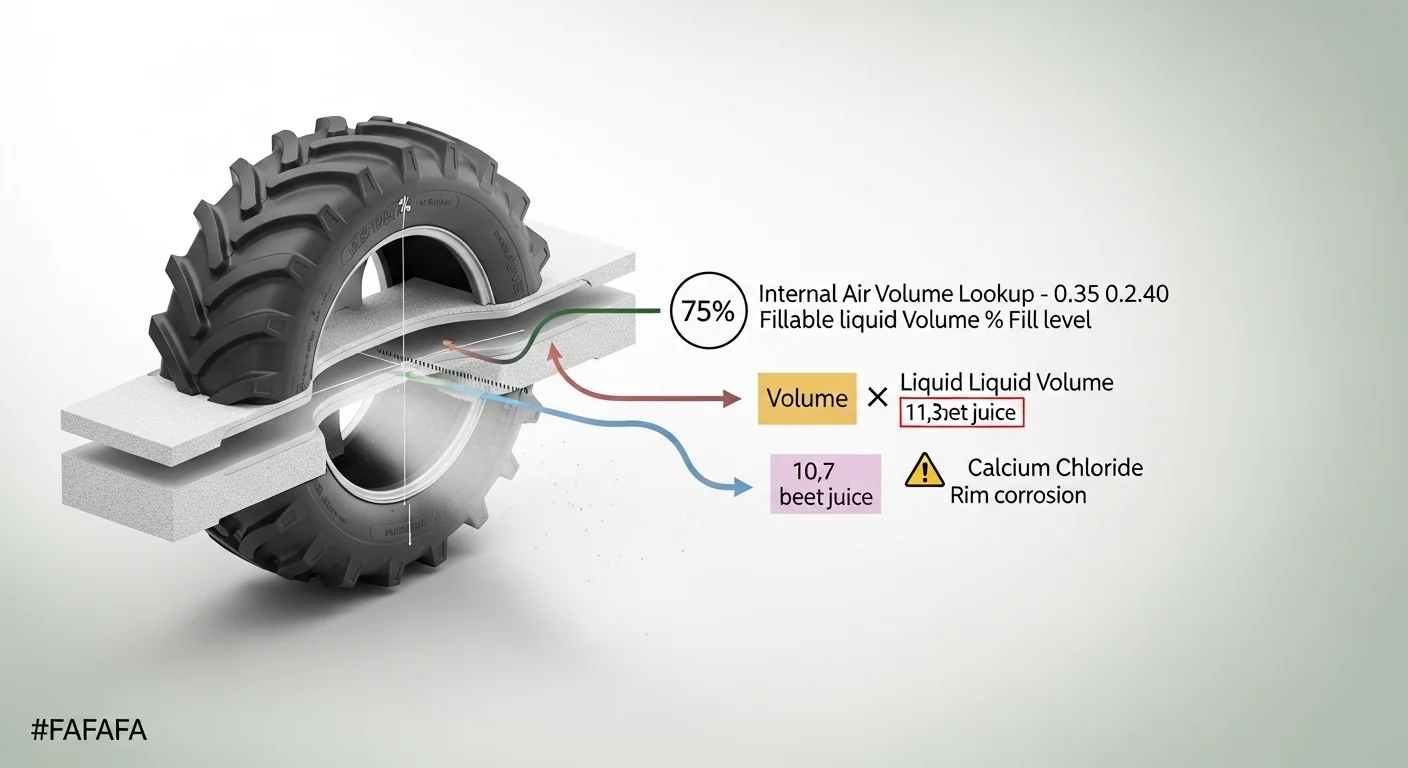
- Step 1 – Total Tire Volume: Look up the air capacity of your selected tire size from a calibrated tire volume reference table (gallons).
- Step 2 – Fillable Volume:
Fillable Volume (gal) = Total Tire Volume × (Fill% ÷ 100). At 75% fill, the liquid covers the valve stem at the lowest point — the industry standard to prevent air-locking the valve. - Step 3 – Liquid Density: Look up the density of your selected liquid type (lbs/gallon). Water = 8.34, Beet Juice/Rim Guard ≈ 10.7, Calcium Chloride solution ≈ 11.3, RV Antifreeze ≈ 8.7.
- Step 4 – Added Weight Per Tire:
Added Weight (lbs) = Fillable Volume × Density - Step 5 – Total Weight:
Total Added Weight = Weight per Tire × Number of Tires
Key Assumptions
- Tire volumes are standard-inflation reference volumes, not maximum rated volumes.
- Calcium Chloride solution is assumed at the standard 31% concentration used for tire ballast.
- Fill percentage applies uniformly; actual fill may vary by 1–3% depending on valve placement.
- The 75% fill level is the universally accepted maximum that keeps the valve stem above the liquid level during any wheel rotation.
Assumptions & Limits
What This Tool Does Not Account For
- Load index ratings — always verify your rim and axle weight capacity before adding ballast. Exceeding axle ratings voids warranties and is a safety hazard.
- Freeze-up risk — Water freezes at 32°F. Calcium Chloride solution protects to approximately -35°F but is highly corrosive. Beet Juice / Rim Guard protects to -35°F with zero corrosion risk.
- Tube-type vs. tubeless tires — Calcium Chloride is especially destructive in tube-type tires where pinhole leaks trap corrosive fluid against the steel rim 24/7.
- Regional climate — Always choose a liquid rated below the lowest ambient temperature in your area.
- Tire size accuracy — Tire volumes are reference approximations. Custom, dual, or metric tire sizes may differ by up to 5%.
Safety Note
- Do not exceed 90% fill under any circumstances — trapped air compression at operating tire pressures can cause dangerous pressure spikes.
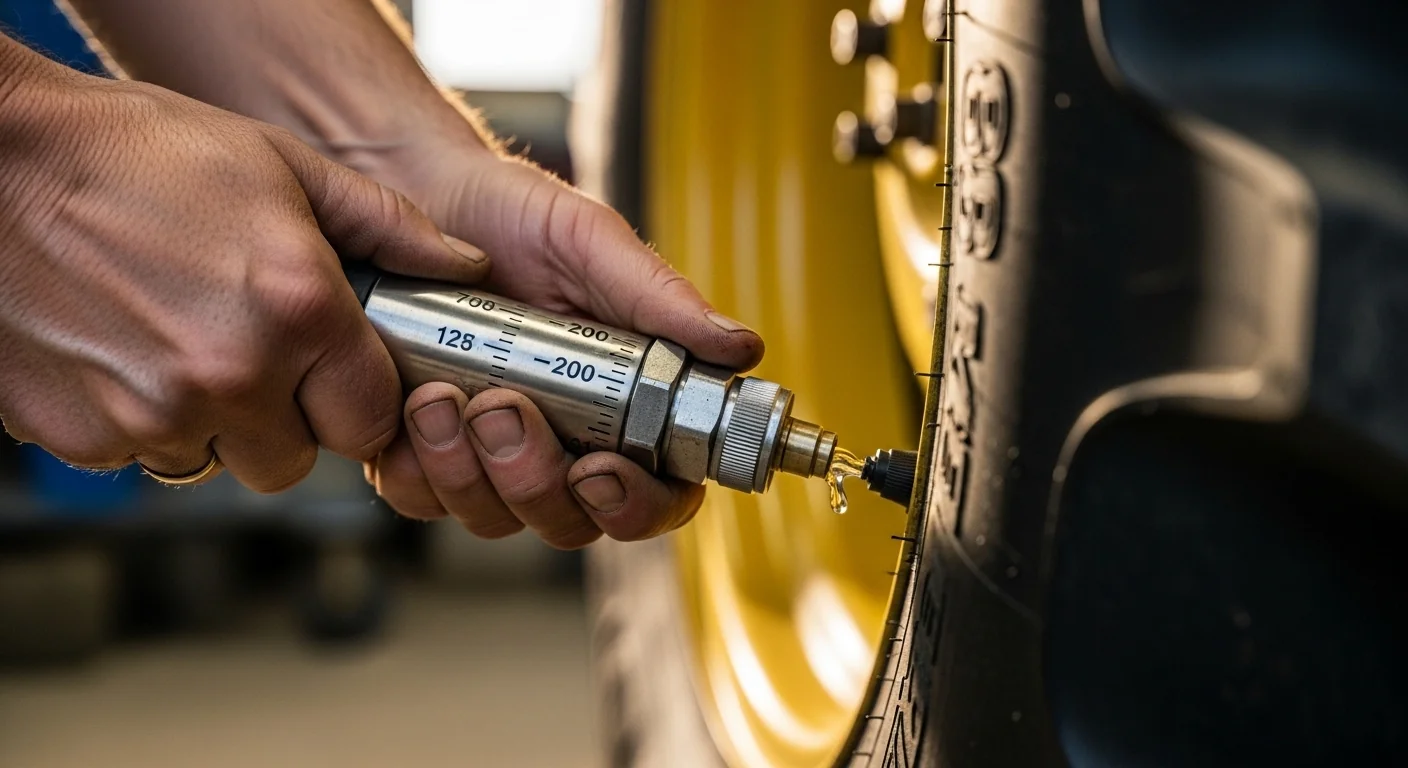
- Always use liquid-safe Schrader valve cores rated for liquid ballast service. Standard cores corrode rapidly in contact with CaCl₂ or beet juice.
Before you start, have your rear tire sidewall in front of you. The size is molded into the rubber and follows a format like 18.4-38 or 16.9-30. You will also need to decide on a fill percentage (75 is the industry standard and the safest default), a liquid type, and the number of tires you plan to fill. If you are filling both rear tires, enter 2. Dual configurations should be calculated per physical tire, not per axle position. If your setup involves a loader or a front-mounted implement that shifts weight forward, check your front axle rating alongside the rear; the tractor loader lift capacity reference covers how front-end weight interacts with rear ballast balance.
Quick Start (60 Seconds)
- Rear Tire Size: Match the size exactly as it appears on the tire sidewall. Common errors include confusing a 16.9-28 with an 18.4-28; those two sizes differ by roughly 9 gallons at 75% fill.
- Desired Fill %: Enter a number between 25 and 90. The standard fill is 75%, which keeps the valve stem above the liquid line at every rotational position. Do not guess; a fill above 75% locks out normal inflation.
- Liquid Type: Select the specific fluid you plan to use. Each has a different density (lbs per gallon), which directly multiplies into the weight output.
- Number of Tires: Enter 1, 2, 3, or 4. The calculator scales the total volume and total weight by this count. Most rear-fill jobs are 2 tires.
- Run the calculation before you order fluid. Source volumes in full drum or tote quantities; the calculator’s gallon output is what you need per tire and in total.
- Note your total added weight. Compare it against your rear axle load rating from the operator manual before ordering. Ballast math alone does not confirm axle compliance.
- Check your valve core type before any liquid is added. Standard Schrader cores corrode in contact with calcium chloride or beet juice. Liquid-rated cores are a required item, not optional.
Inputs and Outputs (What Each Field Means)
| Field | Unit | What It Represents | Common Mistake | Safe Entry Guidance |
|---|---|---|---|---|
| Rear Tire Size | Designation (e.g., 18.4-38) | The section width and rim diameter code molded into the tire sidewall; maps to a calibrated internal air volume | Entering a rim size in inches instead of the full tire designation | Read directly from the tire sidewall; do not rely on a catalog listing |
| Desired Fill % | % (25 to 90) | The fraction of the tire’s total air volume that will be occupied by liquid | Assuming 100% fill is acceptable; it traps air under pressure and submerges the valve core | Use 75% as the default; raise only if the manufacturer explicitly authorizes a higher fill |
| Liquid Type | Named selection | The specific ballast fluid; each has a distinct density that multiplies directly into added weight | Choosing calcium chloride purely for its weight advantage without accounting for rim corrosion risk | Compare the density values and the corrosion ratings before selecting |
| Number of Tires | Count (1 to 4) | How many tires will be filled; scales the total volume and weight outputs | Entering axle count instead of physical tire count on dual setups | Count each physical tire independently; each gets its own fill volume |
| Volume Per Tire | Gallons | Fillable liquid volume for one tire at the selected fill percentage | Using this as a drum-order quantity without rounding up for waste and pump-line dead volume | Add 2 to 3 gallons to your order quantity per tire as a handling buffer |
| Total Volume (All Tires) | Gallons | Volume Per Tire multiplied by the number of tires; your total sourcing quantity | Ordering exactly this amount with no overage | Order 5 to 10% above the calculated total to account for transfer losses |
| Added Weight Per Tire | Pounds | The primary ballast output; liquid volume multiplied by the liquid’s density | Comparing this number to front-axle weight without considering the full tractor moment arm | Use this value in your axle load calculation alongside tractor static rear weight |
| Total Added Weight | Pounds | The combined ballast across all filled tires | Assuming total added weight equals total rear axle load (it does not; static tractor weight must be added) | Add this to the listed rear axle static weight in your operator manual before comparing to the axle rating |
Worked Examples (Real Numbers)
Example 1: Small Utility Tractor, 14.9-28 Rear Tires, Beet Juice
- Tire size: 14.9-28 (total internal volume: 39 gallons)
- Fill percentage: 75%
- Liquid: Beet Juice / Rim Guard at 10.7 lbs per gallon
- Number of tires: 2
Result: Fill volume per tire = 29.3 gallons. Added weight per tire = 313 lbs. Total added weight for both tires = 626 lbs.
For a compact utility tractor in the 40 to 60 horsepower range, 626 lbs of rear ballast represents a meaningful improvement in front axle load distribution when running a heavy 3-point implement. The beet juice choice keeps that rim intact for the life of the tire.
Example 2: Mid-Size Row Crop Tractor, 18.4-38 Rear Tires, Calcium Chloride
- Tire size: 18.4-38 (total internal volume: 87 gallons)
- Fill percentage: 75%
- Liquid: Calcium Chloride solution at 11.3 lbs per gallon
- Number of tires: 2
Result: Fill volume per tire = 65.3 gallons. Added weight per tire = 737.6 lbs. Total added weight = 1,475 lbs.
This is a common setup on row-crop tractors running heavy tillage. The weight advantage over beet juice at the same fill is approximately 39 lbs per tire. Whether that difference justifies the rim corrosion risk depends on the age and condition of the rims and the climate, since freeze-thaw cycling accelerates CaCl2 damage to rim metal.
Example 3: Large Four-Wheel Drive, 30.5-32 Rear Tires, Beet Juice, Four Tires
- Tire size: 30.5-32 (total internal volume: 215 gallons)
- Fill percentage: 75%
- Liquid: Beet Juice / Rim Guard at 10.7 lbs per gallon
- Number of tires: 4
Result: Fill volume per tire = 161.3 gallons. Added weight per tire = 1,725.8 lbs. Total added weight across four tires = 6,903 lbs.
On a large articulated or four-wheel drive tractor, this volume of ballast significantly affects machine mass, transport speed, and road legality. Confirm axle and chassis load ratings before sourcing; at this scale, exceeding ratings causes tire deformation and structural fatigue over time.
Reference Table (Fast Lookup)
All values below use a 75% fill factor, which is the standard fill level for liquid ballast. The weight columns are computed: Fill Volume x Density. Use this table for quick comparisons without running the full calculator.
| Tire Size | Total Vol (gal) | 75% Fill Vol (gal/tire) | Water lbs/tire (8.34) | Beet Juice lbs/tire (10.7) | Calcium Chloride lbs/tire (11.3) | RV Antifreeze lbs/tire (8.7) |
|---|---|---|---|---|---|---|
| 14.9-24 | 33 | 24.8 | 207 | 265 | 280 | 216 |
| 14.9-28 | 39 | 29.3 | 244 | 313 | 331 | 255 |
| 16.9-30 | 54 | 40.5 | 338 | 433 | 458 | 352 |
| 18.4-30 | 66 | 49.5 | 413 | 530 | 559 | 431 |
| 18.4-34 | 76 | 57.0 | 475 | 610 | 644 | 496 |
| 18.4-38 | 87 | 65.3 | 545 | 699 | 738 | 568 |
| 20.8-38 | 110 | 82.5 | 688 | 883 | 932 | 718 |
| 23.1-34 | 130 | 97.5 | 813 | 1,043 | 1,102 | 848 |
| 23.1-30 | 113 | 84.8 | 707 | 907 | 958 | 738 |
| 30.5-32 | 215 | 161.3 | 1,345 | 1,726 | 1,823 | 1,403 |
How the Calculation Works (Formula and Assumptions)
Show the calculation steps
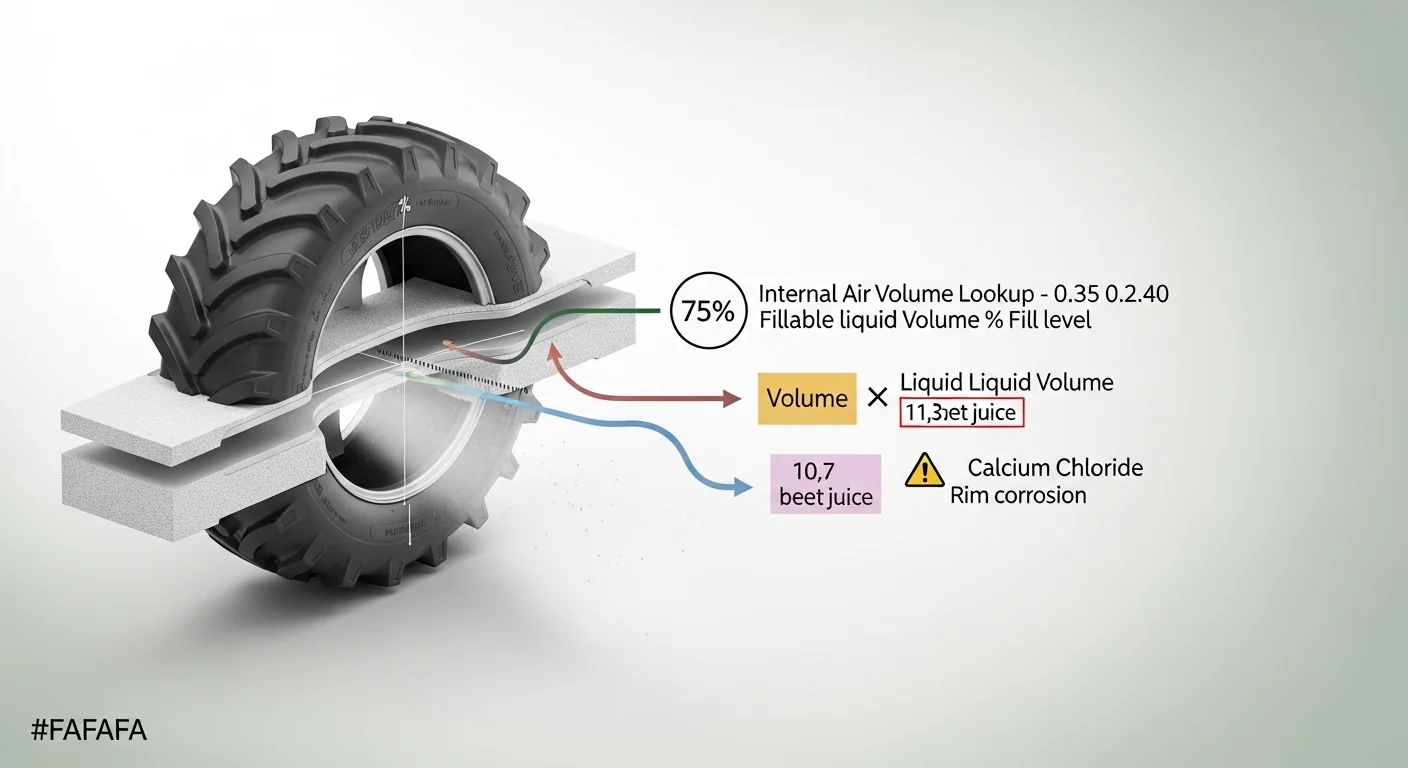
Step 1: Look up total tire volume. Each tire size designation corresponds to a standardized internal air volume in gallons. This calculator uses a reference lookup table calibrated to standard-inflation volumes for common agricultural tire sizes. The size you enter maps directly to this pre-computed volume.
Step 2: Compute fillable volume. Fillable Volume (gallons) = Total Tire Volume x (Fill Percentage / 100). At 75% fill, an 87-gallon tire yields 65.25 gallons of liquid, rounded to one decimal place.
Step 3: Apply liquid density. Each liquid type carries a fixed density value in lbs per gallon: Water = 8.34, Beet Juice / Rim Guard = 10.7, Calcium Chloride solution (standard 31% concentration) = 11.3, RV Antifreeze = 8.7.
Step 4: Compute added weight per tire. Added Weight (lbs) = Fillable Volume x Density. Rounded to one decimal place.
Step 5: Scale to total tires. Total Added Weight = Weight Per Tire x Number of Tires. Total Volume = Fillable Volume Per Tire x Number of Tires.
Rounding rules: Intermediate values are kept to one decimal place. Final weight values are displayed to one decimal place. For sourcing purposes, always round your total volume up to the next whole gallon.
Assumptions and Limits
- Tire volumes are reference approximations based on standard inflation pressures. Actual internal volume varies by manufacturer, ply rating, and wear state; deviations of up to 5% are possible.
- Calcium Chloride density assumes a standard 31% concentration ballast solution. Concentrated CaCl2 added to water at non-standard ratios will produce a different density and a different weight result.
- The 75% fill standard assumes the valve stem is positioned at the standard location on the rim. Aftermarket rim assemblies or relocated valve positions may require a different maximum fill level.
- This calculator does not account for axle load ratings, tire load index limits, or chassis weight ratings. The added weight output must be summed with the tractor’s static rear axle weight before comparing to any rated capacity.
- Freeze protection ratings cited in the warnings reflect manufacturer data for each fluid type under controlled conditions. Field conditions with contaminated or diluted ballast fluid may reduce freeze protection.
- The calculator assumes uniform fill across all tires entered. If you are filling tires of different sizes on the same tractor (for example, duals of mixed designation), run a separate calculation for each size.
- RV antifreeze density assumes propylene glycol-based formulations marketed for non-toxic service. Ethylene glycol antifreeze has a different density and is not appropriate for agricultural tire ballast.
Standards, Safety Checks, and Secret Sauce Warnings
Critical Warnings
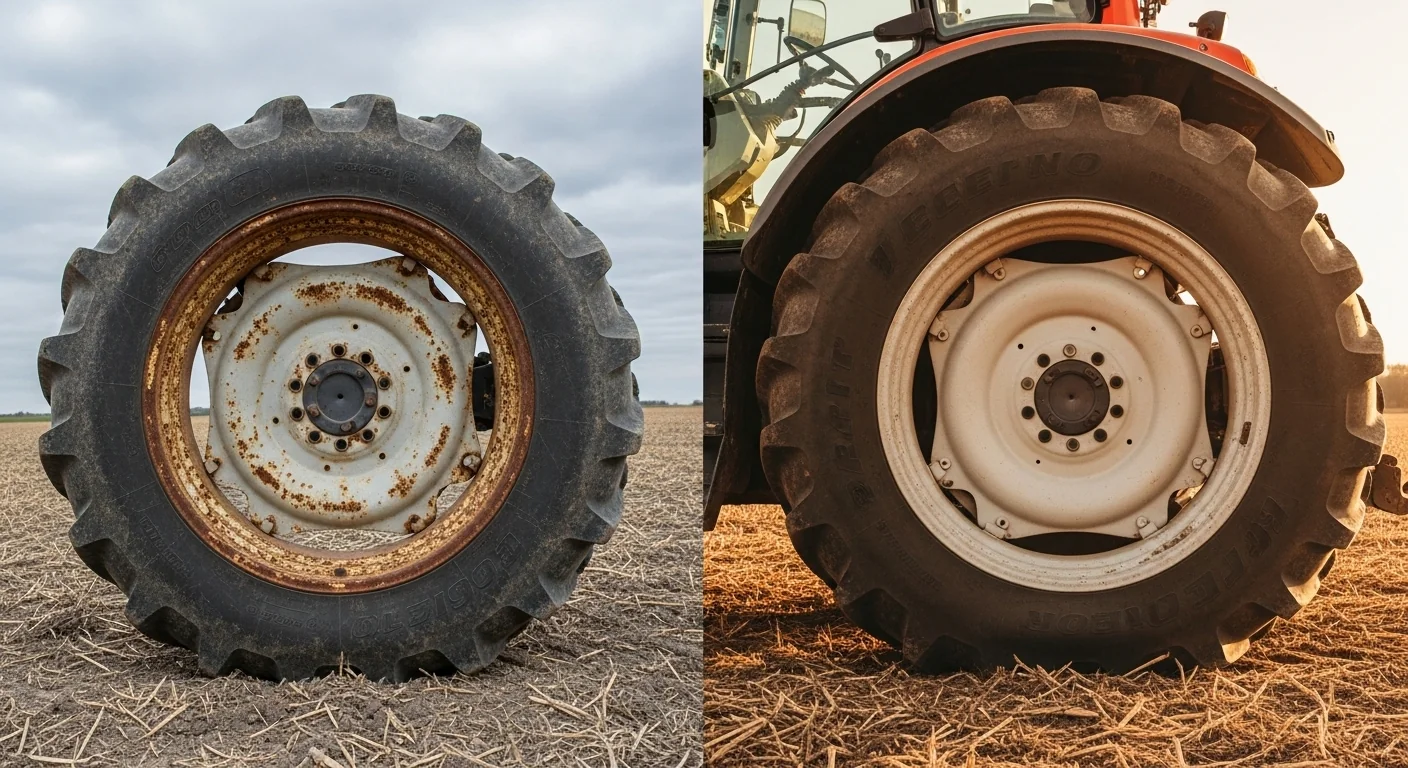
- The Rust-Out Rim failure mode: Calcium chloride solution is corrosive to steel. When a tire with CaCl2 ballast develops a pinhole leak in a tube or valve seal, the fluid pools against the rim’s inner surface continuously. Steel corrosion progresses from the inside out, where it cannot be seen or detected until the rim is structurally compromised. A rim that appears sound on the outside may be critically thinned on the bead seat. This is not a hypothetical failure; it is the reason implement dealers in cold climates have moved away from calcium chloride recommendations over the past decade.
- Valve core incompatibility: Standard automotive Schrader valve cores are not rated for prolonged contact with calcium chloride, beet juice, or other ballast fluids. Corrosion of the valve core body causes slow leaks that are difficult to locate, and it accelerates the pooling risk described above. Always install heavy-duty liquid-rated valve cores specifically marketed for tire ballast service before filling.
- Fill above 75% locks inflation access: When the liquid level covers the valve stem, you cannot add air without first partially draining the tire. On a working tractor with a flat tire in the field, that means an hours-long drain-and-reflate procedure. The 75% fill limit exists specifically to prevent this situation.
- Water ballast in freezing climates: Water freezes at 32 degrees Fahrenheit with no protection. Ice expansion inside a tire can split a bead, crack a rim flange, or shear a valve core entirely. Water is appropriate only where temperatures are reliably above freezing year-round.
Minimum Standards
- Fill must not exceed 90% under any conditions. Air trapped above the liquid provides a small compressibility buffer; filling beyond 90% eliminates that buffer and creates dangerous internal pressure spikes at operating temperatures.
- All liquid ballast installations require liquid-rated valve cores and a compatible tire pressure gauge capable of accurate readings through the valve core type in use.
- Calcium chloride ballast should be inspected for rim corrosion whenever tires are dismounted for any reason. Any visible rust scale or pitting on the rim’s inner bead seat area warrants a rim replacement evaluation before reinstallation.
The Competitor Trap: Most ballast comparison pages present the CaCl2 vs. beet juice decision as a simple weight-per-gallon tradeoff. They show that calcium chloride delivers 11.3 lbs per gallon versus 10.7 for Rim Guard and leave the decision there. That framing omits the only number that actually matters over a five-to-ten year equipment ownership horizon: what a rim replacement costs versus what the per-gallon weight difference represents at any realistic tire size. On an 18.4-38 tire at 75% fill, the difference between CaCl2 and beet juice is approximately 39 lbs per tire. Whether that 39 lbs is worth the rim corrosion risk is a total cost of ownership question, not a density question. Pages that skip that math are not giving you the full picture. Rear ballast weight also directly affects how much pull your tractor can generate at the drawbar; for heavy draft applications where rear tire slip is the limiting factor, the drawbar horsepower calculator is a logical next calculation once your ballast figure is confirmed.
Ballast weight interacts with ground engagement on implements that rely on tractor weight for penetration. If your workflow includes a subsoiler, box blade, or heavy disc harrow, understanding how rear ballast mass translates to pull force is a separate but adjacent calculation. The subsoiler horsepower requirements tool addresses the traction-versus-draft relationship for deep tillage configurations.
Common Mistakes and Fixes
Mistake: Choosing liquid type based on weight alone
The density ranking (CaCl2 > beet juice > RV antifreeze > water) is accurate, but weight per gallon is only one variable in a multi-variable decision. Rim material, climate, tube vs. tubeless construction, expected tire service life, and local fluid availability all affect which choice has the lowest five-year total cost. Selecting CaCl2 to maximize ballast weight without accounting for rim corrosion converts a cheap ballast decision into an expensive rim replacement decision on a timeline that is easy to miss year to year.
Fix: Use the reference table to quantify the actual per-tire weight difference between CaCl2 and beet juice at your specific tire size, then weigh that number against the cost of a rim before deciding.
Mistake: Filling to 100% or above 90%
A tire filled completely has no air buffer. Thermal expansion of liquid at operating temperatures can spike internal pressure well above the tire’s rated maximum. Beyond the pressure risk, a fully filled tire cannot be inflated or deflated without first draining fluid, which eliminates normal tire pressure management entirely. Some operators assume more liquid always means more weight and more traction; beyond the 90% ceiling, it means a tire under stress.
Fix: Use 75% as the default fill. Only deviate upward with explicit guidance from the tire manufacturer and only to a maximum of 90%.
Mistake: Using standard valve cores with liquid ballast
This is the most frequently skipped step in a DIY tire fill. Standard Schrader cores are not designed for continuous immersion or repeated contact with corrosive or viscous fluids. Corrosion of the valve body creates slow leaks that are hard to detect, and it accelerates the exact rim corrosion scenario described in the warnings above. Many operators discover the failure only when a tire pressure check shows unexplained loss weeks after filling.
Fix: Purchase liquid-rated, heavy-duty valve cores before sourcing any ballast fluid. Replace all cores in tires being filled.
Mistake: Not accounting for the effect on turning radius
Added rear ballast changes the tractor’s handling characteristics in ways that matter for row-crop work, loader operations, and transport. The additional weight shifts the center of mass rearward, alters steering response, and increases the minimum turning radius under load. Operators who add significant ballast without reassessing their turning space sometimes encounter geometry conflicts with headlands, gate widths, and implement end-rows. The tractor turning radius calculator is a direct way to check whether your ballasted configuration still fits the geometry of your operation.
Fix: Run a turning radius check after finalizing your ballast weight to confirm that headland clearances remain adequate.
Mistake: Ordering exactly the calculated volume with no buffer
The calculator’s total volume output is the theoretical fill requirement under ideal conditions. Real transfer pumps leave fluid in hoses and fittings, valves trap small volumes, and some fluid is always lost at disconnects. Ordering exactly the calculated number of gallons often means running slightly short on the last tire, requiring a second order for a small top-off quantity.
Fix: Add 5 to 10% to your total volume figure when placing a fluid order, and round up to the nearest full drum or tote size available from your supplier.
Next Steps in Your Workflow
Once you have your ballast weight and volume figures, the immediate next step is confirming that the added weight does not push your rear axle load over its rated capacity. Pull your operator manual and locate the rear axle weight rating; add the calculator’s total added weight to the listed rear static weight for your tractor configuration. The rear weight figure from this calculation also feeds directly into PTO-shaft selection on any rear-mounted driven implement, since rated shaft torque is affected by total rear overhang mass; the PTO shaft sizing calculator is the right tool for that follow-on check.
After the axle load check, the fluid sourcing step is straightforward: divide your total volume by the package size available from your supplier (drums are typically 55 gallons, totes range from 250 to 330 gallons) and round up. Then confirm your valve core inventory before the fill date. For operations where this ballast addition is part of a larger seasonal equipment setup, running the tractor ground speed calculator after ballasting can be a useful check if you are calibrating implement pass rates or spray applications where ground speed accuracy matters.
FAQ
What is the standard fill percentage for liquid tire ballast?
The universally accepted standard is 75%. At this level, the valve stem remains above the liquid surface at every rotational position of the wheel, allowing normal tire inflation and deflation without draining. Filling above 75% is possible up to a hard maximum of 90%, but it requires more planning for routine pressure checks and should only be done when the tire manufacturer explicitly supports it.
How much does beet juice weigh per gallon compared to calcium chloride?
Beet juice (Rim Guard and comparable products) weighs approximately 10.7 lbs per gallon. Calcium chloride solution at standard 31% concentration weighs approximately 11.3 lbs per gallon. The difference is 0.6 lbs per gallon. On a large rear tire at 75% fill with 65 gallons of liquid, that difference amounts to about 39 lbs per tire, or 78 lbs for a two-tire rear fill.
Does liquid ballast prevent tractor rollover?
Liquid ballast lowers the center of gravity and increases rear traction, both of which contribute to rollover resistance on slopes and during implement draft. It does not eliminate rollover risk. A properly fitted rollover protection structure (ROPS) is the primary safety measure for tractor rollover; ballast is a secondary stability aid. Operators should consult manufacturer guidance on safe operating slopes with any given ballast configuration.
Can I mix different liquid types in the same tire?
Mixing ballast fluids is not recommended. Calcium chloride and water will dilute the CaCl2 concentration, reducing both the density and the freeze protection point below the expected values. Mixing calcium chloride with propylene glycol-based antifreeze may produce unexpected chemical interactions. Use a single fluid type per tire, and flush the tire if switching from one ballast type to another.
How do I remove liquid ballast from a tractor tire?
Liquid ballast is removed by positioning the valve stem at the lowest point of the wheel, removing the valve core, and allowing the fluid to drain under gravity with or without light air pressure assist. A liquid-rated transfer pump speeds the process significantly. Calcium chloride ballast requires careful handling and appropriate disposal; some municipalities restrict CaCl2 discharge. Beet juice and RV antifreeze are generally non-toxic and easier to manage.
What happens if I use a standard valve core with liquid ballast?
Standard Schrader valve cores are not designed for prolonged contact with calcium chloride, beet juice, or other ballast fluids. The core body corrodes, which leads to slow but persistent air leaks. In calcium chloride applications, a corroded core also allows the caustic fluid to wick along the valve stem toward the rim, contributing to localized rim corrosion at the valve hole. Liquid-rated replacement cores are a low-cost item that prevents both failure modes.
Conclusion
The tractor tire ballast calculator gives you two numbers that are genuinely hard to estimate by eye: exactly how many gallons to source and exactly how many pounds that adds to your rear axle. Those outputs move the ballasting decision from guesswork into planning. The unique angle this tool adds is the corrosion cost analysis built into the liquid comparison: beet juice and calcium chloride are close in density, but they are not close in what they do to a steel rim over a five-year period. That distinction is the one most comparison guides skip.
The single biggest mistake to avoid is selecting calcium chloride because it is the heaviest option without calculating whether the weight advantage is meaningful at your specific tire size, and without pricing out a rim replacement to compare. At smaller tire sizes, the per-tire weight difference between CaCl2 and Rim Guard is under 20 lbs. That is rarely worth the corrosion risk. At larger sizes the difference grows, but so does the cost of the rim that is at stake. Use the reference table to run that number before you make the call. For operations where rear ballast is one piece of a larger tractor setup, the rotary cutter sizing tool is a useful next step if your implements include rear-mounted PTO-driven equipment that also affects rear weight distribution.