
Firewood Cord Calculator
The Yield Grid — Homesteading & Livestock
Cord Conversion Reference
| Cord Type | Cu Ft | Dimensions (typical) | Notes |
|---|
How This Calculator Works
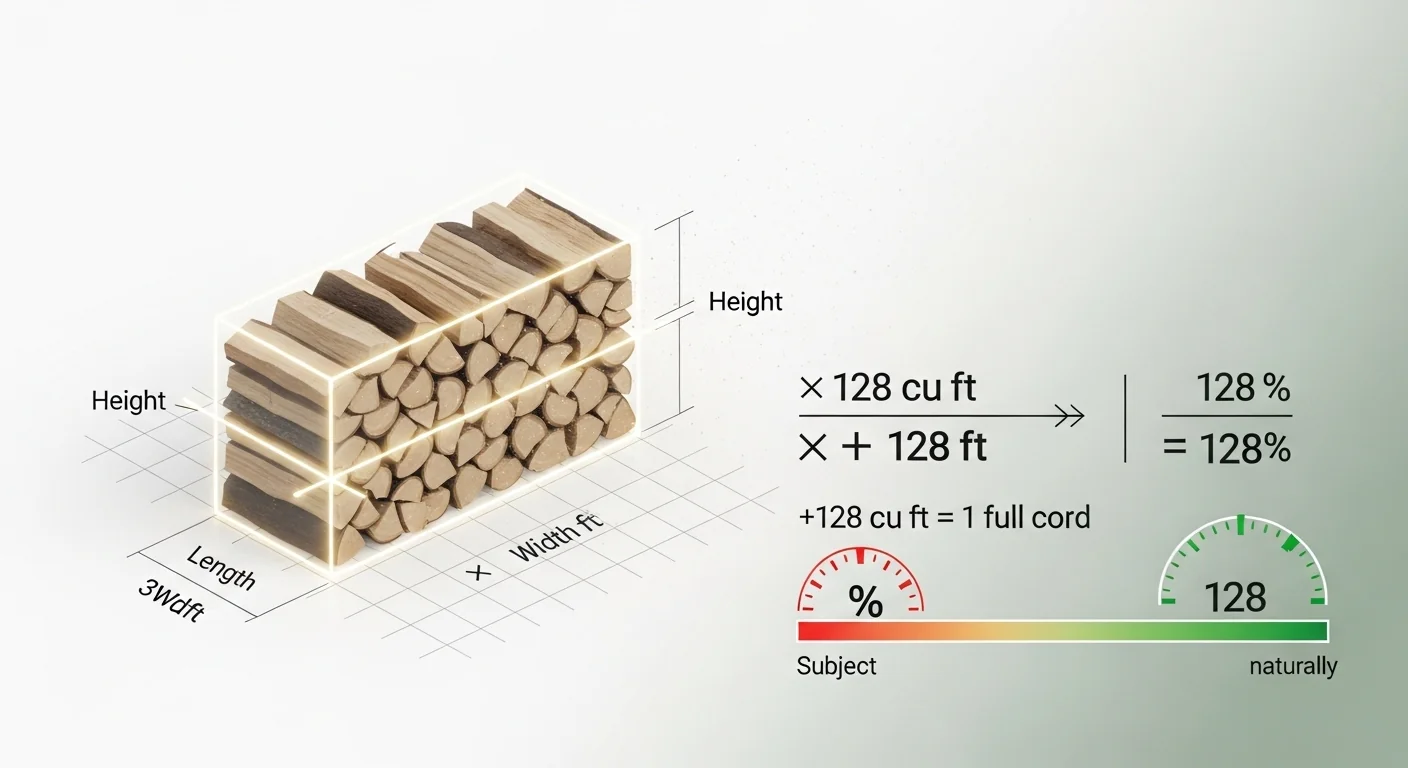
Length × Width × Height
Width is the depth of your stack (log length), typically 4 ft for standard firewood. Result is total cubic feet (cu ft).
Cu Ft ÷ 128
A full cord is defined as a stack of wood measuring 4 ft × 4 ft × 8 ft = 128 cubic feet. This is the legal standard in most U.S. states.
Cu Ft ÷ 42.6
A face cord (also called a rick) is 4 ft high × 8 ft long × 16 in (~1.33 ft) deep. ≈ 42.6 cu ft. It takes approximately 3 face cords to equal 1 full cord.
Full Cords × BTU/cord for selected wood
BTU values are published averages for air-dried (seasoned) firewood at ~20% moisture content. Green/wet wood delivers significantly less heat.
Buying or measuring firewood is deceptively straightforward until the stack arrives and something feels off. A delivery described as a “cord” might occupy far less space than the legal standard, or a stack you’ve been building all season might fall short of what’s actually needed. The problem is almost always the same: volume gets estimated by eye rather than calculated from dimensions. Stack length, depth (log length), and height each multiply together, and even a modest error in one dimension compounds into a significant shortfall of actual cubic feet.
This tool calculates gross stack volume in cubic feet, converts it to full cords and face cords, and flags whether your measurement meets the 128-cubic-foot legal standard for a full cord. It also estimates heat potential in BTUs based on wood species. What it does not do is account for air gaps between logs, green wood moisture loss, or regional cord definitions that occasionally differ from the federal standard. Understanding those limits is just as important as the output number. If you want to go further into the physical properties of individual logs, the log weight calculator covers density and weight by species in the same homesteading context.
Once you have your cubic feet and cord count, you can make a direct, defensible decision: did you receive a full cord, how much heat can you realistically expect this season, and whether it is worth calling your supplier before stacking anything else.
Use the Tool
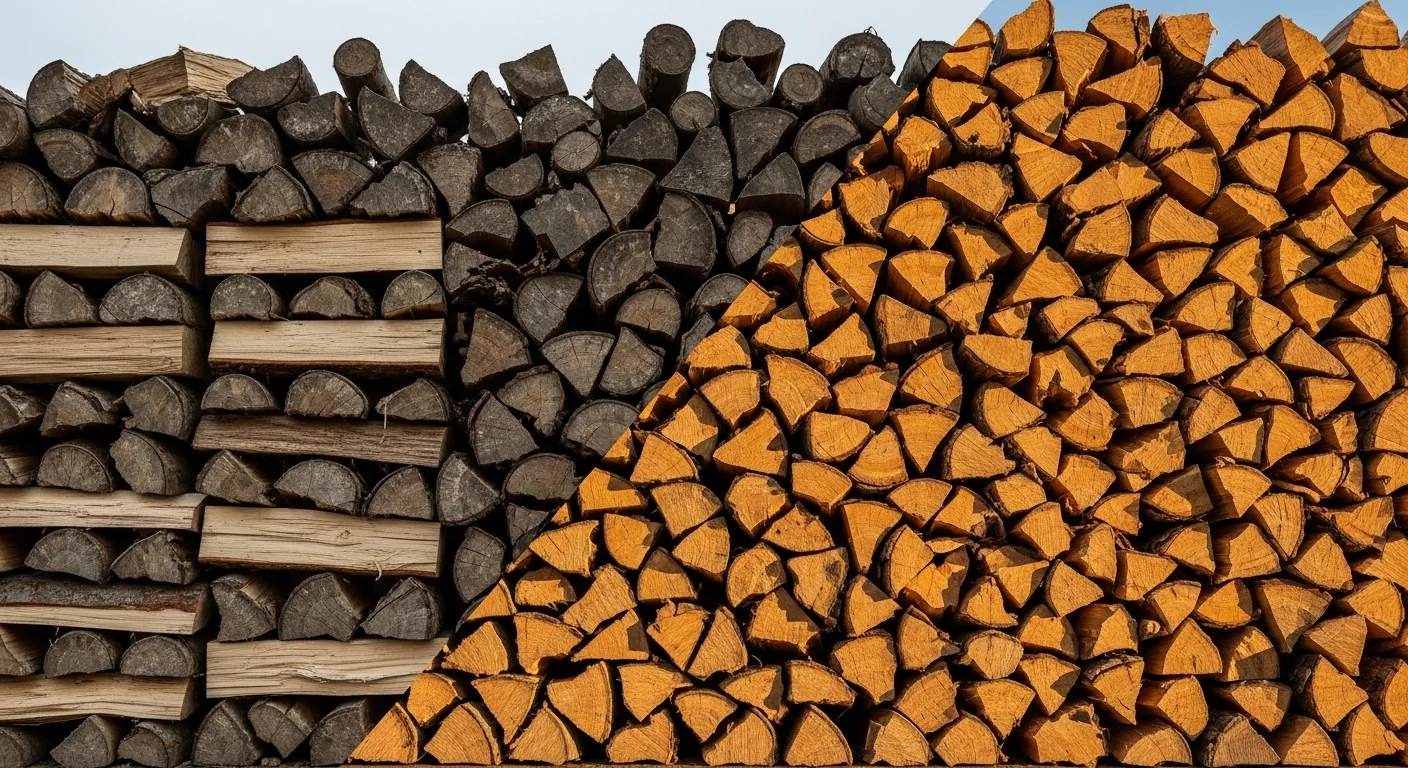
Before entering your dimensions, have a tape measure ready and measure the actual stacked pile, not the space allotted for it. Stack length is the end-to-end run of the pile. Stack width is the log length, also called depth, and it is the single most misreported measurement in firewood purchases. Stack height should be measured from the ground to the top of the actual wood, not to a sagging tarp or loose top layer. All three values go in as feet; enter decimal fractions for partial-foot measurements (for example, enter 3.5 for a 3-foot-6-inch height).
Quick Start (60 Seconds)
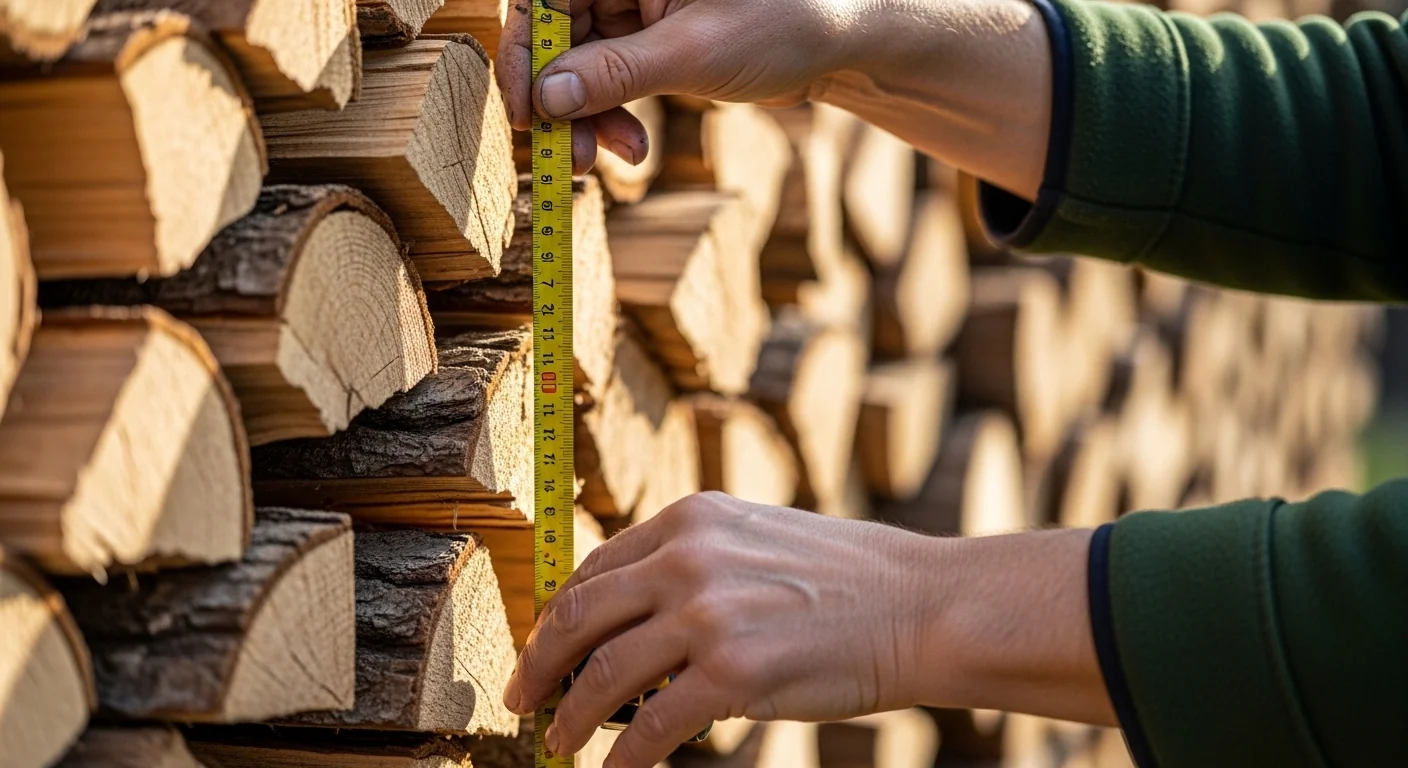
- Stack Length (ft): Measure the total horizontal run of the pile from one end to the other. A standard full-cord stack is 8 feet long. If your pile has gaps or irregular ends, measure only the wood, not the space.
- Stack Width (ft): This is the log length, the depth of the stack from front to back. Standard firewood is cut to 16 inches (1.33 ft), 18 inches (1.5 ft), or 24 inches (2 ft). A full cord requires 4-foot-long logs to achieve 128 cubic feet in a single row. Entering this in inches by mistake is the most common input error.
- Stack Height (ft): Measure from the ground to the consistent top of the stack. Do not measure the highest point of a rounded or uneven pile; use the average working height.
- Wood Type: Select the species closest to what you have. If you have a mixed pile, choose the dominant species or the one with the lower BTU value to get a conservative estimate.
- Units are always feet: Convert inches by dividing by 12. A 16-inch log length = 1.33 ft. A 42-inch height = 3.5 ft.
- Do not round up: Enter actual measured values. A stack that measures 7 feet 9 inches is 7.75 ft, not 8 ft. That difference alone removes more than 16 cubic feet from a standard-depth stack.
Inputs and Outputs (What Each Field Means)
Every field in this calculator has a specific physical meaning. Confusing any one of them with a similar-sounding measurement produces a result that can be significantly wrong. If you also work with other bulk-stacked commodities on your property, the approach to measuring stacked volume is similar to what’s used in the silage bunker capacity calculator, where L x W x H is always the starting point before any packing factor adjustments.
| Field | Unit | What It Means | Common Mistake | Safe Entry Guidance |
|---|---|---|---|---|
| Stack Length | feet | The horizontal length of the pile from end to end | Measuring the space the pile occupies rather than the actual wood run | Measure the actual wood face, not the ground footprint |
| Stack Width (Depth) | feet | The log cut length; how deep the stack is front-to-back | Entering inches instead of feet (e.g., 16 instead of 1.33) | Divide any inch measurement by 12 before entering |
| Stack Height | feet | Vertical height from ground level to the top of the usable pile | Measuring the tallest piece rather than the consistent stacking height | Use the height that the majority of the pile reaches; exclude outliers |
| Wood Type | selection | Species category used to estimate BTU heat output per cord | Selecting hardwood when the pile is softwood, inflating heat estimates | When species is unknown, select the lower-BTU softwood option for a conservative result |
| Cubic Feet (output) | cu ft | Gross stack volume: L x W x H | Treating gross volume as usable wood volume (actual wood is less, due to air gaps) | Use this figure to compare against the 128 cu ft cord standard |
| Full Cords (output) | cords | Cubic feet divided by 128; the legal unit for firewood sales in most U.S. states | Confusing face cords with full cords when comparing supplier quotes | Any value below 1.00 means you have less than a legal full cord |
| Face Cords (output) | face cords | Cubic feet divided by 42.6; also called a rick; one row of 16-inch logs stacked 4 ft high and 8 ft long | Assuming a face cord is equivalent to a full cord when purchasing | It takes approximately 3 face cords to equal 1 full cord |
| BTU Output (output) | million BTU | Estimated heat content based on full cord count and selected wood species | Applying the BTU figure to green (unseasoned) wood, which delivers far less heat | These values assume seasoned wood at roughly 20 percent moisture content |
Worked Examples (Real Numbers)
Example 1: A Textbook Full Cord
- Stack Length: 8 ft
- Stack Width (log length): 4 ft
- Stack Height: 4 ft
- Wood Type: Oak (23.6 million BTU per cord)
Result: 128.0 cubic feet | 1.00 full cord | 3.00 face cords | 23.6 million BTU
This is the textbook definition of a legal cord: 4 ft x 4 ft x 8 ft = 128 cubic feet. Oak at 23.6 million BTU per cord is one of the highest heat-density hardwoods available. A single cord of seasoned oak can run a mid-efficiency wood stove for roughly 260 hours at continuous output, depending on the unit’s rated BTU/hr.
Example 2: A Common Short Delivery
- Stack Length: 8 ft
- Stack Width (log length): 4 ft
- Stack Height: 3 ft
- Wood Type: Birch (17.5 million BTU per cord)
Result: 96.0 cubic feet | 0.75 full cords | 2.25 face cords | 13.1 million BTU
A stack that is only 3 feet tall instead of 4 feet loses a full quarter of a cord. This scenario is common with deliveries where the driver stacks loosely or loads to a visual impression of height rather than measuring. If you paid for a full cord at a going rate, you received only three-quarters of what you purchased. The Rip-Off Detector in the tool flags this as a below-full-cord result.
Example 3: One Face Cord (Rick)
- Stack Length: 8 ft
- Stack Width (log length): 1.33 ft (16-inch logs)
- Stack Height: 4 ft
- Wood Type: Pine (11.0 million BTU per cord)
Result: 42.6 cubic feet | 0.33 full cords | 1.00 face cord | 3.63 million BTU
A single face cord of 16-inch pine is roughly one-third of a full cord and provides the lowest heat density among common firewood species. This is a realistic starting supply for shoulder-season heating or occasional fires, but it falls far short of what most homes need for a primary heat source through a full winter.
Reference Table (Fast Lookup)
| Stack Configuration | L x W x H (ft) | Cubic Feet | Full Cords | Face Cords | Estimated BTU (Oak, 23.6M/cord) |
|---|---|---|---|---|---|
| Standard Full Cord | 8 x 4 x 4 | 128.0 | 1.00 | 3.00 | 23.6 million |
| Three-Quarter Cord | 8 x 4 x 3 | 96.0 | 0.75 | 2.25 | 17.7 million |
| Half Cord | 8 x 4 x 2 | 64.0 | 0.50 | 1.50 | 11.8 million |
| Quarter Cord | 4 x 4 x 2 | 32.0 | 0.25 | 0.75 | 5.9 million |
| Face Cord (Rick) | 8 x 1.33 x 4 | 42.6 | 0.33 | 1.00 | 7.8 million |
| Compact Pallet-Style Stack | 4 x 4 x 4 | 64.0 | 0.50 | 1.50 | 11.8 million |
| Shallow Porch Stack | 8 x 2 x 4 | 64.0 | 0.50 | 1.50 | 11.8 million |
| Double Full Cord | 16 x 4 x 4 | 256.0 | 2.00 | 6.01 | 47.2 million |
| Large Winter Supply | 16 x 4 x 6 | 384.0 | 3.00 | 9.01 | 70.8 million |
| Long Single Row | 12 x 4 x 4 | 192.0 | 1.50 | 4.51 | 35.4 million |
The BTU column is a derived estimate using Oak (23.6 million BTU per full cord) applied proportionally to each cubic footage. Substituting a different species changes the BTU output proportionally. A half cord of hickory (21.6 million BTU/cord) produces approximately 10.8 million BTU; the same half cord in pine (11.0 million BTU/cord) yields roughly 5.5 million BTU.
How the Calculation Works (Formula + Assumptions)
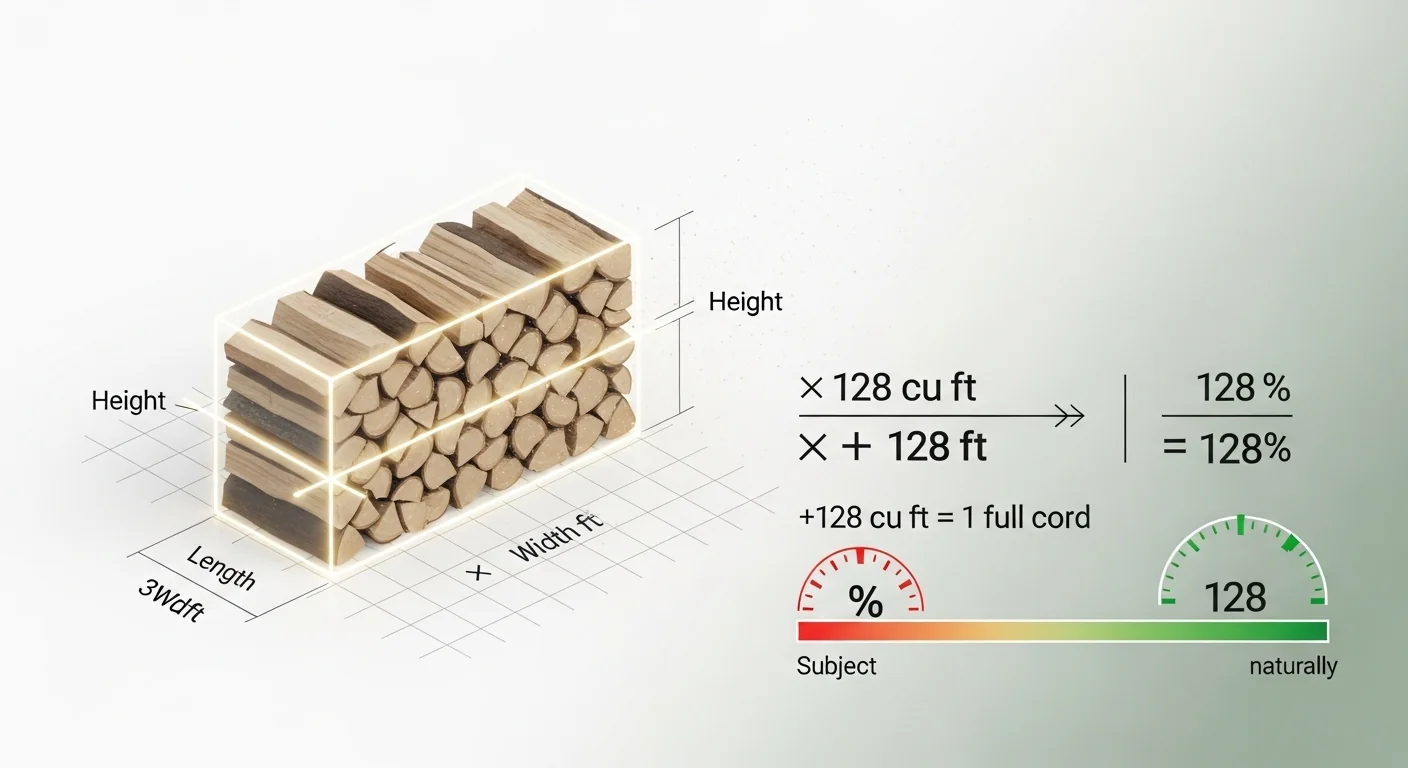
Show the calculation steps
Step-by-Step Formula
Step 1: Gross cubic feet
Cubic Feet = Stack Length (ft) x Stack Width (ft) x Stack Height (ft)
Example: 8 ft x 4 ft x 4 ft = 128.0 cu ft
Step 2: Full cords
Full Cords = Cubic Feet / 128
The value 128 is the legally defined volume of one full cord in the United States (4 ft x 4 ft x 8 ft). Division is straightforward; results are rounded to two decimal places.
Example: 128.0 / 128 = 1.00 cord
Step 3: Face cords
Face Cords = Cubic Feet / 42.6
A face cord (also called a rick) is one row of wood 4 feet high and 8 feet long, stacked one log deep at a 16-inch (approximately 1.33 ft) cut length: 4 x 8 x 1.33 = 42.56, rounded to 42.6 cu ft. Results are rounded to two decimal places.
Example: 128.0 / 42.6 = 3.00 face cords
Step 4: BTU estimate
Total BTU = Full Cords x BTU per cord for selected species
Each species has a published average BTU value per full cord, based on air-dried hardwood or softwood data. The result is displayed in millions of BTU for readability.
Example (Oak): 1.00 x 23,600,000 = 23,600,000 BTU = 23.6 million BTU
Assumptions and Limits
- Gross stack volume is always larger than actual wood volume. Air gaps between logs typically account for 15 to 20 percent of a stacked pile. This tool measures gross volume; the usable wood volume is somewhat less.
- BTU values assume properly seasoned wood at approximately 20 percent moisture content. Green (freshly cut) wood can contain 45 to 50 percent moisture, reducing effective heat output substantially.
- Log shape variation affects packing. Round logs with bark leave larger gaps than split, angular pieces. A pile of unsplit rounds may have significantly more air space than a tightly stacked pile of split wood at the same dimensions.
- Face cord volume (42.6 cu ft) assumes exactly 16-inch cut lengths. Logs cut to 18 inches, 20 inches, or 24 inches produce a proportionally larger face cord volume and a different full-cord equivalent ratio.
- The 128-cubic-foot cord standard is federal and applies in most U.S. states, but some states define the cord differently or regulate terms like “face cord” and “rick” separately. Local weights-and-measures regulations take precedence.
- This calculator does not account for settling. A freshly stacked pile that dries and settles over weeks may lose measurable height. A stack measured immediately after delivery may read slightly larger than its settled volume.
- All inputs are assumed to represent a single, roughly rectangular stack. Irregularly shaped piles or multiple separate stacks should be measured and calculated individually, then summed.
Standards, Safety Checks, and “Secret Sauce” Warnings
Critical Warnings
- A “cord” is a legal unit. In the U.S., the National Institute of Standards and Technology (NIST) Handbook 130 defines a cord as 128 cubic feet of stacked wood. Selling wood described as a “cord” when the actual measured volume is less is a violation of weights-and-measures law in most states. Measure before you stack, not after.
- Face cord confusion is the leading cause of firewood overpayment. A face cord is approximately one-third of a full cord. If a supplier quotes a price “per cord” but delivers a face cord, you receive about one-third the wood you paid for. The terms “rick,” “rank,” “face cord,” and “fireplace cord” are not standardized and should always be converted to cubic feet before comparing prices.
- BTU estimates degrade sharply with wet wood. The heat values in this tool assume seasoned firewood. Burning green wood does not just produce less heat; it also increases creosote buildup in flue systems, creating a fire hazard. A firewood thermometer or moisture meter is the only reliable way to confirm seasoning.
- Stack height measurement errors compound fast. Because height is one of three multiplied dimensions, a one-foot undercount in a standard 8 x 4 stack removes 32 cubic feet, which is a quarter of a cord. Always measure, never estimate by eye.
Minimum Standards
- A full cord must equal at least 128 cubic feet of stacked wood, verified by measuring length, width, and height in feet and multiplying.
- Firewood sold by the “cord” must be accompanied by a receipt showing the quantity and unit of measure in most U.S. states. Request this documentation from any supplier before payment.
- Seasoned firewood suitable for burning should test at or below 20 percent moisture content. Above that threshold, heat output drops and combustion byproducts increase.
Competitor Trap: Most firewood volume guides online simply show you the formula (L x W x H / 128) and move on. What they skip is the step that actually protects you: the comparison against the legal standard before you finish stacking. By the time a pile is fully stacked, you have lost leverage with your supplier. Calculate your cord count from the delivery measurements or from the truck bed dimensions before the wood leaves the vehicle. If you heat a barn or outbuilding in addition to your home, the barn ventilation calculator can help you size the airflow needs that directly affect how much wood you burn per heating season. Winter resource planning, whether it involves firewood, hay, or feed, benefits from working the numbers before the season starts rather than during it; the winter cattle feed calculator uses the same “calculate now, adjust early” logic for livestock operations.
Common Mistakes and Fixes
Mistake: Entering Log Length in Inches Instead of Feet
This is the single most frequent input error. A 16-inch log length entered as “16” in the width field instead of “1.33” inflates the cubic footage by a factor of twelve and produces a completely wrong cord count. The calculator expects all three dimensions in feet. Always divide inch measurements by 12 before entering.
Fix: Mentally confirm that your width entry is less than your stack height and stack length, since log depth is almost always the smallest dimension in a standard firewood stack.
Mistake: Measuring a Face Cord and Assuming It Equals a Full Cord
A face cord stacked to 4 feet high, 8 feet long, and one log deep with 16-inch cuts contains roughly 42.6 cubic feet, which is about one-third of a full cord. Many buyers see a substantial-looking pile and assume it is a cord. The physical impression of volume is misleading, particularly when logs are large in diameter.
Fix: Always convert any purchase to cubic feet first. Multiply the three dimensions and divide by 128. The face cord output in this tool also shows directly how many face cords you have, which makes the comparison clear. Measuring bulk commodities by their stacked dimensions is a skill that transfers across other farm inputs; the same logic behind getting an accurate count applies whether you are measuring wood or assessing hay bale weight for a bulk order.
Mistake: Measuring the Stack Space Instead of the Stack
Some buyers measure the area where the wood is stacked (the allocated space or the rack dimensions) rather than the actual wood pile dimensions. A rack built for a cord does not guarantee the rack is full. Gaps at the ends, uneven top layers, and partially filled sections all reduce the real volume below the rack’s designed capacity.
Fix: Measure the actual wood from its lowest point to its consistent height and from its interior end to the other interior end. Do not use the rack or storage frame dimensions as a proxy.
Mistake: Using Green-Wood BTU Values for Heating Season Planning
Planning a heating season around the BTU figures from this tool assumes the wood is seasoned and dry. Buying green wood in spring with the intention of burning it in fall often results in wood that is still above optimal moisture content by November, particularly in humid climates. The heat output is lower and creosote accumulation is higher.
Fix: Treat the BTU values as a ceiling, not a guarantee. If you are burning wood that was cut within the last six months, reduce your effective BTU estimate accordingly. A moisture meter reading above 20 percent is a direct indicator that the real heat output will be lower than the calculator result.
Mistake: Averaging Measurements Across an Uneven Stack
A pile that is 5 feet high in the middle and 3 feet high at the ends is not a 4-foot-high stack. Using the peak height rather than a representative consistent height overstates the volume, sometimes by a significant margin in loosely stacked or wind-shifted piles.
Fix: Measure height at three or four points along the length of the stack and use the lowest consistent measurement. This approach ensures the cord count is not overstated and reflects what you can actually expect from the pile.
Next Steps in Your Workflow
Once you have confirmed your cord count and heat estimate, the practical next step is comparing that figure against your actual heating requirement for the season. A typical well-insulated home in a cold climate uses one to three cords of hardwood per winter season for primary wood heat; a drafty older structure or large outbuilding can use considerably more. Your cord count from this tool gives you a concrete supply number to work with. From there, the question becomes cost per cord versus available alternatives. The hay cost calculator uses the same unit-cost logic for another bulk commodity that many homesteads manage alongside wood, and the approach to cost-per-unit comparison translates directly.
If you manage livestock in addition to heating your home, wood and feed purchasing often compete for the same fall budget window. Running the numbers on both before committing to suppliers gives you a clearer picture of total input costs. The feed cost calculator covers the livestock side of that planning and can be worked in parallel with your firewood procurement decisions. Order early, confirm volume in cubic feet before the wood leaves the truck, and keep your receipts with the cord measurement documented.
FAQ
What is the exact legal definition of a cord of firewood?
A full cord is defined as a stack of wood measuring 4 feet high, 4 feet wide (the log length or depth), and 8 feet long, yielding exactly 128 cubic feet of gross stacked volume. This definition is established by the National Institute of Standards and Technology (NIST) Handbook 130 and is adopted by most U.S. state weights-and-measures programs. Any sale of firewood described as a “cord” that does not meet this volume standard may be subject to regulatory action.
How many face cords make a full cord?
It takes approximately 3 face cords to equal 1 full cord, assuming all three use the same 16-inch log length and the same stacking height and length. The face cord formula (42.6 cubic feet) divides into 128 cubic feet approximately 3 times. If a face cord uses a different log length, such as 18 or 24 inches, the ratio changes and 3 face cords will no longer equal exactly 1 full cord.
Why do BTU values vary so much between wood species?
BTU output per cord is primarily driven by wood density. Dense hardwoods like oak and hickory pack more combustible material into the same cubic volume as lighter softwoods like pine or aspen. A cord of oak can contain nearly three times the heat energy of a cord of aspen. Moisture content at the time of burning is equally important; even high-density wood delivers dramatically less heat when it is not properly seasoned.
Does this calculator account for air gaps between logs?
No. This tool calculates gross stack volume from the three entered dimensions. The actual solid wood in any stack is always less than the gross volume because of the air space between logs. Published estimates suggest actual wood occupies roughly 80 to 85 percent of gross stacked volume, but this varies with log shape, split versus round, and stacking practice. The gross cubic footage is the standard used for legal cord measurement and for comparing supplier deliveries.
Is a “rick” the same as a face cord?
In common use, yes. A rick and a face cord both describe one layer of logs stacked to a given height and length, with the depth equal to one log length. The term “rick” is regional and informal, while “face cord” is more widely used in firewood commerce. Neither term is legally standardized at the federal level, which means a rick sold by one supplier may not be the same volume as a rick sold by another. Always convert to cubic feet for any comparison.
Can I use this calculator for a round, uneven, or tarped pile?
The calculator is designed for a roughly rectangular stacked pile. For irregular, round, or cone-shaped piles, the L x W x H formula will overstate the volume. In those cases, measure the largest consistent rectangular section of the pile and calculate that portion, then estimate the remainder separately. A covered or tarped pile should be measured underneath the tarp, not at the tarp’s outer dimensions.
Conclusion
The most consequential mistake remains confusing face cords with full cords, and the most consequential habit is making firewood quantity decisions by eye. Use the numbers. Measure your stack, confirm your cord count, and know exactly what you have before winter arrives.