
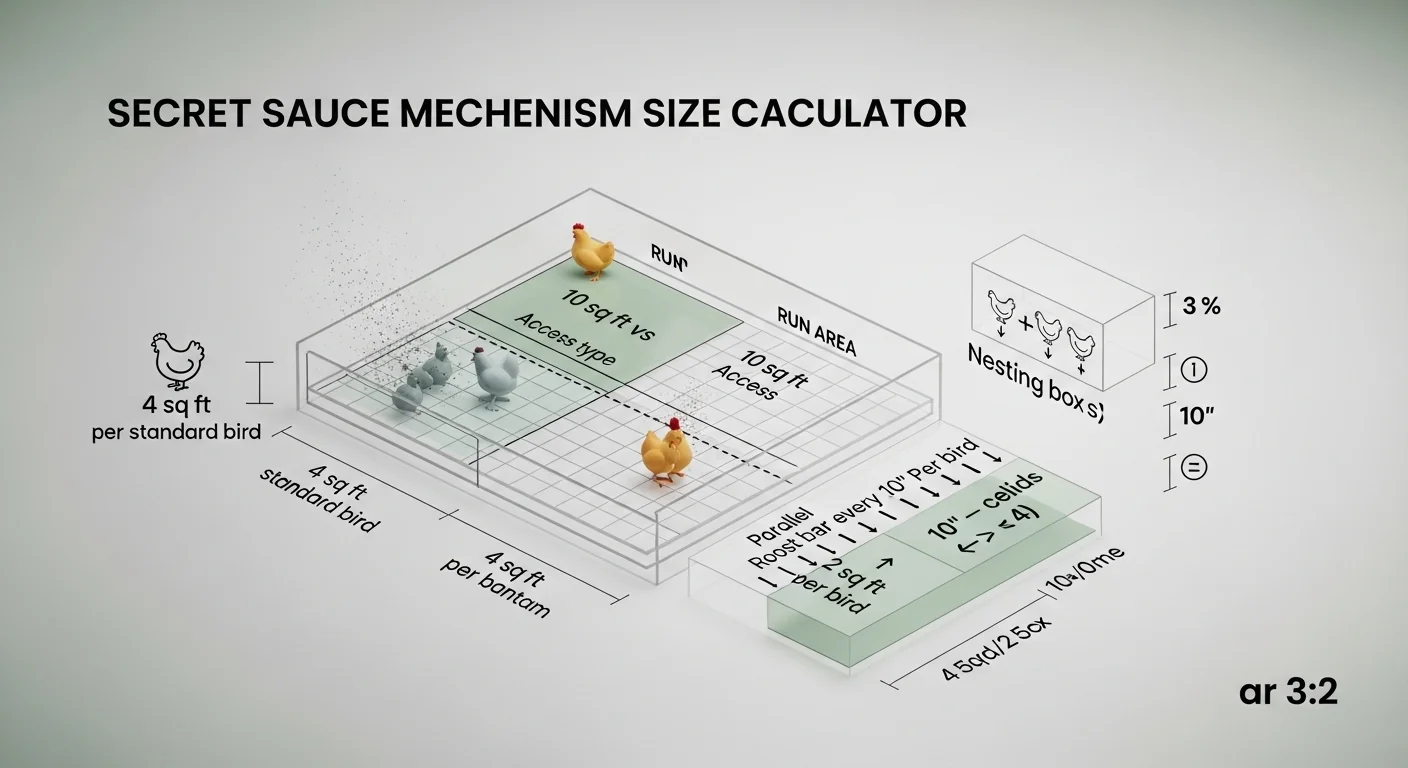
Underestimating coop space is the single most common structural mistake backyard flock keepers make, and it rarely announces itself until birds start injuring each other. Coop area, run area, roost bar length, and nesting box count are not interchangeable figures — each one governs a separate behavioral need, and getting one wrong while optimizing another does not cancel the deficit.
This chicken coop calculator computes four outputs from three inputs: coop floor area, outdoor run area, roost bar length, and the number of nesting boxes your flock requires. It distinguishes between bantam and standard breeds, and it accounts for whether your birds are confined to a fixed run or free ranging on open pasture. What it does not do is factor in ventilation capacity, climate-driven insulation requirements, or predator pressure — those variables require separate evaluation after you have the baseline square footage.
Once you have your results, you can make a concrete decision: whether your current or planned coop footprint meets the minimum per-bird thresholds, and whether you need to expand the run, add roost bar sections, or build a second nesting box before your flock moves in.
Use the Tool
| Birds | Coop Area (std) | Run Area (confined) | Roost (in) | Nest Boxes |
|---|
How This Calculator Works
Coop Floor Area
- Bantam (Small): 2 sq ft per bird
- Standard: 4 sq ft per bird
This is the minimum indoor, enclosed floor space chickens need to sleep, shelter from weather, and lay eggs comfortably.
Run Area
- Confined Run: 10 sq ft per bird (birds cannot roam freely)
- Free Range: 8 sq ft per bird (birds access larger open areas)
The outdoor run is the fenced exercise area attached to your coop. Confined flocks need more dedicated run space since they cannot forage beyond it.
Roost Length
Each chicken needs approximately 10 inches of horizontal roosting bar. Multiple parallel bars can be installed to fit larger flocks.
Nesting Boxes
One nesting box per every 4 hens (rounded up). Overcrowding boxes leads to egg-breaking, stress, and competition.
Assumptions & Limits
- Calculations reflect minimum recommended space; more space always improves flock health.
- Bantam breeds: ≤ 2 lbs (Silkies, Seramas, Dutch Bantams, etc.).
- Standard breeds: most common farm breeds (Rhode Island Red, Leghorn, Plymouth Rock, Australorp, etc.).
- Free range assumes daily access to pasture or open yard of at least 40 sq ft per bird total.
- Roost bars should be placed 18–24 inches above the floor and spaced 12+ inches apart.
- This calculator does not account for regional climate, predator pressure, or ventilation design.
- Maximum supported input: 500 birds. For commercial operations, consult a livestock specialist.
Before you enter numbers, have three pieces of information ready: the total count of birds that will occupy the coop at one time, the confirmed breed classification (bantam or standard), and whether the birds will have unrestricted daily access to open ground. If you are planning a future flock rather than sizing an existing one, use the maximum number of birds you expect to keep, not a conservative low estimate. The calculator outputs minimum figures; building to the minimum and then adding birds later is one of the most common expansion traps in backyard poultry keeping. If you are still planning your flock and considering when eggs will start arriving, the hatch date calculator can help you map incubation timelines to your coop readiness schedule.
Quick Start (60 Seconds)
- Number of Chickens: Enter a whole number between 1 and 500. Count every bird that will sleep in this coop simultaneously, including any future additions you are planning within the next season.
- Breed Size: Select Bantam for breeds under roughly 2 lbs (Silkies, Seramas, Dutch Bantams, Japanese Bantams). Select Standard for all full-size laying and dual-purpose breeds (Rhode Island Reds, Leghorns, Australorps, Plymouth Rocks, Wyandottes).
- Access Type: Choose Confined Run if birds are enclosed within a fixed fenced run 24 hours a day, or most of the day. Choose Free Range only if birds have unrestricted daily access to open pasture or yard space substantially larger than the designated run area.
- Common entry mistake (breed): Mixed flocks containing both bantam and standard breeds should be calculated using the Standard setting. Always size to the largest bird in the flock.
- Common entry mistake (access): Do not select Free Range if birds are released for only 1 to 2 hours per day. Partial access does not meet the behavioral threshold that free-range spacing assumptions are based on.
- Units: All area outputs are in square feet. Roost bar output is in inches. No conversions are required before entering data.
- After calculating: Record all four output figures. The nesting box count and roost bar length are independent constraints and must both be satisfied, not just the floor area.
Inputs and Outputs (What Each Field Means)
| Field | Unit / Type | What It Means | Common Mistake | Safe Entry Guidance |
|---|---|---|---|---|
| Number of Chickens | Integer (1 to 500) | Total birds sharing this coop simultaneously | Entering current flock size and ignoring planned additions | Use maximum anticipated count; do not round down |
| Breed Size | Select (Bantam / Standard) | Determines floor area per bird (2 sq ft vs 4 sq ft) | Classifying a mixed flock as bantam to reduce the coop size output | Always select the breed category of the largest birds in the flock |
| Access Type | Radio (Confined / Free Range) | Sets run area multiplier (10 sq ft confined, 8 sq ft free range) | Selecting Free Range for birds that are actually rotationally grazed in small paddocks | Use Confined unless birds have unrestricted daily open-area access |
| Coop Floor Area | Square feet (output) | Minimum enclosed indoor floor space required | Treating this as the total structure footprint including nest box overhangs | Measure usable floor area only; exclude wall ledges and fixed equipment footprints |
| Run Area | Square feet (output) | Minimum dedicated outdoor exercise and foraging space | Counting the area under the coop (if raised) as part of the run area | Measure ground-level accessible run area only |
| Roost Bar Length | Inches (output) | Total horizontal bar length needed for all birds to roost simultaneously | Installing one long bar instead of multiple parallel bars at different heights | Split total across 2 or more parallel bars spaced at least 12 inches apart vertically |
| Nesting Boxes | Count (output) | Minimum number of 12×12 inch nesting boxes required for the flock | Installing only 1 box for a flock of 6 or more because “chickens share” | Round the calculator result up; never round down for nesting boxes |
Worked Examples (Real Numbers)
Scenario 1: Standard Backyard Layer Flock, Confined Run
- Birds: 6
- Breed Size: Standard
- Access Type: Confined Run
Result: Coop area = 24 sq ft, Run area = 60 sq ft, Roost bar = 60 inches (5 ft), Nesting boxes = 2.
A 24 sq ft coop footprint corresponds roughly to a 4×6 ft structure. The 60 sq ft run is the harder constraint to satisfy; a 6×10 ft run enclosure meets it exactly at minimum. Two nesting boxes are the correct call here: with six hens sharing a single box, peak morning laying hours create competition that leads to broken eggs and feather pecking at the box entrance.
Scenario 2: Bantam Flock, Free Range
- Birds: 12
- Breed Size: Bantam
- Access Type: Free Range
Result: Coop area = 24 sq ft, Run area = 96 sq ft, Roost bar = 120 inches (10 ft), Nesting boxes = 3.
Twelve bantams in free-range conditions produce the same coop footprint as six standard birds, which illustrates how breed size doubles the coop area requirement per bird. The roost bar total of 120 inches is substantial and should be split across at least two parallel bars inside the coop. Three nesting boxes prevent the competition-induced egg damage that becomes common in flocks above eight hens sharing two boxes.
Scenario 3: Small Starter Flock, Standard Breed, Free Range
- Birds: 4
- Breed Size: Standard
- Access Type: Free Range
Result: Coop area = 16 sq ft, Run area = 32 sq ft, Roost bar = 40 inches (approximately 3.3 ft), Nesting boxes = 1.
This is the easiest configuration to build correctly, but also the most common entry point for under-building. A 4×4 ft coop satisfies the 16 sq ft minimum, and a single nesting box is technically sufficient for four hens. If a fourth bird is a rooster or if the flock will grow to five birds within a season, plan for a second nesting box at build time. Retrofitting is significantly more labor-intensive than including it at the outset.
Reference Table (Fast Lookup)
All run area values below reflect Confined Run spacing (10 sq ft per bird). For Free Range, multiply bird count by 8 instead. Roost bar is in inches; nesting boxes are rounded up to the nearest whole box.
| Birds | Breed | Coop Area (sq ft) | Run Area Confined (sq ft) | Roost Bar (in) | Nesting Boxes |
|---|---|---|---|---|---|
| 2 | Standard | 8 | 20 | 20 | 1 |
| 4 | Standard | 16 | 40 | 40 | 1 |
| 6 | Standard | 24 | 60 | 60 | 2 |
| 8 | Standard | 32 | 80 | 80 | 2 |
| 10 | Standard | 40 | 100 | 100 | 3 |
| 12 | Standard | 48 | 120 | 120 | 3 |
| 6 | Bantam | 12 | 60 | 60 | 2 |
| 12 | Bantam | 24 | 120 | 120 | 3 |
| 20 | Standard | 80 | 200 | 200 | 5 |
| 25 | Standard | 100 | 250 | 250 | 7 |
How the Calculation Works (Formula + Assumptions)
Show the calculation steps
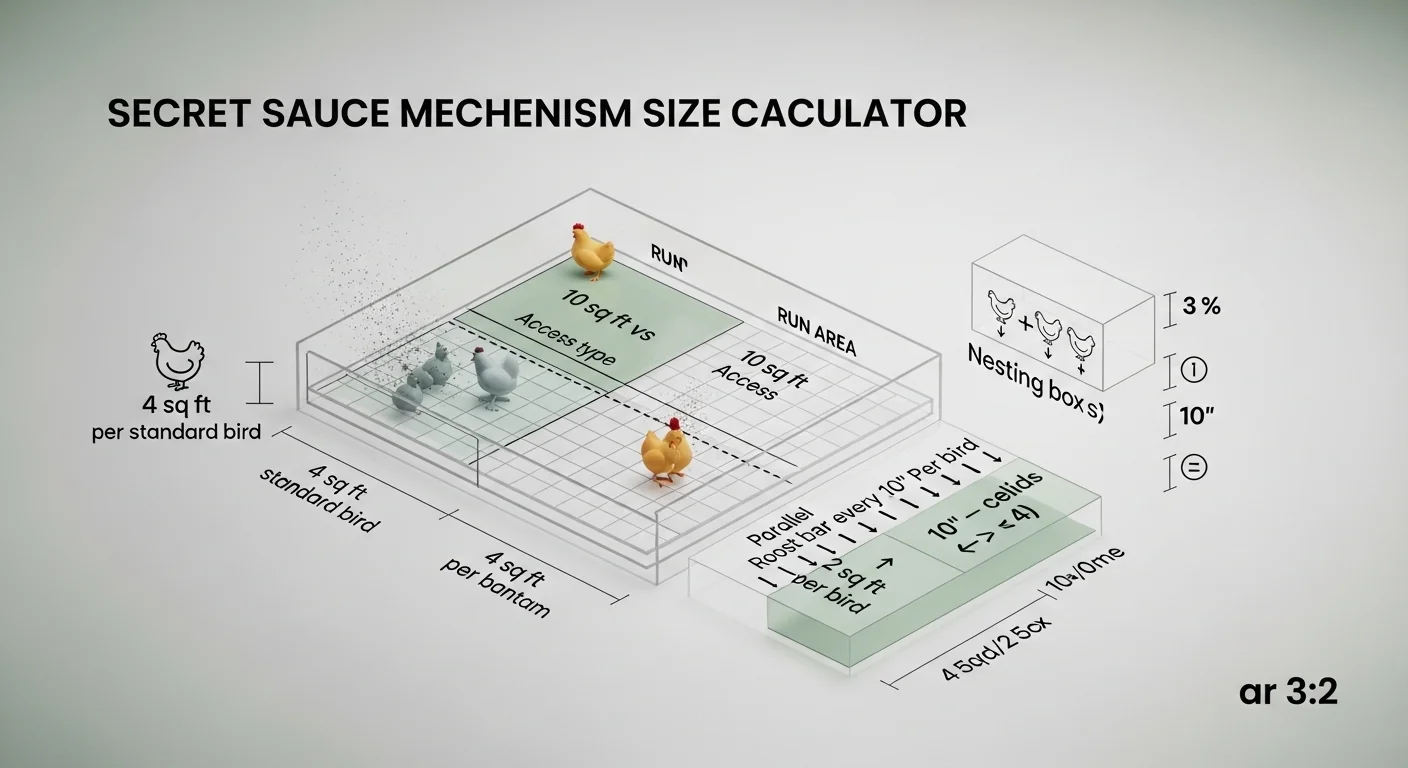
Coop Floor Area: Multiply total bird count by the breed-specific space allowance. Bantam birds receive 2 sq ft each; standard birds receive 4 sq ft each. Result is in square feet, no rounding applied (always a whole number given integer input).
Run Area: Multiply total bird count by the access-type multiplier. Confined run birds receive 10 sq ft each; free range birds receive 8 sq ft each. The lower free-range multiplier reflects that open-pasture foraging supplements the designated run area, reducing dependency on the enclosed space.
Roost Bar Length: Multiply total bird count by 10 inches. This figure represents total linear bar required. A flock of 8 standard birds needs 80 inches of roost, which can be distributed across two 40-inch parallel bars. No rounding is applied; the output is always a multiple of 10.
Nesting Boxes: Divide bird count by 4 and round up to the nearest whole number. This is a ceiling function: 5 birds require 2 boxes (not 1.25), 9 birds require 3 boxes. The ceiling function ensures that partial groups of 4 are never left without dedicated box access.
Assumptions and Limits
- The bantam classification assumes birds under approximately 2 lbs adult weight. Larger bantam variants (some Cochins sold as bantam, for example) should be calculated using the Standard setting if adult weight exceeds 2.5 lbs.
- The free-range run multiplier (8 sq ft) assumes birds have daily unrestricted access to open pasture or yard space of at least 40 sq ft per bird beyond the designated run. Partial daily access does not qualify.
- Roost bar spacing assumes standard horizontal bar construction at 18 to 24 inches above floor level, with bars spaced at least 12 inches apart vertically when stacked. T-shaped or round bars with a diameter of 1.5 to 2 inches are assumed; flat boards over 4 inches wide will require more total length to prevent shoulder-to-shoulder crowding.
- Nesting box dimensions are assumed to be a minimum of 12×12 inches per box. Smaller boxes reduce effective capacity below the 1-per-4-hens standard.
- The calculator does not account for roosters. A rooster in a confined flock may effectively reduce usable floor area through territorial behavior; consider adding 10 to 20 sq ft of run space if a rooster is present in a confined setting.
- Climate variables are outside this calculator’s scope. Cold climates with extended winter confinement periods may require 20 to 30 sq ft of coop floor area per standard bird to prevent disease transmission during periods when birds cannot access the run.
- Maximum supported input is 500 birds. Commercial laying operations operate under separate regulatory frameworks and require professional facility design review.
Standards, Safety Checks, and “Secret Sauce” Warnings
Critical Warnings
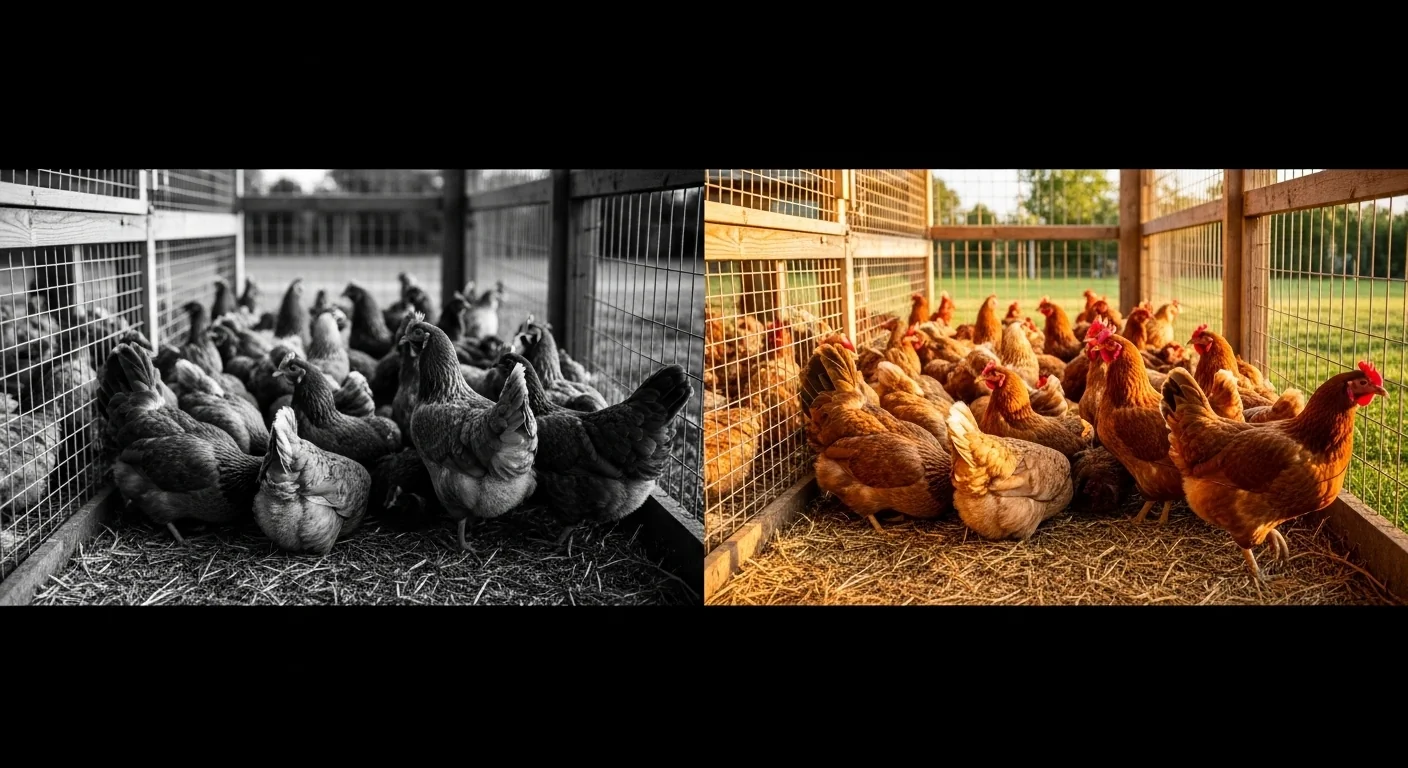
- Overcrowding triggers pecking and cannibalism. Bantam flocks exceeding six birds in minimum-standard coop space are at elevated risk for feather-pecking and vent-pecking injuries. The stress response in confined bantam flocks escalates faster than in standard breeds because bantam territorial behavior is proportionally more intense relative to their small body size. If you observe any feather damage at the tail or vent area, treat it as a space-density problem before attributing it to individual bird aggression.
- Nesting box competition causes egg breakage and injury at the box entrance. A single nesting box shared by more than four hens creates a morning bottleneck that produces broken eggs (and the learned egg-eating behavior that follows), stress-induced delayed laying, and physical conflict at the box opening. The calculator always rounds the nesting box count up, and that ceiling should be treated as a true minimum, not a comfortable target.
- Selecting Free Range when birds are partially confined understates run area. The run area output for free-range selection is 20 sq ft less per bird than the confined calculation. Applying that setting to birds that are actually locked in a small secondary enclosure for 20 or more hours per day produces a run area result that cannot support healthy behavior. When in doubt, use the Confined setting.
- Confined flocks over 10 birds accumulate ammonia in bedding faster than smaller groups. The space output is correct, but sanitation frequency must increase proportionally. Deep litter management alone is not sufficient above 10 birds per 40 sq ft of coop floor without supplemental airflow. The barn ventilation calculator can help you size airflow relative to your bird count and structure dimensions.
Minimum Standards
- Minimum 2 sq ft per bantam bird of enclosed coop floor area (this calculator enforces this).
- Minimum 4 sq ft per standard bird of enclosed coop floor area (this calculator enforces this).
- Minimum 1 nesting box per 4 hens, with interior box dimensions no smaller than 12×12 inches. Boxes should be positioned lower than the roost bar to prevent roosting inside the box.
- Roost bars installed at 18 to 24 inches above floor height. Multiple parallel bars at this height, spaced 12 or more inches apart, allow a large flock to roost without crowding and without high-low pecking order conflicts that arise from tiered bar heights.
Competitor Trap: Most online chicken coop calculators output only a single number: coop square footage. They do not calculate run area, roost bar length, or nesting boxes. A keeper who follows that single-output advice ends up with a correctly sized indoor coop connected to an undersized run, with one nesting box for eight hens and a 3-foot roost bar for twelve birds. The flock’s space deficit does not show up in the coop floor reading; it shows up in injury and production data weeks after setup. If you are comparing coop size calculators and one of them only outputs square footage, it is not accounting for the full behavioral space budget. You need all four numbers, and they are independent constraints. The chick brooder temperature calculator addresses a related gap: birds transitioning out of the brooder into an undersized coop carry compounded space stress from day one.
Common Mistakes and Fixes
Mistake: Sizing the Coop for the Current Flock Instead of the Maximum Planned Flock
A keeper starts with 4 standard hens, builds a 16 sq ft coop, and adds 4 more birds the following spring. The coop is now at half its required capacity for 8 birds, and expanding a finished structure costs more in materials and labor than building to the larger size from the start. Coop construction is a fixed cost regardless of occupancy.
Fix: Enter the maximum number of birds you anticipate keeping within three years, not the number you are starting with.
Mistake: Classifying a Mixed Flock Using the Smaller Breed Category
When a flock contains both bantam and standard birds, entering Bantam to minimize the output produces a coop sized for small birds while standard breeds share the same floor. Standard birds require twice the floor area per bird, and cramming them into bantam-calibrated space accelerates territorial aggression from both breed groups.
Fix: For any mixed flock, select Standard. Size to the largest bird present.
Mistake: Counting the Area Under a Raised Coop as Run Area
Raised coops with open ground underneath are common, and the shaded crawl space is often added to the run area calculation. Chickens do use this space, but it is not reliably ventilated, does not drain effectively after rain, and accumulates fecal matter directly under roosting birds. Counting it as productive run area inflates the available square footage on paper.
Fix: Measure only the fenced, ground-level run area that receives natural light and drains freely. If you want to count under-coop space, apply a 50 sq ft or less credit and verify drainage quality.
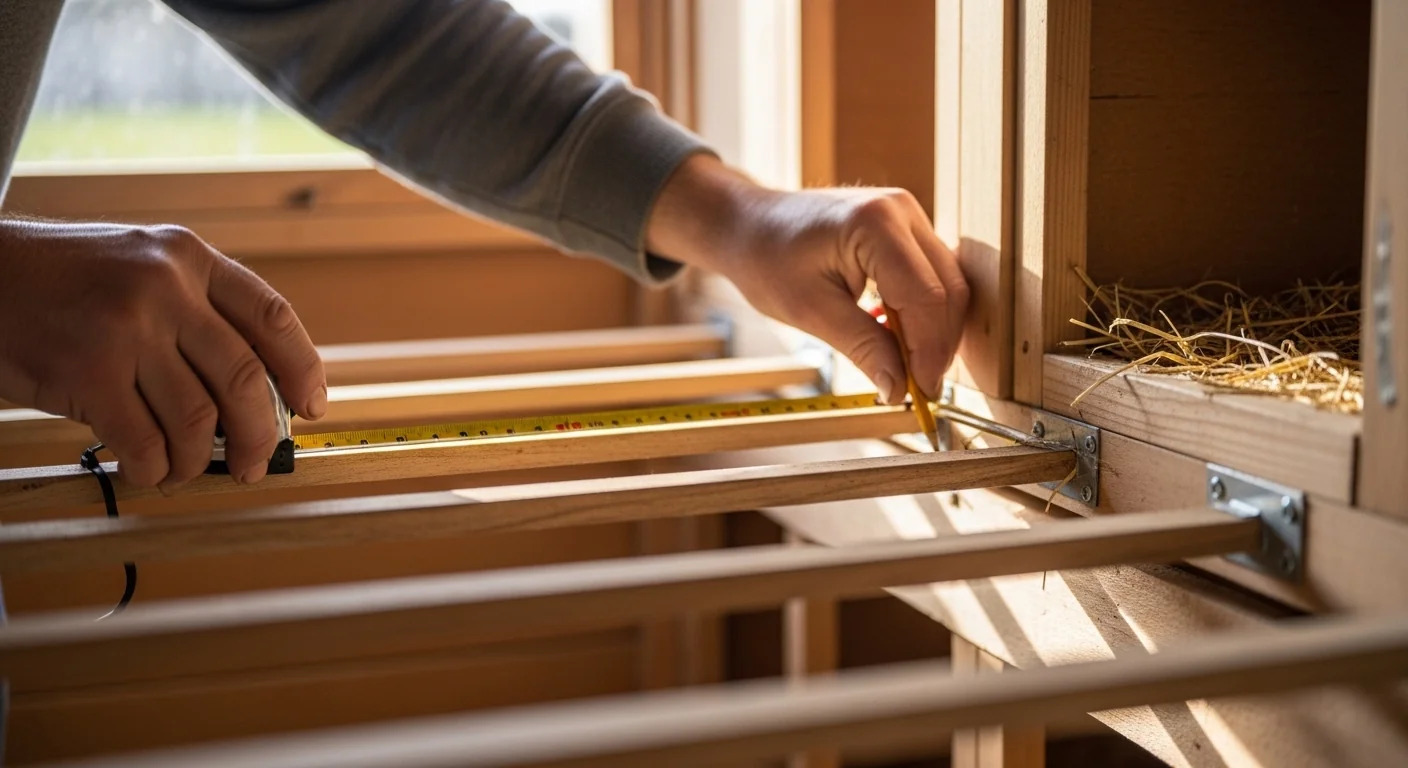
Mistake: Installing a Single Long Roost Bar Instead of Multiple Parallel Bars
A 10-bird flock needs 100 inches of roost bar. Installing one 100-inch bar creates a shoulder-to-shoulder line that triggers constant displacement behavior as birds establish nightly pecking order position. A single bar also eliminates the height variation that birds use to signal social rank, which increases physical confrontation during roost time. If you are planning your pasture setup alongside your coop, the pasture stocking rate calculator can help you determine whether your land supports the free-range flock density that reduces this kind of competition pressure.
Fix: Divide the total roost bar output across two or more parallel bars spaced at least 12 inches apart vertically, with the highest bar no more than 24 inches from the floor.
Mistake: Treating the Nesting Box Count as Optional or Approximate
Many guides round nesting box recommendations down or suggest that “chickens will share.” In practice, four or more hens sharing one box during peak morning laying hours (typically 7 to 11 a.m.) produces egg breakage from crowding, and once broken eggs are consumed, egg-eating behavior persists even after box access is corrected. This is one of the harder flock management problems to reverse after it starts.
Fix: Build the exact number of nesting boxes output by the calculator, treat it as a hard minimum, and add one extra box if you plan to expand the flock within the next season. The feed costs that come with a larger flock can be estimated with the feed cost calculator before you commit to expanding.
Next Steps in Your Workflow
Once you have your four output values, the next practical step is cross-referencing the run area figure against your actual available yard or pasture space. If the calculated run area exceeds what you can enclose, you have two options: reduce the flock count or convert a partially confined setup to a rotational grazing system where birds cycle through multiple paddocks. Rotational setups require planning ahead for temporary fencing and water access at each station. If predator pressure is a factor in your area, the fencing configuration for the run deserves separate attention; the electric fence calculator can help you spec out perimeter length and post spacing for a poultry-grade run enclosure.
After the physical structure is planned, the recurring cost question typically comes next: feed, bedding, supplemental heat in winter, and whether your flock’s egg production offsets those inputs. The ongoing feed budget scales directly with bird count, and the margin between input cost and egg value narrows faster than most keepers expect as the flock grows. Running a feed conversion ratio calculation against your anticipated flock size gives you a grounded baseline before you commit to a final bird count.
FAQ
What is the minimum square footage per chicken in a coop?
The standard minimum is 2 square feet per bantam bird and 4 square feet per standard bird for enclosed coop floor area. These figures apply to the usable floor space where birds can stand and move freely, not the total structure footprint. In cold climates where birds may be confined indoors for extended winter periods, these minimums should be treated as starting points rather than design targets.
Do bantam chickens need the same run space as standard chickens?
No. Bantam chickens need less coop floor area per bird (2 sq ft vs 4 sq ft), but the run area calculation in this tool uses the same per-bird multiplier for both breed sizes. Run space requirements are driven by foraging and exercise behavior, which scales with activity level rather than body size. A bantam flock of 10 birds needs the same run footage as a standard flock of 10 birds.
How many nesting boxes do I need for 10 chickens?
Three nesting boxes. The formula divides bird count by 4 and rounds up: 10 divided by 4 equals 2.5, which rounds up to 3. If your flock of 10 includes a significant number of high-production laying breeds, adding a fourth box at build time prevents bottlenecking during peak morning laying hours without requiring any structural modification later.
What is the correct roost bar height and spacing?
Roost bars should be installed at 18 to 24 inches above the floor. When multiple bars are used, they should be spaced at least 12 inches apart vertically and positioned so that lower bars are not directly below upper bars, which prevents droppings from accumulating on resting birds. Bar diameter of 1.5 to 2 inches allows birds to wrap their feet comfortably without splaying.
Does free range mean I need less coop space?
Free range affects the run area calculation, not the coop floor area. Coop floor space is determined by breed size alone, regardless of access type. The free-range setting reduces the designated run area output because open-pasture foraging is assumed to supplement it. Coop square footage does not change based on how much outdoor time birds receive.
Can I use this calculator for ducks or other poultry?
This calculator is calibrated for chickens specifically. Duck space requirements differ from chickens in several important ways: ducks do not roost, so the roost bar output is irrelevant, and ducks require significantly more floor clearance due to their waddling gait and bedding moisture output. Applying this tool’s outputs to a duck flock will underestimate floor space needs and will not account for the water access infrastructure ducks require inside their housing.
Conclusion
The core differentiator in this chicken coop calculator is that it treats coop size as four independent outputs, not one. A correctly sized coop floor paired with an undersized run, inadequate roost bar, or insufficient nesting boxes is still an undersized setup, and the behavioral consequences show up in injury and production data before they show up in any visual inspection of the coop. The calculation is straightforward; the discipline is in applying all four results simultaneously and not trading one constraint against another to hit a construction budget.
The most avoidable mistake in coop planning is sizing for the current flock count instead of the maximum anticipated flock count. Retrofitting a finished coop or run enclosure to add capacity is consistently more expensive than building to the larger figure from the start. Run your calculation at the bird count you actually intend to reach, not the number you are starting with, and the structure you build will remain serviceable through your flock’s full growth cycle. For those expanding into broader livestock operations, the rotational grazing calculator is a natural next step for integrating chicken pasture rotation into a larger land management plan.