
The failure mode is quiet. A tractor stops moving forward, the engine keeps running, and the tires spin in place against hardpan or compacted gravel. What looks like a soil problem is actually a traction math problem: the required draft force to move the box blade and its scarifier shanks through the ground exceeds the maximum grip the tires can generate. No amount of throttle resolves a traction deficit. Only weight, configuration, or soil selection can.
This box blade draft force calculator takes your blade width, shank count, scarifier depth, tractor weight, drive type (2WD or 4WD/MFWD), and soil resistance category, then computes shank draft, blade draft, total draft, available traction, and wheel slip risk. It identifies the tire polishing threshold deterministically using the soil resistance coefficients from ASABE EP542 research standards. What it does not do is account for slope, wet ground, implement weight transfer, or tire inflation variation. Those factors shift the output in a direction that makes the safe zone smaller, not larger. Understanding how drawbar horsepower relates to draft load fills in part of that picture, but traction is a weight equation first.
After running the calculator, you will know whether your current configuration produces a traction deficit. If it does, the tool shows exactly how many pounds of surplus draft you are generating, and the reference table shows which shank counts would bring you back below the slip threshold with your existing tractor weight.
Use the Tool
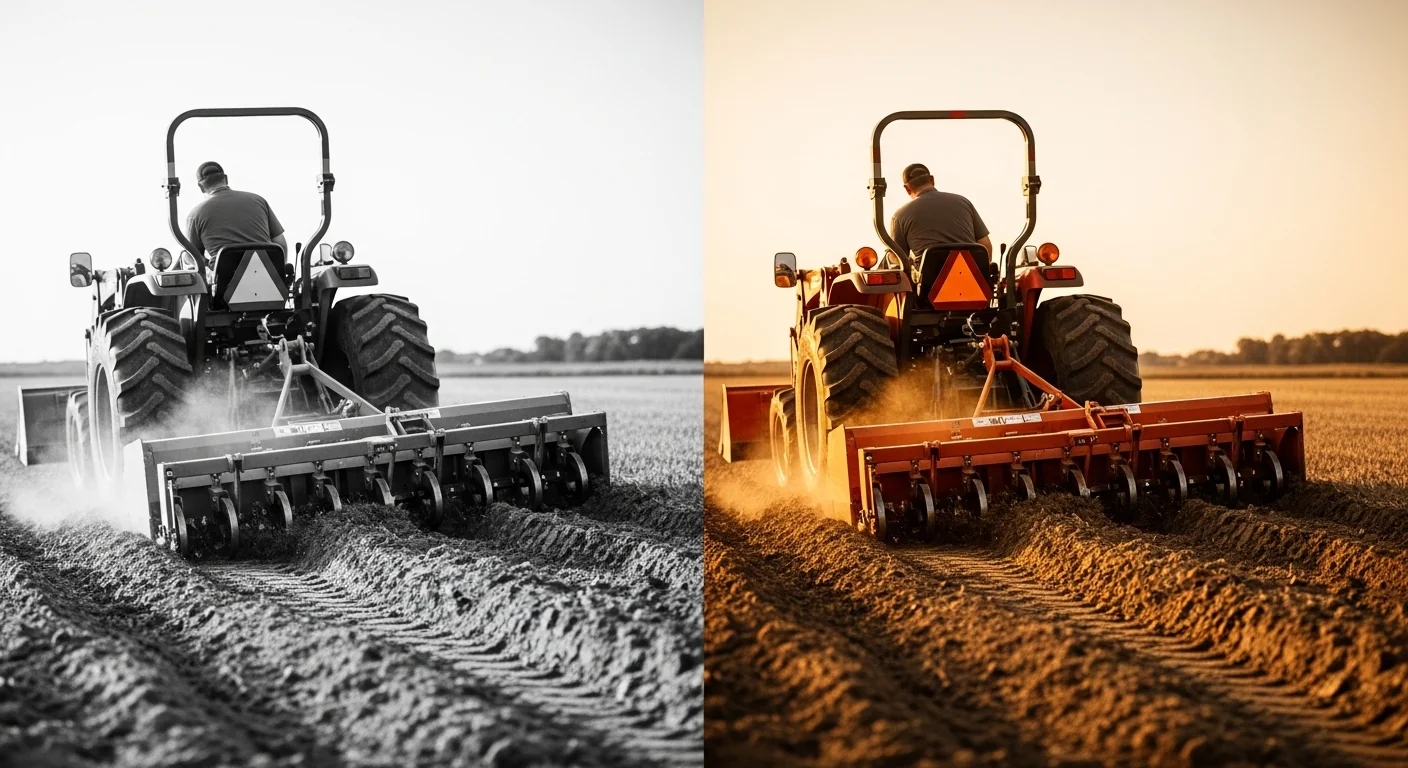
Box Blade Draft Force Calculator
The Yield Grid · Tractor & Farm Machinery
Traction vs. Draft — Safety Gauge
Reference: Estimated Draft by Shank Count (your soil + depth)
| Shanks Dropped | Shank Draft (lbs) | + Blade Draft (lbs) | Total Draft (lbs) | Max Traction (lbs) | Result |
|---|
How This Calculator Works
This box blade draft force calculator uses soil mechanics equations from ASABE traction research standards. Here is exactly what happens when you click Calculate:
- Shank Draft:
Draft_Shanks = Shanks x Depth (in) x Soil Resistance (lbs/in²)Each shank acts as a narrow tillage tool. Draft multiplies linearly with shank count and depth. - Blade Draft:
Draft_Blade = Width (in) x Cut Depth (est. 1 in) x Soil Resistance (lbs/in²)The box blade itself moves soil across its full cutting edge width at an estimated 1-inch effective cut depth when grading. - Total Draft:
Total Draft = Draft_Shanks + Draft_Blade - Maximum Available Traction:
Max Traction (4WD/MFWD) = Tractor Weight x 0.65Max Traction (2WD) = Tractor Weight x 0.45Coefficient of traction is 0.65 for 4WD/MFWD on firm ground; 0.45 for 2WD rear-axle-only drive. - Wheel Slip Risk %:
Slip Risk = (Total Draft / Max Traction) x 100%If Slip Risk exceeds 100%, the tractor will reach full wheel spin (Tire Polishing condition).
Assumptions & Limits
- Soil Resistance Values Used: Sandy/Loose loam = 50 lbs/in², Medium loam = 90 lbs/in², Heavy clay = 130 lbs/in², Compacted gravel/Hardpan = 180 lbs/in². Derived from ASABE EP542 mid-range values.
- Blade cut depth is fixed at 1 inch for grading estimation. Aggressive cuts increase blade draft substantially.
- Traction coefficients: 0.65 for 4WD/MFWD; 0.45 for 2WD. Real-world values vary with tire type, inflation, ground moisture, and slope.
- Slope: This calculator assumes level ground. Each 10% grade can add 5-10% additional draft force.
- Tool width input must be in inches (e.g. 72 in = 6 ft blade).
- Max shank count validated at 12; most commercial box blades offer 5-9 shanks.
Based on your setup and draft analysis, consider these performance upgrades:
Before you start, have these figures ready: your box blade’s cutting width in inches (not feet), your tractor’s operating weight in pounds including any loader or ballast already installed, and the number of scarifier shanks you actually plan to drop for the pass you are sizing. Enter depth in inches, not centimeters. Use the soil condition that matches the worst section of your project area, not the average. If you are working with both gravel and loam, size for the gravel.
Quick Start (60 Seconds)
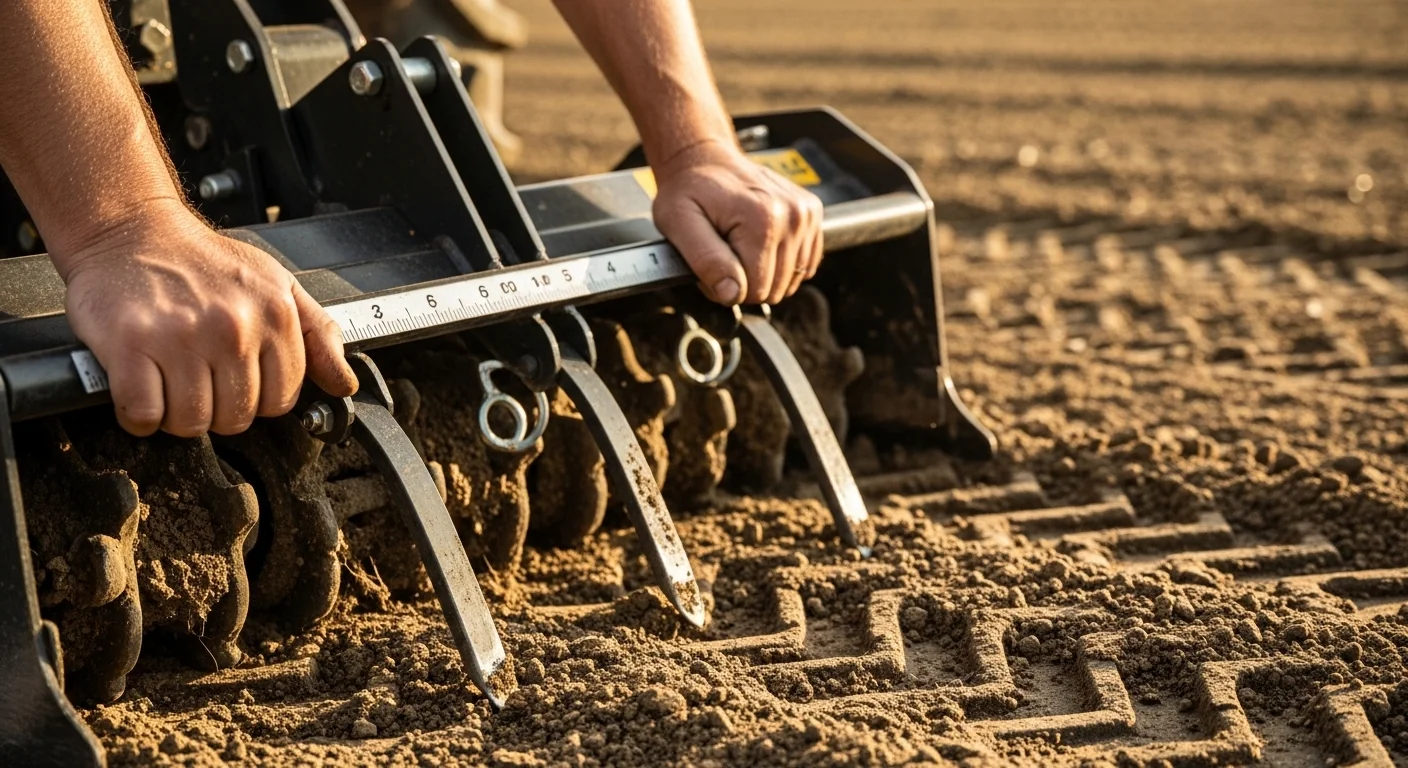
- Box Blade Width: Enter total cutting width in inches. A 6-foot blade is 72 inches. Do not enter feet; the formula uses inch-based soil resistance coefficients and will produce incorrect output if you enter 6 instead of 72.
- Number of Scarifier Shanks Dropped: Count only shanks you will actually lower into the ground for this pass. Raising unused shanks to the fully retracted position means they contribute zero draft. Enter 0 if you plan a pure grading pass with the blade only.
- Scarifier Depth: Enter the depth each engaged shank will penetrate below grade, in inches. This is not the height of the shank above the blade frame; it is depth below the surface. Typical working range is 2 to 6 inches.
- Tractor Operating Weight: This is not the rated shipping weight from the spec sheet. Include fluid levels, a mounted loader if present, and any ballast weights already on the tractor. Operating weight is almost always higher than the advertised figure. Using the spec-sheet number produces a traction overestimate.
- Drive Type: Select 2WD if only your rear axle is powered. Select 4WD/MFWD if your front axle also delivers power. Mechanical front-wheel drive (MFWD) tractors qualify as 4WD for this calculation because both axles contribute traction force.
- Soil / Ground Condition: Choose the category that best matches your actual ground. Compacted gravel is the highest resistance value (180 lbs/in2). If you are splitting between two categories, choose the harder one to size conservatively.
Inputs and Outputs (What Each Field Means)
| Field Name | Unit | What It Means | Common Mistake | Safe Entry Guidance |
|---|---|---|---|---|
| Box Blade Width | Inches | The full cutting-edge width of the box blade. Wider blades create proportionally more blade draft force regardless of shank use. | Entering feet instead of inches (e.g., 6 instead of 72). | Measure the physical blade opening or check the manufacturer label. Enter the number, then confirm it is between 24 and 120. |
| Scarifier Shanks Dropped | Count (0-12) | Number of active shank teeth penetrating the soil. Each additional shank adds a discrete increment to total draft force. | Counting the total shanks the blade has rather than how many are lowered for the current pass. | Walk to the blade and count engaged shanks. Enter 0 for a pure grading pass. |
| Scarifier Depth | Inches | Penetration depth of each active shank below the surface. Depth multiplies against soil resistance for each shank, making it the most sensitive input in the calculation. | Confusing shank height above the blade carriage with ground penetration depth. | Use a ruler or depth gauge to measure actual penetration. Do not estimate. Small depth errors compound across multiple shanks. |
| Tractor Operating Weight | Pounds (lbs) | Total weight of the tractor as it will be used: fluids, loader, ballast, and implement connection weight included. This number determines maximum traction capacity. | Using the published shipping weight or horsepower rating as a traction proxy. Neither correlates to traction force. | Use a scale reading if available. Otherwise, add loader weight, fluid estimates, and ballast to the spec-sheet base weight. See guidance on 3-point lift capacity to understand how implement connection affects rear axle loading. |
| Drive Type | 2WD or 4WD/MFWD | Determines the traction coefficient: 0.45 for 2WD, 0.65 for 4WD/MFWD. This single selection changes maximum traction by 44% at identical operating weight. | Selecting 4WD for a tractor that has MFWD disengaged or disabled. An MFWD that is not engaged behaves as 2WD for traction purposes. | Confirm MFWD is engaged and functional before selecting the 4WD option. |
| Soil / Ground Condition | Category (R value in lbs/in2) | Determines soil resistance applied to both shank draft and blade draft. Sandy = 50, Medium loam = 90, Heavy clay = 130, Compacted gravel = 180. | Choosing medium loam for a compacted gravel driveway because “it is not pure rock.” | Use the hardest material type present in the work area. If gravel exists in any section, model for gravel. |
| Total Draft Force (output) | Pounds (lbs) | The combined pull force required to move the blade and all engaged shanks through the soil at the specified depth. This is what the tractor must overcome to move forward. | Confusing draft force with drawbar pull or horsepower. Draft force is a weight-equivalent load, not a power value. | Compare this number directly to the Max Traction output. If draft exceeds traction, the tractor will not move under load. |
| Wheel Slip Risk (output) | Percentage of Max Traction consumed | Draft force as a fraction of maximum available traction. Values above 100% indicate the tractor cannot move the implement through the selected soil at the selected depth without spinning tires. | Assuming any value below 100% is acceptable. The caution zone begins at 75% because real-world variables (slope, tire wear, wet soil) reduce traction below the calculated maximum. | Target below 70% for a working margin that accommodates ground variation. |
Worked Examples (Real Numbers)
Scenario 1: Compact 4WD Tractor, Sandy Loam, Blade-Only Grading Pass
- Box Blade Width: 48 inches
- Shanks Dropped: 0
- Scarifier Depth: N/A (no shanks engaged)
- Tractor Operating Weight: 5,500 lbs
- Drive Type: 4WD/MFWD
- Soil: Sandy / Loose loam (R = 50 lbs/in2)
Shank Draft = 0 x any x 50 = 0 lbs
Blade Draft = 48 x 1 x 50 = 2,400 lbs
Total Draft = 2,400 lbs
Max Traction = 5,500 x 0.65 = 3,575 lbs
Wheel Slip Risk = 2,400 / 3,575 x 100 = 67.1%
Result: 2,400 lbs total draft force. Wheel slip risk: 67%. Status: Safe.
This configuration falls below the 70% working margin. The blade has adequate traction for a grading pass in sandy loam without scarification. Adding even one shank at this soil type pushes the risk higher but remains manageable for heavier machines.
Scenario 2: Classic Tire Polishing Setup (6 Shanks, Compacted Gravel, Small 2WD)
- Box Blade Width: 72 inches
- Shanks Dropped: 6
- Scarifier Depth: 4 inches
- Tractor Operating Weight: 3,000 lbs
- Drive Type: 2WD
- Soil: Compacted gravel / Hardpan (R = 180 lbs/in2)
Shank Draft = 6 x 4 x 180 = 4,320 lbs
Blade Draft = 72 x 1 x 180 = 12,960 lbs
Total Draft = 17,280 lbs
Max Traction = 3,000 x 0.45 = 1,350 lbs
Wheel Slip Risk = 17,280 / 1,350 x 100 = 1,280%
Result: 17,280 lbs total draft force. Max traction: 1,350 lbs. Traction deficit: 15,930 lbs. Status: Tire Polishing.
The tractor generates roughly 8% of the traction needed to move this configuration. The tires will rotate continuously without forward motion. Rubber contact on compacted gravel under sustained heat causes surface glazing that permanently reduces grip. This scenario requires either dramatically fewer shanks, a much heavier tractor, or a different approach entirely (such as a dedicated subsoiler sized to its actual soil conditions before box blade follow-up).
Scenario 3: 4WD Field Tractor, Heavy Clay, Reduced Shank Count
- Box Blade Width: 60 inches
- Shanks Dropped: 3
- Scarifier Depth: 2 inches
- Tractor Operating Weight: 7,500 lbs
- Drive Type: 4WD/MFWD
- Soil: Heavy clay (R = 130 lbs/in2)
Shank Draft = 3 x 2 x 130 = 780 lbs
Blade Draft = 60 x 1 x 130 = 7,800 lbs
Total Draft = 8,580 lbs
Max Traction = 7,500 x 0.65 = 4,875 lbs
Wheel Slip Risk = 8,580 / 4,875 x 100 = 176%
Result: 8,580 lbs total draft force. Max traction: 4,875 lbs. Traction deficit: 3,705 lbs. Status: Tire Polishing.
Even with only 3 shanks at 2 inches on clay, the blade draft alone (7,800 lbs) is what drives the deficit. A 60-inch box blade on heavy clay requires over 12,000 lbs of tractor operating weight in 4WD to stay below the 100% slip threshold, and over 15,000 lbs to stay within the recommended working margin. This is a geometry and soil category problem, not a shank count problem.
Reference Table (Fast Lookup)
All rows assume a 72-inch box blade. Blade Draft = 72 x 1 x Soil Resistance. Shank Draft = Shanks x Depth x Soil Resistance. Min Tractor Weight (lbs) is the minimum operating weight needed to stay below 100% wheel slip risk. Values are rounded to the nearest 100 lbs.
| Shanks | Depth (in) | Soil Condition | Total Draft (lbs) | Min 4WD Weight (lbs) | Min 2WD Weight (lbs) |
|---|---|---|---|---|---|
| 0 | N/A | Sandy (R=50) | 3,600 | 5,500 | 8,000 |
| 1 | 4 | Sandy (R=50) | 3,800 | 5,900 | 8,500 |
| 0 | N/A | Medium loam (R=90) | 6,480 | 10,000 | 14,400 |
| 3 | 2 | Medium loam (R=90) | 7,020 | 10,800 | 15,600 |
| 4 | 3 | Medium loam (R=90) | 7,560 | 11,600 | 16,800 |
| 0 | N/A | Heavy clay (R=130) | 9,360 | 14,400 | 20,800 |
| 2 | 3 | Heavy clay (R=130) | 10,140 | 15,600 | 22,600 |
| 0 | N/A | Compacted gravel (R=180) | 12,960 | 19,900 | 28,800 |
| 3 | 3 | Compacted gravel (R=180) | 14,580 | 22,400 | 32,400 |
| 6 | 4 | Compacted gravel (R=180) | 17,280 | 26,600 | 38,400 |
Key takeaway from the table: On compacted gravel or heavy clay, even a zero-shank pass requires a tractor that exceeds 14,000 lbs in 4WD. Most compact utility and sub-compact tractors fall well short of these thresholds on hard ground.
How the Calculation Works (Formula + Assumptions)
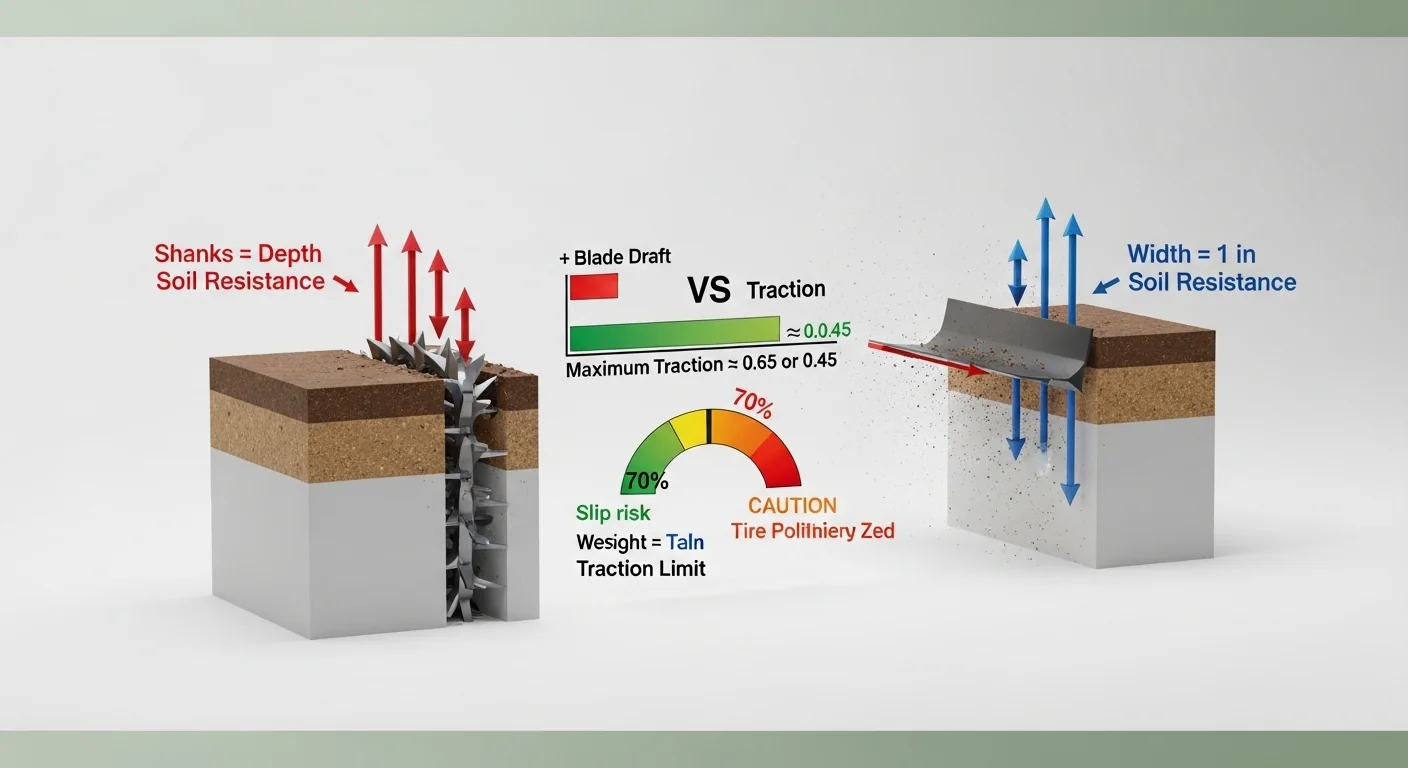
Show the calculation steps
Step 1: Shank Draft
Each active scarifier shank is treated as a narrow tillage tool cutting a vertical slot through the soil.
Draft_Shanks = Number of Shanks x Scarifier Depth (in) x Soil Resistance (lbs/in2)
Units: lbs. Result rounds to the nearest whole number.
Step 2: Blade Draft
The box blade’s cutting edge moves soil horizontally across its full width. The tool fixes the effective blade cut depth at 1 inch, representing a light grading pass.
Draft_Blade = Blade Width (in) x 1 (in) x Soil Resistance (lbs/in2)
Units: lbs. Blade cut depth is a constant assumption, not a user input.
Step 3: Total Draft
Total Draft = Draft_Shanks + Draft_Blade
Units: lbs. This is the combined horizontal force the tractor must generate to move the implement forward.
Step 4: Maximum Available Traction
Max Traction (4WD/MFWD) = Tractor Operating Weight (lbs) x 0.65
Max Traction (2WD) = Tractor Operating Weight (lbs) x 0.45
Traction coefficients are derived from ASABE EP542 for firm-ground conditions with R-4 or agricultural tires.
Step 5: Wheel Slip Risk
Wheel Slip Risk = (Total Draft / Max Traction) x 100
Expressed as a percentage. Values above 100% indicate a traction deficit. Values between 75% and 100% fall in the caution zone. Values below 70% fall in the safe operating zone.
Rounding: Draft force values display to the nearest whole pound. Wheel slip risk displays as a whole percentage. The mini reference table in the widget uses the same rounding rules.
Assumptions and Limits
- Blade cut depth is fixed at 1 inch. Operators working at deeper blade cut angles will generate substantially more blade draft than the tool predicts.
- Soil resistance values are midpoint estimates from ASABE EP542 ranges. Actual resistance varies with moisture content, compaction level, and soil texture even within a single category.
- The traction coefficients (0.65 for 4WD, 0.45 for 2WD) assume firm, dry, level ground with tires in good condition. Wet or soft ground reduces the coefficient significantly; slope adds a rolling resistance penalty the tool does not model.
- Implement weight on the 3-point hitch shifts a portion of the load onto the rear axle, which can improve rear-wheel traction. This tool treats tractor weight as a single static value and does not calculate weight transfer.
- Tire inflation pressure affects the contact patch size and therefore traction capacity. The tool assumes tires are correctly inflated for field use. Under-inflation or over-inflation both reduce available traction from the coefficients used.
- The tool does not account for soil shear failure at extreme shank depths. In highly compacted or rocky soils, a shank may skip or deflect rather than cut cleanly; actual draft in those conditions can differ substantially from predicted values.
- Multiple passes on the same ground track consolidate the soil surface, which can shift the effective soil resistance category upward over time.
Standards, Safety Checks, and “Secret Sauce” Warnings
Critical Warnings
- Tire polishing is a permanent damage event, not a recoverable stall. When a tractor reaches 100% wheel slip on compacted gravel or hardpan, the rubber surface heats against the abrasive ground and glazes. A glazed tire has a permanently reduced friction coefficient on firm surfaces. The tractor appears to move normally on soft ground afterward but will reach wheel slip at lower draft loads than before the event.
- On 2WD tractors, the blade draft alone can exceed maximum traction before any shanks are deployed. A 72-inch blade on heavy clay generates 9,360 lbs of blade draft. A 2WD tractor would need over 20,000 lbs of operating weight to handle that load alone. Most compact 2WD tractors used with box blades weigh between 2,500 and 5,000 lbs. They are already traction-limited by the blade on clay and gravel, not by shank count.
- The 75% caution zone is not conservative: it is the minimum working margin for flat, dry, firm ground. Any deviation from those conditions pushes a 75% result toward 100% slip risk without any change to inputs.
- Switching from 2WD to 4WD/MFWD changes maximum traction by 44% at identical weight. Operators who switch from a 2WD to a 4WD tractor of similar horsepower but similar or lower weight see traction improvement; operators who switch to higher HP at the same weight do not. Traction capacity follows weight, not power.
Minimum Standards
- Wheel slip risk should remain below 70% for all planned work passes to preserve a functional traction buffer for terrain variation.
- Traction coefficients applied here (0.65 for 4WD, 0.45 for 2WD) reflect firm dry ground per ASABE EP542. Do not treat these as absolute maximums; treat them as reference values that degrade with moisture, slope, and tire condition.
- When the tool flags a traction deficit, reduce the shank count first before reducing depth. Fewer shanks at full target depth generates less total draft than all shanks at shallow depth in most configurations, and a shallow shank pass often fails to break the compaction layer it was intended to address.
- If a pass requires more traction than the tractor provides, adding rear wheel ballast increases operating weight and therefore maximum traction. Calculate the required minimum weight first, then size the ballast to close the gap.
Competitor Trap: Most content on box blade setup discusses scarifier depth in terms of horsepower or engine size. That framework is incorrect for traction decisions. Horsepower determines how fast the tractor can deliver energy; traction determines whether it can deliver any forward force at all. A 100 HP tractor spinning its tires generates zero drawbar pull. A 50 HP tractor with adequate weight and 4WD can pull the same implement successfully. Sizing a scarifier pass by HP without running the traction math produces exactly the tire polishing scenario the calculator is designed to prevent. The relevant variable is always operating weight multiplied by the traction coefficient, not the engine rating on the hood.
Common Mistakes and Fixes
Mistake: Using Horsepower to Estimate Safe Shank Depth
Horsepower governs work capacity and fuel burn. It does not determine how much horizontal force the tractor can apply at the tire-ground interface before losing traction. A high-HP machine with a low operating weight will reach wheel slip at lower draft loads than a lower-HP machine that is heavier. The traction coefficient applies to weight, not to power.
Fix: Run the weight-based traction calculation before selecting shank depth. Treat HP as irrelevant to this specific decision.
Mistake: Entering Spec-Sheet Shipping Weight Instead of Operating Weight
Published tractor weights are typically measured at delivery configuration without fluids, front loader, or ballast. A tractor in field-ready condition with a loader attached can weigh 20 to 40 percent more than the spec-sheet figure. Underestimating operating weight produces an underestimate of maximum traction and makes the tractor appear less capable than it is, leading users to unnecessarily reduce shank count or depth.
Fix: Weigh the tractor on a livestock scale or platform scale in field-ready configuration, or add the known weights of all installed equipment and fluid fills to the base figure.
Mistake: Selecting “Medium Loam” for a Compacted Gravel Driveway
Compacted gravel is a distinct material category with soil resistance values approximately double those of medium loam. Misclassifying it halves the calculated draft force, which makes a configuration appear tractable when it will result in immediate wheel slip. This is the single most common input error on hard-surface grading jobs. The disc harrow literature addresses a related classification problem in per-blade weight requirements for varying tillage conditions.
Fix: If gravel of any kind is present in the work zone, select “Compacted gravel / Hardpan” for the soil category.
Mistake: Counting Total Shanks Rather Than Engaged Shanks
A box blade may have 6, 7, or 9 shank slots in the shank bar. Operators sometimes enter the total shank count from the manufacturer spec rather than counting the shanks actually lowered into the working position. Retracted or raised shanks contribute zero draft force; including them inflates the calculated draft requirement and may make a safe configuration appear to require tractor changes.
Fix: Physically walk to the blade and count the shanks making contact with the ground before entering the value.
Mistake: Treating the 100% Threshold as the Operating Target
Some operators interpret the “no red zone” rule as meaning any value below 100% slip risk is acceptable. The calculator flags a caution zone starting at 75% precisely because real operating conditions are never as favorable as the model assumptions. Slope adds rolling resistance; wet ground reduces the traction coefficient; tire wear reduces the contact patch. Operating at 95% slip risk on paper almost always produces wheel slip in the field. For cultivator-scale work, this creates soil compaction patterns that the sweep overlap calculator can help document.
Fix: Target below 70% wheel slip risk for a working margin that survives real-world variation.
Next Steps in Your Workflow
Once you have a shank configuration that stays within the traction budget, the next planning question is ground speed. Draft force is a static load, but the power required to sustain that load at a given field speed scales with velocity. A pass that is tractable at 2 mph may be technically tractable at 3 mph but will shorten the workday significantly due to heat buildup and fuel consumption. Running the ground speed calculator against your transmission ratios and tire size tells you the actual speed range available in each gear so you can select the band that keeps engine RPM in the efficient range without overpowering the draft load.
If your traction analysis reveals that your current tractor cannot handle the required configuration, the path forward is either reducing the scope of the pass (fewer shanks, shallower depth, smaller blade) or increasing operating weight through ballast. Before purchasing cast iron wheel weights, model the required weight increase here, then cross-reference it with the tire ballast calculator to determine how much fluid fill or bolt-on weight closes the traction gap without exceeding your axle or tire load ratings.
FAQ
What is draft force and why does it matter for a box blade?
Draft force is the horizontal pulling force required to move an implement through soil at a given depth. For a box blade with deployed scarifier shanks, draft force combines the resistance each shank generates cutting through soil with the resistance the blade itself encounters moving material. When draft force exceeds the tractor’s maximum traction, the tractor cannot move forward under load, regardless of engine power.
How does soil type affect the draft force calculation?
The calculator uses a soil resistance coefficient measured in pounds per square inch to represent how hard each soil category is to cut. Compacted gravel has a coefficient of 180 lbs per square inch versus 50 for sandy loose loam. Since both shank draft and blade draft multiply against this coefficient, choosing a harder soil category produces dramatically higher total draft force. Moving from sandy to gravel soil increases total draft by a factor of 3.6 for the same configuration.
What is tire polishing and how does it damage a tractor?
Tire polishing occurs when a tractor reaches full wheel slip against a hard abrasive surface. The tire rotates at a speed exceeding forward ground movement, generating friction heat between the rubber contact patch and the surface. This heat cures the rubber surface to a smooth, glazed finish that has permanently lower grip than unaffected rubber. The condition is most severe on compacted gravel and concrete. Tires that have polished cannot fully recover grip through normal use.
Why does the tool use tractor weight rather than horsepower for the traction limit?
Traction is a friction force. Friction force equals the perpendicular load (weight on the driven wheels) multiplied by the friction coefficient (the traction coefficient). Horsepower is a rate of energy delivery that has no direct relationship to the tire-ground friction limit. Two tractors with identical horsepower but different operating weights have different maximum traction values. Weight, not power, determines how much horizontal force a tractor can apply before losing grip.
Can I improve traction for a configuration that shows a deficit without changing shank count?
Yes, three approaches are available: increase tractor operating weight through rear ballast weights or fluid fill (more weight means more available traction), engage front-wheel drive if the tractor has MFWD but you selected 2WD, or change the soil condition by watering the ground first to reduce surface hardness. Reducing ground speed has no effect on draft force or traction; it reduces the power required but not the horizontal force relationship that causes wheel slip.
Does shank depth or shank count have a greater effect on draft force?
It depends on the starting configuration. Each additional shank multiplies depth times soil resistance. Each additional inch of depth multiplies shank count times soil resistance. In most configurations with three or more shanks, reducing depth by one inch has a larger total effect than removing one shank. In very-low-shank configurations (one or two shanks), the opposite may be true. The reference mini-table generated by the calculator after each run shows this breakdown for your specific inputs.
Conclusion
The box blade draft force calculator makes the tire polishing failure mode visible before it happens. The core finding from the formula is consistent across configurations: on clay and compacted gravel, it is the blade draft that determines minimum tractor weight requirements, not the scarifier shank count. A 72-inch box blade on compacted gravel requires over 19,000 lbs of tractor operating weight in 4WD simply to grade the surface with no shanks deployed. That number is not intuitive from looking at the machine, and it does not appear anywhere on a horsepower rating or a three-point lift spec sheet. Traction math produces it directly.
The single most consequential mistake this tool prevents is using HP instead of weight to size a scarifier pass. Horsepower does not determine whether a tractor can pull an implement; traction capacity does, and traction capacity is a weight calculation. Run the numbers before engaging shanks on hard ground. If the result shows a deficit, add ballast, reduce configuration scope, or select different equipment. If you are also evaluating attachment size for related powered implements, the PTO torque sizing reference applies the same principle to rotational loads.