
Buying grass seed based on a bag’s printed coverage range is one of the most common ways homeowners end up with a patchy lawn. The coverage numbers on retail packaging represent ideal conditions: perfect seedbed preparation, professional application equipment, and zero loss to birds, runoff, or uneven distribution. Real-world seeding requires a rate tied to what you are actually doing: establishing bare ground or filling in thin turf on an existing lawn.
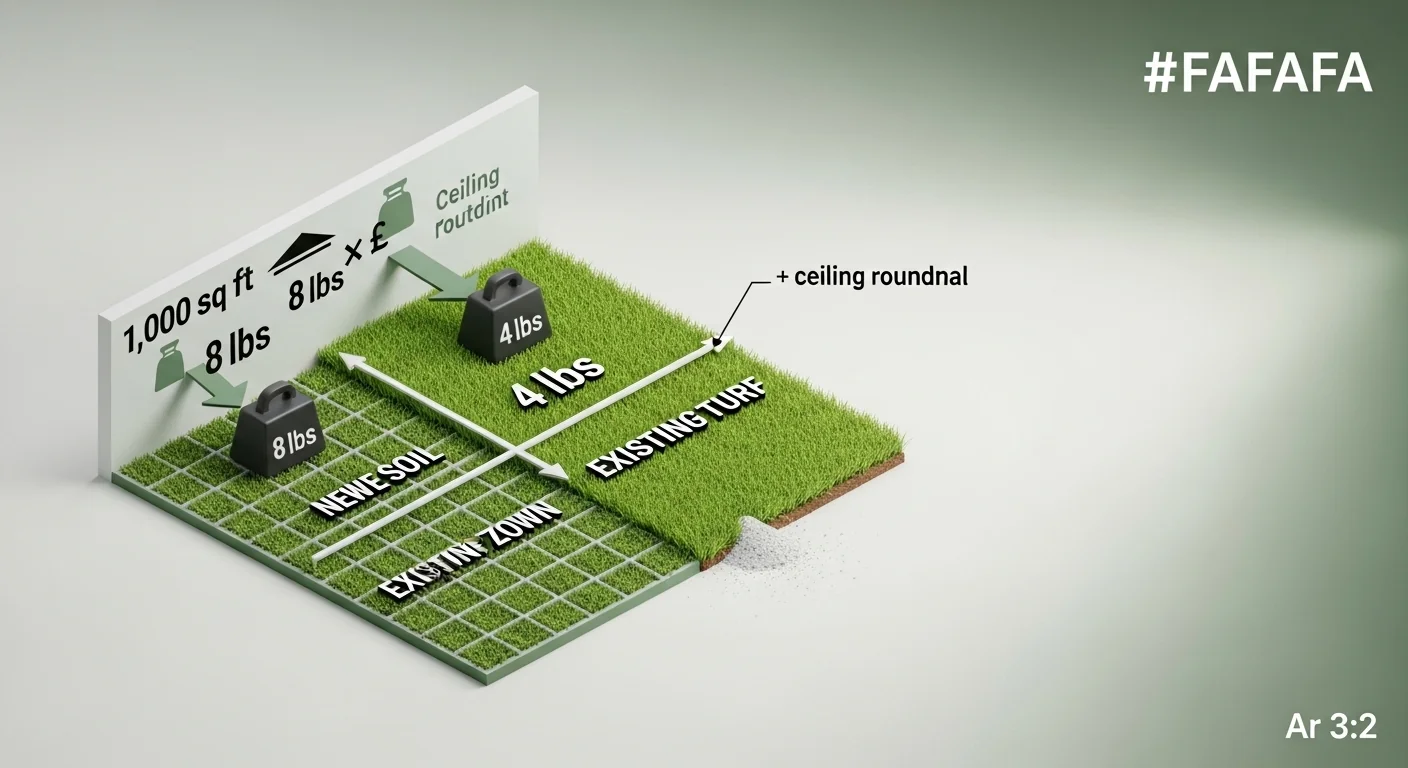
This grass seed calculator applies two distinct seeding rates drawn from agronomic standards: 8 lbs per 1,000 sq ft for new lawn establishment and 4 lbs per 1,000 sq ft for overseeding an existing lawn. Enter your area and select your seeding type, and the tool returns the total pounds needed, rounded up to the nearest whole pound so you never run short mid-application. The calculator does not account for grass species, soil pH, shade conditions, or slope; those variables affect germination success but not the quantity calculation.
After using this tool, you will know the minimum number of seed bags to purchase before you leave the store, with no guesswork and no leftover waste from buying too many.
Use the Tool
| Lawn Size (sq ft) | New Lawn (lbs) | Overseed (lbs) |
|---|
How this calculator works
Overseed: 4 lbs per 1,000 sq ft → Lbs = Area × 4 ÷ 1000
Assumptions & Limits
- Rates are based on standard cool-season grass seed blends (e.g., Kentucky Bluegrass, Fescue, Ryegrass).
- Warm-season grasses (Bermuda, Zoysia) may require different rates; consult the seed bag label.
- This calculator does not account for slope, shade, or soil quality adjustments.
- Results are rounded up to ensure full coverage. Buying 5-10% extra is recommended for irregular shapes.
- Maximum area supported: 500,000 sq ft. For larger properties, calculate in sections.
Before you calculate, measure your lawn area in square feet. For rectangular zones, multiply length by width. For irregular shapes, break the area into rectangles, calculate each, and add the totals. If you are working from a property survey or landscape plan, confirm the dimensions are in feet, not yards or meters, before entering them. Decide in advance whether you are seeding bare ground or topping up an existing lawn, since that choice directly controls which rate the calculator applies. For projects that involve both activities in separate zones, run the calculator twice and add the results. If you have not yet decided whether to seed or install sod as an alternative, compare the coverage you need before purchasing either product.
Quick Start (60 Seconds)
- Measure the area first. Enter total square footage of the zone you plan to seed. Do not include beds, hardscape, or areas you are not seeding.
- Use square feet, not square yards. The calculator expects sq ft. If you measured in yards, multiply by 9 before entering the value.
- Select “New Lawn” for bare ground. This includes fresh grading, bare soil after renovation, or areas with less than 25% live grass coverage.
- Select “Overseeding” for thin existing turf. Use this when the lawn is alive but sparse, and you are adding seed over existing grass without full soil prep.
- Do not round your area down. Always enter the full area. The calculator handles rounding of the seed quantity for you, using ceiling rounding to prevent shortfall.
- Separate large projects into zones if rates differ. A property that has one bare patch and one thin zone needs two separate calculations.
- Note the bag size before buying. Most residential grass seed is sold in 5 lb, 10 lb, 20 lb, or 50 lb bags. Divide your calculated total by the bag weight to find the number of bags needed.
Inputs and Outputs (What Each Field Means)
| Field | Unit | What It Means | Common Mistake | Safe Entry Guidance |
|---|---|---|---|---|
| Lawn Area | sq ft | Total ground surface to be seeded, excluding hardscape and planting beds | Entering square yards instead of square feet, which triples the calculated quantity | Measure length x width for rectangular zones; break irregular areas into sub-rectangles and sum them |
| Seeding Type | Selection | Determines which agronomic rate to apply: 8 lbs/1,000 sq ft (New Lawn) or 4 lbs/1,000 sq ft (Overseed) | Selecting “New Lawn” for an overseeding project, which doubles the quantity and wastes seed | Use “New Lawn” only when soil is bare or vegetation cover is minimal; otherwise use “Overseeding” |
| Seed Needed (output) | lbs | Total pounds of seed required, rounded up to the next whole pound to ensure complete coverage | Treating the output as a precise weight and not accounting for bag sizes that are not multiples of the output | Round up to the nearest available bag increment; buy slightly more for irregular lawn shapes |
Worked Examples (Real Numbers)
Example 1: Small Backyard New Lawn
- Area: 1,500 sq ft
- Seeding Type: New Lawn
- Rate: 8 lbs per 1,000 sq ft
- Raw calculation: 1,500 x 8 / 1,000 = 12.0 lbs
Result: 12 lbs of grass seed.
Two 5 lb bags plus a single 2 lb topdress bag, or one 10 lb bag, would cover this zone at the recommended new establishment rate. No ceiling rounding was needed since the result was already a whole number.
Example 2: Medium Lawn Overseeding
- Area: 8,000 sq ft
- Seeding Type: Overseeding
- Rate: 4 lbs per 1,000 sq ft
- Raw calculation: 8,000 x 4 / 1,000 = 32.0 lbs
Result: 32 lbs of grass seed.
A single 25 lb bag plus a 10 lb bag, or two 20 lb bags, covers this area. Because the seeding type is overseed (not new lawn), the rate is halved compared to bare-ground establishment.
Example 3: Large Property New Lawn Installation
- Area: 22,500 sq ft
- Seeding Type: New Lawn
- Rate: 8 lbs per 1,000 sq ft
- Raw calculation: 22,500 x 8 / 1,000 = 180.0 lbs
Result: 180 lbs of grass seed.
At this scale, purchasing in 50 lb commercial bags (four bags total) is more cost-effective than retail-size packaging. Projects exceeding 10,000 sq ft also benefit from using a calibrated broadcast spreader or slit seeder rather than hand application to maintain even distribution across the full area.
Reference Table (Fast Lookup)
| Area (sq ft) | New Lawn (lbs) | Overseed (lbs) | 50 lb Bags (New) | 50 lb Bags (Overseed) |
|---|---|---|---|---|
| 500 | 4 | 2 | 1 | 1 |
| 1,000 | 8 | 4 | 1 | 1 |
| 2,500 | 20 | 10 | 1 | 1 |
| 5,000 | 40 | 20 | 1 | 1 |
| 7,500 | 60 | 30 | 2 | 1 |
| 10,000 | 80 | 40 | 2 | 1 |
| 15,000 | 120 | 60 | 3 | 2 |
| 20,000 | 160 | 80 | 4 | 2 |
| 25,000 | 200 | 100 | 4 | 2 |
| 43,560 (1 acre) | 349 | 175 | 7 | 4 |
The “50 lb Bags” columns use ceiling rounding: partial bag fractions are always rounded up to a whole bag, since partial bags cannot be purchased at retail.
How the Calculation Works (Formula + Assumptions)
Show the calculation steps
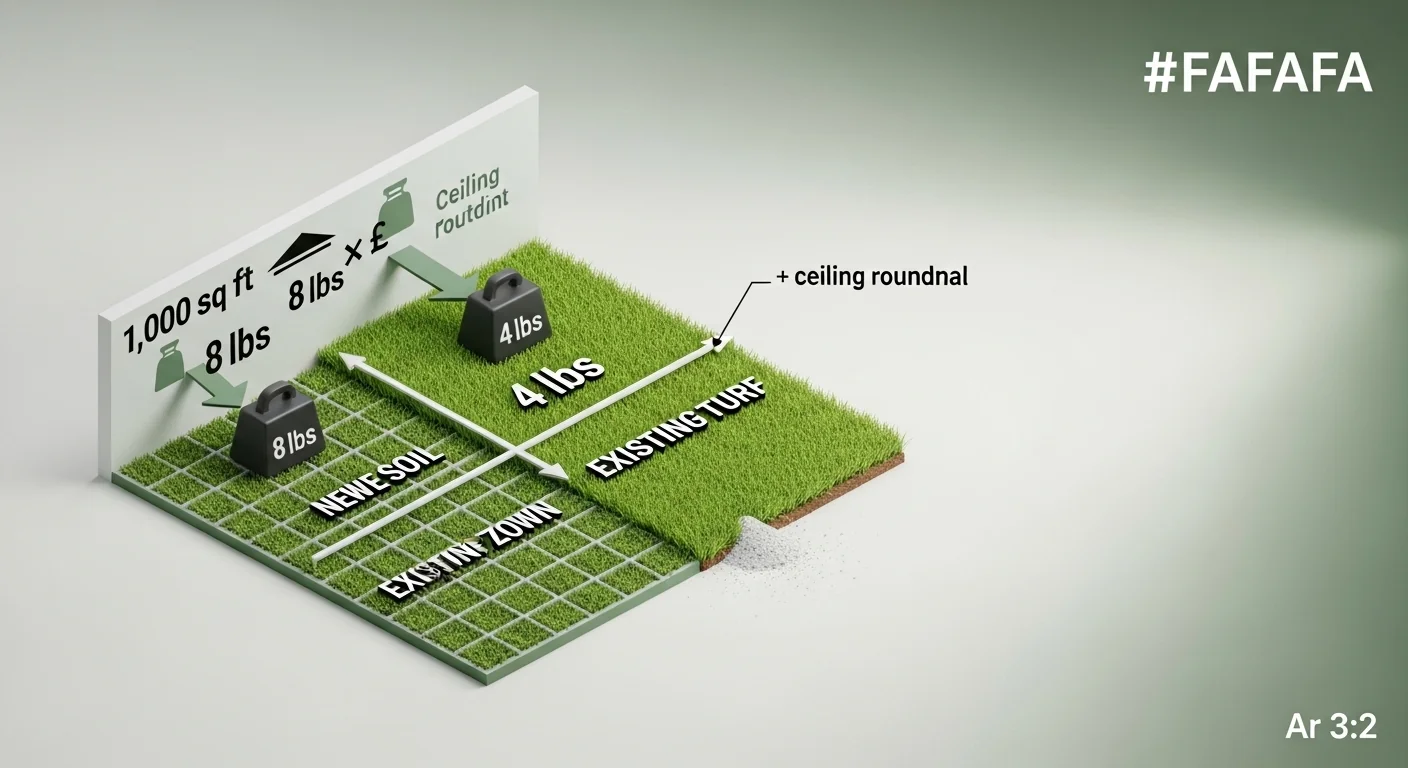
Step 1: Identify the coverage rate.
New Lawn: 8 lbs of seed per 1,000 sq ft.
Overseeding: 4 lbs of seed per 1,000 sq ft.
Step 2: Apply the formula.
Raw lbs = Area (sq ft) x Coverage Rate / 1,000
Example: 6,500 sq ft, overseeding: 6,500 x 4 / 1,000 = 26.0 lbs
Step 3: Apply ceiling rounding.
Round up to the nearest whole pound. If the raw result is 26.0, the output is 26 lbs. If the raw result were 26.1, the output would be 27 lbs.
This rounding rule guarantees you always have enough seed to complete the area, even if minor waste occurs during application.
Unit note: The calculator accepts square feet only. There are no automatic unit conversions. If your measurement is in square yards, multiply by 9. If in acres, multiply by 43,560.
Assumptions and Limits
- Rates are based on standard cool-season grass seed blends including Kentucky Bluegrass, Tall Fescue, Fine Fescue, and Perennial Ryegrass. Warm-season species (Bermuda, Zoysia, Centipede, St. Augustine) have different seeding rates; check the seed bag label for species-specific guidance.
- The calculation assumes a prepared seedbed with good soil-to-seed contact. Heavily thatched or compacted lawns will reduce germination, effectively requiring more seed to achieve the same stand density. The calculator does not adjust for this.
- Irregular lawn shapes introduce measurement error. Any area estimated by eye rather than measured with a tape or measuring wheel should be treated as approximate; buying 5 to 10 additional pounds as a buffer is reasonable.
- Slope is not factored in. On grades steeper than roughly 10 to 15 degrees, seed can wash before germination, requiring a second pass or erosion control measures.
- The calculator does not account for seeding in multiple passes, which some applicators prefer for even distribution. If you plan a crosshatch application (one pass north-south, one pass east-west), split the calculated total between the two passes; the total quantity does not change.
- Maximum input accepted is 500,000 sq ft. Larger properties should be divided into sections and calculated separately.
- The tool does not calculate soil amendment, fertilizer, or topdressing quantities. Those are separate inputs for separate tools.
Standards, Safety Checks, and “Secret Sauce” Warnings
Critical Warnings
- Do not use the New Lawn rate for overseeding. Applying 8 lbs per 1,000 sq ft into an existing lawn does not double your results. Dense existing turf blocks light and space at the soil surface; excess seed germinates poorly, competes with itself, and the surplus is wasted. The correct overseeding rate is 4 lbs per 1,000 sq ft, used in combination with core aeration to open the seedbed.
- Never round down. Cutting the quantity to avoid buying one extra bag results in thin spots that require a second application later, which costs more overall. The ceiling-rounding rule in this calculator exists specifically to prevent this failure mode.
- Bag coverage claims are not the same as seeding rates. Retail packaging often states “covers up to X sq ft,” which reflects a minimum application under ideal conditions, not a standard seeding rate. Using the bag’s coverage claim as your calculation basis will underdeliver seed in most field conditions.
- Species mismatch invalidates the rate. Warm-season grass seed is typically sold by the pound but applied at rates significantly different from cool-season blends. Confirm species compatibility before applying these standard rates to Bermuda, Zoysia, or Centipede grass projects.
Minimum Standards
- New lawn establishment: 8 lbs of seed per 1,000 sq ft is the agronomic baseline for cool-season grass blends with a properly prepared seedbed.
- Overseeding into existing turf: 4 lbs per 1,000 sq ft is the standard rate when adequate soil-to-seed contact is provided by aeration or power raking. Below this threshold, stand density will be insufficient to suppress weeds during establishment.
- After calculating your seed quantity, verify your lawn’s nutrient baseline. Incorporating a nitrogen budget at seeding time supports early root development without burning emerging seedlings.
Competitor Trap: Many grass seed calculators online present a single rate regardless of seeding context, or allow the user to paste in a bag-label coverage number as the divisor. This treats a marketing figure as an engineering input. The result is a quantity that may be correct for ideal lab conditions but will underperform in actual lawns where soil compaction, shade, bird activity, and applicator error all reduce effective seed delivery. The two-rate model used here (new vs. overseed) directly addresses the most common source of miscalculation before the user ever puts seed in a spreader.
Common Mistakes and Fixes
Mistake: Measuring in Square Yards Instead of Square Feet
A lawn that measures 20 yards by 15 yards is 300 square yards, not 300 square feet. Entering 300 into the calculator instead of 2,700 (300 x 9) produces a result that is nine times too low. This mistake often surfaces only after the lawn is partially seeded and the user runs out of product far too early.
Fix: Confirm the unit on your measuring tape or laser before entering anything. If you used a wheel or tape calibrated in feet, enter directly. If you measured in yards, multiply by 9.
Mistake: Treating the Output as a Maximum Instead of a Minimum
Some homeowners interpret the calculated pound total as a ceiling and deliberately buy slightly less to save money. Seed quantities in this calculator are already lean; they reflect a precise agronomic rate, not a padded estimate. Undershooting leaves visible low-density zones that require costly re-application.
Fix: Purchase the calculated quantity and round up to the nearest available bag size. For lawns with irregular edges or obstructions, add a small buffer.
Mistake: Applying the New Lawn Rate to Renovation Projects With Partial Grass Coverage
A lawn that is 40 to 60 percent alive is not a “new lawn” from a seed-rate standpoint. Applying 8 lbs per 1,000 sq ft into moderately established turf pushes seed into grass canopy gaps rather than bare soil, most of which will not germinate. The double rate is not more effective; it is more wasteful.
Fix: Use the Overseed rate for any area with meaningful existing grass cover. If coverage is so low that the lawn functions as bare ground, the New Lawn rate applies. When in doubt, the overseed rate with good aeration produces better results than the new lawn rate without soil preparation.
Mistake: Ignoring Pure Live Seed (PLS) When Comparing Seed Products
Two bags of grass seed can show identical weights on their labels but contain very different amounts of viable, germination-capable seed depending on their purity and germination ratings. Applying this calculator’s output using a low-PLS product will produce sparser results than the same quantity from a high-PLS blend. The Pure Live Seed calculator is the correct tool to compare products on a like-for-like basis before purchase.
Fix: Check the seed tag (required by law in the US) for germination rate and purity. Adjust your purchase quantity upward if PLS is notably below standard.
Mistake: Hand-Broadcasting Seed Uniformly Across Large Areas
Hand broadcasting becomes inconsistent beyond roughly 2,000 to 3,000 sq ft. Coverage gaps form in areas where the applicator’s throw was uneven, and seed concentrations form near the starting and stopping points. The lawn looks fine at seeding but germinates in strips and patches.
Fix: Use a calibrated drop or broadcast spreader for areas above 1,000 sq ft and consider a slit seeder for large overseeding projects where direct soil contact is a priority.
Next Steps in Your Workflow
Once you have your seed quantity, the next decision point is soil readiness. Seed applied to compacted, hydrophobic, or nutrient-depleted soil will germinate at lower rates regardless of the quantity applied. Before seeding day, check whether topdressing or amendment is needed by reviewing your topsoil depth requirements for the project type. Established soil depth targets differ between new construction sites (where subsoil is often exposed) and existing lawns undergoing renovation.
After the seed is down, consistent watering is the single largest variable affecting germination success. New seed requires light, frequent irrigation to keep the seed zone moist without washing seed off the soil surface. A turf watering calculator can help you determine how much water to apply per zone based on your irrigation system’s output rate, avoiding both drought stress and overwatering during the critical first two to three weeks of establishment.
FAQ
How many pounds of grass seed do I need per 1,000 square feet?
For new lawn establishment using cool-season grass blends, the standard rate is 8 lbs per 1,000 sq ft. For overseeding an existing lawn, the rate drops to 4 lbs per 1,000 sq ft. Warm-season species (Bermuda, Zoysia) use different rates listed on the seed bag label; these two rates apply to cool-season blends only.
What is the difference between overseeding and new lawn seeding rates?
New lawn seeding targets bare, prepared soil where seed has direct contact across the entire surface. Overseeding targets existing turf, where seed must compete for light and space with established grass. The lower overseeding rate (4 lbs per 1,000 sq ft) reflects this competition and is paired with mechanical preparation such as aeration or power raking to open the soil surface.
Should I round up or round down when buying grass seed?
Always round up. This calculator already applies ceiling rounding to the pound total. When converting that pound total to bag quantities, round up again to the next available bag size. Running short of seed mid-application is more disruptive than having a small amount left over, and partial bags store well for spot repairs.
Can I use this calculator for warm-season grasses like Bermuda or Zoysia?
The 8 lbs and 4 lbs rates used here are calibrated for cool-season grass blends. Warm-season species have substantially different seeding rates, often specified per 1,000 sq ft on the seed tag. Use those species-specific rates and enter the corresponding area to get a quantity that reflects the actual product you are applying.
How do I measure my lawn area if it is not a rectangle?
Break the lawn into smaller rectangular sections, measure each section’s length and width, calculate the area of each (length x width), and add the totals together. For curved edges, use the outer boundary of the curve. A modest overestimate of a few sq ft is preferable to underestimating, since rounding up the seed quantity is built into the calculation anyway.
Does this calculator account for seed germination rates or purity?
No. The quantities produced assume seed meets standard germination and purity thresholds typical of quality retail blends. If you are comparing products with substantially different germination rates, the pound total from this calculator may need to be adjusted using a Pure Live Seed (PLS) calculation to account for the actual viable seed content in each bag.
Conclusion
The core problem this calculator solves is not arithmetic. Most people can do the multiplication. The real value is in knowing which rate to use before pulling the calculation, and understanding why those two rates (8 lbs vs. 4 lbs per 1,000 sq ft) exist and when each applies. Using the new lawn rate on an overseeding project is the single most common error in consumer grass seed purchasing, and it consistently leads to wasted product and no measurable improvement in lawn density.
Accurate seeding starts with an accurate area measurement, the correct rate for your actual project type, and ceiling-rounded quantities so you never run short. If your project also involves calculating how much topsoil, landscape fabric, or other materials you need for the same zone, the landscape fabric overlap calculator can help you plan adjacent material quantities with the same precision before you begin.