
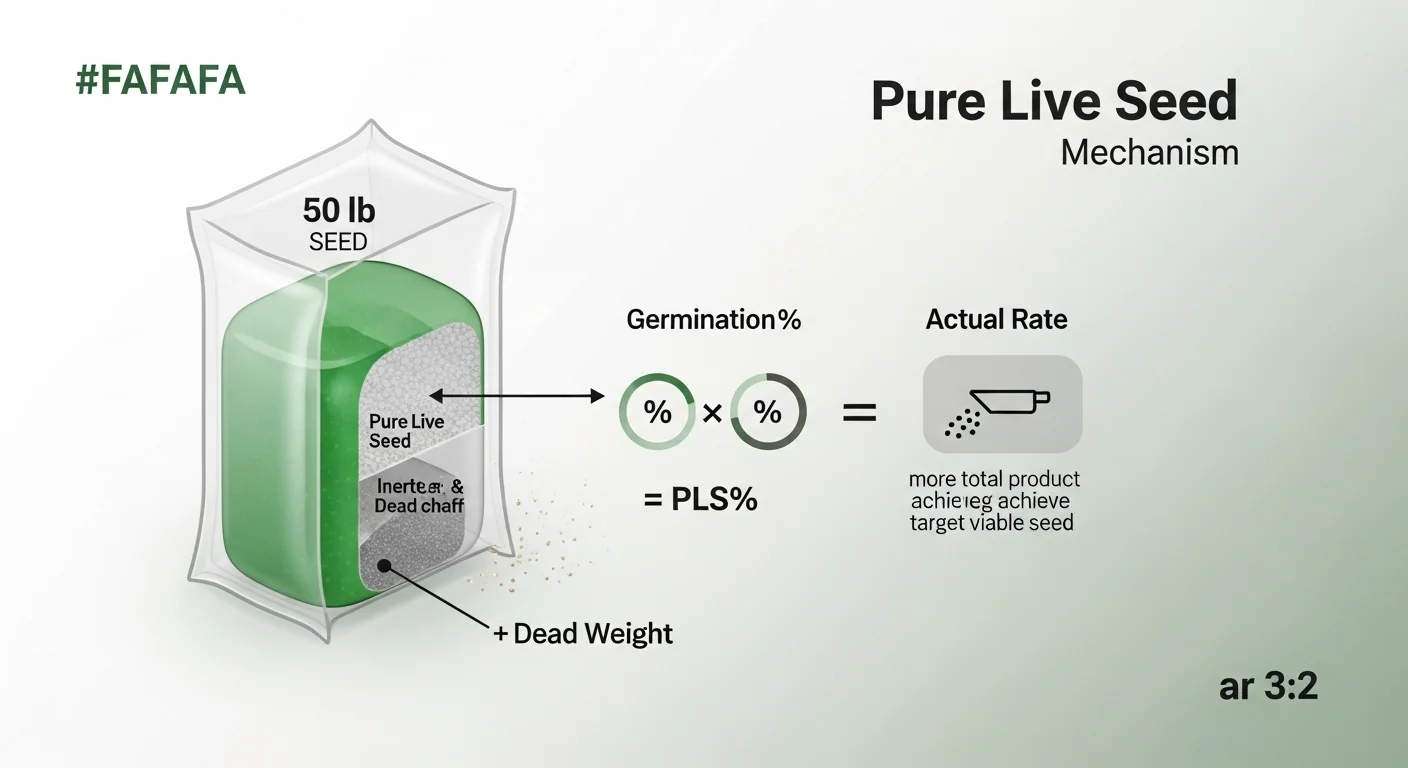
Every grass seed bag carries two numbers on its analysis tag: germination and purity. Taken separately, they tell you almost nothing useful. Combined into a single Pure Live Seed (PLS) percentage, they reveal exactly what fraction of every pound you purchase will actually germinate in your soil. The gap between the labeled weight and the true PLS weight is where most homeowners and turf managers quietly lose money.
This calculator computes your seed’s PLS percentage, then adjusts your spreader’s application rate so that the correct amount of viable seed reaches the ground, regardless of how much inert filler or dead material is in the bag. It does not predict field germination, account for soil temperature, or estimate establishment time. What it does do is strip the math down to a single, defensible number: the actual pounds of product you need to buy.
After running your seed label through this tool, you will know whether your bag is worth its price, how many bags to purchase for your specific area, and whether the purity level is low enough to warrant a weed seed warning. For a broader comparison of seeding methods and their coverage assumptions, the grass seed calculator provides complementary rate guidance based on grass species and establishment type.
Use the Tool
PLS & Overseeding Spreader Calibration
Exposes true seed value & calculates exact bags needed — The Yield Grid
| Seed Type | Typical PLS% | Actual lbs/1K needed | vs. Your Seed |
|---|
How This Calculator Works — Formula & Assumptions
Pure Live Seed (PLS) is the only metric that matters — it measures the percentage of seed in a bag that will actually germinate and grow. Using the label’s Germination % and Purity % together exposes the real value of any bag.
This gives you the true percentage of living, pure seed in every pound you buy. A “cheap” bag with 50% purity and 80% germination only has 40% PLS — you’re buying 60% dead weight.
Because your seed isn’t 100% viable, you must apply more total bag weight to hit your target of actual living seed reaching the soil. This is the number you set your spreader to.
Scales the rate to your full lawn area. If your area is 5,000 sq ft, multiply by 5 (five 1,000 sq ft units).
Always round up — you cannot buy partial bags, and running out mid-job causes uneven coverage.
- All percentages are taken directly from the seed label’s official analysis tag (required by law in the US).
- Application rates assume even coverage in 2 perpendicular passes (halved rate per direction).
- Germination rates on labels represent ideal lab conditions; field germination may be 10–15% lower.
- Weed seed warning triggers at Purity < 80% per standard agronomic thresholds.
- Bag weight is total gross weight as printed; actual seed weight = Bag Weight × (Purity% ÷ 100).
- This tool does not account for soil temperature, moisture, or overseeding into existing turf.
Before you start, pull the seed analysis tag from the bag. You need the germination percentage and pure seed percentage printed on that label, both of which are legally required disclosures in the United States. Have the total bag weight and your measured lawn area in square feet ready. If you are overseeding into an existing stand using a slit seeder, the slit seeder calculator handles seeding depth and row-spacing adjustments that this tool does not address.
Quick Start (60 Seconds)
- Target Application Rate: Enter the seeding rate your seed manufacturer or local extension office recommends, in pounds per 1,000 square feet. Most cool-season grasses fall between 3 and 8 lbs/1,000 sq ft for new seeding; overseeding rates are typically 30 to 50 percent lower.
- Bag Weight: Use the total gross weight printed on the bag, not an estimate. A bag that feels heavy is not necessarily heavier in viable seed.
- Bag Germination %: Read directly from the seed analysis tag. The field marked “Germination” or “Germ%” is the one you want. Do not use the “Tested” date as a substitute.
- Bag Purity %: Listed as “Pure Seed” on the analysis tag. This figure excludes inert matter, other crop seed, and weed seed. Low purity on a coated or clay-encased product is the single most common source of sticker shock once the math runs.
- Total Lawn Area: Enter in square feet. If you have acres, multiply by 43,560. Measure the actual seeding zone, not the full property footprint.
- All five fields are required. The calculator will not produce results until every field passes validation.
- Press the Calculate button or hit Enter from any field to run the computation.
Inputs and Outputs (What Each Field Means)
| Input / Output | Unit | What It Means | Common Mistake | Safe Entry Guidance |
|---|---|---|---|---|
| Target Application Rate | lbs / 1,000 sq ft | The rate of pure live seed you want hitting the soil per 1,000 sq ft | Using the label rate without knowing the PLS%, so the spreader is calibrated to raw bag weight | 0.1 to 50 lbs/1,000 sq ft; use your extension or seed manufacturer’s published recommendation |
| Bag Weight | lbs | Total gross weight of one bag as printed on packaging | Entering the estimated weight from memory rather than reading the bag | 1 to 500 lbs; read the bag |
| Bag Germination % | % | Percentage of pure seed in the bag capable of germinating under lab conditions | Confusing germination with purity, or using an outdated test date when the seed is near expiry | 1 to 100; pull directly from the analysis tag |
| Bag Purity % | % | Fraction of bag weight that is pure, desired seed species (excludes inert matter, weed seed, other crop seed) | Assuming a “grass seed” bag is nearly 100% seed; coated products routinely show 50 to 72% purity | 1 to 100; the “Pure Seed” line on the analysis tag |
| Total Lawn Area | sq ft | The total surface area receiving seed, not the property size | Including driveways, beds, and structures in the square footage count | 100 to 10,000,000 sq ft; measure only the area being seeded |
| OUTPUT: PLS % | % | True percentage of viable, pure grass seed per pound of bag weight | Treating this number as equivalent to germination rate | 80% is the standard minimum; 90% and above is premium territory |
| OUTPUT: Actual lbs/1,000 sq ft | lbs | The amount of total bag product to spread per 1,000 sq ft to deliver your target PLS rate | Calibrating the spreader to the target rate rather than this adjusted rate | This is the number to set on your spreader; it will always be higher than your target rate |
| OUTPUT: Total lbs required | lbs | Total bag product needed across your full area | Rounding down and running short mid-job | Always purchase the ceiling bag count; seed stored properly can carry over to fall or spring |
| OUTPUT: Bags needed | bags | Whole bags required; always rounded up because partial bags are not sold | Buying the exact decimal amount and discovering mid-project that the spreader runs dry | Use the ceiling value; don’t round down |
| OUTPUT: Dead weight per bag | lbs | Pounds of clay coating, inert matter, and non-germinating chaff in each bag | Assuming this number is negligible; on coated seed, it often exceeds the viable seed weight | The higher this number, the worse the seed value for money |
Worked Examples (Real Numbers)
Example 1: The “Budget Bag” Trap (Budget Coated Seed, Large Lawn)
- Target Application Rate: 5 lbs / 1,000 sq ft
- Bag Weight: 50 lbs
- Bag Germination: 80%
- Bag Purity: 50% (common in heavily coated products)
- Total Lawn Area: 5,000 sq ft
Result: PLS = 40.0%. Actual rate = 12.50 lbs / 1,000 sq ft. Total lbs needed = 62.5 lbs. Bags required = 2 bags (100 lbs purchased total).
The homeowner who picked up a single 50 lb bag believing it would cover 5,000 sq ft at 5 lbs/1,000 sq ft will fall more than 37 lbs short. The low purity cuts the seed value nearly in half, forcing the spreader to double its delivery rate just to hit the target. Of each 50 lb bag, 30 lbs is inert coating and dead material.
Example 2: Standard Retail Blend, Medium Lawn
- Target Application Rate: 6 lbs / 1,000 sq ft
- Bag Weight: 25 lbs
- Bag Germination: 85%
- Bag Purity: 85%
- Total Lawn Area: 8,000 sq ft
Result: PLS = 72.3%. Actual rate = 8.31 lbs / 1,000 sq ft. Total lbs needed = 66.5 lbs. Bags required = 3 bags (75 lbs purchased total).
This is a typical mid-grade scenario. The PLS is below the 80% minimum standard, so the spreader must compensate by applying more product. Three bags are necessary where a buyer expecting 25 lbs to cover roughly 4,000 sq ft would have guessed two.
Example 3: Premium Uncoated Seed, Large Renovation
- Target Application Rate: 5 lbs / 1,000 sq ft
- Bag Weight: 50 lbs
- Bag Germination: 92%
- Bag Purity: 98%
- Total Lawn Area: 10,000 sq ft
Result: PLS = 90.2%. Actual rate = 5.55 lbs / 1,000 sq ft. Total lbs needed = 55.5 lbs. Bags required = 2 bags (100 lbs purchased total).
The premium uncoated bag requires only a modest adjustment to the spreader rate. Of every 50 lbs, roughly 45 lbs is viable seed. Comparing this outcome with Example 1 at the same bag weight and lawn size, the premium product delivers the target seed quantity with the same number of bags while carrying almost no dead weight.
Reference Table (Fast Lookup)
All values below are computed using the standard PLS formula. The two adjusted rate columns show how many pounds of bag product must be applied per 1,000 sq ft to deliver a 5 lb or 7 lb pure live seed target. Rows below the 80% PLS threshold are commonly flagged as substandard in turf agronomy practice.
| Seed Type / Quality | Germ % | Purity % | PLS % | Actual lbs/1K (5 lb target) | Actual lbs/1K (7 lb target) |
|---|---|---|---|---|---|
| Coated/filled budget seed | 80 | 50 | 40.0 | 12.50 lbs | 17.50 lbs |
| Economy big-box blend | 80 | 72 | 57.6 | 8.68 lbs | 12.15 lbs |
| Mid-grade retail (lower purity) | 82 | 80 | 65.6 | 7.62 lbs | 10.67 lbs |
| Standard retail blend | 85 | 85 | 72.3 | 6.92 lbs | 9.69 lbs |
| Good quality seed (near threshold) | 87 | 90 | 78.3 | 6.39 lbs | 8.94 lbs |
| Near-premium uncoated | 88 | 93 | 81.8 | 6.11 lbs | 8.56 lbs |
| Premium uncoated seed | 90 | 95 | 85.5 | 5.85 lbs | 8.19 lbs |
| Top-grade certified uncoated | 92 | 98 | 90.2 | 5.55 lbs | 7.76 lbs |
Yellow rows: PLS below 80% (substandard). Green rows: PLS at or above 80%. Adjusted rates are rounded to two decimal places.
How the Calculation Works (Formula + Assumptions)
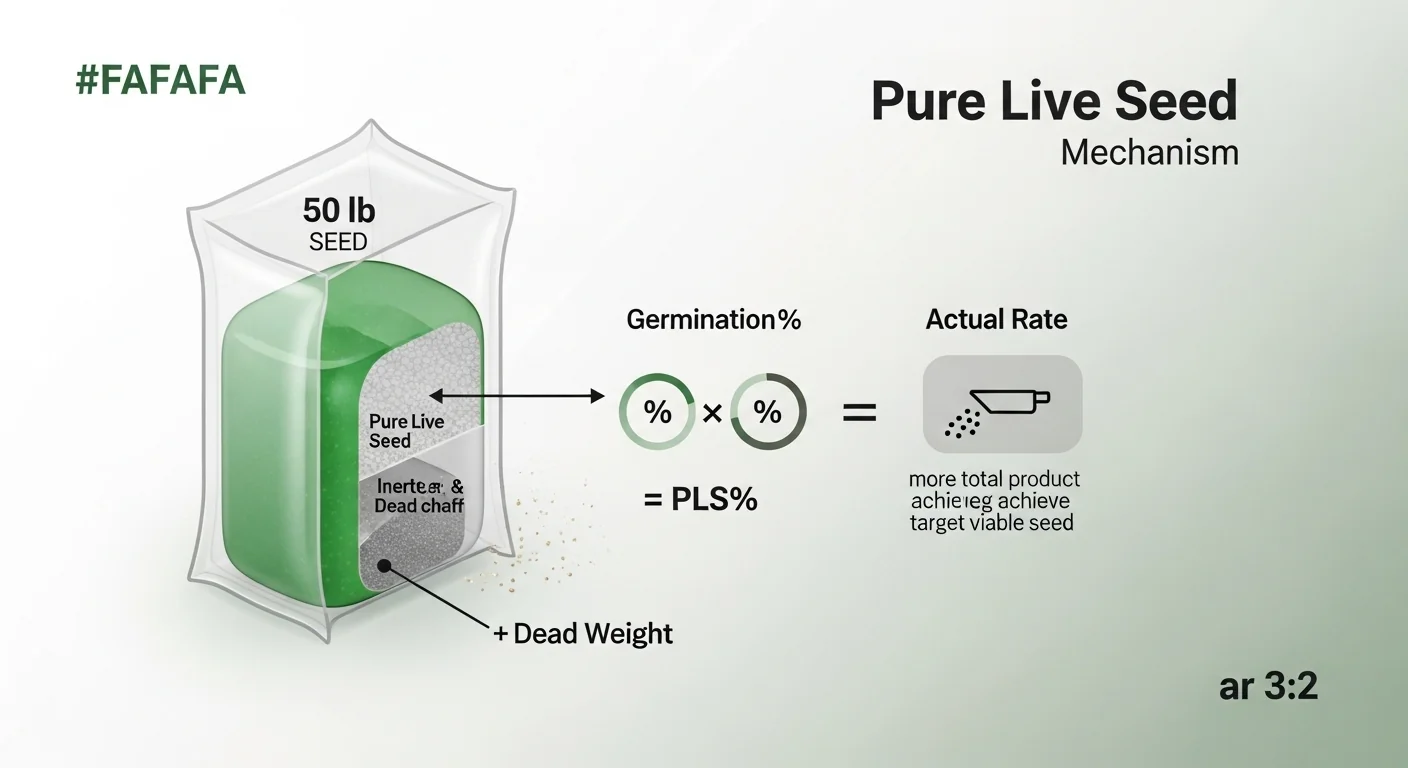
Show the calculation steps
Step 1: Compute PLS Percentage
PLS% = (Germination% / 100) x (Purity% / 100) x 100
This collapses both label values into one number. A bag with 85% germination and 85% purity yields a PLS of 72.25%. That number is the real unit of measure, not the labeled bag weight.
Step 2: Compute the Adjusted Application Rate
Actual Rate (lbs / 1,000 sq ft) = Target Rate / (PLS% / 100)
Because viable seed makes up only a fraction of each pound, the spreader must deliver more total bag product to hit the target. A 40% PLS bag at a 5 lb/1,000 sq ft target requires 12.50 lbs of product per 1,000 sq ft. Always use this number, not your original target rate, when calibrating the spreader.
Step 3: Scale to Total Area
Total lbs needed = Actual Rate x (Area / 1,000)
The area is divided by 1,000 to convert square feet into 1,000-sq-ft units. A 5,000 sq ft lawn multiplies by 5. No rounding at this stage; carry the full decimal into Step 4.
Step 4: Determine Whole Bags
Bags = CEILING(Total lbs / Bag Weight)
Always round up to the next whole integer. Partial bags cannot be purchased, and running short of seed mid-application causes inconsistent coverage that is difficult to correct without re-seeding thin areas.
Dead Weight per Bag
Dead Weight = Bag Weight – (Bag Weight x (Purity% / 100) x (Germination% / 100))
This is the weight of clay coating, inert fillers, non-germinating chaff, and weed seed in every bag. On a 50 lb bag at 50% purity and 80% germination, dead weight equals 30 lbs.
Assumptions and Limits
- Germination and purity values are taken directly from the seed analysis tag, which reflects lab conditions, not field conditions. Field germination is typically 10 to 15% lower than the tag value due to soil temperature variation, moisture stress, and seedbed preparation quality.
- The tool assumes all seed in the bag is of the same species composition throughout. Blended bags with multiple species at differing germination rates will have a composite label value; the tool treats this as a single number.
- Application assumes two perpendicular passes at half the adjusted rate per direction, which is standard broadcast spreader practice. Single-pass application at full rate risks uneven coverage.
- Bag weight is treated as gross weight. If the bag includes a liner, handle, or label material with significant mass, the actual seed content could differ marginally from the label.
- This tool does not account for overseeding into existing turf, where competition from established grass and thatch layer thickness can reduce effective germination below the PLS-predicted rate.
- Weed seed content on the label is a separate field from purity. The tool flags low purity as an indirect indicator of potential weed seed presence, but it does not directly parse the weed seed count from the tag.
- Results assume seed is spread uniformly across the entire entered area. Highly irregular lawn shapes, slopes over 15 degrees, or shaded areas may require adjusted rates not covered by this calculator.
Standards, Safety Checks, and “Secret Sauce” Warnings
Critical Warnings
- Purity below 80%: Weed Seed Risk. A seed analysis tag showing less than 80% pure seed indicates a significant fraction of the bag is inert matter, other crop seed, or undisclosed weed seed. Spreading this product introduces material you have not identified into your lawn. The label’s weed seed line is a required disclosure; read it before purchase, not after.
- PLS below 50%: The Dead Bag scenario. When germination and purity combine to produce a PLS below 50%, more than half of every pound spread will never produce a grass plant. At a PLS of 40%, a homeowner applying what they believe is a 5 lb/1,000 sq ft rate is actually delivering 2 lbs of viable seed and 3 lbs of filler. The adjusted rate required to compensate makes this seed economically inferior to almost any premium alternative, even before comparing retail prices.
- Germination below 75%: Suspect seed age or storage. Germination rates drop as seed ages or is stored improperly. A freshly tested bag from a reputable supplier will typically show germination above 80%. Tags showing below 75% should prompt a check of the test date. If the seed was tested more than 9 to 12 months prior to purchase, the actual germination may be lower than what the tag reports.
- Adjusted rate exceeding 20 lbs/1,000 sq ft: Reconsider the seed source. When the PLS calculation forces an adjusted rate above 20 lbs/1,000 sq ft, the seed’s quality is so low that the quantity required becomes impractical and expensive. A switch to a bag with 90%+ PLS will reduce the effective rate sharply.
Minimum Standards
- 80% PLS is the widely used agronomic floor for acceptable seed quality. Seed below this threshold requires disproportionately large quantity adjustments and introduces higher risk of substandard establishment.
- 98% or higher purity is achievable with top-grade, certified uncoated seed from suppliers like Jonathan Green and Barenbrug. This is the benchmark for comparing any seed purchase against what premium product would cost per pound of actual viable seed.
Competitor Trap: Most seed comparison content online ranks bags by price per pound and germination rate alone, ignoring purity entirely. That framing systematically misleads buyers. A bag priced at half the cost of a premium alternative appears cheaper until PLS math runs: the low-purity bag often requires 1.5 to 2.5 times the volume to hit the same viable seed delivery, erasing the price advantage entirely and frequently exceeding it. The only fair comparison is cost per pound of pure live seed delivered to the soil, not cost per pound of bag weight. For lawns that need full renovation before seeding, comparing the per-square-foot cost of sod against the cost-per-PLS-lb of seed can help clarify which establishment method is more economical; the sod calculator handles that side of the equation. If you are also preparing the seedbed with topdressing, the compost blanket erosion calculator can help size erosion-control topdressing on sloped areas before the seed goes down.
Aeration before overseeding is a documented best practice for improving seed-to-soil contact on compacted turf. The lawn aeration holes per square foot tool can help you plan core spacing and plug density for that preparation step.
Common Mistakes and Fixes
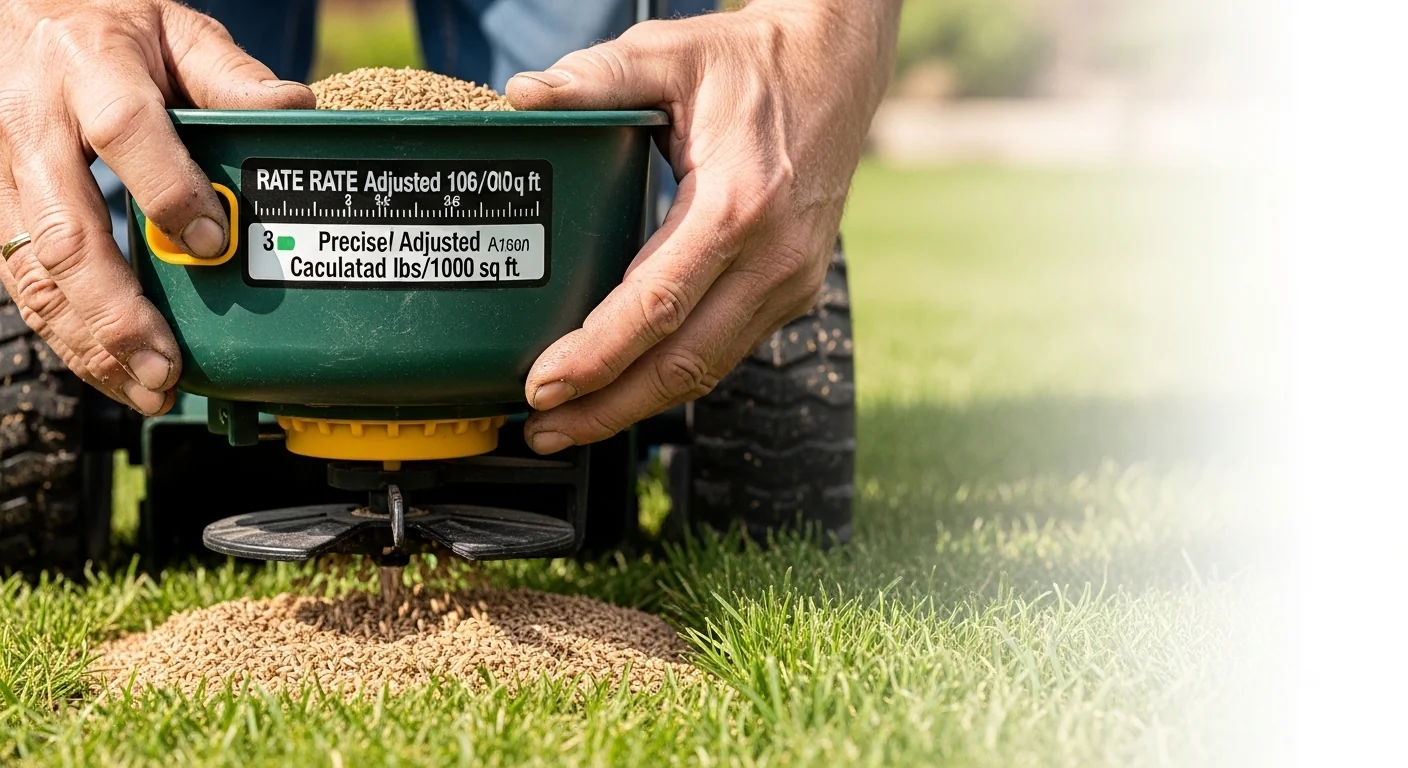
Mistake: Calibrating the Spreader to the Target Rate Instead of the Adjusted Rate
The target application rate is the amount of pure live seed you want to land per 1,000 sq ft. It is not the spreader setting. Once PLS is computed, the spreader must be set to the adjusted rate, which is always higher than the target. Setting a spreader to 5 lbs when the adjusted rate is 8.68 lbs means the lawn receives roughly 57% of the intended viable seed.
Fix: Pull the adjusted rate from the calculator output and use that number when setting spreader deflector plates and hole size settings.
Mistake: Buying Bags Based on Lawn Size Printed on the Bag Label
Bag coverage claims are marketing estimates derived from the label rate, not the PLS-adjusted rate. A bag claiming 5,000 sq ft of coverage rarely accounts for purity losses. That claim may only hold true if the seed has an unusually high PLS, which is not always disclosed on the front of the bag.
Fix: Ignore the coverage claim on the front. Enter the analysis tag values into this calculator and use the computed bag count, not the coverage area printed in large font on the packaging.
Mistake: Not Checking the Seed Test Date
Germination rates on seed tags are valid only for a window following the test date. Seed sitting in a warehouse or retail shelf beyond that window degrades. The printed germination figure no longer reflects the product you are buying. This mistake is nearly invisible because the degraded seed spreads and looks identical to fresh seed until germination time reveals thin coverage.
Fix: Check the “Tested” date on the analysis tag. If it is more than 12 months old, request fresher stock or treat the germination figure as optimistic and plan for additional bags. Proper soil preparation, including adequate topsoil depth, also limits how much outdated germination figures can be compensated for on the ground.
Mistake: Treating Purity as Irrelevant If Germination Is High
A bag with 90% germination and 60% purity has a PLS of only 54%. The high germination figure looks reassuring until purity is multiplied in. This is how premium-marketed seed with coatings or fillers appears competitive on germination while delivering far less viable seed per pound than its price implies.
Fix: Always compute PLS, not just germination. The two figures interact multiplicatively, and purity is frequently the more significant variable for coated or blended products.
Mistake: Skipping Spreader Calibration for Small Areas
A small lawn of 1,000 to 2,000 sq ft can look easy to estimate by hand or with a rough spreader setting. But at low PLS values, even modest under-application across a small area produces visible thin patches within one growing season. The cost of thin coverage and re-seeding typically exceeds the cost of one additional bag. Consistent post-seeding watering also plays a significant role; an under-calibrated application combined with inconsistent irrigation creates compounding failure. The turf watering calculator can help establish a frequency and volume plan once the seed is down.
Fix: Run the calculator even for small areas. The bag count result is the minimum purchase quantity; accurate spreader calibration on any size lawn is non-negotiable for consistent turf density.
Next Steps in Your Workflow
Once the calculator produces your adjusted rate and bag count, the next decision point is seedbed preparation. Viable seed count is only one part of establishment success. Seed-to-soil contact, moisture retention, and surface erosion control on slopes all determine whether the PLS-correct application rate actually translates into turf density. For projects involving dormant or newly seeded areas on a slope, reviewing the soil and coverage plan before the seed goes down prevents the most common cause of reseeding: seed washing before root establishment.
After purchase and application, adjust your irrigation schedule to keep the top half-inch of soil consistently moist for the first two to three weeks. The turf watering calculator can size your run times for that germination window. If your project involves a renovation that will move from overseeding into fertility management once the new stand is established, the grass clippings nitrogen calculator can help you account for nitrogen return from clippings once mowing begins, reducing your first-season fertilizer requirement.
FAQ
What is Pure Live Seed and why does it matter more than the germination percentage alone?
Pure Live Seed (PLS) multiplies germination percentage by purity percentage to give the fraction of each pound that is both pure grass seed and capable of germinating. Germination alone tells you nothing about how much of the bag is actual grass seed versus inert filler. A bag can have 90% germination and still yield poor results if purity is low enough to cut the PLS well below 80%.
How do I find the germination and purity numbers on a seed bag?
In the United States, both figures are required by law on the seed analysis tag attached to or printed on every bag. Look for the lines labeled “Pure Seed” (purity) and “Germination” (germ%). These appear on the same tag as the weed seed percentage, other crop seed percentage, and the test date. The front-of-bag marketing text does not reliably disclose these numbers.
Is PLS percentage the same as the actual germination rate I will see in my lawn?
No. PLS reflects lab germination under controlled conditions. Field germination depends on soil temperature, moisture, seedbed preparation, weather, and seed age. PLS gives you the correct quantity to purchase and spread; it does not guarantee that every viable seed will germinate in your specific conditions. Expect field results to run somewhat lower than the PLS-derived expectation.
Why does the calculator always round bag count up instead of letting me enter a partial number?
Bags of grass seed are sold as whole units. Rounding down even slightly means the actual seed volume available is insufficient to cover the area at the adjusted rate. Running out of seed mid-application forces the user to either leave thin strips untreated until a second purchase or apply the remaining seed unevenly, both of which produce inconsistent turf density that is visible after establishment.
At what PLS percentage should I reject a seed product entirely?
The widely referenced agronomic floor is 80% PLS. Seed below this threshold requires significantly higher application volumes per 1,000 sq ft, increases the risk of weed seed introduction, and often fails to deliver cost efficiency compared to premium alternatives when viewed on a cost-per-viable-pound basis. Seed at 50% PLS or below triggers the Dead Bag warning in this calculator for good reason.
Does this calculator work for overseeding into an existing lawn as well as bare ground seeding?
The PLS math is identical for both uses. The target application rate you enter should reflect the overseeding rate recommendation for your grass species, which is typically 30 to 50% lower than a bare-ground seeding rate. The calculator adjusts from there. It does not account for thatch interference or competition from existing turf, which can reduce effective germination beyond what the PLS figures suggest.
Conclusion
Grass seed is sold by bag weight, but it is only useful by viable seed weight. The gap between those two figures, driven entirely by purity and germination, is where budget products fail the math test even when they pass the shelf-appeal test. Running a pure live seed calculation before purchase converts a guessing decision into a deterministic one: exactly how many bags, exactly what spreader rate, and exactly what fraction of each purchase is dead material you are paying to haul to the curb.
The single mistake that produces the most consistent reseeding failures is calibrating the spreader to the target rate rather than the PLS-adjusted rate. That error is invisible at application time and only becomes visible 30 to 60 days later as thin, patchy turf that did not receive enough viable seed per square foot. For lawns where the seeding project connects to a larger turf renovation involving edging, grading, or reshaped beds, the landscape edging calculator can help scope the perimeter work alongside your seeding plan. Use the PLS calculator first, buy the ceiling bag count, and calibrate before you start the spreader.