Renting a drum aerator for an afternoon and making a single pass over the lawn is one of the most common lawn care rituals in North America. It also, in the majority of cases, does almost nothing to relieve soil compaction. The reason is arithmetic, not effort: a standard drum aerator running one pass over 4-inch by 6-inch tine spacing produces roughly 6 plugs per square foot. University agronomy research consistently places the minimum effective threshold for compaction relief at 20 holes per square foot. That gap is not marginal. It is the difference between a lawn that drains, breathes, and takes up nutrients versus one that looks aerated but behaves exactly as it did before.
This calculator computes two numbers: plug density (holes per square foot) and topdressing volume (cubic yards of sand or compost). It accounts for tine spacing, pass count, lawn area, and target dressing depth. What it does not do is predict how deeply a specific machine will penetrate a specific soil type, nor does it account for tine wear or uneven overlaps during operation. The output is a pre-job planning number, not a post-job confirmation.
Once you run the numbers, you will know immediately whether your planned pass count meets the 20-plug minimum or not. If it does not, the fix is simple and the calculator shows you exactly how many passes it takes to cross that line before you load the machine onto the trailer.
Use the Tool
| Spacing (W x L) | 1 Pass | 2 Passes | 3 Passes | Rating |
|---|
How This Calculator Works
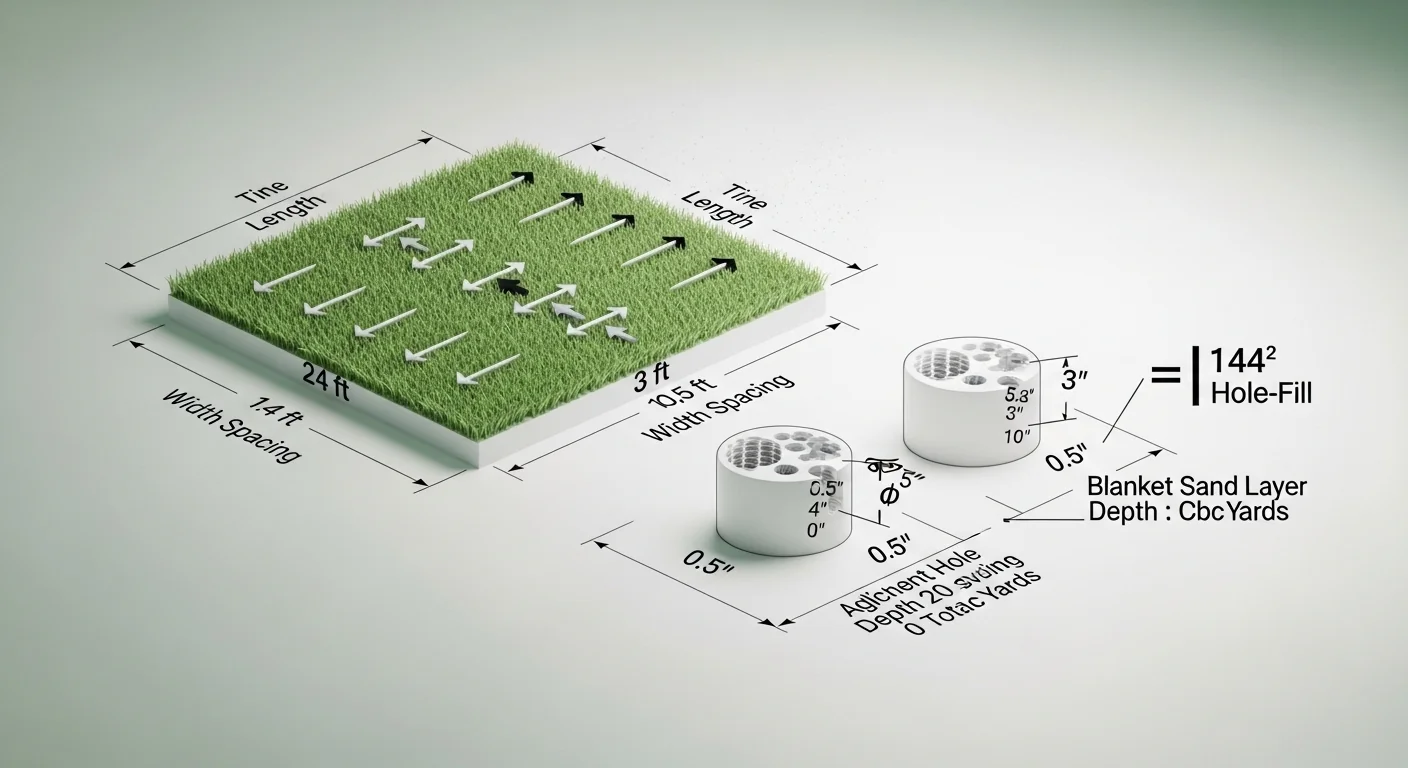
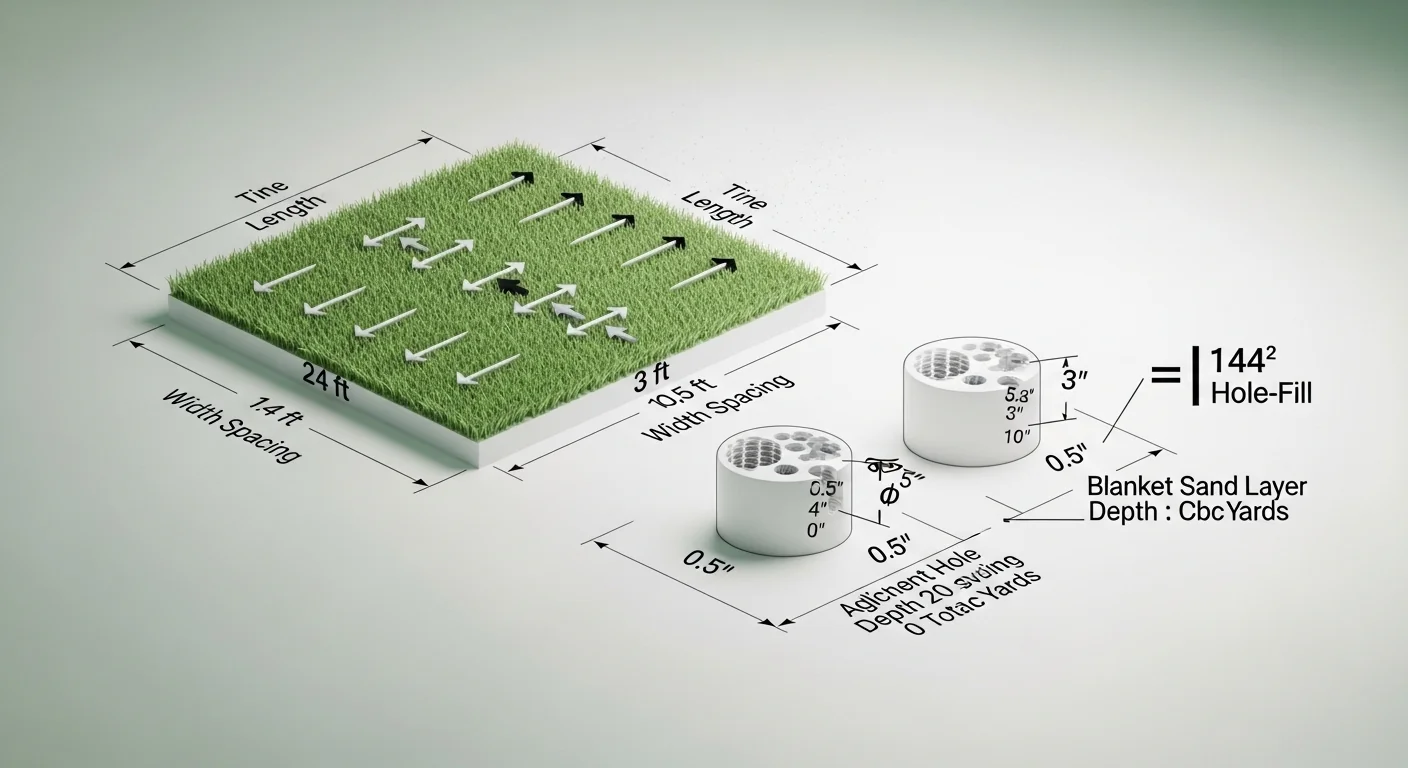
Step 1 – Plug Density: We divide 144 (the number of square inches in 1 sq ft) by the product of tine spacing width and length to get plugs per sq ft on a single pass. Then multiply by the number of passes.
Formula: Plugs/sq ft = (144 / (Spacing Width x Spacing Length)) x Number of Passes
Step 2 – Topdressing Volume (blanket): Area (sq ft) x (Depth in inches / 12) gives volume in cubic feet, then divide by 27 to convert to cubic yards.
Formula: Topdressing (cu yd) = (Area x Depth / 12) / 27
Step 3 – Volume to Fill Aeration Holes: Total plugs x cross-sectional area of each plug hole (using 0.5″ diameter = 0.25″ radius) x tine depth (assumed 3 inches). This estimates how much topdressing material falls into the holes.
Formula: Hole Fill Volume = Total Plugs x PI x 0.25^2 x 3 (inches) / 1728 (cu in per cu ft) / 27 (cu ft per cu yd)
Assumptions & Limits
Tine diameter is assumed to be 0.5 inches (standard hollow-tine core aerator).
Plug depth is assumed to be 3 inches (typical penetration for drum aerators in moist soil).
The “fill holes” volume assumes cylindrical holes with no taper or collapse.
Actual plug density varies with soil moisture, machine weight, speed, and turf density. Double-pass estimates assume the second pass creates new holes (not re-entering existing ones).
Topdressing volume is a blanket estimate. Some material settles into holes and low spots – order 10-15% extra.
For compacted clay soils, university agronomy research recommends a minimum of 20 holes per sq ft to meaningfully relieve compaction.
Before entering your numbers, have three things ready: the measured square footage of the lawn area you plan to aerate (do not use lot size), the tine spacing specification from your aerator's manual or rental sheet (listed as width between rows and length between tines along each row), and your planned topdressing depth in inches. If you are working with compost rather than sand, the cubic yard output still applies since the volume formula is material-agnostic. For a related volume exercise, the topsoil calculator on this site uses the same cubic-yard conversion logic if you need to cross-check a bulk order.
Quick Start (60 Seconds)
- Lawn Area (sq ft): Measure the turf surface you are aerating, not the full property lot. Exclude beds, hardscape, and structures. Accepted range is 1 to 500,000 sq ft.
- Tine Spacing Width (inches): The lateral distance between rows of tines as the drum or roller tracks across the lawn. Check your machine's spec sheet; do not guess. Entry range is 1 to 12 inches.
- Tine Spacing Length (inches): The distance between individual tine holes along each row, determined by drum rotation speed and ground speed. This is almost always larger than the width value. Range is 1 to 12 inches.
- Number of Passes: Select 1, 2, or 3. A "double pass" or "star pattern" means running perpendicular on the second pass, which doubles hole density. This single selection has the largest effect on whether you cross the 20-plug threshold.
- Topdressing Depth (inches): The target blanket depth of sand or compost you plan to apply. A light sand dressing after aeration is typically 0.25 inches; a heavier renovation application might reach 0.5 inches. Range is 0.0625 to 2 inches. Do not enter a number larger than the tine depth or material will simply sit on the surface.
- Common unit mistake: Do not enter tine spacing in centimeters or feet. The calculator expects inches for all spacing and depth fields.
- Click Calculate only after all five fields are filled. The button does not trigger on partial input.
Inputs and Outputs (What Each Field Means)
| Field | Unit | What It Represents | Common Mistake | Safe Entry Guidance |
|---|---|---|---|---|
| Lawn Area | sq ft | Turf surface to be aerated | Using lot size instead of turf-only area | Measure turf zones only; subtract beds and hardscape |
| Tine Spacing Width | inches | Lateral row-to-row gap across drum width | Confusing width and length values | Confirm from machine spec sheet; typically 2 to 6 inches |
| Tine Spacing Length | inches | Hole-to-hole gap along each row | Assuming both spacing values are equal | Usually larger than width; check rental spec sheet |
| Number of Passes | count (1, 2, 3) | How many times machine crosses the entire area | Assuming one pass is sufficient | Select 2 (double/star pattern) as a minimum for compaction relief |
| Topdressing Depth | inches | Target blanket thickness of sand or compost applied | Entering depth thicker than aeration plug depth | Typical range 0.25 to 0.5 inches; 0.25 for light dressing |
| Plugs Per Sq Ft (output) | holes/sq ft | Calculated aeration hole density | Assuming any number above 0 is effective | Minimum 20 required for compaction relief; 20-30 is the target range |
| Total Plugs (output) | count | Density times total area | Treating this as a weight or volume figure | Reference number; useful for estimating cleanup or drag-mat passes |
| Topdressing Volume (output) | cu yd / cu ft | Total material needed for blanket + hole fill | Ordering only the blanket volume and running short | Add 10 to 15 percent to account for settling and uneven spread |
Once you know your sand or compost volume, the turf watering calculator helps you plan the irrigation schedule for the 48 to 72 hours after aeration, when the soil is most receptive to water penetration through the open channels.
Worked Examples (Real Numbers)
Example 1: Suburban Front Lawn, Single Pass
- Lawn Area: 2,500 sq ft
- Tine Spacing Width: 4 inches
- Tine Spacing Length: 6 inches
- Number of Passes: 1 (single pass)
- Target Topdressing Depth: 0.25 inches
Result: 6.0 plugs per sq ft | 15,000 total plugs | 1.93 cu yd topdressing total
Six plugs per square foot falls far below the 20-plug minimum. Applying 1.93 cubic yards of topdressing sand at this density is largely wasteful because the material has no open channels to enter. The single pass has not relieved compaction. A second perpendicular pass would bring this lawn to 12 plugs per sq ft, still below threshold. A third pass would reach 18 plugs per sq ft, still below. This tine spacing cannot achieve 20 plugs per sq ft even with three passes, and the tool's warning indicator will reflect that.
Example 2: Backyard Renovation, Double Pass with Narrower Tines
- Lawn Area: 6,000 sq ft
- Tine Spacing Width: 3 inches
- Tine Spacing Length: 4 inches
- Number of Passes: 2 (double/star pattern)
- Target Topdressing Depth: 0.25 inches
Result: 24.0 plugs per sq ft | 144,000 total plugs | 4.63 cu yd topdressing total
This configuration crosses the 20-plug threshold cleanly. A 3-by-4-inch tine spacing on a double pass is one of the most practical combinations available on commercial rental equipment. The topdressing volume of roughly 4.6 cubic yards for a 6,000 sq ft lawn at a quarter-inch dressing depth is a realistic bulk bag order from most landscape supply yards.
Example 3: Large Athletic Field or Estate Lawn, Triple Pass
- Lawn Area: 20,000 sq ft
- Tine Spacing Width: 4 inches
- Tine Spacing Length: 6 inches
- Number of Passes: 3 (triple pass)
- Target Topdressing Depth: 0.5 inches
Result: 18.0 plugs per sq ft | 360,000 total plugs | 30.9 cu yd topdressing total
Even three passes at 4-by-6-inch spacing only reaches 18 plugs per sq ft. The tool will display a below-minimum warning. This is a common trap on tow-behind drum aerators with wide tine patterns. Switching to a 3-by-4-inch or 2-by-4-inch spacing aerator for this lawn would make three passes unnecessary; a double pass at the narrower spacing would suffice and reduce equipment time. At 0.5-inch depth, topdressing volume jumps to nearly 31 cubic yards, which represents multiple truckloads from a bulk supplier.
Reference Table (Fast Lookup)
| Spacing W x L (in) | 1 Pass | 2 Passes | 3 Passes | Min Passes to Hit 20 | Practical Rating |
|---|---|---|---|---|---|
| 2 x 2 | 36.0 | 72.0 | 108.0 | 1 | Excellent on 1 pass |
| 2 x 4 | 18.0 | 36.0 | 54.0 | 2 | Good on 2 passes |
| 3 x 3 | 16.0 | 32.0 | 48.0 | 2 | Good on 2 passes |
| 3 x 4 | 12.0 | 24.0 | 36.0 | 2 | Good on 2 passes |
| 3 x 5 | 9.6 | 19.2 | 28.8 | 3 | Needs 3 passes to reach threshold |
| 4 x 4 | 9.0 | 18.0 | 27.0 | 3 | Barely meets on 3 passes |
| 4 x 6 | 6.0 | 12.0 | 18.0 | Cannot reach 20 | Ineffective at any pass count |
| 5 x 5 | 5.8 | 11.5 | 17.3 | Cannot reach 20 | Ineffective at any pass count |
| 6 x 6 | 4.0 | 8.0 | 12.0 | Cannot reach 20 | Ineffective at any pass count |
| 6 x 8 | 3.0 | 6.0 | 9.0 | Cannot reach 20 | Ineffective at any pass count |
Key takeaway: Any tine spacing wider than roughly 3 x 5 inches cannot reach the 20-plug minimum regardless of pass count. This eliminates most standard-consumer drum aerators from contention when the goal is genuine compaction relief on clay soils.
How the Calculation Works (Formula + Assumptions)
Show the calculation steps
Step 1: Plugs Per Square Foot
One square foot contains 144 square inches. Dividing 144 by the product of tine spacing width (inches) and tine spacing length (inches) gives the number of holes produced in one pass over one square foot. Multiplying by the number of passes gives total plug density.
Formula: Plugs/sq ft = (144 / (Width x Length)) x Passes
Example: 3-inch width, 4-inch length, 2 passes = (144 / 12) x 2 = 24.0 plugs/sq ft
Step 2: Total Plugs
Plugs per sq ft multiplied by the total lawn area (sq ft) gives total hole count. This is an integer approximation; fractional plugs are rounded to one decimal.
Step 3: Blanket Topdressing Volume
Area (sq ft) multiplied by depth converted to feet (depth in inches divided by 12) gives cubic feet. Dividing by 27 converts to cubic yards. This is the blanket volume independent of the holes.
Formula: Topdressing (cu yd) = (Area x (Depth / 12)) / 27
Step 4: Hole Fill Volume
Each aeration hole is modeled as a cylinder. The tine diameter is assumed at 0.5 inches (0.25-inch radius), and plug depth is assumed at 3 inches. Volume per hole = PI x 0.25^2 x 3 = approximately 0.589 cubic inches. Total hole volume = total plugs x 0.589 cubic inches. Converting: divide by 1,728 (cubic inches per cubic foot) then by 27 to get cubic yards.
Rounding rules: Plug density rounds to one decimal. Volume rounds to two decimals. Total plug count is rounded to the nearest whole plug.
Unit conversion path: All spacing and depth values enter in inches. Volumes output in cubic yards and cubic feet.
Assumptions and Limits
- Tine diameter is assumed at 0.5 inches (standard hollow-tine core aerator). Solid-tine aerators displace rather than remove soil and are not modeled here.
- Plug depth is assumed at 3 inches. Actual penetration depth depends on soil moisture, machine weight, tine sharpness, and travel speed. Dry or heavily compacted soils may reduce depth to 1 to 2 inches.
- Hole geometry is assumed to be a perfect cylinder with no taper, collapse, or sidewall crumbling. Real holes in sandy soils may collapse partially before topdressing is applied.
- Double-pass calculations assume the second pass creates entirely new holes. Overlap or re-entry of existing holes would reduce effective density below the calculated value.
- Topdressing volume adds blanket depth plus hole fill volume. Real-world material losses from wind, boot tracking, uneven spreading, and settling are not included. Plan for 10 to 15 percent overage when ordering.
- The formula assumes uniform tine spacing across the entire drum. Some drum aerators space tines asymmetrically or have missing tines from wear. Verify before calculating.
- This calculator does not account for cores left on the surface. Decomposing surface cores do contribute organic matter but they do not substitute for topdressing material being worked into the holes.
Standards, Safety Checks, and "Secret Sauce" Warnings
Critical Warnings
- The single-pass trap: A drum aerator on a single pass over standard consumer tine spacing (4 x 6 inches) produces roughly 6 holes per square foot. University agronomy research places the minimum for meaningful compaction relief at 20 holes per square foot. Running one pass, then applying topdressing sand, wastes the material cost entirely because there are insufficient channels for it to migrate into the root zone.
- Wide-tine spacing is unfixable: Tine spacings of 4 x 6 inches or wider cannot reach 20 plugs per sq ft at any number of passes. If this is the only machine available from a rental center, the solution is not more passes. It is a different machine with narrower tine spacing or a plug aerator with denser tine patterns.
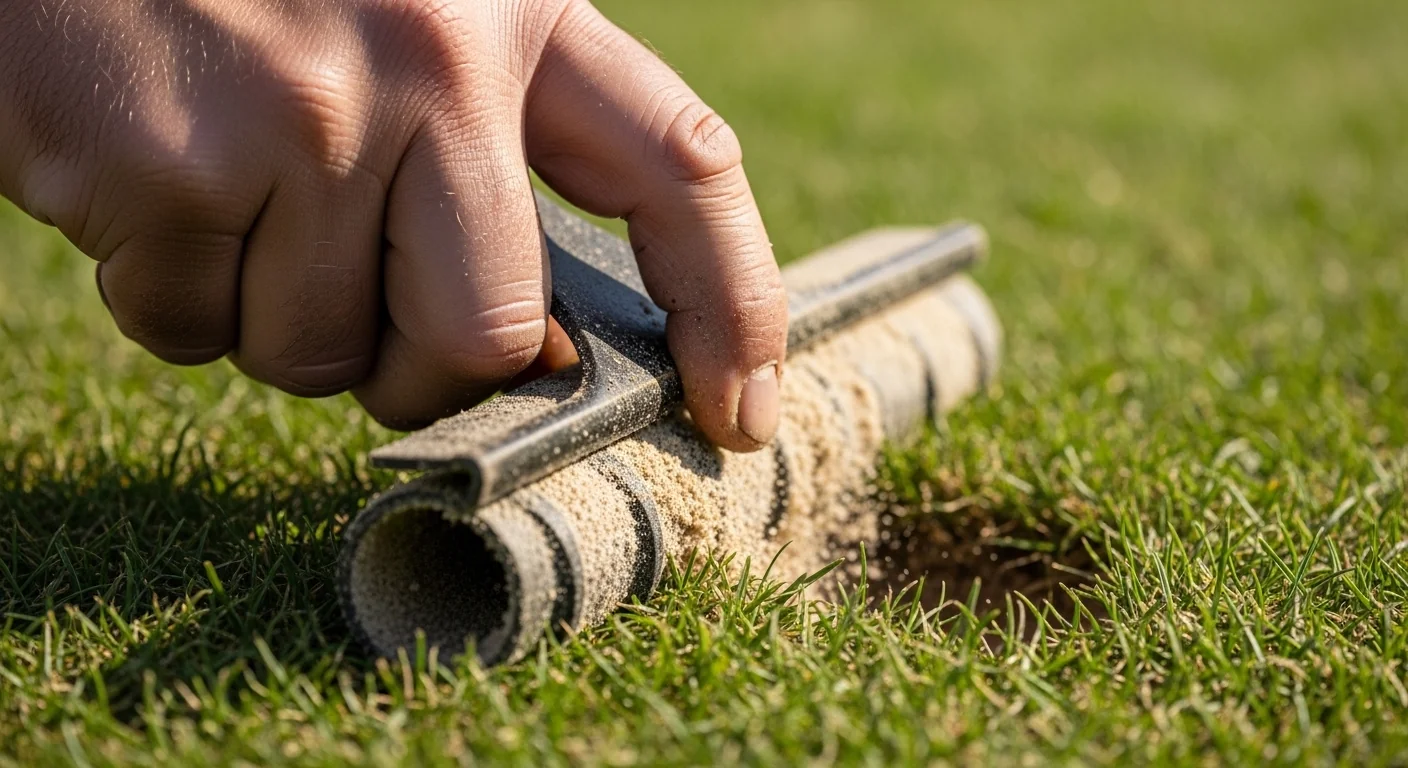
- Topdressing timing: Sand or compost applied immediately after aeration must be worked into the holes with a drag mat or similar implement. Material left sitting on the surface without mechanical incorporation does not deliver its compaction-relief or root-zone-amendment benefit, regardless of plug density.
- Clay soil requires higher density: On heavy clay soils with severe compaction, the 20-plug minimum is a floor, not a target. Turf management literature for sports fields and high-traffic areas often references 25 to 30 plugs per sq ft as the working target for measurable compaction reduction in a single season's treatment.
Minimum Standards
- Minimum effective plug density for compaction relief: 20 holes per square foot (per university agronomy research standards)
- Target range for sand leveling and root zone amendment to be effective: 20 to 30 holes per square foot
- Recommended minimum topdressing depth for sand integration into aeration channels: 0.25 inches (blanket)
- For lawns being renovated with overseeding immediately after aeration, the pure live seed calculator can help determine accurate overseeding rates since aeration holes also serve as seed-to-soil contact points that improve germination.
Competitor Trap: Nearly every general lawn care guide advises homeowners to "aerate once a year" without specifying plug density. The advice is not wrong in intent, but it is incomplete in execution. A homeowner who aerates faithfully every fall with a 4 x 6 inch drum aerator on a single pass will have logged ten years of aeration sessions and achieved, mathematically, near-zero cumulative compaction relief. The plug density check is the one number almost no guide includes, and it is the one number that determines whether the entire operation has any agronomic value. If you are not hitting 20 holes per square foot, you are maintaining the appearance of lawn care without delivering its outcome. If your lawn's compaction is severe enough that you are considering starting over with new turf, the sod calculator can help you size that project accurately.
Common Mistakes and Fixes
Mistake: Using Lot Size Instead of Turf Area
Homeowners frequently enter the total property square footage from a listing or appraisal document. This number includes the house footprint, driveway, beds, and hardscape. The aerator only travels over grass, so the effective area is substantially smaller. Overestimating area inflates the topdressing volume calculation and leads to over-ordering bulk material.
Fix: Measure only the grass zones. A simple length-times-width sketch for each turf section takes five minutes and prevents a material overage that costs real money.
Mistake: Assuming Both Tine Spacing Values Are Identical
Many drum aerators have non-square tine patterns where the lateral spacing between rows differs from the longitudinal spacing between holes along a row. Assuming both values are, say, 4 inches when the actual pattern is 4 x 6 inches overstates plug density by 50 percent. The job looks compliant on paper but falls below the compaction threshold in the field.
Fix: Pull the spec sheet for the specific machine being rented. If it is unavailable, physically measure the tine positions on the drum before calculating.
Mistake: Ordering Topdressing Material Before Running the Plug Density Check
Scheduling a bulk delivery of masonry sand before confirming that the planned pass count will hit 20 plugs per sq ft is a sequencing error that homeowners and landscape contractors both make. If the plug density check shows the planned aeration will not reach the threshold, the topdressing order is effectively premature. For adjacent material calculations, the mulch calculator demonstrates the same cubic-yard ordering logic applied to a different organic material type.
Fix: Calculate plug density first. Confirm the threshold is met. Then place the topdressing material order.
Mistake: Skipping the Drag Mat Step After Topdressing
Spreading sand over aeration holes without mechanically working it into the holes leaves the majority of the material resting on the turf canopy. Gravity does not reliably move fine sand into 3-inch cylindrical holes through turf blades. Without a drag mat or similar implement to push material into the channels, the "topdressing" is effectively just surface dressing.
Fix: Budget time for at least one pass with a flexible drag mat or leveling rake immediately after spreading sand. For large areas, a tow-behind drag mat attached to a lawn tractor is the practical tool.
Mistake: Aerating Dry Soil
Hollow-tine aerators depend on the tine physically extracting a core plug from the soil. In dry, hardened clay, tines cannot achieve their rated penetration depth and may bounce across the surface rather than puncturing it. The calculated plug density assumes rated tine penetration, which is only achievable in moist soil conditions.
Fix: Water the lawn to a depth of 1 inch 24 to 48 hours before aerating if the soil is dry. Do not aerate immediately after heavy rain when soil is saturated and prone to smearing.
Next Steps in Your Workflow
After confirming that your planned tine spacing and pass count cross the 20-plug threshold, the next immediate decision is topdressing material selection. Masonry sand is the standard choice for leveling and improving drainage in compacted or clay soils. Screened compost is the choice when the goal is organic matter supplementation in sandy or depleted soils. The two are not interchangeable for soil amendment purposes, though the cubic-yard volume calculation the tool produces applies equally to both. If your project includes a full lawn renovation with overseeding following aeration, the grass seed calculator on this site lets you determine seed quantities by area and species once the aeration and topdressing stages are mapped out.
For larger properties where aeration connects to a broader soil improvement program, consider sequencing the treatment with a compost blanket for erosion-prone slopes or compacted zones near drainage paths. Aeration opens channels that make subsequent soil amendment applications significantly more effective, which is why the plug density number matters so much as a planning gate rather than a post-job metric. After the aeration-and-topdress work is done, logging the tine spacing and pass count used creates a baseline for comparing results year over year, particularly in high-traffic areas where compaction rebuilds quickly. Use the turf watering calculator to schedule irrigation that drives topdressing material down into the aeration channels during the critical first 72 hours after the job.
FAQ
What is the minimum number of lawn aeration holes per square foot needed to relieve soil compaction?
University agronomy research consistently sets 20 holes per square foot as the minimum threshold for meaningful compaction relief. Below that density, the physical disruption of the soil structure is insufficient to create channels deep enough for root penetration and topdressing material integration. The 20 to 30 plug range is the practical target for most residential and light commercial lawn renovation projects.
Can a standard homeowner drum aerator reach the 20-plug minimum in a single pass?
Almost never with typical consumer rental tine spacings of 4 x 6 inches or wider. At 4 x 6 inches, a single pass produces 6 plugs per square foot. Even three passes at that spacing only reaches 18, which is still below the threshold. The machine choice, specifically tine spacing, is as important as the number of passes. Narrow tine spacings of 3 x 4 inches or tighter can reach 20 plugs in two passes.
What is the correct tine spacing math formula for plug density?
The formula is: Plugs per sq ft = (144 / (Tine Spacing Width x Tine Spacing Length)) x Number of Passes. The 144 represents the number of square inches in one square foot. Dividing by the tine spacing area gives plugs per pass, and multiplying by pass count gives total density. Both spacing values must be in inches for the formula to produce plugs per square foot correctly.
How much topdressing sand do I need after aerating a 5,000 square foot lawn?
At a standard 0.25-inch blanket depth, a 5,000 sq ft lawn requires approximately 3.86 cubic yards of sand as a blanket, plus a small additional volume to fill the aeration holes themselves. Total comes to roughly 3.9 to 4.1 cubic yards depending on plug density. Add 10 to 15 percent for spreading losses, settling, and uneven application, bringing a practical order quantity to approximately 4.5 cubic yards.
What is the difference between a single pass and a double pass star pattern during core aeration?
A single pass means the aerator travels over the entire lawn area once in parallel rows. A double pass or star pattern means the aerator runs a second full pass perpendicular to the first. Because the tines travel in a new direction, the second pass creates an entirely new grid of holes rather than re-entering existing ones. This doubles the plug count per square foot and is the most practical path to reaching the 20-plug threshold on machines with moderate tine spacing.
Does aerating dry or hard soil affect plug density calculations?
The formula calculates theoretical plug density based on spacing alone. It does not account for soil conditions. In reality, dry or severely compacted soil can reduce tine penetration depth significantly, producing plugs that are shorter and narrower than rated specs, or causing tines to skip entirely on very hard surfaces. This is why soil moisture conditions before aerating affect real-world results even when the calculated density looks acceptable on paper.
Conclusion
The practical value of this calculator is not the cubic yard number. It is the plug density check that happens before you commit to a machine, a pass count, and a topdressing order. Most lawn aeration guides skip this gate entirely, which is why single-pass aeration with wide-spaced drum aerators has been repeated as a routine without agronomic results for decades. Knowing your tine spacing and target pass count before you rent the equipment is what separates a productive aeration from an expensive lawn care ritual.
The one mistake worth repeating: assuming that any amount of aeration is better than none when the density falls below 20 plugs per square foot. At sub-threshold densities, compaction is not meaningfully reduced, topdressing material cannot enter the root zone, and overseeding germination rates do not improve. The threshold is not arbitrary. It is the point at which the physical disruption becomes agronomically meaningful. Run the numbers first. If your planned approach does not cross that line, adjust the machine selection or the pass count. For further reading on lawn soil volume work, the topsoil calculator covers bulk material planning for lawn renovation projects that go beyond aeration and topdressing into full soil profile improvement.