
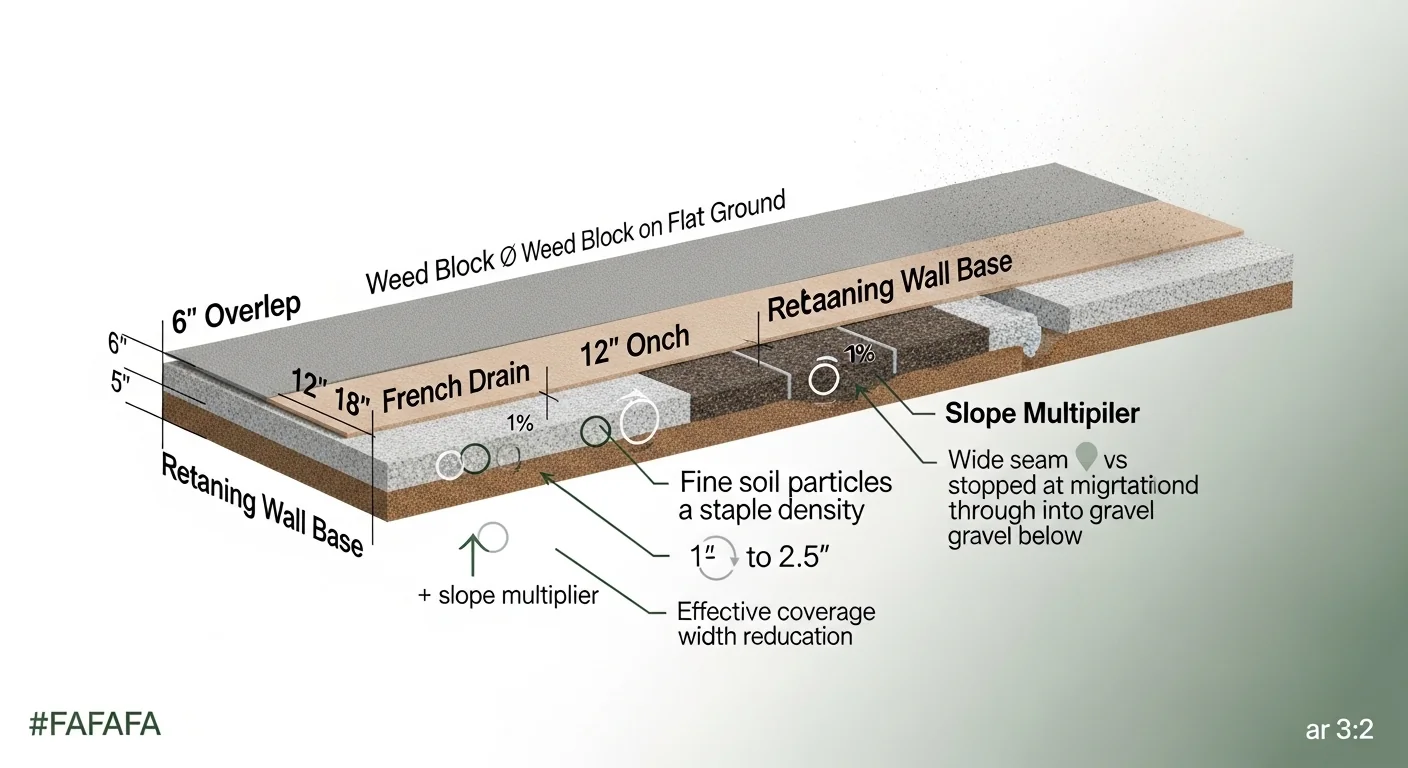
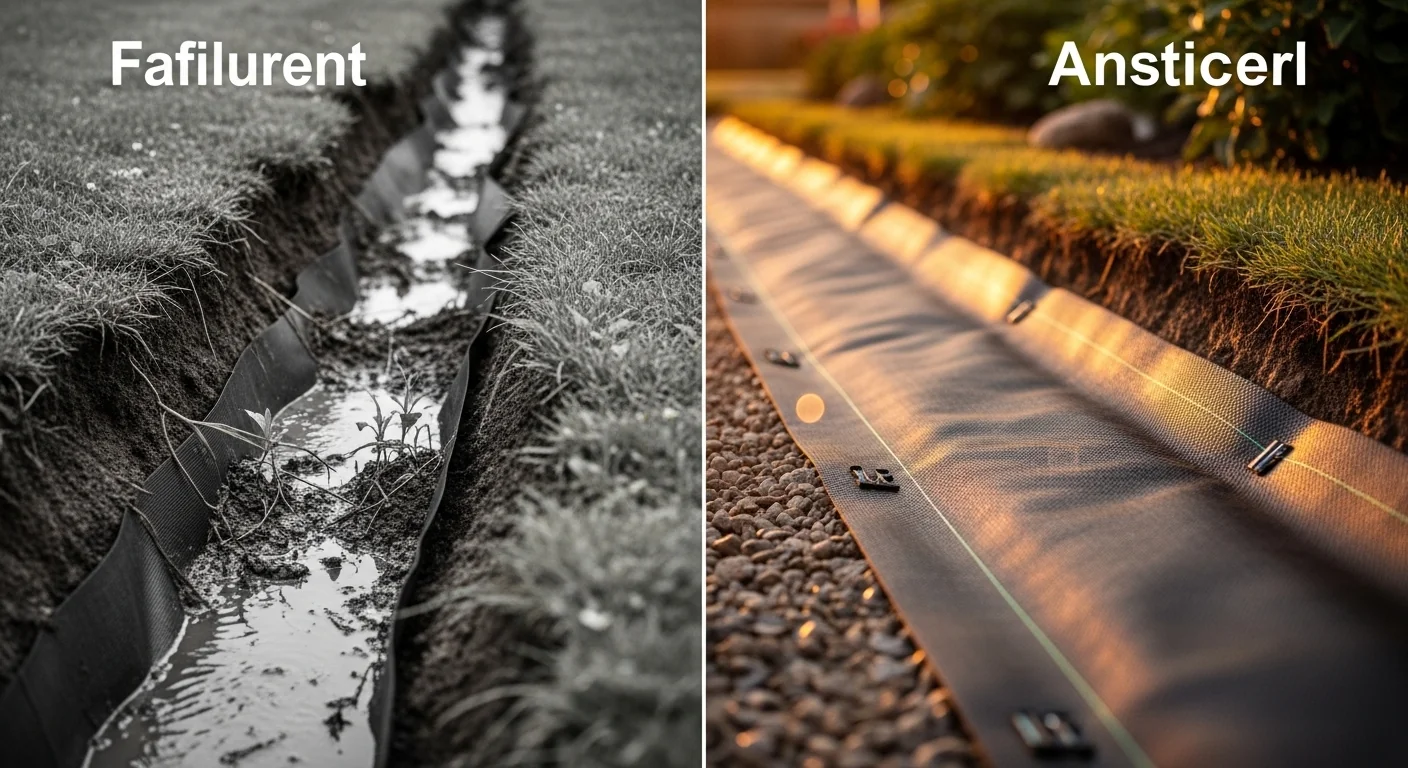
Seam overlap is not a preference. It is a hydraulic engineering decision. When underground water moves at speed through saturated soil, it carries fine clay and silt particles with it. If those particles encounter a geotextile seam that is too narrow, they pass straight through, migrate into the washed gravel aggregate below, and the drainage pathway closes permanently. No amount of flushing recovers a gravel bed that has silted solid. The overlap width printed on a roll of landscape fabric is a minimum shipping recommendation, not an installation standard.
This landscape fabric overlap calculator determines three things: the required seam overlap in inches based on application type and slope, the number of fabric rolls needed after accounting for that overlap, and the total landscape staple count weighted by slope angle. It does not account for site-specific soil classification, extreme freeze-thaw cycles, or subsurface water table pressure beyond what slope angle implies. Projects in high-clay or artesian-pressure environments may need engineering review beyond what any online calculator provides. When planning a French drain project, understanding your gravel volume requirements alongside fabric coverage is equally important, since under-specified gravel and under-specified overlap fail together.
After using this tool, you will know the minimum seam overlap your application legally and structurally requires, how many rolls to purchase without under-buying, and how many 6-inch steel landscape staples to budget for your slope condition. That number is your purchase list.
Use the Tool
Landscape Fabric Overlap & Pin Spacing Calculator
Calculate precise fabric overlap, roll quantity, and staple counts to prevent soil migration and drain failure.
| Metric | Value |
|---|
Quick Reference: Overlap by Application
| Application | Min Overlap | Staples/ft | Risk Level |
|---|
Recommended Materials
- 6-oz Commercial Non-Woven Geotextile Fabric (heavy-duty weed/soil barrier)
- 6-inch Heavy-Duty Steel Landscape Staples (rust-resistant, thick gauge)
- Magnetic Staple Plunger (saves knees & back, drives staples flush)
- 4-inch Corrugated Drainage Pipe (for French drain applications)
How This Calculator Works
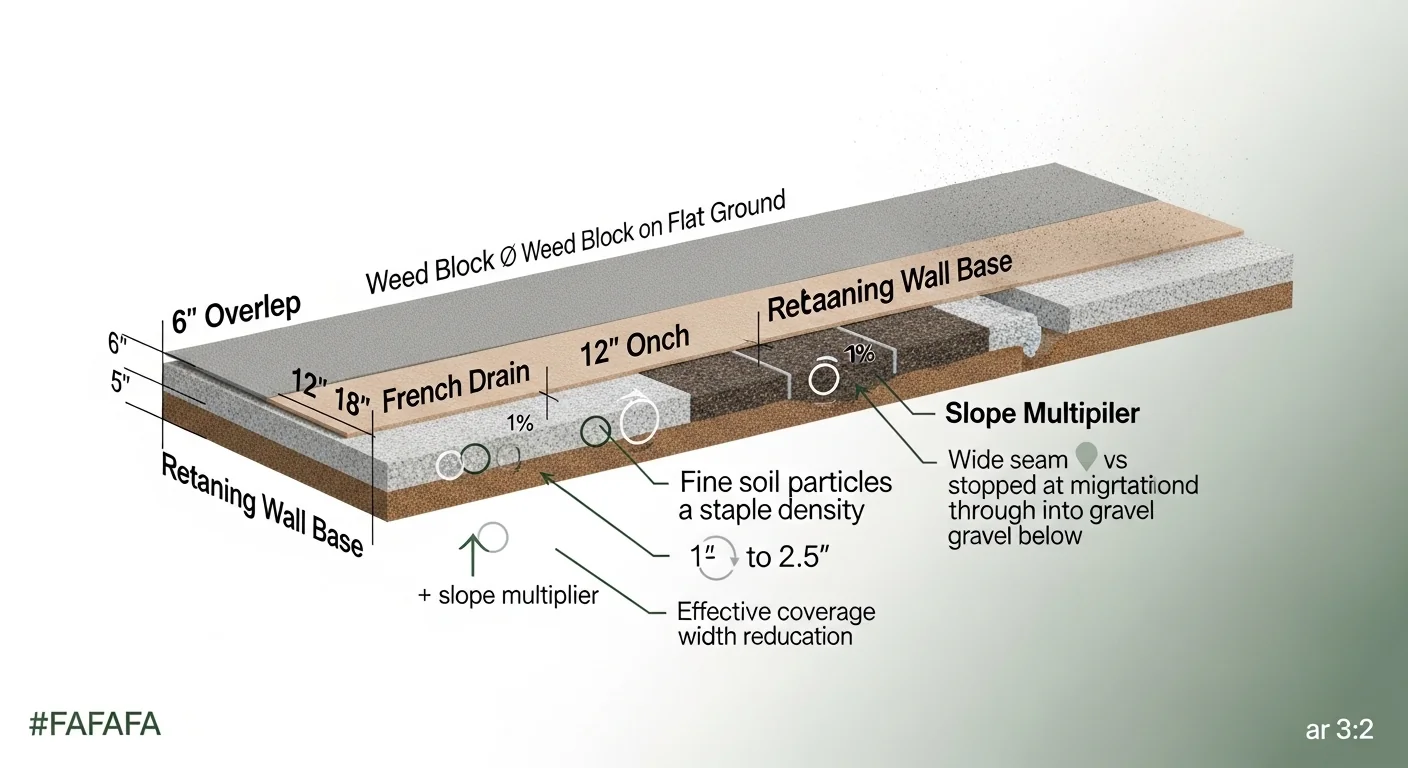
Step 1 — Determine Overlap: Base overlap is 6 inches for flat weed block. For drainage wraps or retaining wall bases, the overlap increases to 12–18 inches to prevent soil migration through seams under hydrostatic pressure.
Step 2 — Slope Multiplier: Steeper slopes require more staples because gravity and water runoff increase the force pulling fabric apart. The slope multiplier is calculated as 1 + (slope° ÷ 30), capping at 2.5× for extreme slopes.
Step 3 — Rolls Needed:
Effective Coverage Width = Roll Width − Overlap
Number of Strips = ⌈ Project Width ÷ Effective Coverage Width ⌉
Total Rolls = Number of Strips (each strip runs the full project length)
Step 4 — Staple Count:
Perimeter Staples = Perimeter × 2 staples per linear foot
Interior Staples = Area ÷ (4 ÷ Slope Multiplier) sq ft per staple
Seam Staples = (Number of Seams × Length × 2) staples at 12″ spacing along each seam edge
Total Staples = Perimeter + Interior + Seam Staples
Assumptions: Standard 6-oz non-woven geotextile. Staple spacing assumes 6-inch heavy-duty steel staples. Slopes over 30° may require anchoring trench at top. Roll length assumed sufficient for project length (typically 50–300 ft rolls).
Assumptions & Limits
- Maximum supported area: 5,000 × 5,000 ft (25M sq ft)
- Slope range: 0° (flat) to 45° (steep embankment)
- Overlap values follow ASTM D4439 geotextile installation standards
- Staple density increases with slope to counter gravity and runoff forces
- For slopes above 30°, an anchoring trench (6″ deep) at the top of slope is strongly recommended in addition to increased staple density
- French drain wraps assume standard 4″ corrugated pipe trench width of 12″
- Retaining wall base assumes structural backfill conditions requiring maximum overlap
Before you start, measure your project area in feet (length and width separately), estimate your slope in degrees (a phone inclinometer app works for this), and confirm the width of the fabric roll you intend to buy. If you are wrapping a French drain trench, measure the trench length as your project length and the total wrap width (around the pipe and up both trench walls) as your project width. For projects that also involve permeable base layers, the paver base calculator can help you plan adjacent material quantities before you finalize your order.
Quick Start (60 Seconds)
- Project Length (ft): Enter the longest dimension of your installation area in feet. For irregularly shaped beds, use the longest axis. Do not enter square footage here.
- Project Width (ft): Enter the perpendicular dimension in feet. For French drain trenches, enter the total fabric wrap width around the pipe, not just the pipe diameter.
- Slope Angle (degrees): Enter 0 for flat ground. A gentle yard grade is typically 2 to 5 degrees. A steep embankment approaches 30 to 45 degrees. Overestimating slope by a few degrees increases your staple count slightly but never causes failure; underestimating does.
- Application Type: Select Weed Block for garden beds and pathways, French Drain Wrap for trench drainage installations, or Retaining Wall Base for soil separation behind gravity or segmental walls.
- Roll Width (ft): Match this exactly to the roll you plan to purchase. Using a wider roll than specified will undercount the rolls needed.
- All five fields are required. The calculator does not run with empty inputs and will display inline error messages for any field that is missing or out of range.
- After calculating, check the traffic-light indicator and the overlap gauge bar before accepting the result. A red indicator means your configuration carries critical soil-migration risk.
Inputs and Outputs (What Each Field Means)
| Field | Unit | What It Represents | Common Mistake | Safe Entry Guidance |
|---|---|---|---|---|
| Project Length | Feet | The dimension fabric strips run parallel to (the direction rolls unroll) | Entering square footage instead of linear feet | Measure with a tape; accepted range is 1 to 5,000 ft |
| Project Width | Feet | The perpendicular span that determines how many strips are needed | Forgetting to include the full wrap width on drainage trenches | For French drains, add both trench wall heights plus pipe diameter |
| Slope Angle | Degrees | Incline of the installation surface; drives the staple density multiplier | Entering percent grade instead of degrees (a 10% grade is about 5.7 degrees) | Use a phone inclinometer app; accepted range is 0 to 45 degrees |
| Application Type | Category | Determines the minimum seam overlap requirement per installation standard | Selecting Weed Block for a French drain to reduce material cost | Match to your actual use case; each type carries a different overlap floor |
| Roll Width | Feet | The physical width of the geotextile roll being installed | Guessing a width; using the wrong roll width misprices the entire order | Confirm the roll label before entry; common widths are 3, 4, 6, and 12 ft |
| Rolls Required (output) | Count | Number of roll lengths needed; assumes each roll covers the full project length | Assuming one roll length covers the entire project when it does not | Verify the roll's linear footage on the product label before purchase |
| Overlap per Seam (output) | Inches | The enforced minimum seam overlap for your application and slope condition | Treating this as optional; reducing overlap to save one roll | This is a structural requirement, not a recommendation |
| Total Staples (output) | Count | Sum of perimeter, interior, and seam staples weighted by slope multiplier | Buying only perimeter staples and skipping interior and seam counts | Purchase at least the calculated count; add 10% for breakage and corners |
Worked Examples (Real Numbers)
Example 1: Flat Backyard Garden Bed, Weed Block
- Project Length: 40 ft
- Project Width: 20 ft
- Slope: 0 degrees (flat)
- Application Type: Weed Block
- Roll Width: 6 ft
Seam overlap is 6 inches (0.5 ft). Effective coverage per strip: 6 - 0.5 = 5.5 ft. Strips needed: ceiling(20 / 5.5) = 4 strips. Total rolls: 4. Area: 800 sq ft. Perimeter staples: 2 x (40 + 20) x 2 = 240. Interior staples: ceiling(800 / 4) = 200. Seams: 3. Seam staples: ceiling(3 x 40 x 2) = 240.
Result: 4 rolls of 6-ft fabric, 680 total landscape staples.
A flat weed block installation carries the lowest risk profile in this calculator. The 6-inch overlap meets standard residential garden bed requirements and the slope multiplier is 1.0, meaning staple density is at its baseline level.
Example 2: French Drain Trench Wrap
- Project Length: 60 ft
- Project Width: 4 ft (total wrap width around pipe and trench walls)
- Slope: 5 degrees
- Application Type: French Drain Wrap
- Roll Width: 6 ft
Overlap is enforced at 12 inches (1 ft) for drainage applications. Effective width per strip: 6 - 1 = 5 ft. Strips: ceiling(4 / 5) = 1 strip. Total rolls: 1. Area: 240 sq ft. Perimeter: 128 ft. Perimeter staples: 256. Slope multiplier: 1 + (5/30) = 1.167. Interior staples: ceiling(240 / (4 / 1.167)) = ceiling(240 / 3.43) = 70. Seams: 0. Seam staples: 0.
Result: 1 roll of 6-ft fabric, 326 total landscape staples.
A single-strip French drain installation requires no seam overlap along the length, but the enforced 12-inch transverse overlap is what prevents clay particle migration into the gravel bed. Saving money here by cutting overlap to 6 inches is the most common cause of premature drain failure.
Example 3: Retaining Wall Base on a Steep Slope
- Project Length: 25 ft
- Project Width: 8 ft
- Slope: 20 degrees
- Application Type: Retaining Wall Base
- Roll Width: 4 ft
Overlap is enforced at 18 inches (1.5 ft) for retaining wall base applications. Effective width: 4 - 1.5 = 2.5 ft. Strips: ceiling(8 / 2.5) = 4. Total rolls: 4. Area: 200 sq ft. Perimeter: 66 ft. Perimeter staples: 132. Slope multiplier: 1 + (20/30) = 1.667. Interior staples: ceiling(200 / (4 / 1.667)) = ceiling(200 / 2.4) = 84. Seams: 3. Seam staples: ceiling(3 x 25 x 2) = 150.
Result: 4 rolls of 4-ft fabric, 366 total landscape staples.
On a 20-degree slope, the staple density multiplier increases to 1.67x, significantly raising interior staple requirements. The 18-inch overlap is non-negotiable for structural backfill applications: narrower seams allow fine-grained soil to migrate through under the differential pressure created by heavy rain events.
Reference Table (Fast Lookup)
| Application | Slope (degrees) | Required Overlap | Slope Multiplier | Approx. Staples per 100 sq ft | Risk Level |
|---|---|---|---|---|---|
| Weed Block | 0 | 6 in | 1.00x | ~30 | Low |
| Weed Block | 5 | 6 in | 1.17x | ~35 | Low |
| Weed Block | 15 | 8 in | 1.50x | ~50 | Medium |
| Weed Block | 25 | 12 in | 1.83x | ~65 | High |
| French Drain Wrap | 0 to 5 | 12 in | 1.00 to 1.17x | ~55 | High |
| French Drain Wrap | 10 | 12 in | 1.33x | ~65 | High |
| Retaining Wall Base | 0 | 18 in | 1.00x | ~70 | Critical |
| Retaining Wall Base | 20 | 18 in | 1.67x | ~100 | Critical |
| Erosion Control (any type) | 25 or more | 18 in minimum | 1.83 to 2.50x | ~120 to ~180 | Critical |
Staples per 100 sq ft are calculated using the formula: Interior staples = ceiling(Area / (4 / SlopeMultiplier)), then divided by area and normalized per 100 sq ft. Seam staples are excluded from this normalization since they depend on strip count. Add seam staples separately using the full calculator output.
How the Calculation Works (Formula + Assumptions)
Show the calculation steps
Step 1: Determine Seam Overlap
Base overlap is 6 inches for Weed Block on flat or gentle slopes. For French Drain Wrap, the overlap floor is 12 inches. For Retaining Wall Base, the overlap floor is 18 inches. If slope exceeds 15 degrees on a Weed Block installation, the overlap increases to 8 inches. If slope exceeds 25 degrees on any application type, overlap is elevated to at least 12 inches to counteract runoff shear force on the seam.
Step 2: Calculate Effective Strip Width
Effective Strip Width (ft) = Roll Width (ft) - Overlap (ft)
Overlap is converted from inches to feet before subtraction. If the result is 0.5 ft or less (which could occur with very wide overlaps on narrow rolls), the calculator floors it at 0.5 ft to prevent infinite strip counts.
Step 3: Calculate Number of Strips and Rolls
Number of Strips = ceiling(Project Width / Effective Strip Width)
Total Rolls = Number of Strips
Each strip runs the full project length. Roll length is assumed sufficient to cover project length without splicing. Confirm this against the roll's linear footage on the product label.
Step 4: Calculate Slope Multiplier
Slope Multiplier = 1 + (Slope Degrees / 30)
The multiplier is capped at 2.5 for slopes approaching 45 degrees. This factor scales interior staple density to counteract gravitational pull and water runoff forces on the fabric surface.
Step 5: Calculate Staple Counts
Perimeter Staples = ceiling(Perimeter x 2)
Perimeter = 2 x (Length + Width)
Interior Staples = ceiling(Area / (4 / Slope Multiplier))
On flat ground, this places one staple per 4 sq ft. As slope increases, the denominator shrinks, increasing density.
Seam Staples = ceiling(Number of Seams x Length x 2)
Number of Seams = Number of Strips minus 1
Total Staples = Perimeter Staples + Interior Staples + Seam Staples
Rounding Rules: All staple counts are rounded up using the ceiling function. Rolls are counted as whole rolls. Overlap is calculated to two decimal places in feet and displayed in whole inches. Waste percentage is displayed to one decimal place.
Assumptions and Limits
- Roll length is assumed to equal or exceed project length. If your project length exceeds standard roll lengths (typically 50 to 300 linear feet), additional spliced lengths must be counted and their splice seams treated with full overlap requirements.
- The slope multiplier is a linear approximation. Actual forces on steep slopes are non-linear; installations above 35 degrees should be reviewed by a licensed civil or geotechnical engineer.
- Staple spacing assumes 6-inch heavy-duty steel landscape staples driven flush. Shorter or lighter-gauge staples in hard-packed or rocky soil may require tighter spacing than this calculator provides.
- The calculator uses ASTM D4439 geotextile installation overlap standards as the basis for overlap floors. Local codes may impose stricter requirements; always verify with your municipal engineering department for permitted applications.
- Soil classification is not an input. Fine-grained soils (clay-heavy or silty) under high saturation generate greater hydrostatic particle migration pressure. In such soils, consider increasing overlap beyond the minimum calculated value.
- The tool does not account for fabric weight or tensile strength requirements. Non-woven 6-oz geotextile is assumed for drainage and retaining wall applications. Lighter fabrics may require additional stapling frequency.
- Maximum supported project dimensions are 5,000 ft by 5,000 ft. Slope range is 0 to 45 degrees.
Standards, Safety Checks, and Warnings
Critical Warnings
- The 2-Inch Seam Failure: Seam overlaps under 6 inches allow fine clay and silt particles to penetrate geotextile fabric seams under hydrostatic pressure during rain events. Once clay migrates into washed gravel, it binds with aggregate surfaces and permanently reduces void space. This is not a slow degradation; a single heavy rain event on a compromised seam can initiate irreversible clogging. This calculator enforces minimum overlaps that prevent particle migration under standard hydrologic loading. The rain garden sizing calculator addresses related surface drainage design if you are routing overflow from a drainage system.
- Retaining Wall Soil Separation Failure: Landscape fabric installed behind a retaining wall with less than 18 inches of overlap at seams allows structural backfill to migrate into the drainage aggregate layer over multiple wet-dry cycles. The result is differential wall settlement and in severe cases, hydrostatic pressure buildup against the wall face. See the retaining wall calculator for wall-specific drainage layer specifications, and review geogrid reinforcement requirements for walls over 4 feet in height.
- Slope-Driven Staple Failure: On slopes above 15 degrees, gravity acts continuously on fabric edges. Staples installed at flat-ground spacing intervals pull progressively through the fabric as soil below the fabric shifts during freeze-thaw or saturation cycles. The slope multiplier in this calculator directly addresses this by increasing staple density proportional to slope angle.
- Anchoring Trench Omission: On slopes above 30 degrees, staples alone are not sufficient to prevent fabric from sliding downhill over time. A 6-inch deep anchoring trench at the top of slope, where the fabric is folded and buried, is required as a supplemental anchor. The calculator flags this condition but does not compute trench dimensions.
Minimum Standards
- ASTM D4439 defines geotextile installation procedures and specifies minimum seam overlap for drainage applications at 12 inches under normal loading conditions, increasing to 18 inches in high-stress applications such as retaining wall bases.
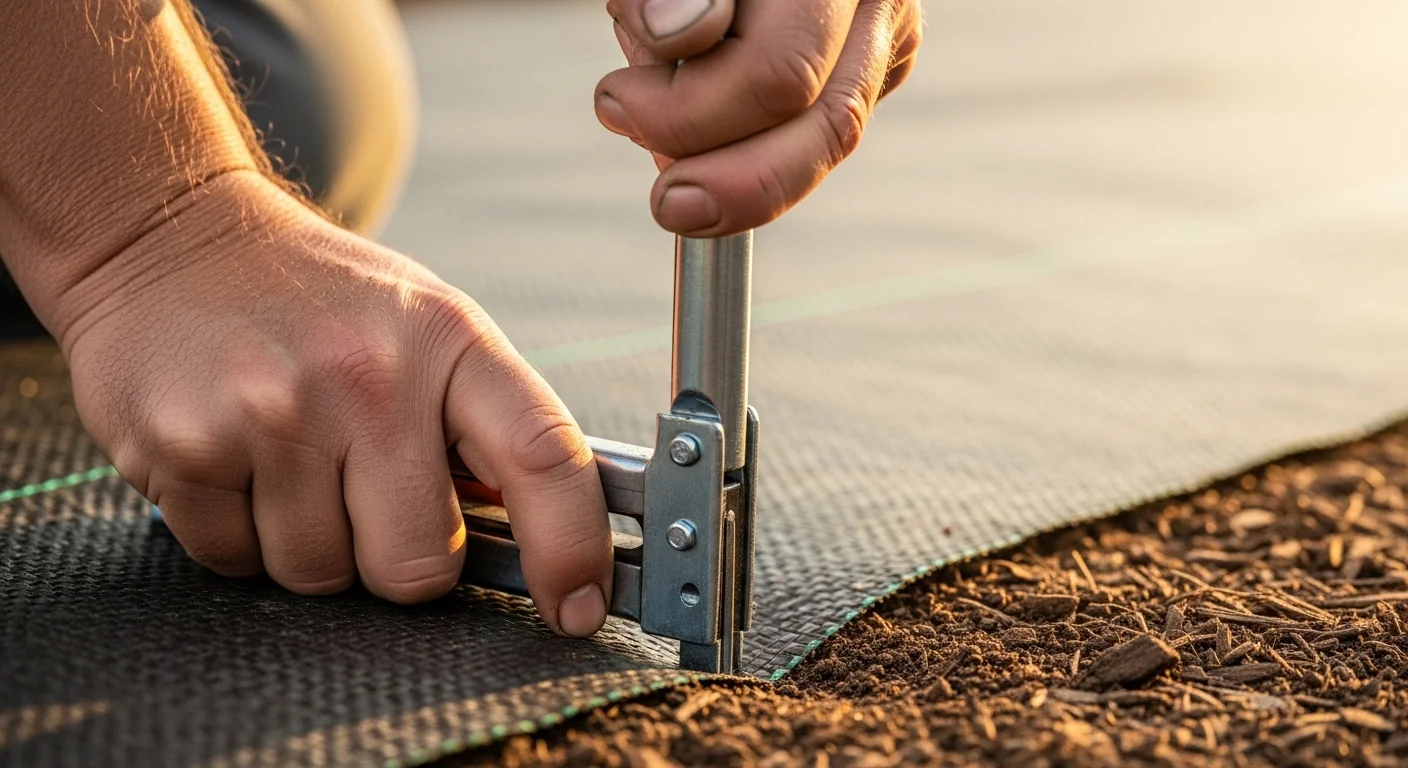
- Landscape staples must penetrate the soil a minimum of 4 inches below grade to provide adequate holding force. In sandy or loose soils, 6-inch staples are the minimum acceptable length.
- Non-woven geotextile fabric of at least 4 oz per square yard is required for weed suppression applications; 6 oz per square yard is the professional standard for drainage and soil separation applications where long-term structural performance is expected.
- Seam edges must lap in the direction of water flow, meaning the upper strip must overlap the lower strip on any slope to prevent water from lifting and undermining the seam from below.
Competitor Trap: Most landscape fabric guides online specify a single overlap number across all installation types: typically 6 inches, which comes from flat-ground weed suppression applications. Applying that same number to French drain wraps or retaining wall soil separation layers is a categorical error. The hydrostatic mechanics of drainage and wall applications are fundamentally different from surface weed suppression, and the overlap requirement reflects that difference. Installers who follow generic overlap advice on drainage projects are systematically under-specifying seams for the application, and the failure mode does not appear until months or years after installation when the drain is fully silted and excavation is the only remedy.
Common Mistakes and Fixes
Mistake: Using Weed Block Overlap Standards for Drainage Applications
The 6-inch overlap printed on most consumer landscape fabric packaging is calibrated for surface weed suppression, where seam integrity is a cosmetic concern. French drain and retaining wall installations operate under active water pressure, which creates particle transport forces that 6-inch seams cannot resist. Installers who apply the same overlap to drainage projects may save one roll of fabric but create a drainage system that fails within a few wet seasons.
Fix: Use the Application Type selector in this calculator to automatically enforce the correct overlap floor for your installation type.
Mistake: Counting Area Coverage but Not Seam Waste
Calculating how many square feet of fabric the project requires and dividing by roll coverage produces the wrong roll count whenever overlap is significant. On a 6-foot roll with a 1-foot seam overlap, the effective coverage width is only 5 feet per strip. The difference compounds across multiple strips. Projects ordered this way routinely run short by one or two rolls.
Fix: Enter your roll width and let the calculator subtract overlap before computing strips. The output accounts for effective coverage width, not nominal roll width.
Mistake: Skipping Interior Staples and Budgeting Only for Perimeter
Perimeter stapling secures the edges of the installation but leaves interior fabric sections free to lift, buckle, and shift under wind or water. On slopes, this creates pockets where water runs beneath the fabric rather than through the surface drainage pathway. For a dry creek bed or erosion control application, reviewing the dry creek bed stone size calculator alongside this tool ensures that the surface material above the fabric does not create additional uplift load on unsecured interior sections.
Fix: Use the total staple count from this calculator, which sums perimeter, interior, and seam staples separately. Do not budget based on perimeter alone.
Mistake: Applying the Wrong Roll Width to the Calculator
Estimating roll width rather than confirming the product label leads to a systematic miscount of strips needed. A 5-foot roll entered as 6 feet causes the calculator to undercount strips by a predictable amount across the project width. The error scales with project size. A large paver base installation can end up two or three strips short. When planning a complete hardscape project, checking the pond liner calculator for adjacent water feature fabric quantities can reveal that standardizing on a single roll width across both applications reduces order complexity.
Fix: Confirm roll width from the product label or supplier spec sheet before entry. Common widths are 3, 4, 6, 12, and 15 feet, but non-standard widths exist.
Mistake: Ignoring Seam Direction on Sloped Installations
Overlapping strips so that the lower strip covers the upper strip creates a forward-facing seam pocket that water can enter from above and lift from below. This is the opposite of the correct installation direction. The correct approach is for the upper-slope strip to lap over the lower-slope strip, shedding water away from the seam interface rather than into it. This mistake is invisible at installation time and only becomes apparent after the first significant rain event dislodges fabric sections on steeper slopes.
Fix: Always install strips so the uphill edge overlaps the downhill edge, matching the direction a shingle overlaps a shingle on a roof.
Next Steps in Your Workflow
Once you have your roll count and staple count from the calculator, cross-reference the linear footage on your intended roll product before placing an order. Most commercial non-woven geotextile rolls come in 50, 100, 150, or 300-foot lengths. If your project length is 80 feet and the roll is 50 feet, you will need to splice, and each splice creates an additional seam requiring the same overlap standards as any other seam. Account for those splice seams by adding additional linear footage to your material estimate. For projects that also involve topsoil grading before fabric installation, the topsoil calculator can help you complete that portion of your order alongside your fabric quantities.
After installation, the most important follow-up step is verifying that all staples are driven flush and that no fabric edges are exposed above the surface material. Exposed edges on weed block installations catch wind and eventually pull interior sections free. On drainage installations, exposed seam edges provide a path for surface water to bypass the geotextile entirely and introduce surface particles into the aggregate below. If you are also managing erosion on the surrounding slope area, the compost blanket erosion calculator addresses a complementary technique for stabilizing bare soil adjacent to newly installed drainage fabric.
FAQ
How much overlap does landscape fabric need at seams?
The required overlap depends entirely on the application. Flat weed suppression installations require a minimum of 6 inches at each seam. French drain wraps require a minimum of 12 inches. Retaining wall base applications require a minimum of 18 inches. These are not preferences; they are structural minimums derived from ASTM D4439 geotextile installation standards for each loading condition.
How many landscape fabric staples do I need per square foot?
On flat ground, a baseline density of one staple per 4 square feet covers interior sections. Perimeter staples are placed at 2 per linear foot. Seam staples require 2 per linear foot along each seam edge. On slopes, interior staple density increases proportionally: at a 20-degree slope, density rises to approximately one staple per 2.4 square feet. Use the calculator to get a count specific to your project dimensions and slope angle.
Why does a French drain clog when landscape fabric is installed?
French drain fabric fails most often at seam overlaps that are too narrow. When underground water moves through saturated soil under hydrostatic pressure, it carries fine clay and silt particles in suspension. Seam gaps narrower than 12 inches allow those particles to pass through, migrate into the washed gravel aggregate, and fill the void space permanently. Once gravel is silted solid, the drainage pathway closes and excavation is typically the only repair option.
What is geotextile fabric used for?
Non-woven geotextile fabric serves three primary landscape functions: soil separation (preventing fine soil from mixing with coarse aggregate layers), filtration (allowing water to pass while blocking particulates), and drainage (creating a permeable layer that directs water movement). Each function carries different overlap and staple requirements. This calculator addresses all three through the Application Type input.
What staple size should I use for landscape fabric?
Six-inch heavy-duty steel landscape staples are the professional standard for most geotextile installations. Shorter staples (3 to 4 inches) are acceptable for lightweight weed suppression fabric on flat ground with non-rocky soil. For slopes above 15 degrees, compacted clay, or any drainage application, 6-inch staples are the minimum. Staples with a wider crown (6 inches of arc width versus the standard 1 inch) distribute holding force over a larger fabric surface and are recommended for high-wind or high-slope conditions.
Can I overlap landscape fabric pieces lengthwise (end to end)?
Yes, when a roll ends before the project does, the splice must be treated with the same overlap requirement as any transverse seam: 6 inches minimum for weed block, 12 inches for drainage, 18 inches for retaining wall base. The splice seam must also be staked with staples at the same density as a lateral seam. Shedding direction matters here too: the uphill or upstream strip must lap over the downhill or downstream strip.
Conclusion
The landscape fabric overlap calculator on this page enforces minimum seam widths derived from structural loading conditions, not from generic packaging recommendations. The key differentiator between a drainage installation that lasts decades and one that fails within a few seasons is the seam overlap specification at the time of installation. Two inches of extra fabric at each seam is the cheapest insurance available in any landscape drainage project, and it is the single most commonly skipped specification in residential and commercial landscape contracting.
The next step after calculation is procurement, and the most consequential mistake to avoid is purchasing roll quantities based on nominal coverage area rather than effective coverage width after overlap. This error is so common precisely because it is invisible during installation and only reveals itself as roll shortages mid-project. Run your numbers through this tool before you order. For projects that also involve decorative edging to contain the fabric border, the landscape edging calculator can complete the remaining material estimate for your full perimeter treatment.