
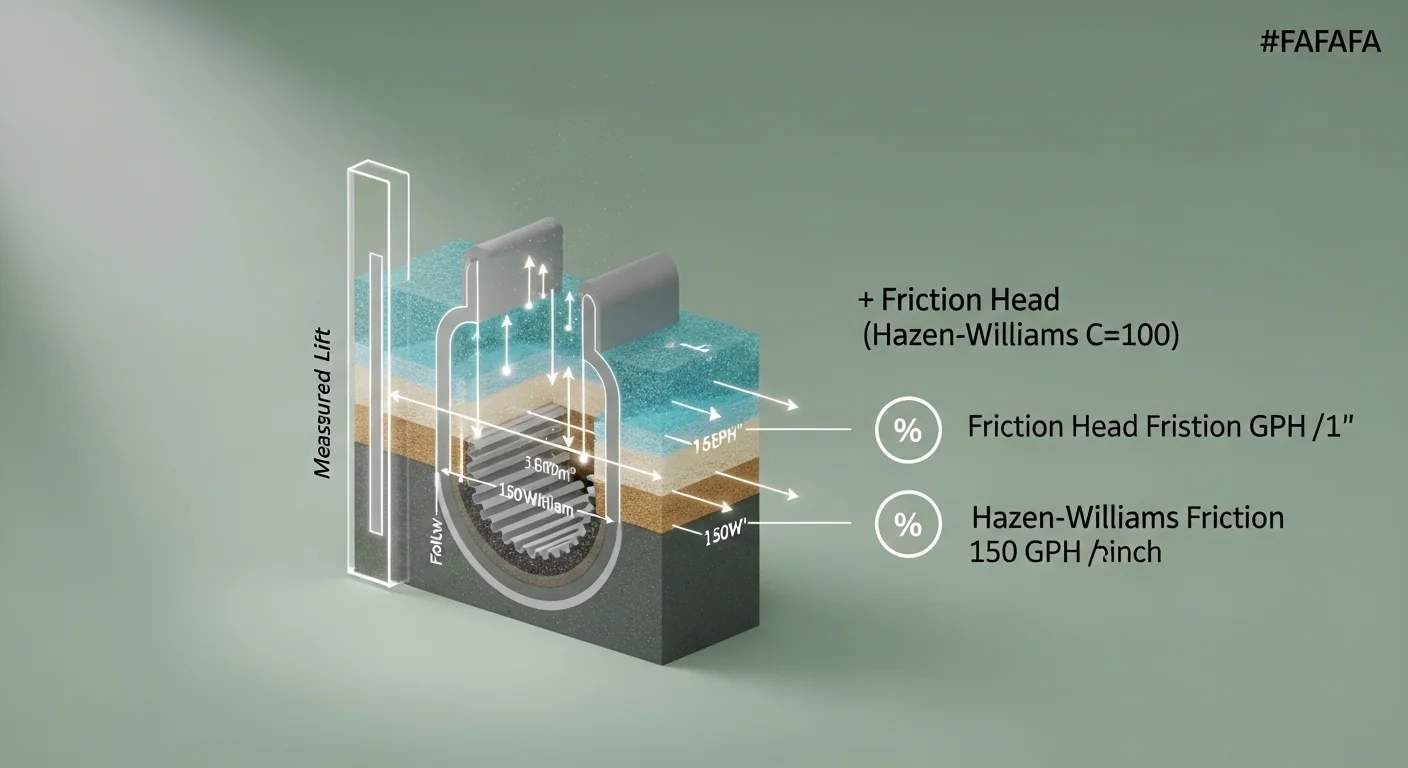
The most common pond pump failure has nothing to do with the pump itself. A homeowner measures the height of their waterfall, buys a pump with a matching GPH rating, and switches it on. The result is a thin dribble instead of a full, rolling sheet of water. The issue is that vertical lift is only one component of the total resistance the pump must overcome. Pipe friction, run length, and diameter combine to create a second, often larger, load that rated-capacity labels never show you.
This calculator solves for Total Dynamic Head (TDH), which is the sum of the vertical lift and friction head losses through your pipe run. It uses the 150 GPH per inch of spillway standard to derive required flow rate, then applies the Hazen-Williams equation (C=100 for corrugated pond tubing) to calculate friction losses. Before you use it, make sure you have measured your waterfall spillway width in inches, the vertical distance from your pond surface to the waterfall top in feet, the full pipe run length in feet, and your pipe’s inside diameter in inches. For guidance on the pond itself, the pond liner size calculator is a useful companion for confirming pond dimensions before you finalize pump placement.
After running your numbers, you will know the minimum pump rating (at your actual TDH, not at zero head) required to produce a full-width waterfall. If that number exceeds the pump you were considering, you can either upsize the pipe to reduce friction or select a high-head pump with a performance curve that delivers adequate GPH at your TDH.
Use the Tool
Waterfall Pump Calculator
Pond & Waterfall Total Dynamic Head (TDH)
| Component | Value |
|---|
Warnings & Standards
| Spillway (in) | Required GPH | Min Pipe Dia. |
|---|
How This Calculator Works
Step 1 — Required Flow Rate: Multiply spillway width (inches) by 150 GPH per inch. This is the industry-standard rule for a full, attractive sheet of water across the lip.
Step 2 — Static Head: The vertical lift from the pond surface to the top of the waterfall, measured in feet. This is direct gravitational resistance.
Step 3 — Friction Head: Calculated using the Hazen–Williams equation for the given pipe length, diameter, and flow rate. Smaller pipes and longer runs dramatically increase friction losses.
Step 4 — Total Dynamic Head (TDH): TDH = Static Head + Friction Head. This is the total resistance the pump must overcome.
Step 5 — Pump Selection: Compare the required GPH at the calculated TDH against your pump’s flow curve. Most pumps lose significant output as TDH rises.
Assumptions: Uses C=100 (corrugated/ribbed pond tubing). Smooth PVC pipe would reduce friction ~30–40%. No fittings losses are included; add 5–10% for elbows and valves. The 150 GPH/inch rule produces a full sheet flow; use 100 GPH/inch for a lighter cascade.
Assumptions & Limits
Pipe type: Corrugated/ribbed pond tubing (Hazen-Williams C=100). Smooth PVC (C=150) has much lower friction.
Fittings: Not included. Each 90° elbow adds roughly 2–5 ft equivalent pipe length depending on diameter.
Flow rule: 150 GPH per inch of spillway for a full sheet. Reduce to 100 GPH/inch for a lighter look.
Valid ranges: Spillway 2–120 in, Lift 0.5–30 ft, Pipe length 1–500 ft, Pipe diameter 0.75–4 in.
Altitude & temperature: Not factored. Negligible effect on pond-scale systems.
Have your tape measure ready before you start. Spillway width is measured across the lip where water exits, not the width of the waterfall box. Vertical lift is measured from the pond water surface, not the ground. Pipe length is the total run including any horizontal segments from the pump to the waterfall top. If your setup uses multiple pipe diameters, enter the smallest diameter, which is the bottleneck. The pond liner calculator can help confirm overall pond dimensions if you are still in the planning phase.
Quick Start (60 Seconds)
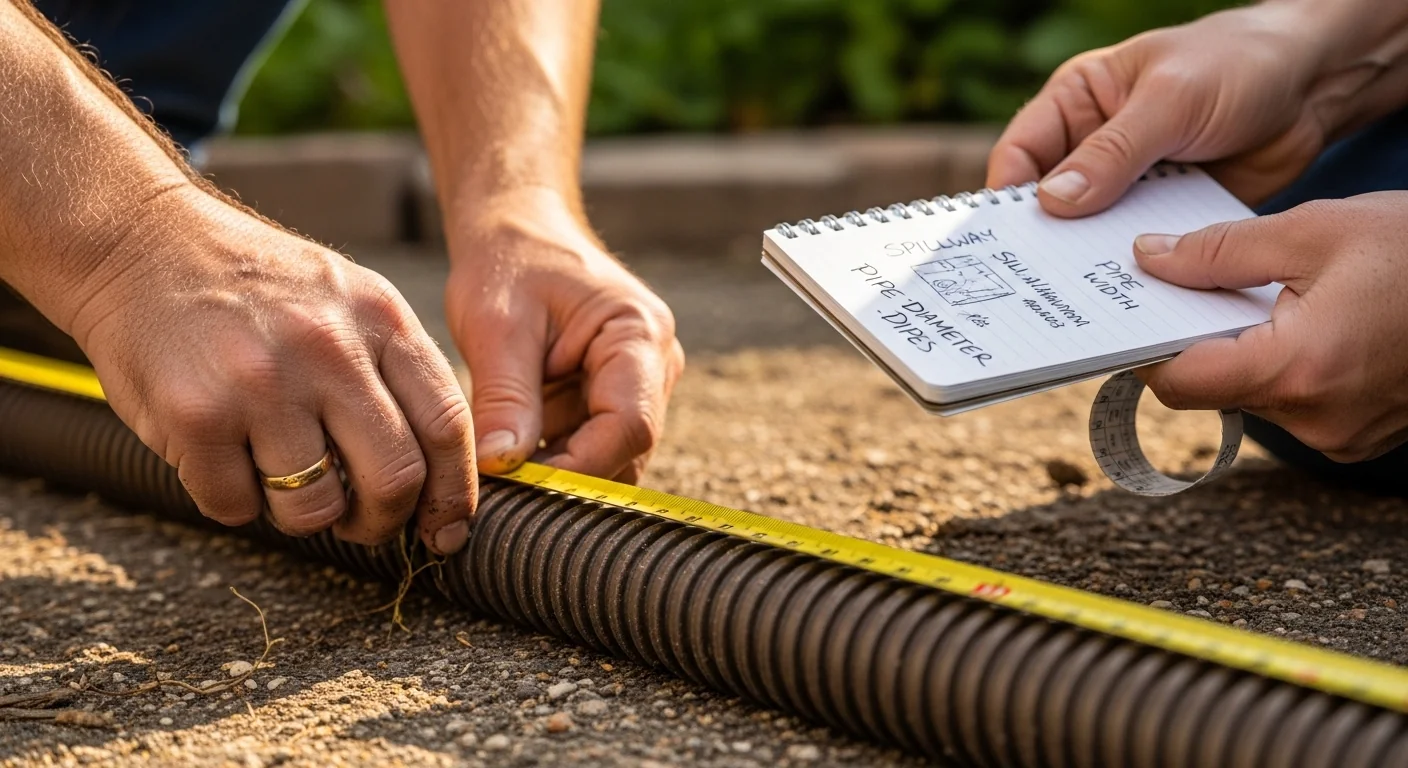
- Spillway Width (inches): Measure the waterfall lip width with a tape measure. Wider spillways demand dramatically more flow. A 24-inch spillway needs twice the GPH of a 12-inch one. Enter the number as a whole number or decimal; the valid range is 2 to 120 inches.
- Vertical Lift (feet): Measure from your pond's water line to the top of the waterfall or spillway outlet. Do not measure from the ground or the pump. This is your static head component. Valid range: 0.5 to 30 feet.
- Pipe Length (feet): Measure the full pipe run from pump outlet to waterfall discharge, including horizontal runs and any up-and-over routing. Underestimating pipe length is one of the most common mistakes. Add 10 to 15 feet if you have multiple elbows. Valid range: 1 to 500 feet.
- Pipe Diameter (inches): This is the inside (inner) diameter of your pipe, not the outside diameter. Most pond supply pipe is labeled by outside diameter, so verify the actual ID. Common corrugated pond tubing IDs: 0.75 in, 1 in, 1.25 in, 1.5 in, 2 in, 3 in, 4 in. Valid range: 0.75 to 4 inches.
- Unit reminder: All lengths must be in feet for the Vertical Lift and Pipe Length fields. Spillway and Pipe Diameter use inches only.
- Common input error: Entering vertical lift as the height of the waterfall structure (e.g., the rock face) instead of the actual water-surface-to-outlet elevation change. These can differ by 1 to 3 feet depending on pond depth and structure design.
- Run the calculation, then check the result against your pump's flow curve PDF, not just the label. The label rating is always measured at zero head.
Inputs and Outputs (What Each Field Means)
| Field Name | Unit | What It Means | Common Mistake | Safe Entry Guidance |
|---|---|---|---|---|
| Waterfall Spillway Width | Inches | The horizontal width of the waterfall lip where water sheets over the edge. Drives required flow rate at 150 GPH per inch. | Measuring the waterfall box width instead of the actual overflow lip | Measure the active spillway edge only; round to the nearest inch |
| Vertical Lift (Static Head) | Feet | Elevation difference between the pond water surface and the point where water exits the pipe at the top of the waterfall. Represents gravitational resistance the pump must overcome. | Measuring from ground level or from the pump body rather than the pond surface | Use a level or smartphone level app to confirm true elevation; measure from water surface |
| Pipe Length | Feet | Total length of the supply pipe from pump outlet to waterfall discharge, including all horizontal and vertical segments. | Ignoring horizontal pipe runs or underestimating route length around obstacles | Walk the actual pipe route with a tape; add equivalent length for fittings (about 2 to 5 ft per 90-degree elbow) |
| Pipe Diameter | Inches | The inside diameter of the supply pipe. Smaller diameters create exponentially higher friction losses at the same flow rate. | Entering the outside diameter, which is printed on the pipe exterior | Check pipe packaging or manufacturer spec sheet for inside diameter (ID). When in doubt, measure with calipers. |
| Required GPH (output) | GPH | Flow rate needed at the spillway to produce a full water sheet, calculated as Spillway Width x 150. | Comparing this number to the pump label rating instead of the pump curve at TDH | This is the minimum target; buy a pump rated at least 25% above this value (at your TDH) |
| Friction Head (output) | Feet | Pressure loss caused by water moving through the pipe, expressed as an equivalent vertical lift. Increases with flow rate, pipe length, and smaller pipe diameter. | Treating friction head as negligible for "short" runs; even 30 ft of 1-inch pipe can produce 5 to 10 ft of friction head at high flow rates | If friction head exceeds static head, your pipe diameter is the limiting factor, not the pump |
| Total Dynamic Head / TDH (output) | Feet | Static Head plus Friction Head. The actual total resistance the pump must overcome. This is the number to use when reading a pump performance curve. | Buying a pump based on static head alone and not adding friction losses | Look up your pump's published GPH at this exact TDH value, not the headline rating |
Worked Examples (Real Numbers)
Example 1: Small Backyard Fountain Waterfall
- Spillway Width: 12 inches
- Vertical Lift: 4 feet
- Pipe Length: 30 feet
- Pipe Diameter: 1.5 inches
Result: Required GPH = 1,800. Friction Head = 4.7 ft. TDH = 8.7 ft.
This falls in the moderate range, close to the 8-foot threshold where pump derating begins. A pump rated at 2,200+ GPH at 9 ft of head would be the minimum recommendation. At 1.5 inches of pipe diameter and 30 feet of run, friction is significant but not catastrophic; upgrading to 2-inch pipe for this scenario would drop friction head to roughly 1.5 ft and TDH to about 5.5 ft, opening up a much wider pump selection.
Example 2: The Weeping Waterfall (Undersized Pipe Failure)
- Spillway Width: 20 inches
- Vertical Lift: 10 feet
- Pipe Length: 50 feet
- Pipe Diameter: 1 inch
Result: Required GPH = 3,000. Friction Head = 145.7 ft. TDH = 155.7 ft.
This is the "weeping waterfall" failure mode. A 1-inch pipe carrying 3,000 GPH over 50 feet produces roughly 146 feet of friction head alone. No standard pond pump operates at 155 ft of TDH. The waterfall would produce a thin trickle at best. The fix is straightforward: replace the 1-inch line with 2-inch corrugated tubing, which reduces TDH to approximately 15 ft for the same flow and same pipe run.
Example 3: Correct Sizing for a 20-Inch Spillway
- Spillway Width: 20 inches
- Vertical Lift: 10 feet
- Pipe Length: 50 feet
- Pipe Diameter: 2 inches
Result: Required GPH = 3,000. Friction Head = 5.0 ft. TDH = 15.0 ft.
Right at the 15-ft warning boundary. A pump rated 3,750 GPH at 15 ft of head (25% oversizing buffer) would be the target purchase. At this TDH level, the pump performance curve matters significantly because many magnetic-drive pumps lose 30 to 50 GPH per foot of head above 8 feet. Confirm the actual delivered GPH from the curve, not the packaging.
Reference Table (Fast Lookup)
All friction head values assume corrugated pond tubing (Hazen-Williams C = 100). Static head (vertical lift) shown in the TDH column header for each scenario. Pipe lengths are the stated run length; add equivalent footage for fittings in your actual setup.
| Spillway Width | Required GPH | Pipe Diameter | Pipe Length | Static Head | Friction Head | TDH | Status |
|---|---|---|---|---|---|---|---|
| 12 in | 1,800 | 1.5 in | 30 ft | 4 ft | 4.7 ft | 8.7 ft | Moderate |
| 12 in | 1,800 | 2 in | 30 ft | 4 ft | 1.5 ft | 5.5 ft | Good |
| 18 in | 2,700 | 2 in | 40 ft | 6 ft | 3.1 ft | 9.1 ft | Moderate |
| 20 in | 3,000 | 1 in | 50 ft | 10 ft | 145.7 ft | 155.7 ft | Danger |
| 20 in | 3,000 | 2 in | 50 ft | 10 ft | 5.0 ft | 15.0 ft | Warning |
| 24 in | 3,600 | 2 in | 60 ft | 6 ft | 7.9 ft | 13.9 ft | Warning |
| 24 in | 3,600 | 3 in | 60 ft | 6 ft | 1.5 ft | 7.5 ft | Good |
| 36 in | 5,400 | 3 in | 80 ft | 10 ft | 4.8 ft | 14.8 ft | Warning |
| 36 in | 5,400 | 4 in | 80 ft | 10 ft | 1.2 ft | 11.2 ft | Good |
| 48 in | 7,200 | 4 in | 100 ft | 12 ft | 3.2 ft | 15.2 ft | Warning |
Key takeaway from the table: pipe diameter has a far greater effect on TDH than pipe length. Compare the 20-inch spillway rows: 1-inch pipe at 50 feet produces 155.7 ft of TDH; 2-inch pipe at the same length produces 15.0 ft. That is a 90+ foot difference from one pipe sizing decision.
How the Calculation Works (Formula + Assumptions)
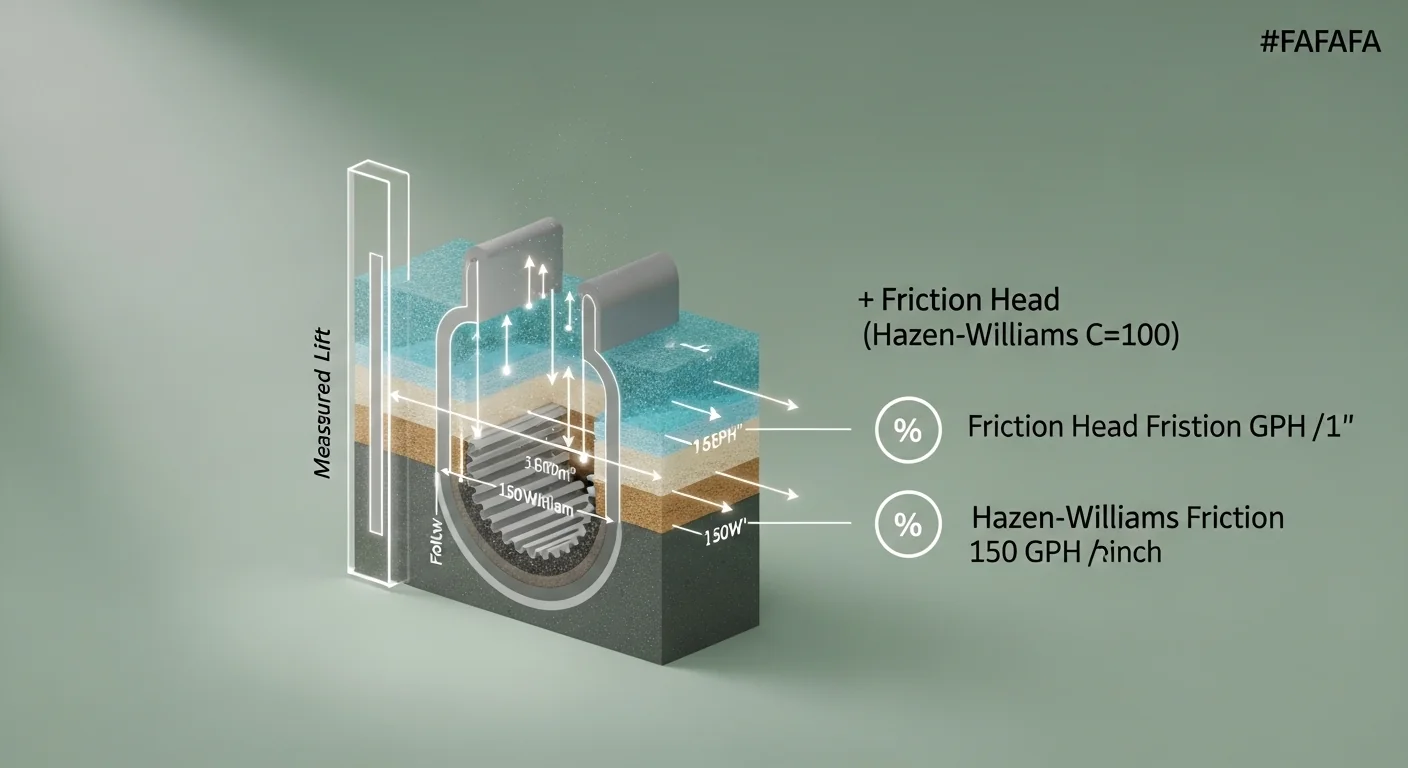
Show the calculation steps
Step 1: Required Flow Rate
Required GPH = Spillway Width (inches) x 150
The 150 GPH-per-inch figure is the landscaping industry standard for producing a full, unbroken sheet of water across a waterfall spillway. Using a lower number (100 GPH/inch) produces a lighter, more transparent curtain; using less than 75 GPH/inch typically results in gaps and drips.
Step 2: Convert to gallons per minute (GPM)
GPM = Required GPH / 60
The Hazen-Williams friction loss formula requires flow in GPM as input.
Step 3: Calculate Friction Head (Hazen-Williams equation)
Friction Head (ft) = 0.002082 x Pipe Length x (100 / C)^1.852 x GPM^1.852 / Pipe Diameter (in)^4.87
Where C = 100 for corrugated/ribbed pond tubing. Pipe diameter is entered in inches. Pipe length is in feet. The result is friction head in feet.
Step 4: Calculate Total Dynamic Head
TDH = Static Head (Vertical Lift) + Friction Head
Both terms are in feet. TDH is the value to use when reading a pump's performance curve.
Rounding: Friction head is displayed to two decimal places internally; TDH is shown to one decimal place in the result. For pump selection, round TDH up to the nearest foot.
Assumptions and Limits
- Pipe type assumed: Corrugated/ribbed flexible pond tubing (Hazen-Williams C = 100). Smooth PVC pipe carries a higher C-value of approximately 150 and would produce significantly lower friction head for the same diameter and flow rate.
- Fittings not included: Each 90-degree elbow adds roughly 2 to 5 feet of equivalent pipe length, depending on diameter. Ball valves and check valves add additional resistance. The calculator does not model these; add equivalent pipe footage manually before entering Pipe Length.
- Single-diameter pipe assumed: If your system steps up or down in diameter, the narrowest section dominates friction losses. Enter the smallest inside diameter for a conservative (safe) result.
- Single pump assumed: The tool is not designed for parallel pump configurations.
- Altitude and water temperature: Not factored. Effects are negligible for residential pond-scale installations at normal operating temperatures.
- Pump curve derating not calculated: The tool calculates the TDH you need to look up on a pump curve; it does not predict actual delivered GPH at that head. You must consult the manufacturer's performance curve for that step.
- Valid input ranges: Spillway 2-120 inches, Lift 0.5-30 ft, Pipe Length 1-500 ft, Pipe Diameter 0.75-4 inches. Inputs outside these ranges trigger inline validation errors and the calculation does not run.
Standards, Safety Checks, and "Secret Sauce" Warnings
Critical Warnings
- Pump label ratings are zero-head measurements. A pump sold as "3,000 GPH" delivers that flow rate only when pumping against zero resistance. At 15 ft of TDH, that same pump may deliver 1,500 GPH or less, depending on the model's performance curve. Never compare your Required GPH against a pump label; compare against the pump's published flow at your calculated TDH.
- Friction head can exceed static head. Many installations see more head pressure from the pipe run than from the vertical lift. A 1-inch corrugated line carrying 3,000 GPH over 50 feet creates roughly 146 feet of friction alone. The vertical lift in that scenario barely registers. Pipe undersizing is the number-one root cause of the "weeping waterfall" failure.
- Wide spillways amplify the effect. A 36-inch waterfall needs 5,400 GPH. Delivering that through 2-inch pipe produces substantially higher friction losses than a 12-inch waterfall using the same pipe. Wider spillways require either larger-diameter pipe or multiple supply lines to keep TDH manageable.
- Corrugated tubing has much higher friction than smooth PVC. If you are using kink-free corrugated pond tubing (common in residential installs), the C = 100 assumption in this tool is appropriate. If you switch to smooth PVC in part of the run, the actual friction losses will be lower than calculated, giving a conservative (safe) result.
Minimum Standards
- 150 GPH per inch of spillway width is the industry minimum for a full water sheet with no gaps or dry spots.
- TDH below 8 ft: most standard magnetic-drive pond pumps operate near rated capacity. Pump selection is straightforward.
- TDH between 8 and 15 ft: performance curve verification is required. Expect meaningful derating from label capacity. Target a pump rated 25 to 40 GPH above your Required GPH at that head.
- TDH above 15 ft: a high-head pump is needed, or the pipe system must be redesigned. Do not attempt to solve high TDH with a larger pump alone if the pipe is undersized; the pipe is the bottleneck.
Competitor Trap: Most online "pond pump calculators" ask for waterfall height and produce a single GPH recommendation with no friction analysis. They are calculating static head only, as if you had a frictionless pipe of infinite diameter. The result looks like a useful number, but it systematically undersizes pumps for any real-world installation with a meaningful pipe run. If you used one of those tools and your waterfall is underperforming, this is why. For installations with longer runs or tight pipe diameters, the friction head is often larger than the static head. Any sizing tool that ignores friction is incomplete by design.
If you are considering a solar-powered alternative for a feature pond, the solar pump calculator can help you assess whether solar-powered flow rates are sufficient for your spillway width and lift requirements.
Common Mistakes and Fixes
Mistake: Using the pump's headline GPH rating instead of its curve value
Pump packaging shows the maximum flow rate, measured at zero head. This number is irrelevant for any system with vertical lift or pipe run. A pump rated 2,500 GPH might deliver 1,100 GPH at 12 ft of TDH, turning a would-be 18-inch waterfall into a disappointing trickle. The fix is to download the manufacturer's performance curve PDF and read the GPH value at your calculated TDH before purchasing.
Mistake: Measuring vertical lift from ground level
The static head component is the elevation difference between the pond water surface and the waterfall outlet, not from the ground or the pump housing. In ponds with deep water features or sump-mounted pumps, the actual lift can be 1 to 3 feet different from a ground-to-top measurement. This error propagates directly into TDH and affects pump selection. Always measure from the visible water surface in the pond.
Mistake: Ignoring pipe run length when planning the waterfall location
Positioning a waterfall at the far end of a long pond and running 80 feet of corrugated tubing produces dramatically more friction than a 25-foot run on a compact install. For a project still in the design phase, the retaining wall calculator can help finalize the waterfall structure position before committing to a pipe route. Shorter pipe runs and larger pipe diameters are almost always cheaper than upgrading to a higher-head pump.
Mistake: Entering outside pipe diameter instead of inside diameter
Most corrugated pond tubing is labeled by its nominal outside diameter. The inside diameter is smaller and is what controls friction losses. For a 2-inch nominal corrugated tube, the inside diameter is typically 1.75 to 1.85 inches. Entering 2 inches when the actual ID is 1.75 inches understates friction head and leads to a pump selection that is too small. Check the pipe spec sheet or measure with calipers.
Mistake: Not accounting for fittings and valves in the pipe length
A 90-degree elbow is hydraulically equivalent to an additional 2 to 5 feet of straight pipe, depending on diameter. A ball valve adds more. A system with five elbows and a check valve might have 20 to 30 feet of equivalent friction length beyond the measured pipe run. When entering pipe length, estimate the equivalent length of your fittings and add it to the physical measurement before running the calculation. This is one of the most underestimated sources of friction in residential pond installations.
Next Steps in Your Workflow
Once you have your TDH figure, the immediate action is to locate the pump manufacturer's performance curve for any model you are evaluating. Most reputable pond pump manufacturers publish these as downloadable PDFs or interactive curves on their product pages. Find the GPH value at your calculated TDH, not at the zero-head point. If no pump in your budget category delivers the required GPH at that TDH, your best option is usually to increase pipe diameter, which reduces TDH substantially and brings more pump options into range. Recalculate with a larger diameter before assuming you need a high-head commercial pump.
With pump selection confirmed, two additional calculations often come next for feature ponds. The pond UV clarifier sizing tool helps you match the UV sterilizer flow rate to your pump's actual output at TDH, which is critical for water clarity in ponds with fish. And if you are designing for summer operation in a warm climate, the pond evaporation calculator gives you a sense of how much water volume the feature will lose weekly, which affects how often you will need to top off and whether an autofill valve is worth installing.
FAQ
What is Total Dynamic Head in a pond pump system?
Total Dynamic Head (TDH) is the total resistance a pump must overcome to deliver water. It is the sum of static head (vertical lift from pond surface to waterfall outlet) and friction head (pressure losses caused by water flowing through the pipe). TDH is measured in feet. It is the correct value to use when reading a pump's performance curve to find actual delivered flow.
Why does my waterfall look like a trickle when the pump is rated for
enough GPH?
The pump's GPH rating is measured at zero head. In real installations with vertical lift and pipe run, the pump delivers significantly less than its rated capacity. The longer or narrower the pipe, the worse the derating. Calculate your TDH and look up the pump's actual delivered GPH at that head value. If friction head is the dominant component, increasing pipe diameter is the most cost-effective fix.
How many GPH do I need per inch of waterfall spillway?
The industry standard is 150 GPH per inch of spillway width to produce a full, unbroken water sheet. A 20-inch spillway requires 3,000 GPH at the spillway outlet. This is the flow rate the pump must deliver at your system's TDH, not the pump's label rating at zero head. Some designers use 100 GPH per inch for a lighter, more transparent curtain effect.
What is friction head, and how does pipe diameter affect it?
Friction head is the pressure loss caused by water moving through the pipe, expressed as an equivalent height in feet. Pipe diameter has an exponential effect on friction: halving the pipe diameter roughly multiplies friction losses by a factor of 28 to 30 for the same flow rate and length. This is why stepping from 1-inch to 2-inch pipe can reduce TDH by over 100 feet in high-flow applications.
Should I use corrugated pond tubing or smooth PVC pipe?
Smooth PVC has a much lower friction coefficient (Hazen-Williams C of approximately 150 vs 100 for corrugated tubing). For the same diameter and flow rate, smooth PVC produces roughly 40 to 50 fewer feet of friction head per 100 feet of run. If your TDH calculation is in the warning or danger zone, switching to smooth PVC (or smooth-bore flexible tubing) can bring TDH down meaningfully without changing pipe diameter or pump.
Is a higher pump rating always better for a pond waterfall?
Not necessarily. An oversized pump can push too much water through a spillway weir, causing spray, splashing, and erosion around the pond edge. Targeting 25 to 40 GPH above your Required GPH at TDH is the standard practice. Also, excessive flow through undersized pipe does not produce proportionally more waterfall flow; most of the energy goes into friction losses. Right-sizing the pipe is more effective than chasing higher pump ratings.
Conclusion
The central lesson from TDH analysis is that pipe selection is as consequential as pump selection. A correctly sized pump attached to undersized pipe will underperform just as badly as a small pump on a large pipe. Running this calculator before purchasing any equipment costs nothing; correcting a misjudged pump or a buried pipe run after the fact can cost hundreds of dollars in labor and materials. The single most avoidable mistake is buying a pump based on its zero-head GPH label and skipping the friction loss calculation entirely.
If you are building out a full water feature, the sizing work extends beyond the pump. For projects involving significant excavation and stone placement, the gravel calculator can help you estimate material needs for the pond base, surrounding drainage, and stream bed underlayment. Approach the full system as a set of interconnected calculations rather than isolated component choices, and the result will be a waterfall that performs as designed from the first day.