
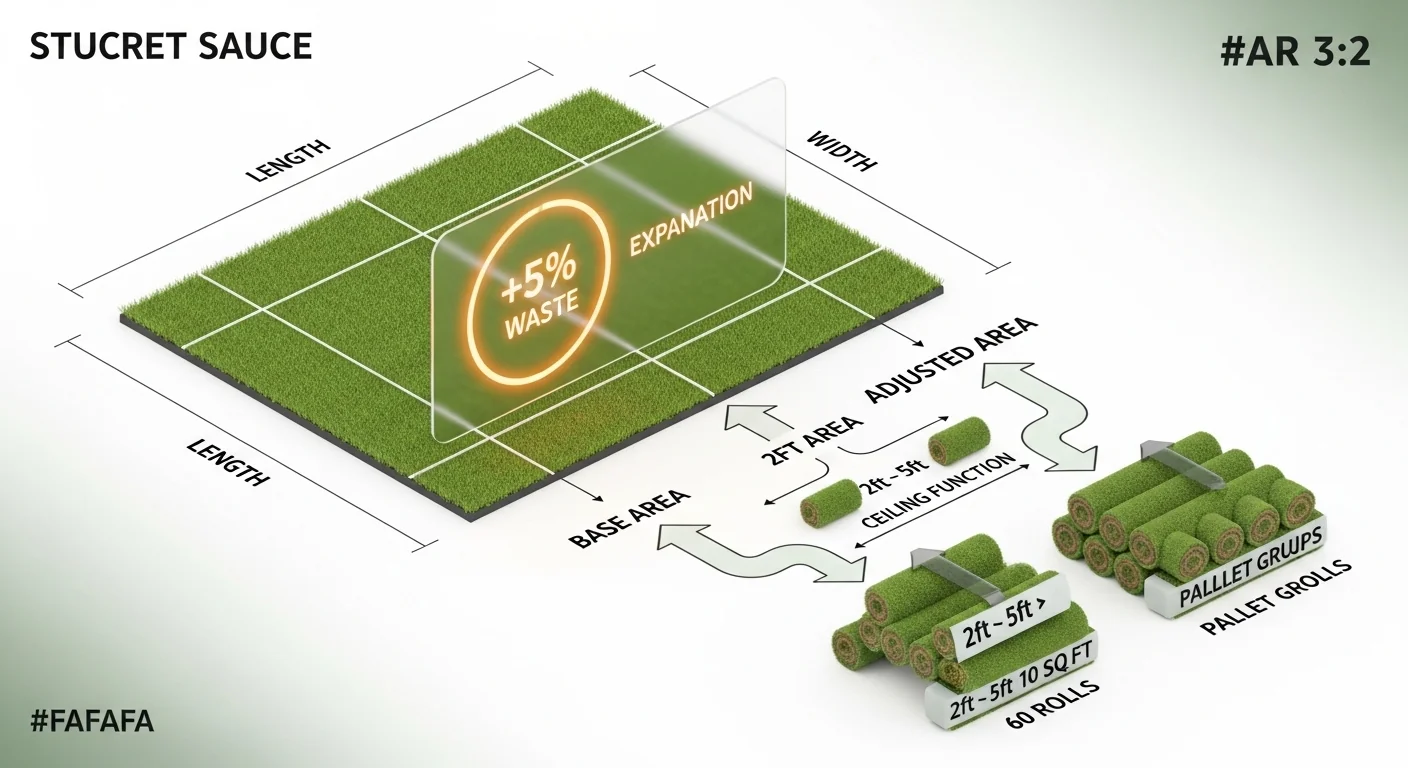
Ordering sod is a one-shot material call. Unlike paint or mulch, you cannot easily top off a sod order mid-installation without risking mismatched turf from a different batch or delivery date. The number of rolls you need comes down to three fixed variables: the lawn’s measured area, the physical dimensions of a standard sod roll, and the cut waste that accumulates on any real-world installation. Getting even one of these wrong produces either a visible bare strip or a pallet of expensive, perishable material sitting on a driveway in summer heat.
This sod calculator accepts two inputs, length and width in feet, and outputs the exact roll count and pallet estimate using an industry-standard formula. It does not account for curved beds, irregular polygons, or slope-adjusted area, and it does not price materials. For projects where seeding is a viable alternative, the grass seed calculator covers seed quantity for the same area type.
After running your measurements, you will have a roll count rounded up to the nearest whole unit and a pallet estimate that tells you how many standard pallets to request from your supplier before asking about per-pallet pricing breaks.
Use the Tool

| Metric | Value |
|---|
| Lawn Size (ft) | Area (sq ft) | Rolls Needed | Pallets (~60 rolls) |
|---|
- Measure your lawn area: Area = Length (ft) × Width (ft)
- Add waste factor: Adjusted Area = Area × 1.05 (adds 5% for cuts and corners)
- Determine roll count: Rolls = Adjusted Area ÷ 10 sq ft per roll (rounded up)
- Standard sod roll size: Each roll is 2 ft × 5 ft = 10 sq ft
- Pallet estimate: Pallets = Rolls ÷ 60 (a standard pallet holds ~60 rolls)
Assumptions & Limits
- Standard sod roll dimensions: 2 ft × 5 ft (10 sq ft per roll). Some suppliers offer different sizes; check with your vendor.
- A 5% waste factor is included for trimming and fitting around curves, edges, and obstacles.
- Irregularly shaped lawns may need more waste allowance (up to 10%). This calculator assumes a rectangular area.
- Pallet count assumes ~60 rolls per pallet, which is the most common configuration. Some suppliers use 50 or 70 rolls per pallet.
- This tool estimates quantity only. Actual cost depends on sod variety, supplier, and delivery fees.
- For best results, install sod within 24 hours of delivery to prevent drying.
Before entering values, have a physical measurement of your lawn in feet. Pacing off distances introduces rounding errors that compound across large areas. A 100-foot tape measure or a digital measuring wheel gives reliable numbers. If you are working from a property survey or site plan, convert any dimensions listed in yards to feet (1 yard = 3 feet) before entering them. For projects that require substantial soil preparation before sodding, run the topsoil calculator alongside this tool to coordinate material deliveries.
Quick Start (60 Seconds)
- Length (ft): Measure the longest dimension of your lawn in feet. Enter a decimal if needed (e.g., 47.5). Do not round to the nearest 5 or 10 at this stage.
- Width (ft): Measure the perpendicular dimension. If the lawn is irregular, break it into rectangles, calculate each separately, and add the roll totals.
- Units: Both fields expect feet only. Metric measurements must be converted before entry (1 meter = 3.281 feet).
- Do not pre-add waste: The calculator applies the 5% waste factor automatically. Manually padding your dimensions before entry stacks the factor and produces an inflated order.
- Verify roll size with your supplier: The calculator assumes the industry-standard 2 ft x 5 ft roll (10 sq ft). Confirm this dimension before placing an order.
- Check pallet quantity: The output shows pallets as a decimal. Round up to the nearest whole pallet when placing the order, unless your supplier sells individual rolls separately.
- Hit Calculate only once: The results panel updates instantly. There is no need to submit the form multiple times.
Inputs and Outputs (What Each Field Means)
| Field | Unit | What It Means | Common Mistake | Safe Entry Guidance |
|---|---|---|---|---|
| Length | Feet (ft) | The longest measured dimension of the rectangular lawn area | Entering yards or meters without converting | Use a tape measure; accept decimals to one place |
| Width | Feet (ft) | The perpendicular dimension to Length | Guessing based on pacing rather than measuring | Measure at the narrowest point if the lawn tapers |
| Base Area (output) | Square feet (sq ft) | Length x Width before any waste adjustment | Treating this as the final order quantity | Always use the adjusted area for ordering |
| Adjusted Area (output) | Square feet (sq ft) | Base area multiplied by 1.05, accounting for 5% cut waste | Calculating rolls from base area instead of adjusted area | This is the value that drives the roll count |
| Rolls Needed (output) | Rolls (whole number) | Adjusted area divided by 10 sq ft per roll, rounded up | Rounding down to save cost, leaving the job short | Always round up; partial rolls cannot cover gaps |
| Pallets Needed (output) | Pallets (decimal) | Roll count divided by 60 rolls per pallet | Ordering exactly the decimal shown instead of rounding up to full pallets | Round up to the nearest whole pallet when ordering |
Worked Examples (Real Numbers)
Example 1: Small Backyard Patch
- Length: 20 ft
- Width: 15 ft
- Base area: 300 sq ft
- Adjusted area (+ 5%): 315 sq ft
Result: 32 rolls (0.5 pallets)
At this scale, a full pallet contains nearly double the required rolls. Confirm with your supplier whether partial pallet or individual roll purchasing is available, since buying a full pallet creates significant leftover material that cannot be stored long-term.
Example 2: Standard Suburban Front Lawn
- Length: 50 ft
- Width: 30 ft
- Base area: 1,500 sq ft
- Adjusted area (+ 5%): 1,575 sq ft
Result: 158 rolls (2.6 pallets)
This result sits between 2 and 3 pallets. Ordering 3 pallets gives 22 surplus rolls. Ordering only 2 pallets (120 rolls) leaves the job 38 rolls short. Order 3 full pallets and negotiate a return credit for sealed, undamaged rolls if your supplier allows it.
Example 3: Large Residential or Light Commercial Lawn
- Length: 100 ft
- Width: 80 ft
- Base area: 8,000 sq ft
- Adjusted area (+ 5%): 8,400 sq ft
Result: 840 rolls (14.0 pallets)
At exactly 14 pallets, this project hits a clean pallet count with no fractional surplus. Projects with highly irregular cut patterns or significant corner trimming may benefit from ordering an additional half pallet as a buffer, particularly when the sod variety cannot be guaranteed to match from a second delivery.
Reference Table (Fast Lookup)
| Lawn Dimensions (ft) | Base Area (sq ft) | Adjusted Area + 5% (sq ft) | Rolls Needed | Full Pallets to Order | Surplus Rolls in Full Pallet Order |
|---|---|---|---|---|---|
| 10 x 10 | 100 | 105 | 11 | 1 | 49 |
| 20 x 20 | 400 | 420 | 42 | 1 | 18 |
| 30 x 30 | 900 | 945 | 95 | 2 | 25 |
| 50 x 30 | 1,500 | 1,575 | 158 | 3 | 22 |
| 50 x 50 | 2,500 | 2,625 | 263 | 5 | 37 |
| 80 x 40 | 3,200 | 3,360 | 336 | 6 | 24 |
| 100 x 50 | 5,000 | 5,250 | 525 | 9 | 15 |
| 100 x 100 | 10,000 | 10,500 | 1,050 | 18 | 30 |
The "Surplus Rolls" column shows how many rolls remain when you round up to the nearest full pallet. A surplus under 20 rolls is generally acceptable. A surplus over 40 rolls (as in the 10 x 10 example) signals that individual roll purchasing or a smaller project scope is more economical than a full pallet commitment.
How the Calculation Works (Formula + Assumptions)
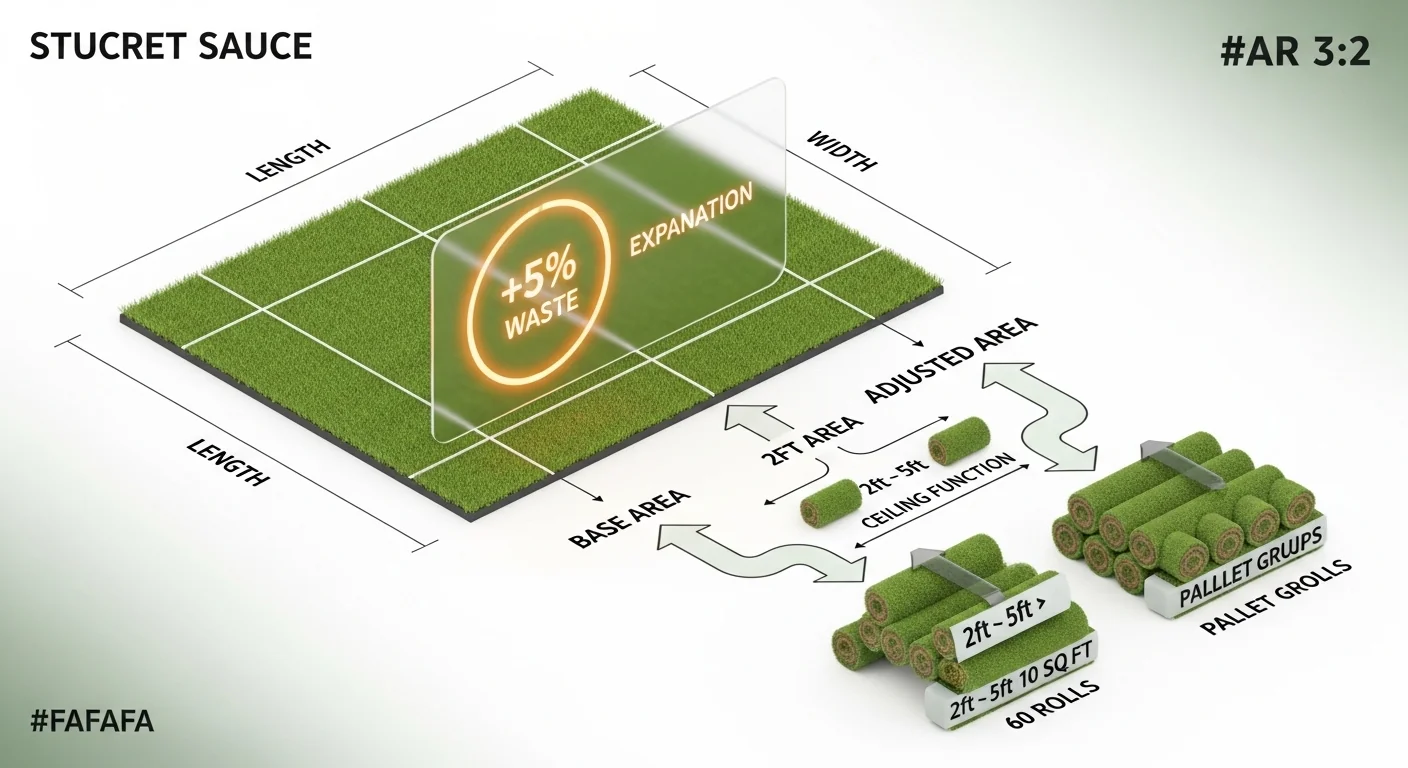
Show the calculation steps
Step 1 -- Calculate base area:
Area (sq ft) = Length (ft) x Width (ft)
This is a simple rectangular area. No slope adjustment, no curve correction.
Step 2 -- Apply the 5% waste factor:
Adjusted Area = Area x 1.05
The 5% addition covers material lost to straight-edge trimming along borders, diagonal cuts around curved beds, and any rolls that split or tear during handling. This factor is fixed, not user-adjustable, because variable waste inputs are a common source of underordering errors.
Step 3 -- Calculate roll count:
Rolls = ceiling(Adjusted Area / 10)
Each standard sod roll covers 10 sq ft (2 ft x 5 ft). The ceiling function (round-up) ensures the result is always a whole roll. Rounding down would leave an uncovered area.
Step 4 -- Calculate pallet count:
Pallets = Rolls / 60
A standard pallet holds 60 rolls, covering approximately 600 sq ft before the waste adjustment. This output is shown as a decimal to allow manual rounding based on supplier pallet policies.
Rounding rule: Roll count rounds up always. Pallet count displays as a decimal; round up to the nearest full pallet when placing a supplier order.
Assumptions and Limits
- Roll dimensions are assumed to be the North American industry standard: 2 ft x 5 ft (10 sq ft per roll). This is not universal. Some suppliers stock rolls as small as 9 sq ft or as large as 12 sq ft, particularly for commercial cultivars. Verify before ordering.
- Pallet quantity is based on 60 rolls per pallet. Some suppliers use 50-roll or 70-roll pallets. Confirm your supplier's pallet configuration.
- The 5% waste factor is a baseline for standard rectangular installations. Lawn shapes with significant curves, multiple cut-outs, or built-in obstacles (trees, garden beds, downspouts) typically generate 8 to 15 percent waste and should use this calculator as a floor, not a ceiling.
- The calculator does not account for slope. Sod on grades steeper than 3:1 typically requires stapling and may experience higher installation waste.
- No soil preparation, delivery fees, or labor estimates are included. Material quantity only.
- Sod is highly perishable. Quantities must be calibrated to what can be installed within 24 to 36 hours of delivery. Very large orders may need to be split across delivery dates, which affects roll count consistency between batches.
- This calculator treats the lawn as a single rectangle. Multi-zone or irregularly shaped lawns should be broken into rectangular segments and calculated separately, with roll totals added.
Standards, Safety Checks, and "Secret Sauce" Warnings
Critical Warnings
- Do not skip the waste factor. Calculating rolls from raw area (Length x Width / 10) without the 5% adjustment is the single most common cause of running short on installation day. On a 1,500 sq ft lawn, skipping the waste factor removes 8 rolls from the order. That is enough to leave a visible unfinished strip.
- Confirm roll dimensions before ordering. The 2 ft x 5 ft (10 sq ft) standard is dominant but not universal. A roll size of 9 sq ft changes the roll count for a 1,500 sq ft lawn from 158 to 175. Entering the wrong roll size silently shifts every downstream number.
- Perishable material cannot be returned. Sod that sits uninstalled in warm weather for more than 48 hours degrades rapidly. Order what you can install in one session; do not order surplus "just in case" for large projects unless you have confirmed your supplier accepts returns of sealed pallets.
- Highly irregular or curved lawns need a higher waste buffer. The 5% factor built into this calculator is calibrated for rectangles. Freeform shapes with multiple curves routinely reach 10 to 15 percent cut waste. For those projects, use the roll output from this tool as a starting point and add one additional partial pallet.
Minimum Standards
- Standard sod roll: 2 ft x 5 ft = 10 sq ft coverage per roll (North American default)
- Standard pallet: approximately 60 rolls = approximately 600 sq ft gross coverage
- Minimum waste factor for rectangular installations: 5% (applied automatically by this calculator)
- Recommended waste factor for irregular or curved installations: 10 to 15%, applied by adding rolls manually beyond the calculator output
Competitor Trap: A substantial portion of sod calculators published online omit the waste factor entirely and return a roll count based solely on raw square footage. This produces a result that looks cleaner and lower, which is superficially appealing, but it guarantees underordering on any installation with borders, curves, or standard trimming. Some calculators add a waste input field but default it to zero, which has the same outcome unless the user knows to change it. This calculator fixes the waste factor at 5% and applies it automatically because the failure mode of underordering is worse than the cost of ordering a few extra rolls. If you are also considering a weed-suppression layer under your sod perimeter, the landscape fabric calculator handles overlap-adjusted coverage for that step. For projects where synthetic turf is under evaluation as an alternative surface, the artificial grass infill calculator covers the material requirements for that installation method.
Common Mistakes and Fixes
Mistake: Measuring Once From Memory
Estimating dimensions based on a previous measurement taken months or years earlier introduces compounding errors. A 5-foot error in a 50-foot dimension creates a 10% discrepancy in area, which may be enough to put the roll count in the wrong pallet tier. Retake physical measurements at the time of ordering.
Fix: Measure the length and width on the day you plan to order, not the day you plan to install.
Mistake: Treating the Pallet Count as a Whole Number From the Start
The pallet output in this calculator is intentionally shown as a decimal. Rounding down to a whole pallet because it "looks close enough" can leave a significant shortfall. On a result of 2.6 pallets, rounding to 2 pallets leaves the project 36 rolls short.
Fix: Always round the pallet count up to the next whole number when placing a supplier order.
Mistake: Skipping Pre-Installation Aeration
Laying sod over compacted soil without prior aeration reduces root-to-soil contact and slows establishment. This is not a material quantity error, but it creates an outcome failure that no amount of correct roll-count math can prevent. Projects on clay-heavy or previously compacted ground should plan for aeration before delivery. The lawn aeration calculator helps determine coverage requirements for that preparatory step.
Fix: Complete soil preparation before finalizing a delivery date, not after.
Mistake: Comparing Sod and Seeding Costs Using Incompatible Area Calculations
When evaluating sod versus seed for a lawn project, the square footage input must be identical between both estimates. Using a different measurement basis for each comparison distorts the cost-per-sq-ft analysis. The pure live seed calculator uses the same rectangular area approach, making it a direct comparison tool when both options are being priced out.
Fix: Use the same length and width values for both the sod and seed calculations before comparing totals.
Mistake: Ordering Sod Before Confirming the Delivery Window
Sod ordered too far in advance of the install date will begin degrading on the pallet, particularly in summer heat. Ordering the exact roll count does not matter if the material quality has declined by the time installation begins. Coordinate delivery to arrive within 24 hours of the scheduled installation start.
Fix: Lock in a delivery date before finalizing the roll order, not as an afterthought.
Next Steps in Your Workflow

Once you have a roll count and pallet estimate, the next practical step is comparing prices across at least two suppliers using the same roll dimensions. Ask specifically whether pricing changes at full-pallet thresholds and whether the supplier supports same-variety reorders if a second delivery is needed. Sod variety consistency across deliveries is a quality concern that does not show up in roll-count math but becomes visible in the finished lawn within a growing season. After installation, your primary variable becomes water. The turf watering calculator provides application rate guidance calibrated to square footage during the sod establishment period.
For the perimeter of the sodded area, mulched borders around beds and tree rings help define the lawn edge and reduce trimming requirements during maintenance. If that is part of your project scope, the mulch calculator handles coverage estimates for those adjacent zones. Both calculations can be run in the same planning session so that material deliveries can be coordinated.
FAQ
What is the standard size of a sod roll?
The most common sod roll in North America measures 2 feet by 5 feet, which covers 10 square feet per roll. Some suppliers offer different sizes, including 2 ft x 4 ft or larger contractor rolls. Always confirm the roll dimensions with your specific supplier before using any calculator output to place an order.
How many sod rolls come on a pallet?
A standard pallet typically holds 60 rolls of sod at the 2 ft x 5 ft (10 sq ft) size, providing approximately 600 square feet of coverage before the waste factor is applied. Pallet configurations vary by supplier, region, and sod variety. Verify the roll count per pallet directly with your supplier before finalizing your order quantity.
Why is a 5% waste factor included?
Every real-world sod installation generates cut waste. Straight trimming along borders, diagonal cuts around curved landscape beds, and minor handling tears all reduce the usable coverage of each roll below its gross square footage. The 5% factor is the baseline for rectangular installations with standard perimeter trimming. Irregular shapes require a higher buffer.
Can this calculator handle L-shaped or curved lawns?
This calculator is designed for rectangular areas only. For L-shaped or irregular lawns, divide the space into multiple non-overlapping rectangles, calculate each separately, and add the roll totals. The 5% waste factor in each calculation may be conservative for highly curved layouts; consider adding 5 to 10 additional rolls per complex zone as a manual buffer.
Should I round up or round down on the pallet count?
Always round up. Ordering fewer pallets than the decimal result suggests risks running short during installation. Sod from a different delivery or a later order may not match the original batch in color, density, or cultivar. A surplus of a few rolls is a recoverable situation; running short mid-installation is not.
How long can sod sit on a pallet before it must be installed?
Sod is perishable. Most industry guidance recommends installation within 24 to 36 hours of delivery. In hot or humid conditions, this window shortens. Sod that heats excessively in the stack will begin to yellow and the root system deteriorates. Do not order sod until an installation date is confirmed.
Conclusion
The roll count this calculator produces is only as useful as the measurements you bring to it. A precisely calculated 158-roll estimate based on a roughly guessed 50 x 30 dimension is not precise; it just carries false confidence. Measure the lawn, apply the formula, round up on pallets, and confirm the roll size with your supplier before the order is placed.
The most consequential error in sod ordering is calculating from raw area without a waste factor. It is also the most common one, because raw area math is simpler and the number it produces is lower. This calculator applies the 5% factor automatically and displays the adjusted area transparently so the logic is auditable. For the finishing details around a newly sodded lawn, including edge definition and border containment, the landscape edging calculator covers linear footage and material estimates for that final installation step.