
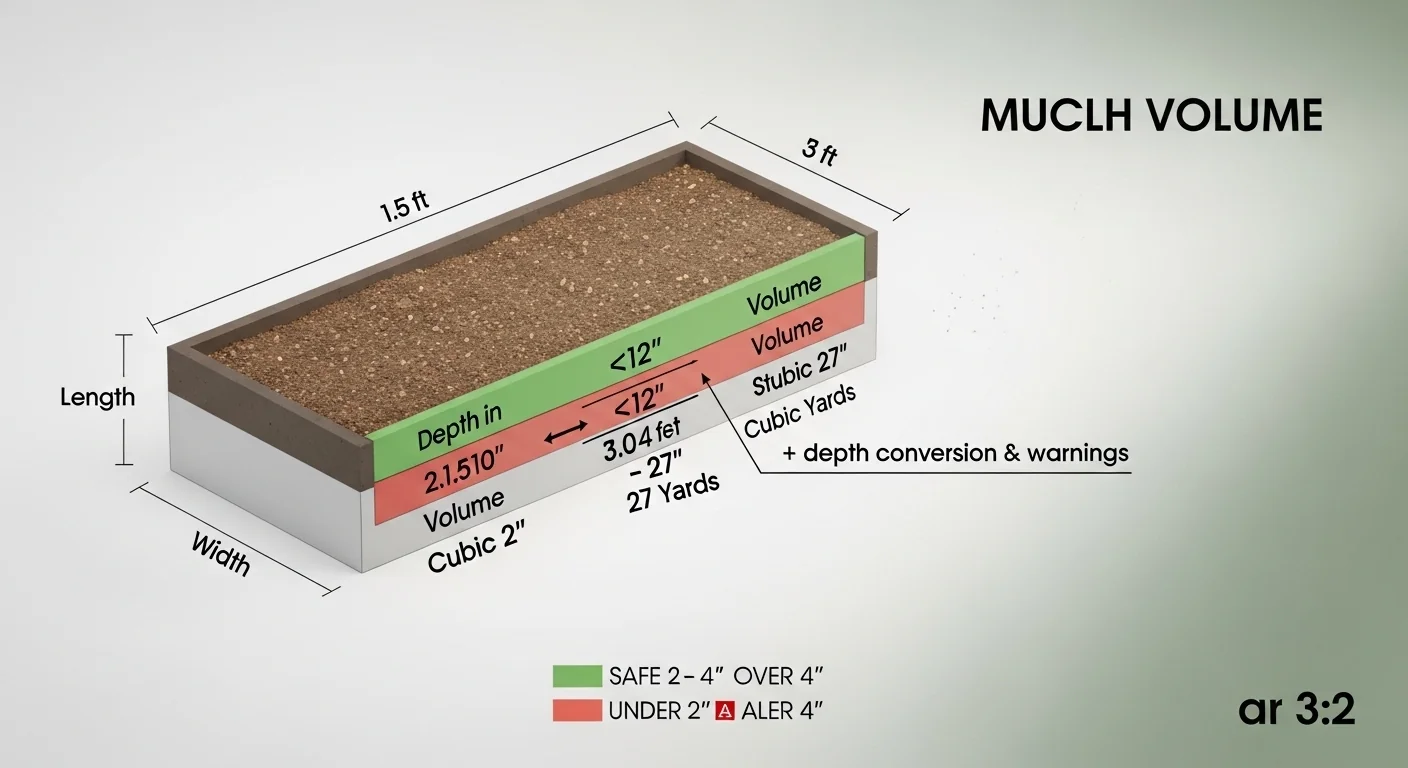
Ordering mulch without a volume calculation is one of the costlier guessing games in landscape work. A bed that looks manageable can demand far more material than a rough mental estimate suggests, and the gap between too thin and too deep is narrower than most guides acknowledge. The real precision problem is not converting square feet to yards; it is knowing which depths are safe, which depths waste money, and where your specific project falls on that spectrum.
This mulch calculator takes three measurements: length and width in feet, and depth in inches. It returns the total volume in cubic yards, the equivalent in cubic feet, and the number of standard 2-cubic-foot bags you would need to cover that area. What it does not do is account for irregular shapes, sloped beds, or existing mulch layers you intend to top-dress; those scenarios require breaking the area into rectangular sections and running the tool separately for each. For ground-cover comparisons that involve a different material entirely, the topsoil calculator uses the same formula structure and makes cross-material planning straightforward.
Once you have your cubic yard figure, you can decide confidently between bulk delivery and bagged product, set a realistic budget, and avoid the two most expensive depth mistakes this tool is specifically built to catch.
Use the Tool
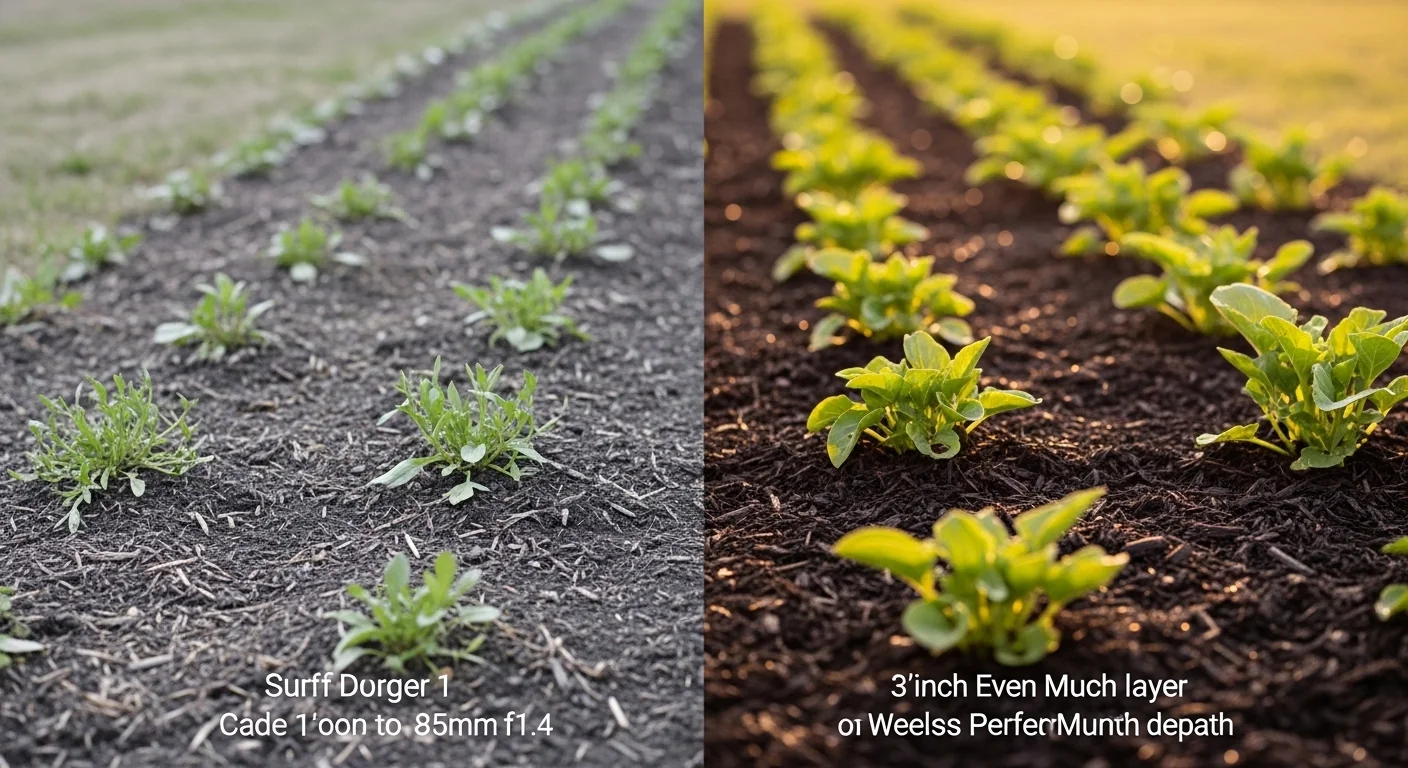
Before you start, measure each bed at its longest and widest points. Use a tape measure rather than pacing; pacing errors compound quickly when beds are narrow. Enter length and width in feet (decimal values are accepted, so 7.5 feet is a valid entry), and enter depth in inches as your target layer, not the current ground level. The calculator handles all unit conversions internally.
Quick Start (60 Seconds)
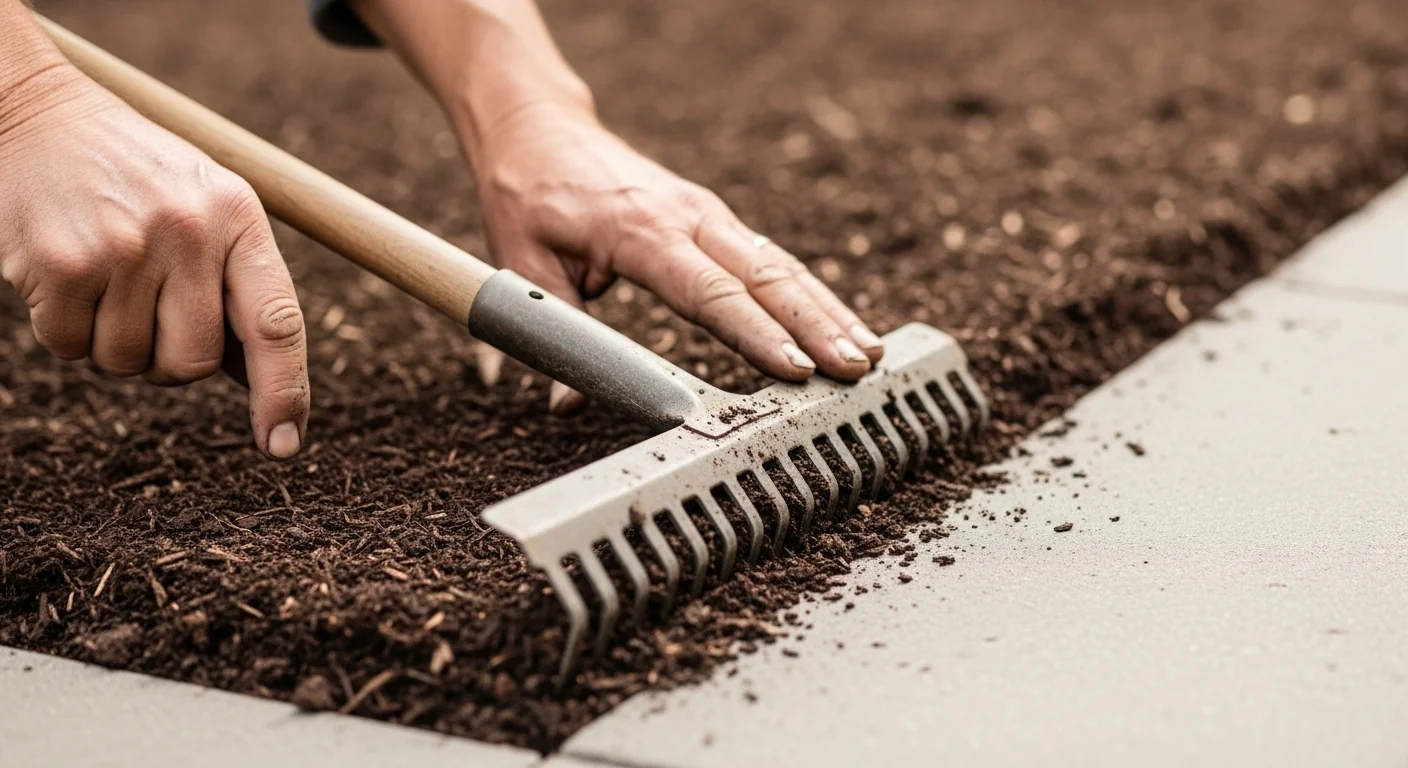
- Length (feet): Measure the longest dimension of the bed in a straight line. For L-shaped or irregular beds, split the area into rectangles and run the calculator separately for each section.
- Width (feet): Measure at the widest point perpendicular to length. If the bed tapers, use the average width rather than the widest point to avoid over-ordering.
- Depth (inches): Enter your target depth for the new layer only. If you are top-dressing over existing mulch, measure what is already there and subtract it from your target before entering the value. Common mistake: entering total desired depth when existing mulch is already present.
- Unit check: Length and width must be in feet; depth must be in inches. Entering depth in feet is the single most frequent input error and inflates the result by a factor of 12.
- Depth range: The tool accepts depths from 0.5 to 12 inches. Any entry outside that range returns an error before the calculation runs.
- Bag count: The bag figure assumes the standard 2-cubic-foot bag sold at most garden centers and home improvement retailers. Check your bag label before purchasing; some premium or specialty products come in 1.5-cubic-foot bags.
- Add a buffer: Mulch compresses during delivery, handling, and settling. Ordering an additional 10 cubic feet beyond the calculated amount is a practical safeguard for most residential projects.
Inputs and Outputs (What Each Field Means)
| Field | Unit | What It Means | Common Mistake | Safe Entry Guidance |
|---|---|---|---|---|
| Length | Feet | Longest horizontal dimension of the area to be covered | Measuring in yards and entering the yard value | 0.1 to 10,000 ft; decimals allowed |
| Width | Feet | Perpendicular dimension; average if the bed narrows | Using the widest point on a tapered bed, inflating the estimate | 0.1 to 10,000 ft; decimals allowed |
| Depth | Inches | Target layer thickness of new mulch being applied | Entering feet instead of inches, multiplying the result by 12 | 0.5 to 12 in; recommended 2 to 4 in |
| Cubic Yards | yd³ | Primary output; matches units used by bulk suppliers and delivery quotes | Confusing with cubic feet; 1 yd³ = 27 cu ft | Use this figure when ordering by the yard or comparing supplier pricing |
| Cubic Feet | cu ft | Intermediate output; used to calculate bag count directly | Treating cubic feet as cubic yards, under-ordering by a factor of 27 | Cross-check against bag label volume before purchase |
| 2 cu ft Bags | Bags | Number of standard 2-cubic-foot bags needed; rounded up to the nearest whole bag | Assuming all retail bags are 2 cu ft; some brands vary | Verify bag size on the label; adjust count proportionally for different sizes |
| Square Feet | sq ft | Calculated coverage area; shown for reference and cross-checking | Using square feet to order mulch instead of converting to volume | Coverage charts on bag labels show square feet; compare to confirm |
If you plan to install weed barrier fabric beneath the mulch layer, the landscape fabric overlap calculator helps you size and budget that material before the mulch goes down, which avoids a second measurement trip.
Worked Examples (Real Numbers)
Example 1: Front Flower Bed Refresh
- Length: 20 ft
- Width: 5 ft
- Depth: 3 inches
Calculation: 20 × 5 = 100 sq ft. 100 × (3 ÷ 12) = 25 cu ft. 25 ÷ 27 = 0.93 yd³. Bags: ceil(25 ÷ 2) = 13 bags.
Result: 0.93 cubic yards, 13 bags (2 cu ft each)
At 3 inches, this is within the safe weed-suppression range. A single bulk bag delivery would be unnecessary here; buying 13 to 14 bagged units is the practical choice.
Example 2: Narrow Side-Yard Strip
- Length: 40 ft
- Width: 3 ft
- Depth: 2 inches
Calculation: 40 × 3 = 120 sq ft. 120 × (2 ÷ 12) = 20 cu ft. 20 ÷ 27 = 0.74 yd³. Bags: ceil(20 ÷ 2) = 10 bags.
Result: 0.74 cubic yards, 10 bags (2 cu ft each)
Two inches is the minimum recommended depth. This result clears the weed-suppression threshold by the narrowest margin; if the strip has heavy weed pressure, increasing depth to 3 inches is worth the extra 5 bags.
Example 3: Large Backyard Garden Bed
- Length: 15 ft
- Width: 12 ft
- Depth: 4 inches
Calculation: 15 × 12 = 180 sq ft. 180 × (4 ÷ 12) = 60 cu ft. 60 ÷ 27 = 2.22 yd³. Bags: ceil(60 ÷ 2) = 30 bags.
Result: 2.22 cubic yards, 30 bags (2 cu ft each)
At 4 inches this is the maximum recommended depth. Bagging 30 units is feasible but hauling cost and time often make a bulk delivery more practical at this volume. Adding a 10-cubic-foot settling buffer brings the effective order to approximately 2.6 yd³.
Reference Table (Fast Lookup)
All rows use the formula (Area × Depth ÷ 12) ÷ 27. Bag count is rounded up to the nearest whole unit. The "Threshold Flag" column applies the built-in depth standards from the tool.
| Area (sq ft) | Depth (in) | Cu Ft | Cu Yards | 2 cu ft Bags | Threshold Flag |
|---|---|---|---|---|---|
| 50 | 2 | 8.3 | 0.31 | 5 | Minimum acceptable depth |
| 50 | 3 | 12.5 | 0.46 | 7 | Safe zone |
| 100 | 2 | 16.7 | 0.62 | 9 | Minimum acceptable depth |
| 100 | 3 | 25.0 | 0.93 | 13 | Safe zone, ideal for most beds |
| 200 | 3 | 50.0 | 1.85 | 25 | Safe zone; consider bulk delivery |
| 400 | 2 | 66.7 | 2.47 | 34 | Minimum depth; high weed-pressure beds should go deeper |
| 400 | 3 | 100.0 | 3.70 | 50 | Safe zone; bulk delivery recommended |
| 400 | 4 | 133.3 | 4.94 | 67 | Maximum recommended depth; do not exceed |
| 600 | 3 | 150.0 | 5.56 | 75 | Bulk delivery strongly recommended |
| 600 | 4 | 200.0 | 7.41 | 100 | Maximum depth; bulk only |
How the Calculation Works (Formula + Assumptions)
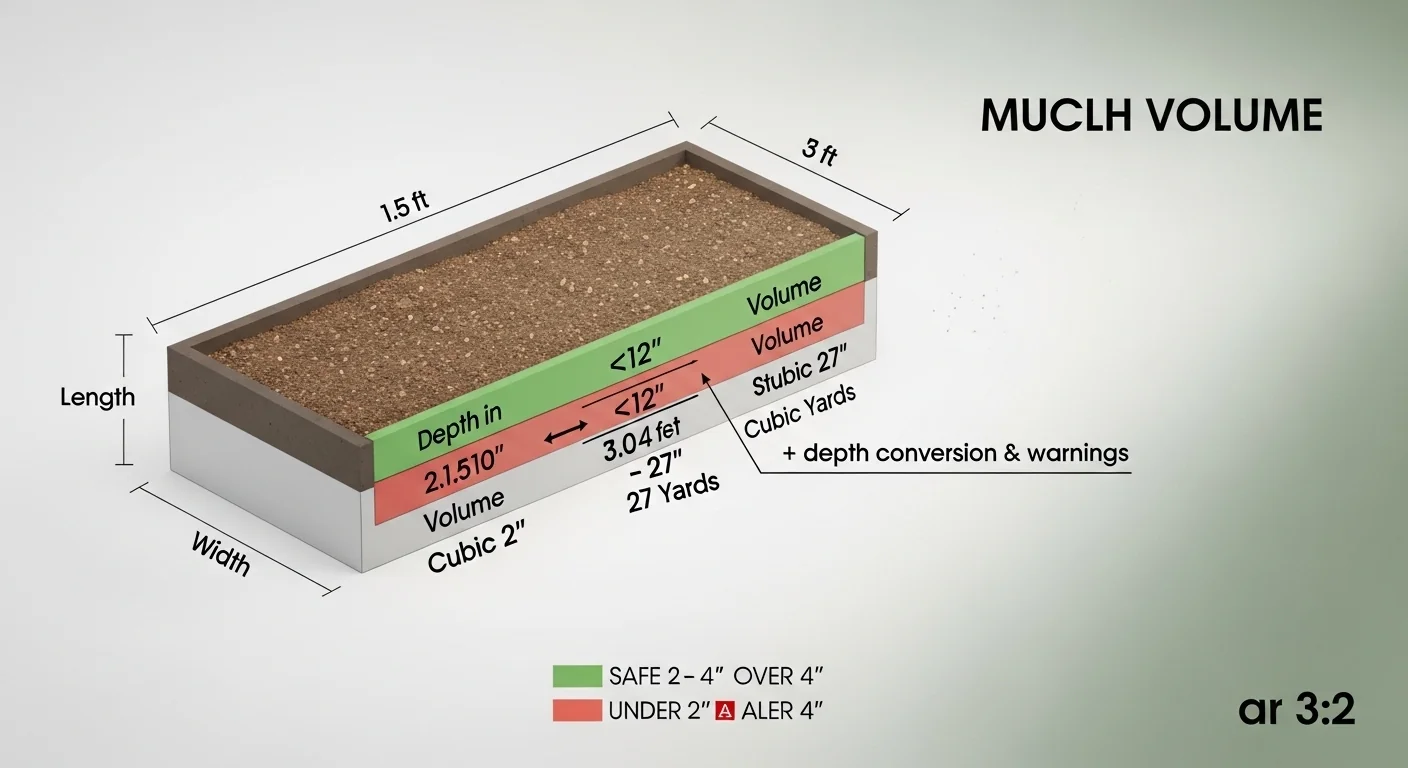
Show the calculation steps
The formula converts three real-world measurements into a standardized volume unit that suppliers and project planners use interchangeably.
- Area in square feet: Length (ft) × Width (ft) = Area (sq ft)
- Depth conversion: Depth (in) ÷ 12 = Depth (ft). This step is critical; mulch depth is measured and specified in inches but volume calculations require consistent units.
- Volume in cubic feet: Area (sq ft) × Depth (ft) = Volume (cu ft)
- Volume in cubic yards: Volume (cu ft) ÷ 27 = Volume (yd³). There are exactly 27 cubic feet in one cubic yard (3 ft × 3 ft × 3 ft).
- Bag count: Volume (cu ft) ÷ 2 = bag count, rounded up to the next whole number. The tool uses ceiling rounding so you never arrive at a job short by a partial bag.
Rounding: Cubic yard output is rounded to two decimal places. Bag count is always rounded up (ceiling), never down.
Assumptions and Limits
- The bed surface is assumed to be flat and level. Sloped or contoured beds hold different effective volumes; add material incrementally on slopes rather than applying a single calculated depth uniformly.
- The bag count assumes a 2-cubic-foot bag. Some specialty, premium, or play-surface mulch products are sold in 1.5-cubic-foot bags; verify the label before purchase and adjust accordingly.
- The formula calculates the volume of new mulch to be applied. If existing mulch is present, measure its current depth, subtract it from your target depth, and enter only the difference.
- The tool does not account for mulch settling. Organic mulch typically compresses 10 to 15 cubic feet per 100 cubic feet of applied volume over the first season; ordering a modest buffer reduces the risk of a thin final layer.
- Depth limits are enforced between 0.5 and 12 inches. Inputs outside that range produce an error rather than a calculation, preventing impractical entries from generating misleading outputs.
- The formula treats the area as a single uniform rectangle. Circular, curved, or polygon-shaped beds require either an approximation or decomposition into rectangular sections before the tool can be used accurately.
- The weed-suppression and root-suffocation warnings are based on generally accepted landscape horticulture depth standards. Site-specific factors including soil drainage, plant species, and regional climate can shift these thresholds; use the warnings as starting guidance, not as absolute rules for every plant type.
Standards, Safety Checks, and "Secret Sauce" Warnings
Critical Warnings
- Depth below 2 inches: A layer thinner than 2 inches does not reliably block sunlight from reaching weed seeds at the soil surface. Light penetrates thin mulch, and germination rates remain high. The tool flags any depth below 2 inches with an explicit warning before you finalize your order.
- Depth above 4 inches: Excessive depth creates an anaerobic environment at the soil-mulch interface, limiting gas exchange and water infiltration to the root zone. Established plants in beds mulched beyond 4 inches frequently show moisture stress symptoms despite adequate irrigation because water does not penetrate the dense mulch mass efficiently. The tool surfaces this warning the moment the entered depth clears the 4-inch threshold.
- Volcano mulching: Piling mulch directly against tree trunks or plant stems, regardless of the calculated depth, creates a separate and serious root and bark problem. The calculator result is irrelevant if the application method concentrates material at the base; keep mulch 3 to 6 inches clear of any woody stem.
Minimum Standards
- The accepted professional standard for landscape bed mulch is 2 to 4 inches of applied depth, measured after settling, not immediately after installation.
- Annual top-dressing to 2 to 3 inches is generally more effective than infrequent deep applications, which risk crossing the 4-inch safety threshold as material accumulates year over year.
- For projects where mulch serves both aesthetic and erosion-control functions on grades, the compost blanket erosion calculator provides a parallel check for whether your depth selection meets stabilization criteria on slopes.
- When substituting gravel or decorative rock for organic mulch in part of the landscape, the gravel calculator uses the same volume formula and applies identical depth thresholds, making it easier to compare material costs on a per-yard basis.
Competitor Trap: Many mulch calculators online return only cubic yards or only bag counts, with no depth validation at all. A homeowner entering a 1-inch depth gets a clean number with no warning, buys the correct volume for an ineffective application, and then wonders why the beds are full of weeds by mid-summer. Skipping the safety check turns the math into false assurance. This tool enforces the depth check before any result is displayed; if the entered depth is outside the safe range, the warning appears alongside the output so the user can adjust before ordering.
Common Mistakes and Fixes
Mistake: Entering Depth in Feet Instead of Inches
The formula divides depth by 12 to convert inches to feet before calculating volume. Entering a value of 3 when you mean 3 inches is correct; entering 0.25 because you converted to feet yourself causes the tool to divide again, returning a result 12 times too small. The input field explicitly labels the unit as inches, but the error is common enough to note here.
Fix: Always enter depth as a whole or decimal inch value. The tool handles conversion internally.
Mistake: Ignoring Existing Mulch Depth
Top-dressing over existing material is a routine annual task, but treating the target depth as the total new application produces a significant over-order. A bed with 1.5 inches of existing mulch that needs to reach 3 inches only requires 1.5 inches of new material, not 3.
Fix: Measure the current depth with a ruler or dowel rod at three or four points across the bed, average the readings, subtract from the target depth, and enter only the difference.
Mistake: Measuring Irregular Beds as a Single Rectangle
An L-shaped or curved bed entered as one rectangle inflates the square footage by including areas that will not receive mulch. The larger the bed and the more pronounced the irregular shape, the worse the overestimate becomes. For a landscape edging project where the bed perimeter is already defined, using the landscape edging calculator first gives a precise boundary length that can inform a more accurate area estimate.
Fix: Break the bed into rectangles, run the tool once per section, and add the results.
Mistake: Assuming All Retail Bags Are 2 Cubic Feet
The standard 2-cubic-foot bag is dominant at large retailers, but 1.5-cubic-foot bags appear on premium and specialty products, and some regional brands sell 3-cubic-foot bags. Using the wrong bag size silently shifts the count by 25 to 50 units on large orders.
Fix: Check the cubic footage printed on the bag label. Divide the tool's cubic foot output by the actual bag size to get the true count.
Mistake: Ordering Exact Volume with No Settling Buffer
Organic mulch settles during delivery, compacts under its own weight, and decomposes at the soil interface. A precisely calculated order with no buffer frequently leaves a final application below the target depth, especially in high-rainfall regions where decomposition accelerates. Projects that involve newly seeded areas nearby, such as those managed with a sod layout, are particularly sensitive to mulch boundary gaps where weed pressure can undermine new turf establishment.
Fix: Add 10 cubic feet per 100 cubic feet of calculated volume as a practical buffer before placing the order.
Next Steps in Your Workflow
Once you have the cubic yard figure, the next decision is whether to order bulk or bagged material. Bulk delivery from a landscape supply yard is generally more cost-effective above 2 cubic yards, though the calculus shifts with delivery fees, site access, and whether you have storage capacity for material that will be spread over multiple days. If the project involves raised beds, berms, or a terrace structure adjacent to the mulched area, confirming structural dimensions with the retaining wall calculator before ordering mulch avoids a situation where delivery trucks access the site before wall construction is complete.
For mixed-material landscapes where mulch transitions to river rock or decorative stone, plan both orders together. The river rock calculator uses equivalent volume logic and outputs the same cubic yard units, making it straightforward to compare material volumes and costs in a single planning session. Spreading installation across material types in sequence also prevents cross-contamination at boundaries, which is difficult to correct after both materials are in place.
FAQ
How many cubic yards of mulch do I need for 200 square feet at 3 inches deep?
Using the formula: 200 × (3 ÷ 12) = 50 cubic feet. Divide by 27 to get 1.85 cubic yards. That is 25 standard 2-cubic-foot bags. Add a small settling buffer if you are using organic mulch and will not be topping up within the same season.
What is the difference between cubic feet and cubic yards for mulch?
One cubic yard equals exactly 27 cubic feet (3 feet in each dimension). Bag labels use cubic feet; bulk suppliers quote in cubic yards. Mixing up the two units is the most common ordering error. Always convert to cubic yards before placing a bulk order, and verify the cubic foot rating on any bagged product you buy at retail.
Is 2 inches of mulch enough to stop weeds?
Two inches is the minimum threshold at which mulch meaningfully restricts light from reaching weed seeds. It works reliably on beds that are already fairly clean. High weed-pressure areas or beds that were not pre-treated often perform better at 3 inches, which blocks light more consistently through the growing season.
Can I apply more than 4 inches of mulch?
Depths beyond 4 inches are not recommended for planted beds. The risk is reduced water infiltration and restricted gas exchange at the root zone, which can stress or damage established plants. In utility areas without active plantings, deeper layers are less problematic, but the calculator flags this threshold regardless of context so the decision is deliberate.
How do I calculate mulch for a circular bed?
Multiply pi (3.1416) by the radius squared to get the area in square feet, then use that area with your target depth in the calculator. For a circular bed with a 6-foot radius: 3.1416 × 36 = 113 sq ft. Enter 113 as the product of length and width using 11.3 and 10, or any two numbers that multiply to 113, and the volume result will be accurate.
How do I know if I should buy bagged or bulk mulch?
The crossover point where bulk delivery typically becomes cheaper than bagged product is roughly 2 to 3 cubic yards, though it depends on local delivery fees and retail bag pricing. Run the calculator first; if your result exceeds 2 cubic yards and delivery access is not an obstacle, request a bulk quote and compare it against the bagged unit cost multiplied by the required bag count.
Conclusion
The mulch calculator's core value is not the arithmetic; any multiplication and division sequence can be done manually. The value is the built-in depth check that prevents two specific and common application failures: a layer too thin to suppress weeds and a layer too deep to support root health. Those two failure modes cost more in replanting, retreatment, and additional material purchases than any calculation shortcut saves. Getting the volume right and getting the depth right are separate tasks, and this tool handles both in one step.
The single most avoidable mistake across mulch projects at every scale is applying the mathematically correct volume at the wrong depth. Order what the calculation returns, but verify that the depth entry reflects only the new material being added, not the cumulative target including what is already in the bed. That distinction, and the 2-to-4-inch standard, are what separate a functional application from one that looks finished for a week and fails for the rest of the season. For any adjacent groundcover or paving project, the paver base calculator applies the same volume methodology to compacted base material, keeping your workflow consistent across material types.