
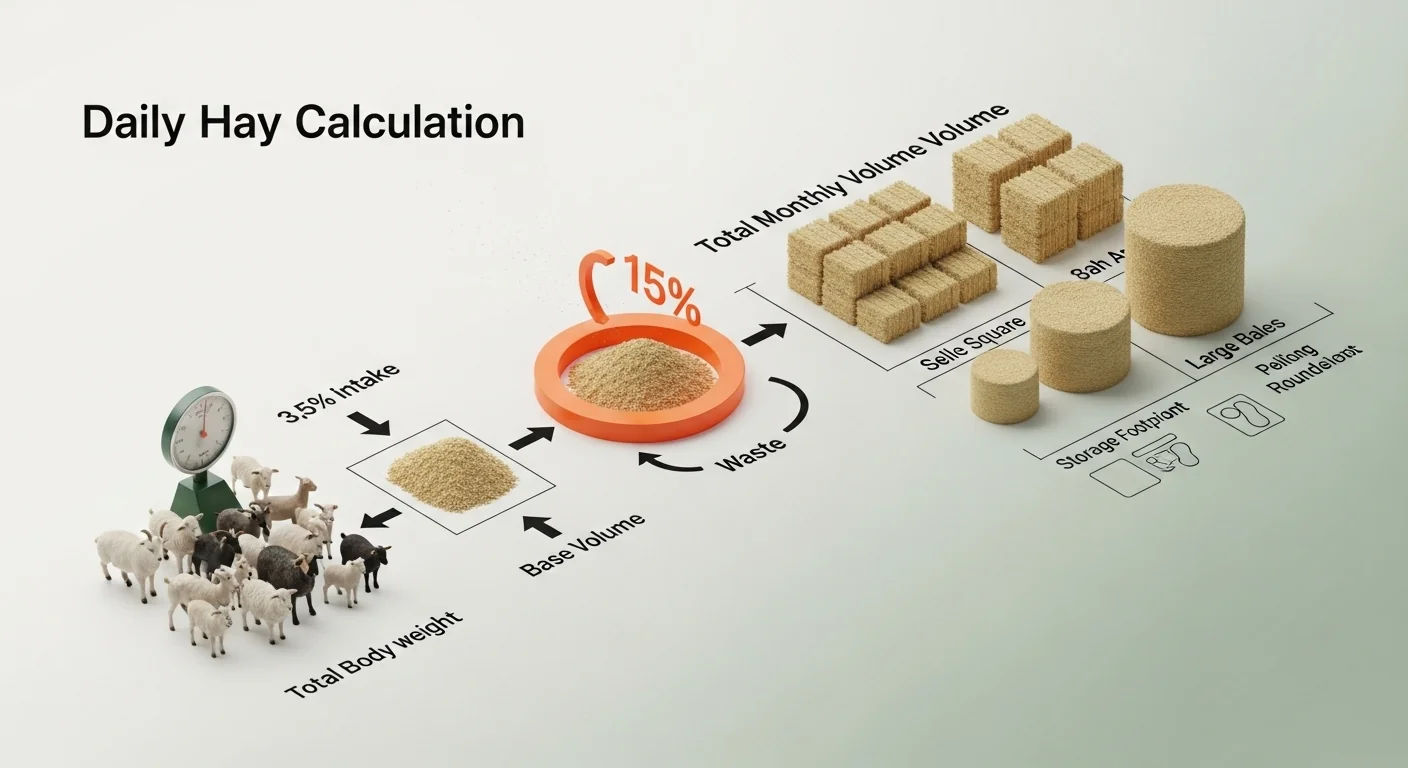
Calculating how much hay a goat or sheep herd needs sounds straightforward until you realize that raw consumption figures ignore the single biggest variable in small-ruminant feeding: waste. Goats pull hay from feeders, scatter it across bedding, trample it, and soil it before other animals get a chance to eat it. Sheep are somewhat tidier but still lose a meaningful portion of every bale that hits the ground. Ordering hay on consumption figures alone is one of the most consistent reasons homesteaders run short before mud season ends.
This hay cost calculator is built specifically for goat and sheep operations. It takes three inputs — herd size, average animal weight, and bale type — and produces monthly bale counts, total hay weight, and barn storage square footage requirements. It applies a 15% waste factor automatically, something most generic livestock hay calculators omit entirely. What it does not do: account for pasture availability, hay quality adjustments, lactating or growing animals, or geographic price per bale. Those are site-specific variables that belong in a farm management spreadsheet, not a standardized formula.
After running this calculator, you will know exactly how many bales to order for a 30-day winter feeding window and how much covered barn space you need to store them — before you place a single hay order.
Use the Tool
Goat / Sheep Hay Feeder Calc
Calculate monthly hay needs, bale count & barn storage
| Herd Size | Avg Wt (lbs) | Daily w/Waste (lbs) | Bales/Month | Barn Space (sq ft) |
|---|
How this calculator works — Formula & Assumptions
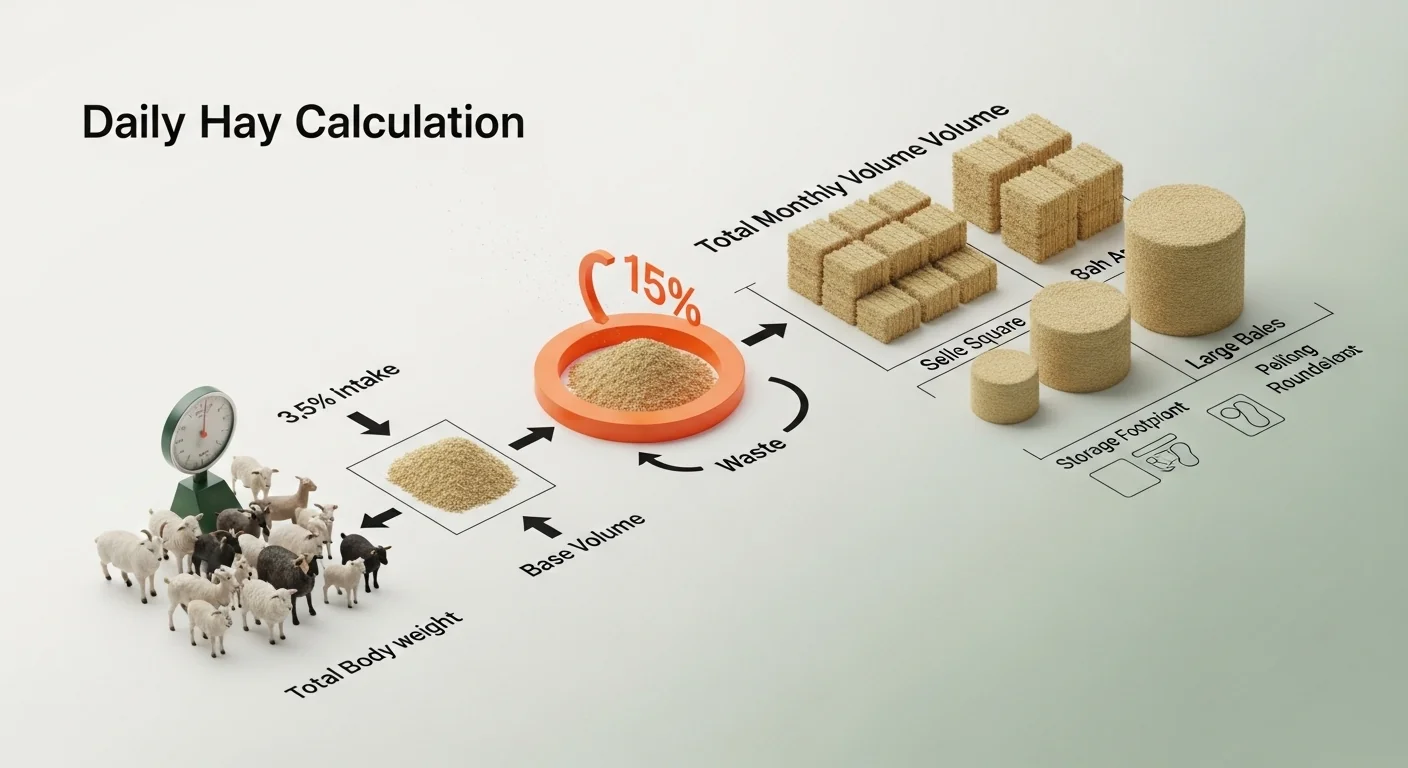
Step 1 — Daily Intake (base): Goats and sheep need approximately 3.5% of their body weight in hay per day (winter standard).
Step 2 — Add Waste Factor: Goats are notoriously messy eaters. A 15% waste factor is automatically applied to account for hay pulled from feeders, soiled hay, and spillage.
Step 3 — Monthly Total: Multiply daily hay (with waste) by 30 days.
Step 4 — Bales per Month: Divide monthly total by the selected bale weight and round up to ensure you never run short.
Step 5 — Barn Storage: Square bales occupy ~2 sq ft per bale stacked 3 high. Round bales occupy ~25 sq ft each on the ground.
- Intake rate: 3.5% of body weight/day — standard for winter maintenance feeding.
- Waste factor: fixed at 15% (goats and sheep are messy feeders; actual waste may be 10–25%).
- Month length: fixed at 30 days for consistent comparisons.
- Bale density is assumed constant within each bale type; actual hay weight varies by moisture and forage type.
- Storage estimate assumes bales are stacked 3 high (square) or single layer (round) in a dry barn environment.
- Does not account for access to pasture; during grazing season, hay needs are lower.
- Valid for herd sizes 1–10,000 animals; avg weight 10–500 lbs.
Before entering your values, have three numbers ready: your current herd headcount, the average body weight of the animals (not the heaviest, not the lightest -- a realistic midpoint), and the weight of the bale type you typically buy. If you are unsure whether your supplier's bale weights are accurate, a hanging livestock scale or a trip to a grain elevator with a sample bale removes the guesswork. You can also use The Yield Grid's hay bale weight calculator to estimate bale weight from dimensions and hay type. No account or registration is needed to use this tool.
Quick Start (60 Seconds)
- Herd Size: Count every animal that will receive hay, including wethers and dry does. Enter a whole number between 1 and 10,000. Do not enter decimal values -- the field accepts integers only.
- Avg Animal Weight (lbs): Use the average live body weight across the herd, not the heaviest outlier. For mixed-age groups, a visual body condition estimate of 100 to 150 lbs covers most adult meat-breed goats; dairy breeds often run heavier. Acceptable range is 10 to 500 lbs.
- Hay Bale Type: Select the bale type that matches what you purchase, not what you wish you could buy. If your supplier provides both small square and round bales, run the calculator twice to compare bale counts and storage requirements side by side.
- Unit check: All weights are in pounds. There is no metric option. Convert kilograms to pounds by multiplying by 2.205 before entering values.
- What triggers errors: Leaving any field blank, entering text in a numeric field, or entering a weight below 10 lbs or above 500 lbs will produce an inline validation error. The results panel will not update until every field is valid.
- Live recalculation: Once you have run the calculator once, changing any input triggers a 250-millisecond debounced update. You do not need to click the button again to see revised results.
- Reset button: Clears all inputs and hides the results panel entirely. Use this when switching between herd scenarios.
Inputs and Outputs (What Each Field Means)
| Field | Unit | What It Means | Common Mistake | Safe Entry Guidance |
|---|---|---|---|---|
| Herd Size | Count (integer) | Total number of goats or sheep receiving hay during this feeding period | Forgetting to count bucks, rams, or animals in quarantine pens | Count every animal, including temporary additions. Use 1 as the minimum. |
| Avg Animal Weight | Pounds (lbs) | Mean live body weight across the entire herd | Using the weight of the heaviest animal, which inflates results significantly for mixed herds | Weigh a representative sample of 4 to 6 animals and average them. Range: 10 to 500 lbs. |
| Bale Type | Pounds per bale | The packaged weight of the hay format you purchase from your supplier | Selecting "1,000 lb round" when your actual bales are 800 lb -- a 25 lb underestimate per bale | Ask your supplier for actual bale weight, not the nominal size. Bale weights vary by moisture content and forage species. |
| Daily Hay Needed (output) | lbs/day | Raw daily hay consumption at 3.5% of total herd body weight, before waste | Ordering to this figure and running short within two weeks | Use this figure for comparison only. Order to the "with waste" figure. |
| Daily with 15% Waste (output) | lbs/day | Adjusted daily requirement including the automatic 15% waste allowance | Ignoring this field and ordering only enough for base consumption | This is the number to share with your hay supplier when estimating monthly delivery quantities. |
| Monthly Hay Total (output) | lbs | Total pounds of hay needed over a 30-day period, waste included | Converting bale counts to pounds using a wrong assumed bale weight | Cross-reference this figure with your supplier's bale weight to verify the bale count shown. |
| Bales per Month (primary output) | Bales | Number of bales required, rounded up to the nearest whole bale so you never run short | Rounding down to save money and running out at week three | Always round up. The formula uses ceiling rounding, which is already built in. |
| Barn Storage (output) | Square feet | Floor space required to store one month's supply of hay, based on bale stacking assumptions | Not accounting for aisle clearance or ventilation space around bales | Add at least 20 sq ft to the output figure for walkway clearance. See the Assumptions section for stacking details. |
For those tracking the full cost of a feeding program, pairing this tool with The Yield Grid's feed cost calculator lets you attach a dollar figure to the monthly bale count the hay calculator produces.
Worked Examples (Real Numbers)
Scenario 1: Small Hobby Farm, 6 Goats on Small Square Bales
- Herd Size: 6 goats
- Avg Animal Weight: 100 lbs
- Bale Type: Small Square (50 lb)
Daily base intake: 6 x 100 x 0.035 = 21.0 lbs/day
Daily with 15% waste: 21.0 x 1.15 = 24.15 lbs/day
Monthly total: 24.15 x 30 = 724.5 lbs
Bales per month: ceil(724.5 / 50) = 15 bales
Storage: 15 bales x 2 sq ft = 30 sq ft (stacked 3 high)
Result: 15 small square bales per month, requiring 30 sq ft of barn floor space.
A 6-animal hobby herd at 100 lbs average is well within a typical small barn's capacity. The 30 sq ft footprint fits comfortably in a single corner of a 10x12 stall.
Scenario 2: Mid-Size Sheep Operation, 25 Animals on Round Bales
- Herd Size: 25 sheep
- Avg Animal Weight: 150 lbs
- Bale Type: Standard Round (1,000 lb)
Daily base intake: 25 x 150 x 0.035 = 131.25 lbs/day
Daily with 15% waste: 131.25 x 1.15 = 150.94 lbs/day
Monthly total: 150.94 x 30 = 4,528 lbs
Bales per month: ceil(4,528 / 1,000) = 5 bales
Storage: 5 bales x 25 sq ft = 125 sq ft (single layer, ground placement)
Result: 5 round bales per month, requiring 125 sq ft of ground-level storage.
Five round bales fit in a 12x12 space with room for a tractor to deliver. The 15% waste factor here adds roughly 19 lbs per day beyond base consumption -- enough to matter across a four-month winter.
Scenario 3: Growing Meat Goat Herd, 40 Animals on Medium Square
Bales
- Herd Size: 40 goats
- Avg Animal Weight: 130 lbs
- Bale Type: Medium Square (75 lb)
Daily base intake: 40 x 130 x 0.035 = 182.0 lbs/day
Daily with 15% waste: 182.0 x 1.15 = 209.3 lbs/day
Monthly total: 209.3 x 30 = 6,279 lbs
Bales per month: ceil(6,279 / 75) = 84 bales
Storage: 84 bales x 2 sq ft = 168 sq ft (stacked 3 high)
Result: 84 medium square bales per month, requiring 168 sq ft of stacked storage.
At 40 animals this herd demands consistent delivery scheduling. At two bales per day on average, a two-week delivery gap requires 28 bales on hand as a working buffer beyond the monthly count.
Reference Table (Fast Lookup)
All rows below use an average animal weight of 150 lbs. Results include the 15% waste factor. Bale counts use ceiling rounding. Storage for small square bales assumes stacking 3 high (2 sq ft per bale footprint); storage for round bales assumes single-layer ground placement (25 sq ft per bale).
| Herd Size | Daily w/Waste (lbs) | Monthly Total (lbs) | 50 lb Sq Bales/Mo | 1,000 lb Round Bales/Mo | Storage: 50 lb Bales (sq ft) | Storage: Round Bales (sq ft) |
|---|---|---|---|---|---|---|
| 5 | 30.2 | 905 | 19 | 1 | 38 | 25 |
| 10 | 60.4 | 1,811 | 37 | 2 | 74 | 50 |
| 15 | 90.6 | 2,717 | 55 | 3 | 110 | 75 |
| 20 | 120.8 | 3,623 | 73 | 4 | 146 | 100 |
| 30 | 181.1 | 5,434 | 109 | 6 | 218 | 150 |
| 50 | 301.9 | 9,056 | 182 | 10 | 364 | 250 |
| 75 | 452.8 | 13,584 | 272 | 14 | 544 | 350 |
| 100 | 603.8 | 18,113 | 363 | 19 | 726 | 475 |
The derived column to pay attention to is the storage square footage. A herd of 30 animals on small square bales needs 218 sq ft of floor space just for hay -- larger than the footprint of many small goat shelters. Knowing this figure before the first hard freeze informs whether a round-bale format makes more logistical sense despite higher per-delivery coordination.
How the Calculation Works (Formula + Assumptions)
Show the calculation steps
Step 1 -- Base Daily Intake
The calculator uses a 3.5% of body weight intake rate, which is the established winter maintenance standard for small ruminants on dry hay. This rate assumes the animal is not lactating, not pregnant in the final trimester, and is not a growing kid or lamb.
Formula: Daily Intake (lbs) = Herd Size x Avg Body Weight (lbs) x 0.035
Step 2 -- Waste Adjustment
A 15% waste factor is multiplied into the daily figure. This reflects hay lost to soiling, moisture contact with bedding, animals pulling flakes apart, and selective feeding behavior where goats reject stems after stripping leaves.
Formula: Daily with Waste (lbs) = Daily Intake x 1.15
Step 3 -- Monthly Total
The daily waste-adjusted figure is multiplied by 30 days. The month length is fixed at 30 for consistent comparisons regardless of the calendar month being planned.
Formula: Monthly Total (lbs) = Daily with Waste x 30
Step 4 -- Bales per Month
Monthly total is divided by bale weight and the result is rounded up using ceiling rounding, so a partial bale is always counted as a full bale. This prevents the undercount that occurs with standard rounding.
Formula: Bales per Month = CEILING(Monthly Total / Bale Weight)
Step 5 -- Barn Storage
Small square bales (50, 75, 100 lb) are assumed to occupy 2 sq ft per bale when stacked 3 high. Round bales (800, 1,000, 1,200 lb) are assumed to occupy 25 sq ft per bale on single-layer ground placement. No stacking factor is applied to round bales because stacking round bales without specialized equipment is uncommon on small farms and carries significant safety risk.
Formula: Storage (sq ft) = Bales per Month x sq_ft_per_bale_type
Assumptions and Limits
- The 3.5% intake rate applies to adult maintenance-condition animals in winter. Lactating does and ewes, growing animals under 12 months, and animals recovering from illness have higher energy requirements that this formula does not model.
- The 15% waste factor is a fixed constant. Actual waste varies by feeder design. Open-floor feeding and loose-hay piles produce higher losses; purpose-built hay nets and keyhole feeders reduce losses.
- Month length is standardized at 30 days. For a 31-day month, actual usage will be slightly higher than the output. For a 28-day month, it will be slightly lower.
- Bale weight is assumed to be the listed weight at the point of purchase. Wet hay or hay stored outdoors can weigh more due to moisture, while the dry matter content is lower -- meaning animals may need more of it to meet nutritional needs.
- Storage estimates assume a dry, covered barn environment with no moisture encroachment that would force rearrangement of the bale stack. They also do not account for the structural load limits of loft-stored hay.
- This formula does not incorporate forage quality (crude protein, acid detergent fiber, total digestible nutrients). A herd on low-quality hay may require supplementation that increases overall feed volume beyond these estimates.
- The calculator is designed for goats and sheep. Cattle, horses, and other livestock have different intake rates and the results should not be applied to those species without recalibration.
Standards, Safety Checks, and "Secret Sauce" Warnings
Critical Warnings
- The 15% waste factor is a minimum, not a ceiling. Open-floor or ground-level feeding without a feeder frame produces substantially higher losses. If your animals receive hay directly on bare ground, consider increasing your order quantity beyond what this calculator recommends, and invest in a keyhole, tombstone, or hay-ring feeder before the next winter season.
- Running out of hay mid-winter is a supply chain problem, not just a math problem. Emergency hay purchases at peak demand carry significant price premiums and may require accepting lower forage quality. The calculator's bale count is a starting point; a two-week buffer on top of the monthly result provides a practical safety margin for delivery delays or unexpected herd additions.
- Barn storage figures assume covered, dry conditions. Hay stored outdoors under tarps or in an open-sided shed loses dry matter to moisture and becomes a mold risk within weeks in humid climates. The square footage output in this tool should be interpreted as covered indoor storage, not total outdoor staging area.
- Round bale waste with unmanaged access is a known feeding management issue. Animals left with continuous, unrestricted round bale access tend to waste more than the 15% this calculator applies. A bale ring or round-bale feeder frame reduces this waste and is one of the highest-return equipment purchases on a small ruminant operation.
Minimum Standards
- Hay should make up the majority of a small ruminant's winter diet when pasture is dormant or unavailable. The 3.5% body weight intake rate represents a maintenance floor, not a performance target.
- Barn storage should include at least 18 inches of clearance between the bale stack and exterior walls to allow airflow and reduce condensation buildup on stored hay.
- Monitor body condition score (BCS) on a 1-5 scale at least twice per month during winter feeding. A BCS of 2.5 or below in adults indicates the hay ration is insufficient even if the calculator figures are being met -- which typically points to forage quality issues rather than quantity problems.
Competitor Trap: Most generic livestock hay calculators show base consumption only -- the raw 3.5% figure -- without any waste adjustment. That makes their results look impressively efficient and their numbers feel satisfying. The real-world consequence is an order that falls short by roughly one bale in seven. Operators who run short often discover it when hay suppliers are at seasonal peak demand. The 15% waste factor built into this calculator is not padding; it is the difference between a plan that works on paper and one that works in a muddy paddock in February.
Pair this tool with the rotational grazing calculator if your animals have any pasture access during the shoulder seasons -- the two tools together give a complete picture of annual forage requirements rather than just the hay-only winter window.
For operations that also run cattle, the winter cattle feed calculator applies a parallel methodology for beef breeds and can be run alongside this tool to estimate combined barn storage needs.
Common Mistakes and Fixes
Mistake: Using Body Weight From Memory Rather Than a Recent
Weigh-In
Body weight recalled from last year's shearing or a purchase receipt can be significantly different from current live weight, especially if seasonal grazing has been below average or if animals have been through a high-demand period like late pregnancy. A 20 lb error in average weight across a herd of 30 animals changes the monthly hay figure by more than 600 lbs.
Fix: Weigh a sample of 4 to 6 representative animals within two weeks of running the calculation and use that average as the input.
Mistake: Selecting Bale Weight by Name Rather Than Actual Weight
"Small square" and "round bale" are marketing categories, not standardized weights. A "small square" bale can weigh anywhere from 40 to 90 lbs depending on compression, moisture content, and forage species. The same nominal bale type from two different suppliers in the same county can differ by 15 lbs per bale -- which across 100 bales becomes a 1,500 lb discrepancy.
Fix: Weigh an actual bale from your specific supplier's current cutting before entering the value. Do not rely on the listed bale type name alone.
Mistake: Ignoring the Storage Output and Discovering a Space Problem
in November
The barn storage figure is frequently dismissed as secondary information. Operators focus on bale count and price, then discover that storing 80 square bales requires space that does not exist in a 10x12 barn that also houses equipment and feed bins. Last-minute bale storage outdoors degrades hay quality and increases waste beyond what the 15% factor accounts for.
Fix: Run the storage calculation before placing a hay order, not after. If covered space is insufficient, either recalculate for round bales (which are more space-efficient per pound of hay) or arrange bi-monthly deliveries.
Mistake: Applying the Same Calculation to a Mixed Herd Without
Segmenting by Weight Class
Running the calculator with a single "average" weight for a herd that includes a mix of 60 lb kids and 200 lb does produces a figure that undersupplies the heavy animals and wastes hay on the small ones. The formula is linear, so large weight deviations from the true average create meaningful errors in both directions.
Fix: Run the calculator separately for each distinct weight class in your herd -- one calculation for kids, one for yearlings, one for adults -- and sum the bale counts. The feed conversion ratio calculator is useful here for identifying whether different age classes in your herd are converting feed at expected rates before budgeting hay quantities.
Mistake: Treating the Monthly Bale Count as an Ordering Target Rather
Than a Minimum
The calculator output is a consumption estimate, not a purchasing plan. Hay suppliers have variable availability, delivery schedules, and seasonal pricing. Ordering exactly the monthly quantity leaves no buffer for a missed delivery, unexpected herd additions, or a colder-than-average stretch that increases consumption.
Fix: Add a two-week buffer -- approximately half the monthly bale count -- to every order, especially for the first delivery of the winter season when supplier availability is tightest.
Next Steps in Your Workflow
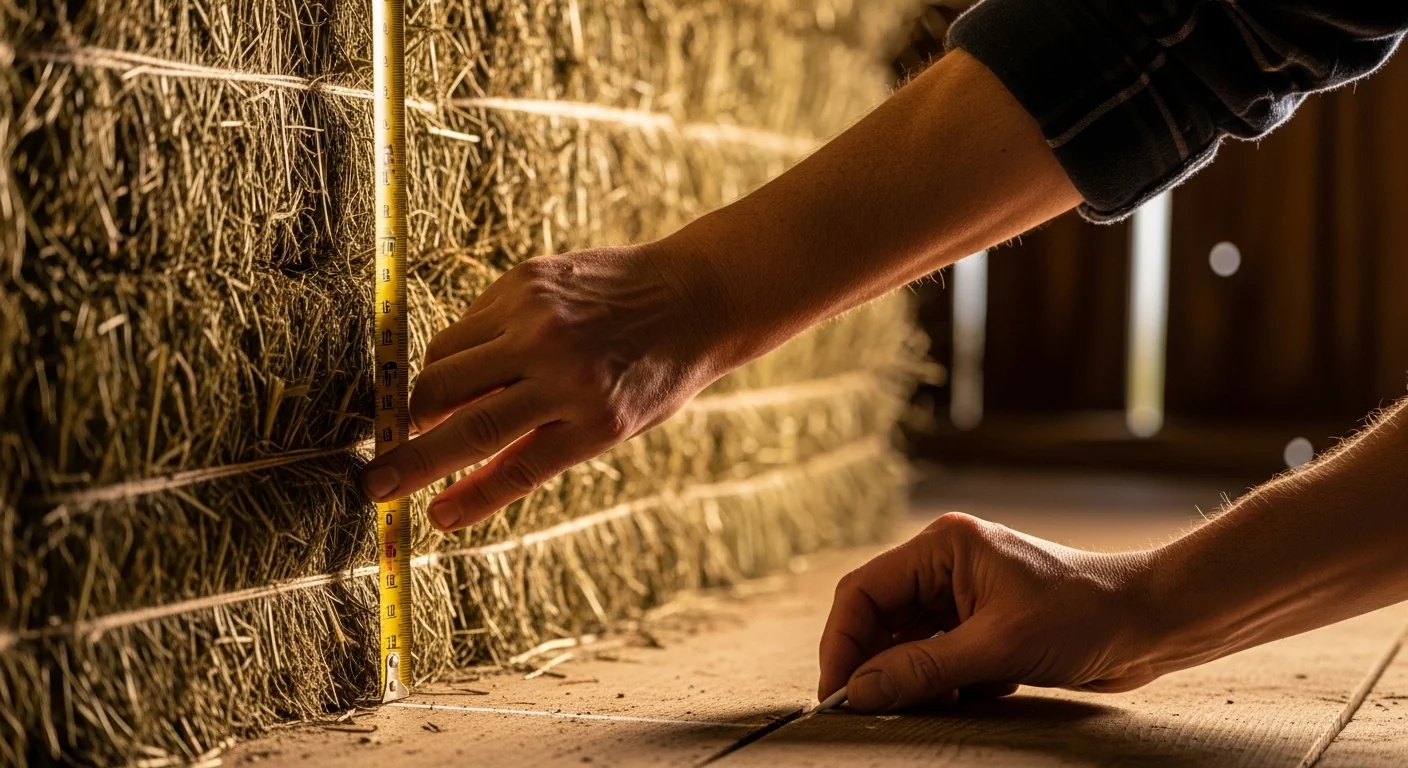
Once you have your monthly bale count, the practical next step is barn space planning. Measure your available covered storage area before contacting suppliers. If the storage figure from the calculator exceeds your current covered space, you have two options: shift to a larger bale format (round bales store more hay per square foot of floor space) or arrange split deliveries every two weeks instead of monthly. A two-week delivery schedule reduces peak storage requirements by roughly half, which can make the difference between a workable hay storage plan and an expensive barn expansion. For operations where hay is stored in an enclosed barn with multiple animal species, proper airflow becomes critical -- the barn ventilation calculator helps size fan capacity and inlet area for the additional moisture load that stored hay introduces.
The second step is fencing and containment review. If your goats or sheep are accessing pasture at any point during the year, their supplemental hay needs drop, but the transition periods -- when pasture is sparse but not zero -- require the most careful monitoring. Hay consumption during those windows is notoriously variable, and animals that graze even a few hours per day may not consume the full calculated ration. An electric fence calculator helps determine whether your current perimeter fence is adequate for keeping small ruminants on managed rotational sections, which directly affects how long your winter hay supply needs to stretch.
FAQ
How much hay does a goat eat per day?
A goat at winter maintenance needs approximately 3.5% of its body weight in hay per day. A 120 lb goat requires roughly 4.2 lbs of hay daily before accounting for waste. With a 15% waste factor applied, plan on providing around 4.8 lbs per day to that animal. Multiply across herd size for total daily requirements.
Do sheep eat the same amount of hay as goats of the same weight?
At maintenance, sheep and goats of the same body weight have similar dry matter intake requirements. The 3.5% rate used in this calculator applies reasonably to both species for winter maintenance feeding. Significant differences emerge in late gestation and lactation -- both species require higher energy inputs during those phases, which this tool does not model.
Why does the calculator add a 15% waste factor?
Goats and sheep waste hay through selective feeding, pulling hay from feeders, soiling bales with urine and feces, and trampling loose hay. A 15% waste addition reflects typical losses on managed small farms using conventional feeders. Farms using hay nets or keyhole feeders may experience lower waste; open-ground feeding typically produces higher losses than 15%.
What is the difference between hay consumption for winter versus summer?
This calculator is designed specifically for winter hay feeding when pasture is dormant. During active grazing seasons, animals sourcing a portion of their intake from pasture require less supplemental hay. The 3.5% rate should be adjusted downward in proportion to available pasture quality and grazing hours per day, something this tool does not calculate automatically.
How do I convert the barn storage result into bale stacks?
For small square bales, the storage output assumes 3-high stacking, so a 2 sq ft footprint per bale on the floor. Divide the total square footage by 2 to confirm the footprint matches your available floor space. For round bales, each bale occupies 25 sq ft on a flat floor with no stacking. Add 20 sq ft of aisle clearance to the total output figure for practical working space.
Can this calculator be used for other livestock species?
This tool is calibrated for goats and sheep using a 3.5% body weight intake rate standard for small ruminants in winter. Cattle, horses, and llamas have different dry matter intake requirements and feeding behavior profiles. Applying this calculator to those species without adjusting the intake rate will produce inaccurate results. Separate tools calibrated for cattle and horses should be used for those species.
Conclusion
The most common mistake to avoid is treating the monthly bale count as an exact order quantity. It is a consumption floor, not a purchasing target. Build at least a two-week buffer into every first-winter order, verify your bale weights directly with your supplier, and segment mixed herds by weight class for the most accurate results. For operations expanding beyond hay management into full pasture planning, the pasture stocking rate calculator provides the complementary land-side view of how many animals a given acreage can realistically support before hay becomes the primary -- and most expensive -- nutrition source.