
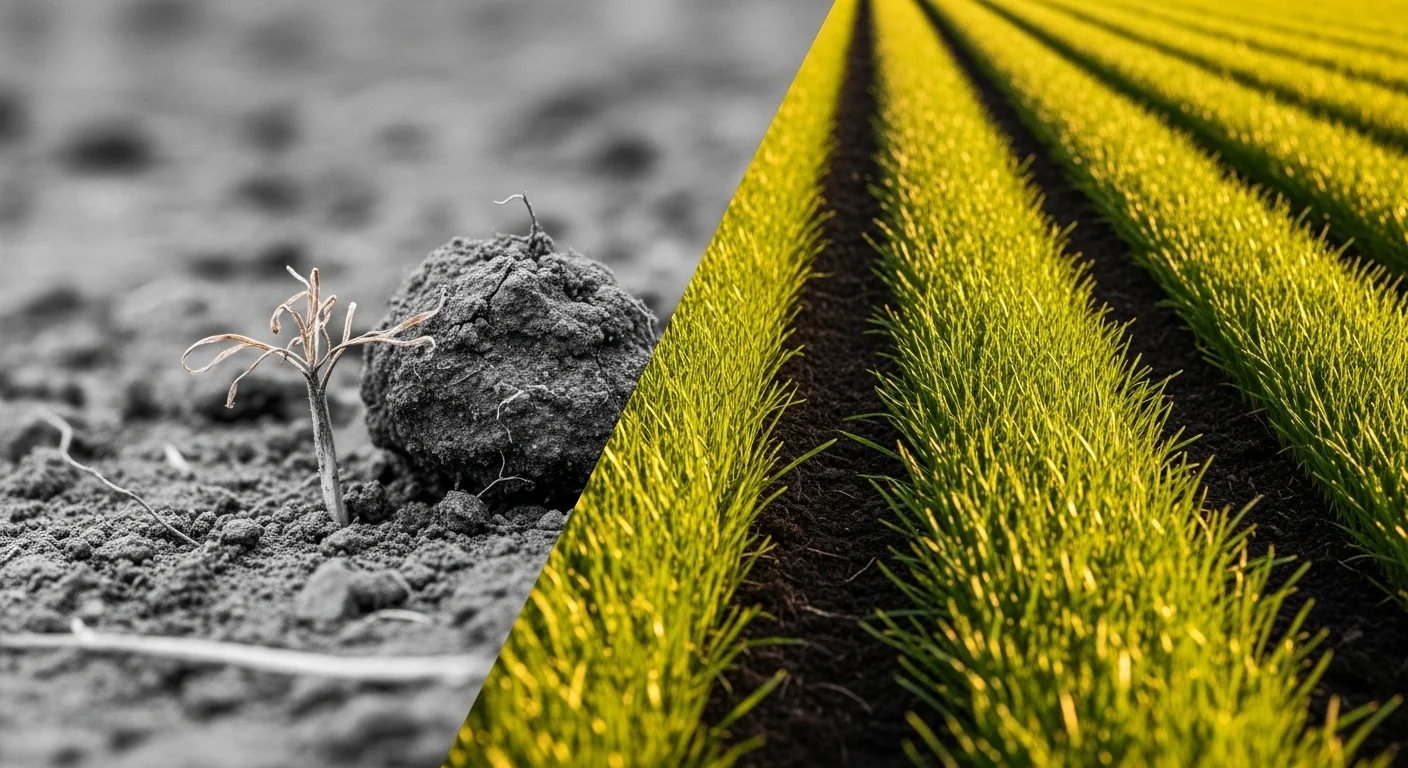
Setting a slit seeder blade by feel or by copying a neighbor’s rental settings is the single fastest way to guarantee a failed overseeding project. The depth that works for a tall fescue renovation will kill every Kentucky Bluegrass seedling in the furrow. The mechanism is not poor soil contact or wrong timing; it is seed biology. Tiny-seeded grasses carry a finite endosperm energy reserve, and if buried past their biological ceiling, the seedling consumes that reserve in darkness before the sprout reaches the surface.
This slit seeder calculator takes four inputs, applies species-specific depth lookup tables, and returns a recommended blade depth, slits per square foot, and estimated seed density per furrow. It does not predict germination rates, account for soil temperature, or substitute for a soil test. Its job is to put your blade setting inside the safe biological window for your chosen species and eliminate one well-documented failure mode before you start the machine.
After running this calculator, you will know the maximum blade depth your grass species can safely tolerate and whether your current compaction level requires a pre-aeration pass before you slit seed.
Use the Tool
| Grass Type | Seed Size | Min Depth | Max Safe Depth | Endosperm Limit | Status |
|---|---|---|---|---|---|
| Kentucky Bluegrass | Tiny (microscopic) | 0.125″ | 0.25″ | ~0.25″ starvation zone | Strict limit |
| Perennial Ryegrass | Medium | 0.125″ | 0.375″ | ~0.5″ starvation zone | Moderate flex |
| Tall Fescue | Large | 0.25″ | 0.50″ | ~0.75″ starvation zone | Most tolerant |
| KBG @ 1.0″ depth | Tiny | DANGER — never set this depth | Endosperm depleted in darkness | Fatal | |
| Fescue @ 0.75″ | Large | Marginal — possible with rich seed lots | Near upper limit | Marginal | |
Formula Steps & Logic
This calculator uses seed biology lookup tables combined with blade geometry to determine optimal depth and seed placement density.
DepthTarget = Lookup(SeedType)KBG → 0.125″–0.25″ | Ryegrass → 0.125″–0.375″ | Fescue → 0.25″–0.50″
Compaction modifier: Medium adds +0.0625″, High adds +0.125″ (capped at safe max).
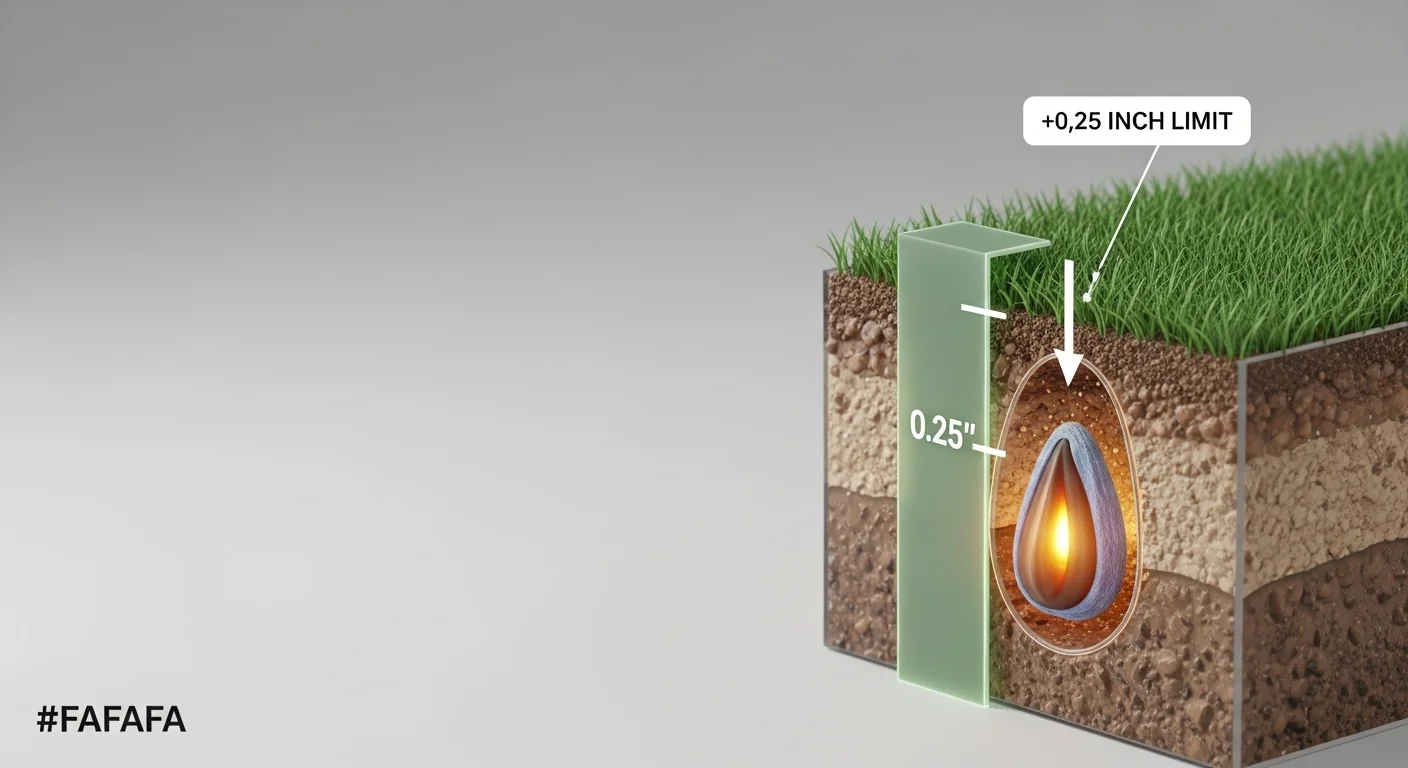
If KBG and Depth > 0.25" → ENDOSPERM STARVATION WARNINGKBG seed contains a tiny endosperm energy reserve. Burial past 0.25″ causes the seedling to use all energy reaching light before it can establish. The sprout runs out of fuel and dies in the dark.
Slits/sqft = 12 / BladeSpacinge.g. 1.5″ spacing → 8 slit rows per 12″ width
SeedRate_lbs_per_sqft = SeedRate / 1000Seeds/sqft = SeedRate_lbs_per_sqft × SeedsPerLb(type)Seeds/slit/ft = Seeds/sqft / Slits/sqftSeeds per lb: KBG ≈ 2,200,000 | Ryegrass ≈ 227,000 | Fescue ≈ 227,000
RiskPct = (DepthTarget / 1.25) × 100 (capped 0–100%)The gauge bar marker moves based on how close you are to the 1″+ danger zone relative to your seed type’s safe maximum.
Assumptions & Limits
- Seeds per pound values are averages; premium blends (e.g., Ryan Knorr / Twin City Seed) may vary ±15%.
- Assumes a motorized slit seeder (not a hand-operated unit) with consistent blade depth control.
- Soil temperature must be 50°F+ for germination — this calculator does not account for temperature.
- Blade spacing inputs between 0.5″–4.0″ are accepted. Outside this range, results may be unreliable.
- Compaction modifier is a linear approximation; use a soil penetrometer for precision testing.
- This tool applies to cool-season grasses only. Warm-season species (Bermuda, Zoysia) have different depth requirements.
- Overseeding into existing turf may require a pass rate 25–50% higher than a new seeding rate.
- Always verify blade depth with a physical gauge or caliper before seeding a full area.
Before entering values, have these figures on hand: the species name on your seed bag label (not just “grass seed”), the blade spacing spec from the slit seeder’s rental sheet or owner’s manual, and your intended seed application rate in pounds per 1,000 square feet. If you are not certain of your soil compaction level, a basic penetrometer reading or the “screwdriver test” (how easily a flat-blade screwdriver sinks 6 inches into dry soil) gives a workable estimate. If you are still deciding on seed type and rate, the grass seed calculator on this site will help you determine application rates before you come back here for blade depth.
Quick Start (60 Seconds)
- Grass Seed Type: Match the species on your seed bag exactly. “Turf blend” does not work here; identify whether the primary species is Kentucky Bluegrass, Tall Fescue, or Perennial Ryegrass. Mixed blends should use the most depth-sensitive species present, which is almost always KBG.
- Blade Spacing (inches): Read this from the slit seeder’s adjustment panel or rental documentation, not from measuring tire tracks. Standard settings are 1.5 inches or 2 inches. Do not enter the slit depth here; blade spacing is the lateral distance between adjacent cutting discs.
- Seed Application Rate (lbs / 1,000 sq ft): Use the overseeding rate from the seed bag, not the new lawn rate. Overseeding rates are typically 50 to 75 percent of new-seeding rates. Enter the number only; do not include the unit label in the field.
- Soil Compaction Level: Choose Low for recently core-aerated or freshly tilled ground, Medium for a typical residential lawn with light traffic, and High for clay-dominant soils, clay-compacted sports fields, or areas showing poor water infiltration (pooling after rain).
- Avoid decimal confusion: Blade spacing of one and a half inches is 1.5, not 1.50 or 15. The field accepts decimals.
- Click Calculate once all fields are filled. The tool will not run until every field has a valid entry. Inline error messages identify which fields need attention.
- Use Reset to clear all fields if you want to run a second scenario for a different area of the lawn with different compaction or species.
Inputs and Outputs (What Each Field Means)
| Field Name | Unit | What It Means | Common Mistake | Safe Entry Guidance |
|---|---|---|---|---|
| Grass Seed Type | Category (dropdown) | Determines the biological depth ceiling based on endosperm energy reserve size | Choosing the species that is easiest to type rather than what is on the bag | Check the seed bag label; if blended, choose the most sensitive species |
| Slit Seeder Blade Spacing | Inches | Lateral distance between cutting blade discs; determines rows of slits per linear foot | Confusing blade spacing with blade cutting depth; these are different adjustments on the machine | Read from the machine’s rental card or adjustment plate; accepted range 0.5 to 4 inches |
| Seed Application Rate | lbs / 1,000 sq ft | Target seed quantity per area unit, used to compute seeds per furrow | Using new-lawn seeding rates for an overseeding application, doubling density unnecessarily | Use the overseeding column on the seed bag; typically 2 to 10 lbs depending on species |
| Soil Compaction Level | Category (dropdown) | Influences the compaction modifier added to baseline depth to improve furrow fidelity in hard soil | Selecting Low compaction because the lawn looks green, not testing actual penetration resistance | Use a penetrometer or screwdriver test on dry soil before selecting; clay soil is nearly always High |
| Recommended Blade Depth (output) | Inches | The computed target depth within the safe biological window, adjusted for compaction | Treating this as a minimum rather than a target; going deeper “for safety” causes endosperm failure | Set the machine to this value exactly; verify with a physical depth caliper before the full pass |
| Slits per Square Foot (output) | Slits / sq ft | Number of seed furrow rows crossing each square foot of turf at the entered blade spacing | Assuming more slits always means better coverage; too-narrow spacing at wrong depth tears turf | Standard residential overseeding: 6 to 8 slits per sq ft is adequate for most applications |
| Seeds per Slit (output) | Seeds / linear foot of slit | Estimated seed count deposited per linear foot of furrow; derived from rate, seeds-per-pound, and spacing | Ignoring this number entirely; low values indicate inadequate rate for the chosen spacing | For KBG, values below 200 seeds per linear foot suggest increasing application rate |
| Seeds per Sq Ft (output) | Seeds / sq ft | Total estimated seed density across the area; cross-check against species recommendations | Expecting this number to predict germination percentage; germination depends on many other factors | KBG: 6,000 to 8,000 seeds/sqft is a healthy target; Fescue: 1,200 to 2,000 seeds/sqft typical |
For a related calculation that accounts for seed purity and germination percentage before you run this tool, see the pure live seed calculator, which adjusts your effective seeding rate based on what is actually viable in the bag.
Worked Examples (Real Numbers)
Scenario 1: Standard Kentucky Bluegrass Residential Overseeding
- Grass Type: Kentucky Bluegrass (KBG)
- Blade Spacing: 1.5 inches
- Seed Rate: 3 lbs / 1,000 sq ft
- Soil Compaction: Medium
Calculation: Base depth = (0.125 + 0.25) / 2 = 0.1875 inches. Medium compaction adds 0.0625 inches. Target = min(0.25, 0.25) = 0.25 inches (capped at hard biological maximum). Slits per sq ft = 12 / 1.5 = 8. Seeds per sq ft = (3 / 1000) x 2,200,000 = 6,600. Seeds per slit per linear foot = 6,600 / 8 = 825.
Result: 0.25-inch blade depth | 8 slits/sq ft | 6,600 seeds/sq ft
This is operating at the absolute biological ceiling for KBG. Any increase beyond 0.25 inches triggers the endosperm starvation failure mode. The medium compaction modifier has consumed all remaining depth margin; a core aeration pass before seeding would allow staying slightly shallower and still achieving good seed-to-soil contact.
Scenario 2: Tall Fescue Renovation on Heavily Compacted Clay Lawn
- Grass Type: Tall Fescue
- Blade Spacing: 2 inches
- Seed Rate: 7 lbs / 1,000 sq ft
- Soil Compaction: High
Calculation: Base depth = (0.25 + 0.50) / 2 = 0.375 inches. High compaction adds 0.125 inches. Target = min(0.50, 0.75) = 0.50 inches. Slits per sq ft = 12 / 2 = 6. Seeds per sq ft = (7 / 1000) x 227,000 = 1,589. Seeds per slit per linear foot = 1,589 / 6 = 265.
Result: 0.50-inch blade depth | 6 slits/sq ft | 1,589 seeds/sq ft
Tall Fescue’s larger endosperm reserve handles 0.50 inches without starvation risk, but this scenario is at the top of the safe range. The high compaction warning applies: blade deflection on hardpan clay can place seed inconsistently. A pre-aeration pass is the safest approach before this depth setting.
Scenario 3: Perennial Ryegrass Sports Field Thin Spot Repair
- Grass Type: Perennial Ryegrass
- Blade Spacing: 1.5 inches
- Seed Rate: 10 lbs / 1,000 sq ft
- Soil Compaction: Low
Calculation: Base depth = (0.125 + 0.375) / 2 = 0.25 inches. Low compaction modifier = 0. Target = 0.25 inches. Slits per sq ft = 12 / 1.5 = 8. Seeds per sq ft = (10 / 1000) x 227,000 = 2,270. Seeds per slit per linear foot = 2,270 / 8 = 284.
Result: 0.25-inch blade depth | 8 slits/sq ft | 2,270 seeds/sq ft
A high seed rate with tight blade spacing on loose soil is a strong scenario for Ryegrass. The shallow depth in low-compaction conditions keeps the blade from tearing established turf roots unnecessarily, and 2,270 seeds per sq ft sits in a productive density range for thin spot repair without overcrowding.
Reference Table (Fast Lookup)
All depth and density values below are computed directly from the calculator’s formula. The “Seeds/Sq Ft” column is the derived output used for quick pre-planning decisions.
| Grass Type | Blade Spacing (in) | Target Depth (in) | Slits / Sq Ft | Seed Rate (lbs/1k sqft) | Seeds / Sq Ft (derived) |
|---|---|---|---|---|---|
| Kentucky Bluegrass | 1.5 | 0.25 | 8 | 2 | 4,400 |
| Kentucky Bluegrass | 1.5 | 0.25 | 8 | 3 | 6,600 |
| Kentucky Bluegrass | 2.0 | 0.25 | 6 | 3 | 6,600 |
| Perennial Ryegrass | 1.5 | 0.25 | 8 | 8 | 1,816 |
| Perennial Ryegrass | 2.0 | 0.375 | 6 | 10 | 2,270 |
| Tall Fescue | 1.5 | 0.375 | 8 | 6 | 1,362 |
| Tall Fescue | 2.0 | 0.50 | 6 | 7 | 1,589 |
| Tall Fescue (high compaction) | 2.0 | 0.50 | 6 | 8 | 1,816 |
| KBG at 1.0-inch depth | 1.5 | 1.0 (FATAL) | 8 | 3 | Endosperm depleted; seedling death |
How the Calculation Works (Formula + Assumptions)
Show the calculation steps
Step 1: Depth Target Lookup by Species
Each grass species maps to a biological depth range based on seed size and endosperm energy reserve. KBG: 0.125 to 0.25 inches. Perennial Ryegrass: 0.125 to 0.375 inches. Tall Fescue: 0.25 to 0.50 inches. The midpoint of each range becomes the base depth.
Step 2: Compaction Modifier
Medium compaction adds 0.0625 inches to the base depth. High compaction adds 0.125 inches. The modified depth is then capped at the species’ hard biological maximum (KBG: 0.25″, Ryegrass: 0.50″, Fescue: 0.75″). Low compaction carries a zero modifier.
Step 3: Slits per Square Foot
Slits/sqft = 12 / BladeSpacing
This is a simple geometric calculation: 12 linear inches per foot divided by the inter-blade distance in inches. A 1.5-inch spacing produces 8 slit rows per foot; a 2-inch spacing produces 6.
Step 4: Seed Density Outputs
Seeds/sqft = (SeedRate / 1000) x SeedsPerLb
Seeds per pound by species (assumed averages): KBG = 2,200,000; Tall Fescue = 227,000; Perennial Ryegrass = 227,000.
Seeds per slit per linear foot = Seeds/sqft / Slits/sqft
Step 5: Risk Gauge Score
RiskPct = (TargetDepth / 1.25) x 100, capped between 0 and 100. The 1.25-inch ceiling represents a depth well past the fatal threshold for all supported species; 100 on the gauge means dangerous territory regardless of species.
Rounding: Target depth is displayed to 3 decimal places. Slits per sq ft to 1 decimal. Seed counts are rounded to the nearest whole number.
Assumptions and Limits
- Seeds-per-pound values are species averages. Premium certified seed lots from suppliers such as Ryan Knorr Lawn Care blends or Twin City Seed may vary from these averages by roughly 10 to 15 percent in either direction.
- This tool applies to cool-season grasses only. Bermuda, Zoysia, St. Augustine, and other warm-season species have different depth requirements and are not supported.
- The compaction modifier is a linear approximation. Precise depth compensation requires a soil penetrometer reading, not a visual assessment.
- Blade depth on a motorized slit seeder varies with operator speed, blade wear, and soil resistance. The calculated depth is a machine-setting target, not a guaranteed furrow depth. Always verify with a physical depth caliper on a test strip before full coverage.
- Soil temperature is not factored into this calculator. Germination requires a consistent soil temperature at the 2-inch depth; for most cool-season species that threshold is approximately 50 degrees Fahrenheit for KBG and 50 to 65 degrees Fahrenheit for Fescue and Ryegrass.
- Overseeding into existing turf may require increasing the seed application rate by 25 to 50 percent above the bag’s overseeding recommendation to compensate for competition from established grass.
- Blade spacing inputs outside 0.5 to 4 inches will return a validation error. Consumer-grade slit seeders typically do not go below 1 inch or above 3 inches in practice.
- The calculator does not account for pass direction. A perpendicular second pass can double effective seed coverage at the same rate; the output density numbers reflect a single-direction pass.
Standards, Safety Checks, and “Secret Sauce” Warnings
Critical Warnings
- The 1-Inch Burial Failure for KBG: Kentucky Bluegrass is among the smallest-seeded turf grasses available. Its endosperm, the stored energy that powers germination before photosynthesis begins, is proportionally tiny. When buried at 1 inch or deeper, the seedling successfully germinates but runs out of fuel in the dark before the coleoptile can break the soil surface. The seed will appear to have germinated (the radicle is active below ground) but the lawn will show zero visible establishment. This is not a soil or fertilizer problem. It is a physics and biology problem, and it is irreversible once the seed has been placed.
- Depth Beyond 0.25 Inches Triggers Endosperm Starvation Risk for KBG: The biological ceiling for Kentucky Bluegrass is 0.25 inches. Even 0.375 inches, a depth appropriate for Ryegrass, places KBG seedlings in a marginal energy situation. The calculator will flag this with a danger-level warning and the gauge bar will shift toward the risk zone immediately. Do not override this warning.
- Wide Blade Spacing Reduces Coverage Without Compensating Depth: Blade spacings above 2.5 inches produce fewer than 5 slit rows per foot. At standard application rates, this leaves large fractions of the soil surface unseeded. The fix is a second perpendicular pass, not a deeper blade setting.
- High Compaction Without Pre-Aeration Produces Inconsistent Furrows: On clay-heavy or heavily trafficked soils, slit seeder blades deflect unpredictably. The furrow depth varies by several tenths of an inch across a single pass, placing some seed at the safe ceiling and some significantly deeper. A core aeration pass one to two weeks before slit seeding is the established solution. The lawn aeration holes per square foot calculator can help you plan the correct aeration pass density for your area size.
Minimum Standards
- KBG blade depth must never exceed 0.25 inches regardless of compaction level. The compaction modifier for KBG in this tool is constrained so the output never exceeds this threshold.
- Verify blade depth with a physical gauge on a test strip before seeding the full area. Do not rely on the machine’s depth adjustment dial alone; wear and mechanical play introduce real-world variance.
- Starter fertilizer should be applied at seeding or within 24 to 48 hours. Formulations compatible with Mesotrione (sold as Tenacity) are safe for use on KBG and Fescue seedings and allow simultaneous crabgrass suppression without damaging germinating seed.
- Post-seeding watering must keep the top 0.25 to 0.5 inches of soil consistently moist until first mow. For irrigation planning after seeding, the turf watering calculator on this site can help set run times based on your system’s output rate.
Competitor Trap: Most slit seeding guides on the web instruct users to set blade depth to “1/4 inch to 1/2 inch” as a universal recommendation across all grass types. This is correct for Fescue and borderline for Ryegrass, but it is a fatal instruction for Kentucky Bluegrass. Applying a 0.5-inch depth setting to KBG seed places it at double the biological maximum, guaranteeing endosperm starvation in the furrow. The missing variable in every generic guide is seeds-per-pound, which is the proxy for endosperm size. Small seeds have small fuel tanks. A flat depth recommendation that ignores species biology is the most common reason otherwise well-executed overseeding projects fail with no obvious cause.
If your overseeding plan also includes nitrogen management after establishment, the grass clippings nitrogen calculator provides a way to quantify how much nitrogen you can return through mulch mowing once the new turf is established, reducing your fertilizer inputs during the critical first season.
Common Mistakes and Fixes
Mistake: Matching Depth to What the Previous Tenant Set on the Rental
Machine
Rental slit seeders are returned with all manner of leftover blade depth settings from the previous user’s completely different project. A setting left at 0.75 inches from a Fescue renovation will kill a KBG overseeding without any visible mechanical failure. The machine will run exactly as expected, deposit seed at exactly the wrong depth, and you will wait three weeks for germination that will not come.
Fix: Always reset and verify blade depth against your species’ calculated target before beginning, using a physical depth caliper on a test strip.
Mistake: Applying the New-Lawn Seed Rate to an Overseeding
Application
New-lawn seeding rates are calibrated for bare soil with no competitive pressure from established turf. Applied to an overseeding scenario, they produce extreme seed density in the furrows, which creates competition among seedlings for light and nutrients in the narrow slit opening. Germination percentage per seed drops and the visual result is a patchy stand rather than uniform coverage.
Fix: Use the overseeding rate column on your seed bag. If none is listed, apply 60 to 70 percent of the new-lawn rate as a starting point.
Mistake: Selecting “Low Compaction” on Clay Soil Because the Lawn
Looks Normal
Clay soils look and behave normally on the surface during the growing season, especially when covered by established turf that is masking drainage problems underneath. The appearance of a healthy lawn does not indicate loose, well-structured soil below the root zone. Clay soil almost always tests as High compaction with a penetrometer, regardless of surface appearance.
Fix: Test compaction physically. Push a 3/8-inch flat-blade screwdriver into dry soil; if you cannot reach 6 inches by hand pressure alone, select High. The topsoil calculator is useful if you are also planning a top-dressing application to improve soil structure alongside the overseeding.
Mistake: Treating the Blade Spacing Adjustment as the Depth
Adjustment
Consumer-grade slit seeders have two separate adjustable parameters: the lateral spacing between blade discs (how far apart the rows of slits are) and the cutting depth (how deep each blade penetrates). Some models place these adjustments in proximity to each other on the machine frame. Operators who misidentify which dial does which can inadvertently run extremely wide or narrow row spacing thinking they have corrected depth, or vice versa. The outputs of this calculator reflect blade spacing in the slits-per-sq-ft result; running the wrong spacing invalidates that output.
Fix: Consult the machine’s diagram or rental documentation and identify both adjustments by name before making any changes. Mark the confirmed settings with a paint pen if the dial has no locking mechanism.
Mistake: Running a Single Pass and Considering Coverage Complete
A single slit seeder pass at 2-inch blade spacing produces 6 slit rows per foot of width. In a standard pass pattern, roughly 83 percent of the soil surface is never opened and never receives seed. This is not a flaw; it is the expected performance of the machine at that spacing. The design assumes either tight spacing (1.5 inches or less) or a second perpendicular pass to achieve adequate coverage density for thin stands.
Fix: Plan for two perpendicular passes if your blade spacing is 2 inches or wider. This doubles your seeds-per-sq-ft at the same application rate, which is particularly important for KBG’s lower coverage density at standard seeding rates. For new turf scenarios where you are comparing slit seeding against laying sod, the sod calculator provides a square footage and material estimate for comparison.
Next Steps in Your Workflow
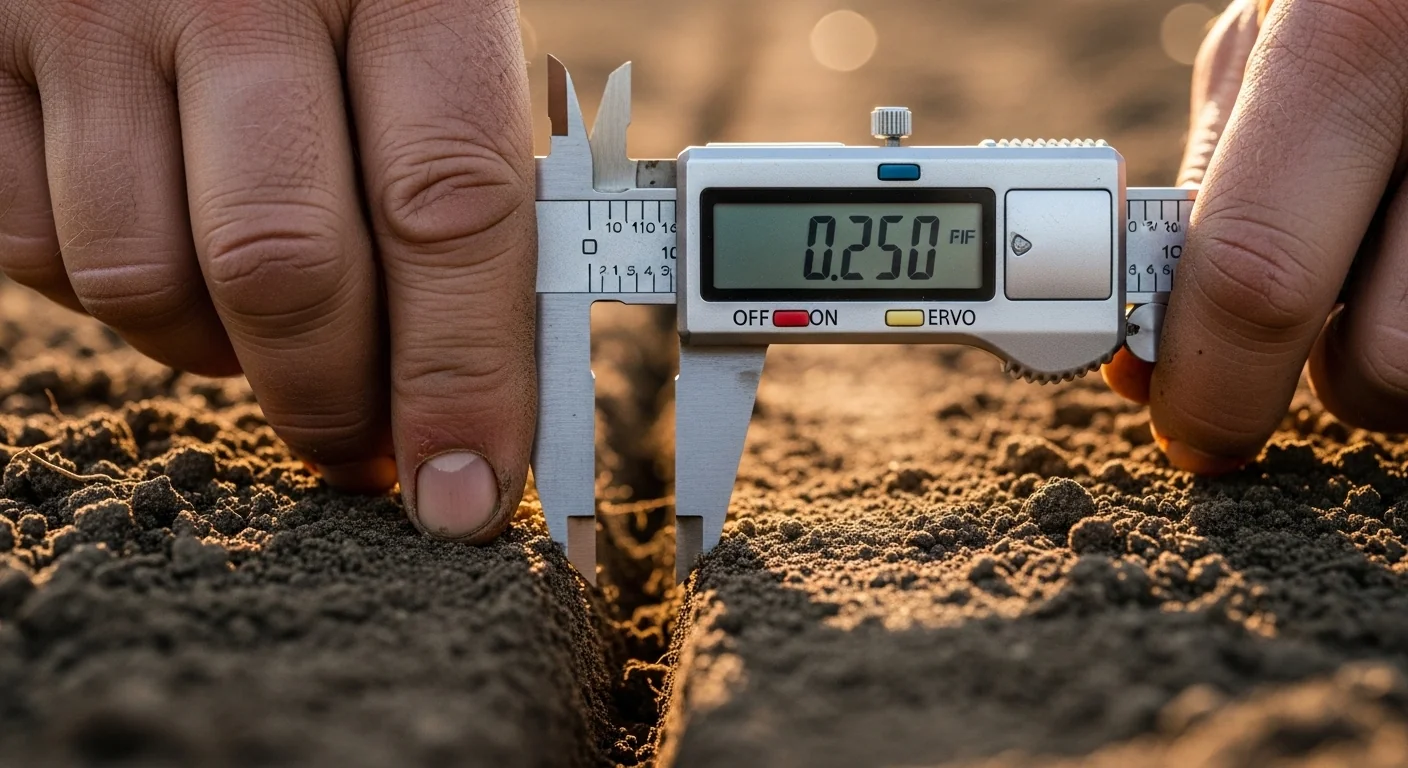
Once the calculator returns a blade depth within the safe window for your species, the next action before touching the machine is a physical verification pass. Cut a single 10-foot slit on an inconspicuous area of the lawn at your calculated setting, then use a narrow ruler or depth gauge to measure the actual furrow depth at three points along that strip. Rental machines in particular carry mechanical play in depth adjustment mechanisms, and a 0.05-inch real-world deviation from your target is common. On KBG, that 0.05-inch margin is the entire difference between safe and marginal territory. Adjust and re-measure before proceeding to the full area.
After your seeding pass, the two most consequential variables for germination success are moisture and starter nutrition. Set your irrigation schedule to provide light, frequent watering that keeps the top quarter-inch of soil consistently moist without saturating it; the turf watering calculator can convert your irrigation system’s output rate into the run times needed for this. Apply a starter fertilizer within 48 hours; phosphorus-forward formulations support root development in the critical pre-emergence phase and are compatible with Tenacity (Mesotrione) if you are simultaneously managing crabgrass in warm-season windows.
FAQ
What is the maximum safe blade depth for Kentucky Bluegrass?
The hard biological maximum is 0.25 inches. KBG seed carries a proportionally small endosperm energy reserve relative to other cool-season species. Burial at any depth greater than 0.25 inches places the seedling in progressively greater risk of exhausting that reserve before the sprout reaches light. The calculator will flag depths above 0.25 inches for KBG as a danger-level warning and will not recommend settings past this ceiling.
How is slits per square foot different from seed density?
Slits per square foot is a geometric output: how many slit rows cross one square foot of surface area at a given blade spacing. Seed density is a biological output: how many individual seeds are present in that square foot based on application rate and seeds per pound. Both matter independently. You can have 8 slits per square foot with very low seed density, or 4 slits per square foot with very high density. Neither metric alone predicts stand quality.
Does higher compaction mean I should set the blade deeper?
The tool adds a small depth increment for medium and high compaction to improve furrow fidelity in harder soil. This increment is modest and is always capped at the species’ biological maximum. The better solution for severely compacted ground is a core aeration pass before slit seeding, which improves furrow consistency without requiring deeper blade settings that could approach or exceed the endosperm safety threshold.
Can this calculator handle mixed grass seed blends?
Not directly. If your blend is labeled as a mix, identify the most depth-sensitive species it contains. In most cool-season blends that contain Kentucky Bluegrass, the KBG is the limiting factor. Run the calculation using KBG as the species input; the resulting depth will be safe for the other species in the mix as well, since Fescue and Ryegrass tolerate shallower depths without harm.
What does the risk gauge bar on the results panel indicate?
The gauge maps your calculated blade depth against a normalized risk scale from zero to 1.25 inches. The marker moves rightward as depth increases relative to the danger zone threshold. Green territory on the left indicates depths well within the biological safe range for any supported species. Orange and red zones indicate depth settings that approach or exceed endosperm tolerance thresholds. The gauge is a visual summary; read the specific warning messages beneath it for actionable guidance.
Is slit seeding better than core aeration for overseeding?
They address different problems. Core aeration creates air channels that relieve compaction and improve water infiltration, but it does not create consistent seed furrows. Slit seeding creates direct seed-to-soil contact in controlled furrows but does not materially relieve compaction. The highest-performing overseeding programs use core aeration one to two weeks before slit seeding, allowing the aeration holes to close slightly before the slit seeder runs, while retaining the improved soil structure that helps seedling roots establish quickly.
Conclusion
The single most important output this calculator provides is not the depth number itself; it is the endosperm starvation warning that appears when depth and species are in conflict. That warning does not appear on rental instruction cards, seed bag labels, or most competing guides. If you are seeding Kentucky Bluegrass and your machine is currently set past a quarter inch, that warning is the reason this page exists. For projects where slit seeding is part of a broader lawn renovation involving area estimates, material quantities, and coverage planning, the grass seed calculator is the recommended starting point before returning to set blade depth here.