
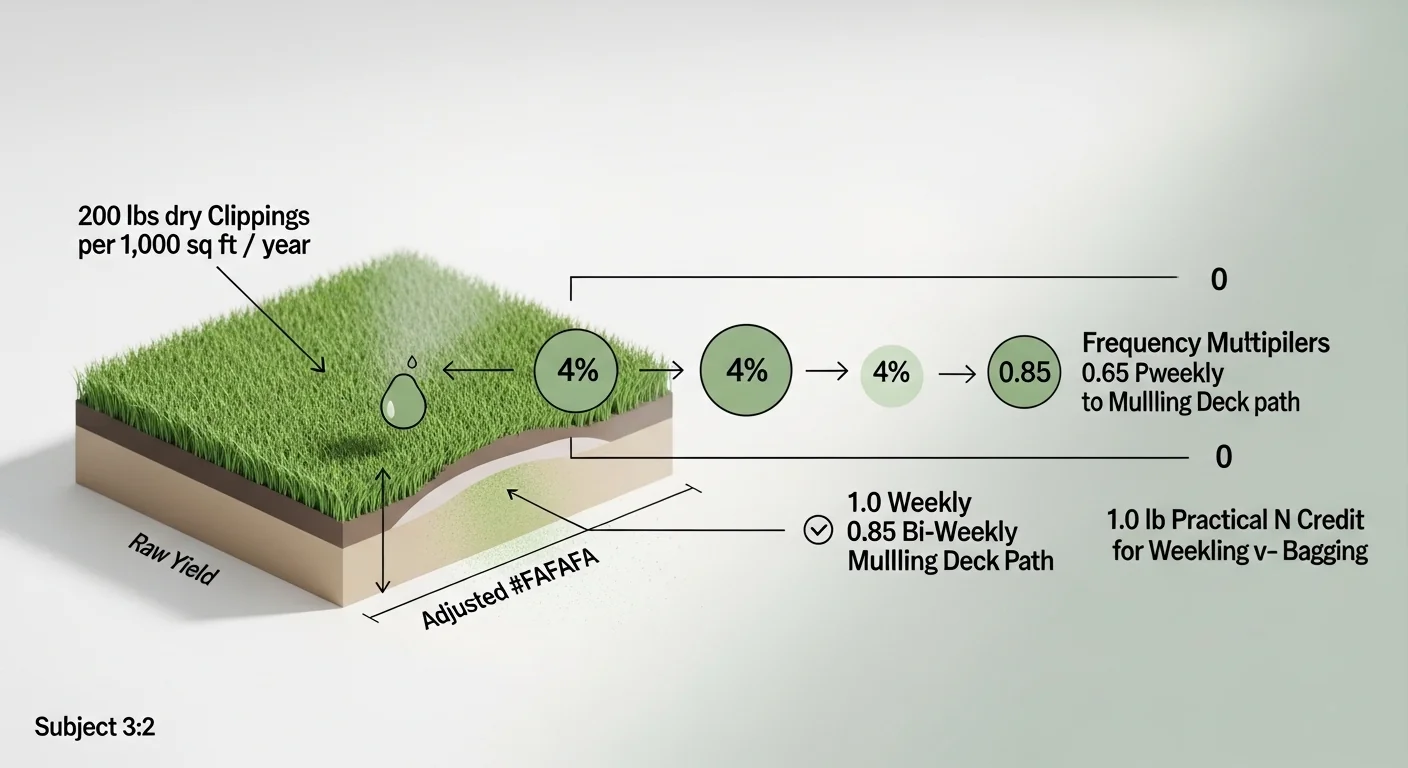
Every mowing session, a measurable quantity of nitrogen leaves your lawn in a bag, a trailer, or a compost pile. The mechanism is straightforward: grass tissue contains roughly 4% nitrogen by dry weight, and when clippings are removed instead of returned to the soil, that nutrient is permanently lost from the turf system. The loss is not trivial. At a practical recovery rate of approximately 1.0 lb of nitrogen per 1,000 sq ft per year, bagging is a recurring, quantifiable fertilizer expense that most homeowners and lawn care operators absorb without ever noticing it.
This calculator takes your lawn size, mowing frequency, mower type, and annual nitrogen target, then computes exactly how much nitrogen your clippings are capable of returning and how much purchased fertilizer you can realistically cut. It does not predict soil test results, account for nutrient leaching, or replace a site-specific fertilization program. What it does is give you a defensible number to work with before you buy your next bag of granular nitrogen.
After running the calculator, you will know whether switching to a mulching deck or increasing mowing frequency changes your fertilizer budget in a meaningful way for your specific lawn area.
Use the Tool

| Scenario | Clippings N Credit | Fertilizer Needed | Annual Savings |
|---|
How This Calculator Works
- Estimate dry clippings yield: A healthy lawn produces approximately
200 lbs dry clippings / 1,000 sq ft / yearwhen mowed regularly. - Calculate nitrogen content: Grass clippings contain about
4% nitrogen by dry weight, so:Returned N = 200 × 0.04 = ~8.0 lbs N raw potential / 1,000 sq ft. - Apply mowing frequency factor: Weekly mowing captures full potential (factor = 1.0). Bi-weekly reduces it (factor = 0.85). Every 3 weeks reduces further (factor = 0.65) due to longer clippings decomposing less efficiently.
- Apply mower type factor:
If Mulching Deck: Clippings are finely chopped and returned to soil, providing a practical credit of approximately1.0 lb N / 1,000 sq ft / year.If Bagging: All clippings are removed, so nitrogen credit = 0. - Calculate adjusted fertilizer need:
Fertilizer Needed = Target Annual N - Clippings N Credit. - Dollar savings: Based on ~$0.70 per lb of nitrogen from typical granular fertilizer.
Assumptions & Limits
- Dry clippings yield of 200 lbs/1,000 sq ft/year assumes a cool-season turf mowed at 3–3.5 inches during a full growing season.
- Nitrogen percentage (4%) is an average across common turfgrass species (Kentucky Bluegrass, Tall Fescue, Perennial Ryegrass).
- The practical nitrogen credit for mulching (~1.0 lb N) accounts for decomposition timing, microbial immobilization, and real-world clipping distribution.
- Actual values vary with soil type, irrigation, climate zone, grass species, and mowing height.
- This calculator does not account for slow-release organic nitrogen sources already applied.
- Thatch is caused by dead roots and stems (lignin), not by grass clippings. Clippings are ~80% water and decompose within 48 hours.
- Savings estimate uses $0.70/lb N as an average retail fertilizer cost.
Before you start, have three measurements ready: your total lawn area in square feet (you can divide that number by 1,000 to get the entry value), your normal mowing interval during the growing season, and your target annual nitrogen rate. If you are unsure of your nitrogen target, check your grass species: cool-season grasses like tall fescue and Kentucky bluegrass typically need 2 to 4 lbs of nitrogen per 1,000 sq ft per year, while warm-season varieties like bermudagrass often run higher. If you want to estimate how long each mowing session takes at your current frequency, the mowing time calculator can give you a useful cross-reference.
Quick Start (60 Seconds)
- Lawn Size: Enter your total turfgrass area divided by 1,000. A 7,500 sq ft lawn is entered as 7.5. Do not include beds, driveways, or structures in this number.
- Mowing Frequency: Choose the interval that reflects your actual growing-season habit, not your ideal schedule. If you mow every ten days on average, select bi-weekly. Overestimating frequency inflates the calculated credit.
- Mower Type: Select Mulching Deck only if your mower is equipped with a mulching blade and deck that re-circulates clippings. A standard side-discharge mower with clippings left on the surface does not perform the same fine-cut decomposition as a true mulching setup.
- Target Annual Nitrogen: Use your fertilization program’s total annual N rate in lbs per 1,000 sq ft. If you apply multiple products across the year, add those N values together. Acceptable entry range is 0.5 to 10 lbs N/1,000 sq ft.
- Run the calculation: All four fields must be filled before the result appears. The tool will flag any empty or out-of-range entry inline before it runs.
Inputs and Outputs (What Each Field Means)
| Field | Unit | What It Represents | Common Mistake | Safe Entry Guidance |
|---|---|---|---|---|
| Lawn Size | 1,000s of sq ft | Total turfgrass area receiving nitrogen management | Entering raw sq ft (e.g., 5000) instead of divided value (5.0) | Measure or estimate entire mowable turf area; divide by 1,000 before entering |
| Mowing Frequency | Interval category | How often clippings are cut and returned during active growth | Selecting “weekly” when actual mowing averages 10 to 14 days | Choose the interval that reflects the majority of your growing-season mowings |
| Mower Type | Categorical | Whether clippings are finely mulched back into the turf or collected and removed | Assuming side-discharge equals mulching; it does not | Confirm your deck is a dedicated mulching design, not a converted bagger with the bag removed |
| Target Annual Nitrogen | lbs N / 1,000 sq ft | The total nitrogen rate your turf needs in a calendar year across all applications | Entering per-application rate instead of annual total | Sum all planned or historical N applications for the full year; typical cool-season range is 2 to 4 lbs |
| Clippings N Credit (output) | lbs N / 1,000 sq ft | Nitrogen returned to the soil from mulched clippings annually | Treating this as a guarantee rather than an estimate | Read result as a planning figure; actual recovery varies with soil temperature, moisture, and microbial activity |
| Fertilizer Still Needed (output) | lbs N / 1,000 sq ft | Adjusted annual nitrogen requirement after subtracting clippings credit | Using this number to eliminate fertilizer entirely without a soil test | Pair with a soil test before making large reductions to synthetic nitrogen |
| Annual Savings (output) | US dollars | Estimated cost of nitrogen fertilizer avoided by returning clippings | Expecting exact match to your local fertilizer prices | Based on approximately $0.70 per lb of nitrogen from typical granular products; recalculate if your cost differs |
If you are still determining how many square feet of lawn you are managing, the grass seed calculator requires the same area input and can serve as a parallel sizing exercise for renovation planning.
Worked Examples (Real Numbers)
Example 1: Small Suburban Lawn, Weekly Mulching
- Lawn size: 2,500 sq ft (entered as 2.5)
- Mowing frequency: Weekly
- Mower type: Mulching deck
- Target annual nitrogen: 4 lbs N / 1,000 sq ft
Result: Clippings return 1.0 lb N/1,000 sq ft. Fertilizer needed drops to 3.0 lbs N/1,000 sq ft. Total fertilizer across 2.5 units = 7.5 lbs N. Estimated annual savings = $1.75.
At this scale, the dollar savings are modest, but the nitrogen reduction is meaningful: the lawn requires 25% less purchased fertilizer with no change in mowing schedule, only in deck type.
Example 2: Large Lawn, Bi-Weekly Mulching
- Lawn size: 10,000 sq ft (entered as 10.0)
- Mowing frequency: Bi-weekly
- Mower type: Mulching deck
- Target annual nitrogen: 4 lbs N / 1,000 sq ft
Result: Frequency factor of 0.85 reduces practical credit to 0.85 lbs N/1,000 sq ft. Fertilizer needed = 3.15 lbs N/1,000 sq ft. Total across 10 units = 31.5 lbs N. Estimated savings = $5.95 per year.
Bi-weekly mowing produces longer clippings that decompose at a slower rate, which is reflected in the reduced frequency factor. Moving to weekly mowing would recover the full 1.0 lb credit and push savings to $7.00 at this scale.
Example 3: Switching from Bagging to Mulching on a 10,000 sq ft Lawn
- Lawn size: 10,000 sq ft (entered as 10.0)
- Mowing frequency: Weekly
- Before: Bagging mower, target 4 lbs N / 1,000 sq ft
- After: Mulching deck, same frequency and target
Result: Bagging scenario requires 40 lbs N total with no clippings credit. Mulching scenario requires 30 lbs N total with a 1.0 lb/1,000 sq ft credit applied. The switch eliminates the need to purchase 10 lbs of nitrogen per year and saves $7.00 annually at the $0.70/lb cost assumption.
This example illustrates the compounding effect over multiple seasons: a homeowner bagging the same lawn for a decade effectively buys the equivalent of 100 lbs of nitrogen they never needed to purchase.
Reference Table (Fast Lookup)
| Lawn Size (1,000 sq ft) | Mowing Frequency | Mower Type | Target N (lbs/1,000 sq ft) | Clippings Credit (lbs/1,000 sq ft) | Fertilizer Still Needed (lbs/1,000 sq ft) | Annual Savings (est.) |
|---|---|---|---|---|---|---|
| 1.0 | Weekly | Mulching | 2.0 | 1.00 | 1.00 | $0.70 |
| 1.0 | Weekly | Mulching | 4.0 | 1.00 | 3.00 | $0.70 |
| 2.5 | Weekly | Mulching | 4.0 | 1.00 | 3.00 | $1.75 |
| 5.0 | Weekly | Mulching | 4.0 | 1.00 | 3.00 | $3.50 |
| 5.0 | Bi-weekly | Mulching | 4.0 | 0.85 | 3.15 | $2.98 |
| 5.0 | Every 3 weeks | Mulching | 4.0 | 0.65 | 3.35 | $2.28 |
| 5.0 | Weekly | Bagging | 4.0 | 0.00 | 4.00 | $0.00 |
| 10.0 | Weekly | Mulching | 3.0 | 1.00 | 2.00 | $7.00 |
| 10.0 | Weekly | Mulching | 4.0 | 1.00 | 3.00 | $7.00 |
| 10.0 | Bi-weekly | Mulching | 4.0 | 0.85 | 3.15 | $5.95 |
| 10.0 | Weekly | Bagging | 4.0 | 0.00 | 4.00 | $0.00 |
How the Calculation Works (Formula + Assumptions)
Show the calculation steps
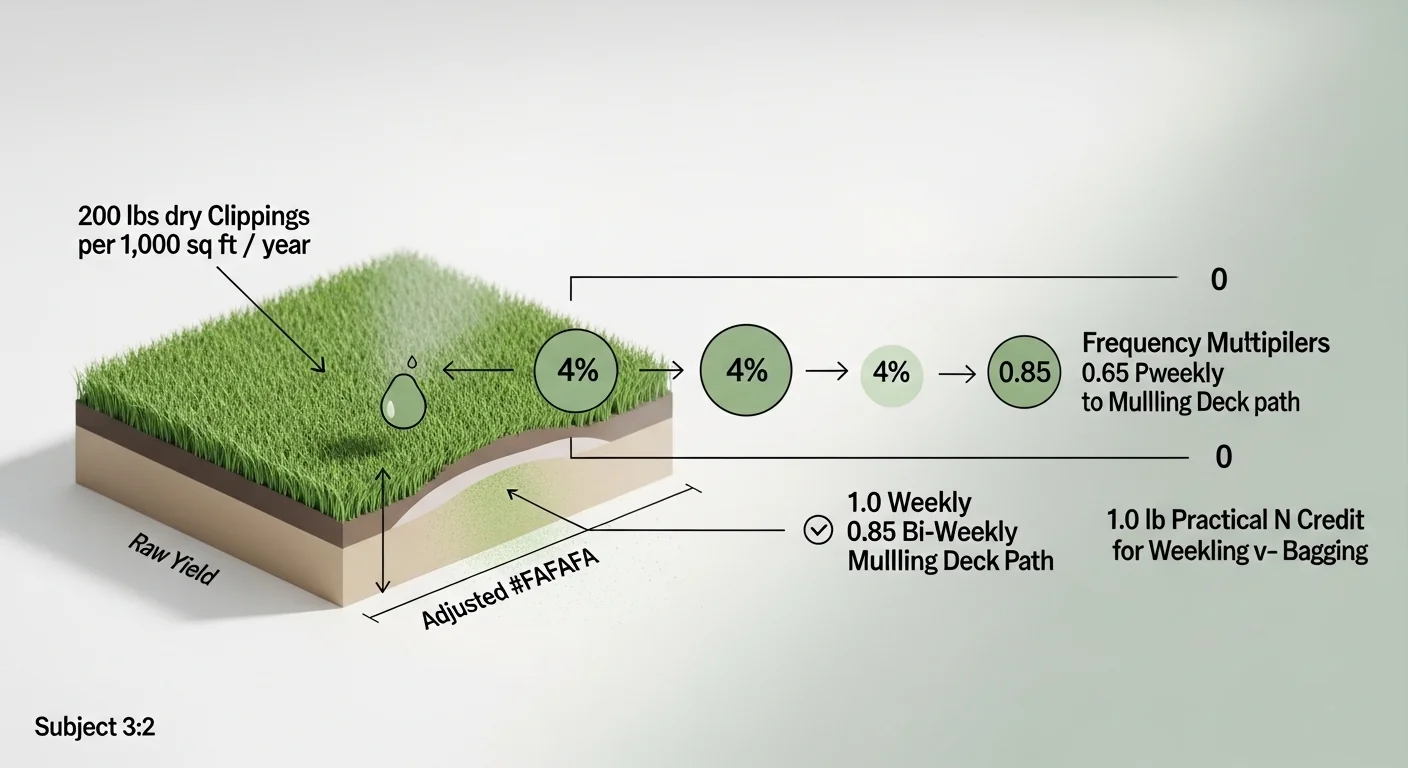
Step 1: Establish baseline clippings yield. A healthy turfgrass stand managed at a standard mowing height produces approximately 200 lbs of dry clippings per 1,000 sq ft per year. This is the starting mass from which nitrogen content is calculated.
Step 2: Calculate nitrogen content. Grass clippings contain roughly 4% nitrogen by dry weight. Multiplying 200 lbs by 0.04 gives 8.0 lbs of nitrogen theoretically present in the clippings per 1,000 sq ft per year. This is the raw potential, not the recoverable credit.
Step 3: Apply the practical recovery factor. Not all of that nitrogen becomes plant-available in the same growing season due to microbial immobilization, decomposition timing, and clipping distribution variability. The practical credit for a mulching deck operated correctly is approximately 1.0 lb N per 1,000 sq ft per year. This number is consistent with published university extension recommendations and is used as the base credit for the weekly mulching scenario.
Step 4: Apply the mowing frequency factor. Weekly mowing produces short, fine clippings with a factor of 1.0. Bi-weekly mowing produces longer clippings that take more time to decompose and have a factor of 0.85. Mowing every three weeks produces the longest, most uneven clippings with a factor of 0.65. These factors are multiplied against the 1.0 lb base credit to produce an adjusted credit.
Step 5: Apply mower type logic. If the mower type is Bagging, the clippings credit is set to zero regardless of frequency, because all nitrogen-bearing material is physically removed from the system.
Step 6: Calculate adjusted fertilizer requirement. Fertilizer needed = Target Annual N minus Clippings N Credit. The result cannot go below zero.
Step 7: Scale to lawn size. All per-unit (per 1,000 sq ft) values are multiplied by the number of lawn units entered.
Step 8: Estimate savings. Dollar savings = Clippings N Credit x Lawn Units x $0.70. The $0.70 per lb figure reflects an approximate mid-range cost for nitrogen from commonly available granular fertilizer products.
Rounding: Results are displayed to two decimal places for dollar values and one decimal place for nitrogen figures. No intermediate rounding is applied during calculation.
Assumptions and Limits
- The 200 lbs dry clippings per 1,000 sq ft per year estimate assumes a cool-season turfgrass managed at 3 to 3.5 inches throughout a full growing season. Warm-season grasses with different growth patterns may produce higher yields during their active season.
- The 4% nitrogen figure is an average across common species including Kentucky bluegrass, tall fescue, and perennial ryegrass. Actual nitrogen content varies with fertilization history, irrigation, and clipping maturity at time of cut.
- The practical 1.0 lb N credit is a conservative planning estimate, not a laboratory measurement of plant-available nitrogen release in a specific soil.
- Frequency factors (1.0, 0.85, 0.65) represent relative decomposition efficiency. They are not derived from a single study but reflect the agronomic principle that shorter clippings decompose faster and release nitrogen more reliably within the same growing season.
- The $0.70 per lb nitrogen cost assumption should be adjusted if your local fertilizer prices differ significantly from this estimate.
- This calculator does not account for existing soil nitrogen reserves, organic matter levels, slow-release fertilizer already applied, or any nitrogen inputs from irrigation water.
- In drought conditions or during dormancy, clipping decomposition slows considerably, reducing the effective nitrogen return below what this calculator predicts.
Standards, Safety Checks, and “Secret Sauce” Warnings
Critical Warnings
- Bagging is an active removal of nitrogen, not a neutral choice. At the practical recovery rate used in this calculator, a homeowner with a 5,000 sq ft lawn who bags weekly is removing approximately 5.0 lbs of nitrogen from their property every year. That nitrogen must then be replaced through purchased fertilizer at a recurring cost. The act of bagging is not fertilizer-neutral; it is fertilizer-negative.
- Clippings do not cause thatch. Thatch is a layer of undecomposed organic matter between the soil surface and the green canopy. It is composed primarily of dead roots, crowns, and stems that contain lignin, a compound that resists biological breakdown. Fresh grass clippings are approximately 80% water and decompose within 48 hours under normal conditions. They contribute negligibly to thatch formation. Bags marketed around thatch prevention are solving a problem that clippings do not create.
- Mowing frequency directly controls the quality of your nitrogen return. The calculator applies a 0.65 factor for every-three-week mowing because long clippings create clumps that shade the turf, slow decomposition, and reduce uniform nitrogen distribution. If you intend to capture the full nitrogen credit, weekly mowing is the enabling condition, not just a preference.
Minimum Standards for Valid Clippings Recycling
- Use a dedicated mulching deck with a mulching blade. A standard blade with the discharge chute blocked or the bag removed does not produce the fine particle size needed for rapid decomposition.
- Never remove more than one-third of the blade length in a single cut. Following the one-third rule keeps clippings short enough to fall through the canopy and reach the soil surface quickly.
- Maintain adequate soil moisture. Dry, compacted soils slow microbial activity and delay nitrogen mineralization from decomposing clippings. Routine core aeration improves clipping breakdown and nutrient uptake. The lawn aeration calculator can help you plan an aeration program that supports healthy clipping decomposition.
- Match your overall nitrogen program to soil test results. Clippings return is a supplement to a planned fertilization schedule, not a reason to eliminate all nitrogen applications without measuring actual soil nutrient levels. If your turf shows signs of iron or micronutrient deficiency, those are distinct from the nitrogen credit this calculator addresses. Keeping watering rates appropriate for your soil type also affects how quickly soil biology processes returned clippings; the turf watering calculator provides a complement to this tool for overall turf nutrition management.
Competitor Trap: Most articles on grass clippings either repeat the thatch myth as a warning or overclaim that clippings “feed your lawn for free.” Both framings are imprecise in ways that matter for decision-making. The thatch myth leads to unnecessary bagging and fertilizer purchases. The “free fertilizer” framing ignores that the nitrogen credit is mowing-frequency-dependent, mower-type-dependent, and soil-condition-dependent. This calculator avoids both traps by using a defensible practical credit figure and applying frequency factors that reflect real-world decomposition variance rather than best-case laboratory conditions.
Common Mistakes and Fixes
Mistake: Using a Side-Discharge Mower and Expecting Mulching Results
A side-discharge deck does not re-circulate clippings. It produces clippings of varying length that are ejected to the side and can form visible rows. These rows decompose more slowly and unevenly than finely shredded mulch and do not reliably deliver the same nitrogen return as a purpose-built mulching deck. Setting the mowing speed faster also increases clipping length, compounding the problem.
Fix: Install a dedicated mulching blade matched to your mower’s deck diameter. The blade geometry matters for particle size. For reference on how blade speed affects cut quality and clipping size, see the mower blade tip speed calculator.
Mistake: Entering Annual Target N as a Single-Application Rate
Entering 1.0 lb when you apply 1.0 lb four times a year produces a severely understated nitrogen target, which makes the clippings credit appear to cover nearly the entire requirement. The resulting “fertilizer needed” output will underestimate your actual program needs. This is one of the most common data-entry errors for users running multi-application programs.
Fix: Add all planned or historical nitrogen application rates across the full growing season before entering the target value.
Mistake: Applying the Credit to Warm-Season Turf in a Cold Climate
The base assumptions in this calculator were developed around cool-season turfgrass growth patterns. Warm-season grasses like bermudagrass and zoysia can produce higher dry matter yields during their active summer growth window, which would increase the raw nitrogen potential. Applying the cool-season credit figure to a warm-season turf may understate what is available.
Fix: Treat the calculator output as a conservative lower bound for warm-season species. Consult regional extension publications for species-specific nitrogen return data if precision matters for your program.
Mistake: Ignoring Soil Condition When Reducing Purchased Fertilizer
The nitrogen credit only converts to plant-available nitrogen if the soil has adequate moisture, a functioning microbial community, and a pH that supports decomposition. Compacted, dry, or heavily acidic soils reduce decomposition rates substantially. Cutting purchased nitrogen without addressing underlying soil conditions can lead to visible nutrient deficiencies even when the calculator suggests the credit should be sufficient.
Fix: Address pH, compaction, and organic matter levels first. If your soil requires amendment, the topsoil calculator can assist in sizing amendment quantities before adjusting your fertilizer program.
Mistake: Treating the Dollar Savings Estimate as a Fertilizer Product Cost
The savings figure in this calculator is based on an assumed cost per pound of nitrogen, not per bag of fertilizer. Actual fertilizer products vary in nitrogen concentration (expressed as the first number in the N-P-K analysis on the bag), so the per-bag cost you pay at retail does not directly equal the per-lb-N cost used here. A 50-lb bag of 30-0-3 fertilizer contains 15 lbs of nitrogen, making the per-lb-N cost dependent on bag price, not just bag weight.
Fix: Divide the retail price of your fertilizer by the pounds of nitrogen it contains to get your actual cost per lb N, then compare that figure to the $0.70 assumption used here to calibrate the savings estimate for your market.
Next Steps in Your Workflow
After calculating your adjusted fertilizer requirement, the logical next action is to convert that per-unit figure into a product purchase quantity. Nitrogen concentration varies by product, so the lbs N per 1,000 sq ft output from this tool is an input to, not a substitute for, a full product selection calculation. If your revised program includes overseeding to fill in thin areas that developed under a previous low-nitrogen bagging approach, the pure live seed calculator can help you size a seeding quantity that accounts for germination rate and seed purity, which matters when you are trying to match existing turf density.
For lawns that need broader renovation after years of nutrient depletion from bagging, it is also worth evaluating whether the existing turf density justifies fertilizer investment alone or whether a partial resodding program makes more economic sense over a multi-year horizon. The sod calculator can give you a cost-comparison starting point if renovation is on the table. In either case, the nitrogen budget you generate here sets the baseline for any program moving forward.
FAQ
Does mulching grass really prevent the need for fertilizer?
No. Returned clippings offset part of your annual nitrogen requirement but do not replace a fertilization program. The practical credit of approximately 1.0 lb N per 1,000 sq ft per year is meaningful but represents a fraction of what most turfgrass species need annually. Think of it as a discount on purchased fertilizer, not a substitute for it.
Why does mowing frequency affect how much nitrogen I get back?
Shorter, more frequent cuts produce finer clippings that fall through the canopy quickly and decompose rapidly. Longer clippings from infrequent mowing form thicker layers on the surface, decompose more slowly, and distribute unevenly. The nitrogen in those clippings still exists, but it may not mineralize into plant-available form within the same growing season at the same rate.
Is the thatch-from-clippings concern completely false?
Yes, for practical purposes. Thatch is built from lignin-rich materials: dead roots, stolons, and stems. Fresh grass clippings are predominantly water and simple proteins that decompose quickly. Peer-reviewed turfgrass science has not supported the clippings-cause-thatch conclusion in normal mowing conditions. The concern is a persistent myth, not a documented agronomic risk under standard management.
What if my lawn has existing thatch right now?
Existing thatch predates any change you make to your clipping management. Switching to mulching will not worsen thatch caused by previous cultural practices. To address existing thatch, core aeration and vertical mowing (dethatching) are the appropriate mechanical interventions. Biological dethatcher products containing enzyme blends can support decomposition of the existing layer over time.
Can I use this calculator for warm-season grasses?
The calculator provides a reasonable estimate for warm-season species, but the base assumptions were developed around cool-season turfgrass growth patterns. Warm-season species with high summer growth rates may generate more dry matter and therefore more nitrogen potential than the calculator reflects. Treat the output as a conservative planning figure for bermudagrass, zoysia, and similar species.
How do I convert the fertilizer needed output to actual product bags?
Find the nitrogen concentration of your selected product (the first number in the N-P-K analysis on the bag label, expressed as a whole number representing pounds of N per 100 lbs of product). Divide your total lbs N needed by that decimal equivalent to get the total product weight required. For example, if you need 15 lbs N and your product is 30-0-0, divide 15 by 0.30 to get 50 lbs of product.
Conclusion
The core insight this calculator operationalizes is simple: removing grass clippings from your lawn is not a neutral act. It is a recurring removal of nitrogen that must then be purchased and re-applied. The thatch myth is the mechanism by which that cost is justified in most homeowner decision-making, and the biology does not support it. Clippings decompose. Thatch does not come from clippings. Every season a bag gets filled instead of a mulching deck running, a measurable quantity of nitrogen exits the system at your expense.
The single most important mistake to avoid after using this tool is conflating the clippings credit with complete fertilizer elimination. The credit is real and calculable. It is not large enough to dismiss your annual nitrogen program, and it depends on the quality of your equipment and the consistency of your mowing schedule. If you are evaluating a mower upgrade to capture this return, the specifications that determine cut quality, including blade geometry and tip speed, are worth examining in detail with the mower blade tip speed calculator before making a purchase.