
Planter Weight Calculator
Estimate total planter weight and footprint pressure from project-specific inputs
A planter can create a localized or concentrated load. The calculated footprint pressure cannot be compared directly with a code-prescribed uniformly distributed live load to declare a balcony, deck, roof or elevated slab safe. Placement requires review of the actual structure, existing loads, support geometry and adopted code by the property owner and a licensed Structural Professional Engineer (PE).
Calculation Method
Gallon mode: volume (ft³) = U.S. gallons × 231 ÷ 1,728.
Dimension mode: volume (ft³) = internal width (in) × internal depth (in) × internal height (in) ÷ 1,728.
2. Dry media weight
Dry media weight (lb) = volume (ft³) × user-supplied dry bulk density (lb/ft³). No universal media-density preset is used.
3. Retained water weight
Retained water weight (lb) = user-supplied retained U.S. gallons × 8.34 lb/gal.
4. Estimated total planter weight
Total weight (lb) = empty pot weight + dry media weight + retained water weight + plant/accessories weight.
5. Estimated footprint pressure
Estimated footprint pressure (lb/ft²) = estimated total planter weight (lb) ÷ actual supported footprint area (ft²).
Assumptions & Limits
• Dimension mode models a rectangular internal volume. For tapered, round or irregular containers, use a measured fill volume in gallon mode.
• Dry bulk density must come from the specific product at the intended compaction or from a representative measured sample. The calculator does not assign a generic density by media name.
• To measure dry bulk density, tare a container of known volume, fill it at the intended compaction, weigh the dry media, and divide its weight by the known container volume in ft³.
• Retained water is supplied by the user and is not inferred from labels such as “moist,” “wet” or “saturated.” Measure it when possible from the change in assembly weight after drainage, divided by 8.34 lb/gal.
• The 8.34 lb/gal water factor is an engineering approximation. Temperature and dissolved material can change actual density.
• Actual supported footprint area means the area that transfers load to the supporting surface. Feet, rails, rings or point contacts may produce higher local bearing effects than this simple average.
• Include the plant, saucer, stand, irrigation reservoir, ballast and permanent hardware in “Plant & Accessories Weight.”
• People, temporary tools, wind, seismic effects, snow, impact, deterioration and other loads are outside this calculation.
• Estimated footprint pressure is not structural capacity, code compliance, a uniformly distributed design live load, a point-load analysis or permission to place the planter.
Original Sources
- NIST Handbook 44 (2026), Appendix C — General Tables of Units of Measurement: 1 U.S. liquid gallon = 231 cubic inches; 1 cubic foot = 1,728 cubic inches.
- U.S. Geological Survey, Estimated Use of Water in the United States in 2000 — Conversion Factors: 1 gallon of water = approximately 8.34 pounds; 1 cubic foot of water = approximately 62.4 pounds.
- International Code Council, 2024 International Building Code, Chapter 16 and Table 1607.1: structural design-load context for floors, balconies and decks. Local adoption and amendments control. Uniformly distributed live loads are not used here as an automatic planter pass/fail threshold.
Calculation Test Vectors
| Vector | Inputs | Expected | Runtime Check |
|---|---|---|---|
| A | 5 gal; pot 8 lb; density 25 lb/ft³; water 2 gal; plant/accessories 5 lb; footprint 1 ft² | 46.4 lb; 46.4 lb/ft² | Waiting for JavaScript |
| B | 12 × 12 × 14 in; pot 10 lb; density 30 lb/ft³; water 3 gal; plant/accessories 10 lb; footprint 1.5 ft² | 80.0 lb; 53.3 lb/ft² | Waiting for JavaScript |
Licensed Structural PE Review Record
- Calculator version
- TYG-PWC-EQ-1.0.0
- Technical update
- August 31, 2026
- Reviewer name
- Not supplied
- Credential
- Licensed Structural Professional Engineer (PE) — not yet verified
- License record
- Jurisdiction and license number not supplied
- Review date
- Not supplied
- Review scope
- Calculation method, input assumptions, test vectors and structural-safety language
- Version reviewed
- Not yet recorded
- Status
- Pending independent PE review; no professional approval is claimed.
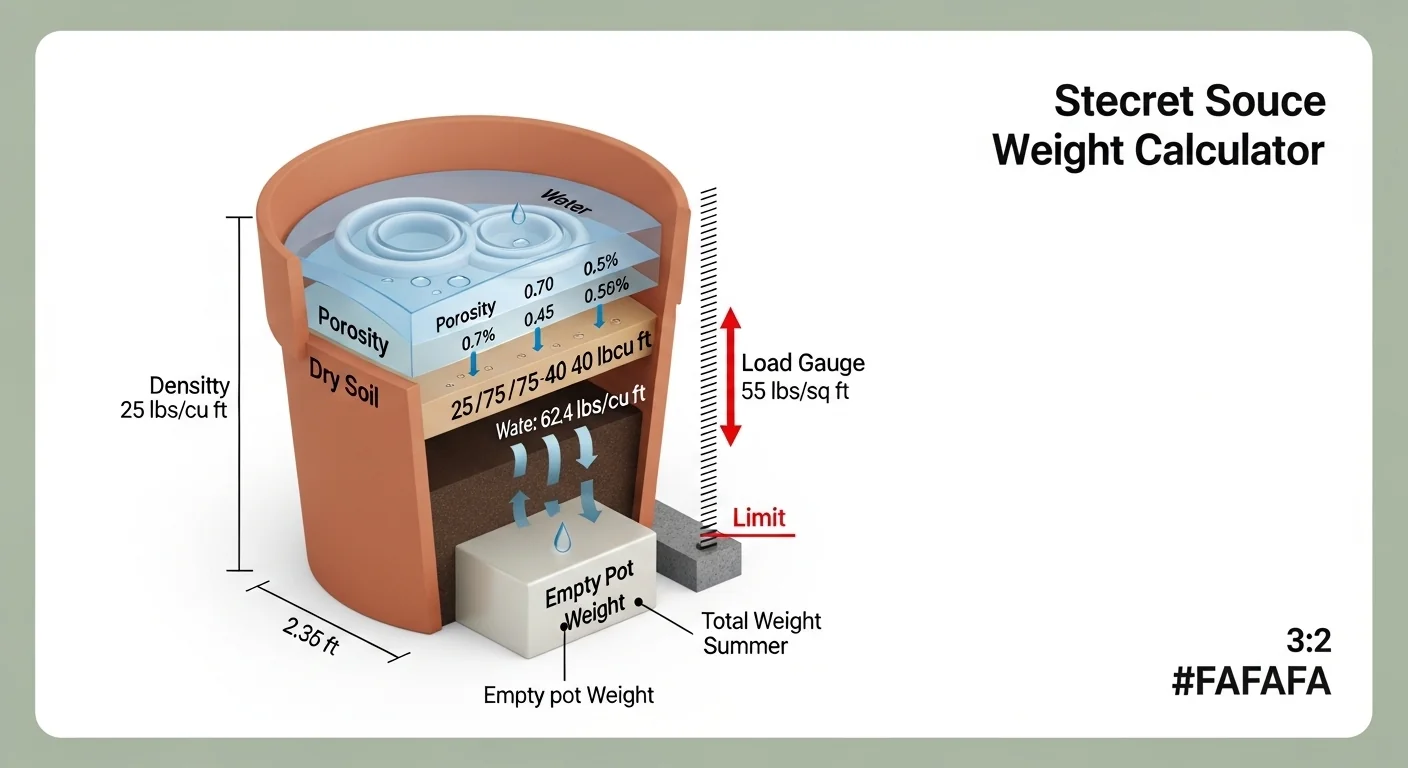
Placed without calculation, a container garden can quietly accumulate hundreds of pounds on a surface rated for far less. The problem is not the pot or the plant. It is water retention. A 25-gallon planter filled with potting mix weighs roughly 98 lbs when dry. After a prolonged rain with blocked drainage, the same planter can reach 244 lbs. The footprint has not changed. The soil has. That 2.5x increase in load is exactly what this tool is designed to expose before the planter is placed.
This calculator estimates total planter weight by separately computing dry soil mass, retained water mass, and empty pot weight, then divides the total against the pot footprint to produce a load-per-square-foot figure. That figure is then checked against the standard residential balcony live load threshold of 50 to 60 lbs per sq ft. What the tool does not do: it does not account for plant weight, structural resonance, dynamic loading from wind, or the actual rated capacity of any specific balcony. For unusual structures, a licensed structural engineer must verify the load.
After running this calculator, you will know whether your planned container setup is safely within typical balcony limits, in a caution zone that warrants redistribution, or over the threshold where placement should be halted until a structural review occurs.
Use the Tool
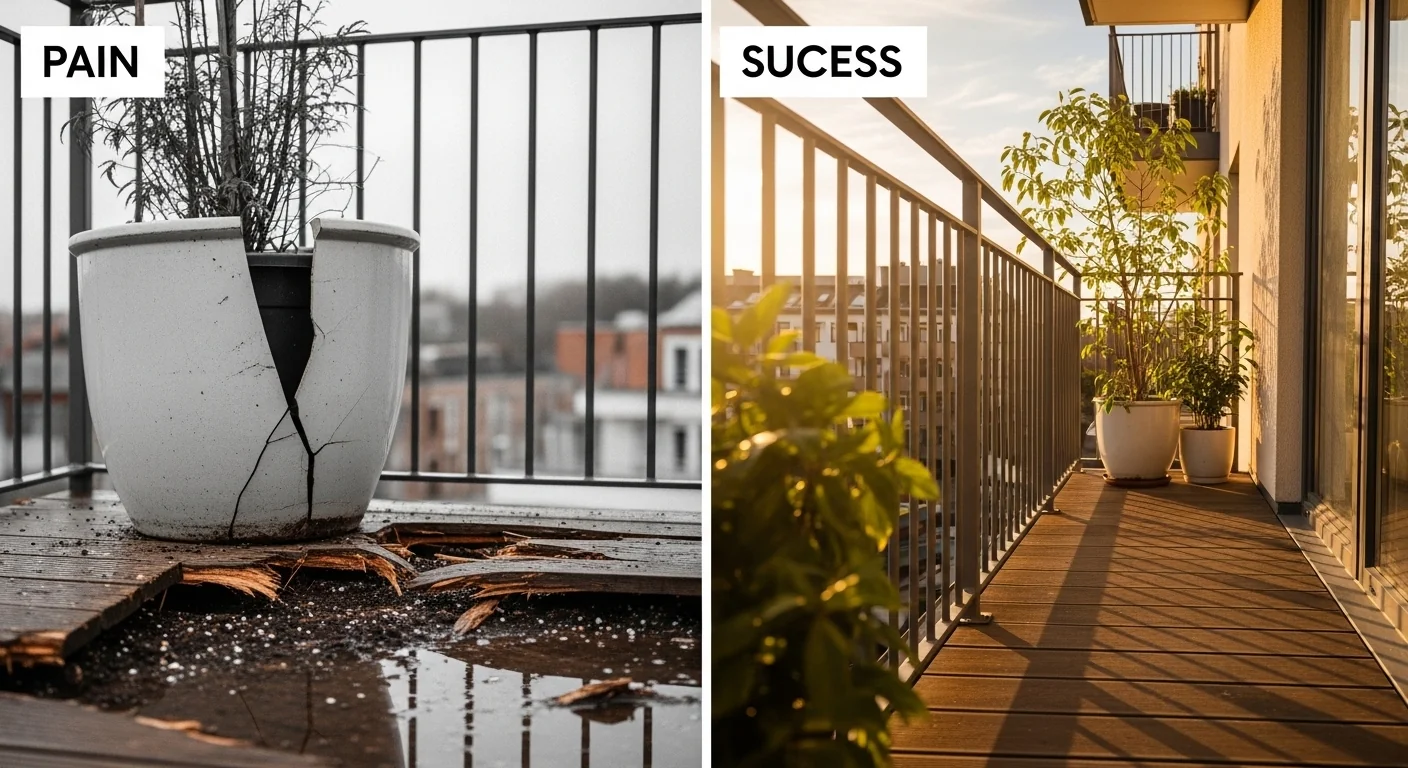
Before starting, have these items ready: the pot volume in gallons (check the nursery label or product listing) or the interior dimensions in inches. Weigh the empty pot on a bathroom scale if possible. If you plan to use bagged topsoil or garden soil rather than standard potting mix, that distinction changes the result substantially since topsoil carries three times the dry density. For accurate volume estimates on large builds, the topsoil calculator can help you cross-check how much soil your container actually holds before you place the order.
Quick Start (60 Seconds)
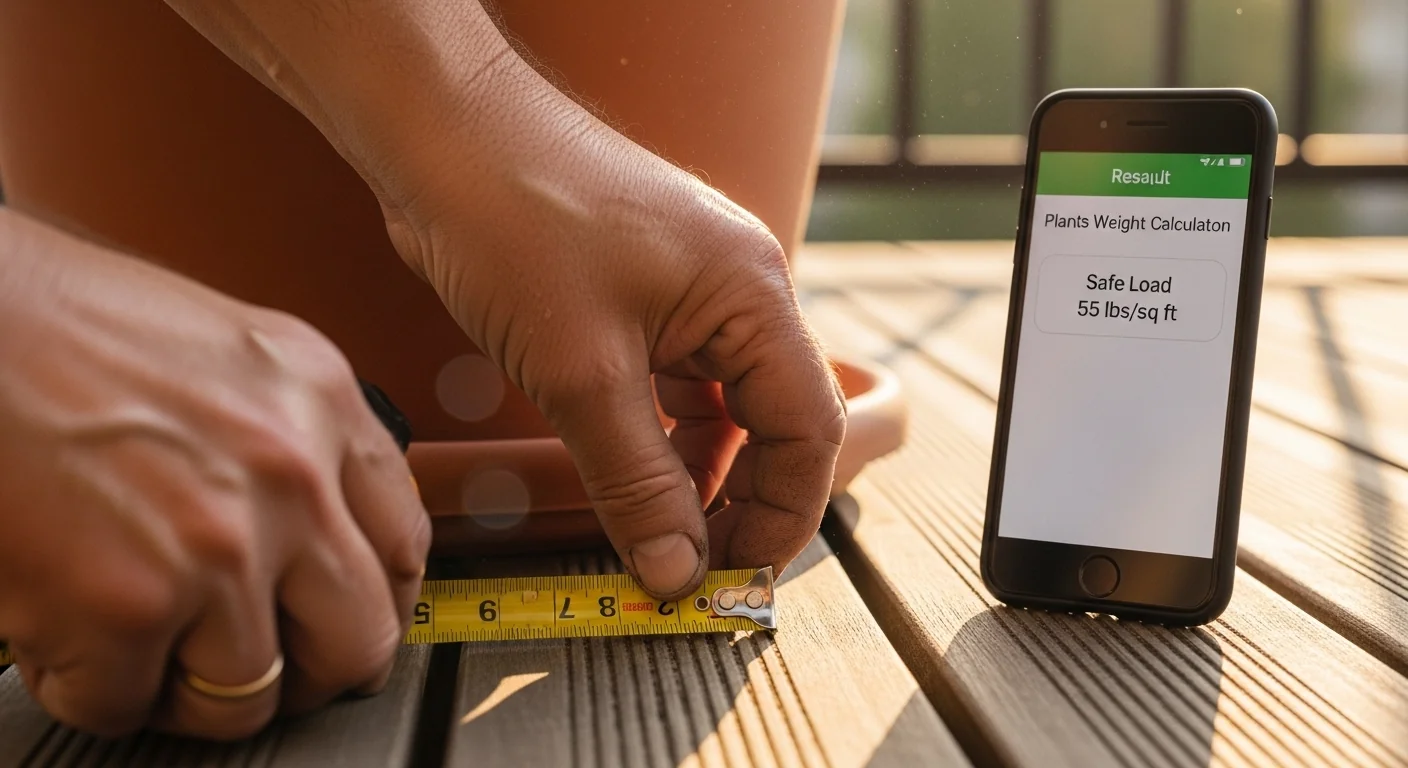
- Volume input mode: Use “Gallons” if your pot has a gallon rating on the label. Use “Dimensions” if you only have a tape measure. Dimensions must be interior measurements, not exterior.
- Pot volume: Enter the numeric gallon value only (e.g., 15, not “15 gal”). Acceptable range is 0.1 to 500 gallons.
- Pot weight (empty): Weigh the pot without soil, water, or plants. Plastic pots typically run 2 to 8 lbs; ceramic and concrete pots can reach 30 to 60 lbs. Skipping this field and entering 0 will undercount total load.
- Soil mix: Potting Soil (25 lbs/cu ft) is the standard bagged mix from a garden center. Topsoil (75 lbs/cu ft) is dense mineral soil, often sourced in bulk. Compost Blend (40 lbs/cu ft) falls between the two. Do not select Potting Soil if you are using bulk garden soil.
- Water saturation: Choose the condition you want to plan for, not just the current condition. For balcony safety checks, always run the “Fully Soaked” scenario as a worst-case.
- Pot footprint area: Measure the base of the pot in inches, convert to feet (divide each dimension by 12), then multiply. A 14-inch-square pot has a footprint of roughly 1.36 sq ft.
- Click “Calculate Weight”: The load gauge and safety warning update automatically. If any field is blank or out of range, an inline error will appear next to that field and the result will not display.
Inputs and Outputs (What Each Field Means)
| Field | Unit | What It Means | Common Mistake | Safe Entry Guidance |
|---|---|---|---|---|
| Pot Volume (gallons) | US gallons | Total interior soil capacity of the container | Using exterior pot dimensions instead of interior soil volume | Use the nursery label rating or measure interior dimensions and use Dimension mode |
| Width / Depth / Height | Inches | Interior dimensions for volume auto-calculation | Measuring to the outer wall; tapered pots require averaging top and bottom width | Measure inside rim to inside rim for width and depth; measure interior soil depth for height |
| Pot Weight (empty) | lbs | Weight of the container alone, no soil or plant | Leaving at 0 or guessing; heavy glazed ceramic pots can add 40+ lbs | Weigh on a bathroom scale before filling; check manufacturer specs for large planters |
| Soil Mix | Selection | Sets the dry bulk density and porosity used in both soil and water weight steps | Selecting Potting Soil when using bagged garden soil or bulk topsoil | Match the actual product: garden centers carry both; bulk delivery is almost always topsoil or heavy blends |
| Water Saturation | Selection (0 to 100) | Fraction of soil pore space filled with water | Using Dry for a balcony safety check; planters get soaked by rain | Run once at current condition, then again at Fully Soaked for a worst-case safety check |
| Pot Footprint Area | sq ft | Base area the planter contacts the surface; divides total weight into load per sq ft | Entering the interior planting area instead of the outer base contact area | Measure the widest point of the pot base; for round pots, use pi times radius squared |
| Total Weight (output) | lbs | Pot + dry soil + retained water; the number you need for placement decisions | Treating this as a fixed number; it will rise substantially after rain if drainage is poor | Plan for the soaked-condition weight, not the dry weight at time of placement |
| Load per sq ft (output) | lbs/sq ft | Structural load imposed on the surface per unit area | Ignoring this number and only looking at total weight; distribution matters as much as mass | Keep below 40 lbs/sq ft for confident safety; flag anything above 50 lbs/sq ft for review |
Worked Examples (Real Numbers)
Scenario 1: Small Balcony Herb Planter (Dry Placement)
- Pot volume: 5 gallons
- Empty pot weight: 4 lbs (lightweight plastic)
- Soil mix: Potting Soil (25 lbs/cu ft, porosity 0.70)
- Water saturation: Dry (0)
- Pot footprint: 0.75 sq ft (approximately 10 in x 13 in base)
Result: Volume = 5 / 7.48 = 0.668 cu ft. Dry soil = 0.668 x 25 = 16.7 lbs. Water = 0.668 x 0.70 x 0 x 62.4 = 0 lbs. Total = 4 + 17 + 0 = 21 lbs. Load = 21 / 0.75 = 28 lbs/sq ft.
At 28 lbs/sq ft this falls well inside the standard balcony limit. However, running this same scenario at Fully Soaked changes the water component to 29 lbs, pushing total weight to 50 lbs and load to 67 lbs/sq ft, above the threshold. Drainage integrity on balcony planters matters.
Scenario 2: Large Topsoil Planter, Fully Soaked
- Pot volume: 15 gallons
- Empty pot weight: 12 lbs (glazed ceramic)
- Soil mix: Topsoil (75 lbs/cu ft, porosity 0.45)
- Water saturation: Fully Soaked (100)
- Pot footprint: 2 sq ft (approximately 18 in x 16 in base)
Result: Volume = 15 / 7.48 = 2.005 cu ft. Dry soil = 2.005 x 75 = 150.4 lbs. Water = 2.005 x 0.45 x 1.0 x 62.4 = 56.3 lbs. Total = 12 + 150 + 56 = 218 lbs. Load = 218 / 2 = 109 lbs/sq ft.
At 109 lbs/sq ft this exceeds the typical residential balcony threshold by roughly double. Topsoil in large containers on elevated surfaces requires structural verification before placement, not after.
Scenario 3: 10-Gallon Compost Blend, Moist Condition
- Pot volume: 10 gallons
- Empty pot weight: 6 lbs (standard plastic)
- Soil mix: Compost Blend (40 lbs/cu ft, porosity 0.55)
- Water saturation: Moist (40)
- Pot footprint: 1.2 sq ft (approximately 14 in x 15 in base)
Result: Volume = 10 / 7.48 = 1.337 cu ft. Dry soil = 1.337 x 40 = 53.5 lbs. Water = 1.337 x 0.55 x 0.40 x 62.4 = 18.4 lbs. Total = 6 + 54 + 18 = 78 lbs. Load = 78 / 1.2 = 65 lbs/sq ft.
Even at a moderate moisture level, this arrangement exceeds the conservative 55 lbs/sq ft threshold. Switching to a potting mix instead of compost blend and spreading the footprint to 1.6 sq ft would bring the soaked-condition load to approximately 49 lbs/sq ft, which is within range.
Reference Table (Fast Lookup)
Assumed pot weights: 1 gal = 1 lb (plastic), 3 gal = 3 lbs, 5 gal = 4 lbs (plastic) or 6 lbs (ceramic for topsoil), 10 gal = 6 lbs (plastic) or 10 lbs (ceramic), 15 gal = 10 lbs, 25 gal = 14 lbs. These are common defaults; enter your actual weight for precise results.
| Pot Size | Soil Type | Pot Weight (lbs) | Total Dry (lbs) | Total Soaked (lbs) | Soaked Weight Gain (lbs) |
|---|---|---|---|---|---|
| 1 gal | Potting Soil | 1 | 4 | 10 | +6 |
| 3 gal | Potting Soil | 3 | 13 | 31 | +18 |
| 5 gal | Potting Soil | 4 | 21 | 50 | +29 |
| 5 gal | Topsoil | 6 | 56 | 75 | +19 |
| 10 gal | Potting Soil | 6 | 39 | 97 | +58 |
| 10 gal | Topsoil | 10 | 110 | 148 | +38 |
| 15 gal | Potting Soil | 10 | 60 | 148 | +88 |
| 25 gal | Potting Soil | 14 | 98 | 244 | +146 |
The “Soaked Weight Gain” column is the figure most often missing from generic planter weight guides. For a 25-gallon potting soil container, rain adds 146 lbs to the base dry weight. That gain is proportional to the soil volume and porosity, not the pot size or material.
How the Calculation Works (Formula + Assumptions)
Show the calculation steps
Step 1: Convert volume to cubic feet.
If entering gallons: Volume (cu ft) = Gallons / 7.48. One US gallon equals 0.1337 cubic feet. This conversion is exact for standard US liquid gallons.
If entering dimensions: Volume (cu ft) = (Width in x Depth in x Height in) / 1728. There are 1728 cubic inches in one cubic foot.
Step 2: Calculate dry soil weight.
Dry Soil Weight (lbs) = Volume (cu ft) x Soil Density (lbs/cu ft).
- Potting Soil: 25 lbs/cu ft
- Topsoil: 75 lbs/cu ft
- Compost Blend: 40 lbs/cu ft
Round to the nearest whole pound for display.
Step 3: Calculate water weight.
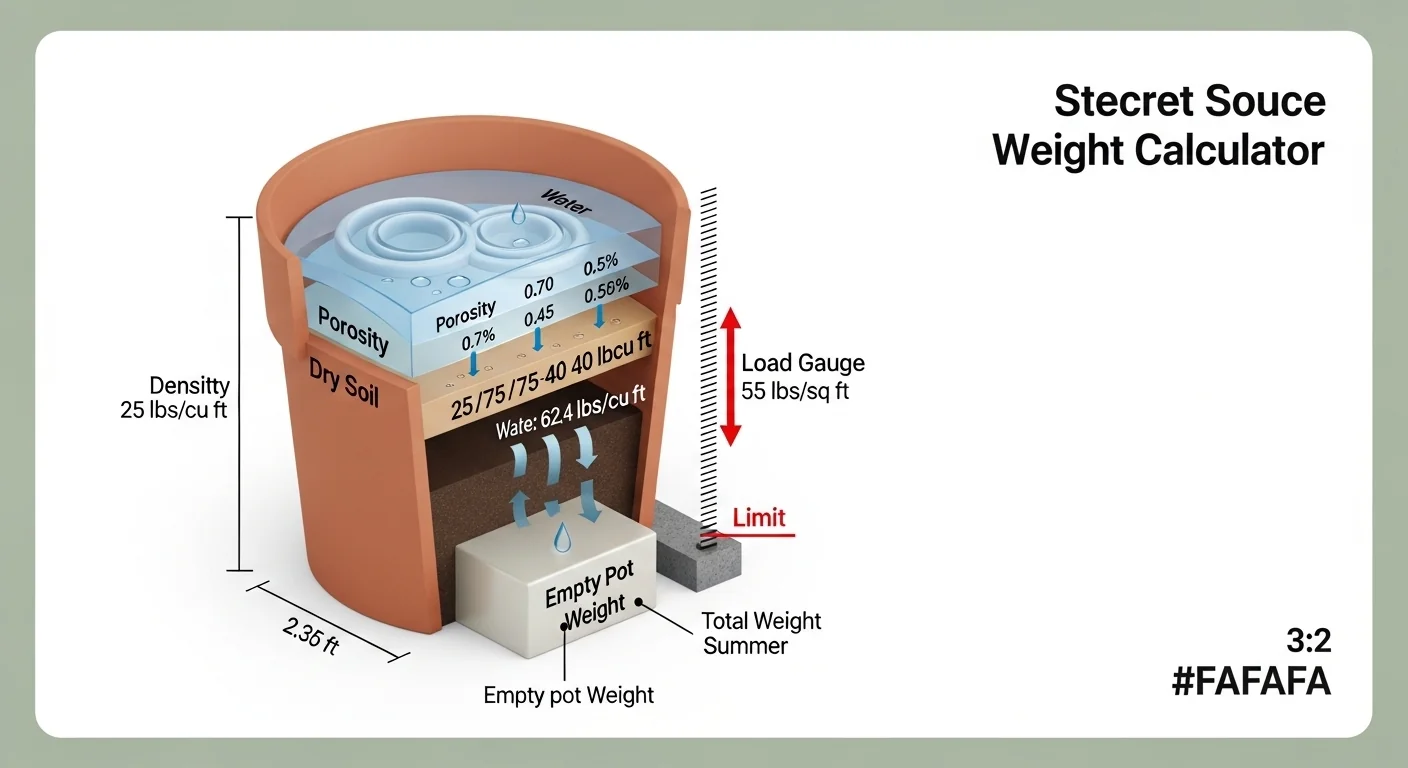
Water Weight (lbs) = Volume (cu ft) x Porosity x Saturation Fraction x 62.4 lbs/cu ft.
Porosity is the fraction of the soil volume available to hold water: Potting Soil 0.70, Topsoil 0.45, Compost 0.55. Water density is 62.4 lbs/cu ft. Saturation fractions: Dry = 0, Moist = 0.40, Wet = 0.70, Fully Soaked = 1.0.
Step 4: Calculate total weight.
Total (lbs) = Empty Pot Weight + Dry Soil Weight + Water Weight.
Step 5: Calculate load per square foot.
Load (lbs/sq ft) = Total Weight / Footprint Area (sq ft). This value is compared to the 55 lbs/sq ft threshold for the safety gauge.
Assumptions and Limits
- Soil densities are representative averages for typical commercial products. Actual density varies by brand, compaction level, and organic content. Freshly mixed potting soil from different manufacturers may vary by 15 to 25 lbs/cu ft from these values.
- Porosity values assume loosely packed, uncompacted soil. Soil that has been in a container for more than one season compacts and may hold more or less water than the model assumes.
- The 50 to 60 lbs/sq ft balcony live load range is derived from common residential structural standards (IRC Section R507). Older construction, non-standard balconies, cantilever structures, and commercial buildings may have different ratings. Only a licensed structural engineer can determine the actual rating for a specific structure.
- This calculator does not include the weight of plants. Mature plants in large containers can add 5 to 30 lbs or more depending on species, pot density, and plant size.
- The “Fully Soaked” scenario assumes no drainage: all pore space is filled with water simultaneously. Functional drainage holes will reduce actual retained water weight in most conditions. This scenario represents a blocked-drain or tray-pooling worst case.
- Tapered pots, irregular shapes, and half-barrel or trough planters may require dimension-mode entry rather than gallon labels, which are sometimes rounded to the nearest standard size by manufacturers.
- The tool uses a single footprint value. If a planter has feet, risers, or an uneven base, only the actual contact area with the surface contributes to the load distribution. Using total base area for a footed pot will understate the actual pressure at each contact point.
Standards, Safety Checks, and Warnings
Balcony load limits are not suggestions. The International Residential Code establishes live load requirements for decks and balconies, with common residential ratings landing between 40 and 60 lbs per square foot depending on the structure’s design, era, and jurisdiction. This tool uses 55 lbs/sq ft as its threshold, representing a conservative midpoint. If your load calculation approaches or exceeds that number, the planter must be repositioned, the soil type changed, the pot size reduced, or the footprint increased before placement proceeds.
When planning raised hardscape features alongside heavy planters, the retaining wall calculator provides complementary structural load context for adjacent earthwork. For surface grade and drainage planning around patio areas where planters will sit, the patio slope calculator helps ensure water does not pool beneath containers and contribute to soil saturation that worsens load conditions.
Critical Warnings
- Rain saturation is the primary unmodeled risk. Most planter weight references report only dry soil weight. That figure applies only at the moment of filling. A 15-gallon potting soil planter can gain up to 88 lbs after sustained rain with blocked drainage holes. Plan for soaked weight, not placement weight.
- Footprint matters as much as total weight. A 150-lb planter on a 3 sq ft base exerts 50 lbs/sq ft, which is borderline. The same planter on a 1.5 sq ft base exerts 100 lbs/sq ft, which is structurally dangerous. Never assume total weight alone determines safety.
- Old balconies often carry undocumented ratings. Structures built before current code cycles may have lower actual capacity than the residential norm. When in doubt about the specific structure, conservative placement and professional consultation are the correct responses.
- Ceramic and concrete pots on balconies add substantial dead load before a single cup of soil is placed. A large glazed ceramic pot can weigh 40 to 80 lbs empty. That weight counts against your load budget regardless of what is in the pot.
Minimum Standards
- Keep the soaked-condition load below 40 lbs/sq ft for unrestricted placement on standard residential balconies.
- Flag any calculation between 40 and 55 lbs/sq ft for footprint review before placement.
- Do not place planters with a soaked load above 55 lbs/sq ft on elevated surfaces without structural verification.
- Maintain clear drainage in balcony planters; trapped water in drip trays adds weight and extends saturation duration after rain events.
Competitor Trap: Generic planter weight guides typically present a single weight estimate based on soil volume and dry density. They omit water retention modeling entirely, producing numbers that can be 40 to 80 lbs lower than actual saturated weight for a 15-gallon container. A homeowner reading one of those guides, placing a 15-gallon topsoil planter on a balcony rated for 50 lbs/sq ft, and losing the planter through a structural failure, followed every recommendation given. The guide just did not ask the right question. This tool asks it by default.
Common Mistakes and Fixes
Mistake: Planning for dry weight and placing in rain-exposed locations
The dry weight of a container is the weight at the moment of installation, before any irrigation or precipitation. Balconies, rooftop gardens, and elevated patios are fully exposed to rainfall. A planter that reads as safe at installation can exceed structural limits within hours of a rain event if drainage is compromised. Fix: Always run the calculation at Fully Soaked before confirming placement, even if drainage holes are present.
Mistake: Using gallon labels from tapered or novelty pots without
verification
Manufacturers stamp gallon equivalents on pots, but these reflect nominal nursery trade sizes, not precise interior soil volumes. A pot sold as “15 gallon” may hold anywhere from 12 to 17 gallons of usable soil volume depending on shape and internal geometry. Tapered pots, half-round wall planters, and trough shapes are particularly prone to label inaccuracy. Fix: Use the Dimensions input mode, measure the interior, and let the calculator derive volume directly from geometry.
Mistake: Treating potting mix and topsoil as interchangeable in the soil
field
Bagged potting mix is formulated to be lightweight, typically around 25 lbs/cu ft dry. Bulk topsoil or bagged garden soil is mineral-dense and runs roughly 75 lbs/cu ft, three times the dry weight per unit volume. Choosing the wrong soil type in the calculator produces results that are off by a factor of three in the soil component. Understanding the density difference also matters when comparing volume-based landscape material orders with the boulder weight calculator to manage total site load budgets. Fix: Read the bag or check the order description carefully; if the material was delivered in bulk or sourced from a landscape supplier, it is almost always topsoil, not potting mix.
Mistake: Using outer pot dimensions instead of inner dimensions
The width of the outer wall of a thick ceramic, concrete, or cast stone planter can subtract 1 to 3 inches from each dimension, which compounds significantly for volume. A concrete pot with 1.5-inch walls on a pot labeled as 14 inches wide has an interior width of 11 inches, reducing volume by roughly 35%. This causes the soil and water weight to be understated and the result to look safer than it is. Fix: Measure from interior rim to interior rim for width and depth, and measure the interior soil depth for height.
Mistake: Ignoring plant weight in the footprint load calculation
The calculator covers pot, soil, and water. A large ornamental grass, shrub, or small tree adds meaningful weight beyond those three components. A mature 6-foot arborvitae in a container can weigh 20 to 40 lbs on its own. For large specimen plants on elevated structures, plant weight is not optional to include. Fix: Add an estimated plant weight to the empty pot weight field as a workaround, clearly noting it includes plant mass, until a full multi-component entry is available.
Next Steps in Your Workflow
Once the weight and load figures are confirmed, the next practical step is placement strategy. If the soaked load is within limits, position the planter with functional drainage and avoid drip tray configurations that allow water to pool and accumulate. If the result is in the caution zone, consider switching from dense soil to a lightweight potting mix. That single change can reduce the dry soil component by 60 lbs or more in a 10-gallon container, and the water retention component drops in parallel because potting soil has lower density despite higher porosity than topsoil. Combining this with a mulch layer on the surface slows evaporation and keeps the upper zone drier between watering cycles, which helps moderate the wet weight over time.
For outdoor living spaces where planters share the surface with other structural elements, load budgeting across all features matters. A balcony that has a planter, outdoor furniture, and a pergola anchor simultaneously carries cumulative load, not just point load. If you are also planning ground-level bed borders or edging structures adjacent to the planter zone, confirming post embedment depth and surface anchoring is a useful parallel step using the fence post depth calculator for any vertical structural features nearby.
FAQ
How much does a 5-gallon pot weigh with potting soil when dry?
A standard 5-gallon plastic pot weighing about 4 lbs, filled with commercial potting mix at roughly 25 lbs/cu ft dry density, yields a total dry weight of approximately 21 lbs. Volume converts as follows: 5 gallons divided by 7.48 equals 0.668 cubic feet, multiplied by 25 equals 16.7 lbs of soil, plus 4 lbs for the pot. Results vary slightly by pot material and soil brand.
How much heavier does a planter get when it is fully soaked with water?
The added water weight depends on soil volume and porosity. A 10-gallon potting soil container gains approximately 58 lbs when fully saturated compared to its dry state. Potting soil has a high porosity of roughly 0.70, meaning 70 of every 100 cubic feet of soil volume can fill with water. Multiply that fraction by the water density of 62.4 lbs/cu ft to get the maximum water weight contribution.
What is the standard balcony weight limit for plants?
Common residential balconies built to International Residential Code standards are typically rated for 40 to 60 lbs per square foot of live load. This calculator uses 55 lbs/sq ft as a conservative working threshold. Load ratings vary significantly based on the balcony’s age, design, construction method, and local code amendments. When placing heavy planters on elevated structures, a licensed structural engineer should confirm the actual rating for that specific build.
Does potting soil or topsoil weigh more in a planter?
Topsoil weighs substantially more. Dry topsoil runs around 75 lbs per cubic foot, compared to approximately 25 lbs per cubic foot for commercial potting mix. A 10-gallon container filled with topsoil carries roughly 100 lbs of dry soil versus about 33 lbs for the same volume of potting mix. For balcony applications, potting mix is nearly always the correct choice from a structural load standpoint.
Can I calculate planter weight from dimensions instead of gallon size?
Yes. This calculator includes a dimension input mode for exactly this reason. Enter interior width, depth, and height in inches. The calculator converts cubic inches to cubic feet by dividing by 1728, then applies the same soil density and water retention formulas. Interior dimensions must be used, not the exterior measurements of the pot wall.
Should I include plant weight in the planter weight calculation?
The calculator does not have a dedicated plant weight field, but plant mass is real and should not be ignored for large specimens. A mature containerized shrub or small ornamental tree can add 15 to 40 lbs. As a workaround, add your estimated plant weight to the empty pot weight field and note that the combined figure represents pot plus plant. For small herbs and annuals, the contribution is minor and can generally be treated as negligible.
Conclusion
The single most important habit this tool reinforces: always run the worst-case soaked scenario before finalizing a placement. Drainage integrity and soil type selection are the two variables with the most leverage over the final load figure. For further structural planning across your landscape project, the gravel calculator can assist with adjacent ground-level drainage and base material planning to route water away from elevated container areas. Get the load right before the planter goes up, not after.