
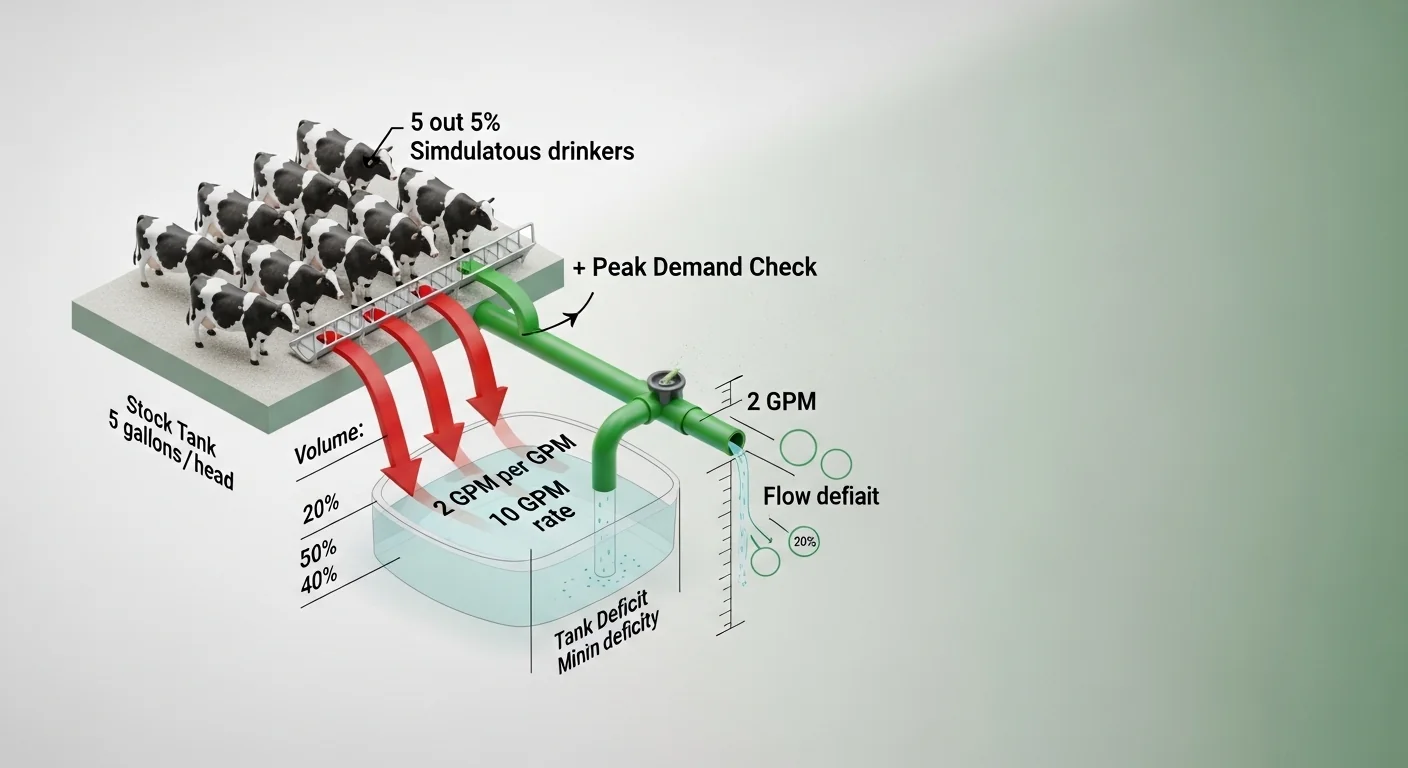
The number that ruins summer watering plans is not the daily total. It is the peak flow rate. A rancher can do the daily-gallon math perfectly, install a float valve that will technically refill the tank overnight, and still watch a 50-cow herd empty a trough in under ten minutes on a 95-degree afternoon. The reason is herd dynamics: dominant animals drink first, drink fast, and physically block subordinates. The float valve you chose to match daily volume has nothing to do with what happens in that ten-minute rush window. Sizing equipment without accounting for instantaneous peak demand is the central failure mode this tool is designed to catch. For context on how herd density compounds these pressures, see how total animal units map against available pasture using the pasture stocking rate calculator.
This calculator computes four distinct outputs: total daily water requirement for your herd (by species and temperature), the peak simultaneous drinking rate your float valve must meet, whether your tank capacity is large enough to buffer crowding events, and the full refill time for a drained tank. It does not predict individual animal behavior, account for water quality degradation, or adjust for lactation stages beyond baseline multipliers. The results reflect steady-state thermal conditions; a short cold snap before a sudden heat wave may lag actual intake by 24 to 48 hours.
After using this tool, you will know whether to upgrade your float valve, add a second tank, or confirm your current setup is adequate, with specific GPM and gallon targets in hand before you buy anything.
Use the Tool
Livestock Waterer GPM Refill & Heat Stress Sizer
| Metric | Value |
|---|
| Temp (°F) | Gal/Head/Day | Your Herd Total |
|---|
1. Daily Water per Head is determined by animal type and ambient temperature. For beef cows, the baseline is ~15 gal/day at 70°F, scaling up to ~30 gal/day at 90°F and beyond (dairy cows use higher multipliers). The formula interpolates linearly between known temperature benchmarks.
2. Total Daily Herd Requirement = Herd Size × Daily Water per Head.
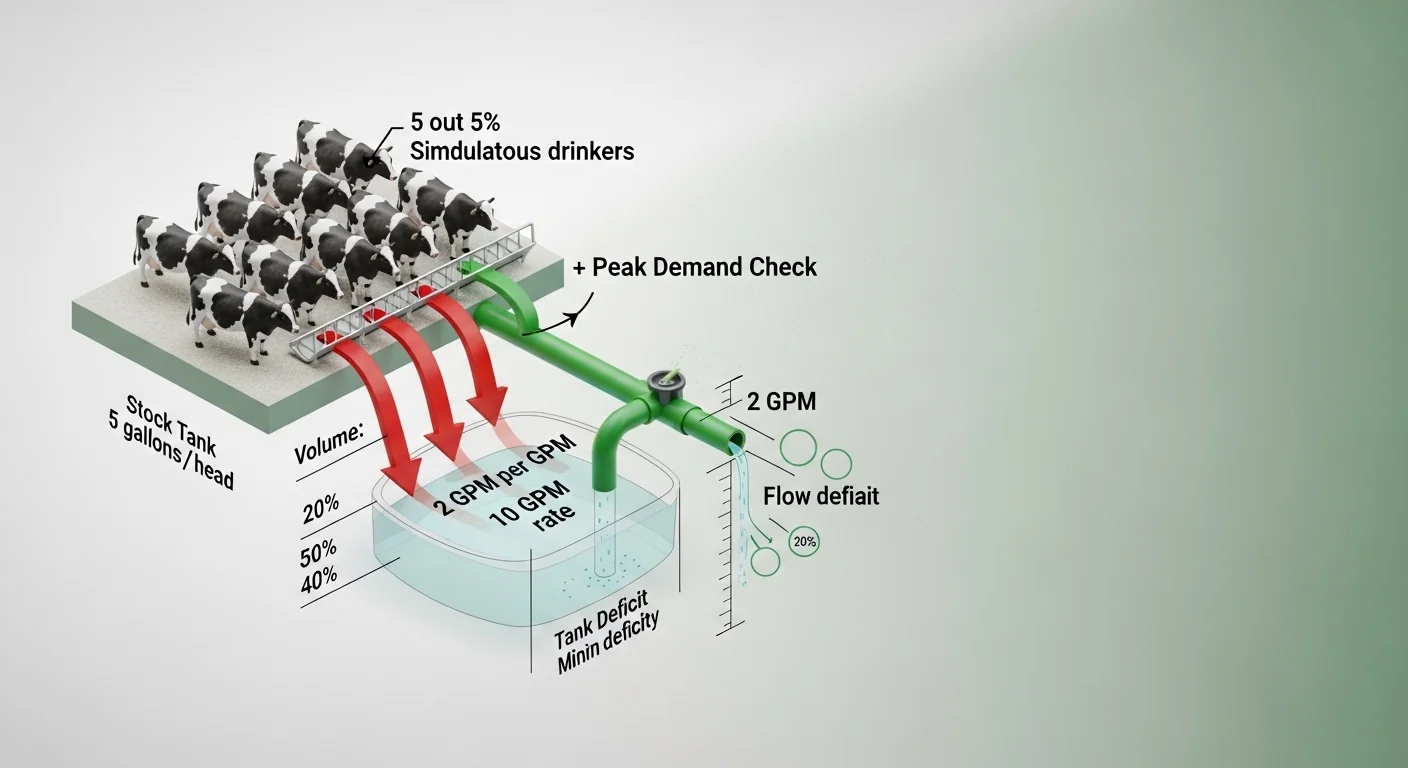
3. Peak Drinking Rate = Herd Size × 10% simultaneous drinkers × 2 GPM per cow. This estimates the worst-case flow demand when dominant animals crowd the trough.
4. Tank Runs Dry Check: If your float valve GPM is less than the Peak Drinking Rate, the trough cannot keep up during a rush — dominant animals will drain it before subordinates can drink.
5. Crowding Panic Check: If your tank capacity is less than Herd Size × 5 gallons, there is not enough standing water for multiple animals to drink at once. This triggers a crowding/panic risk — calves and subordinate animals get blocked out.
6. Refill Time = Tank Capacity ÷ Float Valve GPM. This tells you how long a fully drained tank takes to refill.
Assumptions & Limits
• Water requirements are based on USDA/extension service averages for mature, non-lactating livestock. Lactating dairy cows may need 30–50+ gallons/day.
• Temperature scaling assumes a linear increase between reference points (70°F → 90°F). Extreme heat above 100°F can push requirements even higher; consult your veterinarian for heat-emergency protocols.
• Peak drinking rate assumes 10% of the herd drinks simultaneously at 2 GPM per head. Actual behavior varies with trough access, herd hierarchy, and trough placement.
• The “Dominant Guzzler” scenario models real herd dynamics: dominant animals will physically block subordinates from a small trough, especially in heat. Multiple troughs and higher flow rates mitigate this risk.
• This calculator does not account for water quality degradation, evaporation losses, or seasonal freezing. In winter, consider thermostatically controlled de-icers.
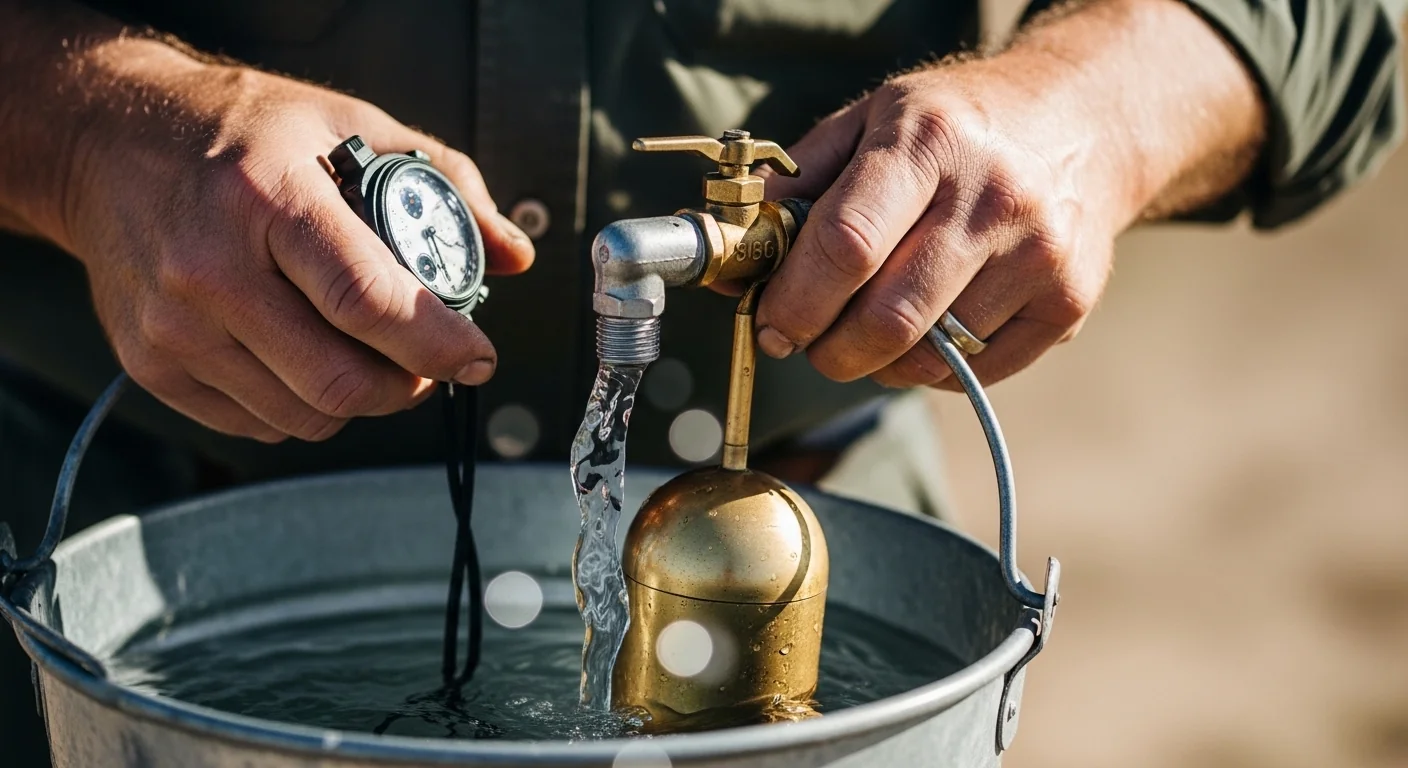
• For best accuracy, measure your actual float valve GPM with a bucket test rather than relying on pipe diameter estimates.
Recommended Equipment
• Float Valves: Heavy-duty brass float valves (e.g., Hudson or Jobe) rated for livestock use — avoid cheap plastic valves that crack in UV/heat.
• Stock Tanks: Rubbermaid 100–300 gallon structural foam tanks resist UV and impact.
• Winter De-Icers: Thermostatically controlled trough de-icers prevent ice formation without overheating.
• Plumbing: PEX plumbing fittings handle freeze/thaw cycles better than rigid PVC and are easier to install in field runs.
Before entering values, have four things ready: your herd count (number of head, not AUs), your float valve flow rate in gallons per minute (run a bucket test if you do not have the spec sheet), your trough or stock tank capacity in gallons from the manufacturer label, and your expected peak summer high temperature for the field location. If you run a rotational system with multiple paddocks, check each paddock’s water access independently since herd size per water point is what matters here, not total operation headcount. The rotational grazing calculator can help you determine how many animals will be on each paddock at a time.
Quick Start (60 Seconds)
- Animal Type: Select the species closest to your herd. “Calf” applies to animals under roughly 600 lb. Do not use beef cow values for stocker calves; the daily requirement is roughly half.
- Herd Size: Enter the number of animals that share a single water point, not your total operation headcount. A 120-cow operation split between two pastures should be entered as 60, not 120.
- Peak Summer Temperature (°F): Use the hottest ambient air temperature expected at the field, not the weather station at your barn. South-facing slopes run several degrees hotter. Enter a realistic worst-case, not an average.
- Float Valve Flow Rate (GPM): If you do not have a spec sheet, fill a 5-gallon bucket from the supply line with the float valve removed and time the fill in seconds. Divide 5 by the number of seconds, then multiply by 60. This gives actual site GPM.
- Trough / Tank Capacity (Gallons): Use the labeled capacity, not an estimate. A 100-gallon Rubbermaid tank that has a mineral block taking up space effectively holds less. Enter the usable volume.
- Common unit error: Do not confuse GPH (gallons per hour) with GPM. A valve listed at 120 GPH is only 2 GPM, which is dangerously low for herds larger than a handful of animals.
- Run the calculation before the hot season, not during it. Equipment procurement takes time. Use last summer’s peak temperatures and your actual head count as inputs.
Inputs and Outputs (What Each Field Means)
| Field | Unit | What It Means | Common Mistake | Safe Entry Guidance |
|---|---|---|---|---|
| Animal Type | Category | Species determines the baseline daily water requirement and the per-animal drinking rate used in peak flow calculations | Using “beef cow” for lactating dairy cows, which need significantly more water | Select “Dairy Cow” for any milking animal regardless of breed |
| Herd Size | Head | Number of animals sharing a single water point; determines total daily volume and the number of simultaneous drinkers | Entering total farm headcount instead of animals per water point | Count animals per trough location, not per operation |
| Peak Summer Temperature | Degrees Fahrenheit | Drives water intake scaling; the formula increases per-head requirements substantially above 70 degrees F | Using the regional average high instead of the worst-case field temperature | Add 3 to 5 degrees to regional averages for exposed south-facing fields |
| Float Valve Flow Rate | GPM | The actual supply rate of your pipe-and-valve system; must meet peak simultaneous drinking demand, not just daily volume | Using pipe diameter ratings or label GPM instead of measuring actual site flow | Conduct a timed bucket test at the field supply point for accuracy |
| Trough / Tank Capacity | Gallons | Standing water volume available; must exceed 5 gallons per head to prevent crowding events at the tank | Using nominal tank size when the tank is never filled past 70 to 80 capacity in practice | Measure actual operating level, not the stamped maximum |
| Total Daily Requirement (Output) | Gallons per day | Herd size multiplied by per-head daily intake at the entered temperature; the number you need your supply system to deliver over 24 hours | Assuming this alone determines whether the system is adequate | Cross-check against peak flow output, not just this total |
| Peak Drinking Rate (Output) | GPM | Flow demand during a simultaneous-drinking event: 10% of herd drinking at once at the species drinking rate | Ignoring this number because the daily total looks fine | Your float valve GPM must meet or exceed this number, full stop |
| Tank Refill Time (Output) | Minutes | How long a fully drained tank takes to refill at the entered float valve GPM; long refill times compound heat stress risk if the tank is emptied during a rush | Assuming the valve will catch up quickly without calculating the actual refill window | Refill times above 60 minutes represent a significant vulnerability in high-temperature conditions |
Worked Examples (Real Numbers)
Example 1: The Classic Undersized Setup (50 Beef Cows, 95 degrees F,
100-Gallon Tank, 2 GPM Valve)
- Animal Type: Beef Cow
- Herd Size: 50 head
- Peak Temperature: 95 degrees F
- Float Valve Flow: 2 GPM
- Tank Capacity: 100 gallons
Result: Daily requirement: 1,500 gallons. Simultaneous drinkers: 5. Peak demand: 10 GPM. Your valve delivers 2 GPM. Flow deficit: 8 GPM. Tank minimum: 250 gallons. Your tank: 100 gallons. Status: CRITICAL on both flow and capacity.
The daily math tells you 2 GPM times 1,440 minutes equals 2,880 gallons, so overnight refill looks feasible. But the 5 dominant cows drain the 100-gallon tank in 10 minutes at 10 GPM total consumption, and the 2 GPM valve takes 50 minutes to refill it. That is a 40-minute gap in lethal heat, repeated every time the dominant animals drink.
Example 2: Adequate Setup (25 Horses, 85 degrees F, 200-Gallon Tank, 8
GPM Valve)
- Animal Type: Horse
- Herd Size: 25 head
- Peak Temperature: 85 degrees F
- Float Valve Flow: 8 GPM
- Tank Capacity: 200 gallons
Result: Daily requirement: approximately 438 gallons. Simultaneous drinkers: 3. Peak demand: 4.5 GPM. Valve flow surplus: 3.5 GPM. Tank minimum: 125 gallons. Your tank: 200 gallons. Status: SAFE.
The valve outpaces peak demand and the tank buffer is 60 gallons above minimum. Even if the tank were drained completely, it refills in 25 minutes, short enough that heat stress from a single drinking event is unlikely to compound.
Example 3: Large Herd With a Marginal Valve (200 Beef Cows, 90
degrees F, 800-Gallon Tank, 15 GPM Valve)
- Animal Type: Beef Cow
- Herd Size: 200 head
- Peak Temperature: 90 degrees F
- Float Valve Flow: 15 GPM
- Tank Capacity: 800 gallons
Result: Daily requirement: 6,000 gallons. Simultaneous drinkers: 20. Peak demand: 40 GPM. Flow deficit: 25 GPM. Tank minimum: 1,000 gallons. Your tank: 800 gallons. Status: CRITICAL on flow; CROWDING PANIC on capacity.
A 15 GPM valve sounds substantial until you scale it to a 200-head herd. The peak drinking event pulls 40 GPM, and the 800-gallon tank is 200 gallons short of the minimum buffer. Operators of large herds frequently underestimate how quickly peak demand scales with head count, and how much valve GPM is required to compensate.
Reference Table (Fast Lookup)
Values below are for beef cows. All GPM figures reflect the calculated peak demand for each herd size at each temperature (10% simultaneous drinkers at 2 GPM per head). Use this table to confirm whether your valve rating clears the threshold before installing equipment.
| Temp (°F) | Gal/Head/Day (Beef Cow) | 25-Head Total (gal) | 50-Head Total (gal) | 100-Head Total (gal) | Peak GPM Needed (50 Head) | Minimum Tank (50 Head, gal) |
|---|---|---|---|---|---|---|
| 60 | 15.0 | 375 | 750 | 1,500 | 10.0 | 250 |
| 70 | 15.0 | 375 | 750 | 1,500 | 10.0 | 250 |
| 75 | 18.8 | 469 | 938 | 1,875 | 10.0 | 250 |
| 80 | 22.5 | 563 | 1,125 | 2,250 | 10.0 | 250 |
| 85 | 26.3 | 656 | 1,313 | 2,625 | 10.0 | 250 |
| 90 | 30.0 | 750 | 1,500 | 3,000 | 10.0 | 250 |
| 95 | 30.0 | 750 | 1,500 | 3,000 | 10.0 | 250 |
| 100+ | 30.0 | 750 | 1,500 | 3,000 | 10.0 | 250 |
Note: The formula’s temperature ceiling for beef cows is 90 degrees F. Requirements at higher temperatures are conservatively held at the 90-degree figure. In extreme heat above 100 degrees F, actual intake can exceed these values; consult extension service recommendations for your region.
How the Calculation Works (Formula + Assumptions)
Show the calculation steps
Step 1: Daily Water per Head
The calculator uses two anchor points for each species: a baseline intake at 70 degrees F and a peak intake at 90 degrees F. For beef cows, these are 15 gallons and 30 gallons respectively. Between 70 and 90 degrees F, intake scales linearly. Below 70 degrees F, the lower baseline is used. At or above 90 degrees F, the upper baseline is used.
Formula: DailyPerHead = base70 + (base90 - base70) * ((Temp - 70) / 20) for temperatures between 70 and 90 degrees F.
Step 2: Total Daily Herd Requirement
Multiply daily per-head intake by herd size. This gives total gallons your supply system must deliver in a 24-hour period.
Formula: TotalDaily = HerdSize * DailyPerHead
Step 3: Peak Drinking Rate
The tool assumes 10% of the herd drinks simultaneously at the species per-animal drinking rate. For beef cows, that rate is 2 GPM per animal. For dairy cows, 2.5 GPM. For horses, 1.5 GPM. For calves and swine, 1 GPM. For sheep and goats, 0.5 GPM.
Formula: PeakGPM = ceil(HerdSize * 0.10) * speciesDrinkRate
Step 4: Tank Runs Dry Check
If your float valve GPM is less than PeakGPM, the trough cannot keep pace with a simultaneous-drinking event. The trough will drain faster than it refills. This triggers the TANK RUNS DRY warning.
Step 5: Crowding Panic Check
Minimum tank capacity is set at 5 gallons per head. This represents the standing water needed for multiple animals to drink at overlapping times without the trough going completely empty during normal non-rush conditions. If your tank capacity is less than HerdSize times 5, the CROWDING PANIC threshold is triggered.
Step 6: Refill Time
Formula: RefillMinutes = TankCapacity / FloatGPM. Refill times above 60 minutes are flagged as a slow-refill vulnerability.
Rounding: Daily per-head values are shown to one decimal place. Total daily requirements and minimum capacity are rounded to the nearest whole gallon. Flow rates are shown to one decimal place. Refill times are rounded to the nearest minute.
Assumptions and Limits
- Daily water requirements are averages for healthy, non-lactating adult animals at rest in open conditions. Lactating dairy cows may need 30 to 50 gallons or more per day; the tool’s dairy cow values are conservative baselines.
- The 10% simultaneous drinkers assumption is a commonly cited planning figure from livestock extension guidance. Actual crowding behavior depends on tank placement, fence layout, shade availability, and herd hierarchy. Denser or more stressed herds may see higher simultaneous access rates.
- The per-animal drinking rate (2 GPM for beef cows) is a conservative figure for a thirsty, heat-stressed animal. Resting, well-watered animals drink more slowly, but equipment must be sized for worst-case conditions.
- The temperature ceiling for the beef cow formula is 90 degrees F. The tool holds requirements flat above this point. This is a conservative minimum; some research suggests requirements continue to climb above 90 degrees F in extreme conditions.
- Evaporation, mineral contamination, and algae growth can reduce effective tank volume over time. The tool calculates only physical capacity, not water quality.
- Winter use is not modeled. At temperatures below 32 degrees F, ice formation reduces usable tank volume. Thermostatically controlled de-icers are required; this calculator does not account for that loss.
- The tool assumes a single continuous water source. Multi-source or gravity-fed systems with varying flow rates require separate calculations per source point.
Standards, Safety Checks, and Secret Sauce Warnings
Critical Warnings
- Flow rate, not daily volume, determines whether subordinate animals survive a heat emergency. A valve sized to refill the tank overnight but incapable of matching peak instantaneous demand will drain the trough during the hottest part of the day and leave calves, heifers, and lower-ranking animals waiting for up to an hour in dangerous heat. Daily volume math will show your system as “adequate” right up until animals die.
- The dominant guzzler drought is a physical event, not a theory. At 95 degrees F, a thirsty beef cow consumes approximately 2 gallons per minute. Five dominant animals surrounding a 100-gallon tank consume it in roughly 10 minutes. Because they also physically occupy the space around the trough, subordinate animals cannot access water during or immediately after the drain event. If refill takes 50 minutes, those animals go without water for close to an hour in lethal heat. A second tank or a significantly higher-capacity valve eliminates this scenario.
- Temperature spikes between 88 and 92 degrees F often trigger the largest single-day increases in water consumption because this range coincides with the onset of active heat dissipation behavior in cattle. The first 90-degree day of the season typically produces a surge that reveals infrastructure problems that were invisible during the mild weeks before it.
Minimum Standards
- Float valve flow rate must meet or exceed the calculated peak simultaneous drinking demand (10% of herd at species drinking rate). Meeting daily volume requirements without meeting this threshold is not a safe configuration.
- Tank standing capacity should be at least 5 gallons per head sharing a single water point. This is a planning minimum, not an ideal. For herds with known dominant-submissive hierarchies or long distances from shade to water, a larger buffer reduces risk.
- Refill time for a drained tank should ideally be under 30 minutes in high-temperature conditions. Over 60 minutes is a documented vulnerability, not an acceptable operating condition.
Competitor Trap: The vast majority of cattle watering guides online present daily gallons-per-head tables and suggest sizing your tank to hold one or two days’ supply as a buffer. This advice is technically accurate for daily volume planning but completely ignores instantaneous peak demand. A 500-gallon tank sounds like a two-day reserve for 25 cows in summer heat, but if it drains in eight minutes during a rush and takes 83 minutes to refill with a 6 GPM valve, the buffer is meaningless. The guides that teach you to “size your tank to daily needs” are solving the wrong problem.
Heat stress affects more than water consumption. Proper barn and shelter airflow plays a parallel role in keeping summer conditions manageable; the barn ventilation calculator is a logical companion tool for summer infrastructure planning. And if your water access strategy involves paddock rotations, confirming that each paddock’s electric fence energizer handles the full perimeter load matters; check the electric fence joule calculator as part of the same planning pass.
Common Mistakes and Fixes
Mistake: Sizing the Float Valve to Daily Volume Instead of Peak Demand
The most widespread planning error is confirming that a valve can deliver enough water over a 24-hour period and stopping there. A 2 GPM valve can deliver 2,880 gallons in a day, which on paper covers 96 beef cows at 90 degrees F. But the same valve cannot match a peak demand of 19.2 GPM. The tank empties in minutes at peak; the valve crawls to refill it over hours. Fix: calculate peak GPM first, and size the valve to that number, then confirm daily volume is also covered.
Mistake: Using Pipe Diameter to Estimate Flow Rate
Pipe diameter tables give theoretical maximums at assumed pressure; actual site flow depends on supply pressure, pipe length, fittings, and elevation change. A 3/4-inch line rated at 10 GPM in a table might deliver 3 GPM after running 400 feet to a remote pasture tank. Fix: always conduct a timed bucket test at the actual water point before sizing equipment.
Mistake: Ignoring Tank Algae as a Capacity Problem
A 150-gallon tank with 3 inches of algae mat on the bottom and sides is effectively smaller than labeled, and the algae-fouled water is frequently avoided by animals that are not severely dehydrated, compressing actual usable volume further. Routine cleaning and treatment prevents a slow erosion of effective capacity. The stock tank algae calculator can help estimate treatment needs for maintaining clean standing water.
Mistake: Running One Water Point for a Rotationally Grazed Herd
In rotational systems, the herd concentration per paddock is higher than the operation average, sometimes dramatically so. Entering total farm headcount rather than animals per water point produces a severe underestimate of both daily volume and peak demand per trough. Fix: calculate independently for each paddock based on the animals present during that rotation period, not the total herd number.
Mistake: Skipping Winter Planning Because This Is a Summer Calculator
Watering infrastructure is often evaluated in July and forgotten until the next July. But winter cattle water intake, while lower in volume, is harder to deliver because supply lines freeze, de-icers fail, and cattle refuse to drink water that is painfully cold. Sizing up tank capacity and valve capacity now, while considering year-round demands, avoids a second planning cycle in November. The winter cattle feed calculator covers the nutritional side of cold-season planning and pairs well with water infrastructure review.
Next Steps in Your Workflow
Once you have your GPM requirement and minimum tank capacity from this tool, the next step is a field verification, not a purchase. Measure your actual float valve flow rate with a bucket test, confirm your tank’s labeled capacity matches actual fill practice, and map how many animals per water point your current setup serves. If the calculator returns a critical result, prioritize fixing the flow rate first: upgrading the valve or adding a second supply line addresses the acute risk. Tank size is important, but a large tank with an undersized valve still drains and does not recover in time during a heat event. From there, reassess your total operational feed and water costs as a system. The hay cost calculator and feed cost calculator help model the full per-head summer cost once water infrastructure is confirmed.
If this review surfaces infrastructure gaps, build your equipment list before the hot season, not during it. Procurement timelines for quality brass float valves and large stock tanks can run two to four weeks through farm supply channels. Running this calculation in April with last year’s peak temperatures and current head count gives you the lead time to order, install, and test before the first 90-degree week arrives.
FAQ
How many gallons of water does a beef cow drink per day in summer?
A mature beef cow requires approximately 15 gallons per day at 70 degrees F. At 90 degrees F, that figure roughly doubles to 30 gallons per day. The increase is driven by increased respiration and heat dissipation. These are baseline figures for non-lactating cows; lactating beef cows need more.
What GPM does a float valve need to supply 50 beef cows?
For 50 beef cows, the calculated peak simultaneous drinking demand is 10 GPM (5 simultaneous drinkers at 2 GPM each). Your float valve flow rate must meet or exceed 10 GPM. A valve delivering less will allow the trough to drain faster than it refills during peak drinking events, regardless of daily volume adequacy.
How big should a stock tank be for 50 cows?
The minimum recommended capacity is 5 gallons per head, placing the minimum at 250 gallons for 50 animals. This is a planning floor. A larger tank provides more buffer against peak-demand drain events, slower refill rates, and the physical space constraints that drive crowding behavior around small troughs.
What causes cattle to empty a water tank so fast?
Heat-stressed cattle drink rapidly and en masse. Dominant animals access the tank first and may drink 2 gallons per minute each. In a herd of 50, five animals consuming simultaneously creates a 10 GPM draw. A 100-gallon tank empties in approximately 10 minutes under these conditions. This is normal herd behavior, not a management failure, and it is the primary reason peak demand sizing matters more than daily volume planning.
Does water temperature affect how much cattle drink?
Cattle show a preference for cool water, particularly in high heat. Water temperature above 80 degrees F in the tank can reduce voluntary intake. The calculator does not adjust for tank water temperature, which is an additional reason to use shaded tank locations and consider insulated tanks in regions with very high solar radiation.
How do you measure actual GPM from a field water line?
Remove or bypass the float valve so the line flows freely. Time how many seconds it takes to fill a 5-gallon bucket. Divide 5 by the fill time in seconds, then multiply by 60 to convert to gallons per minute. For example, a bucket filling in 45 seconds gives 5 divided by 45 times 60, which equals 6.7 GPM. Use this field-measured figure in the calculator rather than pipe-diameter table estimates.
Conclusion
The single most preventable mistake in summer livestock watering is sizing a float valve to daily volume and assuming the rest takes care of itself. Run both the flow check and the capacity check before each hot season, measure actual GPM at the field supply point rather than relying on pipe tables, and treat the 5-gallons-per-head tank minimum as a floor, not a target. For operations managing multiple species or complex paddock systems, the gestation calculator for cattle is a useful addition to the seasonal planning workflow, particularly when calving timing intersects with peak summer heat demand.