
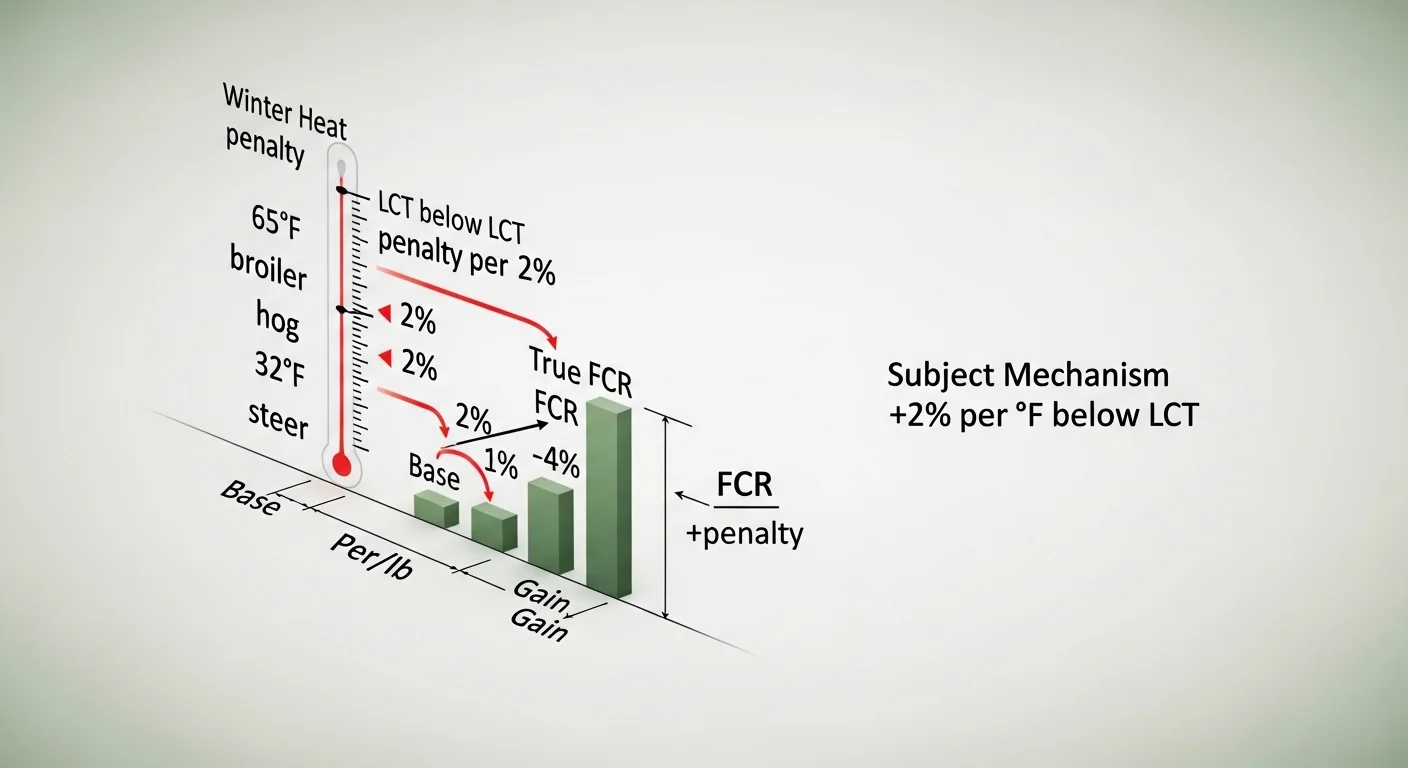
Feed conversion ratio is straightforward math until the temperature drops. At that point, the same animal eating the same ration produces less gain, and almost no standard FCR calculator accounts for it. The thermodynamic reality is that every species has a Lower Critical Temperature (LCT): the air temperature below which the animal must divert metabolic energy away from tissue growth and toward generating body heat. When ambient conditions fall below that threshold, your feed bill does not stop, but your pounds of gain slow down in direct proportion.
| Metric | Value |
|---|
How This Calculator Works
Step 1 — Base FCR: Divide total feed consumed by total weight gained. Base FCR = Feed Consumed (lbs) ÷ Weight Gained (lbs).
Step 2 — Lower Critical Temperature (LCT): Each species has a temperature below which it must burn extra calories to stay warm. Broiler Chickens: 65 °F. Hogs: 60 °F. Steers (dry winter coat): 32 °F.
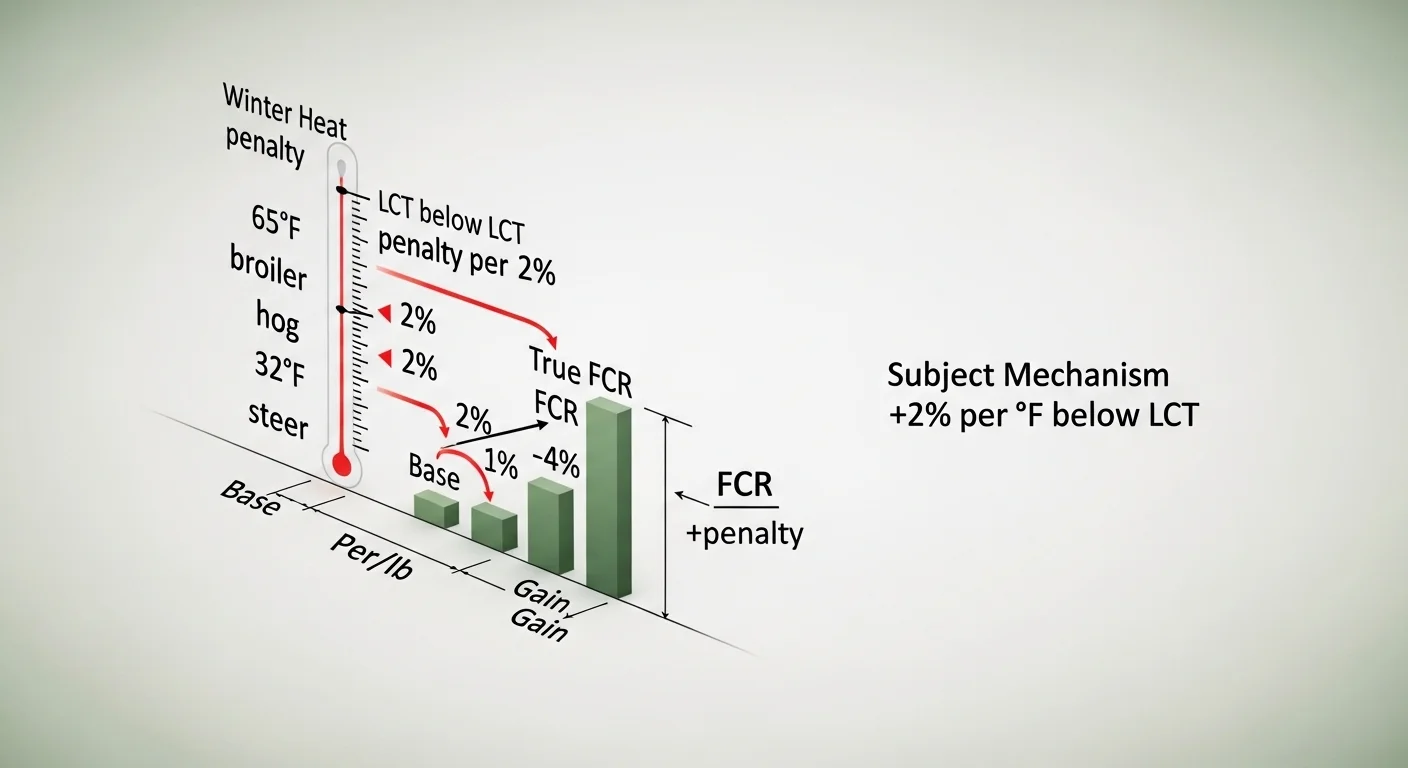
Step 3 — Cold Penalty: If the ambient temperature is below the LCT, the animal increases metabolic rate. FCR worsens by 2% for every degree below the LCT. True FCR = Base FCR × (1 + 0.02 × Degrees Below LCT).
Step 4 — Cost per Lb of Gain: Multiply the True FCR by your feed cost per pound. Cost/Lb Gain = True FCR × Feed Cost/Lb.
Assumptions: LCT values assume typical body condition and dry coat/feathers. Wet animals, wind chill, or thin body condition will raise the effective LCT significantly. The 2% per degree rule is a widely used livestock management approximation.
Assumptions & Limits
LCT values are approximations for animals in average body condition with dry coat or plumage. Actual LCT varies with breed, age, body fat, hair/feather coverage, and wind exposure.
The 2% FCR penalty per degree is a rule-of-thumb used in livestock nutrition guides. In extreme cold (>40 °F below LCT), actual metabolic increase may be non-linear.
This calculator does not account for wind chill, humidity, or wet conditions, all of which raise the effective LCT and increase heat loss dramatically. A steer with a wet coat may have an LCT as high as 59 °F instead of 32 °F.
Feed costs entered should reflect actual delivered cost, including waste and spoilage.
Valid input ranges: Temperature –60 °F to 120 °F; Feed Consumed 0.1–100,000 lbs; Weight Gained 0.01–50,000 lbs; Feed Cost $0.001–$10/lb.
Reference: Typical FCR by Species
| Animal | Good FCR | Average FCR | Poor FCR | LCT (°F) |
|---|---|---|---|---|
| Broiler Chicken | 1.6 – 1.8 | 1.9 – 2.2 | > 2.3 | 65 |
| Hog (Finishing) | 2.5 – 3.0 | 3.1 – 3.5 | > 3.6 | 60 |
| Steer (Beef) | 5.5 – 6.5 | 6.6 – 8.0 | > 8.0 | 32 |
This tool calculates your base FCR from raw feed-consumed and weight-gained inputs, then applies a species-specific cold-weather penalty based on degrees below the LCT. It outputs a true FCR adjusted for thermal environment, a cost-per-pound-of-gain figure broken into base cost and cold penalty, and a color-coded warning when cold stress is significant. It does not predict animal health outcomes, forecast market weights, or account for wind chill, humidity, or wet-coat conditions, all of which worsen the penalty substantially.
After using this calculator, you can determine whether your current shelter setup is costing you more in cold-penalty feed than an infrastructure improvement would cost to build.
Use the Tool
Before entering values, have your feed records and scale weights ready. You need total pounds of feed delivered to the group (not per head), total pounds of live weight gained over the same period, and your delivered feed cost per pound including freight. For the temperature input, use the average ambient temperature during the feeding period, or a representative single-temperature snapshot for a current scenario.
If you are working from a single weigh-in and a feed ticket, those two documents contain everything this calculator needs. For a precise delivered feed cost figure, the Feed Cost Calculator can help you back-calculate cost per pound from bulk purchase data.
Quick Start (60 Seconds)

- Animal Type: Select the species from the dropdown. LCT values differ substantially across species; a broiler chick and a beef steer are not interchangeable here.
- Ambient Temperature (°F): Enter the air temperature at animal level, not the outdoor high for the day. Barn temperatures, especially at night, are the operative number.
- Total Feed Consumed (lbs): Use the total pounds consumed by the group over the measurement period, not an estimated daily amount. Pull this from your feed delivery tickets or bin measurements.
- Total Weight Gained (lbs): Use the group's total live weight gain (ending weight minus starting weight for the group). Do not use individual head estimates.
- Feed Cost per Lb ($): Enter the per-pound cost of the ration as delivered. If you buy by the ton, divide the ton price by 2,000. Include delivery charges in the cost if they are significant.
- Common input mistake: Using daily averages rather than period totals. FCR requires both numerator (feed) and denominator (gain) to cover the exact same time window. Mismatched periods inflate or deflate your ratio artificially.
- After calculating: Run the tool a second time with your target temperature to see what the summer or fall FCR would look like without the cold penalty. The difference reveals the cost of inadequate shelter.
Inputs and Outputs (What Each Field Means)
| Field | Unit | What It Means | Common Mistake | Safe Entry Guidance |
|---|---|---|---|---|
| Animal Type | Selection | Determines the Lower Critical Temperature used in the cold-penalty calculation | Selecting a generic type that does not match body condition (e.g., using Steer for a thin yearling with a sparse coat) | Select the species and production class that best matches your animals |
| Ambient Temperature | °F | The air temperature at the location where the animals are housed or pastured | Using the outdoor daytime high rather than the nighttime barn temperature, which is usually lower | Use the average temperature during the feeding period; nighttime lows matter |
| Total Feed Consumed | lbs | Total pounds of feed delivered and consumed by the group during the measurement period | Including feed that was wasted, spoiled, or not consumed | Use feed actually consumed, not feed purchased; account for refusals and waste |
| Total Weight Gained | lbs | The group's combined live weight increase from start to end of the same period | Using estimated weights instead of scale weights, especially for cattle where visual estimation error can be large | Weigh the group at the start and end of the period on the same scale under consistent conditions |
| Feed Cost per Lb | $/lb | The delivered price of the ration per pound, inclusive of freight and handling | Using the mill price without adding freight, which can add several cents per pound for remote operations | Divide total invoice cost (including delivery) by total pounds purchased |
| True FCR (output) | lbs feed / lb gain | The thermally adjusted feed conversion ratio, accounting for cold-weather metabolic demand | Comparing this number to industry benchmarks that were recorded under thermoneutral conditions | Use for cost modeling and shelter ROI analysis; compare only to other cold-adjusted FCR values |
| Total Cost per Lb of Gain (output) | $/lb gain | The full feed cost to produce one pound of live weight gain under current conditions | Treating this as the total cost of gain; it does not include labor, vet, interest, or depreciation | Use as the feed-only component of your cost-of-gain analysis |
Worked Examples (Real Numbers)
Scenario 1: Broiler Flock in a Lightly Heated House at 60°F
- Animal Type: Broiler Chicken (LCT: 65°F)
- Ambient Temperature: 60°F
- Total Feed Consumed: 420 lbs
- Total Weight Gained: 220 lbs
- Feed Cost per Lb: $0.22
Result: Base FCR = 420 / 220 = 1.91. Temperature is 5°F below the LCT, producing a 10% cold penalty. True FCR = 1.91 x 1.10 = 2.10. Total cost per lb of gain = 2.10 x $0.22 = $0.462.
A 60°F barn feels warm to the farmer but sits below the broiler's thermoneutral threshold. The flock is diverting energy to body heat rather than breast muscle, adding roughly $0.042 per pound of gain over the baseline cost. Over a 10,000-bird flush that is a measurable margin impact.
Scenario 2: Finishing Hogs in an Uninsulated Barn at 45°F
- Animal Type: Hog, Finishing (LCT: 60°F)
- Ambient Temperature: 45°F
- Total Feed Consumed: 800 lbs
- Total Weight Gained: 240 lbs
- Feed Cost per Lb: $0.19
Result: Base FCR = 800 / 240 = 3.33. Temperature is 15°F below the LCT, generating a 30% cold penalty. True FCR = 3.33 x 1.30 = 4.33. Total cost per lb of gain = 4.33 x $0.19 = $0.823.
An uninsulated finishing barn commonly reaches 45°F or below overnight in northern winters. This single scenario shows a 30% increase in feed required per pound of gain, adding $0.19 per pound of pork above baseline. For a group of 50 hogs each gaining 200 lbs, that penalty approaches $1,900 in extra feed cost per finishing cycle.
Scenario 3: Beef Steers on Pasture at 10°F
- Animal Type: Steer, Beef (LCT: 32°F)
- Ambient Temperature: 10°F
- Total Feed Consumed: 3,500 lbs
- Total Weight Gained: 480 lbs
- Feed Cost per Lb: $0.16
Result: Base FCR = 3,500 / 480 = 7.29. Temperature is 22°F below the LCT, producing a 44% cold penalty. True FCR = 7.29 x 1.44 = 10.5. Total cost per lb of gain = 10.5 x $0.16 = $1.68.
At 10°F with a dry winter coat, nearly half again as much feed is required to produce the same pound of gain as at thermoneutral conditions. This is the scenario where "cheap winter feed" becomes the most expensive feed on the farm. The steer is using the ration as a furnace, not as a protein source.
Reference Table (Fast Lookup)
The table below shows how the cold penalty compounds across species and temperature ranges, using a representative base FCR for each species. The "Feed Multiplier" column is the derived value: how many times more feed is required per pound of gain compared to thermoneutral conditions.
| Animal | Ambient Temp (°F) | LCT (°F) | Degrees Below LCT | Cold Penalty | Base FCR (example) | True FCR (adjusted) | Feed Multiplier |
|---|---|---|---|---|---|---|---|
| Broiler Chicken | 65 | 65 | 0 | 0% | 1.90 | 1.90 | 1.00x |
| Broiler Chicken | 60 | 65 | 5 | 10% | 1.90 | 2.09 | 1.10x |
| Broiler Chicken | 55 | 65 | 10 | 20% | 1.90 | 2.28 | 1.20x |
| Hog (Finishing) | 60 | 60 | 0 | 0% | 3.00 | 3.00 | 1.00x |
| Hog (Finishing) | 45 | 60 | 15 | 30% | 3.00 | 3.90 | 1.30x |
| Hog (Finishing) | 35 | 60 | 25 | 50% | 3.00 | 4.50 | 1.50x |
| Steer (Beef) | 32 | 32 | 0 | 0% | 7.00 | 7.00 | 1.00x |
| Steer (Beef) | 20 | 32 | 12 | 24% | 7.00 | 8.68 | 1.24x |
| Steer (Beef) | 5 | 32 | 27 | 54% | 7.00 | 10.78 | 1.54x |
| Steer (Beef) | -10 | 32 | 42 | 84% | 7.00 | 12.88 | 1.84x |
These calculations use the same 2% per degree rule applied in the calculator. The base FCR values are illustrative starting points; enter your own measured base FCR to see your true multiplier.
How the Calculation Works (Formula + Assumptions)
Show the calculation steps
Step 1 - Base FCR: Divide the total pounds of feed consumed by the total pounds of live weight gained during the same period.
Base FCR = Total Feed Consumed (lbs) / Total Weight Gained (lbs)
Round to two decimal places. No unit conversion is needed; both inputs are in pounds.
Step 2 - Lower Critical Temperature lookup: The calculator retrieves the LCT for the selected species. The values used are: Broiler Chicken 65°F, Hog (Finishing) 60°F, Steer (Beef, dry winter coat) 32°F.
Step 3 - Degrees below LCT: Subtract the ambient temperature from the LCT. If the result is zero or negative (temperature at or above LCT), no penalty applies.
Degrees Below LCT = LCT - Ambient Temperature (if positive; otherwise 0)
Step 4 - Cold penalty calculation: Multiply degrees below LCT by 2 to get the penalty as a whole number representing the additional feed percentage required.
Cold Penalty (%) = Degrees Below LCT x 2
Step 5 - True FCR: Apply the penalty to the base FCR.
True FCR = Base FCR x (1 + Cold Penalty / 100)
Step 6 - Cost per pound of gain: Multiply the true FCR by the feed cost per pound.
Cost per Lb Gain = True FCR x Feed Cost per Lb ($)
Round cost outputs to two decimal places.
Assumptions and Limits
- LCT values assume average body condition, dry coat or plumage, and still air. Any deviation from these conditions increases the effective LCT and worsens the penalty.
- A beef steer with a wet coat has an effective LCT closer to 59°F, not 32°F. Wind chill compounds this further. The calculator does not model either variable.
- The 2% per degree rule is a widely referenced approximation used in livestock nutrition guidelines. It is linear, which means the model does not capture the non-linear effects that may occur at extreme temperature deficits.
- LCT values vary by age, breed, body fat, and hair or feather coverage. Thin yearlings and freshly shorn animals have higher LCTs than the values built into this calculator.
- The calculator assumes all entered feed was consumed and all weight gain occurred during the same time period. Mismatched measurement windows produce meaningless FCR values.
- Feed cost represents feed cost only. Labor, health inputs, depreciation on housing, and financing costs are not included in the cost-per-pound-of-gain output.
- Valid entry ranges: Temperature -60°F to 120°F; Feed Consumed 0.1 to 100,000 lbs; Weight Gained 0.01 to 50,000 lbs; Feed Cost $0.001 to $10.00 per lb.
Standards, Safety Checks, and "Secret Sauce" Warnings
Critical Warnings
- The "Shivering Burn" is invisible in basic FCR math. A steer 20°F below its LCT is burning 40% more feed calories to maintain core temperature. That feed does not show up as muscle. The gain you record on the scale at the end of the period is the gain that survived the thermal deficit. Your basic FCR calculation will look poor, and many producers blame feed quality or genetics rather than the thermal environment.
- Cheap winter feed is not always cheap. When the cold penalty is severe, a low-cost ration with a high base FCR can produce a higher true cost per pound of gain than a premium, energy-dense ration fed under better shelter conditions. The hay cost breakdown tool can help compare effective ration costs before making a sourcing decision in winter months.
- Wet-coat conditions invalidate the standard LCT for cattle. Rain, mud, or snow contact dramatically increases heat loss. If your cattle are exposed to precipitation or standing in wet bedding, the effective LCT rises sharply. The calculator uses 32°F as the beef steer LCT and will understate the cold penalty under wet conditions.
- Cold water intake suppression compounds the feed efficiency problem. When water becomes uncomfortably cold, animals reduce intake, which slows digestion and reduces overall feed conversion efficiency beyond what temperature alone accounts for. Managing water temperature with heated waterers is a direct input into FCR improvement. The cattle water requirement calculator can help size heated tank systems for cold-weather demand.
Minimum Standards
- For beef cattle, any sustained ambient temperature below 20°F (12°F below the standard dry-coat LCT) produces a cold penalty large enough to materially affect profitability in a thin-margin operation. At this threshold, shelter improvements or ration energy upgrades should be evaluated economically.
- Broiler houses should maintain temperatures at or above 65°F during grow-out to eliminate cold penalties entirely. Even modest drops to 55-60°F produce measurable efficiency losses that aggregate across a flock cycle.
- Finishing hogs should be housed above 60°F throughout the finishing phase. Barn ventilation and insulation standards exist partly to manage this temperature floor. A barn ventilation design that maintains minimum winter temperatures directly improves FCR, and the barn ventilation calculator can help size systems that hold temperatures above LCT thresholds.
The Competitor Trap: Most FCR calculators available online treat feed conversion as a fixed nutritional relationship between animal genetics, feed formulation, and time. They deliver a single ratio and leave cold stress entirely out of the equation. This produces benchmarks that are calibrated to controlled research environments, not to a 20°F January night in an uninsulated hoop barn. When farmers compare their on-farm FCR to university extension benchmarks and find a gap, the thermal environment is almost always part of the explanation, and almost never part of the comparison. This calculator gives you the adjusted number, not the flattering one.
Common Mistakes and Fixes
Mistake: Comparing On-Farm FCR to Industry Benchmarks Without
Adjusting for Temperature
Published FCR benchmarks for broilers, hogs, and beef cattle are almost universally generated under controlled-environment or thermoneutral conditions. A finishing hog FCR of 3.8 in a cold barn is not evidence of poor genetics or bad feed. It may simply reflect an uninsulated structure during a cold stretch. Fix: Before concluding that your FCR indicates a management problem, calculate the cold-penalty-adjusted base FCR and compare that to the benchmark instead.
Mistake: Using the Same FCR Target Year-Round
Feed conversion efficiency is not static across seasons. Producers who set a single annual FCR target without accounting for winter thermal conditions are measuring against a standard that is impossible to meet consistently. Summer and fall FCR will always outperform winter FCR in non-climate-controlled facilities, and the gap widens with latitude. Fix: Set seasonal FCR targets based on expected ambient temperatures for each quarter, or track the cold-adjusted base FCR separately.
Mistake: Calculating FCR from Mismatched Time Windows
Entering feed consumed from one delivery period and weight gained from a different weigh interval produces a meaningless ratio. This is especially common when feed delivery cycles and weigh days fall on different schedules. The error can make FCR look artificially high or low depending on the direction of the mismatch. Fix: Always define a specific start and end date, record scale weights at both endpoints, and sum only the feed delivered and consumed within that window.
Mistake: Ignoring Feed Waste in the Feed Consumed Input
If feeders are not properly adjusted or hay is fed on the ground, refusals and trampling losses can be substantial. Including wasted feed in the total inflates the FCR and makes the cold penalty calculation misleading, since wasted feed generated no heat and no gain. Fix: Estimate and subtract waste before entering the feed consumed figure, or improve feeder management to minimize waste before relying on FCR as a performance metric. For operations tracking hay and forage use, the pasture stocking rate calculator can help align forage availability with actual herd demand.
Mistake: Treating Cost per Pound of Gain as the Total Cost of Gain
The output of this calculator is the feed cost component of cost of gain only. Labor, veterinary inputs, depreciation on facilities, interest on feed inventory, and bedding costs are all excluded. Producers who use the feed-cost-per-pound-of-gain output as a complete breakeven number will underestimate their true production cost by a significant margin. Fix: Use this output as the feed line item in a full cost-of-gain budget, not as a standalone profitability measure.
Next Steps in Your Workflow
Once you have your true FCR and cold-penalty cost in hand, the most useful next action is a shelter ROI calculation. Take the cold penalty cost per pound of gain from this tool, multiply it by your expected total pounds of gain per year from the affected group, and compare it to the annualized cost of a windbreak, insulation upgrade, or heated housing improvement. That comparison is the business case for infrastructure investment. The winter cattle feed calculator can help you model total feed volume requirements under cold conditions, which pairs directly with the cost-per-pound output from this tool to project total seasonal feed spend.
For operations running multiple animal classes or rotating animals across paddocks, feed efficiency also connects to forage management and grazing pressure. A group spending more time at a feed bunk due to cold-stress demand may place less pressure on pasture, which changes your carrying capacity math for the season. The rotational grazing calculator can help adjust paddock schedules when winter feeding patterns shift animal movement and forage utilization.
FAQ
What is a good feed conversion ratio for beef cattle?
Under thermoneutral conditions with a dry winter coat, a finishing steer FCR between 5.5 and 6.5 is generally considered efficient for beef production. Values between 6.6 and 8.0 are average, and values above 8.0 suggest a problem with feed quality, health, management, or thermal environment. Cold-weather-adjusted FCR will be higher than these benchmarks in unprotected conditions.
What is the Lower Critical Temperature for chickens?
For broiler chickens in grow-out, the Lower Critical Temperature is approximately 65°F. Below this point, birds redirect energy from growth to body heat maintenance. Young chicks have higher LCTs that decrease as they develop feathers. Brooder management during the first weeks of life requires careful temperature control since early cold stress has lasting effects on final weight.
How much does cold weather affect hog FCR?
The calculator applies a 2% FCR penalty per degree below the LCT of 60°F for finishing hogs. A barn at 45°F is 15 degrees below the LCT, which produces a 30% increase in feed required per pound of gain. At 35°F, the penalty reaches 50%. These are approximate values derived from a widely used livestock nutrition rule of thumb; actual results vary by pig size, diet, and housing configuration.
Does wind chill affect livestock FCR?
Wind chill significantly increases the rate of body heat loss from animals, effectively raising the operative temperature well below the still-air ambient temperature. This calculator uses still-air ambient temperature as the input and does not model wind chill. In exposed pasture or open barn conditions during windy weather, the actual metabolic cold stress and the corresponding FCR penalty will be greater than what this tool calculates.
What is swine FCR and how is it measured?
Swine FCR, often called feed efficiency in swine production, measures pounds of feed consumed per pound of live weight gained. It is calculated by dividing total feed consumed by total gain over a defined period. It is typically measured from weaning through market weight in a finishing context. Values are compared against breed and ration benchmarks, but those benchmarks assume temperatures above the LCT unless otherwise stated.
Can I use this calculator for a single animal instead of a group?
Yes, the formula works at any scale. Enter the feed consumed by a single animal and that animal's weight gain over the same period. The cold penalty applies equally. The limitation is data accuracy: individual feed consumption is difficult to measure precisely in group housing, and individual weights require a scale. Group-level measurements are usually more practical and statistically meaningful for production management.
Conclusion
The single most consequential mistake to avoid is comparing your cold-weather FCR to a thermoneutral benchmark and concluding you have a feed quality or genetics problem. The thermal environment is almost always the variable that explains the gap. Run this calculator with the actual temperatures your animals experienced, calculate the adjusted base FCR, and then evaluate whether your shelter infrastructure is the most cost-effective place to improve production efficiency. For operations where water access is also a limiting factor during cold months, the cattle water requirement calculator is a natural companion to this tool for building a complete winter feeding and management plan.