
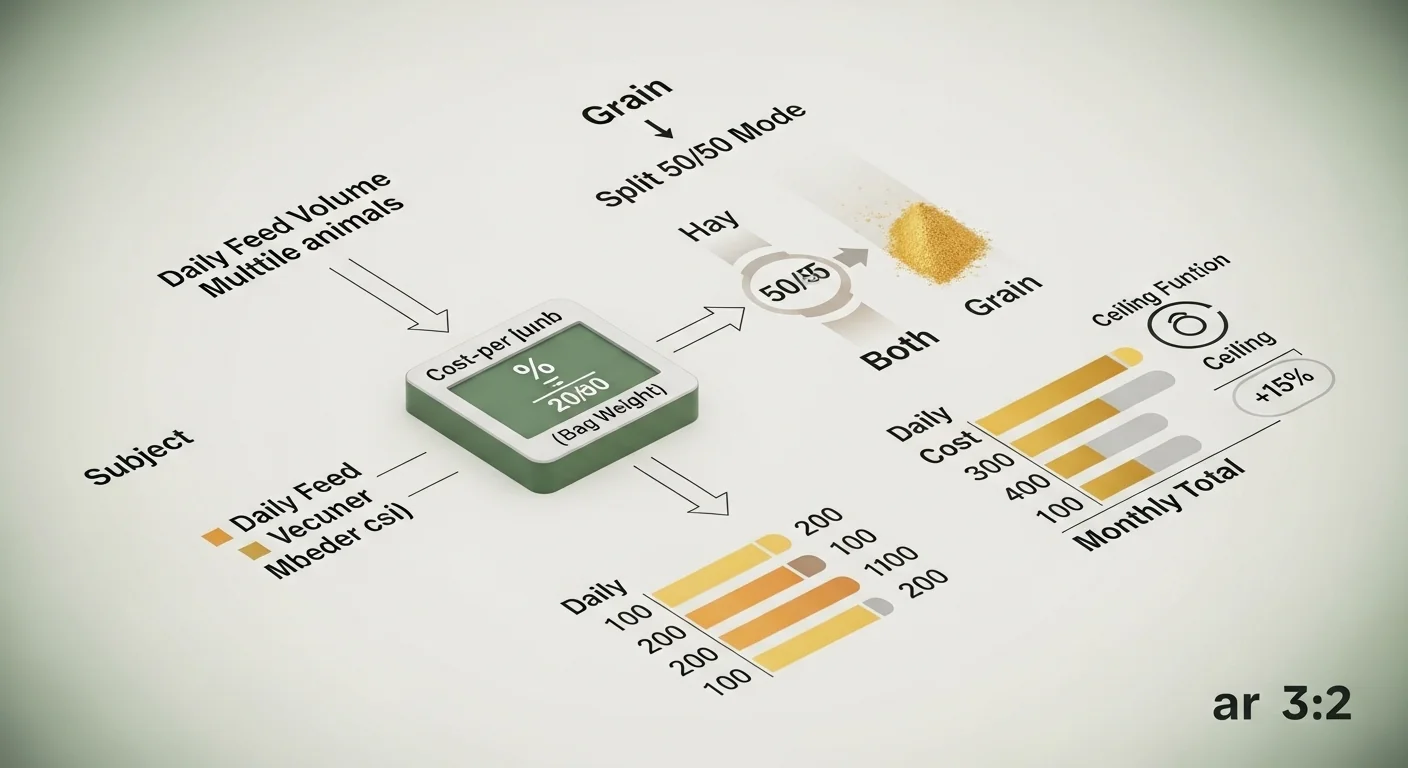
Calculating feed cost seems simple until the hay bill arrives and it does not match the spreadsheet. The problem is almost never the price per bag; it is a mismatch between daily consumption by species and the bag weight being purchased. A 50-pound bag lasts a very different number of days for a horse versus a goat, and most manual estimates collapse at that exact point. The livestock feed calculator below handles that math automatically, separating forage and grain so the result reflects how feed is actually purchased and consumed.
This tool estimates monthly feed expenditure based on species-specific average daily intake, bag pricing, and bag weight. It calculates cost per pound, daily cost, monthly cost, and the number of bags needed to stock 30 days of feed. It does not account for pasture availability, seasonal intake variation, breed-specific adjustment, or production-stage requirements such as lactation or gestation. Those factors require a nutritionist’s input; this calculator handles the budgeting arithmetic once daily intake is known. If you are working from estimated bale weight rather than bag weight, pair this with the hay bale weight calculator first to convert your bale figures into usable per-pound pricing.
After running this calculator, you will know exactly how many bags to order each month and whether your current per-pound feed cost puts you inside or outside a typical budget range for your species and herd size.
Use the Tool
Animal Feed Cost Estimator
Livestock monthly feed budget calculator — The Yield Grid
| Animal Count | Daily Consumption (lbs) | Bags / Month | Monthly Cost |
|---|
How this calculator works
Formula steps (plain language):
- Daily Consumption = Average lbs per animal (by species) × Number of animals
DailyConsumption = avgLbsPerAnimal × animalCount - Cost per lb = Bag cost ÷ Bag weight
CostPerLb = bagCost / bagWeight - Daily Cost = Cost per lb × Daily Consumption
DailyCost = CostPerLb × DailyConsumption - Monthly Cost = Daily Cost × 30 days
MonthlyCost = DailyCost × 30 - Bags per month = Monthly Consumption ÷ Bag weight (rounded up)
BagsPerMonth = ceil((DailyConsumption × 30) / bagWeight)
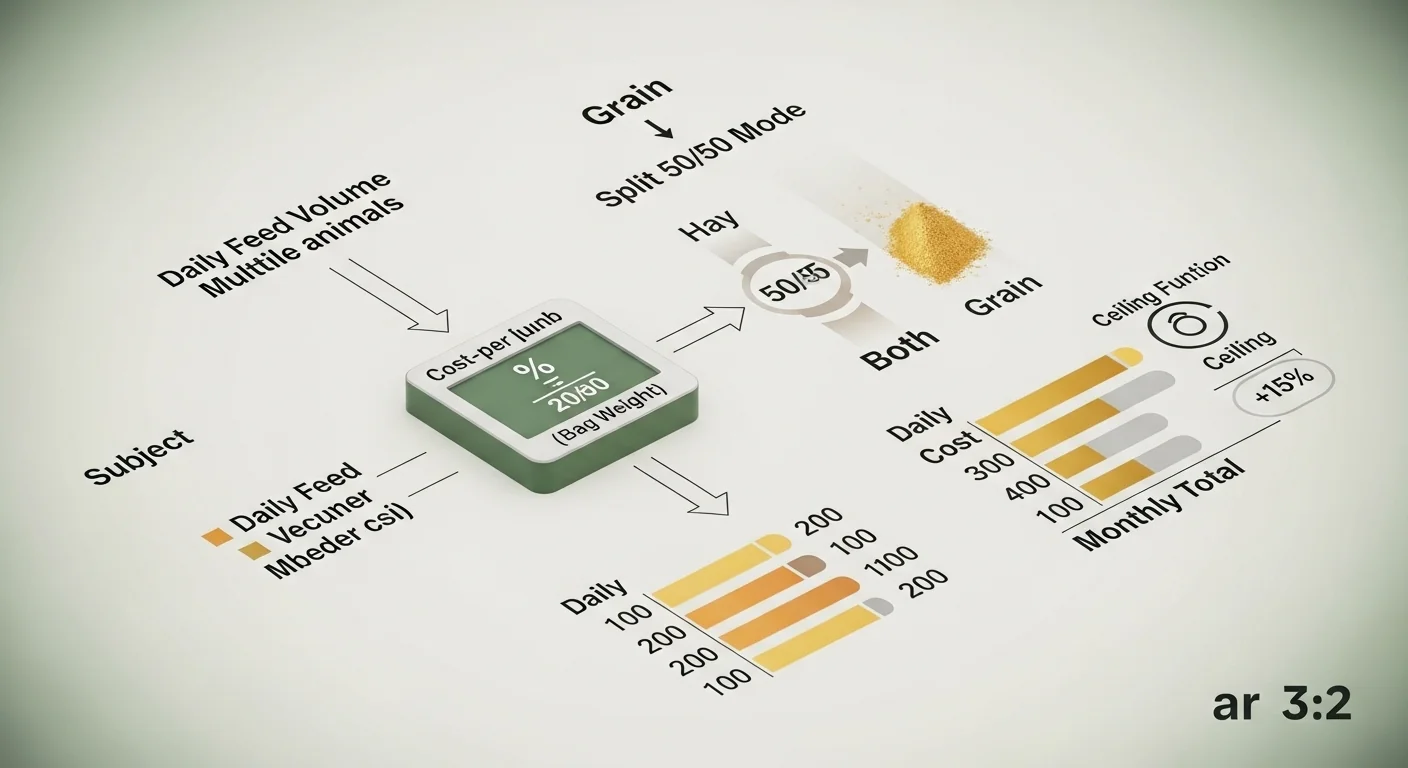
Hay vs Grain split: When “Both (50/50)” is selected, daily consumption is split equally between hay and grain, each calculated separately with the same bag cost/weight, then summed.
Average daily intake by species (lbs/animal):
Horse: 25 lbs • Cow: 30 lbs • Goat: 5 lbs • Chicken: 0.25 lbs
Assumptions & Limits
- Daily feed intake is based on typical averages; actual consumption varies by breed, age, weight, activity level, and season.
- A 30-day month is used for all monthly projections.
- Hay and grain are assumed to have the same price per bag when “Both” is selected; enter two separate calculations for different prices.
- No waste factor is included — real-world usage is typically 5–15% higher.
- Inputs: Animal count 1–10,000; Bag cost $0.01–$10,000; Bag weight 1–2,000 lbs.
- This tool is for budgeting purposes only. Consult an animal nutritionist for precise rations.
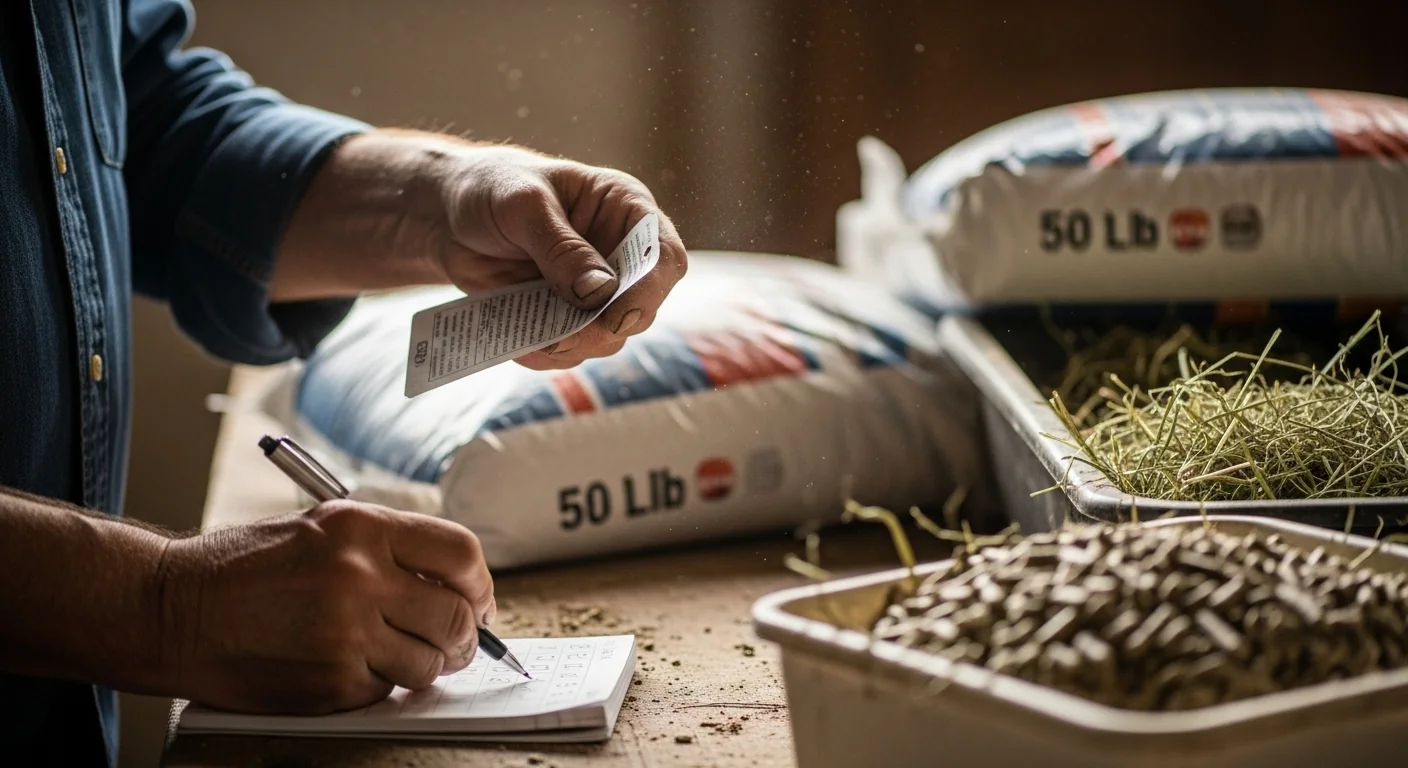
Before entering values, have the feed bag tag in hand. You need the printed bag weight in pounds and the price you actually pay at the register, not the listed retail price. Enter the number of animals as a whole number. Select the feed type that matches what you are purchasing: hay or forage products, bagged grain or pelleted feed, or both if you are splitting the diet roughly 50/50. For operations tracking hay separately by bale rather than bag, see the hay cost calculator for per-bale breakdowns.
Quick Start (60 Seconds)
- Animal Count: Enter the total number of animals being fed from this bag. Count each animal individually; do not combine species across one calculation run.
- Species: Select Horse, Cow, Goat, or Chicken. The calculator uses a fixed average daily intake per animal for each species: 25 lbs for horses, 30 lbs for cows, 5 lbs for goats, 0.25 lbs for chickens. If your animals are significantly heavier or lighter than average, note that these defaults may over- or underestimate.
- Bag Cost ($): Enter the price per bag in US dollars including any local tax you pay. Do not enter the cost per pound; enter the full bag price.
- Bag Weight (lbs): Enter the weight printed on the bag, not the weight of a half-used bag sitting in the barn. Common sizes are 40, 50, and 100 lbs.
- Feed Type: Choose Hay/Forage if you are budgeting forages only, Grain/Pellets for concentrate feeds only, or Both (50/50) if the diet splits evenly. Selecting Both generates a split bar showing each component’s cost contribution.
- Run the calculation: Click Calculate Feed Cost. All fields must be filled before results appear.
- Read the bag count first: The bags-per-month figure is the most actionable number. Use it to set your standing order or delivery schedule before reviewing the cost totals.
Inputs and Outputs (What Each Field Means)
| Field | Unit | What it means | Common mistake | Safe entry guidance |
|---|---|---|---|---|
| Animal Count | Whole number | Total animals consuming feed from the same bag source | Mixing species in one run; goats and horses eat very differently | Run one species at a time; sum the monthly totals |
| Species | Category | Determines the average daily feed intake used internally | Selecting Cow when feeding dairy heifers on grain-only diets | Use the species closest to your animal; adjust bag count manually if intake differs significantly |
| Bag Cost ($) | US dollars | Price paid per complete bag including tax | Entering a per-pound cost instead of per-bag cost | Check your receipt; use the amount charged at checkout |
| Bag Weight (lbs) | Pounds | Net weight of one full bag as printed on the label | Entering 50 for a bag that is actually 40 lbs, inflating the cost-per-lb and deflating bag count | Read the label; common weights are 40, 50, and 100 lbs |
| Feed Type toggle | Category | Determines whether consumption is assigned to forage, concentrate, or split evenly | Selecting Grain for ruminants that actually need the majority of their diet as forage | If the diet is mixed, use Both; run two separate calculations for unequal splits |
| Monthly Cost (output) | $/month | Total projected feed expenditure over 30 days | Treating this as a hard quote rather than a budget estimate | Add 10-15% for waste and spillage in real-world conditions |
| Daily Cost (output) | $/day | One-day feed spend; useful for comparing with daily production revenue | Ignoring it; daily cost reveals whether the feed program is sustainable per head | Compare against per-animal daily revenue for profitability checks |
| Bags per Month (output) | Bags (rounded up) | Minimum bags needed to cover 30 days; always rounds up to a whole bag | Ordering exactly this number; leaves no buffer for delivery delays | Add 15% to the calculated bag count as a standing buffer stock target |
Worked Examples (Real Numbers)
Scenario 1: Two Horses on Hay
- Animal Count: 2
- Species: Horse
- Bag Cost: $22.00
- Bag Weight: 50 lbs
- Feed Type: Hay / Forage
Daily consumption: 25 lbs x 2 = 50 lbs/day. Cost per pound: $22 / 50 = $0.44/lb. Daily cost: $0.44 x 50 = $22.00/day. Monthly cost: $22.00 x 30 = $660.00. Bags per month: ceil(1,500 / 50) = 30 bags.
Result: $660.00/month, 30 bags required.
Two horses on hay at this price point cost $330.00 per horse per month. If the per-bag cost rises by $2.00, the monthly total increases by $60.00, which demonstrates why even small price changes compound quickly with horses.
Scenario 2: One Cow on Grain
- Animal Count: 1
- Species: Cow
- Bag Cost: $15.00
- Bag Weight: 50 lbs
- Feed Type: Grain / Pellets
Daily consumption: 30 lbs x 1 = 30 lbs/day. Cost per pound: $15 / 50 = $0.30/lb. Daily cost: $0.30 x 30 = $9.00/day. Monthly cost: $9.00 x 30 = $270.00. Bags per month: ceil(900 / 50) = 18 bags.
Result: $270.00/month, 18 bags required.
Note that grain-only budgeting for a single cow is a useful starting point, but the vast majority of a beef cow’s diet should come from forage. Running this scenario as “Grain” isolates the concentrate cost; forage must be budgeted separately.
Scenario 3: Twenty Chickens on a 50/50 Diet
- Animal Count: 20
- Species: Chicken
- Bag Cost: $12.00
- Bag Weight: 25 lbs
- Feed Type: Both (50/50)
Daily consumption: 0.25 lbs x 20 = 5 lbs/day. Split: 2.5 lbs hay + 2.5 lbs grain. Cost per pound: $12 / 25 = $0.48/lb. Daily cost: $0.48 x 5 = $2.40/day. Monthly cost: $2.40 x 30 = $72.00. Bags per month: ceil(150 / 25) = 6 bags.
Result: $72.00/month, 6 bags required.
At $0.48/lb this is a moderately priced feed. The hay/grain split shows $36.00 per component per month, helping identify which side of the diet to optimize if prices change.
Reference Table (Fast Lookup)
All rows below use a reference bag price of $18.00 for a 50 lb bag ($0.36/lb). Bags per month column is always rounded up to a whole bag. Monthly cost is computed from daily cost x 30.
| Species | Animal Count | Feed Type | Daily Consumption (lbs) | Bags/Month (50 lb bag) | Monthly Cost at $0.36/lb |
|---|---|---|---|---|---|
| Chicken | 10 | Grain | 2.5 | 2 | $27.00 |
| Chicken | 50 | Grain | 12.5 | 8 | $135.00 |
| Goat | 5 | Hay | 25.0 | 15 | $270.00 |
| Goat | 10 | Both (50/50) | 50.0 | 30 | $540.00 |
| Cow | 1 | Hay | 30.0 | 18 | $324.00 |
| Cow | 5 | Both (50/50) | 150.0 | 90 | $1,620.00 |
| Horse | 2 | Hay | 50.0 | 30 | $540.00 |
| Horse | 4 | Both (50/50) | 100.0 | 60 | $1,080.00 |
| Horse | 8 | Hay | 200.0 | 120 | $2,160.00 |
How the Calculation Works (Formula + Assumptions)
Show the calculation steps
Step 1 – Daily Consumption (lbs)
Multiply the species average daily intake (lbs per animal) by the number of animals.
DailyConsumption = avgLbsPerAnimal x animalCount
Step 2 – Cost per Pound ($/lb)
Divide the bag cost by the bag weight.
CostPerLb = bagCost / bagWeight
Step 3 – Daily Cost ($/day)
Multiply cost per pound by daily consumption.
DailyCost = CostPerLb x DailyConsumption
Step 4 – Monthly Cost ($/month)
Multiply daily cost by 30. The calculator always uses a 30-day month.
MonthlyCost = DailyCost x 30
Step 5 – Bags per Month
Multiply daily consumption by 30 to get monthly lbs, then divide by bag weight and round up to the next whole bag.
BagsPerMonth = ceil((DailyConsumption x 30) / bagWeight)
Hay vs. Grain Split (Both option)
When “Both” is selected, daily consumption is split 50/50 between hay and grain. Each half is calculated independently using the same bag cost and weight, then the results are summed. For diets with an unequal forage-to-concentrate ratio, run two separate calculations and add the totals.
Rounding rules: Bag count always rounds up (ceiling function) because you cannot purchase a partial bag. Cost figures are rounded to two decimal places. Daily consumption is displayed to one decimal place.
Assumptions and Limits
- Species average daily intake figures are general population averages. Actual intake varies by body weight, breed, age, reproductive stage, climate, and activity level.
- A 30-day month is used for all projections regardless of actual month length. Annual projections should multiply monthly output by 12, not by 365.
- When “Both (50/50)” is selected, the tool assumes hay and grain cost the same per bag and have the same bag weight. If your hay bales and grain bags differ in price or weight, calculate each separately.
- No waste factor is built into the default output. Field waste from spillage, spoilage, and refusals typically adds 5 to 15 lbs per animal per month in real-world conditions.
- The tool does not account for pasture contribution. Animals with access to quality pasture consume significantly less purchased feed, making the output an overestimate during grazing season.
- Chicken intake of 0.25 lbs per day is an average for laying hens. Broilers, meat breeds, and chicks consume differently; validate your flock’s actual consumption before relying on this estimate for purchasing.
- Inputs are capped at 10,000 animals, $10,000 per bag, and 2,000 lbs per bag. Inputs outside those ranges require manual calculation.
Standards, Safety Checks, and “Secret Sauce” Warnings
Critical Warnings
- Grain-only diets for ruminants are nutritionally and financially misleading. Cows and goats are ruminants that require the majority of their diet to come from forage. Running a Cow or Goat calculation with the Grain-only option produces a bag count and cost that represents only the concentrate supplement. Budgeting as if that covers the full diet will result in a significant shortfall in both feed supply and actual monthly spend.
- Per-pound cost above $0.50 warrants verification. The calculator flags this threshold because specialty, alfalfa, or medicated feeds frequently cross it, and accidentally comparing them to grass hay on a cost-per-bag basis produces invalid conclusions. Verify feed type consistency before comparing two scenarios side by side.
- Bag count is a minimum, not a target order quantity. The ceiling function in the formula guarantees you do not underorder, but it includes zero buffer for delivery delays, price spikes, or animals that eat above average in cold weather. The recommended buffer is 15% above the calculated monthly bag count, equivalent to roughly a two-week supply.
- Mixing species in a single calculation run inflates or deflates all outputs. Entering “10 animals” for a herd that is actually 7 goats and 3 horses will produce a meaningless average. Run one species at a time and sum the results.
Minimum Standards
- Every livestock operation should be able to state a cost per pound of feed for each species on the property. If that figure is unknown, purchasing decisions are made on bag price alone, which varies by bag size and is not comparable across suppliers.
- Monthly bag orders should be set from a calculated bag count, not from memory or habit. Orders that are “about what we usually get” accumulate overruns or shortfalls that compound across seasons.
- A two-week buffer stock target is standard practice for operations without guaranteed delivery windows. Operations in rural areas with infrequent delivery access should target four weeks of buffer.
Competitor trap: Most animal feed cost calculators online treat all feed as a single commodity. They ask for “feed cost per day” or “feed per animal” and multiply up, skipping the bag-level math entirely. That approach cannot tell you how many bags to order, cannot separate hay from grain costs, and cannot flag when your per-pound price is anomalous. The result looks like a calculation but functions as a unit-conversion multiplier with no decision value. The hay vs. grain split is where actual purchasing decisions get made. If a calculator ignores it, the output is not usable for real livestock budget planning. For ruminants specifically, understanding pasture carrying capacity alongside purchased feed costs is essential; the pasture stocking rate calculator addresses that side of the equation, and the rotational grazing calculator helps reduce dependence on purchased feed during growing season.
Common Mistakes and Fixes
Mistake: Entering price per pound instead of price per bag
When a feed store posts a per-pound price on the shelf tag, entering that number in the Bag Cost field while still using the bag weight produces a cost-per-pound that is the original per-pound price divided by the bag weight, which is orders of magnitude too low. The resulting monthly cost appears implausibly cheap, which is the tell. Fix: always use the total register price for one complete bag.
Mistake: Using the same bag weight for hay bales
Round bales and square bales are not bags. Their weights vary dramatically by moisture content, cutting, and compression. Entering “1,200” as a bag weight for a round bale and “$60” as the bale cost will produce a valid calculation, but bale weight must first be confirmed rather than assumed. A 1,200 lb estimate for a bale that actually weighs 900 lbs underestimates bags per month and overstates how long each unit lasts. Fix: weigh a representative bale or use the hay bale weight estimator before entering bale figures as bag inputs.
Mistake: Running one calculation for a mixed-species herd
A property with goats, chickens, and one horse cannot be calculated in a single run because each species has a different daily intake built into the tool. Averaging the count across species produces a number that is accurate for none of them. Fix: run three separate calculations, one per species, then add the monthly costs and bag counts to get the property total.
Mistake: Ignoring the feed conversion context for growing animals
The intake averages in this tool reflect adult maintenance requirements. Young, growing, or lactating animals consume more feed per body weight unit than the averages suggest. Using the adult average for a herd of weaned calves will understate both cost and bag requirements. Fix: consult your extension service intake tables for the specific production stage, then adjust the “animal count” input upward proportionally to simulate higher intake, or use the feed conversion ratio calculator to benchmark how efficiently your animals are converting feed to production output.
Mistake: Treating the monthly cost as a fixed number across all seasons
Feed consumption rises in cold weather as animals burn more energy for thermoregulation. A calculation run in August will underestimate January costs for horses and cattle by a meaningful margin. Chickens in cold climates also eat more to maintain body temperature. Fix: run two versions of the calculation, one for warm-season and one for cold-season intake, and budget the higher figure for the months it applies. For cattle specifically, a dedicated winter cattle feed calculator accounts for cold-weather adjustments that this general tool does not include.
Next Steps in Your Workflow
Once you have a monthly bag count and cost figure, the immediate next step is converting it into a supplier order schedule. Most feed operations have minimum delivery quantities or charge delivery fees below a threshold. Compare your monthly bag count to those minimums and determine whether a bi-weekly or monthly order cycle makes more sense at your scale. Large horse or cattle operations that regularly cross 50 bags per month should request a bulk pricing conversation with their supplier; per-bag costs drop noticeably at volume, and the savings compound over a full year.
Feed cost is one input into a larger livestock operating budget. Water requirements, medication, and veterinary costs run alongside it and should be planned with the same structured approach. The cattle water requirement calculator is a direct complement for operations managing water delivery or trough capacity alongside feed purchasing. For the full seasonal picture on winter hay stockpiling for cattle herds, the winter cattle feed calculator extends this tool’s output with cold-weather consumption adjustments and hay inventory requirements.
FAQ
What daily intake figures does this calculator use for each species?
The built-in averages are: Horse at 25 lbs per animal per day, Cow at 30 lbs, Goat at 5 lbs, and Chicken at 0.25 lbs. These reflect typical adult maintenance consumption. Animals outside normal weight ranges, in active production stages, or in extreme weather will consume differently from these defaults.
Can I use this for hay bales instead of bags?
Yes, with one important caveat. Enter the bale price in the Bag Cost field and the bale weight in lbs in the Bag Weight field. The output will then show cost per pound and bales per month rather than bags. You must know or estimate the actual bale weight accurately; an incorrect bale weight figure produces proportionally incorrect results throughout the calculation.
Why does the tool always round up on bags per month?
Bags are purchased as whole units. If the math produces 17.2 bags of feed needed for the month, you must buy 18 bags; there is no such thing as buying 0.2 of a bag. The ceiling function ensures the output is always a purchasable quantity. It also means the result already includes a small automatic buffer on the fractional remainder.
How do I calculate feed cost for a herd with multiple species?
Run one calculation per species using the animal count for that species only. Record the monthly cost and bag count for each. Sum all the monthly costs to get the total property feed budget. Sum the bag counts to determine how many total bags are needed across all species for the month.
The calculator shows a very high cost per pound. Is that an error?
Not necessarily. Cost per pound above $0.40 is common for specialty feeds, medicated feeds, alfalfa pellets, and premium senior or performance formulas. The calculator flags values above $0.50/lb as a check prompt. Verify the bag weight entry first, since entering the wrong weight is the most common source of an inflated cost-per-pound figure.
Does selecting “Both” mean I need twice as many bags?
No. Selecting Both (50/50) splits the total daily intake across two feed types but does not change the total daily consumption. A horse eating 25 lbs per day on Both uses 12.5 lbs of hay and 12.5 lbs of grain, not 25 lbs of each. The total monthly bag count in Both mode reflects the same total consumption as a single-type selection, distributed across the two feed categories.
Conclusion
The single most avoidable mistake is running a mixed-species operation through a single calculation pass. Run one species at a time, total the outputs, and build in a 15-bag buffer above your calculated minimum. For operations managing electric fencing, barn ventilation, or pasture infrastructure alongside feed costs, the electric fence calculator is the next most-used tool in the homesteading and livestock planning workflow on The Yield Grid.