
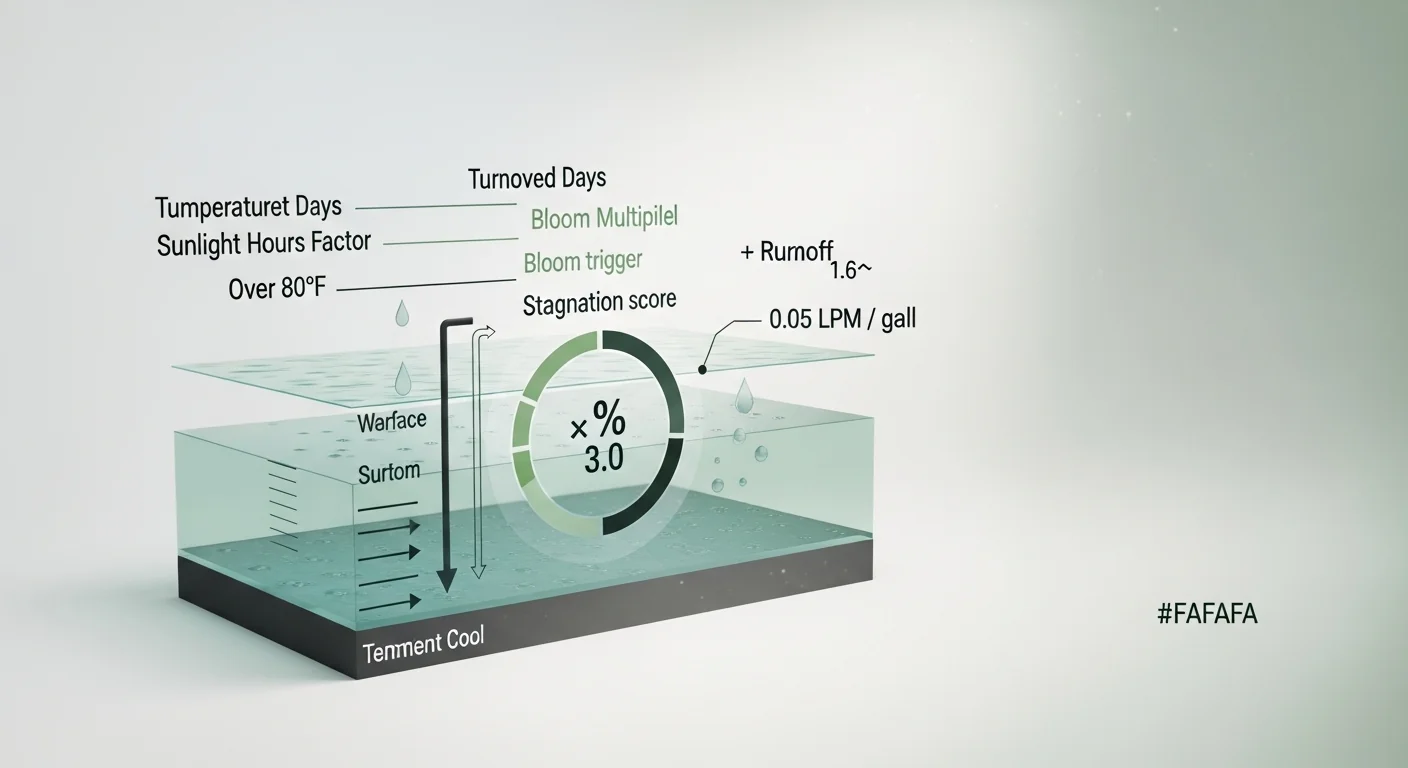
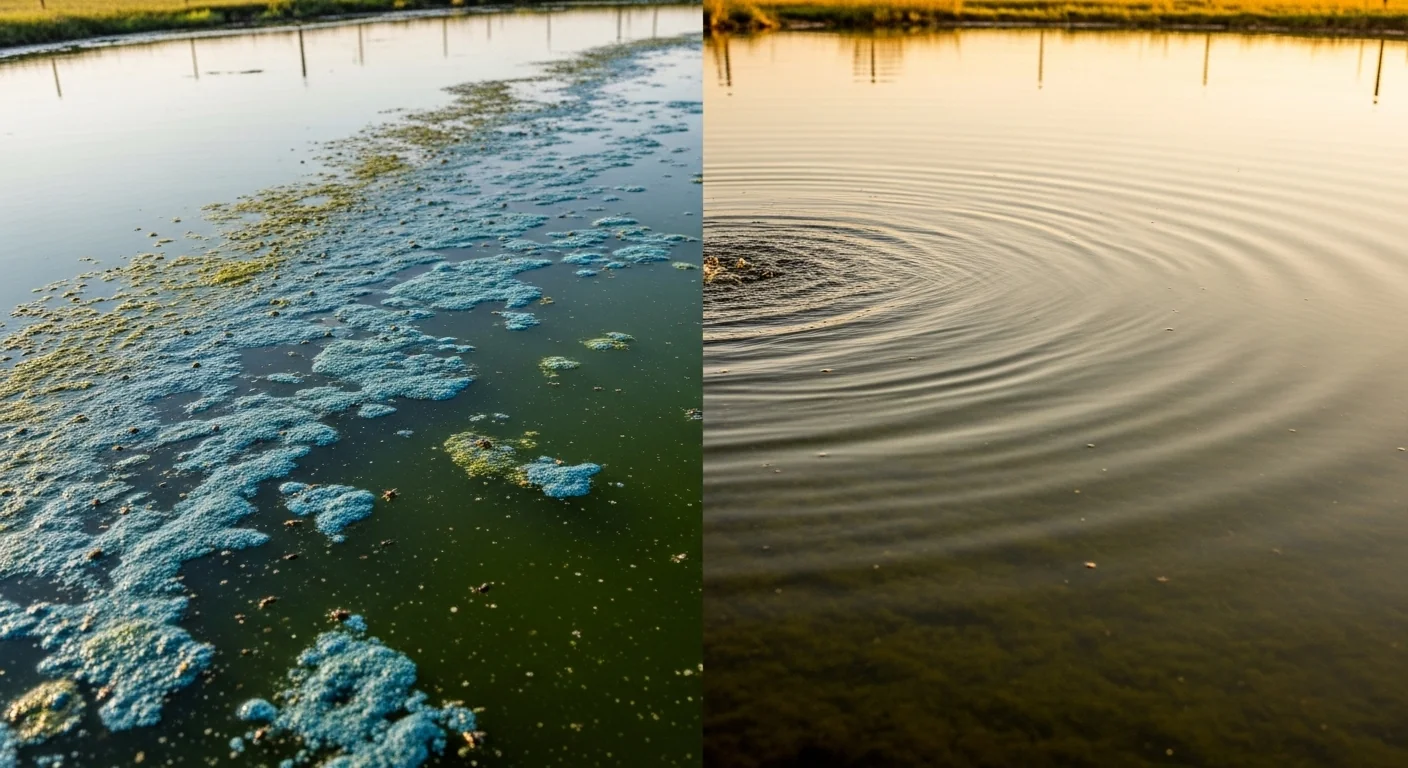
Green water in a stock tank is a symptom, not just an inconvenience. The organism driving that color change is most often cyanobacteria, a photosynthetic bacterium that produces microcystins and anatoxin-a, toxins potent enough to kill a 1,200-pound cow after a single drinking session in advanced bloom conditions. The cascade from “water looks a bit green” to a lethal concentration of neurotoxin can happen within 48 to 72 hours when temperature, stagnation, and nutrient load align. Managing that window requires sizing aeration correctly before the bloom starts, not reacting after the scum layer forms.
This tool calculates the minimum continuous airflow your trough requires, scores cyanobacteria bloom risk on a 0-to-10 stagnation index, identifies whether your current conditions have crossed the bloom trigger threshold, and estimates the solar panel capacity needed to run aeration off-grid. It does not predict water chemistry or replace a lab test. The copper sulfate dosage output is a reference ceiling, not a prescription, and the tool flags the sheep toxicity threshold explicitly because it is the most commonly overlooked species-specific hazard in shared livestock water systems.
After running the calculator, you will know whether your trough needs more airflow, whether this season’s temperature and turnover rate puts your water in the bloom trigger zone, and whether copper sulfate is even an appropriate intervention given the animals sharing that water source.
Use the Tool
Solar Water Trough Aerator & Cyanobacteria Lockout Calculator
Calculate required airflow, assess bloom risk, and protect your livestock from toxic blue-green algae in stock tanks and water troughs.
The Yield Grid| Tank Size (gal) | Min. Airflow (LPM) | Solar Panel (W) | Bloom Risk at 85°F / 5d |
|---|
How This Calculator Works
Required Airflow (LPM):
Your stock tank volume drives the minimum continuous aeration needed to prevent thermal stratification and oxygen depletion — the two conditions that allow cyanobacteria to dominate.
A 500-gallon trough needs at least 25 LPM to break the surface film that traps nutrients and heat near the top — the exact zone where blue-green algae blooms.
Stagnation Index (0–10):
Combines water turnover rate, temperature, sunlight, and nutrient load to produce a single bloom-risk number.
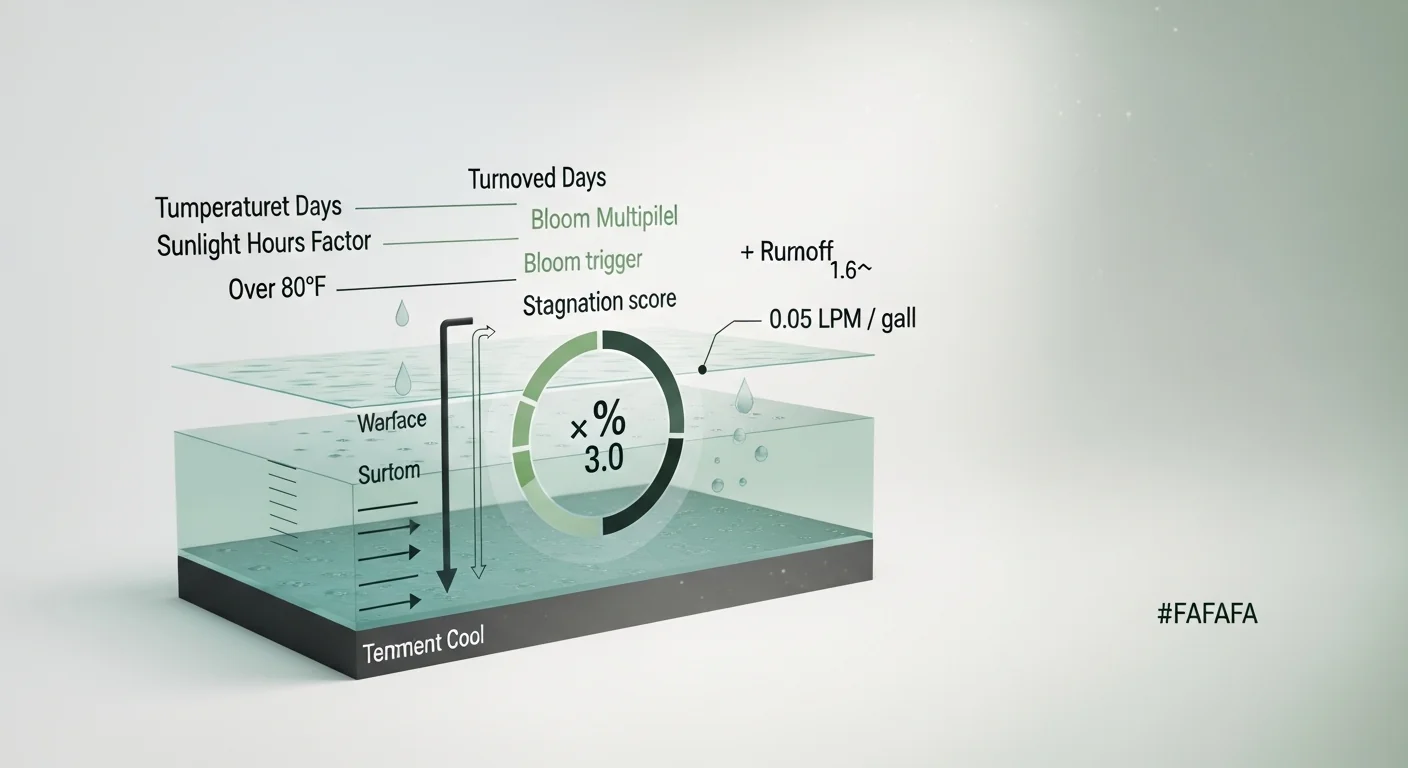
Where: TempFactor = max(0, (Temp – 60) / 20), SunFactor = Sunlight / 8, RunoffMultiplier = 1.6 if manure present, 1.0 if not. Index is clamped to 10.
Bloom Trigger:
A bloom is declared CRITICAL when water temperature exceeds 80°F AND the stagnation index exceeds 3.0. Both conditions must be met — this matches how Cyanobacteria (Microcystis, Anabaena) outcompete beneficial algae in practice.
Copper Sulfate Dosage:
Calculated at the standard control dose (1.0 PPM) which is effective against algae but safe for cattle and horses. The tool flags the sheep/lamb toxicity threshold explicitly — doses above 0.6 PPM can cause fatal liver disease in small ruminants within 24 hours.
Solar Panel Sizing:
Assumes standard 12V floating aerator efficiency of approximately 4 LPM per watt at peak sun. Multiply required LPM by 0.25 W to get minimum panel wattage, then apply a 1.4× safety factor for cloud cover and angle losses.
Assumptions & Limits: Airflow formula assumes continuous 24/7 operation with a diaphragm or vibrating plate pump. Solar panel estimate assumes direct south-facing mount at 35° latitude. Temperature input should reflect peak summer afternoon reading, not morning temperature. Barley straw extract is an algistatic supplement — it inhibits new growth but does not kill existing blooms. This calculator does not account for fish presence, which lowers the copper sulfate safe threshold further.
The Science: Why Cyanobacteria Kills Livestock
“Blue-Green Death” — The Microbiology
Cyanobacteria (commonly called blue-green algae) are photosynthetic bacteria — not true algae — that have thrived on Earth for 3.5 billion years. In warm, nutrient-rich, stagnant water they produce microcystins (liver toxins), anatoxins (neurotoxins), and cylindrospermopsins (cytotoxins).
A 1,200-lb cow drinking from a bloomed stock tank can receive a lethal dose in a single drinking session. Anatoxin-a, known as “Very Fast Death Factor,” can kill a large animal in 20–30 minutes by blocking neuromuscular transmission — essentially suffocation while standing. Microcystins destroy liver tissue and can cause death within 24–72 hours.
The Perfect Storm: Direct summer sun + shallow trough + manure nutrient runoff + no aeration = conditions that trigger explosive bloom growth within 48–72 hours. A trough that looks green one morning can be scum-covered and deadly by afternoon if temperatures spike.
Warning Signs: Blue-green or teal surface film; thick “pea soup” water; dead blue-green scum on windward shore; paint-like surface sheen; musty or earthy odor. If any of these are present, remove livestock access immediately and do not touch the water without gloves.
Before entering values, have your trough's gallon capacity on hand. If you do not know it, multiply length × width × depth in feet and multiply by 7.48 to convert cubic feet to gallons. Measure or estimate the hottest water temperature you expect in mid-summer, not a cool morning reading. Your water turnover rate is the number of days between full replenishments, whether by float valve refill cycling, manual filling, or livestock drinking the tank down and refilling. If you run cattle and horses at the same water point, also see the cattle water requirement calculator to confirm your trough is sized for actual daily demand before optimizing aeration.
Quick Start (60 Seconds)
- Tank volume in gallons: Enter the total capacity, not the current water level. A standard 100-gallon Rubbermaid stock tank is 100 gallons; a concrete trough may be 500 to 2,000 gallons. Undersizing this number underestimates your required airflow.
- Daily sunlight hours: Count direct sun exposure, not total daylight. A tank under partial shade or a barn overhang receives fewer hours of photosynthetically active radiation, which directly dampens bloom potential. Enter 0 for a fully shaded trough.
- Water turnover rate in days: This is how long the same body of water sits in the tank before being fully displaced. A float valve that trickles in fresh water continuously does not mean a short turnover rate unless the tank is actively overflowing and flushing old water out.
- Water temperature in °F: Use the peak summer afternoon temperature, not the ambient air temperature. Water in a metal or uncovered trough in direct sun can run 10 to 20°F warmer than air temperature. The bloom trigger threshold is 80°F.
- Nitrogen/phosphorus runoff: Select "Yes" if the tank is downslope from a feedlot, barn, or heavily grazed sacrifice area. Manure nutrients entering the water apply a 1.6x multiplier to the stagnation index score because phosphorus is the primary growth limiter for cyanobacteria in most livestock water systems.
- Read the gauge first: The Bloom Risk Index is the fastest output to check. If it reads "Critical," the airflow number is secondary; remove livestock access and follow the next steps below before treating the water.
- Sheep on the property: If any sheep or lambs drink from this water source, treat the copper sulfate output as a hard ceiling you must stay well below, not a target dose. The tool flags this warning automatically but the decision is yours.
Inputs and Outputs (What Each Field Means)
| Field | Unit | What It Means | Common Mistake | Safe Entry Guidance |
|---|---|---|---|---|
| Tank Volume | Gallons | Total water-holding capacity of the trough or tank | Entering current water level instead of full capacity | 10 to 50,000 gal; use nameplate capacity or length × width × depth (ft) × 7.48 |
| Daily Sunlight | Hours/day | Direct sun exposure driving surface heating and algal photosynthesis | Confusing total daylight with direct sun on the water surface | 0 to 16 hours; shaded tanks score lower bloom risk regardless of temperature |
| Water Turnover Rate | Days | Days between complete water displacement; determines stagnation window | Assuming a float valve means low turnover when it only maintains level, not flushes | 0.5 to 30 days; target under 3 days during bloom season |
| Water Temperature | °F | Peak water temperature used to determine temperature factor in stagnation score | Using morning air temp instead of afternoon water temp at the surface | 32 to 120°F; use peak summer reading; 80°F is the bloom trigger threshold |
| Manure Runoff | Yes / No | Presence of nitrogen and phosphorus from animal waste in the water supply | Selecting "No" when the tank is downslope from a sacrifice area or feed bunk | Select "Yes" if any grazing, feeding, or housing area drains toward the trough |
| Required Airflow | LPM | Minimum continuous aeration output to prevent thermal stratification and O2 depletion | Buying an aerator rated at peak output, not continuous output at operating pressure | Size the aerator to meet or exceed this number at back-pressure, not at free air |
| Stagnation Index | 0 to 10 | Composite bloom-risk score combining temperature, sun, turnover, and nutrient load | Treating it as a pass/fail number rather than a trend indicator across seasons | Below 2.5 is low risk; above 5.5 is high risk; above 7.5 is critical |
| Bloom Trigger | Pass / Fail | Indicates whether both bloom conditions are simultaneously active (Temp >80°F AND Index >3.0) | Assuming no bloom is possible because the water "looks okay" | Either condition alone does not trigger the flag; both must be met |
| Solar Panel Size | Watts | Minimum panel capacity to run the aerator continuously at peak sun, with 1.4x safety factor for cloud cover and angle losses | Pairing the right LPM pump with an undersized panel that cannot sustain output on cloudy days | Add a 12V battery backup for overnight and overcast operation in high-risk seasons |
| Copper Sulfate Dose | PPM | Reference control dose effective against algae and safe for cattle and horses at this concentration | Applying this dose to troughs where sheep or lambs are present | 1.0 PPM is cattle-safe; 0.6 PPM is the approximate upper limit for sheep; do not dose an active bloom directly |
Worked Examples (Real Numbers)
Scenario 1: Small Horse Trough in Peak Summer, No Runoff
- Tank volume: 150 gallons
- Daily sunlight: 8 hours
- Water turnover rate: 4 days
- Water temperature: 82°F
- Manure runoff: No
Result: Required airflow = 7.5 LPM. Stagnation Index = 8.8. Bloom TRIGGERED. Solar panel = 3W minimum.
Even without manure nutrients, a 4-day turnover at 82°F with 8 full hours of sun produces a stagnation index of 8.8, well above the 3.0 bloom trigger threshold. A horse drinking from this trough is exposed to bloom conditions. A 3-watt solar panel driving a small diaphragm aerator is the minimum intervention; shade cloth over the trough would be the fastest secondary measure.
Scenario 2: Large Cattle Stock Tank With Feedlot Runoff
- Tank volume: 500 gallons
- Daily sunlight: 7 hours
- Water turnover rate: 3 days
- Water temperature: 88°F
- Manure runoff: Yes
Result: Required airflow = 25 LPM. Stagnation Index = 10 (capped). Bloom TRIGGERED. Solar panel = 9W minimum.
The 1.6x runoff multiplier combined with high temperature and moderate sun pushes the raw stagnation score above the 10-point ceiling. This is the scenario described in the tool's secret sauce background: a 500-gallon tank in direct summer sun near a feedlot, conditions responsible for acute cyanobacteria livestock fatalities. The 25 LPM airflow requirement needs a mid-range 12V floating aerator, not a small pond bubbler.
Scenario 3: Large Shaded Ranch Trough, Slow Turnover, Mild Temperature
- Tank volume: 1,000 gallons
- Daily sunlight: 4 hours
- Water turnover rate: 7 days
- Water temperature: 72°F
- Manure runoff: No
Result: Required airflow = 50 LPM. Stagnation Index = 4.2. Bloom NOT triggered. Solar panel = 18W minimum.
At 72°F the temperature condition for bloom trigger is not met, even though the stagnation index of 4.2 exceeds 3.0. The tank still needs 50 LPM of continuous aeration to prevent oxygen depletion and biofilm buildup, and an 18-watt panel to sustain it. If summer temperatures climb above 80°F without any other changes, the bloom trigger would activate immediately, because the stagnation index is already above 3.0.
Reference Table (Fast Lookup)
Values in the "Standard Conditions" columns assume 6 hours daily direct sun, 5-day turnover, no manure runoff, and 85°F water temperature. The copper sulfate mass column is calculated at 1.0 PPM for cattle-safe dosing.
| Tank Volume (gal) | Min. Airflow (LPM) | Solar Panel (W) | Stagnation Index (Std. Conditions) | Bloom Triggered at 85°F? | Copper Sulfate at 1.0 PPM (grams) |
|---|---|---|---|---|---|
| 50 | 2.5 | 1 | 3.2 | Yes | 0.71 |
| 100 | 5.0 | 2 | 3.2 | Yes | 1.42 |
| 200 | 10.0 | 4 | 3.2 | Yes | 2.84 |
| 300 | 15.0 | 5 | 3.2 | Yes | 4.26 |
| 500 | 25.0 | 9 | 3.2 | Yes | 7.10 |
| 750 | 37.5 | 13 | 3.2 | Yes | 10.65 |
| 1,000 | 50.0 | 18 | 3.2 | Yes | 14.20 |
| 2,500 | 125.0 | 44 | 3.2 | Yes | 35.50 |
| 5,000 | 250.0 | 88 | 3.2 | Yes | 71.00 |
| 10,000 | 500.0 | 175 | 3.2 | Yes | 142.00 |
Key observation: At 85°F with a 5-day turnover and 6 hours of daily sun, every tank size above 50 gallons is in bloom trigger territory regardless of volume. The stagnation index does not change with tank size under identical environmental conditions, only the required airflow and panel wattage scale up with volume.
How the Calculation Works (Formula + Assumptions)
Show the calculation steps
Step 1: Required Airflow
Airflow in liters per minute is calculated directly from tank volume:
Req_Airflow (LPM) = Tank Volume (gallons) × 0.05
The 0.05 coefficient represents the minimum continuous surface agitation rate needed to disrupt thermal stratification and maintain dissolved oxygen above the threshold that prevents anaerobic conditions in the bottom layer. At sub-threshold airflow, warm surface water and cool bottom water separate into distinct layers. Phosphorus trapped in the sediment layer is released into the water column during this anoxic phase, feeding the bloom from below while sunlight drives photosynthesis from above.
Step 2: Stagnation Index
The index combines four factors into a 0-to-10 risk score:
TempFactor = max(0, (Temperature_F - 60) / 20)
SunFactor = Sunlight_Hours / 8
RunoffMultiplier = 1.6 if manure runoff present, 1.0 if not
StagnationRaw = (TurnoverDays / 5) × TempFactor × SunFactor × RunoffMultiplier
StagnationIndex = clamp(round(StagnationRaw × 10, 1 decimal), 0, 10)
Values below 60°F contribute zero to the temperature factor. The divisors (5 for turnover, 8 for sun) normalize each input against a moderate-risk baseline. The result is clamped at 10 to prevent index inflation in extreme multi-variable scenarios.
Step 3: Bloom Trigger
BLOOM TRIGGERED if: Temperature > 80°F AND StagnationIndex > 3.0
Both conditions must be met simultaneously. High temperature alone does not trigger the flag if turnover is fast and sun exposure is limited. High stagnation alone does not trigger the flag if water temperature remains below 80°F, because cyanobacteria growth rates roughly double for every 10°C rise in temperature and most virulent species require warm conditions to outcompete green algae.
Step 4: Solar Panel Sizing
Solar Panel (W) = (Req_Airflow / 4) × 1.4
The formula assumes a standard 12V floating diaphragm aerator producing approximately 4 LPM per watt at peak efficiency. The 1.4x safety factor accounts for panel angle losses, cloud cover, degradation over time, and wiring resistance. Results are rounded to the nearest whole watt.
Step 5: Copper Sulfate Reference Dose
The tool outputs 1.0 PPM as the standard control ceiling for cattle and horses. Grams of copper sulfate crystals for a specific volume: multiply volume in gallons by 3.785 to get liters, then multiply by 0.001 to get grams at 1 PPM. The sheep-safe upper limit of 0.6 PPM is flagged as a hard warning because copper accumulates in sheep liver tissue and chronic low-level exposure below the acute kill threshold can still cause cumulative toxicity over weeks.
Assumptions and Limits
- The 0.05 LPM/gallon coefficient assumes a fully exposed, uncovered trough in summer conditions. Shaded or enclosed troughs with lower evaporation may tolerate slightly lower airflow, but no reduction is built into the formula because erring conservative is safer for livestock.
- The temperature input should reflect peak summer afternoon water surface temperature, not ambient air or morning readings. Metal and plastic troughs in direct sun regularly exceed air temperature by 10 to 20°F.
- The runoff multiplier is a fixed 1.6x binary factor. It does not scale with nutrient concentration or proximity to the contamination source. Troughs very close to high-density feeding areas may carry higher nutrient loads than the multiplier captures.
- The solar panel estimate assumes a south-facing, unshaded panel at approximately 35 degrees latitude. Operations at higher latitudes or with panel shading should add additional capacity beyond the calculated wattage.
- Barley straw extract is not modeled in the formula. It is an algistatic supplement that inhibits new growth but does not actively remove existing blooms or reduce the stagnation index.
- The stagnation index does not account for wind-driven mixing, which can partially substitute for mechanical aeration on large open ponds. It is conservative for small enclosed troughs, which have minimal wind exposure and benefit most from mechanical aeration.
- Fish presence is not modeled. Troughs or ponds containing fish have a lower copper sulfate tolerance threshold than cattle-only water systems.
Standards, Safety Checks, and "Secret Sauce" Warnings
Critical Warnings
- Never apply copper sulfate directly to an active cyanobacteria bloom. When copper sulfate contacts living cyanobacteria cells, it causes rapid cell lysis. Dead cells release their entire stored toxin load simultaneously into the water column. A trough that was dangerous before treatment can become acutely lethal within hours of an uncontrolled copper sulfate application during a bloom. Remove livestock access first. Allow the bloom to collapse naturally through water exchange before treating preventatively.
- The 1.0 PPM copper sulfate dose in this calculator is a cattle and horse reference only. Sheep accumulate copper in the liver with every exposure. A dose that shows no immediate effect in sheep can trigger fatal hemolytic crisis 2 to 8 weeks later when the liver copper threshold is exceeded. If sheep share the watering point, barley straw extract and mechanical aeration are the only safe chemical-free interventions.
- Visual inspection is not a reliable early warning system for cyanobacteria. Water can carry dangerous microcystin concentrations before the characteristic blue-green or teal color is visible. Blooms can also develop overnight during thermal inversions. A risk index score above 5.5 warrants preventive action regardless of what the water looks like.
- Anatoxin-a can kill a large ruminant within 20 to 30 minutes of ingesting a sufficient quantity of bloom-contaminated water. By the time clinical signs appear, the toxin dose is already absorbed and supportive care options are extremely limited. Prevention through aeration and turnover management is the only practical defense at the operation level.
Minimum Standards
- Maintain water turnover at 3 days or less during any period when water temperature exceeds 75°F and direct sun exposure exceeds 4 hours per day.
- Run continuous aeration at no less than 0.05 LPM per gallon throughout the high-bloom season. Intermittent aeration creates stagnation windows long enough for surface stratification to re-establish.
- Install a vegetated buffer strip or gravel filter pad between any feedlot, barn, or sacrifice paddock and the water source if manure runoff is present. This addresses the bloom at its nutrient source rather than at the trough.
- If installing electric fencing around a contaminated trough to restrict access, confirm your fence energizer output is adequate for the perimeter. The electric fence joule calculator can help size your energizer correctly for temporary exclusion fencing.
Competitor Trap: Most algae management guides for livestock focus on reactive treatment: "add copper sulfate when you see green water." This misses the biology entirely. Cyanobacteria blooms are predictable based on temperature, stagnation, and nutrient load, all three of which are measurable and largely controllable before the bloom starts. An operation that waits for visual confirmation of a bloom before acting has already lost the 48-to-72-hour prevention window. The stagnation index in this tool is designed to make that window visible before it closes.
For operations using pasture rotation to manage grazing pressure near water sources, the pasture weed killer calculator pairs well with buffer strip design, since the same areas that collect runoff often carry invasive weed pressure and require coordination between treatment and exclusion timing.
Common Mistakes and Fixes
Mistake: Buying an Aerator Rated by Peak Output, Not Continuous Delivery at Pressure
Aerator packaging often lists the maximum free-air output at zero back-pressure. Once the pump is submerged or connected to diffuser tubing, actual output drops, sometimes by 30 to 50 percent depending on tubing length and depth. A pump rated at "50 LPM" may only deliver 28 to 35 LPM at operating conditions. Always verify the continuous LPM at the manufacturer's stated operating depth or static pressure before purchasing.
Fix: Request the performance curve from the manufacturer, or select a pump with a nameplate continuous rating at least 20 percent above your calculated requirement.
Mistake: Treating Turnover Rate as the Float Valve Refill Rate
A float valve that continuously tops off evaporation losses does not flush old water, it maintains level. Stagnation in a float-valve-fed trough is determined by how quickly livestock actually drink the tank down and fresh water enters to replace it. A 500-gallon trough with 20 cattle may turn over in 2 days; the same trough with 4 cattle may sit for 10 days. Entering a short turnover rate when the trough is actually stagnating inflates your risk assessment in the wrong direction.
Fix: Calculate actual turnover from daily water consumption. If 20 cattle consume 20 gallons each per day, a 500-gallon tank turns over in approximately 1.25 days. Use the cattle water requirement calculator to estimate daily consumption before entering the turnover field.
Mistake: Applying Barley Straw Extract After a Bloom Has Started
Barley straw and its commercial liquid extract work by releasing hydrogen peroxide-like compounds during decomposition that inhibit algal cell division. This is a preventive mechanism, not a curative one. In the presence of an established bloom with high cell density, the inhibitory compound concentration is insufficient to reverse growth. Applying it during an active bloom delays the chemical treatment window without reducing the toxin hazard.
Fix: Apply barley straw extract at the beginning of the high-risk season, before water temperature reaches 75°F. Maintain it as a continuous background treatment through autumn.
Mistake: Ignoring Seasonal Stocking Changes in Water Risk Assessment
A trough that runs at low bloom risk during spring with 10 stocker cattle becomes a high-risk system in August when 30 yearlings are added, grazing pressure increases near the tank, and summer temperatures peak. The nutrient load, turnover rate, and temperature inputs all shift simultaneously. Many operations run this calculator once in spring and do not reassess when stocking density changes.
Fix: Re-run the calculator at each stocking change and at the beginning of each month from May through September. Use the pasture stocking rate calculator to keep stocking density data current, then carry the updated turnover rate estimate into this tool.
Mistake: Trusting "No Smell" as a Safety Indicator
Cyanobacteria blooms produce a musty or earthy odor caused by geosmin, but not all strains produce detectable levels of geosmin at toxic concentrations. Microcystins and anatoxin-a are odorless. Livestock have also been documented drinking from visibly scum-covered tanks when no clean water alternative is available. The absence of an algae smell does not indicate the absence of toxins in the water.
Fix: Base risk decisions on the stagnation index score and bloom trigger status, not on sensory inspection. Use a clean secondary water source as a backup during high-risk periods so livestock are not forced to self-select contaminated water.
Next Steps in Your Workflow
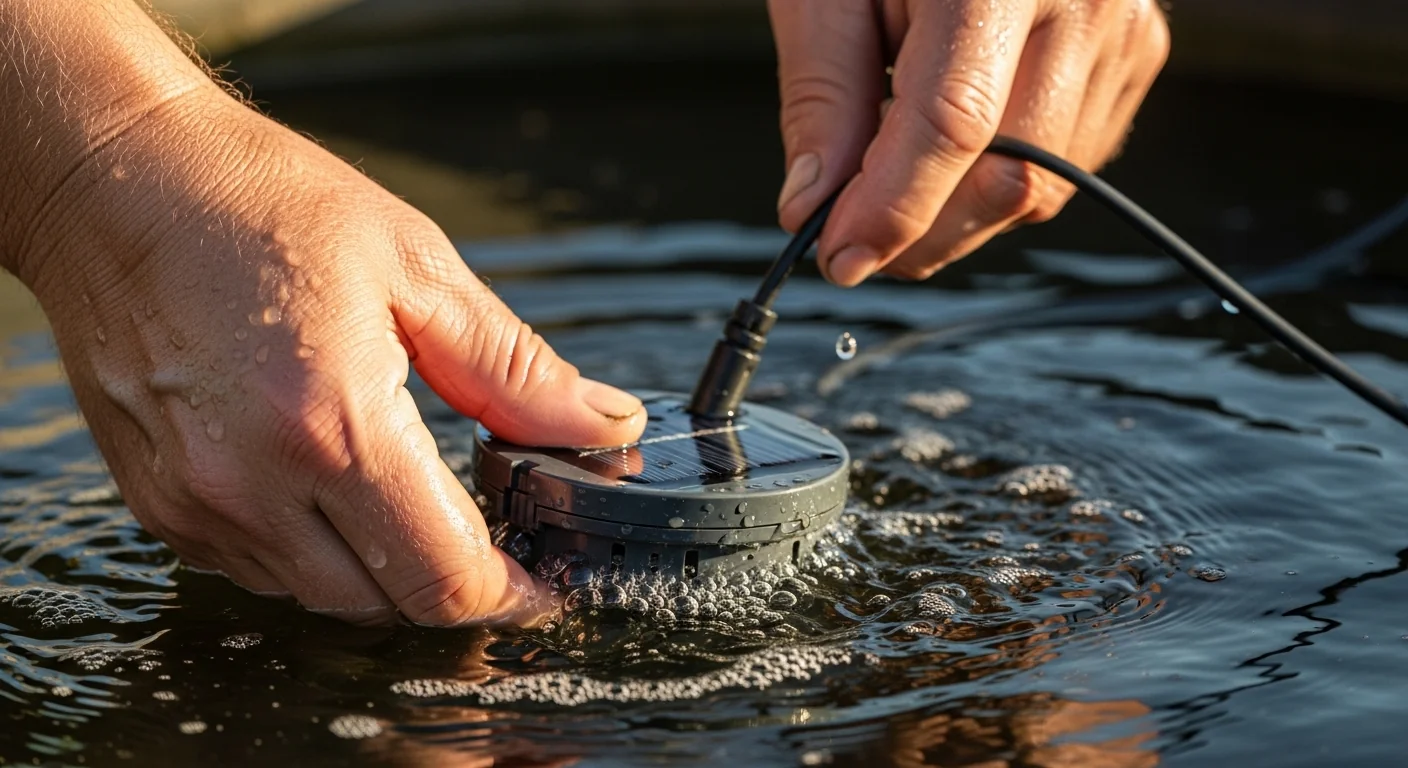
Once you have the required airflow and solar panel size from the calculator, the next decision point is system placement. A floating aerator works well for round or square troughs where the diffuser head can reach the center. For long concrete troughs, a submersible diffuser system placed at one end with a linear bubble curtain running the length provides more even oxygenation than a single floating unit. If your operation relies on gravity-fed systems with variable water levels, choose an aerator rated for the minimum operating depth, not the average depth, since the pump will be less submerged during low-water periods and airflow will vary accordingly. For operations managing both water quality and fencing around multiple paddocks, the rotational grazing calculator can help structure paddock rotation to reduce the time cattle congregate near a single high-risk water point, which reduces both nutrient input and overgrazing around the trough area.
If the calculator flagged an active bloom, the immediate sequence is: fence off access, do not treat with copper sulfate in the presence of living bloom cells, and increase water exchange by pumping or draining the tank and refilling from a clean source. Once the tank is clean and refilled, install the aerator before stocking resumes and apply barley straw extract as a preventive measure going forward. For operations carrying sheep and cattle on the same range, consider running two separate water systems, one for cattle that can tolerate copper sulfate intervention and one for sheep that cannot. Sizing and cost planning for a second system is easier with the hay cost calculator and feed planning tools to understand the full seasonal operational budget, since water system infrastructure typically competes with feed cost for the same capital budget in late summer.
FAQ
What is the difference between green algae and cyanobacteria in a stock tank?
True green algae (Chlorophyta) are eukaryotes and generally do not produce toxins harmful to livestock at bloom concentrations typical in stock tanks. Cyanobacteria are prokaryotic bacteria that produce microcystins, anatoxins, and cylindrospermopsins. The visual distinction is unreliable because both can produce blue-green or emerald-green water. The bloom trigger and stagnation index in this tool are specifically tuned to cyanobacteria bloom conditions.
Can I use the copper sulfate dose from this calculator if I have both cattle and sheep on my property?
No. The 1.0 PPM reference dose is safe for cattle and horses but exceeds the sheep tolerance threshold. Sheep accumulate copper in the liver with repeated low-level exposure and can develop fatal hemolytic crises weeks after the initial ingestion. If sheep access the same water, limit intervention to mechanical aeration, barley straw extract, and increased water turnover rate.
How often should I recalculate my aeration requirements?
Recalculate at any change in stocking density, at each seasonal temperature shift, and whenever you observe changes in the water's appearance or odor. A static calculation done in spring may significantly understate risk by midsummer when water temperature peaks, sunlight hours are longest, and grazing pressure near the trough is highest.
Does continuous aeration eliminate the need for copper sulfate entirely?
In most stock tank scenarios, yes. Adequate mechanical aeration prevents the thermal stratification and oxygen depletion that allow cyanobacteria to outcompete other organisms. Operations that maintain the minimum airflow rate calculated here and keep turnover below 3 days during bloom season typically do not require chemical algaecide treatment. Copper sulfate remains a backup option for established blooms, with the caveats detailed in the warnings section.
What is barley straw extract and does it actually work?
Barley straw extract is a liquid concentrate derived from the decomposition products of barley straw in water. During decomposition, phenolic compounds and hydrogen peroxide precursors are released that inhibit algal cell division. It is algistatic, meaning it slows growth rather than kills existing cells. Independent research supports its use as a preventive measure applied at the start of the growing season, not as a treatment for active blooms.
My tank has a solar-powered float valve that constantly refills it. Do I still need an aerator?
Yes. A float valve maintains water level by replacing evaporation losses, but it does not circulate or oxygenate the water. In a stagnant tank, the same molecules of water can sit at the surface for weeks despite the float valve operating normally. The stagnation index is based on how quickly the entire water volume is displaced, not how often the valve opens. Aeration is necessary regardless of the refill mechanism.
Conclusion
The stock tank algae problem is fundamentally an aeration and nutrient management problem, not a chemical treatment problem. The calculator here makes the relationship between physical conditions and bloom risk quantitative rather than subjective. When the stagnation index crosses 3.0 and water temperature exceeds 80°F simultaneously, the biology is in place for a cyanobacteria event. That window is predictable weeks in advance based on seasonal temperature trends and management decisions around water turnover and grazing layout. The required airflow output gives you the engineering specification to close that window before it opens.
The single most consequential mistake operations make is applying copper sulfate reactively after a bloom is visible. That sequence, wait for visual confirmation and then treat, is the opposite of what the biology requires. Toxin release during chemical lysis of living bloom cells can spike concentrations in the tank above the already dangerous pre-treatment level. Plan aeration infrastructure in the late winter or early spring when budgets allow more options. For operations managing the full livestock water and grazing picture, the barn ventilation calculator covers a parallel environmental quality concern for confined animals during the same hot months when stock tank bloom risk is highest.