
Calculating how many animals a pasture can support is not simply a matter of dividing available grass by daily appetite. The number that looks correct on paper can still trigger a slow-motion ecological collapse if it ignores what happens below the soil surface when livestock graze past a specific threshold. Forage quantity and forage biology are two different inputs, and most stocking rate guides conflate them.
This calculator uses the Animal Unit Month (AUM) framework alongside the Take-Half, Leave-Half biological threshold to compute a maximum safe herd size for a given pasture size, forage yield estimate, animal weight, and intended grazing duration. It does not predict forage regrowth during the grazing period, account for drought adjustments, or replace a site-specific NRCS range management assessment. Those caveats matter and are detailed further below.
After running your numbers, you will know the upper limit of animals your pasture can support for a defined period without crossing the root-damage threshold — and you can decide whether to reduce herd size, shorten the grazing window, or split the pasture into rotational paddocks.
Use the Tool
Pasture Stocking Density & AUM
The Yield Grid — Livestock & Homesteading Tools
| Grazing Duration | Max Herd Size | Stocking Intensity |
|---|
How This Calculator Works
The Take-Half, Leave-Half Law
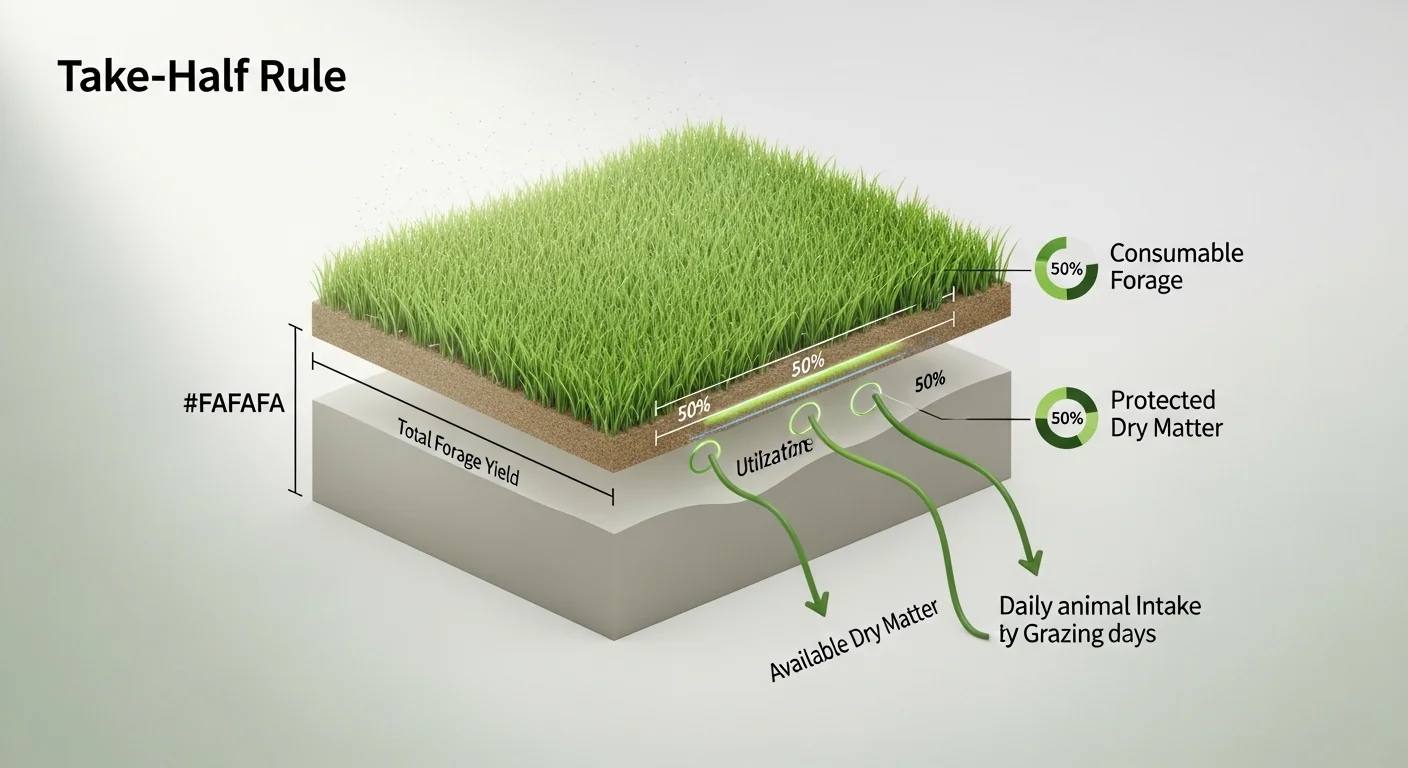
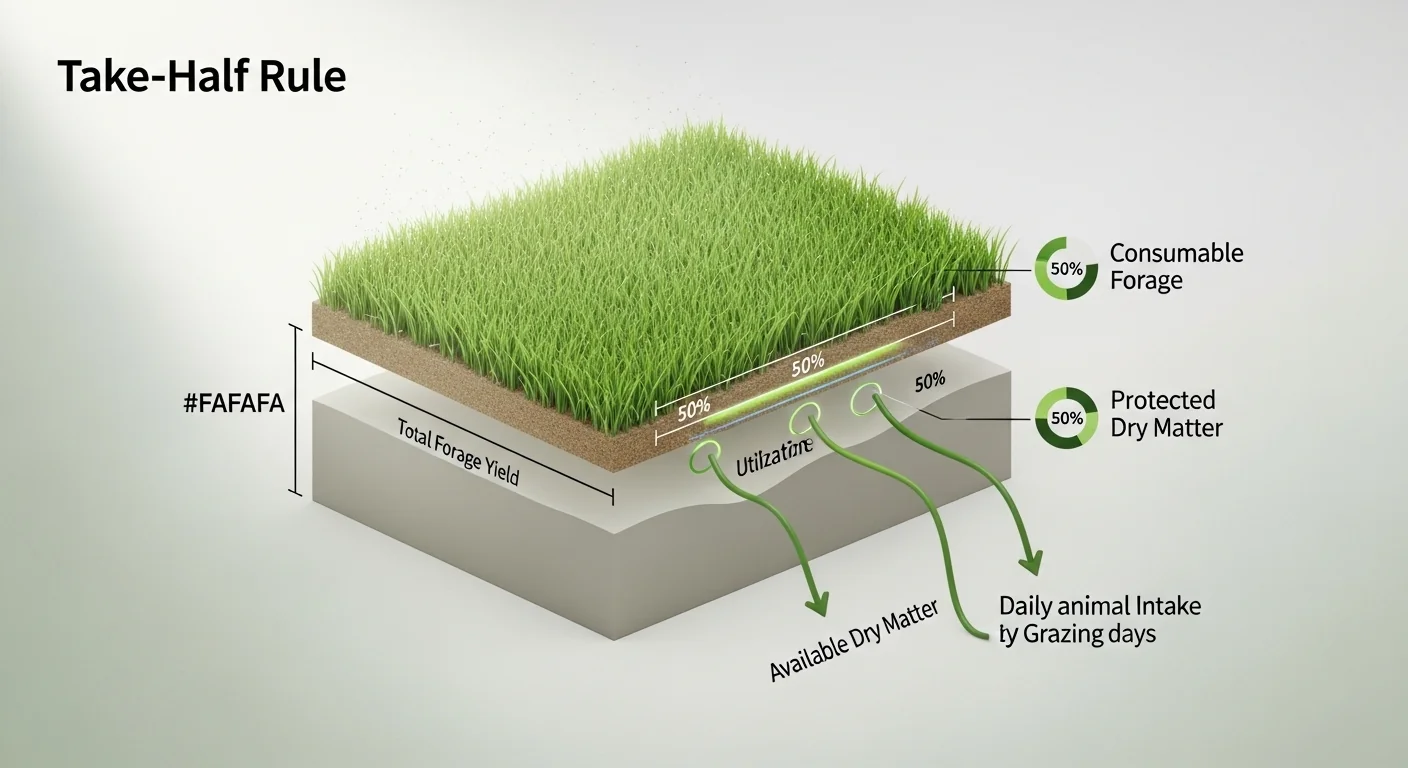
This calculator enforces the most critical biological rule in pasture management: cattle should never consume more than 50% of available forage. If more than 50% of the grass blade is grazed, the plant stops all root growth for up to 30 days while it repairs leaf tissue. This root starvation spiral — amplified by drought — can permanently destroy a pasture in a single season.
AUE = Animal Weight (lbs) ÷ 1,000A 1,200 lb cow-calf pair = 1.2 AUE. The standard Animal Unit (AU) is defined as a 1,000 lb beef cow.
Total DM = Acres × Yield × 0.50Only 50% of standing forage is available without triggering root damage. Assumptions: uniform distribution, no terrain losses, no drought adjustment.
Daily Intake = Animal Weight × 0.03Livestock consume approximately 3% of their body weight in dry matter per day. This is a standard NRC-derived average.
Max Herd = Total DM ÷ (Daily Intake × Days)This is the maximum number of animals your pasture can support for the specified duration without exceeding the 50% grazing threshold.
AUM = Max Herd × AUE × (Days ÷ 30)AUM is the standard federal grazing lease unit. One AUM = one 1,000 lb animal grazing for 30 days.
Assumptions & Limits
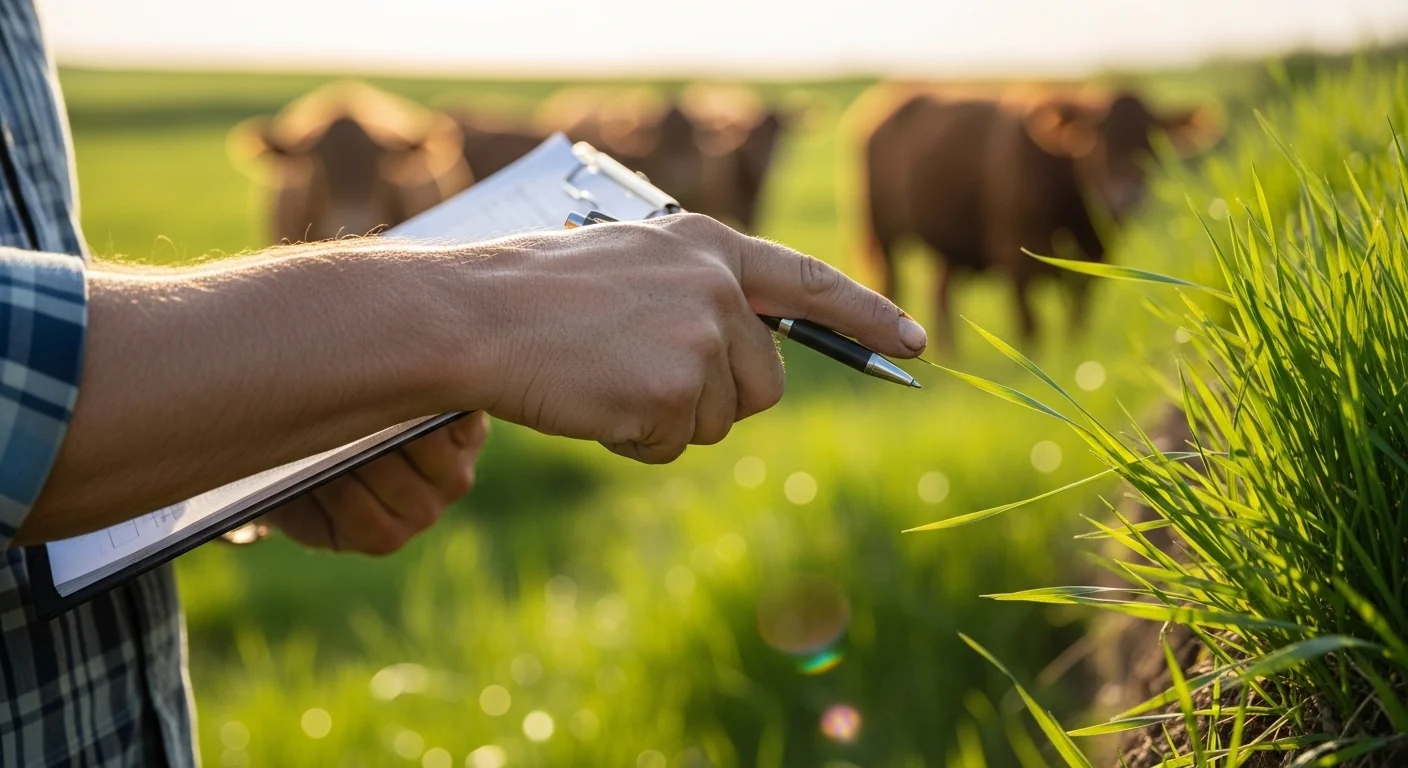
- Forage yield is user-estimated; ground-truth with a forage sampling cage + scale for accuracy.
- The 3% intake figure is an average. High-producing lactating cows may consume up to 3.5%; growing stockers may need adjustment.
- This calculator does not account for forage regrowth during the grazing period.
- Rotational grazing with rest periods of 30–60 days dramatically improves long-term carrying capacity beyond what this static model shows.
- Drought, poor soil fertility, or invasive weeds may reduce effective yield by 30–60%.
- Always consult your local NRCS or cooperative extension office for region-specific stocking rates.
Before entering values, have your pasture acreage confirmed (not estimated by eye), a forage yield figure in pounds of dry matter per acre, your animals' average live weight, and the number of days you plan to graze the area continuously. If you are working with mixed herds or multiple animal types, convert each animal to its Animal Unit Equivalent before entering a single representative weight. For operations that rotate across several paddocks, the rotational grazing calculator handles multi-paddock sequencing once you know the per-paddock carrying capacity this tool produces.
Quick Start (60 Seconds)
- Pasture Size (Acres): Enter the total grazeable area, not the total property. Exclude ponds, building lots, brushy non-grazeable corners, and any areas currently resting. Minimum entry is 0.1 acres.
- Forage Yield (lbs Dry Matter per Acre): This is standing dry matter, not green weight. Cool-season grasses typically range from 2,000 to 4,000 lbs/acre in peak season; warm-season species from 3,000 to 6,000. If unsure, use 2,000 lbs/acre as a conservative starting point. Common mistake: entering green weight, which is roughly 4 to 5 times higher than dry matter.
- Animal Weight (lbs): Use the average live weight of one animal unit in your herd. A standard 1,000 lb beef cow equals 1.0 AUE. A 1,200 lb cow-calf pair equals 1.2 AUE. Stockers at 600 lbs equal 0.6 AUE. Do not average mixed herds here -- calculate each type separately and sum the results.
- Grazing Duration (Days): Enter the number of consecutive days animals will graze this specific area before moving or being removed. Rotational operations: typically 3 to 7 days per paddock. Continuous operations: 30 to 180 days. Do not enter the total grazing season length if you plan to rotate.
- Read the result carefully: The output is a maximum, not a target. Running at the exact maximum leaves zero buffer for drought, late flushes, or forage variability across the field.
Inputs and Outputs (What Each Field Means)
| Field | Unit | What it represents | Common mistake | Safe entry guidance |
|---|---|---|---|---|
| Pasture Size | Acres | Total grazeable land area in this paddock or pasture | Including non-grazeable zones (ponds, laneways, woodlots) | Walk the perimeter; exclude at least 10% for unusable edges |
| Forage Yield | lbs dry matter / acre | Standing dry matter available before grazing begins | Entering green weight instead of dry matter (4x to 5x overestimate) | Use a forage cage + scale for accuracy; 2,000 lbs/acre is a safe default |
| Animal Weight | lbs | Live weight of one animal in the grazing unit; defines AUE | Using target weight instead of current live weight | Weigh animals; do not estimate by breed standard alone |
| Grazing Duration | Days | Consecutive days this specific area will be grazed | Entering total season length for a rotational system | For rotational systems, enter days per paddock, not total season |
| Animal Unit Equivalent (AUE) | Unitless ratio | Ratio of animal weight to the 1,000 lb standard Animal Unit | Treating all cattle as 1.0 AUE regardless of size | Calculated automatically from weight input; no entry required |
| Total DM Available | lbs | Dry matter accessible under the Take-Half rule (50% of standing crop) | Assuming all standing forage is available | Output only; enforces the biological threshold automatically |
| Daily Intake per Head | lbs dry matter / day | Estimated consumption at 3% of live body weight per day | Using green-weight intake figures (typically 8 to 10% of body weight) | Output only; NRC standard for mature beef cattle |
| Max Herd Size | Animals | Maximum number of animals at the entered weight the pasture can carry for the entered duration | Rounding up to the next whole animal without checking total forage draw | Treat as a ceiling, not a target |
| AUM | Animal Unit Months | Federal grazing lease unit: one 1,000 lb animal grazing 30 days | Confusing AUM with AUE; they measure different dimensions | Use for BLM or Forest Service grazing permit comparisons |
Worked Examples (Real Numbers)
Example 1: Small Homestead, Continuous Grazing
- Pasture size: 5 acres
- Forage yield: 2,500 lbs dry matter per acre
- Animal weight: 1,200 lbs (cow-calf pair)
- Grazing duration: 30 days
AUE = 1,200 / 1,000 = 1.2
Total DM available = 5 x 2,500 x 0.50 = 6,250 lbs
Daily intake = 1,200 x 0.03 = 36 lbs/day
Max herd = 6,250 / (36 x 30) = 5.8 cow-calf pairs
AUM = 5.8 x 1.2 x (30/30) = 6.96 AUM
Result: 5.8 cow-calf pairs for 30 days. Running 6 pairs consumes marginally above the safe threshold; 5 pairs provides a meaningful buffer for uneven grazing distribution and drought variability.
Example 2: Rotational Paddock, 7-Day Rotation
- Pasture size: 2 acres (one paddock in a multi-paddock system)
- Forage yield: 3,000 lbs dry matter per acre
- Animal weight: 1,000 lbs (standard steer)
- Grazing duration: 7 days
AUE = 1,000 / 1,000 = 1.0
Total DM available = 2 x 3,000 x 0.50 = 3,000 lbs
Daily intake = 1,000 x 0.03 = 30 lbs/day
Max herd = 3,000 / (30 x 7) = 14.3 steers
AUM = 14.3 x 1.0 x (7/30) = 3.3 AUM
Result: 14.3 steers per paddock on a 7-day rotation. A high-density short-duration rotation like this is well within biological safe limits. The 53-day rest period across remaining paddocks (assuming 8 total) is sufficient for full root recovery.
Example 3: Mid-Size Operation, 3-Week Grazing Block
- Pasture size: 50 acres
- Forage yield: 2,000 lbs dry matter per acre (dry year estimate)
- Animal weight: 1,400 lbs (mature cow-calf pair)
- Grazing duration: 21 days
AUE = 1,400 / 1,000 = 1.4
Total DM available = 50 x 2,000 x 0.50 = 50,000 lbs
Daily intake = 1,400 x 0.03 = 42 lbs/day
Max herd = 50,000 / (42 x 21) = 56.6 cow-calf pairs
AUM = 56.6 x 1.4 x (21/30) = 55.5 AUM
Result: 56.6 pairs for 21 days. At a dry-year yield of 2,000 lbs/acre, this is a tighter margin than it appears. During drought, effective yield can drop further. This scenario sits at the edge of where selective re-grazing of preferred plants before animals are moved becomes a real risk.
Reference Table (Fast Lookup)
All rows use a standard 1,000 lb Animal Unit (AUE = 1.0). Adjust proportionally for heavier animals.
| Acres | Forage Yield (lbs DM/ac) | Grazing Days | Total DM Available (lbs) | Max Herd (1,000 lb AU) | AUM | Stocking Intensity |
|---|---|---|---|---|---|---|
| 5 | 2,000 | 30 | 5,000 | 5.6 | 5.6 | Moderate |
| 5 | 3,000 | 7 | 7,500 | 35.7 | 8.3 | High (rotational only) |
| 10 | 2,500 | 30 | 12,500 | 13.9 | 13.9 | Moderate |
| 10 | 4,000 | 7 | 20,000 | 95.2 | 22.2 | High (intensive rotational) |
| 20 | 2,500 | 30 | 25,000 | 27.8 | 27.8 | Moderate |
| 20 | 2,000 | 60 | 20,000 | 11.1 | 22.2 | Light (summer continuous) |
| 50 | 3,000 | 30 | 75,000 | 83.3 | 83.3 | High |
| 50 | 2,000 | 60 | 50,000 | 27.8 | 55.6 | Moderate (watch for dry years) |
| 100 | 2,500 | 30 | 125,000 | 138.9 | 138.9 | High |
| 100 | 1,500 | 90 | 75,000 | 27.8 | 83.3 | Light (poor/drought-stressed pasture) |
Note on "High (rotational only)" rows: Short-duration high-density entries only remain biologically safe if the full rest period between grazings is honored. Moving animals back early eliminates the recovery benefit entirely.
How the Calculation Works (Formula + Assumptions)
Show the calculation steps
Step 1: Animal Unit Equivalent (AUE)
AUE = Animal Weight (lbs) divided by 1,000
The standard Animal Unit is a 1,000 lb beef cow consuming approximately 26 lbs of dry matter per day. AUE scales this baseline linearly. A 600 lb stocker = 0.6 AUE; a 1,500 lb mature bull = 1.5 AUE.
Step 2: Total Dry Matter Available (Take-Half Adjustment)
Total DM = Acres x Forage Yield x 0.50
The 0.50 multiplier enforces the Take-Half, Leave-Half threshold. Standing forage is split into two halves: the half above the midpoint of the grass blade that livestock can safely consume, and the half below that midpoint which must remain intact to protect photosynthetic capacity and root regrowth. Removing more than the top half halts root carbohydrate allocation for up to 30 days.
Step 3: Daily Dry Matter Intake per Animal
Daily Intake = Animal Weight x 0.03
The 3% of body weight figure is the NRC-derived average for mature beef cattle on moderate-quality forage. High-producing lactating dairy cows may consume 3.5%; growing stockers in rapid gain phases may vary. The 3% figure is a reasonable conservative estimate for most beef operations.
Step 4: Maximum Herd Size
Max Herd = Total DM divided by (Daily Intake x Days)
Result is expressed in number of animals at the entered weight. This is a static model -- it does not account for forage regrowth during the grazing period. For grazing periods beyond 14 days, actual carrying capacity with regrowth may be somewhat higher, but quantifying regrowth requires species identification and growth-curve data not captured here.
Step 5: Animal Unit Months (AUM)
AUM = Max Herd x AUE x (Days / 30)
AUM is the standard unit used for BLM and US Forest Service grazing permits. One AUM = one standard 1,000 lb animal grazing for 30 consecutive days. Rounding rule: the calculator displays one decimal place for herd size and two decimal places for AUM to match permit reporting conventions.
Assumptions and Limits
- Forage yield is user-entered and subject to estimation error. A forage sampling cage and postal scale provides measurements accurate to within approximately 10 to 15%; visual estimation alone can be off by 40% or more.
- The 3% daily intake rate is an average. Breed, lactation status, forage quality (particularly crude protein and digestibility), and ambient temperature all shift actual intake.
- The model assumes uniform forage distribution across the pasture. Slope, shade, water proximity, and fencing patterns cause animals to graze unevenly, concentrating impact in preferred zones.
- No regrowth during the grazing period is modeled. For short rotational windows (3 to 7 days), this is negligible. For continuous grazing beyond 30 days, regrowth can add meaningful forage but is highly species- and weather-dependent.
- The tool treats all entered acreage as fully productive. Gully erosion areas, brush encroachment, and weed-dominated zones reduce effective yield and should be subtracted from the acreage input.
- The calculator does not model soil fertility depletion, compaction from repeated traffic, or pathogen load accumulation in continuously grazed paddocks -- all of which reduce long-term carrying capacity.
- Results are not a substitute for a certified range management consultant assessment, particularly for operations on leased federal land where AUM allocations carry regulatory weight.
Standards, Safety Checks, and "Secret Sauce" Warnings
Critical Warnings
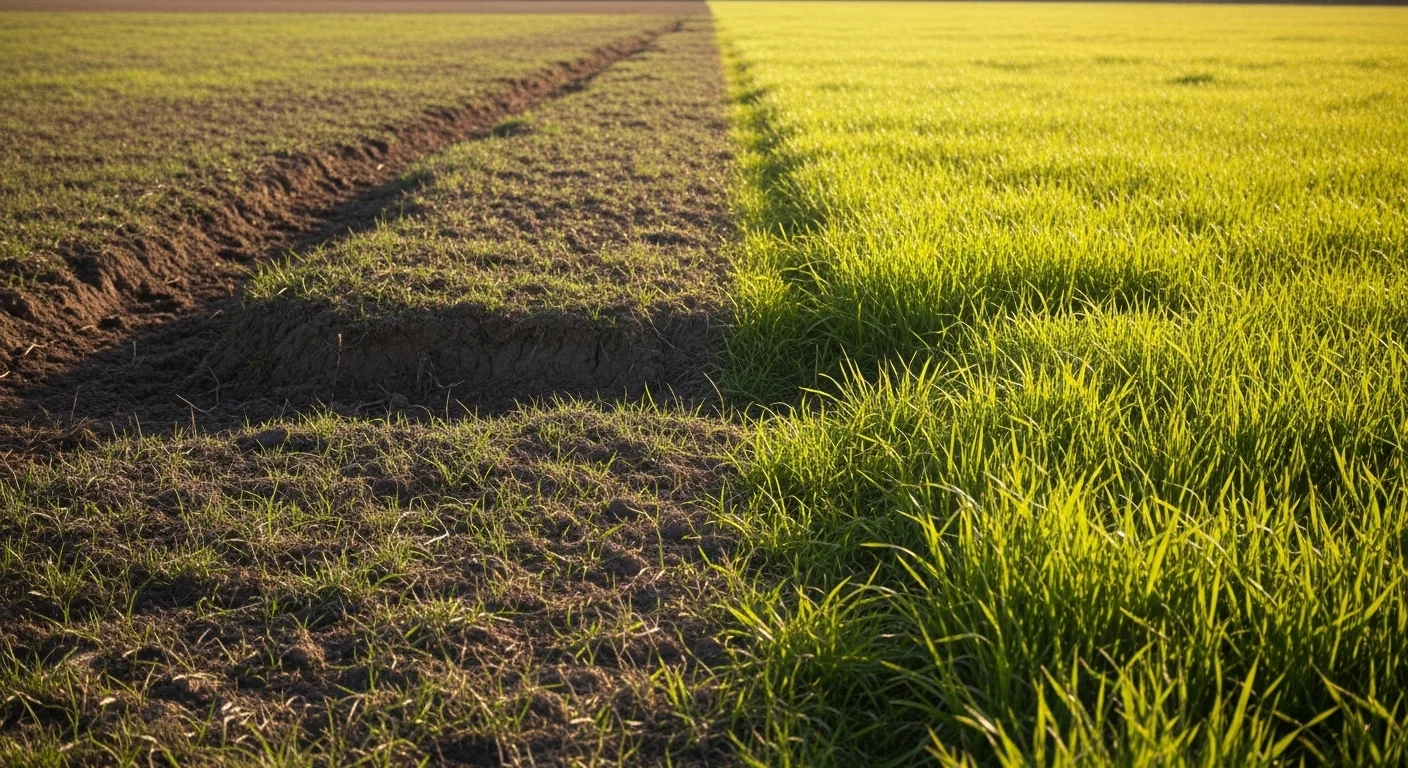
- The Root Starvation Window: When livestock graze past the 50% mark of a grass blade, the plant reroutes all energy from root growth to emergency leaf repair. This shutdown lasts up to 30 days. A single drought event during that window can kill root systems that took years to establish. The damage is not visible from above -- the pasture may still look green for weeks before the die-off becomes apparent.
- The Selective Re-Grazing Trap: In continuous grazing periods exceeding 21 days, animals preferentially re-graze recovering high-quality plants while avoiding less palatable species. The preferred plants are grazed multiple times before the herd moves, triggering repeated root shutdown cycles in exactly the plants you want to encourage. The result is a pasture that shifts toward weedy, less productive species over successive seasons.
- Drought Does Not Reduce Appetite: When forage yield drops due to drought, the calculator's max herd output drops proportionally -- but your existing herd size does not change automatically. The gap between what the pasture can support and what you are currently running is where overgrazing converts a drought year into a permanent pasture degradation event.
- Low-Yield Early Warning: Forage yields below 1,500 lbs dry matter per acre typically signal soil fertility problems, acidic pH, or weed pressure severe enough to require corrective action before re-stocking to capacity. Running animals at calculated max capacity on poor-fertility pasture accelerates compaction and bare-patch formation. Check soil pH and broadleaf coverage before relying on calculated capacity figures for degraded ground. The pasture weed killer calculator can help size a herbicide application to address broadleaf pressure before restocking.
Minimum Standards
- The Take-Half, Leave-Half rule is not a guideline -- it is a biological threshold derived from grass physiology. NRCS and most land-grant university extension programs treat 50% utilization as the maximum safe rate for sustained carrying capacity.
- Rest periods between grazings should be a minimum of 30 days and ideally 45 to 60 days during active growing season to allow full root carbohydrate recovery. Shorter rest periods compound the damage from any overgrazing event during the previous rotation.
- AUM calculations for federal permits use the 1,000 lb standard and a 26 lb/day dry matter consumption figure. This calculator uses the 3% of body weight equivalent (30 lbs/day for a 1,000 lb animal), which is a slightly more conservative estimate and appropriate for private land planning.
Competitor Trap: The most common "cows per acre calculator" on the web simply divides total standing grass by daily intake and returns a head count. That approach treats 100% of standing forage as available and will consistently produce recommendations that are double the biologically safe stocking rate. Producers who follow those numbers often see no immediate problem in year one -- the pasture appears to recover -- but root reserves are declining below the surface each season. By year three, bare spots appear and recovery requires either total destocking or costly reseeding. The 50% utilization cap is not conservative; it is the threshold at which pasture systems operate sustainably without external inputs.
For operations where water access limits grazing distribution -- a key driver of overgrazing in specific zones -- the cattle water requirement calculator helps size tanks and placement to encourage more uniform grazing pressure across the paddock.
Common Mistakes and Fixes
Mistake: Using Total Forage Instead of Available Forage
Entering the full forage yield without applying the 50% take-half adjustment is the single most common calculation error in livestock stocking guides. A pasture with 4,000 lbs of dry matter per acre does not have 4,000 lbs available for consumption -- it has 2,000 lbs that can be safely grazed. Removing more than that triggers root shutdown regardless of how lush the pasture appears. Fix: Always apply the 0.50 multiplier, or use this calculator, which enforces it automatically.
Mistake: Entering Green Weight as Forage Yield
Fresh forage weight and dry matter weight differ by a factor of roughly 4 to 5, depending on species and moisture content. Entering green weight produces a dramatically inflated carrying capacity figure. A paddock that appears to have 10,000 lbs of green grass per acre may contain only 2,000 to 2,500 lbs of actual dry matter. Fix: Convert using your forage species' typical dry matter content, or clip and oven-dry a sample. If unsure, use 2,000 lbs dry matter per acre as a conservative default. The hay bale weight calculator uses similar dry-matter conversion logic and can help calibrate your intuition for DM vs. green weight.
Mistake: Treating Calculated Max as the Operating Target
The calculator returns a ceiling, not a recommendation. Stocking at exactly the maximum provides no buffer for forage variability across the pasture, selective grazing by animals, or yield reduction during stress periods. Most range managers recommend operating at 70 to 80% of calculated capacity to maintain a functional safety margin. Fix: Multiply the max herd output by 0.75 to get a practical operating target that accounts for real-world variability.
Mistake: Ignoring Grazing Duration When Comparing Systems
Two pastures can have the same max herd output in the calculator but completely different ecological outcomes depending on how long animals stay in one area. Concentrating 50 animals in a paddock for 3 days produces a very different plant response than 5 animals grazing the same paddock for 30 days, even if total forage consumption is identical. Short-duration high-density grazing mimics natural herd behavior and tends to produce better plant response than low-density continuous grazing. Fix: Compare scenarios by adjusting the grazing duration field while holding other variables constant. The hay cost calculator can help you evaluate the economic trade-off between supplemental hay feeding and reducing stocking pressure during critical periods.
Mistake: Not Adjusting for Mixed Herds
Running a mixed herd of cows, calves, yearlings, and bulls through a single average weight entry produces an inaccurate result because intake scales linearly with body weight in this model. A 600 lb yearling and a 1,400 lb mature cow consume very different amounts of forage per day. Fix: Calculate each animal class separately using its average weight, determine the max head count for each class, and size the paddock to accommodate the combined total daily intake across all classes.
Next Steps in Your Workflow
Once you have a safe herd size for your pasture, the practical question becomes how to manage the rest period effectively. If your calculation supports a short-duration rotation, the next design task is subdividing the pasture into paddocks that can each sustain the full herd for 3 to 7 days, with enough paddocks total to give each one a minimum 30-day rest before reentry. Fencing layout, water access, and shade distribution all affect whether animals will graze the paddock uniformly or concentrate in corners. Addressing those inputs before the first rotation produces better results than adjusting after bare spots develop. The electric fence calculator can help you plan wire lengths and energizer requirements for the subdivision fencing.
After the grazing season, carrying capacity figures from this year inform next year's planning -- but forage yield is not static. Soil fertility, rainfall, and species composition all shift the yield baseline year over year. Running the calculator at the start of each grazing season with a fresh forage sample gives you a new ceiling to work from rather than assuming last year's capacity still applies. If your operation carries animals through winter on stored feed, the winter cattle feed calculator pairs directly with the stocking capacity output from this tool to estimate total hay tonnage requirements for the off-season period.
FAQ
What is an Animal Unit Month (AUM) and why does it matter?
An Animal Unit Month (AUM) is the amount of forage one standard 1,000 lb beef cow consumes in 30 days. It provides a standardized unit for comparing grazing capacity across different animal types, pasture sizes, and lease agreements. Federal grazing permits on BLM and National Forest land are issued in AUMs, so the figure has both management and regulatory relevance for ranchers operating on public land.
What is the difference between AUM and AUE?
AUE (Animal Unit Equivalent) is a ratio expressing one animal's size relative to the 1,000 lb standard. AUM is a time-based consumption unit. A 1,400 lb cow has an AUE of 1.4, meaning it consumes 40% more forage per day than the standard unit. AUM combines AUE and time: that same cow grazing for 30 days equals 1.4 AUM. The two terms measure different dimensions and are not interchangeable.
How does the Take-Half, Leave-Half rule work biologically?
Grasses store carbohydrate reserves in root tissue to fuel regrowth after grazing events. When more than roughly half the leaf blade is removed in a single grazing event, the plant must redirect all stored root carbohydrates upward to rebuild photosynthetic leaf area quickly. Root growth stops entirely during this period. If a drought or soil moisture deficit occurs while roots are in this shutdown state, the plant cannot access deeper moisture and may die. Maintaining the lower half of the leaf blade intact preserves the photosynthetic surface needed to fund root recovery without drawing down root reserves.
Can I use this calculator for horses, sheep, or goats?
Yes, with an adjusted weight. The 3% dry matter intake estimate is broadly applicable across ruminants and horses at maintenance. A 1,100 lb horse equals approximately 1.1 AUE. Sheep and goats typically range from 0.1 to 0.2 AUE depending on size. Enter the average individual weight and the calculator scales accordingly. Note that sheep and goats graze more selectively and at lower heights than cattle, which means the effective safe utilization threshold may differ in practice.
What forage yield should I enter if I have not sampled my pasture?
Use 2,000 lbs dry matter per acre as a conservative default for non-irrigated cool-season pasture in average rainfall years. For warm-season species in the Southern Plains during good rainfall, 3,000 lbs per acre is a reasonable starting estimate. These are starting points only -- actual yields vary widely by species, soil fertility, and rainfall. A forage sampling cage and scale, available for under $50, significantly improves estimate accuracy.
How is this different from a simple cows-per-acre calculator?
A basic cows-per-acre calculation divides total forage by daily consumption without applying any utilization limit. This tool enforces the 50% Take-Half threshold as a non-negotiable biological parameter, outputs the Animal Unit Month for permit and record-keeping use, and includes grazing duration as an explicit variable that changes the safe stocking outcome. Short rotations support more animals because the forage math is bounded by time, not total season capacity.
Conclusion
Pasture stocking rate math is not complicated, but the version most producers learn omits the single most consequential variable: the biological utilization limit that protects root systems from permanent damage. This calculator hard-codes that limit into every result, which means the output is a number you can act on without mentally correcting for a missing safety factor. The goal is not a conservative guess -- it is a number derived from the actual forage biology of the plants your operation depends on.
The most expensive mistake in pasture management is not immediate. It accumulates quietly below the soil surface over two or three seasons of 80% or 100% forage utilization, then surfaces as bare ground and weed encroachment that costs far more to remediate than the savings realized from the extra animals. Run the numbers before each grazing season, adjust for forage yield variability, and keep actual stocking pressure below the calculated ceiling. For operations managing multiple species and forages, the feed conversion ratio calculator can help evaluate whether supplemental feeding is more economical than reducing stocking density during low-forage periods.