
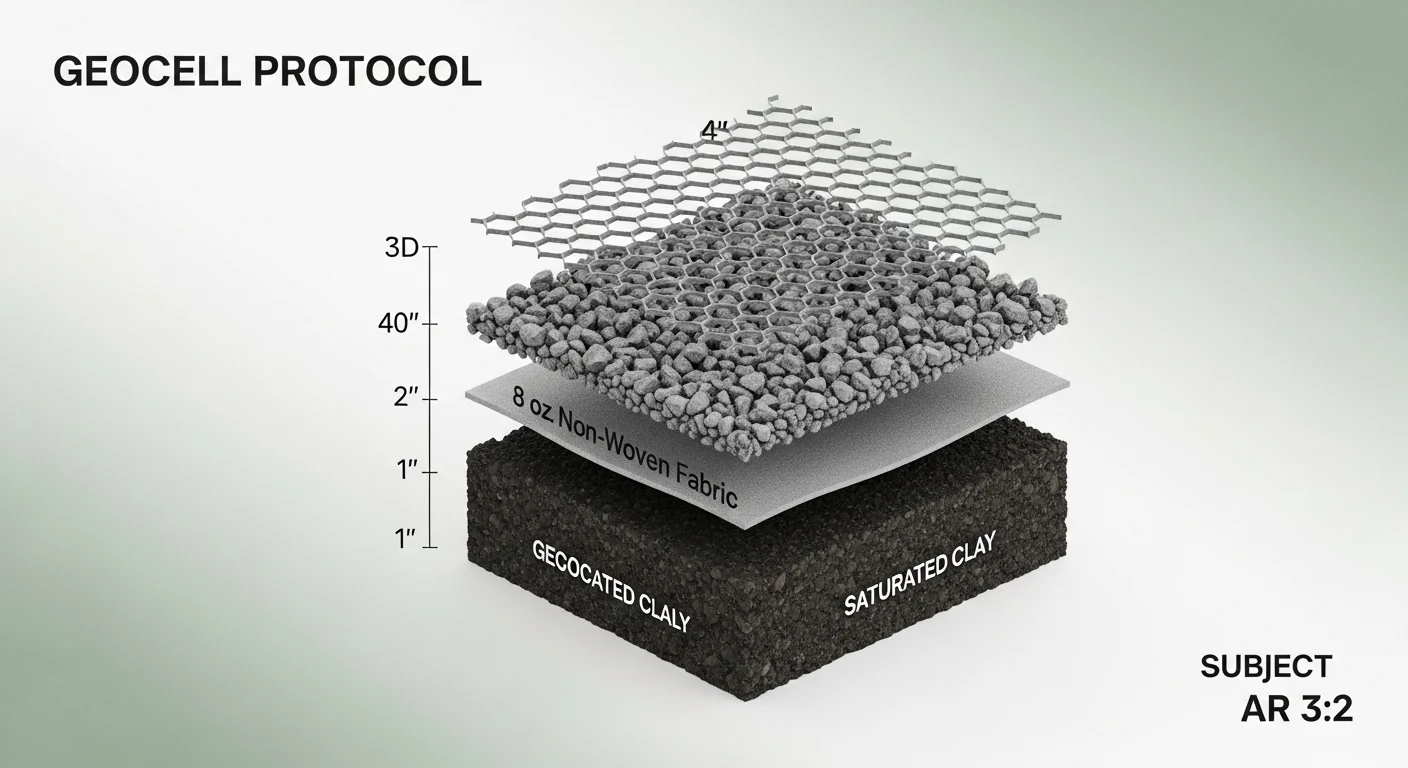
The problem with a muddy horse gate is not the mud itself. It is the clay underneath. Saturated heavy clay behaves like a fluid under repeated dynamic load, and a 1,000 lb horse concentrating weight through a single hoof at each stride delivers far more point pressure than most horse owners account for. Gravel dumped directly onto that surface does not stabilize it. It disappears into it, sometimes within a single wet season, leaving the same mud bog the owner started with and a materials cost that cannot be recovered.
This calculator computes the exact cubic yardage of geocell fill and base rock, the required excavation depth, and the square footage of non-woven geotextile fabric needed to execute a permanent, load-distributed stabilization system for any paddock gate or high-traffic horse area. It does not estimate drainage for perimeter french drain systems, slope correction, or whole-pasture grading. Its scope is specifically the gateway zone where horses congregate, exit, and re-enter, which is where mud failure is almost always most severe.
After running the tool, a horse owner can place a material order with a supplier, knowing the cubic yardage of crushed angular rock needed beneath the geocell panels, the exact geocell coverage area, and whether their current plan includes the geotextile fabric layer that makes the entire system work.
Use the Tool
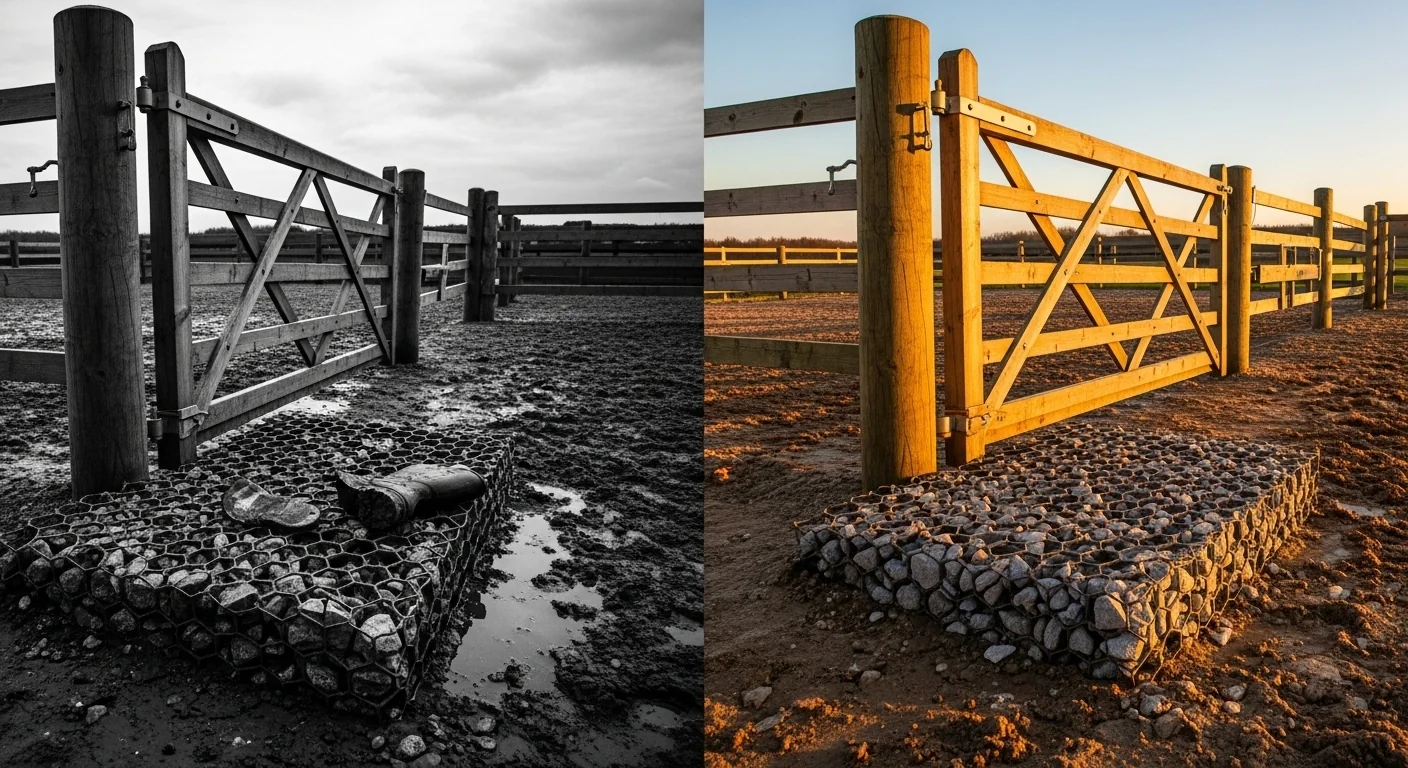
Horse Mud Management Calculator
Estimate geocell fill, base rock, excavation and non-woven geotextile for a high-traffic horse area.
Before entering values, measure the gate or high-traffic zone as a rectangle and multiply length by width to get square footage. Have a mud depth estimate ready, assessed by physically stepping into the worst area at the wettest point of the season. Know your soil type from previous digging or a basic squeeze test: heavy clay holds its shape when squeezed into a ball; silt and loam crumble. If you are also planning to rotationalize pasture access to reduce gate pressure over time, the rotational grazing calculator pairs directly with this tool for whole-property planning.
Quick Start (60 Seconds)
- Area (sq ft): Measure the length and width of the muddy zone in feet, then multiply. A typical single-gate turnout area runs 200 to 600 sq ft. Do not include the entire run or paddock, only the saturated high-traffic section.
- Mud Depth / Severity: Ankle deep means boots sink 3 to 5 inches. Shin deep is 6 to 8 inches. Knee deep is 10 to 12 inches. Use conditions at the worst point of the wet season, not the current depth.
- Soil Type: Choose Heavy Clay if water pools on the surface after rain and the soil sticks to a shovel. Choose Silt/Mixed Loam if water drains within hours and the soil is looser and darker.
- Geocell Grid Height: Select 4-inch panels for standard horse gate areas. Use 6-inch for areas with multiple large draft horses or confirmed knee-deep bog conditions. The 2-inch option is not recommended for heavy clay under horse traffic.
- Geotextile Fabric: Always select "Yes." If the plan is to skip this layer to reduce material cost, the calculator will show the gravel sinkhole alert. There is no workaround for this requirement on clay soil.
- Units reminder: The area input is in square feet, not square yards. Do not convert before entering. The calculator handles all unit conversions internally.
- Click Calculate only after all five fields are filled. The tool validates each input before running and will not produce results if any field is blank or out of range.
Inputs and Outputs (What Each Field Means)
| Field Name | Unit | What It Means | Common Mistake | Safe Entry Guidance |
|---|---|---|---|---|
| Paddock Gate / High-Traffic Area | sq ft | The total surface area of the mud problem zone, measured as a rectangle | Including adjacent pasture or run area inflates the material estimate | Measure only the saturated zone. 1 to 50,000 sq ft accepted. |
| Mud Depth / Severity | Categorical (inches) | How deep a boot sinks at the worst point, which determines required excavation depth | Using current dry-season depth instead of peak wet-season depth causes under-excavation | Estimate at the worst seasonal conditions, not today's conditions. |
| Soil Type | Categorical | Whether the native soil is heavy clay or a silt/loam mix, which affects sinkhole risk and drainage warnings | Guessing "silt" when the soil is actually clay suppresses the critical fabric warning | Confirm by squeezing a handful: clay holds a ball, silt crumbles. |
| Geocell Grid Height | inches (2, 4, or 6) | The vertical height of the geocell honeycomb panel, which sets the depth of the top stabilization layer | Choosing 2-inch panels on heavy clay to save money results in inadequate load distribution | Default to 4-inch for horse traffic. Use 6-inch for draft breeds or extreme bog conditions. |
| Geotextile Fabric Included | Yes / No | Whether 8 oz non-woven geotextile fabric will be installed as the separator layer between native soil and base rock | Selecting "No" to reduce cost eliminates the only mechanism that prevents gravel migration into clay | Always select Yes. The warning alert documents what happens when this layer is omitted. |
| Geocell Volume (output) | cubic yards | The volume of crushed aggregate needed to fill the geocell panel layer | Ordering in cubic feet instead of cubic yards results in a 27x underage | Give this number directly to the supplier in cubic yards. |
| Base Rock Volume (output) | cubic yards | The volume of crushed angular base rock to fill the layer between the geotextile fabric and the bottom of the geocell panels | Using rounded river rock instead of crushed angular rock prevents interlocking inside the cells | Specify 3/4-inch minus crushed angular rock to suppliers, never smooth river gravel. |
| Excavation Depth (output) | inches | How far below existing grade to excavate before installing fabric, base rock, and geocell | Partial excavation on knee-deep bog conditions leaves saturated clay beneath the new system | Excavate to full depth before any material installation begins. |
| Geotextile Fabric (output) | sq ft | Total fabric square footage with 10% added for seam overlap | Ordering the exact area without seam allowance leaves gaps at edges where migration begins | Order the full calculated quantity; overlaps are built into the number. |
| Total Excavation Volume (output) | cubic yards | Total volume of material to remove, needed for disposal hauling or fill placement elsewhere on the property | Forgetting to account for spoil removal when no on-site placement exists leads to project delays | Arrange spoil disposal before excavation begins if there is no low fill area on the property. |
Planning the broader paddock infrastructure around this repair? The barn ventilation calculator covers another common facility bottleneck that affects horse health alongside ground conditions.
Worked Examples (Real Numbers)
Scenario 1: Standard Single-Gate Turnout, Ankle-Deep Mud, Heavy Clay
- Area: 200 sq ft
- Mud severity: Ankle deep (6-inch excavation)
- Soil type: Heavy clay
- Geocell grid height: 4 inches
- Geotextile fabric: Yes
Result: Geocell volume = 2.47 cu yd | Base rock = 1.23 cu yd | Fabric = 220 sq ft | Excavation depth = 6 inches
A 200 sq ft gate area is typical of a single two-horse pasture access point. The base rock layer in this scenario is only 2 inches thick because the 4-inch geocell panel accounts for most of the 6-inch excavation depth. This is the minimum viable installation on clay.
Scenario 2: Multi-Horse Run-In Pad, Knee-Deep Bog, Heavy Clay
- Area: 600 sq ft
- Mud severity: Knee deep (12-inch excavation)
- Soil type: Heavy clay
- Geocell grid height: 4 inches
- Geotextile fabric: Yes
Result: Geocell volume = 7.41 cu yd | Base rock = 14.81 cu yd | Fabric = 660 sq ft | Excavation depth = 12 inches
Knee-deep mud on clay requires the full 12-inch excavation, which creates an 8-inch base rock layer beneath the geocell. Note that the base rock volume at this depth nearly doubles the geocell volume. Suppliers typically quote crushed rock at a lower unit price than geocell panels, so the total cost distribution may be less than expected despite the larger base rock quantity.
Scenario 3: Larger Multi-Gate Area, Shin-Deep Mud, Silt Loam
- Area: 1,000 sq ft
- Mud severity: Shin deep (9-inch excavation)
- Soil type: Silt/mixed loam
- Geocell grid height: 6 inches
- Geotextile fabric: Yes
Result: Geocell volume = 18.52 cu yd | Base rock = 9.26 cu yd | Fabric = 1,100 sq ft | Excavation depth = 9 inches
On silt loam the sinkhole failure risk is lower, but the 6-inch geocell panel here consumes most of the 9-inch excavation depth, leaving only 3 inches for base rock. If budget permits, increasing excavation depth by 3 inches on silt gives the base rock layer more mass and improves long-term drainage under heavy use.
Reference Table (Fast Lookup)
All rows use a 4-inch geocell grid. Excavation depth is determined by mud severity. Fabric includes the 10% seam overlap allowance.
| Area (sq ft) | Mud Severity | Excavation (in) | Geocell Fill (cu yd) | Base Rock (cu yd) | Geotextile Fabric (sq ft) |
|---|---|---|---|---|---|
| 200 | Ankle Deep | 6 | 2.47 | 1.23 | 220 |
| 400 | Ankle Deep | 6 | 4.94 | 2.47 | 440 |
| 600 | Ankle Deep | 6 | 7.41 | 3.70 | 660 |
| 200 | Shin Deep | 9 | 2.47 | 3.09 | 220 |
| 400 | Shin Deep | 9 | 4.94 | 6.17 | 440 |
| 600 | Shin Deep | 9 | 7.41 | 9.26 | 660 |
| 200 | Knee Deep | 12 | 2.47 | 4.94 | 220 |
| 600 | Knee Deep | 12 | 7.41 | 14.81 | 660 |
| 1,000 | Knee Deep | 12 | 12.35 | 24.69 | 1,100 |
How the Calculation Works (Formula + Assumptions)
Show the calculation steps
Step 1: Determine excavation depth from mud severity.
Ankle deep corresponds to 6 inches of excavation. Shin deep corresponds to 9 inches. Knee deep corresponds to 12 inches. If the selected geocell grid height exceeds the mud-derived excavation depth, the excavation depth is raised to match the grid height to ensure the geocell panel fits within the excavated zone.
Step 2: Calculate geocell fill volume.
Geocell Volume (cu yd) = Area (sq ft) x (Grid Height (in) / 12) / 27
The grid height is converted from inches to feet by dividing by 12. The result in cubic feet is divided by 27 to convert to cubic yards. Rounding is to two decimal places.
Step 3: Calculate base rock volume.
Base Rock (cu yd) = Area (sq ft) x ((Excavation Depth - Grid Height) (in) / 12) / 27
The base rock layer fills the space between the bottom of the geocell panel and the geotextile fabric. If the grid height equals or exceeds the excavation depth, base rock volume returns zero and the excavation depth is increased to the grid height.
Step 4: Calculate geotextile fabric area.
Fabric (sq ft) = Area x 1.10
Ten additional square footage is added to the raw area to account for seam overlaps at panel edges. This is a conservative overlap allowance. Steep slopes or many interior seams may require additional fabric.
Step 5: Calculate total excavation volume.
Excavation Volume (cu yd) = Area (sq ft) x (Excavation Depth (in) / 12) / 27
This is the total volume of native soil to be removed, used for spoil disposal or hauling estimation.
Unit conversion reference: 1 cubic yard = 27 cubic feet. 1 foot = 12 inches.
Assumptions and Limits
- Excavation depth categories are based on standard practice for horse-traffic stabilization. Actual saturated clay layers may extend deeper than the mud depth categories suggest, particularly in locations with high water tables or subsurface springs.
- The formula assumes a single geocell layer installation. Stacked or double-layer geocell systems, sometimes used under permanent concrete or asphalt overlays, are not supported.
- Base rock material is assumed to be crushed angular aggregate (3/4-inch minus), which self-compacts and locks inside geocell cells under traffic. Smooth or rounded river rock does not interlock and is not a valid substitution.
- Geotextile overlap is set at a flat 10% addition. Complex shapes with multiple interior seams, or areas wider than 15 feet requiring fabric rolls to be joined mid-field, may need 15 to 20% additional fabric.
- The tool does not account for slope correction, perimeter drainage, or uphill water diversion. Areas receiving concentrated water flow from rooflines, slopes, or compacted laneways may require grading or french drain work before or alongside the geocell installation.
- Maximum area input is 50,000 sq ft. For larger installations spanning multiple gate areas, calculate each zone separately and sum the results.
- Results are material quantity estimates. Supplier product sizing (geocell panel dimensions, fabric roll widths) may require rounding up to the nearest panel or roll. Consult a licensed contractor for installations exceeding 5,000 sq ft or in areas with confirmed high water tables.
Standards, Safety Checks, and Secret Sauce Warnings
Critical Warnings
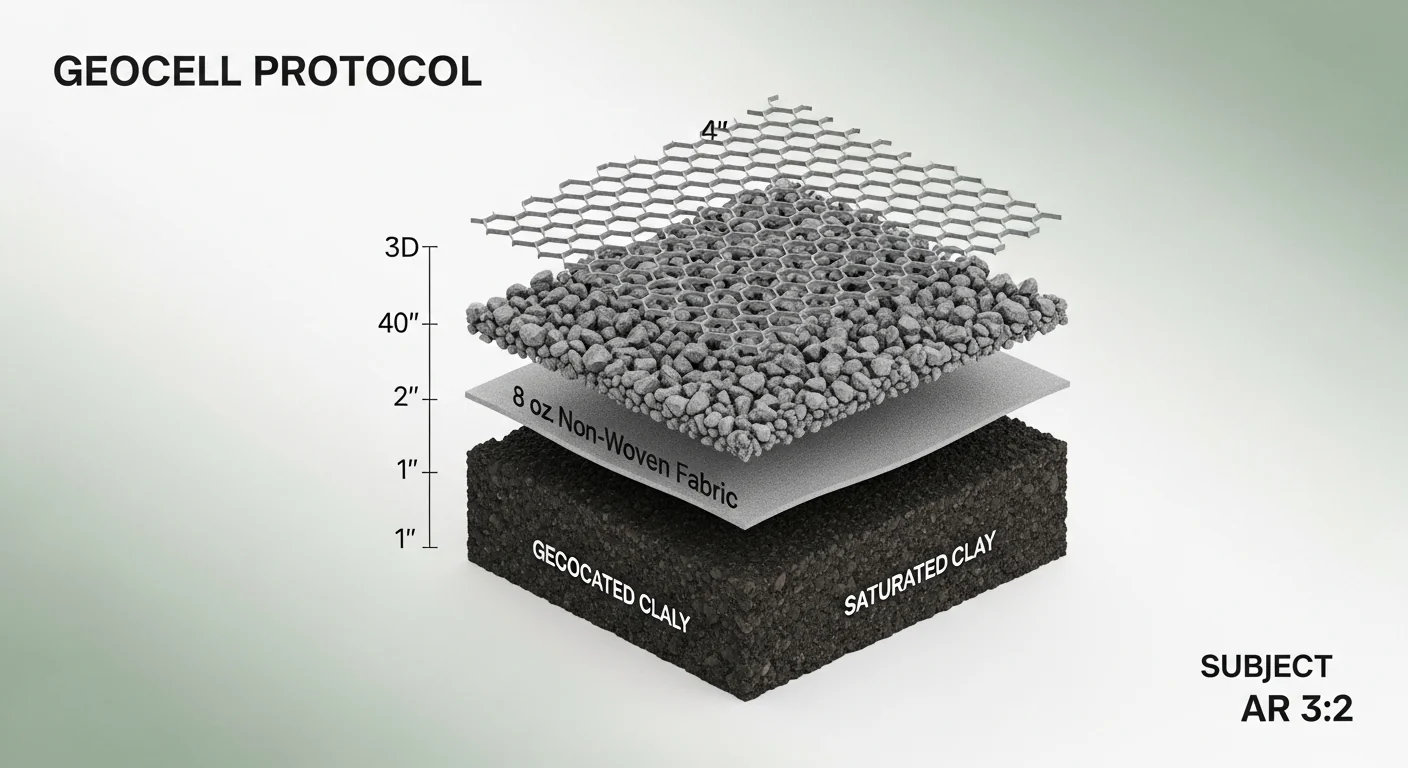
- No geotextile fabric = guaranteed failure on clay. The geotextile separator is not optional. It is the physical membrane that prevents crushed aggregate from migrating downward into the clay matrix under hoof load. Without it, even correctly sized geocell panels will eventually compact the gravel into the soil and the mud will return.
- Knee-deep mud requires full 12-inch excavation, no partial depth. Attempting a shallow excavation of 6 inches on a knee-deep bog leaves the most saturated clay layer intact and directly beneath the new system. Seasonal freeze-thaw or sustained wet periods will cause upward migration of that layer into the base rock.
- Rounded river rock is not interchangeable with crushed angular base rock. The interlocking geometry of crushed angular aggregate is what allows the base rock layer to resist lateral displacement under load. Smooth river gravel shifts, compresses, and migrates. This failure mode appears identical to gravel sinkhole failure but is caused by the wrong rock type, not the absence of geotextile.
- 2-inch geocell panels are undersized for 1,000 lb horse traffic on clay. The 2-inch option is included in the calculator for completeness. The load distribution geometry of a 2-inch cell is not sufficient to absorb the point impact of a shod hoof at speed on saturated clay. The failure is slow but consistent.
Minimum Standards
- Geotextile fabric: minimum 8 oz non-woven. Woven geotextile clogs under fine silt migration and loses permeability over time. Non-woven fabric allows water passage while blocking particle movement.
- Geocell panel height: minimum 4 inches for any area supporting horses heavier than 800 lb on clay soil.
- Base rock layer: minimum 2 inches after geocell depth is subtracted from excavation depth. If the math returns zero or negative base rock, increase excavation depth by 2 to 3 inches beyond the mud-severity default.
- Fabric seam overlap: minimum 12 inches at all panel seams, pinned or stapled before base rock is placed. Overlapping in the direction of the dominant slope prevents water from undercutting the seam.
Competitor Trap: Nearly every competing guide on fixing muddy horse gates recommends a load of gravel as the first step and geotextile fabric as an optional upgrade. This framing has it backwards. The gravel is the optional upgrade. The geotextile and the geocell structure are the system. Gravel placed without a separator layer on clay does not fill a hole. It borrows time from the next mud season while transferring material cost from the supplier's yard to a depth of 18 inches below your gate. The horse owner who learns this after two failed gravel loads has already paid for the correct system once. The calculator forces this decision to the surface before any material is purchased.
Fence infrastructure decisions are closely tied to pasture drainage planning. The H-brace fence calculator covers the tensioned corner post systems often needed when relocating or adding gate locations to reduce congregation points. For full perimeter electrification planning alongside mud remediation, the electric fence calculator addresses wire and energizer sizing for horse paddocks.
Common Mistakes and Fixes
Mistake: Measuring the Mud Area During Dry Conditions
A paddock gate that looks manageable in August may expand to twice its size by February. The excavation depth and area inputs should reflect peak wet-season conditions, not current conditions. Using dry-season measurements results in undersized excavations that leave saturated clay at the perimeter of the repair zone, where it will creep inward after the first wet winter.
Fix: Walk the area after the wettest week of the previous year and flag the extent of visible mud before measuring.
Mistake: Ordering Geocell Fill and Base Rock in Cubic Feet Instead of Cubic Yards
Suppliers price and deliver crushed rock in cubic yards. The calculator outputs cubic yards. Entering cubic yard quantities into a supplier order form expecting cubic feet results in receiving roughly 4 times too little material. A 4 cu yd order delivered as if it were 4 cubic feet worth of rock leaves the project severely short on site.
Fix: Confirm with the supplier that the quantity being quoted is in cubic yards before finalizing the order. The repeated cost of remediation for this project type, when material quantities are consistently underestimated, is documented in the hay cost calculator's context of ongoing annual horse management budgeting.
Mistake: Installing Geocell Panels Before Compacting the Base Rock Layer
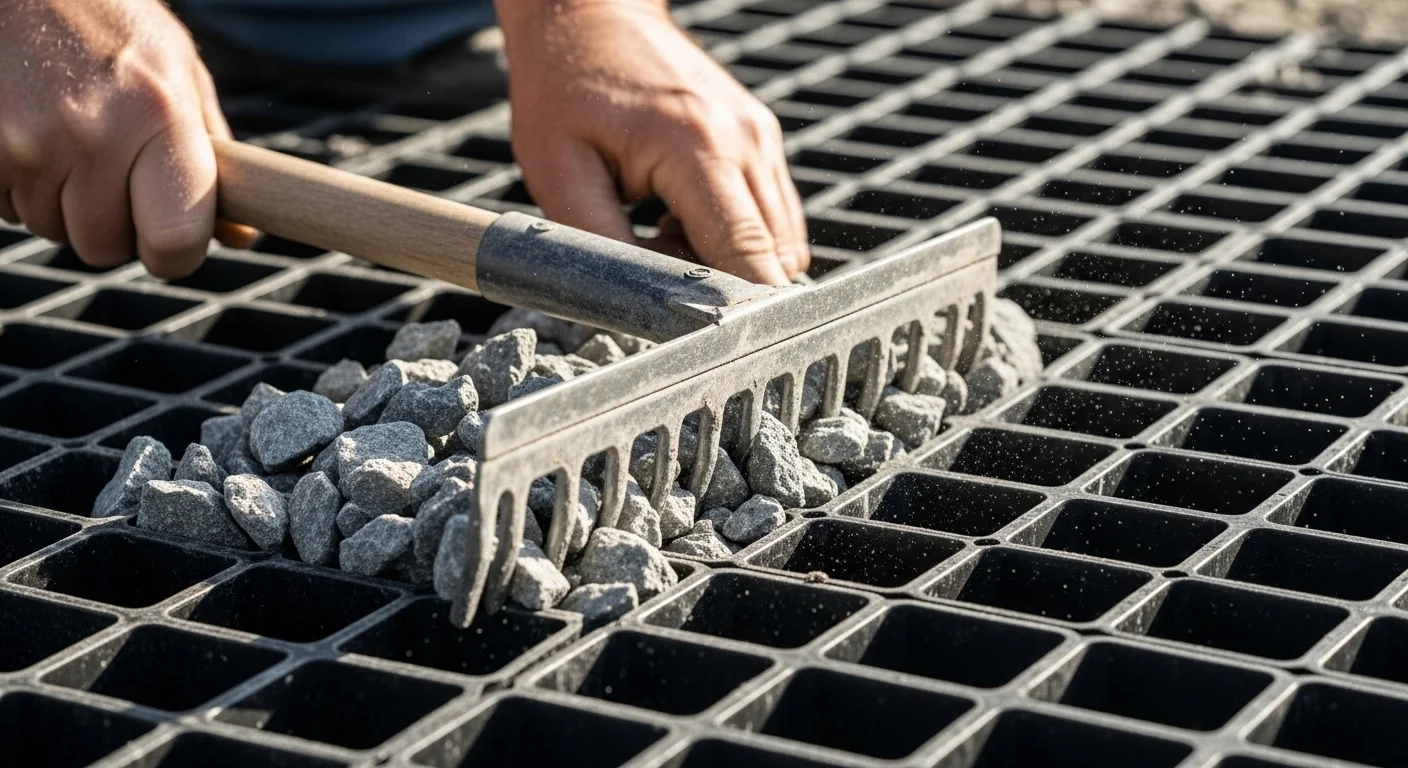
Base rock placed loosely on geotextile fabric and not compacted before geocell panel installation will settle unevenly under the first season of traffic. The geocell panels, which are flexible and conform to the surface beneath them, will develop low spots and rocking sections that concentrate load and accelerate wear.
Fix: Use a plate compactor or hand tamper to compact the base rock layer before unrolling and securing geocell panels. Two passes in perpendicular directions are sufficient for most residential installations.
Mistake: Placing Geocell Panels with Cells Running Parallel to the Gate Direction of Travel
Geocell panels have a preferred orientation relative to traffic direction. When cells are aligned parallel to horse movement, the cell walls provide less resistance to shear force from hooves pushing forward during stride. Panels oriented with the expansion direction perpendicular to primary horse travel resist lateral movement more effectively.
Fix: Expand the geocell panels so that the long cell walls run perpendicular to the direction of heaviest traffic flow before staking them in place.
Mistake: Skipping the Uphill Water Source Inspection
Geocell systems fail faster in areas that receive concentrated water input from an outside source: rooflines without gutters draining toward the gate, compacted laneways that channel runoff, or a slope above the gate that funnels water to the lowest point. The geocell system manages load distribution and drainage through the base, but it does not redirect surface water flow.
Fix: Before excavating, trace any runoff paths leading to the gate area and correct them with grading, gutters, or a diversion swale upslope of the installation zone.
Next Steps in Your Workflow
After calculating material quantities, the next step is confirming a supplier can deliver crushed angular aggregate (3/4-inch minus) in the required cubic yardage. Not all aggregate suppliers carry true angular crush; some regional suppliers carry predominantly rounded river rock, which is not suitable for this application. Ask specifically for "crushed angular base rock" or "road base minus" and visually confirm the angular geometry before accepting delivery. Schedule spoil removal or identify a low-fill area on the property before excavation begins, since wet clay spoil is dense and heavy.
The gate area repair fits within a broader property drainage and fencing plan. If the high-traffic mud zone is connected to a pasture with overgrazing pressure at entry points, the pasture stocking rate calculator can help evaluate whether the congregation behavior driving the mud is also a function of animal density relative to available forage. Addressing both at once reduces the seasonal pressure on any single gate location. For properties with multiple water access points contributing to mud zones, the stock tank algae calculator is a related tool in the livestock water management cluster.
FAQ
Why does gravel always seem to disappear into a muddy horse gate?
Heavy clay soil becomes plastic under sustained saturation. When a 1,000 lb horse strikes gravel at a gate, the point impact drives individual stones downward into the clay matrix. This repeats thousands of times per week. Without a physical separator layer, the gravel migrates into the clay and becomes unrecoverable. The process accelerates on slopes and in freeze-thaw cycles.
Can I use road base or recycled concrete instead of crushed angular rock?
Road base (3/4-inch minus crushed aggregate) is exactly the correct material. Recycled concrete aggregate can work if it is crushed to angular geometry and not contaminated with fines that reduce drainage. Avoid smooth river gravel, pea gravel, or any rounded aggregate. The interlocking geometry of angular crush is what prevents lateral displacement inside the geocell cells.
Is geotextile fabric required on silt soil as well as clay?
Yes. While silt and loam soils have better natural drainage and lower plasticity than heavy clay, fine silt particles will still migrate upward through base rock under sustained dynamic load over time. The geotextile fabric is a low-cost insurance layer on any soil type. Omitting it on silt may delay failure by a few seasons rather than prevent it entirely.
What is the difference between woven and non-woven geotextile fabric?
Non-woven geotextile is made from bonded synthetic fibers that allow water to pass through in all directions while physically blocking soil particles. Woven geotextile has open weave intersections that can clog with fine silt migration over time, reducing permeability and eventually concentrating water pressure. For horse paddock applications on native soil, non-woven fabric at 8 oz or heavier is the correct specification.
How long does a geocell installation last before it needs replacement?
A correctly installed geocell system on well-drained base rock with intact geotextile fabric has an expected service life of 10 to 20 years under normal horse traffic, based on manufacturer specifications for HDPE geocell panels. Failure typically appears as cell wall deformation or panel edge separation, not as sudden collapse. Annual inspection of panel edges and surface drainage helps catch early wear.
Does this calculator work for non-horse livestock like cattle or goats?
The formula applies to any high-traffic livestock gate or congregation point. The mud severity classifications and material quantities are geometry-based, not species-specific. For cattle, the same excavation and base rock formulas apply. Goat and small livestock areas may allow for 2-inch geocell panels on silt soil, but the geotextile fabric requirement remains regardless of species or soil type.
Conclusion
The horse mud management calculator resolves a specific and expensive failure mode: the repeated gravel dump that disappears into saturated clay because the critical separator layer was never installed. The Geocell Protocol is not a product recommendation. It is a material system based on load distribution physics, and the geotextile fabric layer is the component that makes the entire system function. Every input in the calculator is structured to surface that requirement before any material is purchased.
The single most common mistake this tool is designed to prevent is skipping the geotextile fabric to reduce upfront cost. The fabric typically represents a small fraction of total project cost, and its absence guarantees that the base rock and geocell investment will fail within one to three wet seasons. Run the numbers, order the full material list, and start with the excavation at peak wet-season depth. For fence infrastructure planning that often accompanies gate area repair, the woven wire fence calculator covers perimeter and cross-fence material quantities for horse paddock configurations.