
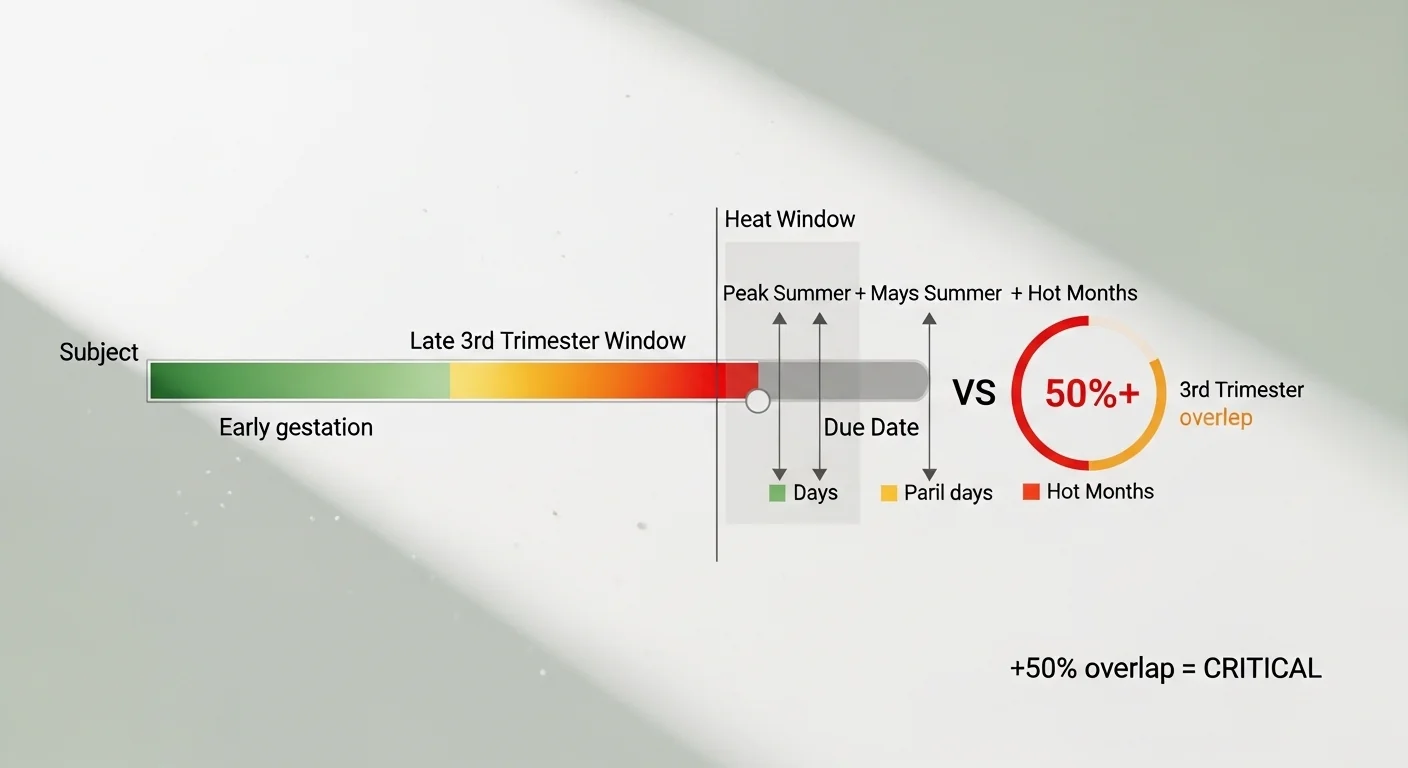
Calculating a due date from a conception date is straightforward arithmetic. What is not straightforward is recognizing when that due date places the final trimester directly inside a regional heat-stress window, a compounding risk factor that can end a pregnancy that would otherwise have been perfectly healthy. For cattle specifically, the third trimester is not just “the last two months.” It is the period of maximum fetal metabolic heat output, when the calf is growing fastest and generating significant internal heat of its own. Layer ambient summer temperatures on top of that, and you have a biological pressure that basic gestation date calculators simply do not capture.
This tool calculates estimated due dates for cows, pigs, sheep, and goats using species-verified gestation lengths. It then flags whether the critical late-term window collides with your local climate’s peak heat month. It does not provide veterinary diagnosis, predict individual animal outcomes, or account for real-time weather data. For incubation-style date math applied to poultry, the hatch date calculator covers that separately. This tool is scoped to livestock gestation, dry-off timing, and the heat-stress overlap check.
After using this calculator, you will know whether your breeding schedule places the third trimester inside a dangerous heat window, and whether adjusting your artificial insemination (AI) date by 6 to 10 weeks would move that risk window entirely out of summer.
Use the Tool
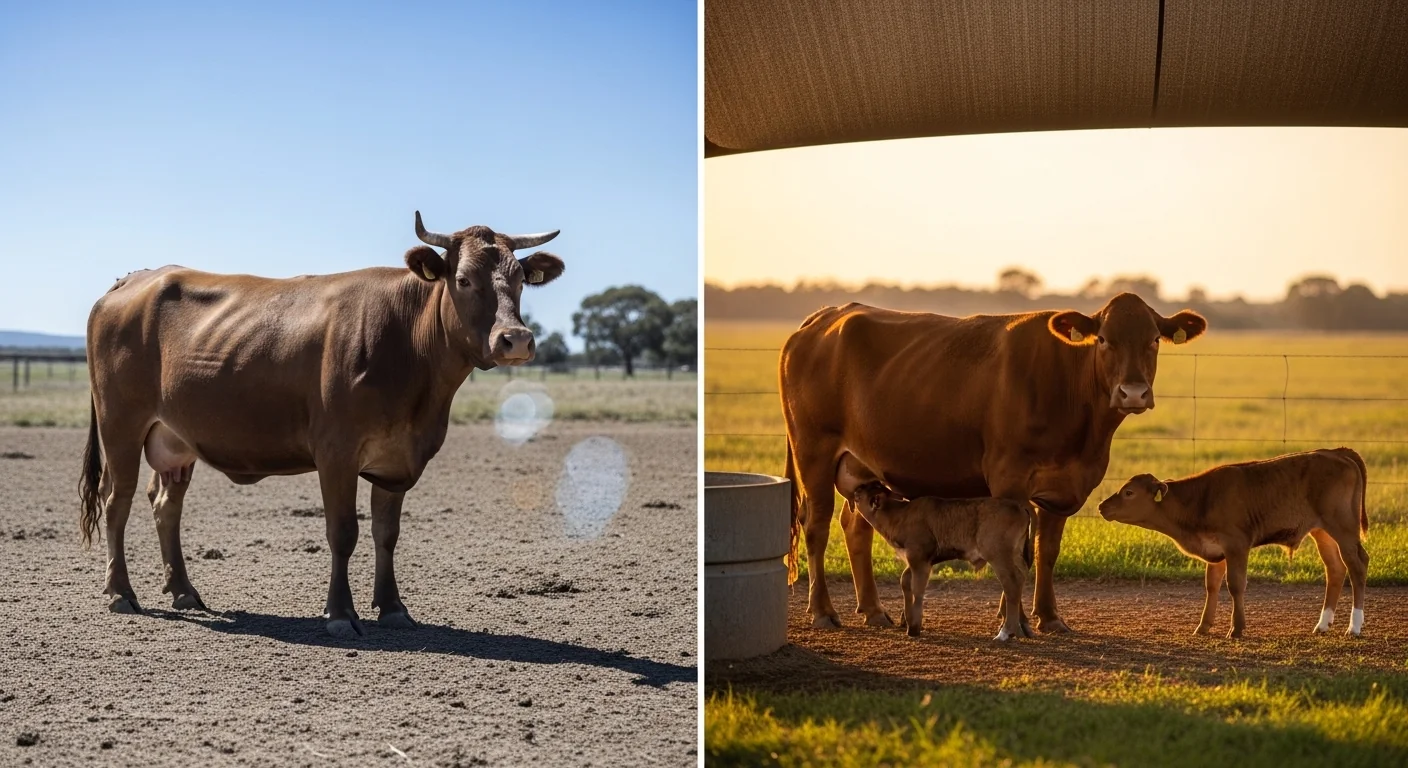
Livestock Gestation & Heat-Stress Abortion Forecaster
| Species | Avg. Gestation | 3rd Trimester | Dry-Off (Dairy) |
|---|---|---|---|
| Cow (Beef/Dairy) | 283 days | Last 60 days | ~60 days pre-due |
| Pig (Sow) | 114 days | Last 30 days | N/A |
| Sheep (Ewe) | 152 days | Last 45 days | N/A |
| Goat (Doe) | 150 days | Last 45 days | ~45 days pre-due |
How This Calculator Works
- Gestation Period Lookup: Each species has a known average gestation length.
Cow = 283 days,Pig = 114 days,Sheep = 152 days,Goat = 150 days. - Estimated Birth Date:
Conception Date + Gestation Period = Due Date. - 3rd Trimester Start: The critical late-term window is calculated as
Due Date − 3rd Trimester Length(60 days for cows, 30 for pigs, 45 for sheep/goats). - Heat-Stress Risk Check: The tool checks if the 3rd trimester overlaps with your selected peak summer month (±1 month buffer). If so, a heat-stress abortion warning is triggered.
- Dry-Off Date (Dairy): For cows and goats, a recommended dry-off date is calculated at 60 days (cow) or 45 days (goat) before the due date.
Units: All durations in calendar days. Dates are based on your local calendar.
Assumptions & Limits
- Gestation lengths are species averages. Individual animals may vary by 5–10 days (more for cattle).
- Heat-stress risk is a simplified model based on calendar months, not real-time weather data. Actual risk depends on Temperature-Humidity Index (THI), shade availability, water access, and breed tolerance.
- The ±1 month buffer around the peak summer month approximates the danger window. Consult local climate records for precision.
- Dry-off recommendations are general guidelines. Dairy management should be adjusted based on body condition score and milk production levels.
- This tool does not account for twin/triplet pregnancies, which may shorten gestation by several days.
- Always consult a licensed veterinarian for breeding and pregnancy management decisions.
Before you calculate, have three things ready: the species you are breeding, the confirmed conception or AI date (not an estimated heat date), and your local peak summer month based on your actual regional climate, not a national average. If you manage multiple breeding groups on the same pasture layout, the pasture stocking rate calculator can help you cross-reference carrying capacity against your projected calving and lambing dates.
Quick Start (60 Seconds)
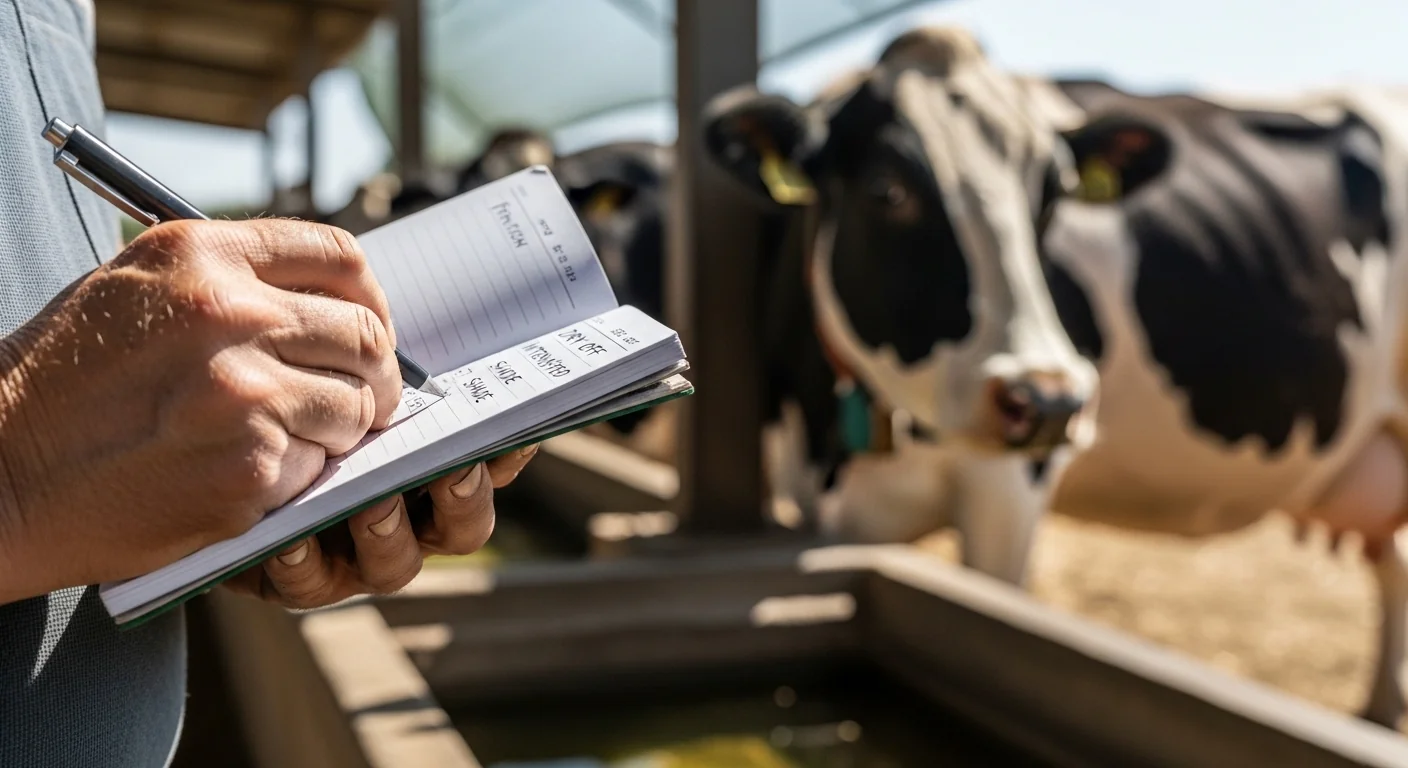
- Animal Species: Select the specific livestock type. Do not substitute a closely related breed category; the gestation periods used (Cow = 283 days, Pig = 114 days, Sheep = 152 days, Goat = 150 days) are species averages, not breed-specific. Individual variation of 5 to 10 days is normal.
- Date of Conception / AI: Enter the confirmed breeding or insemination date in the date picker. If you are unsure whether a natural cover resulted in conception, use the date you confirmed return-to-estrus was absent, not the cover date itself.
- Local Climate Peak Summer Month: Choose the single hottest month in your local climate zone. This is not the national or regional average; it is the month when ambient temperature is highest on your property. In the southern United States this is typically July or August. In Southern Hemisphere operations, the risk months shift accordingly.
- Heat overlap is calculated automatically: The tool checks whether the 3rd trimester window falls within your peak month plus one month on each side. You do not enter a temperature; this is a calendar-based risk signal, not a real-time THI calculation.
- Dry-off date (cows and goats): If you manage dairy animals, the tool outputs a recommended dry-off date at 60 days pre-calving (cows) or 45 days pre-kidding (goats). This is a general management guideline, not a veterinary prescription.
- Result is a risk signal, not a certainty: A “Critical” heat-stress flag does not mean the pregnancy will fail. It means the conditions favor elevated biological stress and you should implement mitigation measures proactively.
- Reset between entries: If you are running multiple animals or breeding groups, use the Reset button to clear all fields between calculations to avoid carryover errors.
Inputs and Outputs (What Each Field Means)
| Field | Type / Unit | What It Means | Common Mistake | Safe Entry Guidance |
|---|---|---|---|---|
| Animal Species | Select (categorical) | Determines the average gestation length and third-trimester window used in all calculations | Selecting “Cow” for a breed with notably shorter gestation (e.g., some Bos indicus types) and treating the output as exact | Select the species, then treat the due date as an estimate with a +/- 10-day window for cattle |
| Date of Conception / AI | Date (calendar) | The starting point for gestation period calculation | Entering the date the animal was observed in heat rather than the confirmed AI or natural cover date | Use the date of insemination or observed mating; confirm pregnancy with palpation or ultrasound separately |
| Local Climate Peak Summer Month | Select (month, 1-12) | The calendar month used to define the heat-stress risk window (peak month +/- 1 month on each side) | Using a national climate average rather than local farm-level data; this can misplace the risk window by 4 to 6 weeks | Use 10-year local temperature records or extension office climate data for your county or district |
| Estimated Due Date (output) | Date (calendar) | Conception date plus species gestation length; the primary output driving all other calculations | Treating this as a hard deadline; actual parturition varies by days to weeks in large-framed cattle | Use as a planning date to schedule monitoring; begin close observation at least 1 week before |
| 3rd Trimester Start Date (output) | Date (calendar) | Due date minus the species 3rd-trimester window (60 days for cows, 30 for pigs, 45 for sheep/goats) | Confusing “3rd trimester start” with “safe to stop monitoring heat stress”; heat risk applies through delivery | Use this date to begin proactive shade, water, and cooling interventions if heat overlap is flagged |
| Dry-Off Date (output, cows and goats) | Date (calendar) | Recommended cessation of milking to allow udder recovery before parturition | Dry-off dates skipped during high-production periods, leading to increased mastitis risk and poor transition health | Adjust based on body condition score and current milk production; this is a guideline, not a fixed protocol |
| Heat Overlap (output) | Days and overlap percentage | Number of days the 3rd trimester window falls within the peak heat month (+/- 1 buffer), expressed as a share of total 3rd trimester days | Ignoring partial overlap; even a two-week overlap in peak heat can elevate late-term stress | Any overlap above zero warrants at minimum a shade and water audit; flags at 50%+ overlap indicate a scheduling problem |
| Risk Level (output) | Categorical: Low / Moderate / Critical | Summary signal derived from the overlap calculation: zero overlap = Low, any overlap = Moderate, 50%+ overlap = Critical | Treating “Low” as “no action needed”; late-summer ambient heat still elevates THI even if the 3rd trimester barely misses the flag | Use as a scheduling trigger, not a guarantee of safety or loss |
Worked Examples (Real Numbers)
Example 1: Beef Cow, AI in Late November, Peak Summer in August (Critical Risk)
- Species: Cow
- AI Date: November 25
- Peak Summer Month: August
- Gestation: 283 days
- Due Date: November 25 + 283 days = September 4 (following year)
- 3rd Trimester Start: September 4 minus 60 days = July 6
- Peak Heat Window (buffer): July, August, September
- Overlap: July 6 through September 4 = 60 days; all 60 days fall inside the heat window
Result: Critical Heat-Stress Risk. 60 of 60 3rd-trimester days overlap with the peak heat window.
This is the breeding scenario the tool is specifically built to catch. A November AI produces a September due date, and the entire late-term period falls in the heart of summer. This is not a marginal risk; it is a scheduling problem that can be corrected by moving AI 8 to 10 weeks earlier (late September) to push the due date to late June and move the 3rd trimester into April and May.
Example 2: Dairy Cow, AI in Mid-January, Peak Summer in July (Moderate Risk)
- Species: Cow
- AI Date: January 15
- Peak Summer Month: July
- Gestation: 283 days
- Due Date: January 15 + 283 days = October 25
- 3rd Trimester Start: October 25 minus 60 days = August 26
- Peak Heat Window (buffer): June, July, August
- Overlap: August 26 through August 31 = 5 days in the heat window
Result: Moderate Heat-Stress Risk. Approximately 5 of 60 3rd-trimester days overlap with the tail end of the heat window.
A modest overlap, but worth flagging. The cow enters the third trimester at the very end of August when ground-level temperatures are still elevated. Shade availability and daily water access should be audited during the last days of August for this animal. Shifting the AI by three weeks later pushes the 3rd trimester entirely past the June through August window.
Example 3: Sow (Pig), AI in Mid-February, Peak Summer in August (Low Risk)
- Species: Pig
- AI Date: February 10
- Peak Summer Month: August
- Gestation: 114 days
- Due Date: February 10 + 114 days = June 4
- 3rd Trimester Start: June 4 minus 30 days = May 5
- Peak Heat Window (buffer): July, August, September
- Overlap: May 5 through June 4 = zero days in the heat window
Result: Low Heat-Stress Risk. The farrowing date and late-term window fall entirely in May and early June, before the peak heat period begins.
A February AI is a solid scheduling choice for operations in climates with an August peak. The sow farrows in early June, nursing occurs through the summer, but the highest-risk third-trimester period is safely in spring. Note that a sow bred in May with an August peak would produce an entirely different risk profile; repeat this calculation for every breeding group.
Reference Table (Fast Lookup)
The table below shows the latest safe AI date to ensure the 3rd trimester ends before the heat window begins (due date before July 1), and the earliest AI date to ensure the 3rd trimester starts after the heat window closes (3rd trimester starting after September 30). These values assume an August peak summer month with a July through September risk buffer. Adjust the target dates by 30 days per month of shift in your local peak.
| Species | Gestation (days) | 3rd Trimester Length | Days: Conception to 3rd Tri Start | Latest AI for Due Date Before July 1 | Earliest AI for 3rd Tri After Sept 30 | Dry-Off Window |
|---|---|---|---|---|---|---|
| Cow (Bovine) | 283 | 60 days | 223 days | Sept 21 (prior year) | Feb 19 | 60 days pre-due |
| Pig (Porcine) | 114 | 30 days | 84 days | Mar 9 | Jul 23 | Not applicable |
| Sheep (Ovine) | 152 | 45 days | 107 days | Jan 30 | Jun 15 | Not applicable |
| Goat (Caprine) | 150 | 45 days | 105 days | Feb 1 | Jun 17 | 45 days pre-due |
| Cow (Bovine) | 283 | 60 days | 223 days | July peak variant: AI before Aug 22 (prior year) or after Jan 20 | 60 days pre-due | |
| Pig (Porcine) | 114 | 30 days | 84 days | July peak variant: AI before Feb 7 or after Jun 23 | Not applicable | |
| Sheep (Ovine) | 152 | 45 days | 107 days | July peak variant: AI before Dec 31 or after May 16 | Not applicable | |
| Goat (Caprine) | 150 | 45 days | 105 days | July peak variant: AI before Jan 2 or after May 17 | 45 days pre-due | |
How to use this table: Find your species row for the relevant peak month scenario. If your AI date falls between the “Latest AI” and “Earliest AI” columns for that row, a heat-stress overlap will occur and you should run the full calculator to see how severe it is.
How the Calculation Works (Formula + Assumptions)
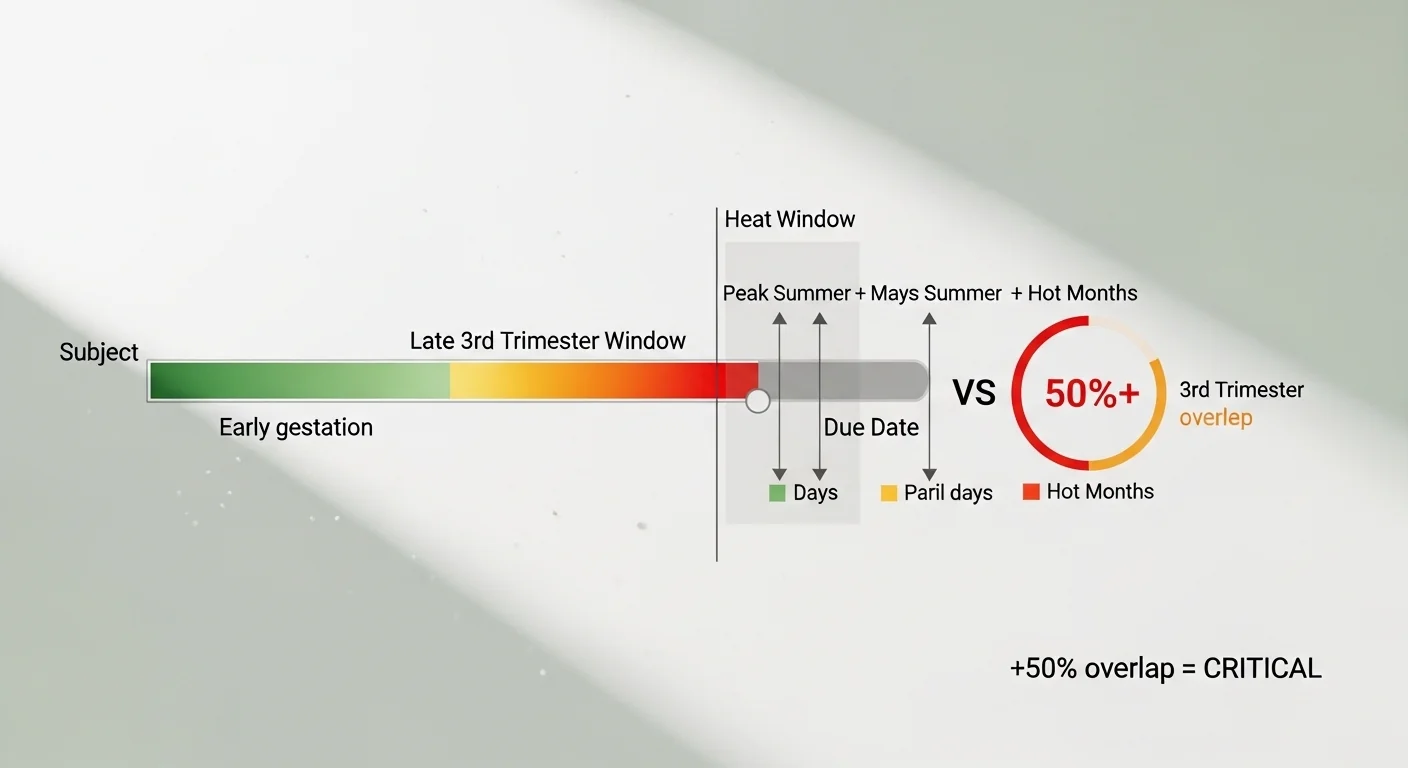
Show the calculation steps
Step 1: Gestation Period Lookup
Each species is assigned a fixed average gestation length in calendar days: Cow = 283 days, Pig = 114 days, Sheep = 152 days, Goat = 150 days. These are literature-derived averages, not breed-specific values.
Step 2: Estimated Due Date
Due Date = Conception Date + Gestation Period (in calendar days, accounting for month lengths and leap years).
Step 3: Third Trimester Start
3rd Trimester Start = Due Date minus 3rd Trimester Length: cows = 60 days, pigs = 30 days, sheep = 45 days, goats = 45 days. The value “Days from Conception to 3rd Tri Start” in the reference table is simply Gestation minus 3rd Trimester Length.
Step 4: Dry-Off Date (dairy species only)
Dry-Off Date = Due Date minus Dry-Off Window: cows = 60 days, goats = 45 days.
Step 5: Peak Heat Window Definition
The tool defines the risk window as Peak Summer Month minus 1 month through Peak Summer Month plus 1 month (a 3-month buffer centered on the peak month). This is a calendar buffer; it does not use Temperature-Humidity Index (THI) data.
Step 6: Overlap Calculation
The tool iterates through every calendar day of the 3rd trimester window. It counts how many of those days fall inside the 3-month heat buffer. Overlap days divided by total 3rd-trimester days yields the overlap share. A share at or above 0.50 (50 of 100 days) triggers Critical. Any overlap above zero triggers Moderate.
Rounding: Overlap percentage is rounded to the nearest whole number for display. Due dates and start dates are calendar-day precise with no rounding.
Assumptions and Limits
- Gestation lengths are population averages. Individual cattle may calve 10 to 14 days early or late; sheep and goats vary by 5 to 7 days. Twin pregnancies often terminate earlier than singletons.
- The heat-stress risk model is calendar-based only. It does not use real-time temperature, humidity, shade coverage, water availability, or breed-specific heat tolerance as variables.
- The one-month buffer on each side of the peak month is a general approximation. In climates with extended heat seasons, the actual risk window may be 4 to 5 months wide.
- The tool treats all cows equally. Bos indicus breeds (Brahman, Gir, Nelore) have meaningfully higher heat tolerance than Bos taurus breeds (Holstein, Angus, Hereford). The heat-stress thresholds in this tool are calibrated for Bos taurus.
- Dry-off recommendations are operational guidelines derived from established dairy management practice. They should be adjusted based on body condition score, current milk production, and veterinarian guidance.
- This tool does not calculate a Temperature-Humidity Index (THI). THI values above 72 are the standard threshold for measurable production loss in dairy cattle; THI above 82 correlates with elevated pregnancy loss risk. A “Low” risk flag from this tool does not guarantee THI will remain below these thresholds throughout the period.
- The tool assumes a Northern Hemisphere climate calendar by default. Southern Hemisphere operators should select peak months accordingly (December through February for most of Australia and South America).
Standards, Safety Checks, and “Secret Sauce” Warnings
Critical Warnings
- The August Late-Term Mortality Peak: When a beef cow is inseminated in late November, the calculated due date lands in early September. The final 60 days of gestation, the third trimester when the calf grows fastest and generates substantial internal metabolic heat, fall squarely in July and August. The combination of ambient heat and fetal heat production creates a compounded thermal load that exceeds the cow’s thermoregulatory capacity without intervention. This is not a hypothetical edge case; it is a predictable outcome of late-autumn AI that is systematically missed by simple due-date calculators.
- Fetal heat is additive, not independent: The common framing of heat stress in cattle focuses on the dam’s body temperature. The third trimester compounds this because the rapidly growing fetus generates its own metabolic heat, which the dam must also dissipate. Even operations with adequate shade structures may underestimate the combined load. Daily water access of sufficient volume is critical during this window. The cattle water requirement calculator can help you verify that your water delivery infrastructure meets the elevated demand of late-gestation animals in heat.
- Late-term heat stress affects colostrum quality: Beyond fetal survival, heat stress in the third trimester is associated with reduced immunoglobulin content in colostrum, meaning calves born after a heat-stressed late-gestation period may have weakened passive immunity transfer even if the calf appears healthy at birth. Stocking colostrum replacer powder ahead of the due date is a practical mitigation step.
- Ventilation matters as much as shade: Passive shade structures reduce radiant heat load but do not reduce humidity or stagnant air temperature. For confined operations, adequate cross-ventilation is essential. The barn ventilation calculator can help you verify airflow rates meet the requirements for pregnant livestock.
Minimum Standards
- A Temperature-Humidity Index (THI) above 72 is the documented threshold for measurable reproductive and production effects in Bos taurus dairy cattle. Operations in humid climates should treat this as a lower trigger point than the calendar-month model alone would suggest.
- Shade structures should provide a minimum of 40 square feet of shade per adult cow during the 3rd trimester heat-overlap period, placed to allow natural airflow rather than block it.
- Fresh, cool water should be available at all times during the heat-overlap window, with trough space sufficient to allow simultaneous access for the number of animals in the group.
- Dry-off should be completed no later than 60 days before the due date for dairy cows and 45 days for dairy goats, regardless of current production level, to allow udder tissue recovery and proper colostrum development.
Competitor Trap: Most online livestock gestation calculators return a single due date and nothing else. Some add a “weeks pregnant” counter. None of the commonly ranked tools check whether the resulting third trimester window falls inside a regional heat-stress period. This means a producer running a November AI program on beef cows in the southern United States can use those tools, see a September due date, and have no programmatic reason to recognize the problem until late-term losses begin occurring. The value of a heat-stress overlap check is not that it tells breeders something they could not calculate manually; it is that it makes an invisible risk visible at the moment the breeding decision is being made.
Common Mistakes and Fixes
Mistake: Using the Observed Heat Date Instead of the AI Date
When a producer records the date a cow showed signs of estrus rather than the date of confirmed artificial insemination or witnessed natural cover, the conception date input can be off by 12 to 24 hours or more. Over a 283-day gestation, this shifts the due date prediction by the same margin, and more importantly it shifts the third-trimester overlap calculation by a day or two, which may affect whether a borderline case triggers a Moderate or Critical flag.
Fix: Record the actual AI date or the date of mating observation, not the onset of heat signs.
Mistake: Applying a National Climate Average for Peak Month
Selecting “July” as the peak summer month because it is statistically the hottest month in the United States ignores local variation. Coastal areas with June fog, inland valleys with August heat islands, and high-altitude ranches with delayed heat peaks can each have meaningfully different actual peak months. A producer in coastal California entering July when their farm peaks in August shifts the risk window by 30 days, potentially missing a Critical flag entirely.
Fix: Use 10-year average temperature data from your county extension office, the NOAA Climate Data portal, or your own on-farm weather records to identify the actual local peak month.
Mistake: Assuming a “Low Risk” Flag Means No Heat Precautions Are Needed
The Low risk output means the third trimester does not overlap with the calendar-month heat buffer. It does not mean the THI will remain below 72, that radiant heat load from solar exposure is negligible, or that water demand does not increase during dry conditions. A cow calving in late June in a humid climate may face significant heat load even with a “Low” flag from this tool. Managing transition cow nutrition, including calcium supplementation protocols around calving, remains important regardless of the heat risk output.
Fix: Treat the risk flag as a scheduling signal and a trigger for proactive infrastructure review, not as a clearance certificate.
Mistake: Calculating Once per Breeding Season Instead of Per Animal or Group
Producers who stagger AI dates across a herd for labor management reasons sometimes calculate the heat risk only for the first group and assume all subsequent groups fall in the same risk category. A three-week difference in AI date shifts the due date by three weeks and the third-trimester window by the same amount, which can move a group from Low to Critical depending on where the seasonal peak falls.
Fix: Run a separate calculation for each distinct breeding group or AI date. The Reset button clears all fields between entries.
Mistake: Skipping the Dry-Off Date Output for Dairy Animals
Producers focused on the heat-stress risk output sometimes overlook the dry-off date, treating it as a secondary result. For dairy cows, the dry-off window determines colostrum quality, udder tissue recovery, and transition cow health entering lactation. A cow that is not dried off on schedule because milk production is still commercially acceptable enters calving already nutritionally and hormonally compromised.
Fix: Record the dry-off date from the calculator output alongside the due date, and add it to your herd management calendar as a hard management event.
Next Steps in Your Workflow
Once you have your due date and heat-stress risk level, the next decision is whether your current AI schedule needs adjustment. If the result is Critical, the most effective intervention is shifting the AI date rather than managing the heat overlap in-place. For cow-calf operations, moving a November AI program to mid-September shifts the due date from September to late June and moves the third trimester into April and May, entirely outside a July through September heat window. That is a significant operational change but a straightforward calendar shift. Use the reference table above to identify your target AI window before the next breeding season. From there, planning the feed budget for a winter-calving or spring-calving program is the logical next step; the winter cattle feed calculator can help you project hay and supplement needs based on your adjusted calving date.
For grazing operations, the calving or lambing date directly affects when you can move cows and calves into fresh paddocks. A herd calving in June needs adequate forage in early summer paddocks, and the timing of rest periods matters. Working through your rotational grazing plan alongside your calving date projections will surface any conflicts between rest periods and the demands of a freshly calved group before they become a problem.
FAQ
What is the average gestation period for cattle?
The average gestation period for beef and dairy cattle is 283 calendar days from conception to calving. This is the value used in this calculator. Individual animals can calve 10 to 14 days earlier or later than the predicted date without it indicating a problem. Certain breeds, particularly large-framed continental breeds, may average slightly longer; some Bos indicus-influenced cattle calve somewhat earlier on average.
How do I calculate a pig farrowing date from the breeding date?
Add 114 days to the confirmed breeding or AI date. The common mnemonic used in swine production is “3 months, 3 weeks, 3 days,” which approximates 114 days reasonably well as a mental shorthand. The calculator uses the precise 114-day figure. The third trimester for pigs is defined as the last 30 days of gestation, when fetal growth rate is highest and the sow is most vulnerable to nutritional and thermal stress.
At what temperature does heat stress affect cattle reproduction?
The standard threshold for measurable reproductive and production effects in Bos taurus cattle is a Temperature-Humidity Index (THI) of 72. This combines temperature and relative humidity into a single value. THI above 82 is associated with more severe impacts including elevated risk of late-term pregnancy loss. This tool uses a calendar-month model as a scheduling proxy, not a real-time THI calculation; producers in humid climates should treat the calendar flag as a conservative minimum.
Does heat stress affect sheep and goat pregnancies the same way it affects cattle?
Sheep and goats are generally considered more heat-tolerant than Bos taurus cattle, but they are not immune to late-gestation heat stress. Third-trimester ewes and does experience elevated thermal load during the period of maximum fetal growth just as cows do. Extreme heat during late gestation in small ruminants is associated with reduced lamb and kid birth weight and impaired colostrum quality, though the effect thresholds differ from bovine values.
What is the recommended dry-off period for dairy cows?
The standard dry-off period for dairy cows is 60 days before the expected calving date. This window allows the mammary gland to undergo involution, clear any subclinical infections, and prepare for colostrum synthesis. Some high-producing modern dairy operations use shortened dry periods of 40 to 45 days, but this is a management decision requiring veterinary guidance and should not be made based on production economics alone.
Can I use this calculator for a goat’s lambing date?
Goats kid rather than lamb, but the calculator fully supports goat gestation. Select “Goat (Caprine)” from the species dropdown. The calculator uses a 150-day gestation period and a 45-day third trimester, and it outputs a recommended dry-off date of 45 days before the due date for dairy goat operations. Sheep use 152 days. These are the standard figures used in extension and veterinary practice.
Conclusion
A gestation calculator for cattle that only returns a due date is solving half the problem. The date tells you when to expect a calf. It does not tell you whether the breeding schedule is placing the most vulnerable period of fetal development inside the worst possible climate window. That connection, between AI calendar decisions made in autumn and heat-stress outcomes that play out the following summer, is what this tool is specifically built to surface at the moment when it is still actionable.
The single most common mistake in livestock breeding calendars is treating the due date as a destination rather than a diagnostic. A September due date in a southern cattle operation is not just a calving date; it is a signal that the entire third trimester will occur in July and August. Once that is visible, the fix is straightforward: shift AI timing. Building your full feed and forage budget around the adjusted calving date is the next planning layer; the hay cost calculator is a practical starting point for that side of the equation.