
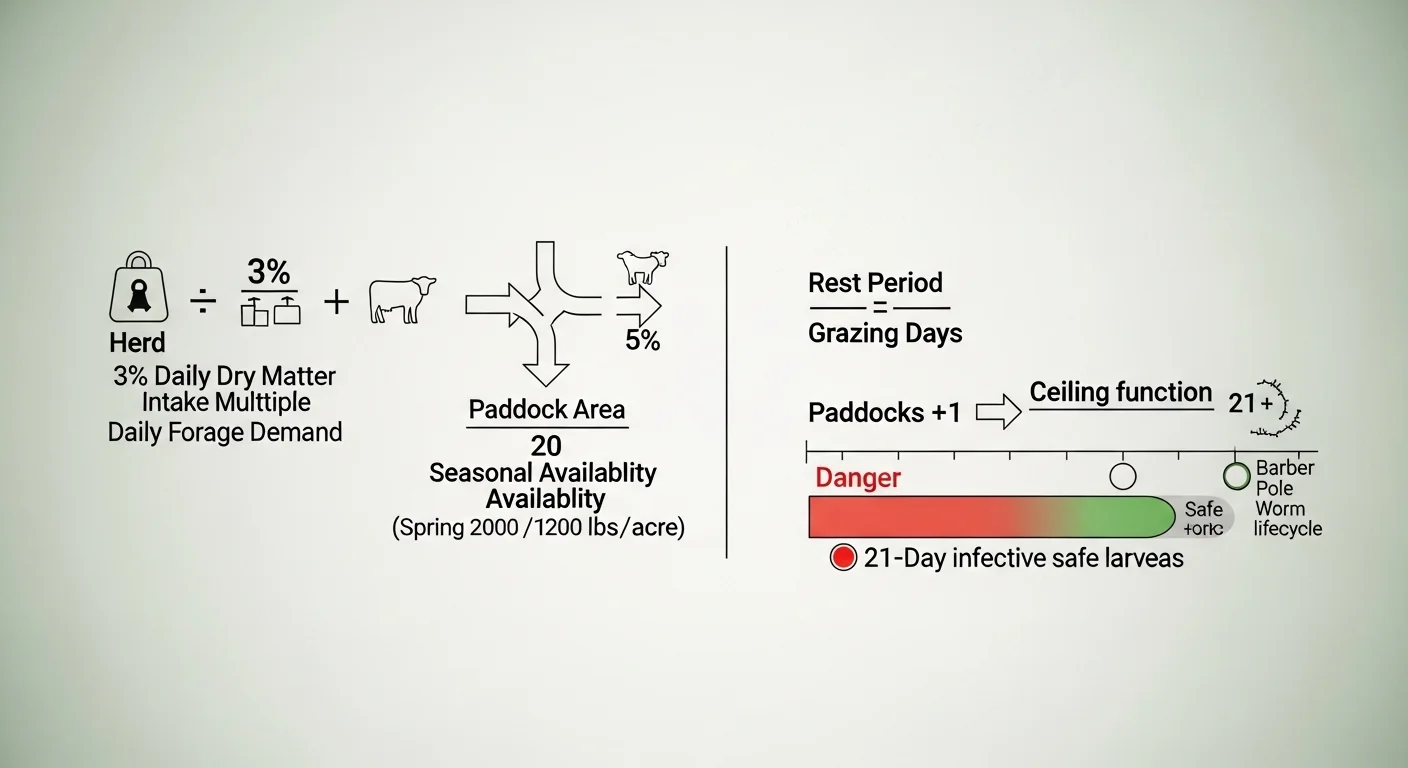
Paddock sizing in rotational grazing fails in two distinct ways: the paddock is too small to provide adequate dry matter for the herd, or the rotation is too fast for the pasture to out-compete the nematode lifecycle. Most calculators handle one of these problems. This tool handles both simultaneously, computing the exact acreage your herd needs per paddock and flagging whether your rest period is biologically safe based on the developmental timeline of infective larvae, specifically Haemonchus contortus, the Barber Pole worm responsible for significant livestock mortality in sheep, goat, and cattle operations.
The calculator uses four inputs to produce five outputs: paddock area in acres, total paddock count, combined fenced acreage, daily dry matter intake, and actual rest days your system will deliver. It does not account for slope, irregular paddock geometry, drought-reduced carry capacity, or individual animal variation in forage selectivity. Those factors require on-the-ground judgment. What this tool gives you is a defensible starting point derived from the 3% body weight dry matter rule and the forage availability benchmarks that vary by season.
After running the calculator, you will know whether your planned rotation structure puts livestock back on a paddock before or after day 21, which is the point at which infective L3 larvae populations on grass blades begin a natural decline. That single decision determines whether you are farming grass or farming worms.
Use the Tool
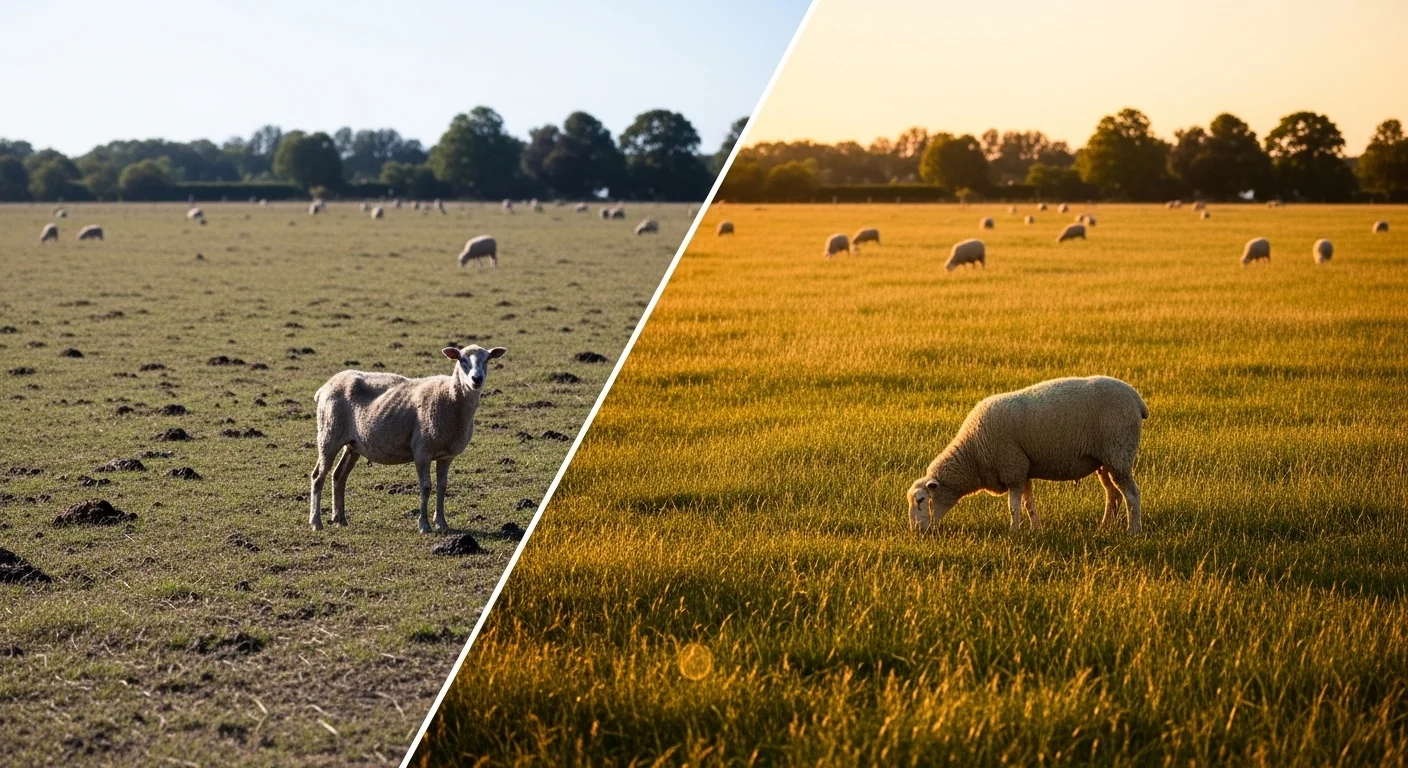
| Herd Weight (lbs) | Graze Days | Season | Paddock Area | Rest OK? |
|---|---|---|---|---|
| 5,000 | 1 | Spring | 0.08 ac | ✓ Safe (28 d) |
| 10,000 | 2 | Spring | 0.30 ac | ✓ Safe (28 d) |
| 12,000 | 3 | Fall | 0.72 ac | ✓ Safe (28 d) |
| 15,000 | 3 | Summer | 1.13 ac | ✓ Safe (28 d) |
| 8,000 | 3 | Summer | 0.60 ac | ⚠ RISK (15 d) |
| 20,000 | 5 | Summer | 2.50 ac | ⚠ RISK (10 d) |
| 50,000 | 7 | Spring | 5.25 ac | ✓ Safe (63 d) |
⚠ Red rows indicate rest period < 21 days — high parasite reinfection risk. Reference computed using same formula as this tool.
How This Calculator Works — Formulas & Assumptions
Paddock Area Formula
- HerdWeight — total live weight of all animals (lbs)
- 0.03 — livestock consume ~3% of body weight as dry matter per day
- GrazingDays — how many days herd spends in the paddock
- AvailableForage — estimated lbs of grazeable forage per acre based on season
Total Paddocks Formula
- Always rounds up to the next whole paddock
- Ensures at least one paddock is always resting while herd grazes
Parasite Risk Check (The 21-Day Rule)
- Actual rest = (TotalPaddocks − 1) × GrazingDays
- Barber Pole worm (Haemonchus contortus) larvae peak on grass between days 10–20 post-deposition
- Returning livestock before Day 21 causes mass L3 larvae ingestion — can be fatal in sheep and goats
- Minimum safe rest: >21 days. Optimal: 28–45 days depending on climate and species
Forage Availability Assumptions
- Fast (Spring): 2,000 lbs available dry matter per acre
- Moderate (Fall): 1,500 lbs available dry matter per acre
- Slow (Summer/Winter): 1,200 lbs available dry matter per acre
- These are conservative estimates for temperate pastures. Adjust for your specific pasture productivity.
Assumptions & Limits
- Does not account for uneven grazing pressure, slope, or water access
- Parasite threshold is based on sheep/goat/cattle nematode biology; consult a veterinarian for species-specific advice
- Forage values assume adequate soil fertility and no drought stress
- For mob grazing (very high density, very short moves), validate with an agronomist
- Dewormer/drench resistance varies by farm — use FAMACHA or fecal egg count testing alongside rotation timing
Before calculating, gather the live weight of every animal in the herd and add them together for a single total in pounds. Decide how many days you want the herd to graze each paddock before moving, choose the season that best represents your current forage growth conditions, and enter the minimum rest period you are planning for each paddock. If you are still working out your pasture layout, the pasture stocking rate calculator can help you establish your baseline animal unit equivalents before sizing individual paddocks here.
Quick Start (60 Seconds)
- Herd Total Weight: Add the live weight of every animal. For a mixed-age cattle herd, weigh or estimate individually, then sum. Do not enter average weight per animal; the formula needs the full herd total in pounds.
- Grazing Period per Paddock: Enter days, not hours. A 12-hour move is 0.5 days. Most rotational systems run 1 to 7 days per paddock. High-density mob grazing may go as low as a fraction of a day, which may fall outside the reliable range of this model.
- Grass Growth Rate / Season: Spring growth is the fastest and supports the most animal days per acre. If it is midsummer or you are in a drought, select the slow-growth option. When in doubt, use the conservative season for a safety margin.
- Minimum Rest Period: This is your target, not the result. Enter the number of days you want each paddock to rest between grazings. The tool calculates whether your paddock count can actually deliver that rest given your grazing period length.
- Read the actual rest output first: The computed actual rest period may differ from what you entered. This is the number that the parasite warning is based on. Trust the output, not the input.
- Watch the color coding: Green means your system clears the 21-day biological threshold. Orange is a marginal zone. Red means your livestock will graze heavily contaminated paddocks.
- Recalculate before fencing: Run at least three scenarios: fast growth, slow growth, and a grazing period one day shorter than your plan. The worst-case scenario governs your infrastructure decisions.
Inputs and Outputs (What Each Field Means)
| Field | Unit | What It Means | Common Mistake | Safe Entry Guidance |
|---|---|---|---|---|
| Herd Total Weight | lbs | Combined live weight of all animals that will graze together as a single mob | Using average weight per head instead of the herd total | Multiply headcount by average live weight, or sum individual weights; range 1 to 500,000 lbs |
| Grazing Period per Paddock | days | How long the herd stays in one paddock before rotating to the next | Confusing this with the total rotation length, which is a different variable | Enter whole or decimal days; 1 to 60 days accepted; for daily moves, enter 1 |
| Grass Growth Rate / Season | lbs/acre (available forage) | Estimated grazeable dry matter per acre based on growth season | Selecting spring when pastures are stressed or recovering from drought | Spring = 2,000 lbs/acre; Fall = 1,500 lbs/acre; Summer or Winter = 1,200 lbs/acre |
| Minimum Rest Period Required | days | The target number of days each paddock should rest before livestock return | Entering the ideal target without checking whether the paddock count actually delivers it | At minimum, enter 21; entering 28 or more provides a biologically safer buffer against nematode reinfection |
| Paddock Area Required (output) | acres | Acreage needed per paddock to supply the herd’s dry matter during the grazing period | Treating this as the total land needed rather than the area per single paddock | Multiply by total paddock count to get total infrastructure acreage |
| Total Paddocks Needed (output) | count | Number of paddocks required so one rests while others are grazed sequentially | Rounding down when the result is fractional; always round up to the next whole paddock | This number drives your fencing material estimate; use the feed cost calculator to model carrying costs per paddock if winter supplementation is needed |
| Total Fenced Acreage (output) | acres | Sum of all paddock areas; the total land enrolled in the rotation system | Forgetting lane access, water points, and handling areas that fall outside paddock acreage | Add 5 to 10% to this number for lanes and infrastructure before ordering fencing materials |
| Daily Dry Matter Intake (output) | lbs/day | Estimated daily forage demand for the entire herd at 3% of combined body weight | Using this as a supplement or hay figure; it reflects total forage demand, not supplemental feed only | Use this figure to plan hay reserves for periods when pasture is unavailable |
| Actual Rest Period (output) | days | The true rest each paddock gets given the number of paddocks and the grazing period length | Ignoring this in favor of the input target without noticing they differ | This is the number the parasite warning is based on; it must exceed 21 days for biological safety |
Worked Examples (Real Numbers)
Scenario 1: Small Sheep Flock on Spring Pasture
- Herd Total Weight: 3,000 lbs (20 ewes at roughly 150 lbs average)
- Grazing Period per Paddock: 2 days
- Season: Spring (2,000 lbs/acre available forage)
- Minimum Rest Period: 28 days
Daily dry matter intake: 3,000 x 0.03 = 90 lbs/day
Paddock area: (90 x 2) / 2,000 = 0.09 acres per paddock
Total paddocks: ceil(28 / 2) + 1 = 15 paddocks
Total acreage: 0.09 x 15 = 1.35 acres
Actual rest: (15 – 1) x 2 = 28 days
Result: 0.09 acres per paddock across 15 paddocks covering 1.35 acres total, with an actual rest period of 28 days. This system clears the 21-day parasite threshold with a 7-day buffer and is viable on a relatively small landholding.
A 15-paddock system on 1.35 acres demands tight fencing management. Temporary polywire and fiberglass step-in posts allow rapid reconfiguration if forage growth outpaces or underperforms the spring estimate.
Scenario 2: Medium Beef Herd in Summer
- Herd Total Weight: 15,000 lbs (12 cow-calf pairs, approximately 1,250 lbs each)
- Grazing Period per Paddock: 3 days
- Season: Summer/Winter (1,200 lbs/acre available forage)
- Minimum Rest Period: 30 days
Daily dry matter intake: 15,000 x 0.03 = 450 lbs/day
Paddock area: (450 x 3) / 1,200 = 1.125 acres per paddock
Total paddocks: ceil(30 / 3) + 1 = 11 paddocks
Total acreage: 1.125 x 11 = 12.375 acres
Actual rest: (11 – 1) x 3 = 30 days
Result: 1.125 acres per paddock, 11 paddocks, 12.4 total acres, 30-day actual rest. The 30-day rest in slow-growth summer conditions exceeds the parasite threshold and allows meaningful grass recovery between grazings.
Note that in a drought year, effective available forage on stressed summer pasture can drop below 1,200 lbs/acre. If conditions deteriorate, reducing the grazing period to 2 days and recalculating is advisable before the system fails and supplemental hay costs escalate.
Scenario 3: High-Risk Setup With Insufficient Paddocks
- Herd Total Weight: 20,000 lbs
- Grazing Period per Paddock: 5 days
- Season: Summer/Winter (1,200 lbs/acre available forage)
- Minimum Rest Period: 15 days (entered target; biologically insufficient)
Daily dry matter intake: 20,000 x 0.03 = 600 lbs/day
Paddock area: (600 x 5) / 1,200 = 2.5 acres per paddock
Total paddocks: ceil(15 / 5) + 1 = 4 paddocks
Total acreage: 2.5 x 4 = 10 acres
Actual rest: (4 – 1) x 5 = 15 days
Result: 2.5 acres per paddock, 4 paddocks, 10 total acres, 15-day actual rest. This system triggers the parasite danger warning because the herd returns to a paddock on day 15, precisely when infective L3 larvae populations on grass blades are near their peak concentration.
The fix is straightforward: adding three more paddocks (for a total of 7) and maintaining the same 5-day grazing period produces an actual rest of 30 days. Total acreage increases from 10 to 17.5 acres, but the infrastructure cost of additional temporary fencing is substantially less than the veterinary and productivity losses from a Barber Pole worm outbreak.
Reference Table (Fast Lookup)
All values computed using the same formula as the tool: paddock area = (herd weight x 0.03 x graze days) / available forage. Paddock count based on the 28-day rest standard (ceil(28 / graze days) + 1). Actual rest = (paddocks – 1) x graze days. Red-coded rows represent scenarios where a farmer’s planned rest period falls under 21 days.
| Herd Weight (lbs) | Graze Days | Season | Daily DMI (lbs) | Paddock Area (ac) | Paddocks (28d rest) | Total Acres | Actual Rest | Parasite Status |
|---|---|---|---|---|---|---|---|---|
| 5,000 | 1 | Spring | 150 | 0.075 | 29 | 2.2 | 28 days | Safe |
| 5,000 | 2 | Summer | 150 | 0.25 | 15 | 3.75 | 28 days | Safe |
| 10,000 | 2 | Spring | 300 | 0.30 | 15 | 4.5 | 28 days | Safe |
| 10,000 | 3 | Fall | 300 | 0.60 | 11 | 6.6 | 30 days | Safe |
| 15,000 | 3 | Summer | 450 | 1.125 | 11 | 12.4 | 30 days | Safe |
| 20,000 | 5 | Summer | 600 | 2.50 | 7 | 17.5 | 30 days | Safe |
| 25,000 | 7 | Spring | 750 | 2.625 | 5 | 13.1 | 28 days | Safe |
| 30,000 | 3 | Fall | 900 | 1.80 | 11 | 19.8 | 30 days | Safe |
| 8,000 | 5 | Summer | 240 | 1.00 | 4 (15d target) | 4.0 | 15 days | RISK: Under 21 days |
| 50,000 | 7 | Spring | 1,500 | 5.25 | 5 | 26.25 | 28 days | Safe |
How the Calculation Works (Formula + Assumptions)
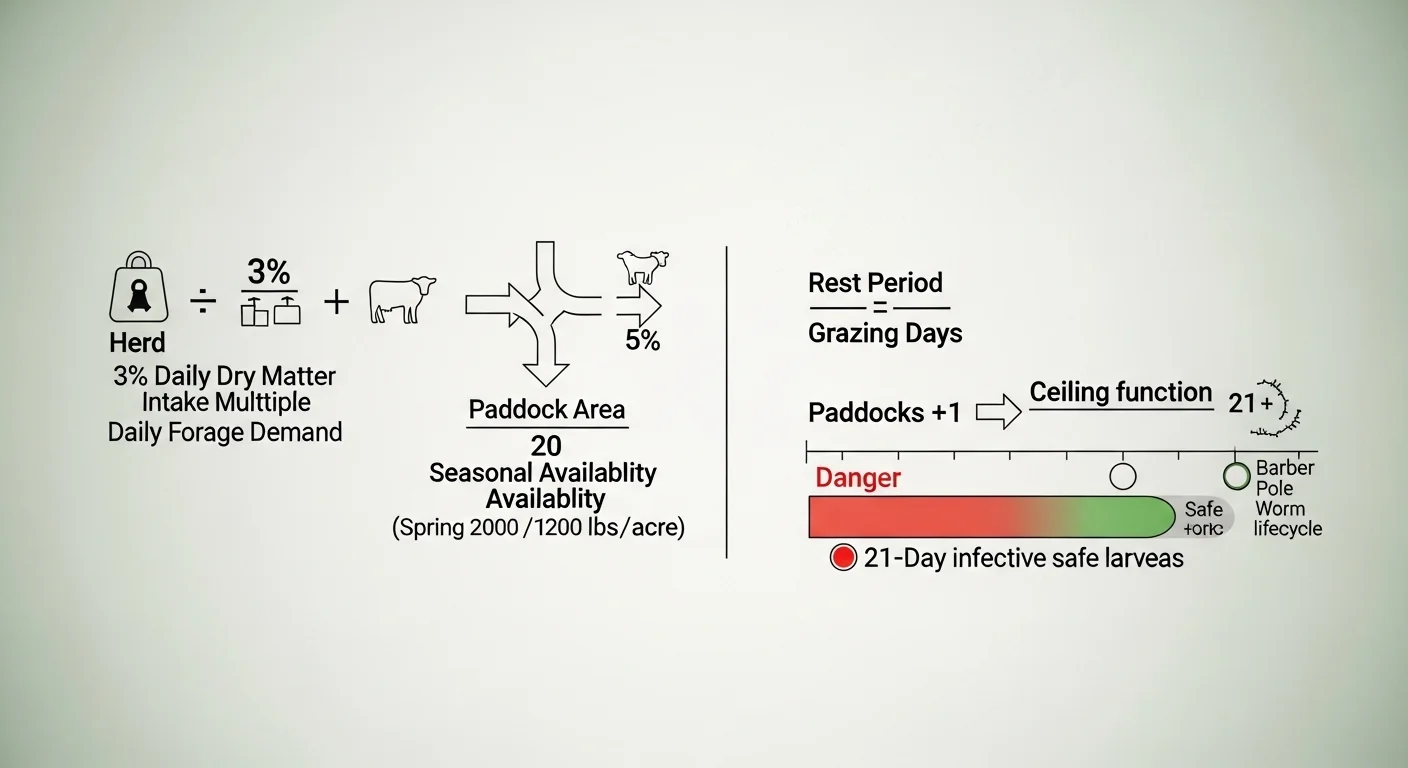
Show the calculation steps
Step 1: Daily Dry Matter Intake
Daily DMI (lbs/day) = Herd Total Weight (lbs) x 0.03
Livestock consume approximately 3% of their body weight in dry matter per day. This is a conservative average across cattle, sheep, and goats under normal body condition and moderate forage quality. High-producing dairy animals or rapidly growing stockers may exceed this rate.
Step 2: Paddock Area
Paddock Area (acres) = (Daily DMI x Grazing Days) / Available Forage (lbs/acre)
This calculates the acreage the herd must consume to satisfy intake during the planned grazing period. Available forage is set by season: 2,000 lbs/acre for fast spring growth, 1,500 for moderate fall growth, and 1,200 for slow summer or winter conditions. The result is rounded to two decimal places. No upward rounding occurs automatically; operators should add a buffer of 10 to 15% in practice to account for trampling loss and selective grazing refusals.
Step 3: Total Paddocks
Total Paddocks = ceil(Rest Period / Grazing Days) + 1
The ceiling function rounds up to the next whole number. Adding 1 ensures that while the herd occupies one paddock, all others are resting simultaneously. If rest period is 28 days and grazing period is 3 days, the result is ceil(28 / 3) + 1 = ceil(9.33) + 1 = 10 + 1 = 11 paddocks.
Step 4: Actual Rest Period
Actual Rest (days) = (Total Paddocks – 1) x Grazing Days
Because paddock count is ceiled, the actual rest delivered may be slightly longer than the target minimum. This actual rest value is compared against the 21-day biological threshold to determine parasite risk status.
Step 5: Parasite Status Check
If Actual Rest is less than 21 days: DANGER. If between 21 and 27 days: CAUTION. If 28 or more days: SAFE.
Assumptions and Limits
- The 3% dry matter intake rate is an average; high-performance or high-stress animals may require 3.5% or more.
- Available forage figures (2,000 / 1,500 / 1,200 lbs/acre) assume productive, well-fertilized temperate pastures without drought stress. Degraded or overgrazed pastures may carry 30 to 50% less.
- The 21-day parasite threshold is based on H. contortus (Barber Pole worm) biology in temperate climates. In hot, dry climates larvae die faster; in cool, moist climates they may persist longer. Consult a local extension veterinarian for climate-adjusted guidance.
- The formula does not account for slope, shade, water point clustering, or irregular paddock geometry, all of which reduce effective grazing area.
- Trampling loss, refusal spots, and lane areas are not included in the paddock area calculation. A practical field correction factor of 10 to 20% added to the output is advisable.
- The model assumes a single-species herd with uniform live weight distribution. Mixed-species grazing (cattle with sheep or goats) requires a separate animal unit conversion step before entering herd weight.
- Dewormer resistance varies by farm. This tool identifies rotation risk but is not a substitute for FAMACHA scoring and regular fecal egg count monitoring.
Standards, Safety Checks, and “Secret Sauce” Warnings
Critical Warnings
- The 21-Day Floor is Biological, Not Arbitrary: Barber Pole worm eggs deposited in manure hatch within 3 to 5 days under warm, moist conditions. The resulting infective L3 larvae migrate up grass blades and reach peak population density between days 10 and 20. A herd returning to a contaminated paddock on day 15 is essentially vacuuming up the maximum available larval load per bite. In sheep and goat systems this produces acute haemonchosis with mortality; in cattle it causes subclinical production losses that frequently go unattributed.
- The 5-Paddock Trap: Many grazing guides and older extension publications recommend a 5-paddock minimum for rotational grazing. For a 3-day grazing period, 5 paddocks delivers only (5 – 1) x 3 = 12 days of rest. That is well below the parasite safety threshold. The actual paddock count needed depends entirely on the ratio of rest days to grazing days, not a fixed arbitrary number.
- Season Selection Errors Cascade Into Paddock Undersizing: Using a spring forage estimate during a summer drought underestimates how much acreage the herd needs per paddock. The result is a paddock stripped bare before the rotation moves, forcing early returns or emergency supplementation.
- Forage Recovery Runs Alongside Parasite Recovery: A paddock that gets only 14 days of rest fails twice: the larvae population is still near peak, and the grass has not recovered enough leaf area to support another full grazing bout. Both failures compound each other.
Minimum Standards
- Actual rest period must exceed 21 days for any parasite management benefit. A target of 28 to 45 days provides meaningful safety margin across most temperate climates.
- Grazing period per paddock should not exceed 7 days for effective parasite management. Longer stays allow livestock to graze down to the ground level where freshly hatched larvae accumulate.
- Total paddock count should be recalculated at the start of each season as growth rates shift. A system that is safe in spring can become dangerous by midsummer if the same rotation schedule is maintained without adjustment.
Competitor Trap: Most rotational grazing calculators ask for paddock count and spit out acreage per paddock. That approach places all responsibility for rest period safety on the operator with no biological cross-check. Entering 4 paddocks with a 5-day grazing period produces reasonable-looking acreage numbers while delivering a 15-day actual rest period. The tool returns clean numbers, the livestock get drenched in larvae, and the operator wonders why the vet bill is growing. The correct sequence is always: compute required rest, derive paddock count from it, then compute area. Never start with a fixed paddock count unless you are verifying a pre-existing system.
For operations where electric fencing defines paddock boundaries, the electric fence calculator can help size wire runs and energizer requirements once paddock dimensions are established from this tool. Getting the joule output right matters particularly for high-pressure cattle in temporary polywire systems; see also the electric fence joule calculator for energizer sizing by fence length and vegetation load.
Common Mistakes and Fixes
Mistake: Using a Fixed 5- or 6-Paddock Default
Grazing textbooks from the 1980s and 1990s often recommended 5 paddocks as a starting framework. That number was a minimum system architecture recommendation, not a biological determination. A 5-paddock system with a 4-day grazing period delivers 16 days of rest, which falls under the parasite threshold. Operators who built their fencing around this rule of thumb and have not recalculated may have been running a parasite production system without knowing it.
Fix: Use the actual rest output from this calculator and add paddocks until that number exceeds 21 days, then aim for 28 or more as a practical target.
Mistake: Entering Herd Weight per Head Instead of Total
A cattle producer with 15 cows averaging 1,200 lbs might enter “1,200” instead of “18,000.” The resulting paddock area appears plausibly small and does not trigger any obvious error. The herd then runs out of forage in a fraction of the planned grazing period, the producer assumes the grass is underperforming, and the real cause, a data entry error, is not identified.
Fix: Always multiply headcount by average live weight before entering the field, or add weights individually. The hint text beneath the field confirms the expected total entry format.
Mistake: Using Spring Forage Estimates Year-Round
Spring pasture at peak growth genuinely produces 2,000 lbs or more of available dry matter per acre on productive ground. That same acre in August under heat stress and reduced rainfall may deliver 800 to 1,100 lbs. An operator who runs the same rotation plan in August that worked in May will find paddocks grazed to bare ground faster than expected, which both degrades plant root reserves and forces early livestock returns.
Fix: Recalculate at each seasonal transition using the conservative summer/winter estimate when any doubt exists about forage productivity. If you track hay consumption to supplement during stress periods, the hay cost calculator can help budget the financial impact of extended rest periods during slow-growth months.
Mistake: Ignoring Water Access When Sizing Paddock Area
The formula outputs forage-based acreage. It does not reserve space for water sources, shade structures, or mineral feeders. When a paddock is sized at 0.5 acres, an operator cannot simply lay out a 0.5-acre rectangle; a portion of that area must be allocated to infrastructure, reducing the effective grazing surface. In dry summer rotations, livestock will also compress grazing to areas near water, creating overgrazing hotspots regardless of theoretical paddock size.
Fix: Add 10 to 15% to the computed paddock area to account for non-grazing infrastructure, and verify water delivery capacity using the cattle water requirement calculator before finalizing paddock layouts.
Mistake: Assuming the Calculator Output Eliminates the Need for Field Monitoring
Paddock sizing is a planning input, not a management substitute. Forage growth rates change week to week, body condition scores shift as lactation or growth phases progress, and larval survival is temperature and moisture dependent. A plan that was safe in April may require adjustment by July without any change in herd size.
Fix: Treat calculator outputs as a starting framework and reassess at minimum every 4 to 6 weeks during the grazing season. Pair rotation scheduling with FAMACHA scoring for sheep and goats, and use fecal egg counts on a sample of the herd at least once per season to validate whether the rest period is working biologically.
Next Steps in Your Workflow
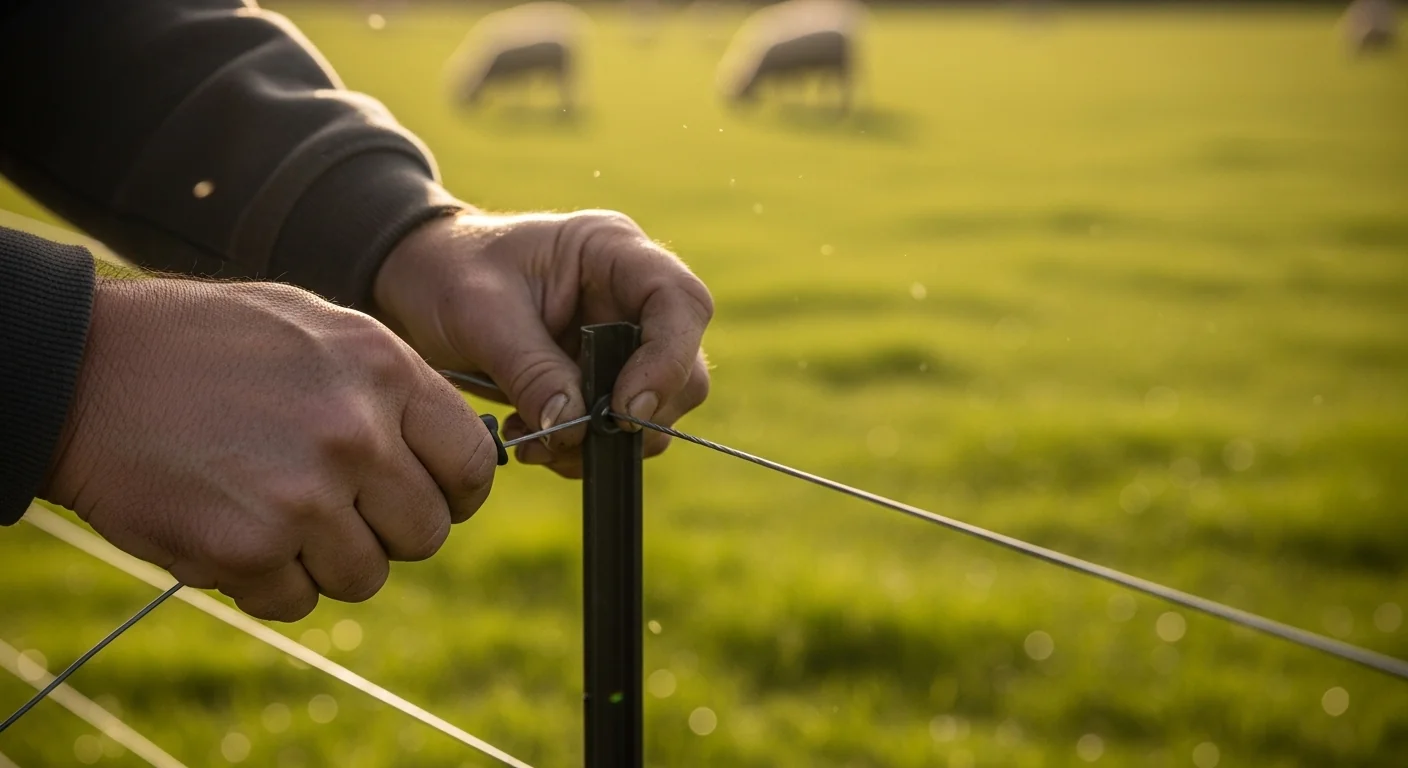
Once paddock count and area are confirmed, the next decision is infrastructure: permanent versus temporary fencing. Permanent high-tensile or woven wire perimeter fencing establishes the outer boundary, but most practitioners use temporary interior electric subdivisions that can be moved as growth conditions change seasonally. The H-brace fence calculator is useful for sizing permanent corner and brace posts once your paddock grid dimensions are set. Spacing and post depth for H-braces that anchor high-tensile wire runs directly from your paddock geometry and wire tension requirements.
After fencing is planned, work backward from your daily dry matter intake figure to validate hay and supplemental feed reserves for the winter or drought period when the rotation must pause. A system that delivers 30-day rest periods during the grazing season can collapse the first winter if the operator has not modeled off-pasture feed requirements. The winter cattle feed calculator picks up where this tool leaves off, helping you size hay inventory and storage needs based on the same herd weight data you just entered here.
FAQ
What is the minimum rest period for rotational grazing?
The absolute biological minimum for meaningful parasite management is 21 days, based on the developmental timeline of Haemonchus contortus larvae from egg deposition to peak infective density on grass. A rest period of 28 to 45 days provides a safety margin that accounts for variation in temperature, moisture, and larval survival rate across different climate conditions and seasons.
How do I calculate how many paddocks I need?
Divide your target rest period by your planned grazing period per paddock, round up to the next whole number, and add one. The extra paddock ensures that one section is always being grazed while all others rest. For example, a 28-day rest with a 3-day grazing period requires ceil(28 / 3) + 1 = 11 paddocks to deliver 30 actual days of rest.
Can I use this calculator for sheep and goats, not just cattle?
Yes. The dry matter intake formula at 3% body weight applies across most ruminant species under average conditions. The parasite threshold warning is especially relevant for sheep and goats, which are far more susceptible to Barber Pole worm mortality than cattle. Enter the total combined weight of all animals regardless of species. For mixed-species herds, the same calculation applies as long as the total weight is accurate.
Why does the actual rest period differ from the rest period I entered?
The total paddock count is ceiled (rounded up to the next whole number). Because you cannot have a fraction of a paddock, the system always rounds up. This rounding produces a slightly longer actual rest period than the minimum you entered. The actual rest output is what the parasite warning is based on, which is why it is the first number to check in the results panel.
What is mob grazing and does this calculator apply to it?
Mob grazing uses very high stocking density for very short moves, sometimes a few hours per paddock across dozens of small subdivisions. This calculator is calibrated for grazing periods of one day or more. Sub-day grazing periods push the formula into ranges where forage trampling, paddock boundary logistics, and animal stress factors dominate the outcome in ways the model does not capture. Mob grazing operations benefit from this tool as a planning ceiling but require more detailed on-site pasture monitoring.
Does the 21-day rule apply in all climates?
No. In hot, arid climates, soil surface temperatures can kill larvae significantly faster, potentially reducing the effective threshold. In cool, wet climates, larvae can survive longer than 21 days on grass blades. The 21-day figure is a temperate-climate minimum derived from Haemonchus contortus biology. High-humidity subtropical operations and cool northern systems should consult local extension veterinary guidance for climate-adjusted rest period targets.
Conclusion
The single most preventable mistake in rotational grazing management is building a paddock system around a default count, whether 4, 5, or 6 paddocks, without computing what actual rest period that count delivers for your specific grazing schedule. Entering a longer target rest period does not guarantee that rest is achieved; only having enough paddocks in the system does. Run the calculation, check the actual rest output, and add paddocks until the number is green.