
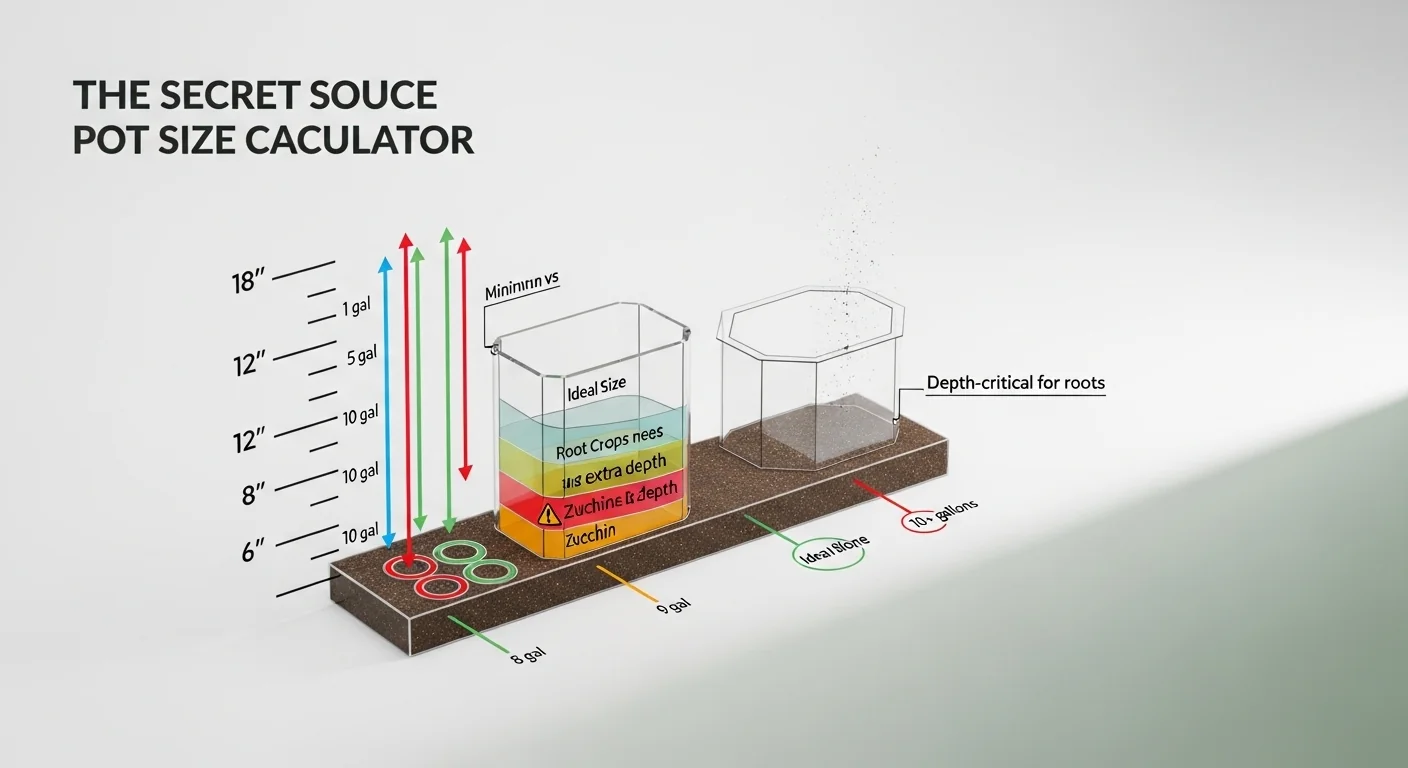
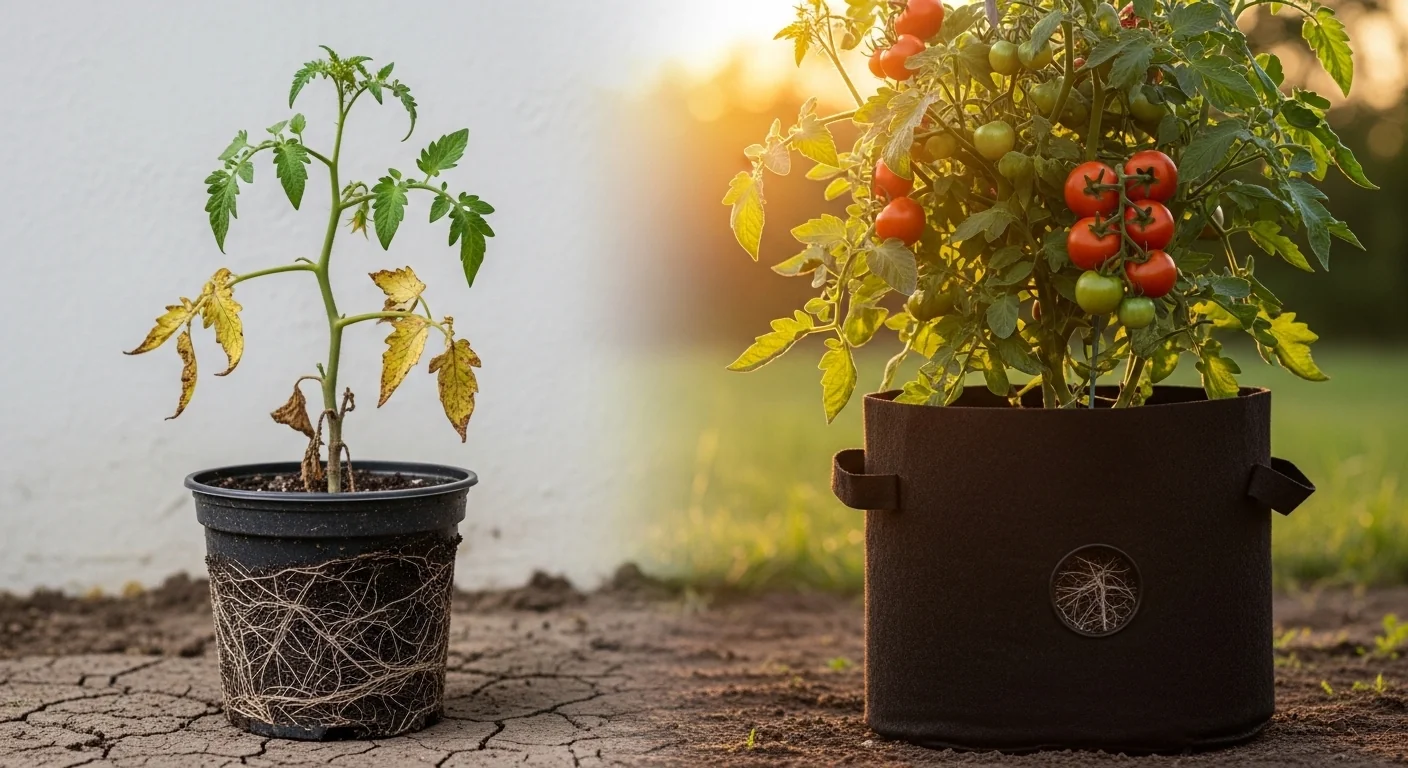
Container gardening fails more often at the nursery than in the ground. The decision that causes the most preventable crop loss happens before a single seed is sown: selecting a pot that is too small for the plant’s mature root mass. A tomato crammed into a 2-gallon bucket will exhaust its soil volume by midsummer, starve of nitrogen, and stall fruit development, regardless of fertilizer schedule or sun exposure. The relationship between container volume, soil depth, and root architecture is specific to each crop family, not a general rule of thumb.
This pot size calculator uses a curated lookup table built from crop-specific root zone requirements to return a minimum container size in gallons alongside the required soil depth in inches. It covers 24 common vegetable and herb types, applies category-specific warnings for fruiting crops, root vegetables, and invasive herbs, and links directly to Amazon listings sized to the recommendation. What it does not do: it cannot account for regional climate, watering frequency, or soil amendment choices. Container performance also depends on drainage, and this tool treats drainage as assumed adequate.
After running the calculator, you will have a specific gallon target and depth requirement for your crop. Use that number to filter pot options before purchasing, not after.
Use the Tool
Container Size Matcher
Pot Size Calculator — The Yield Grid
| Vegetable | Min. Size | Ideal Size | Depth Needed |
|---|
How This Calculator Works — Assumptions & Limits
- Input: You select a vegetable type from a curated list of 24 common container-grown crops.
- Lookup: The calculator uses an expert-curated lookup table to retrieve: minimum container size (gallons), ideal container size, required soil depth (inches), and special notes.
- Secret Sauce checks: Tomato (indeterminate) → enforces “5 gallon minimum” standard. Lettuce → confirms “1 gallon minimum is sufficient.” Root crops (carrot, beet, radish) → triggers a depth warning if the container is often sold at standard 10″ depths.
- Result: Displays minimum gallons, a segmented fill-bar showing relative size vs. 25-gallon max, a category badge, a plain-language interpretation, and an Amazon shopping link specific to the recommended pot size.
- Recommendations are for single-plant growing unless noted.
- Values assume standard potting mix, adequate drainage, and regular watering/fertilizing.
- Indeterminate tomatoes can benefit from up to 15–20 gallons for best yield — 5 gal is the absolute floor.
- Very small containers (1–2 gal) require more frequent watering in hot weather.
- Root vegetables need depth as much as volume — always check the depth spec.
- Amazon links are size-matched search links; exact products may vary by region and availability.
To get an accurate result, know the exact vegetable or herb variety you intend to grow before selecting from the dropdown. Indeterminate and determinate tomato varieties carry different minimum requirements and appear as separate options. If you plan to grow multiple crops in a single season, run the calculator once per crop. For planning how many plants fit within a given outdoor space alongside container choices, the plant spacing calculator can help you coordinate container groupings with in-ground rows.
Quick Start (60 Seconds)
- Select your vegetable type: Use the full name, including variety subtype where relevant. “Tomato (Indeterminate)” and “Tomato (Determinate/Bush)” return different minimum sizes.
- Annual vs. perennial herbs: Basil, parsley, and cilantro are grouped under annual herbs. Rosemary, sage, and thyme are listed separately as perennial herbs, which need more root room over successive seasons.
- Mint is its own category: Select “Mint” specifically, not the general herb option. Mint carries an invasive-runner warning that triggers different guidance.
- Root crops need depth, not just volume: For carrots, beets, and radishes, the soil depth figure in the result is as important as the gallon count. A wide, shallow container of the right volume can still fail a carrot crop.
- Do not average two crops: If you are deciding between two vegetables, run the calculator for each separately and use the larger result to size a shared pot, or use individual pots.
- The Amazon link updates automatically: After each calculation, the shopping link changes to a size-matched search. The gallon size in the link reflects the minimum, not the ideal, container size.
- Click Reset between crops: The results panel does not clear itself when you change the dropdown. Use the Reset button to confirm a clean slate before your next entry.
Inputs and Outputs (What Each Field Means)
| Field | Unit | What It Means | Common Mistake | Safe Entry Guidance |
|---|---|---|---|---|
| Vegetable Type | Selection (categorical) | The specific crop and variety subtype you intend to grow. Each option maps to a distinct root zone profile. | Choosing “Tomato (Indeterminate)” when growing a compact patio or bush variety, inflating the result unnecessarily. | Verify variety type on seed packet or plant tag before selecting. Indeterminate varieties continue vining; determinate varieties stop at a set height. |
| Minimum Container Size (output) | US gallons | The smallest container volume where this crop can complete its growth cycle without root restriction causing yield loss. | Treating the minimum as the target. The minimum is a floor, not an optimum. | When budget allows, use the “ideal size” noted in the interpretation text, which exceeds the minimum by a crop-specific margin. |
| Required Soil Depth (output) | Inches | The vertical soil depth the root system needs for unobstructed development. Especially critical for root vegetables. | Purchasing a wide, shallow decorative pot that meets the gallon requirement but fails the depth requirement for root crops. | Check pot dimensions, not just volume. A 12-inch-deep pot holds roughly 2 to 3 gallons depending on diameter. |
| Category Badge (output) | Text label | Groups the crop into a family (Fruiting, Leafy, Root, Legume, Brassica, Herb, Bulb, Fruit) to contextualize the size recommendation. | Ignoring category context. Root crops carry depth warnings; Fruiting crops carry volume warnings. The category drives the warning type. | Read the warning box below the primary result. The badge and warning work together to explain why the threshold matters for this specific crop family. |
| Container Scale Bar (output) | Visual percentage of 25 gallons | A segmented fill bar showing where the recommended minimum falls on a 1-to-25-gallon spectrum, color-coded green/orange/red by severity. | Treating a green bar as confirmation that any size is acceptable. Green means the crop is container-friendly, not that a smaller pot would work. | Use the bar for visual comparison across crops when planning a multi-container setup. Red bar crops (like zucchini) need dedicated large containers. |
| Amazon Shopping Link (output) | External URL | A size-matched Amazon search link for pots or grow bags at the recommended minimum gallon size. Updates with each new calculation. | Purchasing the first result without checking depth dimensions in the product listing. Amazon listings vary widely in actual depth for the same gallon rating. | Use the link to filter options, then verify soil depth in the product dimensions before adding to cart. Fabric grow bags typically offer better drainage than rigid plastic. |
If you are planning the number of seed starts for your container garden alongside pot sizing, the seed packet calculator can help you work out how many starts to germinate for each container slot.
Worked Examples (Real Numbers)
Scenario 1: Balcony Tomato in a Single Large Container
- Vegetable selected: Tomato (Indeterminate)
- Minimum size returned: 5 gallons
- Ideal size shown: 15 gallons
- Required depth: 18 inches
- Warning level: Orange (warn)
Result: 5-gallon minimum, 15-gallon ideal, 18-inch depth required.
A 5-gallon container will keep an indeterminate tomato alive, but the plant will run out of root space by peak fruiting season in most climates. The 15-gallon ideal figure reflects the volume where sustained fruiting through the full season becomes reliable. On a weight-limited balcony, a 10-gallon fabric grow bag is a practical middle ground.
Scenario 2: Window Box Lettuce Setup
- Vegetable selected: Lettuce / Salad Greens
- Minimum size returned: 1 gallon
- Ideal size shown: 2 gallons
- Required depth: 6 inches
- Warning level: Green (safe)
Result: 1-gallon minimum per plant, 6-inch depth, green safety status.
Lettuce has one of the shallowest root systems of any food crop, which makes it ideal for window boxes, balcony rails, and shallow troughs. A standard 24-inch window box holds roughly 6 to 8 heads of loose-leaf lettuce at 1 gallon per plant. At 6 inches of required depth, nearly any box or trough qualifies.
Scenario 3: Patio Herb Collection with Perennial Rosemary
- Vegetable selected: Herbs (Rosemary, Sage, Thyme) [perennial]
- Minimum size returned: 2 gallons
- Ideal size shown: 3 gallons
- Required depth: 10 inches
- Warning level: Green (safe)
Result: 2-gallon minimum, 3-gallon ideal, 10-inch depth, green status.
Perennial herbs develop woody root structures over multiple seasons, which means a 1-gallon starter pot will need upsizing by year two. Starting in a 3-gallon terracotta pot with drainage holes allows the plant to establish without needing repotting for two to three growing seasons. Terracotta’s porosity also prevents overwatering, which is the primary failure mode for rosemary in containers.
Reference Table (Fast Lookup)
| Vegetable / Herb | Category | Min Size (gal) | Ideal Size (gal) | Min Depth (in) | Container-Friendliness Rating |
|---|---|---|---|---|---|
| Lettuce / Salad Greens | Leafy | 1 | 2 | 6 | Excellent (no restrictions) |
| Radish | Root | 1 | 1 | 8 | Good (depth-critical) |
| Basil / Annual Herbs | Herb | 1 | 1 | 6 | Excellent (windowsill-viable) |
| Spinach | Leafy | 1 | 2 | 6 | Excellent (cool-season window box) |
| Strawberry | Fruit | 1 | 2 | 8 | Excellent (tower planters work well) |
| Mint | Herb | 1 | 2 | 8 | Good (must be isolated container) |
| Onion / Shallot | Bulb | 1 | 2 | 8 | Good (multiple bulbs per pot) |
| Hot / Chili Pepper | Fruiting | 2 | 3 | 10 | Good (compact root system) |
| Carrot | Root | 2 | 3 | 12 | Moderate (depth-critical, choose short varieties) |
| Bush Bean | Legume | 2 | 3 | 10 | Good (no staking needed) |
| Beet | Root | 2 | 3 | 12 | Moderate (depth and spacing both matter) |
| Kale | Leafy | 3 | 5 | 12 | Good (cold-hardy through autumn) |
| Bell / Sweet Pepper | Fruiting | 3 | 5 | 12 | Good (5 gal produces full season) |
| Rosemary / Perennial Herbs | Herb | 2 | 3 | 10 | Good (upsize by year 2) |
| Pea | Legume | 3 | 5 | 12 | Good (trellis required) |
| Tomato (Determinate / Bush) | Fruiting | 5 | 10 | 14 | Moderate (5 gal floor; 10 gal preferred) |
| Tomato (Indeterminate) | Fruiting | 5 | 15 | 18 | Moderate (5 gal is absolute minimum) |
| Pole Bean | Legume | 5 | 7 | 12 | Moderate (needs heavy pot for trellis stability) |
| Cucumber | Fruiting | 5 | 10 | 16 | Moderate (high water demand) |
| Eggplant | Fruiting | 5 | 10 | 16 | Moderate (heat-lover, fertilize every 2 weeks) |
| Broccoli | Brassica | 5 | 10 | 14 | Moderate (one head per container) |
| Cabbage | Brassica | 5 | 10 | 14 | Moderate (heavy feeder, one plant per pot) |
| Zucchini / Summer Squash | Fruiting | 10 | 20 | 18 | Challenging (largest container need of common crops) |
The “Container-Friendliness Rating” column is a derived judgment synthesizing minimum volume, depth requirement, and water demand into a single decision signal. It is not a score from any external standard; it reflects the ratio of the crop’s minimum requirements to what common balcony and patio containers can realistically provide.
How the Calculation Works (Formula + Assumptions)
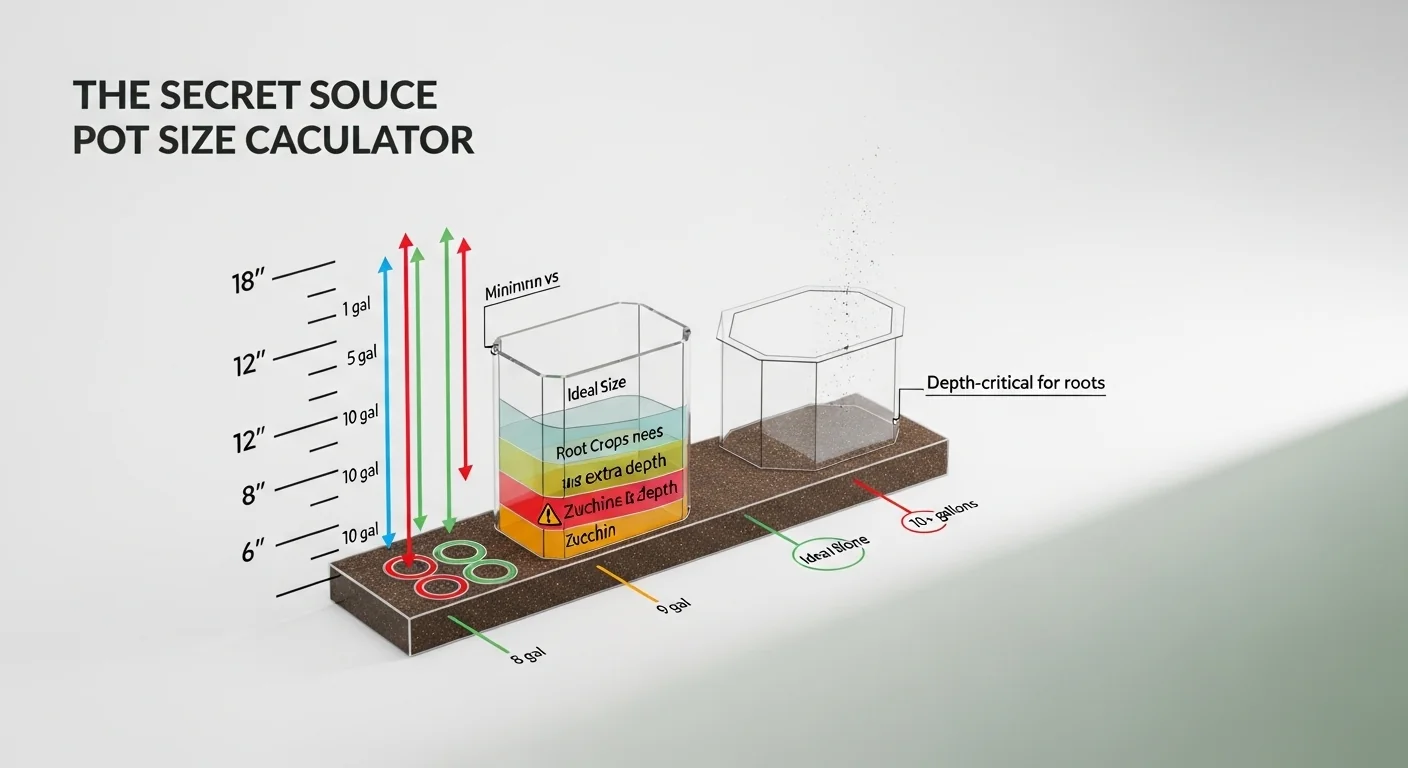
Show the calculation steps
Step 1: Crop identification. The user selects a vegetable from a dropdown of 24 crops. Each crop maps to a unique record in the lookup table stored in the JavaScript layer. No numeric input is required; the entire formula is lookup-based.
Step 2: Retrieve minimum gallon value. The selected crop key retrieves a minGal value representing the smallest container volume, in US gallons, where that crop can complete its growth cycle without root restriction triggering measurable yield loss. This value is drawn from published container-growing guidelines, not computed dynamically from a mathematical formula.
Step 3: Retrieve ideal gallon and depth values. The same lookup record returns an idealGal value (the container size at which yield approaches field-grown performance) and a depthIn value (minimum soil depth in inches). These three figures are displayed in the result panel.
Step 4: Compute fill bar position. The bar position is calculated as: barPercent = min(100, round((minGal / 25) * 100)). The denominator of 25 is a fixed ceiling representing the largest common container size (25 gallons) for typical home garden use. This is a display calculation only; it does not affect the gallon recommendation.
Step 5: Apply threshold logic. Each crop record carries a warnLevel value of “safe,” “warn,” or “danger.” This drives the color of the fill bar and the style of the warning box. The threshold logic is deterministic: it is assigned per crop based on whether the minimum container size represents a significant constraint (danger = 10+ gallon minimum, warn = 5 gallon minimum for fruiting crops or depth-critical root crops, safe = all others).
Rounding rule: All gallon values are whole numbers. No fractional gallons are displayed. The fill bar percentage is rounded to the nearest whole number.
Unit note: All volumes are US liquid gallons. 1 US gallon equals approximately 3.785 liters. Depth is in US customary inches.
Assumptions and Limits
- All recommendations assume a single plant per container unless the crop note specifies otherwise (e.g., radish, onion, lettuce, which can be grown at higher density).
- Values assume standard commercial potting mix with adequate perlite or peat content for drainage. Native soil or topsoil in containers will compress, reduce effective volume, and invalidate the gallon recommendations.
- The lookup table assumes adequate drainage holes. A container of the correct volume with sealed or clogged drainage can fail any crop regardless of size.
- Indeterminate tomato recommendations use 5 gallons as the absolute floor based on root zone studies. The ideal range of 10 to 15 gallons is strongly preferred for sustained fruiting. The calculator displays the minimum, not the optimum.
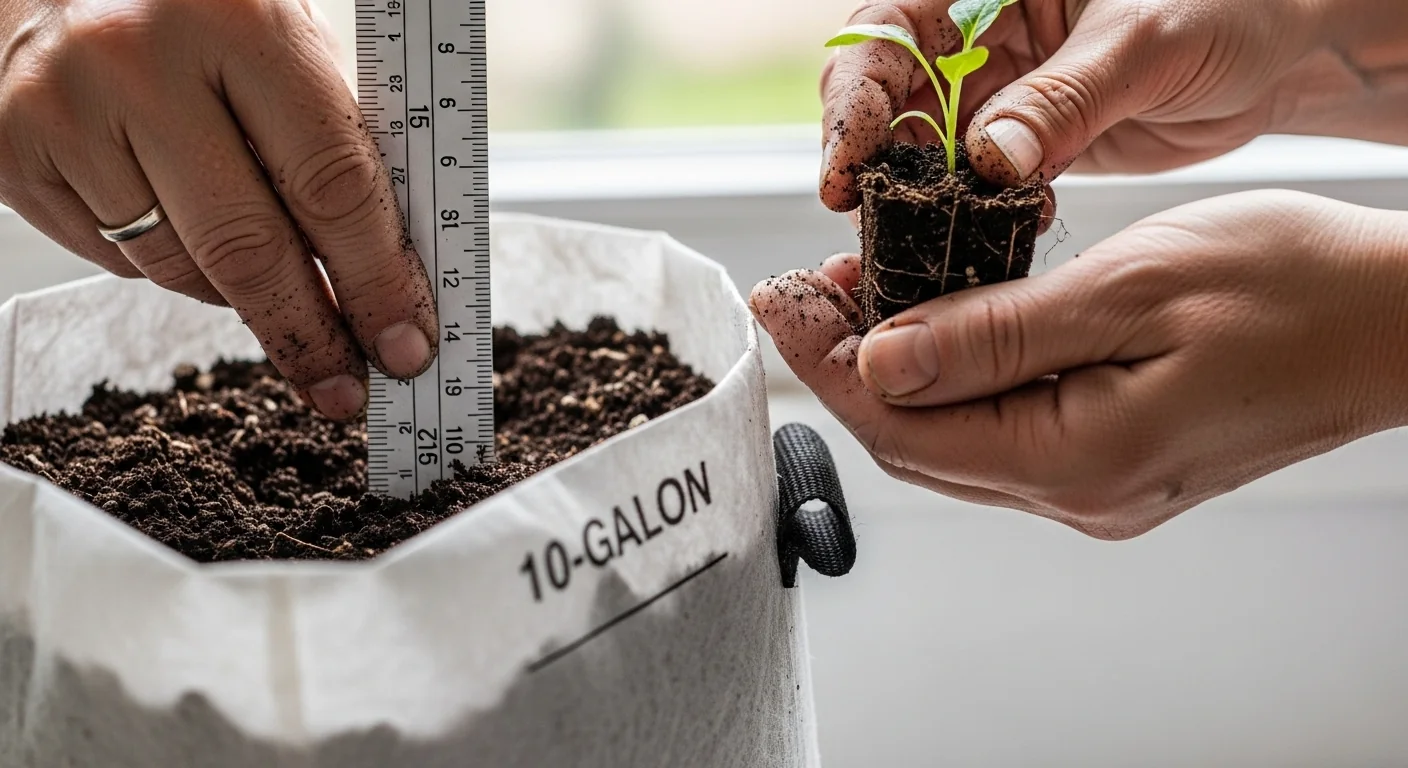
- Root depth values do not account for container taper. A pot labeled “12-inch depth” may have only 9 to 10 inches of actual soil depth once the taper and drainage layer are accounted for. Measure inside depth before purchasing for root crops.
- The Amazon links are size-matched search queries and do not represent endorsements. Exact product availability, depth dimensions, and material quality vary by region and listing date.
- Container performance in extreme heat (above 95 degrees Fahrenheit) may require larger volumes than the minimums shown, as soil moisture depletes faster in smaller containers. This tool does not adjust for climate.
- Perennial herbs in the 2 to 3 gallon range will require repotting by their second or third season. The minimum size shown reflects year-one establishment, not multi-year cultivation without intervention.
Standards, Safety Checks, and “Secret Sauce” Warnings
Critical Warnings
- Indeterminate tomatoes: 5 gallons is the hard floor. This is the most frequently violated container sizing rule in home gardening. A tomato plant in a 1- or 2-gallon pot will germinate, transplant, and begin flowering, leading many growers to believe the size is working. Root restriction typically does not manifest as visible stress until mid-summer, at which point it presents as blossom drop, yellowing lower leaves, and stunted fruit set. By that point, the season is partially lost.
- Root crops fail on depth, not volume. A 2-gallon pot that is wide and shallow will meet the gallon number for carrots but fail the 12-inch depth requirement. Carrot roots will fork, curl, or abort at the container floor. Always verify inside depth on any pot before purchasing it for a root crop. The bulb planting depth chart covers similar depth-critical logic for bulb crops and provides a useful cross-reference for depth standards across root-type plants.
- Zucchini in anything under 10 gallons will underperform. Squash is the most resource-demanding common vegetable for container growing. A 5-gallon pot will keep the plant alive but will result in significantly fewer fruits than in-ground performance, and the plant will become water-stressed within days in summer heat.
- Mint must be isolated. Growing mint in a shared container or raised bed allows its underground runners to colonize adjacent soil within a single season. The calculator’s invasive alert is not a minor caveat; it reflects documented behavior of all common mint varieties.
Minimum Standards
- Any fruiting vegetable (tomato, pepper, eggplant, cucumber) requires a minimum of 2 gallons. Anything below this threshold applies to herbs and leafy greens only.
- Any container intended for root vegetables must have at least 8 inches of inside depth. For full-length carrots, 12 inches is the standard. This depth is non-negotiable and is not compensated by additional volume.
- Brassicas (broccoli, cabbage) should be grown one per container at the 5 to 10 gallon range. Crowding two brassicas into a single large pot rarely produces the same yield as two separate correctly-sized pots.
Competitor Trap: Many pot size guides online list a single generic recommendation such as “most vegetables need at least 5 gallons.” This flattens the spectrum from lettuce (1 gallon) to zucchini (10 to 20 gallons) into a single useless figure. Worse, those same guides almost never mention soil depth as a separate constraint from volume. A gardener who reads “5 gallons” and buys a wide, shallow 5-gallon decorative bowl has technically followed the advice and will still fail with carrots, beets, or tomatoes. The container sizing decision requires both a volume number and a depth number, and they are not interchangeable.
Common Mistakes and Fixes
Mistake: Treating the Minimum Size as the Target
The minimum gallon figure is the threshold below which crop failure becomes likely, not the recommended growing volume. A tomato at the 5-gallon minimum will survive; at 10 to 15 gallons it will produce. Growers who optimize for the smallest possible pot to save cost or space often find they spend more replacing stressed plants mid-season than they saved on containers.
Fix: Where space allows, default to the ideal gallon figure shown in the result interpretation text, not the minimum.
Mistake: Ignoring Depth and Buying on Volume Alone
Container volume is measured by the manufacturer as total capacity, not usable soil depth. A wide, short decorative planter may hold 3 gallons in volume but only 7 inches of soil depth, which disqualifies it for carrot or beet growing even if the gallon number looks right. This mismatch is especially common with decorative ceramic pots and window boxes with internal reservoirs.
Fix: Check inside soil depth in the product dimensions before purchasing for any root crop. The depth requirement is listed separately from the gallon figure in every calculator result.
Mistake: Mixing Crops Without Resizing the Container
Planting a tomato and a basil plant in the same 5-gallon container is a popular companion planting combination, but it treats two root systems as if they occupy no shared volume. The tomato alone needs 5 gallons; adding a second root system in the same pot effectively reduces available root space for both plants. Basil in a shared container with a heavy feeder will show nutrient stress first.
Fix: If companion planting in containers, use the larger crop’s ideal size, not its minimum, as the base container volume. Alternatively, use a dedicated small pot for the companion crop placed adjacent. The square foot gardening planner has a companion planting framework that addresses this kind of spacing logic in both in-ground and raised-bed contexts.
Mistake: Using Garden Soil in Containers
Native soil compacts in containers within a single growing season, reducing effective volume and blocking drainage. Growers who use garden soil in correctly-sized pots often see the same root restriction symptoms (yellowing, blossom drop, slow fruit set) that they associate with undersized containers, when the actual cause is soil compaction rather than volume.
Fix: Use a commercially formulated potting mix with perlite or a perlite-added potting soil. Never fill a container with topsoil or garden soil from a raised bed or plot.
Mistake: Sizing the First-Year Pot for Multi-Year Perennial Herbs
A 1-gallon pot that establishes rosemary or thyme successfully in its first summer will become root-bound by the end of the following season. Growers who do not repot see the plant stunting and the leaves becoming sparse, which they often attribute to disease or pest pressure rather than root restriction.
Fix: Start perennial herbs in their ideal size (2 to 3 gallons), not their minimum. This eliminates the need to repot in year two and gives the root system room to develop the woody structure that improves cold hardiness in container-grown perennials.
Next Steps in Your Workflow
Once you have a container size for each crop on your list, the next decision is whether those container yields actually meet your consumption goals. A single 5-gallon tomato plant will produce a certain number of fruits per season, and that number varies by variety, sunlight, and care. Before purchasing containers, cross-reference your pot sizing decisions with the vegetable yield calculator to estimate whether one container per crop is enough or whether you need two or three pots running in parallel to meet your household output target.
Timing matters alongside sizing. A correctly sized container planted at the wrong time in your climate will still underperform. After locking in your container selection, use the harvest date calculator to work backward from your intended harvest window to a planting date. This is particularly useful for crops like tomatoes and peppers, where the days-to-maturity figure on the seed packet only tells part of the story when container growing extends or compresses the timeline relative to in-ground production.
FAQ
Can I use a fabric grow bag instead of a rigid pot?
Yes, and for most fruiting vegetables, fabric grow bags outperform rigid plastic containers. The porous walls allow air pruning of roots, which prevents root circling and promotes a denser root system. Fabric bags also drain more efficiently, which reduces overwatering risk. Use the same gallon minimums as rigid pots. Ensure the bag has structural support when filled, as wet soil in a large fabric bag can lose its shape.
My tomato is in a 3-gallon pot and looks fine. Do I really need to upsize?
Root restriction in tomatoes typically becomes visible after the plant reaches full canopy size and begins peak fruiting load, usually in midsummer. The plant may look healthy before that point because the root system has not yet saturated the available volume. Once it has, symptoms appear quickly. The 5-gallon minimum is based on the fruiting phase requirement, not the seedling or early vegetative phase.
Can two lettuce plants share a 1-gallon pot?
Not productively. The 1-gallon figure applies to one plant with room to develop a full head. Two plants in 1 gallon will compete for nutrients and moisture, resulting in smaller, faster-bolting leaves. For a multi-plant lettuce setup, use a wider trough or window box that provides 1 gallon of volume per plant slot. A 24-inch window box typically supports six to eight loose-leaf plants.
What happens if I use a pot that is larger than the ideal size?
Oversized containers are rarely harmful to the plant itself. The main risk is overwatering, because a large volume of soil around a small root system retains moisture longer, which can lead to root rot in crops sensitive to wet feet, such as herbs and peppers. Using a well-draining potting mix with perlite mitigates this. Larger pots also dry out more slowly between watering, which is beneficial in high-heat climates.
How do I know if my container is deep enough without measuring?
A common reference: a standard 1-gallon nursery pot is roughly 6 inches deep. A standard 5-gallon bucket is approximately 11 to 12 inches deep. A 10-gallon fabric grow bag typically reaches 12 to 14 inches of soil depth. For carrots and beets, which need 12 inches, a 5-gallon bucket meets depth requirements but falls short on volume for ideal performance. Measure the inside before planting any root crop.
Is there a minimum pot size that works for almost all vegetables?
A 5-gallon container at 12 inches of depth covers most herbs, leafy greens, peppers, bush beans, peas, strawberries, and determinate tomatoes. It does not adequately cover root vegetables (which need verified depth), indeterminate tomatoes at full production, cucumber, eggplant at its ideal, or zucchini under any conditions. There is no single universal size that works for all 24 crops covered by this calculator.
Conclusion
The pot size calculator reduces a common garden planning error to a 30-second lookup. Container sizing is one of the few planting decisions that cannot be corrected after transplant without uprooting the crop, so getting the number right before purchasing saves both money and the growing season. The most important takeaway from the data behind this tool is that the minimum gallon figure and the required soil depth are two separate specifications, and a pot must satisfy both, not just one.
The single most preventable mistake this calculator exists to stop is planting an indeterminate tomato in a 2-gallon pot because it “seemed fine at planting time.” Checking your sun exposure before choosing container placement also matters for final yield; the sun path calculator can help you confirm whether a specific balcony or patio spot receives enough direct sunlight hours for fruiting crops before you commit to container placement. Use the tool, check both numbers, and plant with confidence.