
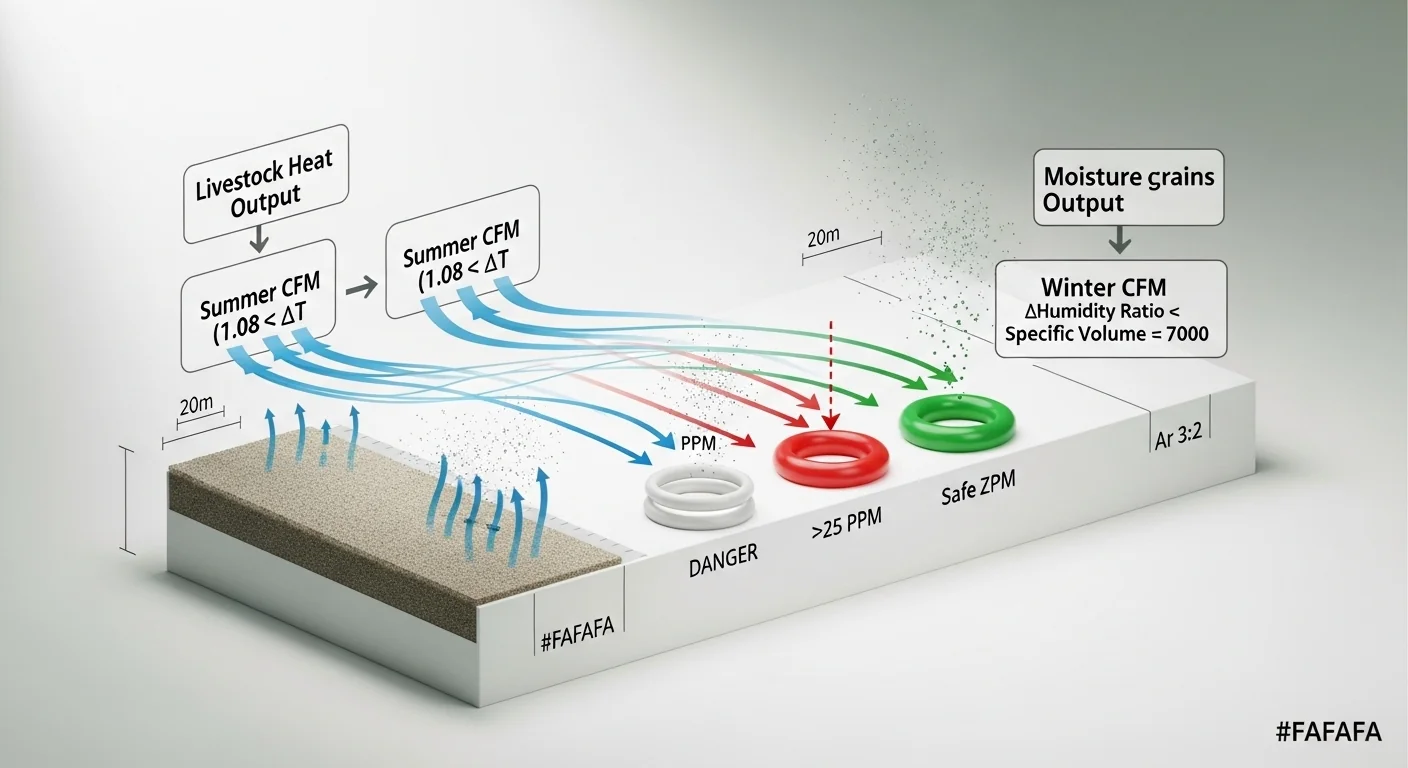
Ventilation failure in livestock barns almost never looks like a broken fan. It looks like a sealed building in January, a homesteader who sealed the chicken coop to “keep the heat in,” and 50 birds dead by morning from ammonia-induced respiratory failure, not from cold. Barn ventilation is not a comfort feature. It is the primary mechanism preventing toxic gas accumulation, moisture-driven disease pressure, and summer heat stress. The math governing it is deterministic, and the thresholds at which it fails are not guesses.
This barn ventilation calculator computes required airflow in CFM (cubic feet per minute) using two separate formulas: one for summer cooling based on animal heat output, and one for winter moisture control based on moisture removal rate. It also estimates steady-state ammonia concentration in parts per million (PPM) and flags when ventilation falls below the threshold for safe air quality. It does not account for wind-assisted passive ventilation, barn insulation R-value, tunnel ventilation dynamics, or ammonia scrubber efficiency. For those who work with poultry specifically, our chicken coop size calculator handles structural space requirements that pair with ventilation design.
After running this calculator, you will know the minimum CFM your exhaust fan system must deliver for your specific species, headcount, and season, and whether your current or planned setup puts your animals in the danger zone for ammonia exposure.
Use the Tool
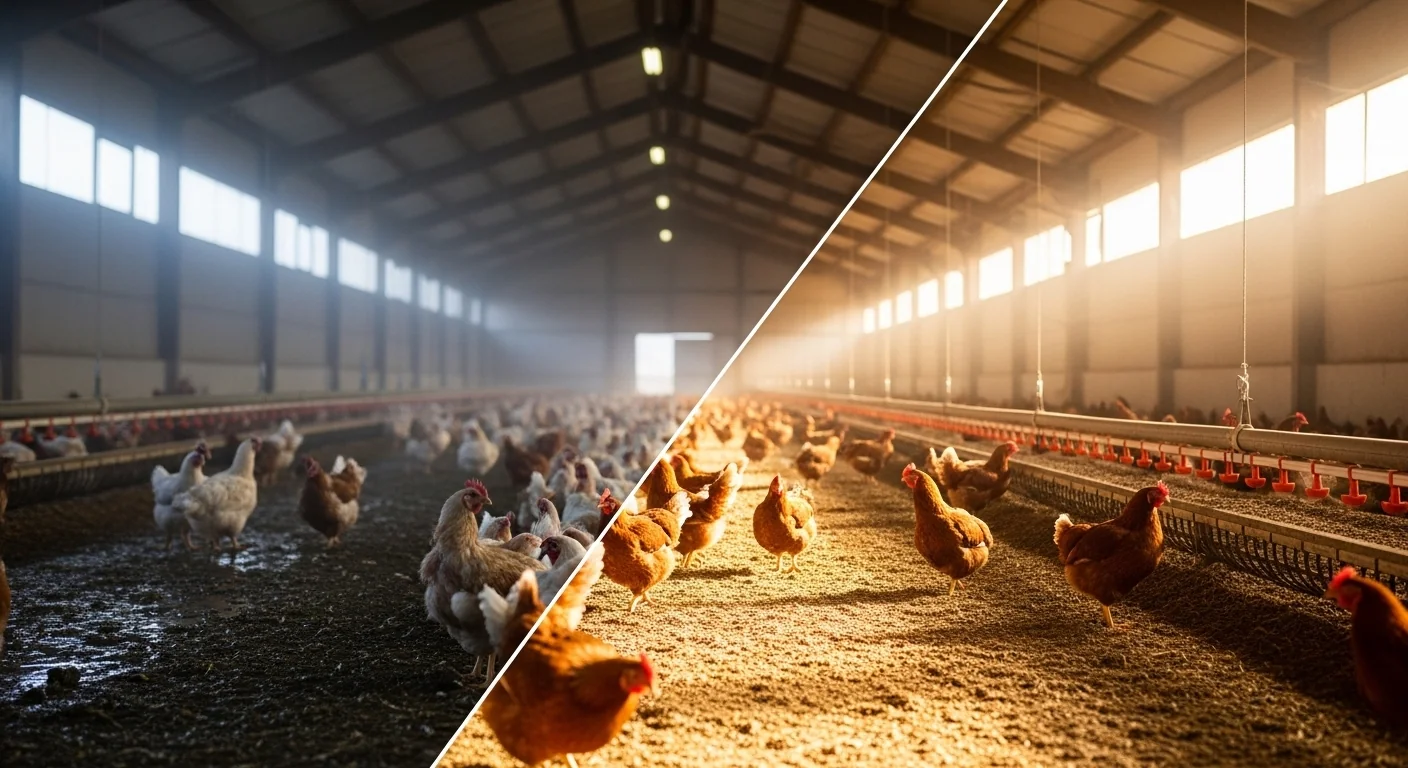
Before you start, have the following ready: barn interior dimensions in feet (not exterior, not approximations), the single livestock species that makes up the majority of the load, and your actual headcount. Enter the ammonia target that reflects your livestock species sensitivity, not the default human OSHA limit. Poultry production begins to suffer at 10 PPM, which is well below the 25 PPM human threshold. Use 10 PPM for poultry and 20 PPM as a working limit for large-animal barns unless your operation has a stricter protocol.
Quick Start (60 Seconds)
- Barn Length, Width, Height: Use interior clear dimensions in feet. Do not use exterior wall-to-wall measurements. Ceiling height should be the lowest finished point, not the peak of a vaulted roof.
- Livestock Type: Select the primary species. Mixed-species barns should be run twice, once per species, to identify the dominant CFM requirement and the higher ammonia risk.
- Animal Count: Use the maximum headcount you plan to house simultaneously, not the current headcount. Ventilation systems are sized for peak load, not average load.
- Season: Summer (Cooling) calculates CFM based on dissipating metabolic heat. Winter (Moisture Control) calculates the minimum CFM to prevent condensation and moisture-driven disease. Run both to size a variable-speed fan system correctly.
- Target Maximum Ammonia (PPM): For chickens and poultry: 10 PPM. For horses and cattle: 20 PPM. Never enter the OSHA human TWA limit of 25 PPM as your target for livestock; that is an emergency threshold, not a comfort target.
- Common input mistake: Entering ceiling peak height instead of the lowest clear height. This inflates barn volume and underestimates how quickly ammonia concentrates near the floor and litter level where animals breathe.
- Units check: All dimensions are in feet, not meters. CFM output is cubic feet per minute, not cubic meters per hour.
Inputs and Outputs (What Each Field Means)
| Field | Unit | What It Means | Common Mistake | Safe Entry Guidance |
|---|---|---|---|---|
| Barn Length | feet | Interior clear length of the barn along the long axis | Using exterior wall-to-wall instead of interior clear span | Measure inside the building, wall surface to wall surface |
| Barn Width | feet | Interior clear width perpendicular to length | Including attached lean-tos or tack rooms in the dimension | Measure only the primary livestock area |
| Barn Height | feet | Interior clear height from floor to lowest ceiling point | Using ridge height on a gable barn instead of eave height | Use the lowest continuous ceiling point, not the peak |
| Livestock Type | species category | Determines heat output (BTU/hr), moisture output (grains/hr), and ammonia output (g/hr) per animal | Using "cattle" for dairy cows when ammonia production differs significantly by management system | Select the species closest to yours; run the tool again for secondary species in mixed barns |
| Animal Count | head | Total number of animals housed simultaneously at peak | Entering average stocking rather than peak stocking | Use maximum planned headcount; ventilation must handle peak load |
| Season | Summer / Winter | Controls which formula runs: Summer = heat dissipation; Winter = moisture removal | Using only summer CFM and assuming it covers winter needs (it massively over-ventilates in cold weather) | Run both modes; use the winter result for minimum fan sizing and the summer result for maximum |
| Target Max Ammonia (PPM) | parts per million | Your acceptable ceiling for barn ammonia concentration | Using 25 PPM (OSHA human limit) as the target; this allows subclinical poultry damage to occur | Use 10 PPM for poultry; 15-20 PPM for horses and cattle |
| Required CFM (output) | cubic feet per minute | Total airflow capacity your exhaust fan system must deliver | Confusing CFM rating at 0 static pressure with actual delivered CFM against louver resistance | Add 20-25% to the calculated CFM when selecting fan models to account for real-world static pressure losses |
| Ammonia PPM (output) | parts per million | Estimated steady-state ammonia concentration under the calculated ventilation rate | Assuming this value represents average barn air; it represents the exhaust air stream concentration | Values above 10 PPM require additional ammonia mitigation (litter amendments, Sweet PDZ), not just more CFM |
| Air Exchanges/Hour (output) | ACH | How many times per hour the entire barn volume is replaced with fresh air | Targeting summer ACH rates in winter, causing excessive heat loss and cold stress | Summer target: 1-2 per minute for poultry. Winter minimum: 4-8 per hour for large animals |
Worked Examples (Real Numbers)
Example 1: Sealed Chicken Coop in January (The Winter Ammonia Trap)
- Barn: 20 ft x 12 ft x 8 ft
- Livestock: 50 Chickens
- Season: Winter (Moisture Control)
- Target ammonia: 10 PPM
Calculation: Barn volume = 1,920 ft³. Total moisture output = 50 × 5.5 = 275 grains/hr. Winter CFM = 275 / (0.0024 × 13.0 × 7,000) = 275 / 218.4 = 1.26, rounded up to 2 CFM. Total ammonia output = 50 × 0.0035 = 0.175 g/hr. At 2 CFM ventilation: ventilated ammonia concentration calculates to approximately 71 PPM.
Result: 2 CFM required for moisture control, but estimated ammonia reaches 71 PPM.
This is the core failure mode: the winter moisture-control CFM rate for small poultry houses is so low that it cannot clear ammonia generated by 50 birds on deep litter. The tool correctly flags this as a DANGER condition. The fix is not more ventilation alone; it requires litter amendment with zeolite (Sweet PDZ) to suppress ammonia at the source and scheduled litter management to reduce uric acid load.
Example 2: 20-Horse Barn, Summer Cooling
- Barn: 100 ft x 40 ft x 14 ft
- Livestock: 20 Horses
- Season: Summer (Cooling)
- Target ammonia: 20 PPM
Calculation: Barn volume = 56,000 ft³. Total metabolic heat = 20 × 2,400 = 48,000 BTU/hr. Summer CFM = 48,000 / (1.08 × 10) = 4,444 CFM, rounded up to 4,444 CFM. Total ammonia output = 20 × 0.45 = 9 g/hr. At 4,444 CFM, ventilated ammonia concentration calculates to approximately 1.6 PPM.
Result: 4,444 CFM required; estimated ammonia at 1.6 PPM, well within 20 PPM target.
Large-animal barns with high summer CFM rates naturally control ammonia as a side effect of heat management. The stall management risk for horses is mud and moisture outside the barn, which is a separate problem from interior air quality.
Example 3: 500-Bird Commercial Laying Flock, Winter
- Barn: 40 ft x 25 ft x 10 ft
- Livestock: 500 Chickens
- Season: Winter (Moisture Control)
- Target ammonia: 10 PPM
Calculation: Barn volume = 10,000 ft³. Total moisture = 500 × 5.5 = 2,750 grains/hr. Winter CFM = 2,750 / 218.4 = 12.6, rounded up to 13 CFM. Total ammonia output = 500 × 0.0035 = 1.75 g/hr. At 13 CFM, ventilated ammonia calculates to approximately 109 PPM.
Result: 13 CFM for moisture control, but estimated ammonia at 109 PPM -- a critical danger condition.
This scenario illustrates why poultry producers cannot rely solely on minimum winter ventilation to manage ammonia. At 500 birds, even aggressive litter management and Sweet PDZ application may not bring ammonia below 25 PPM without a stepped ventilation approach that runs higher CFM than the moisture-control minimum.
Reference Table (Fast Lookup)
| Species | Avg Weight (lb) | Summer CFM/Head | Winter Min CFM/Head | NH3 Output (g/hr/head) | NH3 Risk Level | Ammonia Blindness Threshold (PPM) |
|---|---|---|---|---|---|---|
| Chickens (broiler) | 5 | 7 | 0.7 | 0.0035 | Very High | 10 PPM (production loss onset) |
| Chickens (layer) | 4 | 6 | 0.6 | 0.004 | Very High | 10 PPM |
| Turkeys | 25 | 30 | 3 | 0.015 | High | 15 PPM |
| Swine (finishing) | 250 | 85 | 12 | 0.18 | High | 20 PPM |
| Goats | 150 | 40 | 7 | 0.08 | Moderate | 20 PPM |
| Sheep | 150 | 35 | 6 | 0.07 | Moderate | 20 PPM |
| Horses | 1,100 | 275 | 35 | 0.45 | Moderate | 25 PPM |
| Dairy Cattle | 1,400 | 375 | 45 | 0.55 | Low-Moderate | 25 PPM |
How the Calculation Works (Formula + Assumptions)
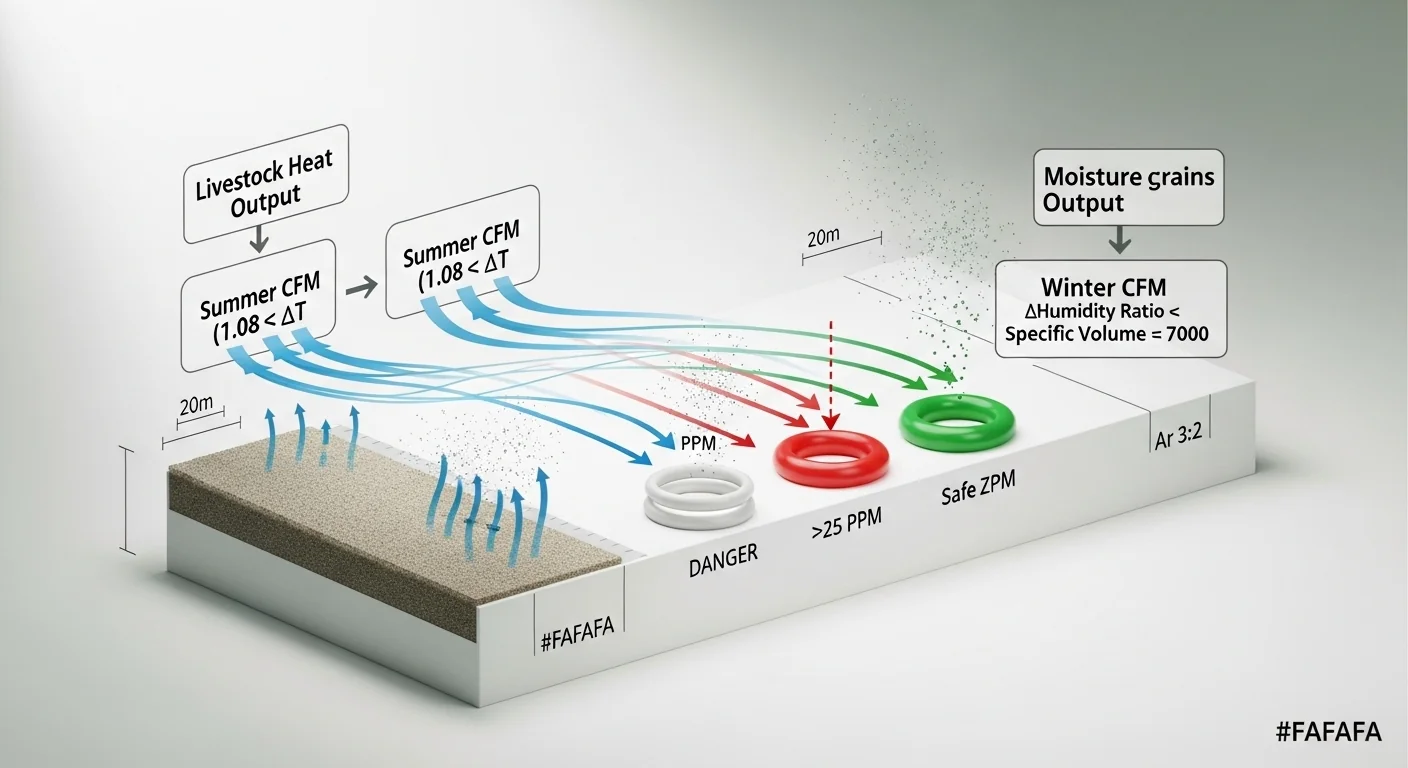
Show the calculation steps
Step 1: Barn Volume
Volume (ft³) = Length × Width × Height
This is the total air mass the ventilation system must exchange. All subsequent calculations derive from this number.
Step 2: Animal Heat and Moisture Output
Each species has a published metabolic heat output (BTU/hr per head) and moisture output (grains of water vapor per hour per head) drawn from ASABE engineering data and Midwest Plan Service reference tables. These are multiplied by headcount to get totals.
Step 3: Summer CFM (Heat Dissipation)
CFM = Total Heat (BTU/hr) / (1.08 × ΔT)
Where 1.08 is the heat capacity factor for standard air (BTU per CFM per °F per hour), and ΔT is the target temperature differential between incoming and outgoing air (default: 10°F). Result is rounded up to the nearest whole CFM.
Step 4: Winter CFM (Moisture Removal)
CFM = Total Moisture Output (grains/hr) / (ΔHumidity Ratio × Specific Volume × 7,000)
ΔHumidity Ratio = 0.0024 lb water/lb dry air (difference between indoor and outdoor humidity ratios at standard winter assumptions). Specific Volume = 13.0 ft³/lb dry air. 7,000 converts pounds of water to grains. This calculates the minimum airflow to carry moisture out of the barn without exceeding the indoor humidity target.
Step 5: Ammonia Concentration Estimate
Total ammonia output (g/hr) = Count × per-head ammonia rate
CFM is converted to liters per minute (1 ft³ = 28.317 liters). Steady-state exhaust concentration:
PPM = (Ammonia g/hr × 1,000,000) / (CFM in L/min × 60 min × 0.73 g/L ammonia density)
The sealed-barn scenario sets CFM to zero and uses barn volume in liters as the denominator, showing worst-case 1-hour accumulation.
Step 6: Air Exchanges per Hour
ACH = (CFM × 60) / Barn Volume (ft³)
This derived value allows comparison to published ACH targets: 1-2 exchanges per minute for summer poultry, 4-8 per hour for winter large-animal barns.
Rounding: CFM results are always rounded up (ceiling function). PPM values are rounded to one decimal place. Fan count is the ceiling of CFM / 1,000.
Assumptions and Limits
- Winter outdoor conditions assumed at 30°F, 70% relative humidity; indoor target assumed at 50°F, 60% relative humidity. Colder climates or tighter buildings will require recalculation with adjusted psychrometric values.
- Summer temperature differential (ΔT) is fixed at 10°F. Tunnel ventilation or evaporative cooling systems operate at different ΔT values and will produce different CFM requirements.
- Ammonia output rates are based on average litter or manure management conditions. Deep-litter, wet bedding, or infrequent manure removal can increase ammonia production by a factor of 2 to 5 above the values used here.
- The ammonia PPM estimate reflects a steady-state concentration in the exhaust air stream, not a spatial average of barn air at animal height. In practice, ammonia stratifies -- concentrations near the floor and litter are higher than at exhaust points.
- Fan CFM ratings published by manufacturers are measured at zero static pressure. Against louvers, ductwork, or dirty fan blades, actual delivered CFM is typically 15 to 30 percent lower than the rated value.
- The tool assumes all ventilation is mechanical (powered exhaust fans). Natural ventilation through ridge vents, sidewall openings, or stack effect is not modeled and cannot be reliably quantified without on-site measurement.
- Mixed-species barns require running the calculator separately for each species and using the higher CFM result as the design target.
Standards, Safety Checks, and "Secret Sauce" Warnings
Critical Warnings
- The 25 PPM threshold is not a target -- it is an emergency limit. OSHA's 8-hour TWA (time-weighted average) for ammonia is 25 PPM for humans. For poultry, subclinical production losses (reduced feed conversion, suppressed immune response, early respiratory damage) begin at 10 PPM. Birds that appear clinically normal at 20 PPM are experiencing measurable stress. Use 10 PPM as your operational ceiling for any poultry building.
- Ammonia blindness does not require sustained high exposure. At concentrations above 25 PPM, ammonia gas dissolves into the moisture layer on corneal surfaces and forms ammonium hydroxide, a caustic compound that burns epithelial tissue. Corneal damage begins within hours. Flocks can die of a combination of blindness (inability to access feed/water) and respiratory tract destruction, not thermal cold stress. This is the outcome when a homesteader seals a chicken coop in January to "keep the birds warm." The barn temperature may be fine. The birds die from the air, not the cold.
- Winter minimum ventilation is never optional. The instinct to seal a barn against cold is the single most dangerous decision in livestock housing. Even at outdoor temperatures of 0°F, a minimum continuous ventilation rate of 0.5 to 1.0 CFM per head of poultry must be maintained. Shutting fans off completely to conserve heat creates a sealed ammonia chamber. Use a thermostat-controlled variable-speed fan system with a hard minimum speed setting.
- Ammonia is invisible and nearly odorless below 5 PPM. At the concentrations that cause subclinical poultry damage (10 to 20 PPM), humans smell little or nothing. By the time humans in the barn detect a strong ammonia smell, concentrations are often already above 25 PPM. Do not rely on smell as a monitoring method. Use ammonia test strips or a continuous monitor.
Minimum Standards
- Poultry houses: target 0.1 CFM per bird minimum in winter; 1.0 CFM per bird in summer; never zero ventilation at any outdoor temperature.
- Horse stalls: 4 air changes per hour minimum in winter; 10 to 15 per hour in summer. Individual stall exhaust is preferred over whole-barn exhaust to prevent cross-contamination.
- Ammonia monitors should be calibrated and checked against ammonia test strips at least once per season. Electronic sensors drift over time and can underreport significantly.
- Fan belts, louver blades, and blade pitch should be inspected each season before the period of peak demand. A fan operating at 60% of rated capacity due to deferred maintenance can create a false sense of adequate ventilation in the building.
For buildings that house newly hatched chicks specifically, temperature control interacts directly with ventilation: if the brooder zone is too cold due to over-ventilation, chicks pile and suffocate. Our chick brooder temperature calculator provides the temperature targets that must be maintained within the ventilated space.
The Competitor Trap: Most barn ventilation guides stop at the CFM number. They provide a simple lookup table (species × headcount = fan size) and call it done. What they consistently omit is the ammonia calculation, the seasonal difference between summer and winter formulas, and the sealed-barn failure mode. A homesteader who follows a generic "10 CFM per horse" rule and installs one 1,500 CFM fan in a 20-horse barn at 30,000 cubic feet may have technically adequate summer cooling, but in winter, when that fan is throttled down or off, the ammonia math becomes lethal. This tool runs both calculations and shows you when the "correct" minimum winter CFM still produces dangerous ammonia concentrations.
Common Mistakes and Fixes
Mistake: Using the Summer CFM Value for Fan Sizing Without Running the Winter Calculation
Summer CFM can be 10 to 50 times higher than winter minimum CFM for the same barn and headcount. Sizing fans only for summer produces a system that massively over-ventilates in cold weather, removing more heat than animals generate and causing cold stress, increased feed consumption, and moisture condensation from rapid temperature swings. The winter minimum ventilation rate must be a separately calculated lower bound that the system can hit reliably with variable-speed control.
Fix: Run this calculator in both Summer and Winter modes, then size your fan system to deliver the summer maximum at high speed and the winter minimum at low speed, with a thermostat controller managing the transition.
Mistake: Treating the OSHA 25 PPM Ammonia Limit as the Poultry Target
The 25 PPM OSHA TWA is a regulatory threshold for human worker safety during 8-hour shifts. It was not set to protect poultry, and it is not a production target. Laying hens show measurable declines in egg production and immune function above 10 PPM. Broiler weight gain and feed conversion are compromised above 10 to 15 PPM. Using 25 PPM as the goal means managing to a human emergency threshold instead of an animal welfare and production standard.
Fix: Set your target ammonia input at 10 PPM for any poultry operation. Accept the resulting higher CFM requirement as a production cost, not a safety luxury.
Mistake: Measuring Ceiling Peak Height Instead of Eave or Lowest Clear Height
On gable barns and monitor-roof buildings, the ridge can be 6 to 10 feet higher than the eave line. Entering ridge height instead of eave height inflates the calculated barn volume by 20 to 40 percent, which causes the calculator to underestimate ammonia concentration in the zone where animals actually live and breathe. Ammonia is heavier than air and accumulates in the lowest portions of the building first.
Fix: Measure the lowest continuous ceiling height in the animal zone. Use the eave height on gable buildings, not the ridge peak.
Mistake: Ignoring Stocking Density When Planning Ventilation
Ventilation is calculated per animal, so stocking density directly determines both total heat load and total ammonia output. Operators who calculate ventilation for their current headcount and then increase stocking density by 20 to 30 percent will have a ventilation system that is undersized from day one of the expansion. This is particularly acute in poultry operations where stocking density decisions affect both air quality and welfare outcomes. The pasture stocking rate calculator provides the outdoor density context that informs how many animals the overall system can sustainably support.
Fix: Run this calculator for your planned maximum headcount, not your current headcount. Size the fan system for peak capacity with room to grow.
Mistake: Assuming Fans Deliver Their Rated CFM Against Real-World Resistance
Fan manufacturers publish airflow ratings at zero static pressure. In a real installation, fans push air against louvers, insect screens, dirty blades, and ductwork, all of which create resistance that reduces actual delivered airflow. A fan rated at 1,000 CFM may deliver 700 to 800 CFM in a typical installation. Cattle and horse barns that require significant total airflow are especially vulnerable, since under-delivery compounds as multiple fans work against shared resistance. For operations managing water usage alongside air quality, the cattle water requirement calculator pairs with ventilation planning to complete the environmental load assessment.
Fix: Add 20 to 25 percent to the calculated CFM requirement before selecting fan models. Request fan performance curves from manufacturers and check the CFM value at a realistic static pressure (0.05 to 0.10 inches of water for most barn installations).
Next Steps in Your Workflow
Once you have the CFM figure from this calculator, the next step is translating it into specific fan count and placement. Divide the total required CFM by the realistic delivered CFM of your selected fan model (factoring in static pressure losses) to get the minimum number of fans. Fans should be placed at the downwind end of the barn with air inlets on the opposite wall, sized to provide 0.1 square feet of inlet area per CFM. For horse operations dealing with wet lots and outdoor mud that degrades hoof health and creates secondary ammonia sources, our horse mud management calculator addresses the outdoor environment that feeds back into indoor air quality.
After the fan system is designed, revisit your feeding and manure management protocols. High-nitrogen feed diets increase ammonia output per animal above the reference rates used in this tool. Frequent litter removal in poultry houses (targeting dry litter below 30 percent moisture) reduces ammonia generation at the source more cost-effectively than adding fan capacity. If feed costs are a variable in your planning, the livestock feed cost calculator can help model the feed changes that reduce both cost and ammonia load simultaneously.
FAQ
What is CFM in a barn ventilation context?
CFM stands for cubic feet per minute, the standard unit for measuring airflow volume. In barn ventilation, it describes how much air an exhaust fan system moves through the building each minute. Higher CFM removes heat, moisture, and gases faster. The required CFM depends on animal species, headcount, barn volume, and the season driving the calculation.
What ammonia level is dangerous to chickens?
Chickens show measurable production losses and immune suppression above 10 PPM. At 25 PPM, corneal damage (ammonia blindness) begins within hours of exposure. Above 50 PPM, acute respiratory tract damage occurs rapidly. Birds can die from ammonia toxicity even when barn temperatures are comfortable, which is why winter sealing with no ventilation is a documented cause of flock loss.
How many air exchanges per hour does a barn need?
It depends on species and season. For summer poultry houses, target 1 to 2 complete air changes per minute. For winter poultry, the minimum is around 4 to 6 per hour. Horse barns should target 4 exchanges per hour in winter and 10 to 15 in summer. These are general benchmarks; actual requirements depend on stocking density and building geometry.
Why is winter ventilation so different from summer ventilation?
Summer ventilation is designed to remove metabolic heat and prevent heat stress, which requires high airflow rates. Winter ventilation has two goals that conflict: remove moisture and ammonia to prevent disease, while conserving enough heat to prevent cold stress. The winter formula calculates the minimum CFM to achieve moisture control, which can be dramatically lower than the summer figure, requiring variable-speed fan systems to bridge the range.
Can I use this calculator for a mixed-species barn?
This tool calculates for one species at a time. For mixed barns, run the calculation separately for each species and use the higher CFM result as your fan system target. Also note that the ammonia output rates differ significantly by species, so you should assess which species creates the higher ammonia risk and manage ventilation to that threshold, which may be lower than the other species' heat-based CFM requirement.
What is Sweet PDZ and does it replace ventilation?
Sweet PDZ is a brand of zeolite-based granular amendment applied to litter and bedding to adsorb ammonia at the source and reduce its release into barn air. It is an effective supplement to ventilation, particularly in small poultry houses where winter minimum ventilation rates are too low to clear ammonia mechanically. It does not replace ventilation. It reduces the ammonia load, which lowers the required CFM and extends the safe operating window of minimum winter ventilation rates.
Conclusion
Barn ventilation math is not complicated, but the failure mode it prevents -- ammonia accumulation in winter -- is severe enough that the calculation deserves more than a lookup table. The central insight this tool encodes is that the winter moisture-control formula and the summer heat-removal formula produce completely different CFM values, and that the winter minimum is often too low to control ammonia in high-density poultry buildings even when it is met exactly. Ventilation is a system problem, not a fan-count problem, and the solution often involves litter management and ammonia mitigation alongside mechanical airflow.
The single most dangerous mistake in livestock housing is sealing a barn in winter to conserve heat. Ammonia does not warn you before it damages corneas and respiratory tracts. If you manage cattle through the winter and want to close the loop on the full environmental load, the winter cattle feed calculator completes the picture by accounting for the increased feed energy requirements that well-ventilated (and therefore slightly cooler) barn conditions create. Run both, and you have a full-season plan rather than a single number.