
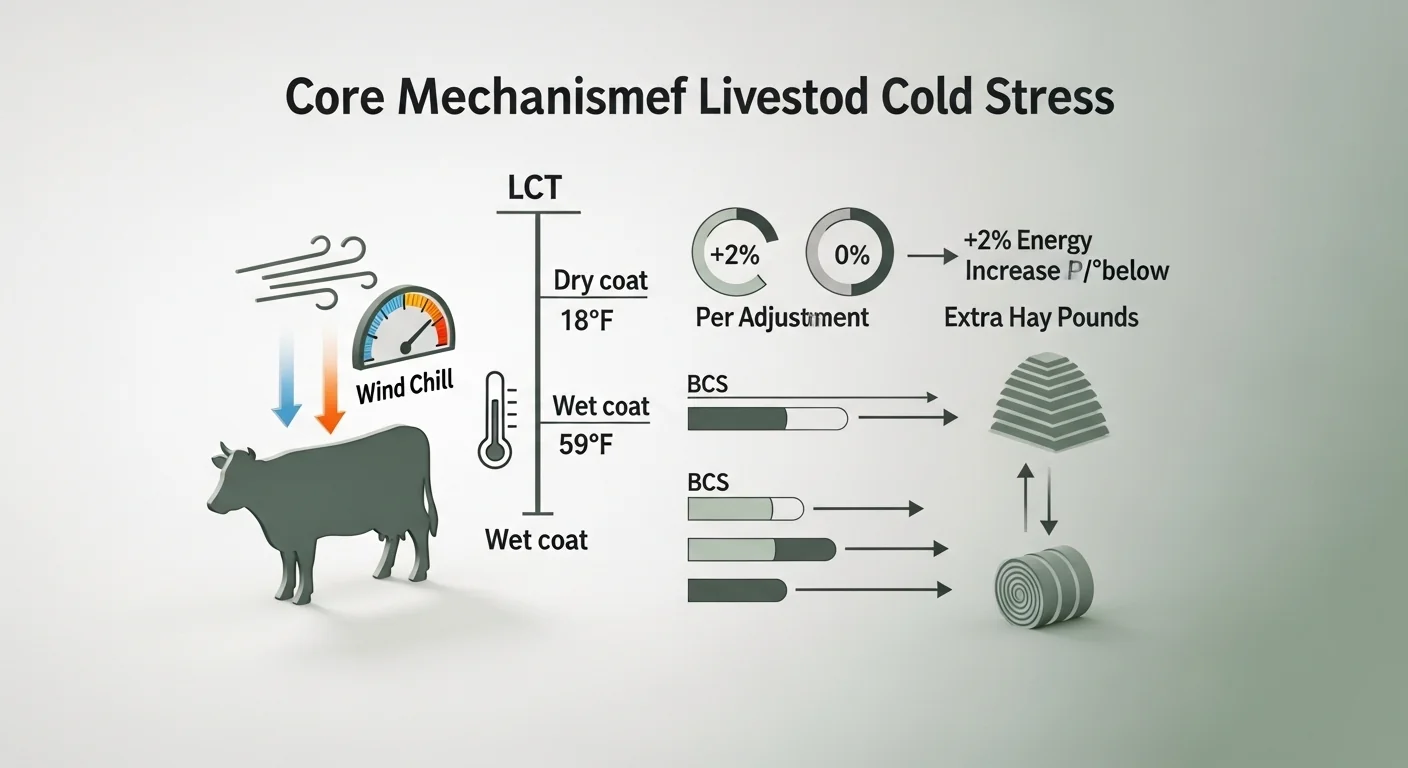
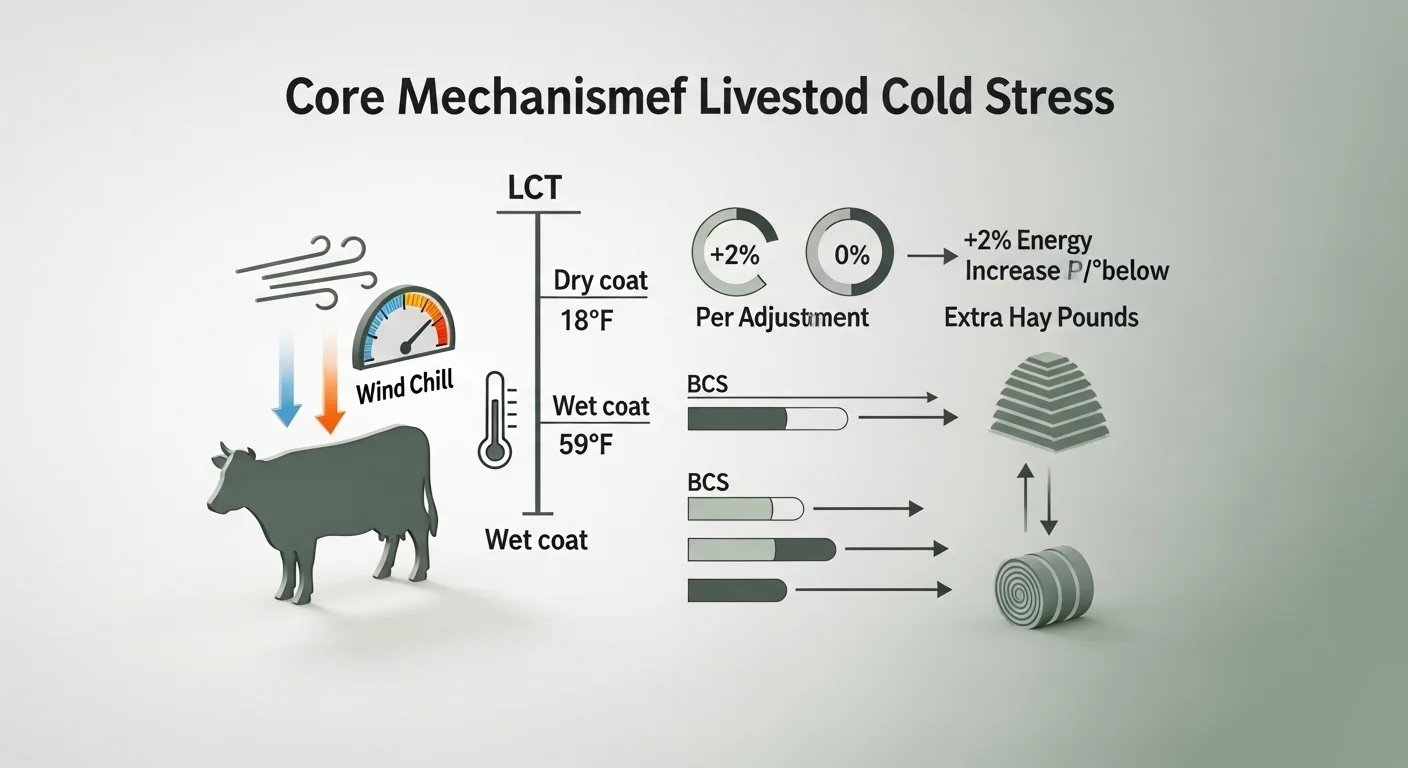
The temperature on your phone means almost nothing for a cow standing in a muddy pen during a north wind. What matters is the animal’s effective thermal load, which is a function of three variables most feeding guides ignore together: the wind chill temperature, the state of the coat’s insulation, and the Lower Critical Temperature (LCT) that defines where extra calories kick in. When any one of these is misjudged, caloric deficits compound silently over days until body condition collapses.
This calculator inputs animal type, Body Condition Score, ambient temperature, wind speed, and coat condition to compute the wind chill-adjusted temperature, compare it against the species- and coat-specific LCT, and return the additional energy requirement as a percentage above maintenance, plus the corresponding extra hay in pounds per day. It does not account for solar radiation, humidity, individual breed variation, pregnancy stage, or lactation demand. Those variables matter, but they require individual animal assessment that no web calculator can replace.
After running the calculator, you will know whether the current conditions demand a feeding increase and, if so, exactly how many extra pounds of average-quality grass hay to provide today, before the animal burns through body reserves it took months to build.
Use the Tool
Livestock Winter Caloric Maintenance
Wind Chill & Lower Critical Temperature Feed Calculator
| Temp (°F) | Coat | LCT (°F) | Below LCT | Energy +% | Extra Hay (lbs) |
|---|
How This Calculator Works
Step 1 — Wind Chill Temperature (WCT): We calculate the effective temperature using the NWS Wind Chill formula:
WCT = 35.74 + 0.6215 × T - 35.75 × V^0.16 + 0.4275 × T × V^0.16
where T = ambient temperature (°F) and V = wind speed (mph). If wind speed is below 3 mph, WCT equals ambient temperature.
Step 2 — Lower Critical Temperature (LCT): The LCT is the temperature below which the animal must burn extra energy to maintain body heat.
Dry/Thick coat: LCT = 18°F | Wet/Muddy coat: LCT = 59°F.
A wet or muddy coat destroys insulating air pockets in the hair, raising LCT dramatically.
Step 3 — Energy Increase: For every 1°F the wind chill drops below the LCT, the animal requires 2% more energy above its normal maintenance requirement.
Extra Energy % = (LCT - WCT) × 2
Step 4 — Additional Hay: Base daily maintenance energy varies by species (Beef ~15.5 Mcal, Dairy ~18.5 Mcal, Horse ~16.5 Mcal). Average grass hay provides ~0.85 Mcal per lb. BCS below 5 increases base needs by 5% per point below 5. Extra hay = (Base × Extra%) / 0.85.
Assumptions: Estimates use mid-range body weights. Actual needs vary by weight, breed, age, lactation status, and activity level. Always consult a veterinarian or livestock nutritionist for precise rations.
Assumptions & Limits
This calculator assumes mid-range body weights: Beef cow ~1,200 lbs, Dairy cow ~1,400 lbs, Horse ~1,100 lbs. Actual energy requirements are influenced by breed, age, pregnancy/lactation status, and activity level.
The NWS wind chill formula is calibrated for human skin but is commonly adapted for livestock cold stress estimation. It provides a useful approximation but does not account for solar radiation, humidity, or shelter.
LCT values (18°F dry, 59°F wet) are generalized; individual animals with very heavy or very thin coats may differ. Body Condition Score adjustments add 5% per BCS point below 5 to reflect increased metabolic demand in thin animals.
Hay energy density (0.85 Mcal/lb) assumes average-quality grass hay. High-quality alfalfa may provide 1.0+ Mcal/lb. Always test your hay.
Valid input ranges: Temperature -60°F to 120°F, Wind speed 0 to 100 mph.
Quick Reference: LCT by Coat Condition
| Coat Condition | LCT (°F) | Notes |
|---|---|---|
| Dry / Heavy Winter Coat | 18°F | Full insulation intact; handles cold well |
| Dry / Fall Coat | 32°F | Moderate insulation; transitional risk |
| Wet / Muddy Coat | 59°F | Insulation destroyed; extreme cold stress risk |
| Newborn Calf (wet) | 60°F+ | No insulation; hypothermia risk is immediate |
Before entering values, have your current weather data pulled up, not yesterday's forecast. Coat condition requires visual inspection; it is not the same as the season. A cow that waded through a muddy creek yesterday has a compromised coat regardless of the calendar date. Use your actual ambient temperature and the current wind reading from your nearest weather station, not an estimate. If you are comparing total hay cost against a feeding increase, the hay cost calculator can help you price out the difference.
Quick Start (60 Seconds)
- Animal Type: Select the species. Beef cows, dairy cows, and horses have different baseline maintenance energy requirements, and the calculator adjusts for each.
- Body Condition Score (BCS): Rate your animal on the 1-to-9 scale, not by memory of how it looked last month. A BCS of 4 or lower means the animal is already carrying an energy deficit that compounds cold stress. If you are unsure how to score, look at the tailhead and ribs before selecting.
- Ambient Temperature: Enter the current outdoor air temperature in Fahrenheit. Valid range is -60 to 120 degrees F. Do not average multiple readings; use the current value.
- Wind Speed: Enter wind speed in mph. Even a 10 mph wind at 20 degrees F drops effective temperature by more than 10 degrees. The calculator handles the math.
- Coat Condition: Choose "Dry / Thick" only if the coat is physically dry and the winter undercoat is present. "Wet / Muddy" applies if the hair is matted, wet, or caked with mud. This is the most consequential input in the entire calculator.
Inputs and Outputs (What Each Field Means)
| Field | Unit | What It Measures | Common Mistake | Safe Entry Guidance |
|---|---|---|---|---|
| Animal Type | Species | Sets the baseline daily maintenance energy (Mcal/day) for the calculation | Selecting "Beef Cow" for a high-producing dairy breed | Use species as bred and managed, not by appearance |
| Body Condition Score | 1-9 scale | Modifies base energy by 5% per BCS point below 5; reflects fat reserves available for insulation and energy buffer | Scoring by memory rather than palpation of ribs and tailhead | Score the animal today; condition changes faster in cold than most producers expect |
| Ambient Temperature | Degrees F | Starting point for the NWS wind chill formula; reflects air temp before accounting for wind | Using the high forecast for the day rather than the current reading during feeding time | Read from a thermometer at animal height, not a roof-mounted sensor |
| Wind Speed | mph | The primary driver of wind chill; even moderate speeds at near-freezing temperatures create significant cold stress | Estimating by feel instead of using a weather station or app reading | Use the nearest NOAA or weather station value; avoid guessing |
| Coat Condition | Dry/Wet | Determines the LCT: Dry/Thick = 18 degrees F; Wet/Muddy = 59 degrees F | Selecting "Dry" because it is winter, without checking the actual coat | Physically examine the coat; wet or muddy means wet or muddy |
| Wind Chill (WCT) | Degrees F | The effective temperature experienced by the animal after wind exposure is factored in | Confusing WCT with ambient temp and undercounting cold stress | Output only; review before acting on the extra hay recommendation |
| Lower Critical Temperature | Degrees F | The threshold below which the animal must generate extra heat; set by coat condition alone in this model | Assuming LCT is fixed at 18 degrees F regardless of coat state | Output only; coat condition is the input that changes this |
| Extra Energy Required | Percent above maintenance | Calculated as 2 percent per degree F the WCT falls below LCT | Treating a 30 percent increase as minor when base energy is already high | Output only; convert to hay using the extra hay field |
| Extra Hay Needed | Lbs per day | Pounds of average grass hay (0.85 Mcal/lb) required above the base daily ration to cover cold stress demand | Using alfalfa without adjusting; alfalfa runs closer to 1.0 Mcal/lb so the actual pounds needed are lower | Output only; adjust for your actual hay's energy density if known |
For animals in late pregnancy or lactation, the baseline energy demand is substantially higher than this calculator's maintenance estimates. The cattle gestation calculator can help you track where cows are in their reproductive cycle, since calving date proximity is a key signal that baseline feed needs are already elevated before cold stress is added on top.
Worked Examples (Real Numbers)
Scenario 1: Beef Cow, Moderate Winter Day
- Animal: Beef Cow, BCS 5
- Ambient Temperature: 20 degrees F
- Wind Speed: 15 mph
- Coat Condition: Dry / Thick
Wind Chill = 35.74 + (0.6215 x 20) - (35.75 x 15^0.16) + (0.4275 x 20 x 15^0.16) = approximately 6 degrees F
LCT = 18 degrees F; degrees below LCT = 12; extra energy = 24 percent
Base energy (beef, BCS 5) = 15.5 Mcal; extra Mcal = 3.72; extra hay = 3.72 / 0.85 = approximately 4.4 lbs per day
Result: At 20 degrees F with a 15 mph wind, even a well-conditioned beef cow with a proper dry coat needs roughly 4.4 additional pounds of grass hay per day to stay in thermal balance.
Scenario 2: Dairy Cow, Cold Snap with Wet Coat and Low BCS
- Animal: Dairy Cow, BCS 3
- Ambient Temperature: -5 degrees F
- Wind Speed: 25 mph
- Coat Condition: Wet / Muddy
Wind Chill = 35.74 + (0.6215 x -5) - (35.75 x 25^0.16) + (0.4275 x -5 x 25^0.16) = approximately -31 degrees F
LCT = 59 degrees F; degrees below LCT = 90; extra energy = 180 percent above maintenance
BCS 3 adjustment: base energy multiplied by 1.10 = 20.35 Mcal; extra Mcal = 36.6; extra hay = 36.6 / 0.85 = approximately 43 lbs per day
Result: This animal is in a survival emergency. The combination of extreme cold, high wind, a destroyed coat, and depleted body reserves drives caloric demand to levels that hay alone cannot realistically cover without supplemental high-fat energy sources.
Scenario 3: Horse at Freezing Point, Dry Coat, Good Condition
- Animal: Horse, BCS 6
- Ambient Temperature: 32 degrees F
- Wind Speed: 5 mph
- Coat Condition: Dry / Thick
Wind Chill = 35.74 + (0.6215 x 32) - (35.75 x 5^0.16) + (0.4275 x 32 x 5^0.16) = approximately 27 degrees F
LCT = 18 degrees F; WCT of 27 degrees F is above LCT, so degrees below LCT = 0
Result: No additional feed is required based on cold stress alone. A well-conditioned horse with a full winter coat at 32 degrees F and low wind remains above its lower critical temperature. Normal maintenance ration is appropriate.
Reference Table (Fast Lookup)
Values below use a beef cow at BCS 5 (base 15.5 Mcal/day, grass hay at 0.85 Mcal/lb). Extra hay rounded to one decimal place.
| Ambient Temp (F) | Wind Speed (mph) | Coat | Wind Chill (F) | LCT (F) | Below LCT | Extra Energy | Extra Hay (lbs/day) |
|---|---|---|---|---|---|---|---|
| 32 | 0 | Dry | 32 | 18 | 0 | 0% | 0.0 |
| 32 | 0 | Wet | 32 | 59 | 27 F | 54% | 9.8 |
| 32 | 20 | Dry | 14 | 18 | 4 F | 8% | 1.5 |
| 20 | 15 | Dry | 6 | 18 | 12 F | 24% | 4.4 |
| 40 | 10 | Wet | 34 | 59 | 25 F | 50% | 9.1 |
| 10 | 20 | Dry | -7 | 18 | 25 F | 50% | 9.1 |
| 0 | 10 | Dry | -16 | 18 | 34 F | 68% | 12.4 |
| 20 | 30 | Wet | 1 | 59 | 58 F | 116% | 21.1 |
| -10 | 20 | Dry | -32 | 18 | 50 F | 100% | 18.2 |
| -20 | 30 | Dry | -53 | 18 | 71 F | 142% | 25.9 |
The 40 degrees F / Wet row is particularly instructive: a temperature that reads as moderate produces the same extra hay demand as 10 degrees F with a dry coat and significant wind. Coat condition is not a secondary input.
How the Calculation Works (Formula + Assumptions)
Show the calculation steps
Step 1: Wind Chill Temperature (WCT)
The calculator uses the National Weather Service wind chill formula:
WCT = 35.74 + (0.6215 x T) - (35.75 x V^0.16) + (0.4275 x T x V^0.16)
T = ambient temperature in degrees Fahrenheit; V = wind speed in miles per hour. If wind speed is below 3 mph, WCT equals T (wind chill does not apply at very low speeds). Results are rounded to the nearest whole degree.
Step 2: Lower Critical Temperature (LCT)
LCT is set by coat condition only, using established university extension values:
Dry / Thick coat: LCT = 18 degrees F
Wet / Muddy coat: LCT = 59 degrees F
Step 3: Degrees Below LCT
Degrees Below LCT = max(0, LCT - WCT). If WCT is above LCT, this value is zero and no extra energy is required.
Step 4: Extra Energy Required
Extra Energy (%) = Degrees Below LCT x 2. Each degree Fahrenheit below the LCT requires a 2 percent increase in energy above baseline maintenance.
Step 5: Extra Hay
Base daily maintenance energy is set by animal type (Beef: 15.5 Mcal/day; Dairy: 18.5 Mcal/day; Horse: 16.5 Mcal/day) and adjusted upward by 5 percent per BCS point below 5 to reflect reduced insulation and depleted reserves in thin animals. Extra Mcal needed = Base Energy x (Extra Energy / 100). Extra Hay (lbs) = Extra Mcal / 0.85 (the assumed energy density of average-quality grass hay).
Rounding: Wind chill rounded to nearest whole degree; extra energy rounded to nearest whole percent; extra hay rounded to one decimal place.
Assumptions and Limits
- Assumed body weights: Beef cow 1,200 lbs, Dairy cow 1,400 lbs, Horse 1,100 lbs. Animals significantly outside these ranges will have proportionally different energy needs.
- The NWS wind chill formula was developed for human skin at 5 feet. Its application to livestock is widely used in extension literature but is an approximation; it does not account for hide thickness or hair coat length beyond the binary Dry/Wet input.
- LCT values of 18 degrees F (dry) and 59 degrees F (wet) are general benchmarks. Newly weaned calves, recently clipped horses, and animals transitioning coats will have different effective LCTs.
- Hay energy density of 0.85 Mcal per pound reflects average grass hay. Alfalfa commonly runs 0.95 to 1.1 Mcal per pound, which would reduce the extra hay pounds needed. If you have a forage test, use that number to manually adjust the output.
- BCS below 5 adds a flat 5 percent per point. Real metabolic adjustments are nonlinear, especially below BCS 3, and this calculator may understate need at very low body condition.
- Solar radiation is not included. A clear sunny day at 10 degrees F with light wind is meaningfully warmer for a dark-coated animal than a cloudy day at the same temperature.
- Shelter reduces effective wind speed. An animal in a three-sided shed with adequate bedding will experience far less wind chill than the open-pen reading used in this calculator.
- Pregnancy and lactation increase baseline energy demand substantially above maintenance. This tool does not model production demands; it models cold-stress additions to a maintenance baseline only.
Standards, Safety Checks, and "Secret Sauce" Warnings
Critical Warnings
- The Muddy Coat Hypothermia Trap: A dry-coated cow at 40 degrees F with a dry coat is above her LCT of 18 degrees F and needs no extra feed. That same animal the morning after a rain, with a muddy coat, now has an LCT of 59 degrees F. At 40 degrees F, she is 19 degrees below her critical threshold, requiring a 38 percent increase in daily energy. The number on the thermometer did not change. The insulation did. Producers who fed correctly in January can be starving cattle in March if a wet spell is not acted on immediately.
- Wind Without Shelter Compounds Every Other Variable: A 25 mph wind at 20 degrees F produces a wind chill of roughly -6 degrees F. That is a 26-degree gap below a dry-coat LCT of 18 degrees F, demanding a 52 percent energy increase on top of normal maintenance. Wind is not a weather curiosity; it is a multiplicative caloric expense. Animals in open lots during high-wind events have energy needs that can exceed the physical capacity of a hay-only diet.
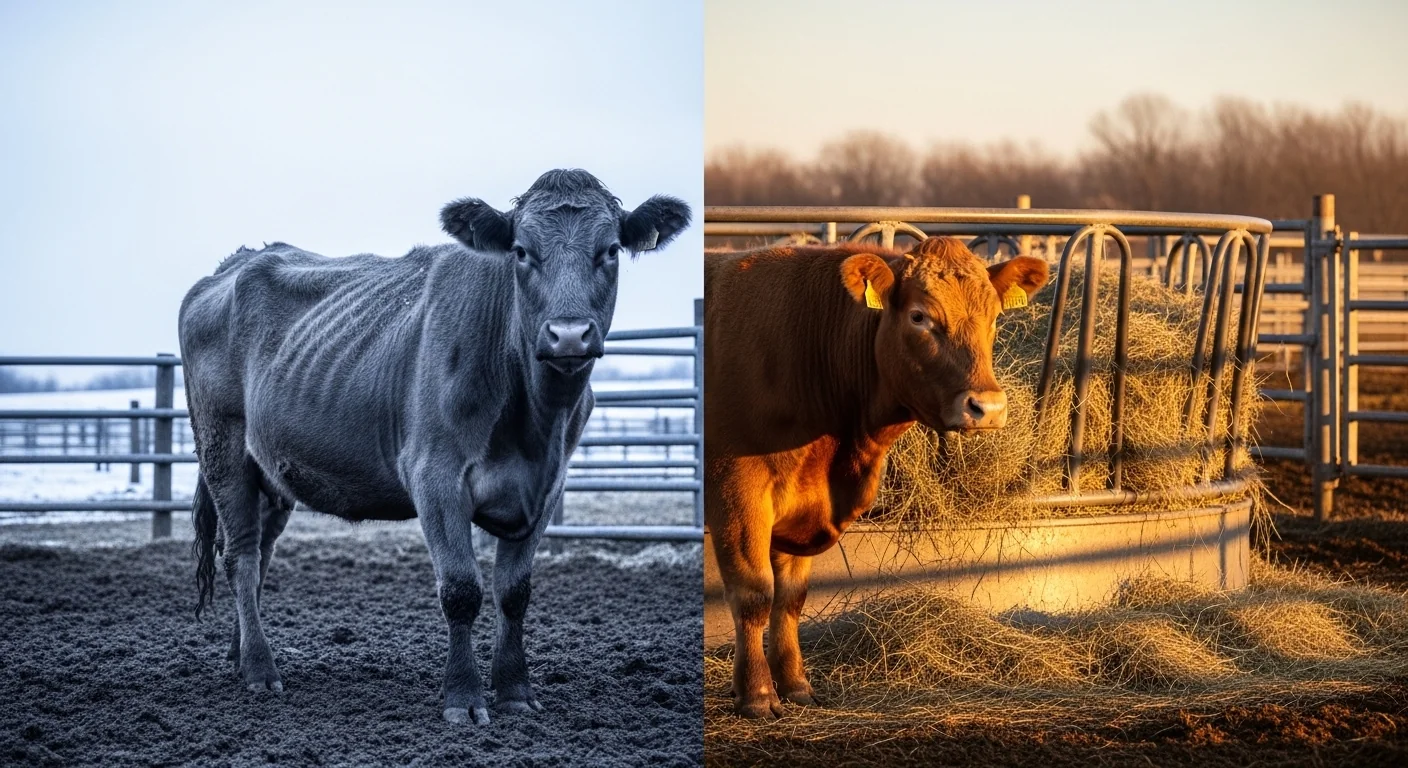
- Thin Animals Cannot Self-Correct: A BCS-3 animal already has insufficient fat reserves to buffer cold stress. Feeding more hay at the point of a cold event is necessary but insufficient; body condition cannot be rapidly rebuilt. Prevention through monitoring BCS monthly and adjusting rations before winter is the only effective strategy.
- Frozen Water = Faster Collapse: Dehydrated animals eat less, which accelerates the caloric deficit during cold stress. When water intake drops because troughs freeze, even perfectly calculated ration increases fail. Checking the cattle water requirement calculator alongside this tool ensures the feeding increase is not wasted on an animal that will not consume it.
Minimum Standards
- Any beef cow with a wet or muddy coat at temperatures below 59 degrees F is below her LCT and requires a calculated feed increase, not a visual assessment of whether she "looks fine."
- Wind chill below -20 degrees F signals a high-risk event requiring active intervention: additional bedding, windbreak access, and supplemental energy beyond hay (high-fat protein blocks, distillers grains).
- Barn ventilation plays a direct role in coat condition. Moisture trapped in a barn with inadequate airflow will wet coats as surely as rain. The barn ventilation calculator is a useful complement when housing is part of the winter management plan.
- BCS should be scored a minimum of 60 days before expected cold events so there is time to build reserves. Attempting to add body condition during a cold event is inefficient and often ineffective.
Competitor Trap: Most winter feeding guides online list a single "increase feed 1-2 percent per degree below 20 degrees F" rule and leave it there. That rule applies only to dry-coated animals with their LCT in the right range. It completely ignores coat condition as a dynamic variable. A producer reading those guides would calculate no additional feed for a 40-degree day and be technically correct for a dry-coated cow, while simultaneously starving a mud-caked cow in the next pen who is experiencing the thermal equivalent of standing outside in a wet shirt at -10 degrees F. The LCT shift from coat condition is not a footnote; it is the most consequential variable in winter cattle nutrition.
Common Mistakes and Fixes
Mistake: Using Ambient Temperature Instead of Wind Chill
A reading of 25 degrees F on a calm morning feels manageable. At 30 mph wind, the effective temperature is closer to -4 degrees F. Producers who read the thermometer and stop there systematically underfeed during high-wind events, which happen to be the exact conditions that accelerate heat loss fastest.
Fix: Always enter the actual wind speed alongside temperature; let the calculator compute the wind chill before making any feeding decision.
Mistake: Selecting "Dry Coat" Without Physically Inspecting
It is tempting to assume that because it has not rained in several days, coats are dry. Mud from previous wet periods can persist and compact into a hard layer that destroys insulation just as effectively as fresh mud. Dew, frost, and heavy snow also wet coats depending on hair length and coat condition.
Fix: Part the hair on the back and sides of at least two animals before deciding. If the hair near the skin is damp or if dried mud compresses the coat, select Wet / Muddy.
Mistake: Ignoring BCS Until the Problem Is Visible
By the time ribs are sharply visible on a beef cow in winter, the animal has already been in caloric deficit long enough that catch-up feeding during a cold event is extremely difficult. Hay has limited energy density and limited intake capacity, and cold weather does not pause while condition is rebuilt. Many producers see visible BCS loss in February and blame the cold, when the deficit began in November.
Fix: Score BCS monthly from October onward and use those scores as early-warning triggers, not reactive tools. If using a rotational grazing system, the pasture stocking rate calculator can help ensure animals are not going into fall already at a caloric deficit from summer overgrazing.
Mistake: Treating Extra Hay as a Fixed Daily Number
Cold stress is not constant. A three-day cold snap with 30 mph winds followed by two mild days requires daily recalculation, not a single feeding increase applied across the week. Overfeeding on mild days is not harmful, but underfeeding during the worst 48 hours because the calculation was done on day one is a real risk.
Fix: Recalculate whenever temperature or wind speed changes by more than 10 units. This takes under 60 seconds with the tool above.
Mistake: Applying Extra Hay Numbers to High-Quality Alfalfa
The extra hay output in this calculator assumes grass hay at 0.85 Mcal per pound. Premium alfalfa commonly runs 0.95 to 1.1 Mcal per pound. Feeding the same number of extra pounds of alfalfa instead of grass hay will provide significantly more energy than calculated, which is not a problem in itself, but using the grass-hay number as a minimum and feeding alfalfa to "be safe" can be costly and unnecessary.
Fix: Get a forage test on your hay. Divide the calculated extra Mcal needed by your actual hay's energy value per pound to get the correct extra pounds for your specific feed.
Next Steps in Your Workflow
Once you know how many extra pounds of hay are required, the practical question becomes sourcing and cost. Hay availability and price fluctuate significantly from fall to late winter, and emergency purchases at peak demand are always more expensive than pre-season planning. Running the feed cost calculator with your hay price and the extra-hay number from this tool will convert the feeding increase into a daily and seasonal dollar figure, which is the number you actually need for budget decisions.
For producers managing multiple animals, the per-head calculation from this tool multiplied across a herd can quickly indicate whether existing hay inventory is adequate for a prolonged cold event. If hay weight and bale count are what you are working from rather than a bulk tonnage figure, the hay bale weight calculator can help you convert inventory into days of supply at the new elevated ration, giving you a runway number before a resupply is needed.
FAQ
What is the Lower Critical Temperature for cattle?
The Lower Critical Temperature (LCT) is the ambient temperature below which an animal must generate additional metabolic heat to maintain core body temperature. For a beef cow with a dry, thick winter coat, the LCT is approximately 18 degrees Fahrenheit. For an animal with a wet or muddy coat, the LCT rises to approximately 59 degrees Fahrenheit because mud destroys the insulating air pockets in the hair.
How does wind chill affect cattle feed needs?
Wind chill lowers the effective temperature experienced by the animal, which can push the experienced temperature well below the LCT even when the air temperature alone would not. Each degree the wind chill falls below the LCT requires roughly a 2 percent increase in daily energy intake above maintenance. At high wind speeds, the gap between air temperature and wind chill can exceed 30 degrees F, creating caloric demands that double or exceed normal maintenance requirements.
How much extra hay does a cow need in winter?
The answer depends entirely on wind chill, coat condition, and body condition score, not on a fixed seasonal rule. A dry-coated cow on a calm 25-degree day may need only 3 to 5 extra pounds of grass hay per day. The same animal with a muddy coat in wind could require 15 to 25 additional pounds. A single universal "winter increase" is not accurate; conditions must be evaluated against the LCT on a day-by-day basis during cold events.
Does a horse have the same Lower Critical Temperature as a cow?
The LCT for horses in this model uses the same dry/wet distinction (18 degrees F dry, 59 degrees F wet), with an adjusted baseline maintenance energy of 16.5 Mcal per day for a mid-range body weight. Horses with body clips, thin blankets, or transitional coats may have effectively higher LCTs than the dry-coat assumption captures, so the calculation should be treated as a minimum estimate for clipped horses.
Can I use this calculator for calves?
This calculator is calibrated for mature animals. Newborn and young calves have substantially higher LCTs, much less body mass to buffer heat loss, and essentially no developed winter coat. A wet newborn calf can reach a critical temperature threshold above 60 degrees F. The outputs of this tool are not appropriate for neonatal or young calf cold stress assessment; those situations require immediate intervention protocols regardless of calculator output.
What does Body Condition Score affect in this calculation?
BCS modifies the base maintenance energy by 5 percent per point below 5. A BCS-3 animal has a base energy demand 10 percent higher than a BCS-5 animal before cold stress is added. This reflects reduced fat insulation and the elevated metabolic cost of maintaining core temperature with less body reserve. In practice, thin animals also tend to consume less during cold events, widening the gap between need and intake.
Conclusion
Wind chill and coat condition are not factors you can eyeball reliably from across a pen. The gap between 18 degrees F (dry coat LCT) and 59 degrees F (wet coat LCT) is 41 degrees F of thermal threshold, and every degree of that gap maps to a 2 percent caloric increase that either comes from your hay feeder or comes from your animal's body reserves. This calculator makes that math explicit so the decision to adjust feeding is grounded in a specific number rather than a general sense that it is cold outside.
The single most consequential mistake in winter cattle nutrition is not underestimating how cold it is; it is selecting coat condition by assumption rather than inspection. A muddy coat in a 40-degree rain is more dangerous than a dry coat in a 10-degree calm, and most feeding guides will tell you to increase feed for the second scenario while missing the first entirely. Check coats physically, run the calculation for current conditions, and adjust the ration before the animal makes up the deficit from body fat it spent months accumulating. For ongoing feeding budget planning, the rotational grazing calculator can help you structure the grazing season so animals are entering winter at target BCS rather than already in deficit.